
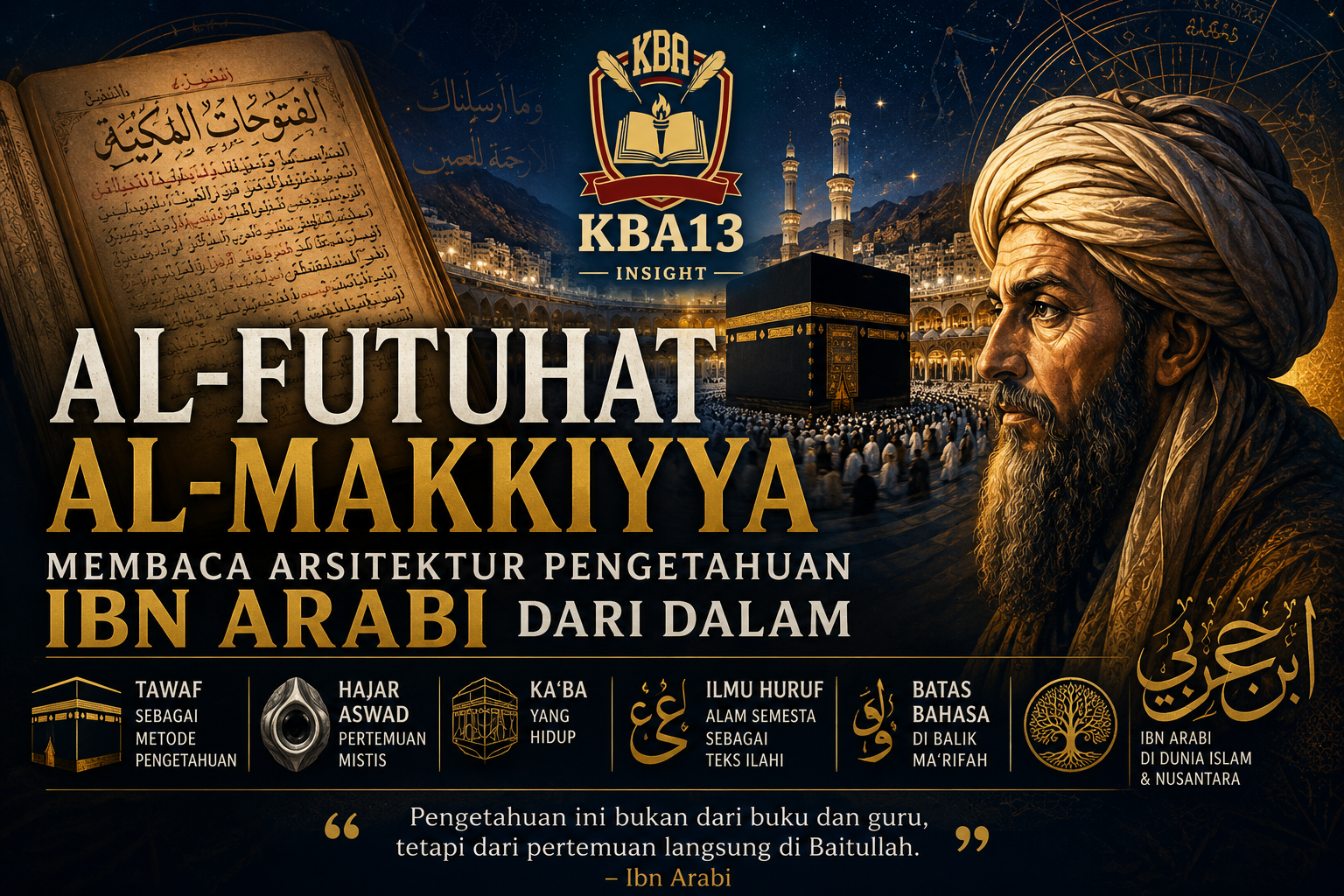
Ibn Arabi and the Book Born of Mecca
Muhyiddin Muhammad ibn Ali ibn Muhammad ibn Ahmad ibn Abdullah al-Hatimi al-Ta’i, known as Ibn Arabi, was born in Murcia, Andalusia, in 560 AH / 1165 CE. He grew up in the Andalusian intellectual tradition, which in the twelfth century still inherited a synthesis of Greek philosophy, kalam (dialectical theology), and Sufism. Before writing Al-Futuhat al-Makkiyya, Ibn Arabi had already written hundreds of short texts, but none matched the scale and ambition of this monumental work. Al-Futuhat is not merely an encyclopedia of Sufism—it is one man’s attempt to record what he received as direct knowledge (kashf) and to hand it to a reader capable of receiving it. The first page of the fourth part that we read states the context: this is al-Juz’ al-Rabi‘ (the Fourth Part), entering al-Fasl al-Awwal fi al-Ma‘arif (the First Chapter: On Knowledge), and its topic is fi ma‘rifat al-ruh—the knowledge of the spirit. This is not an academic preface. Ibn Arabi begins with verse, not prose—a deliberate choice, because he believed that certain truths can only be conveyed through a language that does not present itself as proposition. Al-Futuhat al-Makkiyya was first written in Mecca around 598 AH / 1201 CE, then extensively revised in Damascus until shortly before Ibn Arabi’s death in 638 AH / 1240 CE. The final edition circulating today has 560 chapters in four thick volumes, discussing nearly every aspect of cosmology, epistemology, and spiritual practice in Islam. This scale has no precedent in the earlier Sufi tradition; even al-Ghazali’s work did not touch the same breadth within a single text. The title al-Futuhat al-Makkiyya—literally “The Meccan Openings”—carries a double meaning. Fath (the singular of futuhat) in Arabic means opening, conquest, and unveiling. Ibn Arabi himself, in the section we are reading (page 79), states that he obtained this knowledge not from books and teachers but from a direct encounter he experienced while performing tawaf at the Ka‘ba. He insists this is not a metaphor: he received it as experience, and his task is to record it. In the Sufi tradition there are two main paths of knowledge: ‘ilm al-kasb (knowledge acquired through effort, study, and reasoning) and ‘ilm al-ladunni or ‘ilm al-wahb (knowledge bestowed directly without intermediary). Ibn Arabi does not reject the first—he was deeply learned in fiqh, hadith, and philosophy—but he insists that the content of Al-Futuhat derives from the second. This is no idle claim; he builds his entire epistemology upon an argument for why this kind of knowledge is possible and even necessary. The text we are reading begins with Ibn Arabi’s admission that he arrived in Mecca and found himself in what he calls a layered consciousness: he performed tawaf physically, yet at the same time he “witnessed” (yushahid) something invisible to others. This condition is not hallucination in the modern sense—Ibn Arabi consistently distinguishes between delusion (wahm), active imagination (khayal), and true unveiling (kashf). What he experienced was the third. It is important to understand that Ibn Arabi wrote Al-Futuhat in the context of a very lively theological debate. The twelfth and thirteenth centuries were a time of tension among the fuqaha who rejected Sufism as innovation (bid‘a), the philosophers who inherited the Aristotelian-Neoplatonic tradition, and the Sufis who claimed direct experience as a source of authority. Ibn Arabi did not stand outside this debate—he stood at its center, and Al-Futuhat is his argument that these three traditions are not only compatible but, at a certain level, one and the same. Ibn Arabi is in al-Bab al-Awwal fi al-Ma‘arif—the first chapter on knowledge (ma‘arif), not on law (ahkam) or practice (awrad). This shows that before he speaks of anything to be done, he must speak of the very conditions of the possibility of knowledge. This structure is no accident; it reflects Ibn Arabi’s conviction that the epistemological question precedes the practical one. Page 85 in the text we read marks the beginning of al-Bab al-Thani—the second chapter on the knowledge of letters (al-huruf) and movements (al-harakat) and their relation to the divine names (al-asma’ al-husna). The move from the chapter on the spirit to the chapter on letters is not random: for Ibn Arabi, spirit and letter are two aspects of one cosmological reality. The universe is a text, and to understand its letters is to understand the way God speaks to Himself. This essay will trace these texts systematically: from the mystical encounter at the Ka‘ba, the epistemology of tawaf, the mysterious youth at the Black Stone, the concept of the living Ka‘ba, the divine covenant, the science of letters, the limits of language, to the intellectual legacy Ibn Arabi left behind.
Tawaf as Method: Circling in Order to Know
Tawaf—circling the Ka‘ba seven times counterclockwise—is the most spatially concentrated ritual in Islam. Millions of Muslims perform it each year as an act of worship, yet for Ibn Arabi, tawaf is at once an epistemology. In the opening verse he quotes on page 79, he writes: “qultu ‘inda al-tawafi kayfa atuf / jismun ghayru ‘aqilin harakatiy”—“I said while circling: how do I circle / a body without intellect that moves me?” This question is not rhetorical; it is the point of entry into his entire system of thought about the relationship between body, intellect, and knowledge. In the classical Islamic tradition there is a long debate over whether ritual worship is a means toward knowledge or merely an obligation separate from the cognitive process. The fuqaha tended toward the latter: worship is a command to be obeyed, and it is valid without having to produce any illumination. Ibn Arabi rejects this dichotomy. For him, a tawaf performed with the body but without a certain awareness is a “deficient” tawaf—not in the sense of its validity in fiqh, but in the sense that it does not deliver its performer to the ma‘rifa that ought to be its fruit. Ibn Arabi writes on page 79 that when he performed tawaf, he met a youth (fata) near the Black Stone who “spoke yet did not say, was present yet not there, was alive yet not dead.” This encounter occurred within the context of tawaf—not in a mosque, not in khalwa (retreat), not in a dream, but precisely in the moment when Ibn Arabi’s body was performing the ritual movement. This matters: Ibn Arabi was not seeking knowledge in a space separate from the world; he found it in the midst of the most concrete ritual act. Tawaf has a philosophically interesting structure: it is a circular movement that always returns to the starting point yet never truly returns, because each circuit is performed by a body one second older and one step more practiced. Ibn Arabi raises this structure to the ontological level: the universe itself, in his view, is a kind of tawaf—an emanation from God (fayd) that circles and returns (ruju‘), yet never returns to exactly the same point because each moment is a new reality. Tawaf is the universe in miniature. In the verse quoted on page 79, Ibn Arabi writes: “nazara al-bayta nurahu yatajalla / nazartuhu billahi duna hijabi”—“I beheld the Ka‘ba, its light unveiling / I beheld it with God, without a veil.” The key word here is bi-Allah—with God, not bi-‘ayni (with my own eye). This is a technical formulation in Sufism stating that true perception occurs not when a subject sees an object, but when God sees through the subject. The subject is no longer the source of vision; it becomes the organ of God’s vision. This concept is rooted in a hadith often quoted by the Sufis: “When I love My servant, I become the hearing with which he hears, the sight with which he sees, the hand with which he grasps, and the foot with which he walks.” (Hadith Qudsi, narrated in Sahih Bukhari). Ibn Arabi did not invent this concept from nothing; he developed it into a coherent cosmological system in which every human sense organ is a mirror (mir’at) in which God sees Himself. The direction of tawaf—counterclockwise, or in Arabic: ‘ala al-yasar (to the left)—has a significance of its own in Ibn Arabi’s cosmology. On page 81, he writes of how “if one turns from the Ka‘ba to the left, one faces north, and from the western side to the right, the Ka‘ba faces.” This is not merely geography; in his letter-cosmological system, direction corresponds to divine attributes. Moving to the left (east-to-north) in tawaf means moving against the direction of the sun—a movement that, for Ibn Arabi, reflects the position of the human spirit moving counter to the “ordinary” current of the material universe. Ibn Arabi distinguishes between the tawaf of ordinary people, the tawaf of the saints (awliya), and the tawaf of the Ka‘ba itself. On page 79, he says that he “saw the Ka‘ba circling with itself” (ra’aytu al-ka‘bata tafut bi-dhatiha). This is a very bold statement: the Ka‘ba, the object that is circled, turns out to circle as well. This inverts the whole logic of tawaf: it is not the human being who circles the Ka‘ba, but the Ka‘ba that circles a deeper reality, and the human who performs tawaf merely joins in the Ka‘ba’s own movement. The idea that the Ka‘ba is “alive” (hayy) and circling is not Ibn Arabi’s fantasy alone. It has roots in the hadith tradition about the Ka‘ba in the afterlife, described as a luminous being carried to Paradise after the world ends. Ibn Arabi takes this eschatological image and transforms it into a present ontological fact: the Ka‘ba is already alive now, only not everyone has the perceptual capacity to see it. Tawaf is a training to develop that perceptual capacity. Thus, tawaf in Al-Futuhat is not merely a ritual performed before knowledge begins. Tawaf is knowledge—or more precisely, tawaf is the condition under which a certain knowledge becomes possible. Ibn Arabi does not say that everyone who performs tawaf will receive the illumination he received. He is more careful than that: he says that a correct tawaf, performed with a certain awareness, opens a door—and what lies behind that door depends on the capacity and readiness of the traveler.
The Youth at the Black Stone: Whom Did Ibn Arabi Meet?
One of the most astonishing episodes in Al-Futuhat al-Makkiyya is Ibn Arabi’s encounter with a youth (fata) near the Black Stone during tawaf. From pages 79 to 80, Ibn Arabi describes this encounter in extraordinary detail—yet that very detail refuses to become an adequate description. The youth is portrayed as “speaking yet not a speaker, silent yet not one who is silent, moving yet not a dweller, embodied yet not a body.” Each attribute is immediately followed by its negation. The identity of this youth has been a subject of debate among Ibn Arabi’s followers and interpreters for centuries. Ibn Arabi himself never explicitly identifies him. Yet from the description on pages 79–80 there are several clues: the youth is portrayed as al-murakkab al-basit, al-muhit—the composite yet simple, the all-encompassing. This is not the description of an ordinary human. Interpreters such as Abd al-Razzaq al-Qashani (thirteenth century) and Dawud al-Qaysari (fourteenth century) interpret this youth as al-‘Aql al-Awwal (the First Intellect) or as a manifestation of the Haqiqa Muhammadiyya (the Muhammadan Reality). On page 79, Ibn Arabi writes that he “saw the youth—who spoke yet did not say—on the right side within the House of God.” The position of the “right” (yamin) in Ibn Arabi’s cosmology is not merely a direction; it is the higher side of existence, the side of pure being (wujud) as opposed to the side of nonexistence (‘adam). Placing this youth “on the right” is Ibn Arabi’s way of stating that this entity comes from a more fundamental dimension of reality than the material one. The youth, according to the text on page 80, then “whispered” to Ibn Arabi—but using a sign (ima’), not words. Ibn Arabi writes: “He signaled to me that I must not speak to anyone except through allusion (ramz), and that if I knew something, its utterance must not rise to the eloquence of the masters of rhetoric.” This is an instruction about the mode of communication—the youth teaches Ibn Arabi that the knowledge he will receive is of a kind that cannot be conveyed directly, only indirectly. The instruction to communicate through sign (ima’) is not new in the Sufi tradition. Al-Hallaj (858–922 CE) was executed because he was thought to have uttered the divine secret too openly. Junayd al-Baghdadi (d. 910 CE) was famous for the teaching that the highest knowledge must be “protected” from those not yet ready to receive it. Ibn Arabi places himself within this tradition, but with an important difference: he not only conveys the content of knowledge through allusion, he also explains why the allusion is necessary—because literal language does not have a structure adequate to express the reality he witnessed. On page 80, the youth then says to Ibn Arabi: “I am your companion who waits.” This phrase, in the context of Al-Futuhat, resonates with the concept of the qarin—a spiritual entity that accompanies every human from birth and knows all that the human knows and does not know. Yet Ibn Arabi does not identify the youth as his personal qarin; he leaves that identification open, as if each reader must arrive at their own. What is most striking about this description of the youth is the combination of physical concreteness and ontological impossibility. Ibn Arabi does not say he dreamed or imagined. He writes that he met (laqiytu) the youth physically near the Black Stone, that he kissed his right hand (qabbaltu yaminihi), and that he wiped the sweat from his brow (masahtu ‘araq jibihi). These are highly specific physical acts. Yet the object of these acts is an entity that is ontologically impossible to exist as an ordinary physical object. This paradox is not carelessness—it is an epistemological statement. Ibn Arabi wants to say that there is a category of experience that cannot be placed in the box of “ordinary sensory experience” or “mere imaginary experience.” He uses the concept of ‘alam al-khayal—the imaginal world—to name the domain in which such an encounter takes place. ‘Alam al-khayal for Ibn Arabi is not the world of dreams or fantasy; it is a world as real as the physical world and the world of spirits, only operating by different laws. The twentieth-century French philosopher Henry Corbin, who spent much of his life translating and analyzing Ibn Arabi, used the term mundus imaginalis (the imaginal world) to name this concept—and he borrowed the term directly from Ibn Arabi. Corbin insisted that Ibn Arabi’s ‘alam al-khayal is not a psychological but an ontological concept: it is a self-standing layer of reality, between the world of matter and the world of pure spirit, where forms physically impossible can have legitimate existence. The encounter with this mysterious youth is not merely the opening of the Al-Futuhat narrative—it is a methodological claim. By beginning his book with this encounter, Ibn Arabi states that Al-Futuhat was not written from the study of earlier texts, although he mastered all those texts. It was written from a direct experience that was then checked against text and tradition. This inverts the standard epistemological hierarchy: it is not the text that validates the experience, but the experience that gives the text its true meaning.
The Circling Ka‘ba: The Ontology of a Sacred Object
One of the most surprising statements in the section we are reading is when Ibn Arabi, on page 79, writes that he witnessed the Ka‘ba circling with itself (ra’aytu al-ka‘bata tafut bi-dhatiha). This statement, taken literally, inverts the whole logic of the tawaf ritual: if the Ka‘ba itself circles, then what do the humans circling it do? The answer, in Ibn Arabi’s logic, is that humans do not circle a stone building—humans join in the cosmic movement of the Ka‘ba that has been going on since before humans existed. To understand why Ibn Arabi can make this statement, we need to grasp the concept of al-Bayt al-Ma‘mur—the heavenly Ka‘ba which, according to Islamic tradition, lies directly above the earthly Ka‘ba and is continuously circled by the angels. The Prophet Muhammad (peace be upon him) mentioned al-Bayt al-Ma‘mur in the context of the Night Journey and Ascension (Isra’ Mi‘raj); he witnessed 70,000 angels entering and circling it each day, never returning a second time. For Ibn Arabi, the earthly Ka‘ba and the heavenly Ka‘ba are not two separate things—the earthly Ka‘ba is a manifestation (tajalli) of the heavenly Ka‘ba, and the tawaf movement humans perform is a participation in the angels’ tawaf already taking place in a higher dimension. Yet Ibn Arabi goes further than merely identifying the earthly Ka‘ba with the heavenly one. On page 84, he writes of the relationship between the Ka‘ba, the ‘Arsh (the Throne of God), and the human heart: “The Ka‘ba is My House (bayti), the heart is My House, and every one that circles is a mirror of the other.” These three “houses”—the physical Ka‘ba, the cosmic Throne, and the human heart—stand in an active relationship of correspondence. Tawaf at the physical Ka‘ba is a shadow of the tawaf of the human spirit circling the divine reality, which also occurs as the cosmos circling the principles of its own being. In the text on page 84, Ibn Arabi develops a hierarchy of those who perform tawaf: there are those who circle the physical Ka‘ba with their bodies, those who circle the Throne with their cosmic “body,” and those who circle the heart with the highest faculty of perception. He writes: “The one who circles with your body is like the one who circles the Throne with the environment of his body; the Ka‘ba is like the encompassing Throne.” This is not a decorative analogy—it is a structural claim that physical tawaf and cosmic tawaf have an identical form because both are expressions of one and the same principle. On page 79, Ibn Arabi writes that the Ka‘ba has the attribute of being murakkab (composite) and at the same time basit (simple). “Composite” because the Ka‘ba consists of stone, material, human construction that has changed since the time of Abraham (peace be upon him), demolished and rebuilt many times. “Simple” because its essence as a cosmic point of orientation never changes—as long as humans exist, the Ka‘ba is the center. These two seemingly contradictory attributes are, for Ibn Arabi, precisely the characteristic of all divine manifestations: everything that manifests God must be composite (because it is the many) and simple (because its essence is one). On page 80, Ibn Arabi writes that when he witnessed the Ka‘ba circling, he realized that the Ka‘ba “circled for them”—that is, for the humans circling with it. The Ka‘ba is not a passive object that is circled; it is an active agent that moves for the sake of humans. This radically changes the subject-object relation in tawaf: humans do not perform tawaf upon the Ka‘ba, but the Ka‘ba performs tawaf together with humans, even for humans. The one who performs tawaf is not the human alone, and the object of tawaf is not the Ka‘ba alone—both move together in a single movement. This concept of the Ka‘ba as an active agent connects with Ibn Arabi’s broader ontology, often called wahdat al-wujud (the unity of existence)—although Ibn Arabi himself never used this term in his texts. The term was coined by his later followers and critics. The core of the idea is that Existence (al-Wujud) is only one, namely the Existence of God, and all that appears as other existence is a manifestation (tajalliyat) of that one Existence. If so, then the Ka‘ba—as something that “exists”—is one of the manifestations of divine Existence, and the movement of the Ka‘ba is the movement of that Existence itself expressing itself. This explains why Ibn Arabi cares so much about the question: is the Ka‘ba “alive” (hayy) or not? On pages 79–80, he recounts that at the Black Stone he met the “Fata who speaks yet is not a speaker, who is alive yet not the living (lam yakun hayyan) and not dead (lam yakun mayyitan).” This is not a description of the Ka‘ba itself, but a description of the entity that “guards” the Ka‘ba—and that description uses the same categories Ibn Arabi will use to describe the Ka‘ba: it stands outside the life-death dichotomy that applies to ordinary creatures. On page 84, Ibn Arabi writes of how the Ka‘ba “moves” toward him when he approaches it: “The Ka‘ba moves to his right side, and from the western side it faces to the right.” This could be read as a phenomenological description of the experience of one performing tawaf—the vantage point continuously changes so that the Ka‘ba appears to “move.” But Ibn Arabi does not intend to explain an optical illusion; he intends to say that from a certain perspective, the Ka‘ba does indeed move, and that perspective is the correct one. This understanding of the Ka‘ba as an object that performs tawaf has a practical implication Ibn Arabi formulates directly: if the Ka‘ba circles with itself, then the one who performs tawaf “correctly” is not the one who completes seven circuits fastest, but the one most aware that he is joining the Ka‘ba’s movement, not leading it. This shifts the psychological orientation of the tawaf performer from active to responsive—not “I circle the Ka‘ba” but “I follow the Ka‘ba that circles its essence.”
The Divine Covenant: A Moment That Precedes Time
Page 82 of the text contains a section titled Mushahada Mashhad al-Bay‘a al-Ilahiyya—the Witnessing of the Scene of the Divine Covenant. This refers to the Qur’anic concept of Yawm al-Mithaq—the Day of the Covenant—mentioned in Surah Al-A‘raf, verse 172: “And remember when your Lord brought forth from the loins of the children of Adam their descendants and made them testify concerning themselves: ‘Am I not your Lord?’ They said: ‘Yes, we testify.’” For Ibn Arabi, this is not merely a historical event that happened once in the past—it is a reality that continues in a dimension untouched by linear time. In this section (page 82), Ibn Arabi writes that in his witnessing at Mecca, he “witnessed anew” (ashhada) this moment of the covenant. He describes himself standing before God, who said: “I have placed you in My Sanctuary here, and if you do not find Me here, then you will not find Me anywhere.” This sentence contains an important concept: God’s presence at the Ka‘ba is not a mere geographical privilege—Mecca is the point where the gap between the temporal world and the eternal world is thinnest, the place where the covenant moment that is “before time” is most easily accessed again. Ibn Arabi distinguishes two modes of God’s presence: tajalli ‘am (general manifestation, diffused throughout the universe) and tajalli khass (special manifestation, concentrated at certain points). The Ka‘ba and its Sanctuary are the locus of tajalli khass par excellence. This does not mean God is more “present” in Mecca than elsewhere—for in Ibn Arabi’s ontology, God is fully present everywhere. What differs is the density of His manifestation, or more precisely, the human ability to perceive that manifestation is higher when in Mecca than elsewhere. On page 82, Ibn Arabi continues that in this encounter with God in the “Covenant,” God spoke to him about the way He manifests. God said: “I appear on the Day of Resurrection in a form they recognize, then in a form they do not recognize. They deny Me (yunkirunani) in the unrecognized form, and by that denial they worship Me without realizing it.” This is a highly sophisticated formulation that can be misunderstood: Ibn Arabi is not saying that denying God is worship of God in the general sense. He is saying that the concepts humans hold about God are always partial, and when a concept is shattered by encountering a manifestation of God that does not match expectation, that is precisely when a human is closest to the true God. This connects with Ibn Arabi’s broader theory of tajalli: God never manifests Himself twice in the same form (la yukrar al-tajalli). Every moment is a fresh and new manifestation. The consequence is that anyone who “knows” God through a certain formula and then expects God always to be present in the same formula will “deny” God’s subsequent manifestations. The ‘arif (true knowers) are those who have transcended dependence on any formula and are ready to witness God in every form—even the most unexpected. On page 82, Ibn Arabi writes that in this vision of the covenant, God informed him: “I do not appear to them outside the form of their belief on the Day of Resurrection—whoever declares Me as His servant who has lied, I deny his claim.” This sentence is highly complex: God appears in accordance with one’s i‘tiqad (belief)—but that belief itself, if not purified, will always shrink God to the size of a concept the human mind can contain. This is a fundamental tension in Ibn Arabi’s theology: worship of a “God” that is only a projection of our belief is worship of an entity we ourselves created, not of the true God. The concept of yawm al-mithaq in traditional Islam is usually understood as a cosmic event occurring before creation, in which every human soul testifies that Allah is its Lord. Ibn Arabi does not reject this narrative, but he performs two philosophical operations upon it. First, he “spatializes” the covenant into Mecca—making the Ka‘ba the point where the covenant is most easily “remembered” (tadhakkur). Second, he “temporalizes” it into the present—the covenant did not only happen in the “infinite past” but continues at every moment in the world that is above time. On page 82, after the narrative of this covenant, Ibn Arabi mentions that he received confirmation from God: “True, O Muhammad.” This is a rare use of his personal name in the text—and the context in which he uses it is highly significant: not in a scholarly or debate context, but in the context of a renewed personal covenant between himself and God at Mecca. This is the moment when Ibn Arabi is no longer a writer or a thinker—he is a human standing before the Absolute and hearing his name called. In this section too (page 82), Ibn Arabi mentions the figure of the “mother” (umm) that then “changes form” in his vision: she appears as different shuwar (forms)—as forms of truth (shuwar al-haqq), then asking that that form be followed, then transforming into forms of knowledge (shuwar al-‘ilm), then mute, then speaking again. This change of form is not chaos—it is Ibn Arabi’s way of recording his experience that “truth” does not come in a single static package, but always adapts itself to a person’s capacity to receive. This section on the Divine Covenant closes with Ibn Arabi’s very concise statement on page 82: “Then we agreed upon a number of secrets and tidings.” This concision is deliberate—he does not recount the content of those secrets. This is not evasion; it is consistent with the youth’s instruction at the Black Stone not to convey such knowledge except through allusion. The content of that “agreement” is scattered across the remaining 560 chapters of Al-Futuhat—dispersed in allusion, verse, and arguments that can only be understood by a reader who has already reached a certain level of comprehension.
The Science of Letters and Harakah: The Universe as a Sounding Text
Page 85 marks the beginning of al-Bab al-Thani fi Ma’rifat Maratib al-Huruf wa al-Harakat wa ma laha min al-‘Alam wa ma laha min al-Asma’ al-Husna—the Second Chapter: On Knowing the Ranks of Letters, Movements, and Their Relation to the Universe and to the Beautiful Names of God. This is one of the most technical, most misunderstood, and at the same time most original parts of Al-Futuhat in the history of Islamic thought. ‘Ilm al-huruf—the science of letters—is not Ibn Arabi’s invention. This tradition exists in various forms: in Jewish Kabbalah (the sefirot and the system of Hebrew letters), in Neoplatonic philosophy about the logos (the word as creative principle), in the Islamic tradition of al-asma’ al-husna (the 99 names of God), and in numerological speculation (‘ilm al-jafr) already present among the Shia since the eighth century. What Ibn Arabi does is synthesize all of this into a coherent cosmological system in which the Arabic letters are not merely phonetic symbols but ontological principles that compose the structure of reality. On page 85, Ibn Arabi states that this chapter has three sections: first on letters (fasl fi ma’rifat al-huruf), second on the movements that distinguish letters (fi al-harakat), and third on ‘ilm (knowledge), ‘alam (world), and ma’lum (the known). These three sections are not three different topics—they are three layers of one idea: that the universe is a linguistic structure, that language is not a human tool but a divine one, and that to know God’s language is to know the structure of reality. Why letters? In the Islamic tradition, the creation of the universe is directly linked to speech: God says “kun” (be), and the world comes to be. The word kun consists of two letters: kaf and nun. Thinkers such as Ibn Masarrah al-Jabali (d. 931 CE, of Andalusia—a countryman of Ibn Arabi) had already developed speculation about the letters as the “seed” (badhr) of creation. Ibn Arabi received this legacy and developed it: if kun is the word that creates, then the letters that compose kun are the most basic elements of reality. To understand the letters is to understand the mechanism of creation itself. On page 85, Ibn Arabi divides the Arabic letters into ranks (maratib)—and these ranks are not only phonetic (vowel, consonant, long, short) but also cosmological. Each letter has a correspondence with a certain divine attribute, with a certain level of existence, with a certain element, and with a certain part of the human body. This is not astrology—Ibn Arabi does not say that the letters “govern” human fate in a mechanically causal sense. He says that letter, divine attribute, level of existence, and human body are expressions of one and the same structure, and to understand one is to understand the others. Harakah (movement, or in a phonetic context: the vowel—fathah, kasrah, dhammah) receives special attention on page 85. These movements, which in standard Arabic grammar are merely markers of sound, carry cosmological significance for Ibn Arabi. Fathah (the short ‘a’ sound) is associated with tajalli (divine manifestation in the horizontal/external dimension), kasrah (the short ‘i’ sound) with tanazzul (the descent of knowledge from a higher level to a lower one), and dhammah (the short ‘u’ sound) with taraqqi (the ascent of reality from a lower level to a higher one). These three directions of movement—horizontal, downward, upward—are a cosmic map embedded in every Arabic word. On page 85, in the narrative preceding the technical part on letters, Ibn Arabi recounts another encounter: with someone he describes as “a rider on a three-legged horse that stretched its head toward me.” This entity then “blew” (nafakha) into his consciousness and “made all creatures a mixture” (ja‘alaniy li al-kulliyyat mazazaja). This is Ibn Arabi’s way of stating that the knowledge of letters he will convey was not obtained from studying grammar or numerology—it was obtained through a kind of direct “inoculation” from a cosmic entity possessing that knowledge. The practical consequence of this science of letters is Ibn Arabi’s way of reading a text. For him, the Qur’an is not only a text with meaning of content (what the verses say) but also meaning of form (how its letters are arranged, how many times each letter appears, what the names of the letters mean when spelled out in full). This differs from conventional exegesis, which concentrates on semantic meaning. For Ibn Arabi, the meaning of the letters is a deeper layer of meaning than semantic meaning—because semantic meaning is what God says to humans, whereas the meaning of the letters is how God composes His speech, which reflects the structure of the divine mind itself. On page 85, Ibn Arabi mentions the names of God (al-asma’ al-husna) in the context of letters. This brings us to one of the most complex parts of Ibn Arabi’s theology: the relationship between the divine name and the named. In mainstream Islamic theology, God has names that describe His attributes, but those names differ from the Essence (Dhat) of God, which cannot be described at all. Ibn Arabi does not reject this position, but he adds a new ontological layer: the names of God are not only descriptions of God—they are principles active in sustaining the universe. Al-Rahman (the All-Merciful) is not only a name telling us that God is merciful—Al-Rahman is the principle that makes mercy exist in the universe, the principle that makes creatures bound to and supportive of one another. The relationship between divine name, letter, and universe forms what may be called Ibn Arabi’s “linguistic cosmology”—a view that the universe is the ongoing speech (kalam) of God, that every thing is a word, and that the entire history of the universe is one very long sentence God is speaking to Himself. The human being, in this view, is a special kind of letter possessing an awareness of itself as part of that sentence—and the highest knowledge is when that letter “hears” the sentence in which it is placed.
Knowledge That Cannot Be Spoken: The Limits of Language in Ibn Arabi’s System
One of the productive tensions in Al-Futuhat al-Makkiyya is between Ibn Arabi’s ambition to say everything—this book has 560 chapters and thousands of pages—and his conviction that the most important knowledge cannot be said at all. This tension is not hypocrisy or an unnoticed contradiction; Ibn Arabi is fully aware of it, and he makes it one of the central themes of his work. On page 80, in the context of the conversation with the youth at the Black Stone, Ibn Arabi writes: “He signaled to me that I must not speak to anyone except through ramz (allusion), and that my utterance must not rise to the level of eloquence of the masters of rhetoric.” This instruction is fundamental: not only can certain knowledge not be conveyed directly, but even if one tries to convey it, one must actively lower the clarity of one’s language below the maximum possible standard. Maximum clarity in language, ironically, is an obstacle to maximum comprehension in knowledge. Why does clarity of language obstruct knowledge? This is not anti-intellectualism—Ibn Arabi is a highly analytical thinker. The reason is technical: clear and eloquent language operates by making boundaries (hudud) between one concept and another. “A is B” excludes everything that is not B from A. But the reality Ibn Arabi wants to convey is a reality in which those boundaries do not apply in the same way. The Ka‘ba is “composite yet simple”—a statement that, in formal logic, is a contradiction. The youth at the Black Stone is “alive yet not alive, speaking yet not saying”—again a formal contradiction. If Ibn Arabi used maximally clear language, he would be forced to choose one side of each contradiction, and thereby betray the reality he wants to depict. This explains why Al-Futuhat is full of verse. From pages 79 to 85, Ibn Arabi quotes or writes at least seven verses—and this is only a small fragment of the whole book, which has thousands of lines. Verse is not ornament in this text; it is a mode of discourse structurally more able to bear contradiction than argumentative prose. In verse, two opposing things can be placed side by side without having to be resolved—the tension itself becomes a source of meaning, not a problem to be solved. On page 81, Ibn Arabi writes of the human condition of those who “attain knowledge only through fikr and dalil” (thought and proof), while there is a group who “attain what cannot be obtained through fikr”—namely through ilham (inspiration). He does not say that fikr is wrong or unnecessary; he says there is a domain of knowledge inaccessible to fikr alone. Fikr works by sorting, comparing, and drawing conclusions—all operations that presuppose a distance between the thinking subject and the object thought about. But the deepest domain of reality, according to Ibn Arabi, is the domain where that distance does not exist—where subject and object merge in a single act of knowing that cannot be divided into “the knower” and “the known.” The Sufi tradition calls this condition fana’—the “annihilation” or extinction of the self in the consciousness of God. Ibn Arabi does not use this term much because he considers it imprecise—fana’ can be misread as “becoming God” or “uniting with God” in a sense that blurs the distinction between khaliq (Creator) and makhluq (creature). The term he prefers is mushahada (witnessing)—the servant becomes a witness, not an actor. He does not vanish; he remains as the one who witnesses, but what is witnessed is a divine reality so full that consciousness of the self becomes very thin. On page 83, Ibn Arabi quotes the Qur’an, Surah Al-An‘am verse 125: “Whomever God wills to guide, He expands his breast for Islam; and whomever He wills to lead astray, He makes his breast narrow and constricted as if he were ascending into the sky.” Ibn Arabi quotes this verse not to affirm the doctrine of guidance (hidaya) and misguidance (dhalala) in the ordinary theological sense, but to make an epistemological argument: the expansion of the breast (inshirah al-sadr) is the condition of one who receives true knowledge, and the narrowness of the breast is the condition that causes the rejection of knowledge. Divine knowledge is not attained through intellectual effort alone—it requires the readiness of the heart (hay’at al-qalb). The limit of language in Ibn Arabi’s system also relates to the problem of time. Language operates sequentially—words come one by one, sentences are built part by part, arguments move from premise to conclusion. But the knowledge Ibn Arabi received, as he describes in several places in this section, comes all at once (daf‘atan wahidatan)—wholly and simultaneously, in a single “flash” that he then spent years trying to translate into sequential language. Al-Futuhat is thus a translation from a non-temporal language into a temporal one—a process that inherently loses something in translation. On page 80, Ibn Arabi writes that he said to the youth at the Black Stone: “Show me the majesty of witnessing You (‘azama mushahadatika).” The youth answered this request not with an explanation, but by now “gripping him firmly in his right hand, then turning his face.” The entire “answer” to the question about the majesty of mushahada is a physical movement, not words. This is the highest confirmation of the principle Ibn Arabi repeats again and again: the most important knowledge does not respond to a question with an answer—it responds with a change in the condition of the questioner. This limit of language, paradoxically, is precisely why Ibn Arabi wrote so much. If knowledge could be conveyed in one short sentence, he would have written it. But because it cannot, he must approach his object from hundreds of different angles, using hundreds of different metaphors, hoping that among those hundreds of approaches there will be some that fit the condition of a particular reader at a particular moment and open the door. Al-Futuhat is a collection of keys—and the right key for each reader is different.
Ibn Arabi’s Intellectual Legacy: Between Acceptance, Rejection, and Relevance
Ibn Arabi died in Damascus in 638 AH / 1240 CE, leaving more than 350 works. Al-Futuhat al-Makkiyya is the largest and most comprehensive, but perhaps Fusus al-Hikam (The Bezels of Wisdom, written 627 AH) is the more widely studied, commented upon, and debated—because it is shorter and more concentrated. Yet for serious students, Al-Futuhat is a primary source that cannot be bypassed for understanding Ibn Arabi’s system as a whole. The reception of Ibn Arabi in the Islamic tradition was never simple. On the one hand, he was revered by the great Sufi groups—the Mawlawiyya order founded by Rumi (the two were contemporaries, though they never met directly), the Naqshbandiyya, and nearly all subsequent major orders. Sufi scholars such as Abd al-Razzaq al-Qashani, Dawud al-Qaysari, and Abd al-Karim al-Jili wrote commentaries on his work that became standard references. In the Malay-Nusantara world, Ibn Arabi’s influence was very strong through disciples such as Abd al-Rauf al-Singkili (seventeenth century) and Hamzah Fansuri of Aceh (sixteenth century). On the other hand, the rejection of Ibn Arabi was also fierce. Ibn Taymiyya (1263–1328 CE), the influential Hanbali scholar, wrote a sharp polemic against Ibn Arabi, calling him a misleader and holding that wahdat al-wujud was veiled disbelief—that identifying the universe with God is equivalent to shirk in philosophical form. Ibn Taymiyya’s influence was very strong in the Salafi and Wahhabi traditions that later developed in the eighteenth and nineteenth centuries. This debate continues to this day: for some, Ibn Arabi is al-Shaykh al-Akbar (the Greatest Master); for others, he is a dangerous heretic. The most fundamental question in the debate about Ibn Arabi is: what did he actually mean by “the unity of existence”? If what he meant is “the universe is God” in the sense of classical Western pantheism (Spinoza), then Ibn Taymiyya’s critique has a point. But the text of Al-Futuhat itself, including the pages we read, does not support that simple reading. Ibn Arabi consistently maintains the distinction between al-Haqq (the Real, i.e., God) and al-khalq (creation), and between al-Wajib (the Necessarily Existent) and al-mumkin (the possibly existent). What he says is that this distinction is real but not absolute in the sense of severing all connection—between God and the world there is a deep nisba (relation). On page 84, Ibn Arabi writes about the hierarchy of those who perform tawaf in a way relevant to this debate: he distinguishes between those who circle “with the body” (bi-l-jasad), those who circle “with the environment” (bi-l-muhit), and those who circle “with the heart” (bi-l-qalb). These three levels are not merely spiritual gradations—they are ontological gradations: matter, cosmic environment, and spirit are three different levels of reality, and the human being can operate at all three. This is not a pantheism that dissolves all distinctions; it is a hierarchy that maintains distinction while affirming that each level is connected to the others. Henry Corbin (1903–1978), the French philosopher who became a leading scholar of Islamic Sufism, wrote that Ibn Arabi was not a pantheist but a “panentheist”—one who believes that God encompasses the universe but is more than the universe. This reading is quite helpful in avoiding the caricature of pantheism, although the term panentheism itself, coined by the nineteenth-century German philosopher K.C.F. Krause, is not entirely compatible with Ibn Arabi’s categories. It may be better to let Ibn Arabi speak in his own terms: wahdat al-wujud is the statement that nothing “exists” in the true sense (bi-l-wujud al-haqiqi) except the divine Existence—and what we call “existence” in everyday life is real, but its reality is different, namely “dependently real” (wujud idafi). Ibn Arabi’s legacy in the Nusantara, in particular, deserves special attention. Hamzah Fansuri of Aceh (d. circa 1590–1600 CE) was the first poet and Sufi in the Nusantara to explicitly develop Ibn Arabi’s variant of wahdat al-wujud in the Malay language. His poems, such as Syair Perahu and Asrar al-‘Arifin, use imagery and argument structures rooted in Al-Futuhat and Fusus al-Hikam. Hamzah’s disciple, Shamsuddin al-Sumatrani, continued this tradition—and both were later sharply criticized by Nuruddin al-Raniri (a scholar from Gujarat who lived in Aceh) in the seventeenth century, who wrote Tibyan fi Ma’rifat al-Adyan as an anti-wahdat al-wujud polemic. The struggle over Ibn Arabi is therefore not merely a medieval Middle Eastern event—it became part of the most vibrant intellectual history of the Nusantara. Ibn Arabi’s relevance for the present age does not lie in whether his cosmological “system” can be accepted at face value. His relevance lies in the questions he posed in ways not easily answered: How do we know something? What limits our capacity to know? Is there knowledge that can only be obtained through self-transformation, not through the accumulation of information? Can language express reality, or can it only “point a finger” toward a reality that always exceeds language? These questions are highly relevant not only in the context of religion and spirituality, but also in the philosophy of science, linguistics, and even contemporary cognitive science. On page 81, Ibn Arabi writes: “If one follows a saint, he will not move from his place; but if he closes himself off by pretending to know the reality, then he will not move.” This sentence, in a broader context, is a statement about the conditions of change: it is not enough to learn—one must learn from the right source and with the right disposition. This is not elitism; Ibn Arabi himself wrote for readers who may not have a spiritual guide. But he insists that reading a text without a simultaneous transformation of the self is an incomplete reading. In the final part of page 85 that we read, Ibn Arabi concludes al-Bab al-Awwal on the knowledge of the spirit and begins al-Bab al-Thani on the letters. This is a meaningful transition: from knowing the spirit (ruh—the most personal and closest to the human self) to knowing the letters (huruf—the most cosmic, encompassing the entire language of the universe). These two chapters are two sides of one question: how does the subject (the human spirit) meet the object (God’s cosmic language) in a single act of knowing that does not separate the two? The whole of Al-Futuhat al-Makkiyya is an exploration of that question—and its 560 chapters do not provide a single answer, but rather a number of different entry points toward an answer that each reader must find for themselves. This essay draws directly on the text of Al-Futuhat al-Makkiyya by Muhyiddin Ibn Arabi, pages 79–85, and uses verifiable background knowledge about Ibn Arabi, his historical context, and the intellectual tradition surrounding him. No claim in this essay derives from speculation or unproven association.
About The Author

Rekomendasi Bacaan KBA13 INSIGHT
Jika tulisan ini bermanfaat, dukung jurnal ini dengan mencari bukunya melalui tautan berikut:
- Buku-buku Kamaruzzaman Bustamam Ahmad di Periplus
- Koleksi Islamic Studies di Periplus
- Koleksi Geopolitics & Politik Internasional di Periplus
- Cari buku & perangkat baca di Shopee
- Cari di Blibli
Daftar lengkap: Rekomendasi Buku, Alat Tulis & Layanan. Tautan di atas adalah tautan afiliasi — KBA13 INSIGHT dapat memperoleh komisi kecil tanpa biaya tambahan bagi Anda.
Artikel Terkait
 Tahafut al-Tahafut dan Problem Wajib al-Wujud dalam Filsafat Islam
 Seyyed Hossein Nasr vs Fazlur Rahman: Tradisionalisme dan Pembaruan dalam Pemikiran Islam Kontemporer
 Romantisisme Jerman dan Krisis Kesadaran Rusia: Memahami Russian Thinkers Karya Isaiah Berlin
 Helvétius dan Godaan Tirani yang Berniat Baik: Membaca Karya Isaiah Berlin tentang Bahaya Utilitarianisme Radikal
 Nietzsche and Human, All Too Human: The Human Journey to Break Free from the Illusion of Values
Leave a Reply