KBA13 Insight · Geopolitics · KBA13 Insight Update National
Indonesia at the Crossroads 2026:Rupiah Crisis, Prabowo’s Power Architecture, Papua Conflict, and the Future of the Republic
Indonesia enters 2026 at a decisive historical moment where economic pressure, institutional transformation, security challenges, and geopolitical competition converge. This KBA13 National Update examines Indonesia beyond daily headlines by mapping deeper structural signals behind the rupiah’s pressure, fiscal vulnerabilities, governance challenges, corruption risks, and the transformation of…
Summary
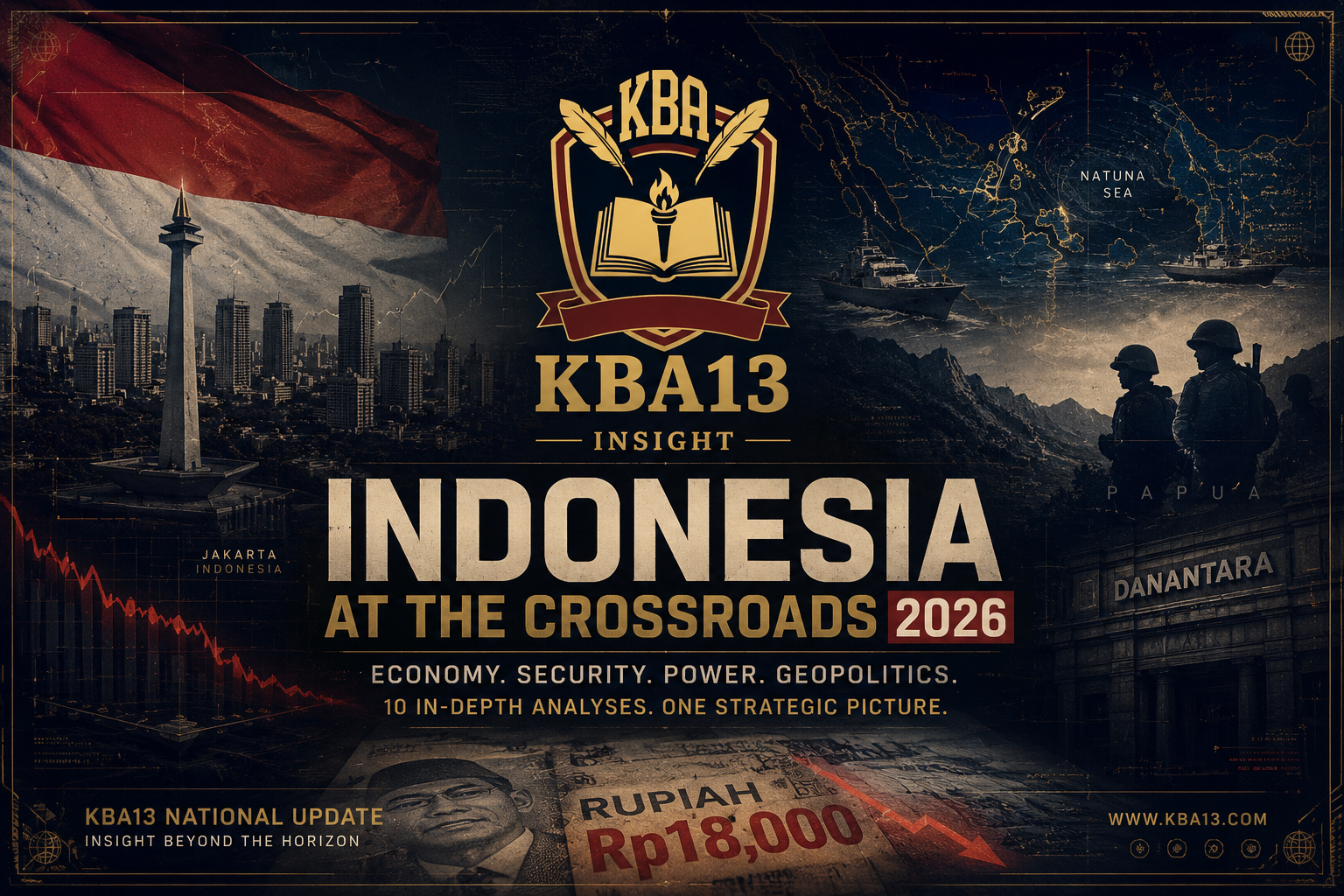
Indonesia enters 2026 at a decisive historical moment where economic pressure, institutional transformation, security challenges, and geopolitical competition converge. This KBA13 National Update examines Indonesia beyond daily headlines by mapping deeper structural signals behind the rupiah’s pressure, fiscal vulnerabilities, governance challenges, corruption risks, and the transformation of national security institutions. The report explores the evolving architecture of the Prabowo administration, TNI–Polri realignment, Papua’s unresolved conflict, Natuna maritime tensions, and Indonesia’s strategic balancing between Washington and Beijing. Rather than viewing these events separately, this analysis argues that Indonesia faces a larger question: whether the Republic can transform its demographic, geographic, and economic potential into institutional strength. Indonesia’s challenge is no longer merely growth — it is the capacity to build governance systems capable of surviving an era of geopolitical disruption, economic uncertainty, and strategic competition.
Keywords
- ASEAN Geopolitics
- Economic Intelligence
- Fiscal Security
- Governance Crisis
- Indonesia 2026
- Indonesia China Relations
- Indonesia Strategic Outlook
- Indonesian politics
- KBA13 Insight
- Military Reform
Indonesia enters the first week of June 2026 carrying the full weight of a nation under simultaneous, compounding stress: a rupiah flirting with Rp18,000, a corruption scandal detonating inside the President’s flagship social program, a low-intensity war raging across Papua’s highland districts, a viral song rewriting the public image of a minister once despised by netizens, a former president’s academic credentials becoming a criminal courtroom drama, a Cabinet Secretary publicly humiliating a diplomat over a three-month tenure, and a military apparatus rotating hundreds of officers across a security architecture that is quietly but unmistakably being remolded in Prabowo’s image. This KBA13 National Update—our most comprehensive English-language field-grade intelligence assessment to date—delivers ten in-depth analyses spanning every critical dimension of Indonesia’s national life in the week of June 5, 2026.
THE RUPIAH APPROACHES Rp18,000: INDONESIA’S CURRENCY IN FREEFALL AND THE ANATOMY OF FISCAL FRAGILITY
| MONETARY SECURITY | ECONOMIC INTELLIGENCE |
On June 5, 2026, the Indonesian rupiah breached the Rp18,000 threshold against the US dollar—a number that does not merely represent a currency valuation but an entire civilizational alarm. In the collective memory of Indonesians who lived through the catastrophic 1997–1998 financial crisis, when the rupiah lost 80 percent of its value and a 32-year authoritarian order collapsed in its wake, the Rp18,000 level is not economic data. It is psychological terror. That it has arrived not amid a regional contagion but as a largely Indonesia-specific phenomenon makes it far more troubling.
The rupiah’s trajectory over the past 30 months tells a damning story of structural decay compounded by external shocks. From Rp15,400 per dollar at the end of 2023, it slid to Rp17,529 on May 12, 2026, drifted to Rp17,839 on June 2, and then surged toward Rp18,000 on June 4. Each increment reflects a specific failure: the USD 2.8 billion in capital outflows from the equity market year-to-date, a trade surplus that shrank to a six-year low in April as imports slightly exceeded exports, and a sovereign credibility deficit that Moody’s and Fitch formalized with negative outlook ratings earlier this year.
Bank Indonesia Governor Perry Warjiyo’s 50-basis-point rate hike in May 2026—the most aggressive single-session tightening in years—was a signal of institutional seriousness, but markets have been unimpressed. Rate hikes are blunt instruments that simultaneously slow economic growth while attempting to defend the currency. May 2026’s PMI Manufaktur recovered to 50.0 from a contractionary 49.1 in April, suggesting manufacturing is barely clinging to neutral. Inflation rose to 3.08 percent year-on-year in May — within target, but the trend line is moving in the wrong direction.
What makes Indonesia’s rupiah problem categorically different from, say, Vietnam’s or India’s periodic currency pressures is the structural dimension of the fiscal base. Indonesia’s tax-to-GDP ratio has chronically hovered below 11 percent for decades — compared to an OECD average of 34 percent and Southeast Asian peers Thailand and Vietnam who are above 15 percent. This is not a cyclical problem. It is a foundational weakness: a state that cannot adequately tax its economy cannot adequately defend its currency without borrowing at rates that impose intergenerational debt burdens.
The Danantara Sovereign Wealth Fund continues to cast a shadow over Indonesia’s sovereign credibility. Fitch, in its negative outlook assessment, specifically cited Danantara as an off-budget vehicle with governance risks. The fund was designed to channel state enterprise dividends into productive investments; instead, it has become an emblem of opacity at precisely the moment when markets demand transparency. Confirmation that PT Danantara Sumberdaya Indonesia (DSI) had been established as a state-linked export entity further rattled markets, with the rupiah dropping even after that announcement.
The geopolitical dimension of the rupiah’s weakness is equally consequential. The Iran-US diplomatic impasse, which Secretary of State-equivalent figures on both sides have publicly acknowledged, has stalled negotiations, keeping oil price risk elevated. Indonesia — a net oil importer — is directly exposed to every dollar increase in Brent crude. Additionally, the US Federal Reserve’s ‘higher for longer’ interest rate posture continues to make dollar-denominated assets more attractive relative to emerging market currencies, generating structural capital outflows from Jakarta’s bond market.
The government’s fiscal response has been largely reactive. Front-loaded global bond issuances at yields as high as 5.5 percent for long-tenor instruments signal distress rather than confidence. The government’s APBN deficit is projected at 2.9 percent of GDP — formally below the statutory 3 percent ceiling—but this figure masks an archipelago of off-budget liabilities through state enterprises, contingent exposures through Danantara, and escalating debt service obligations. The IMF’s flags on sustainability are not abstract warnings; they are forward-looking risk assessments from an institution with unmatched sovereign balance-sheet data.
Paradoxically, GDP grew 5.6 percent in Q1 2026 — the highest in four years. This should have attracted foreign direct investment and portfolio inflows. That it has not — that investor confidence remains structurally impaired even as output expands — reveals that markets are pricing not Indonesia’s current output but its institutional trajectory. A growing economy governed by opaque sovereign funds, extractive budget programs, and a currency in managed decline does not reassure institutional investors whose mandates demand rule-of-law predictability alongside growth.
The author’s assessment: Indonesia needs not another round of monetary firefighting but a structural fiscal compact—a credible, multi-year program to raise the tax-to-GDP ratio toward 14 percent, rationalize off-budget liabilities, and demonstrate that the Prabowo administration’s ‘Indonesia Incorporated’ vision is backed by institutional architecture, not merely political will. Until that compact is credible to Moody’s, Fitch, and JPMorgan simultaneously, every rupiah recovery will be temporary, and every depreciation episode will threaten to trigger systemic panic.
II. THE BGN CORRUPTION SCANDAL: WHEN PRABOWO’S FLAGSHIP PROGRAM BECAME A RENT-EXTRACTION MACHINE
| GOVERNANCE | ANTI-CORRUPTION | INTELLIGENCE |
On the evening of June 2, 2026, President Prabowo Subianto announced a decision with extraordinary speed and force: he dismissed Dadan Hindayana as Head of the Badan Gizi Nasional (BGN), the National Nutrition Agency, along with his two deputies, Sony Sonjaya and Lodewyk Pusung. Less than 24 hours later, the Attorney General’s Office (Kejaksaan Agung) had formally charged all three as suspects in a corruption case involving the Makan Bergizi Gratis (MBG)—Free Nutritious Meals — program. The sequence was clinical: intelligence gathered, decision made, accountability enforced, prosecution activated. By the standards of Indonesian governance, it was breathtakingly fast.
The alleged modus operandi is a textbook example of Indonesia’s systemic corruption architecture. According to Jampidsus Director Syarief Sulaeman Nahdi, the suspects had directed the appointment of Satuan Pelayanan Pemenuhan Gizi (SPPG) — nutrition service units, or ‘MBG kitchens’ — to partner foundations that did not meet eligibility requirements but were secretly affiliated with the suspects themselves. These foundations were then receiving billions of rupiah in government incentives daily. The alleged markup of goods procurement created potential state losses running into trillions of rupiah. This is not improvisational petty corruption. It is an engineered system of rent extraction embedded inside a program designed to feed Indonesia’s children.
Dadan Hindayana’s trajectory is profoundly instructive about Indonesia’s bureaucratic ecology. An agricultural academic appointed by President Jokowi in August 2024 to lead the BGN — a brand-new agency — he had almost no administrative track record in public financial management at scale. The BGN was handed a mandate of extraordinary ambition: implement the Free Nutritious Meals program across hundreds of thousands of distribution points nationwide, targeting schoolchildren from PAUD to SMA, pregnant women, nursing mothers, and toddlers. The budget was Rp335 trillion — nearly 9 percent of the entire state budget. To give a freshly minted agency that scale of financial firepower, without embedding commensurate oversight mechanisms, was an institutional design failure waiting to be exploited.
Kepala Staf Kepresidenan (KSP) Dudung Abdurachman — himself only installed on April 27, 2026 — appeared before Komisi XIII DPR on June 3 and stated that ‘the President had long been gathering information, observing, analyzing, evaluating from multiple sources’ before acting. This framing is significant: it means the intelligence about BGN’s systematic corruption was not a sudden discovery but a slowly accumulated body of evidence that Prabowo chose to act on at a moment of political and operational calculation. The timing — immediately upon Dadan’s return from the haj pilgrimage in Mecca — was either coincidental or deliberately theatrical. The image of a man arrested upon returning from the holiest journey in Islam’s calendar was not lost on the public.
The reaction in front of BGN’s offices was telling: seven bouquets of flowers were delivered to celebrate the firings. This spontaneous public response — traditionally reserved for anticorruption victories — signals that the MBG program’s reputation had already suffered significantly in popular perception. Incidents of mass food poisoning in multiple regions, logistical disasters, and persistent rumors of procurement irregularities had been circulating on social media for months before the formal charges. The public was not surprised. It was vindicated.
From a strategic intelligence perspective, the BGN case exposes a structural vulnerability in how Prabowo’s administration has organized the delivery of its signature social programs. The reliance on a network of yayasan (foundations) and non-state intermediary organizations as distribution partners creates accountability voids that experienced predators exploit with precision. Without robust financial intelligence, real-time monitoring by BPKP, and independent audit trails, these intermediary structures inevitably become vectors for diversion. President Prabowo acknowledged that he had summoned BPKP Chief Muhammad Yusuf Ateh and PPATK Chief Ivan Yustiavandana after receiving reports of irregularities — but the critical question is: why did these agencies not trigger alerts automatically much earlier?
The political economy of the BGN scandal also intersects with the broader elite dynamics of the Prabowo cabinet. Dadan Hindayana was an appointee of Jokowi’s final weeks — a technical academic placed inside a politically sensitive agency. The swiftness with which Prabowo acted against him, and the speed of Kejagung’s prosecution, raises the question of whether this was purely a governance response or also an opportunity to cleanse a Jokowi-era institutional residue from a program now central to Prabowo’s personal legacy.
For Dudung Abdurachman, the BGN affair is his first major public performance as KSP. His appearance before DPR’s Komisi XIII, his measured but firm statements defending the President’s decision, and his framing of the prosecution as proof of Prabowo’s genuine anticorruption commitment — all of this establishes Dudung as a visible executor of presidential authority in the civilian domain. This is a new role for a man whose career was built on commanding infantry battalions and strategic reserve forces. The question is whether the skills of military command translate into the equally complex domain of public political communication.
KBA13’s assessment: The BGN affair will determine whether Prabowo’s anticorruption posture is a durable governing principle or a selective-enforcement mechanism deployed for political effect. The test will come not in the prosecution of Dadan Hindayana—already politically safe—but in whether the investigative net extends to the political networks that approved his appointment, allocated his budget, and monitored his performance without intervention. Accountability that stops at the implementing official, without interrogating the entire accountability chain above him, is the management of scandal, not the eradication of corruption.
III. THE TEDDY VS. DINO AFFAIR: DIPLOMACY, PUBLIC RIDICULE, AND THE CULTURE OF ISTANA DEFENSIVENESS
| FOREIGN POLICY | POLITICAL COMMUNICATION | ELITE DYNAMICS |
The public confrontation between Cabinet Secretary Teddy Indra Wijaya and former Deputy Foreign Minister Dino Patti Djalal—which erupted across Indonesian social media in the final days of May and first days of June 2026 — is one of those episodes that appears trivial on the surface but reveals deep structural tensions in how the Prabowo administration relates to criticism and civil society expertise. What began as Dino’s measured, analytical critique of Prabowo’s frequency of foreign travel became a diplomatic incident in its own right — a demonstration of how Istana’s instinct for defensiveness can transform manageable criticism into a national spectacle.
The sequence: Dino Patti Djalal — a PhD from the London School of Economics, a career diplomat who served as Juru Bicara Presiden SBY for six years, Ambassador to Washington for three years, and briefly as Deputy Foreign Minister — published a structured critique of Prabowo’s external travel frequency and its costs to state finances. He raised legitimate questions: was the pace of presidential foreign visits sustainable? Was APBN being burdened by the entourage costs? Was the diplomatic ROI proportionate to the outlay? These are reasonable, evidence-based questions from a man with deep expertise in Indonesian foreign policy.
Teddy’s response was a six-minute video published to the Sekretariat Kabinet Instagram account. The content included several valid rebuttals: that excess travel costs beyond the state budget were covered personally by Prabowo, that the diplomatic results—BRICS membership, EU tariff reduction to zero, Rp2,430 trillion in investments through BKPM—were concrete and quantifiable. These are fair counterpoints. But Teddy could not resist including a dig that immediately overshadowed everything else: ‘I think he is a great diplomat, having served as Deputy Foreign Minister, although he was only given the opportunity for about three months. ‘ This single sentence—petty, personal, and unprovoked in the context of the substantive debate—turned a policy exchange into a playground spat.
Social media’s reaction was swift. #TeddyvsDino trended nationally. The public began comparing CVs, financial disclosures (LHKPN: Teddy Rp20.1 billion, Dino Rp10.65 billion), and career trajectories. Multiple political commentators noted the irony: a Cabinet Secretary whose professional background is as a former Presidential Aide Camp—essentially an executive-level bodyguard—was patronizing one of Indonesia’s most credentialed living diplomats over the length of his foreign ministry tenure. Dino’s three months as Wamenlu reflected political circumstances rather than professional failure. The subtext was unmissable: Istana’s inner circle bristles at expertise-based criticism from outside its circle of loyalty.
The substantive dimension of Dino’s critique deserves serious engagement that it never quite received. Prabowo has been extraordinarily active in foreign travel—visiting Europe, the Middle East, Washington, Beijing, Tokyo, and multiple ASEAN capitals within his first 18 months. Secretary Teddy cited results: BRICS membership, EU tariff elimination, and and investment commitments. But Dino’s deeper concern was about cost-efficiency and accountability: whether the APBN frameworks governing presidential travel are transparent and whether the claim that ‘personal funds’ cover excess costs is independently verifiable or simply a narrative assertion.
This episode also illuminates the emerging communication culture of the Prabowo presidency. The reflexive impulse when faced with expert criticism is not to engage substantively but to impugn credentials, emphasize loyalty, and treat critique as a political attack. This is a posture borrowed from political campaigning, not governance. In a democratic system with functioning public accountability, criticism from credentialed outside voices should be welcomed as input, not repelled as an insult. The Teddy-Dino episode suggests that Istana has not yet developed an institutional culture for absorbing expert dissent.
The episode also has implications for Indonesia’s diplomatic ecosystem. Senior diplomats and foreign policy professionals who observe Istana treating one of their most accomplished peers with casual public dismissal will internalize a lesson: independent criticism carries reputational costs. This chilling effect—if it extends to the foreign policy community—could narrow the range of voices advising on Indonesia’s external posture at precisely the moment when the global environment demands the most sophisticated diplomatic navigation.
Dino Patti Djalal’s response was measured and showed the temperament of a diplomat. He did not escalate personally; he re-emphasized the substantive points and expressed willingness to continue the conversation. This contrasted sharply with Teddy’s combativeness. In the court of public opinion, Dino’s dignity under provocation further elevated his stature while diminishing the government’s.
KBA13’s assessment: The Teddy-Dino affair is a symptom of a larger problem in Indonesian political culture — the conflation of loyalty with competence and the treatment of outside expertise as political opposition rather than legitimate input. Prabowo’s team would do well to remember that Indonesia’s most consequential strategic decisions in the coming decades will require the best possible expertise from across the full range of Indonesia’s intellectual and diplomatic talent, not merely those who have pledged personal loyalty to the Istana. Closing that door to expertise is a national security risk.
IV. THE JOKOWI DIPLOMA SAGA: A NATION’S UNRESOLVED RECKONING WITH ITS FORMER PRESIDENT
| RULE OF LAW | POST-PRESIDENTIAL POLITICS | SOCIAL MEDIA |
Few issues in Indonesian public life have proven as durable, as legally complex, and as politically revealing as the long-running controversy over former President Joko Widodo’s academic credentials. On June 2–3, 2026, the case entered a new phase: Polda Metro Jaya’s Dirreskrimum Kombes Iman Imanuddin confirmed that the case files for suspects Roy Suryo and Tifauziah Tyassuma (Dr. Tifa) had been declared complete by the Kejaksaan Tinggi DKI Jakarta, signaling imminent trial proceedings. Eight suspects in total across two prosecutorial clusters are now facing a formal legal process.
The case’s legal architecture involves two distinct clusters. The first includes five suspects — Eggi Sudjana, Kurnia Tri Rohyani, Rustam Effendi, Muhammad Rizal Fadillah, and Damai Hari Lubis — who publicly alleged that Jokowi had used a fraudulent UGM (Universitas Gadjah Mada) diploma during his political career. The second, more prominent cluster involves Roy Suryo (former sports minister and digital forensics commentator), Rismon Hasiholan Sianipar (digital analyst), and Dr. Tifauziah Tyassuma — all of whom advanced specific technical claims about inconsistencies in Jokowi’s Forestry Faculty diploma. The legal theory against them is defamation and incitement.
The political subtext of this case is inseparable from the legal substance. Jokowi, who left the presidency in October 2024 after two terms, has become the focal point of two simultaneous narratives in Indonesian political culture. One narrative — emanating primarily from Prabowo supporters and Gerindra networks — treats the diploma controversy as legitimate accountability: holding a former president responsible for alleged misrepresentation of credentials used to hold public office. The opposing narrative—advanced by PDIP and civil liberties advocates — treats the prosecution of diploma critics as political weaponization of the legal system to silence those who question the Jokowi legacy.
Roy Suryo’s public response on June 3 was characteristically combative. Appearing at Polda Metro Jaya, he suggested that the file completion announcement was ‘driven by termul-termul that ngamuk’ — a colloquial reference to agitated Jokowi loyalists pressuring prosecutors. He challenged whether the file was truly ‘P-21’ (formally complete) or merely announced as complete prematurely. His skepticism about the fairness of the legal process reflects a deeper concern: that Indonesia’s prosecutorial apparatus, rather than operating as a neutral arbiter, is responding to political pressure from a former president’s networks.
PDIP — Jokowi’s former party, now estranged from him after the 2024 election — has taken an unexpectedly ambiguous position. DPP PDIP’s Djarot Saiful Hidayat, on May 30, suggested that Jokowi could simply resolve the controversy by publicly displaying his original diploma. This suggestion — which Jokowi’s camp has never accepted — was immediately endorsed by Roy Suryo’s legal team, who argued that Jokowi’s planned ‘safari keliling Indonesia’ in June 2026 presented a perfect opportunity for this public demonstration. The fact that PDIP and Roy Suryo’s defense team are aligned on this point reveals the strange alliances this case has produced.
Jokowi himself, having reportedly recovered from undisclosed health concerns that kept him out of public view for months, is preparing to return to active public engagement through regional tours. His silence on the diploma controversy has been interpreted by critics as evasiveness and by supporters as dignified restraint. In an Indonesian political culture where confessions and explanations are treated as admissions of guilt, Jokowi’s strategic silence is comprehensible. But its effect on public trust — particularly among those who have followed the case closely — is corrosive.
The digital forensics dimension of this case deserves its own analysis. Rismon Sianipar, a digital analyst, had presented technical arguments about what he described as anomalies in the typography, spacing, and institutional letterhead of the suspect diploma. Forensic counter-experts engaged by Jokowi’s camp disputed these findings. The fact that Indonesia’s legal system is now essentially adjudicating a dispute between digital forensics experts over the authenticity of a 1980s document—by criminally prosecuting those who raised the questions — represents a profound institutional failure to create legitimate, neutral verification mechanisms.
Social media’s role in keeping this case alive cannot be understated. The #IjazahJokowi hashtag has generated tens of millions of impressions across Twitter/X, TikTok, and YouTube since its initial emergence. Entire podcast ecosystems have been built around it. The case has become a vehicle for a broader cultural conversation about accountability, elite immunity, and whether Indonesia’s legal system can credibly process challenges to powerful figures from any direction.
KBA13’s assessment: The Jokowi diploma case will not be resolved cleanly through criminal prosecution alone, regardless of verdicts. It is a symptom of Indonesia’s unresolved cultural compact with executive accountability. The deeper question is not whether Jokowi’s diploma is authentic — credible institutions, including UGM, have consistently affirmed it is — but why Indonesia lacks institutional mechanisms to address such disputes without criminal prosecution as the only avenue for public resolution. The case will likely drag through trials, appeals, and social media cycles for years, consuming national attention that should be directed elsewhere.
V. ‘MAS BAHLIL GANTENG’: THE VIRAL SONG, POLITICAL SENTIMENT ENGINEERING, AND THE TIKTOK ECONOMY OF INDONESIAN POLITICS
| SOCIAL MEDIA | POLITICAL COMMUNICATION | DIGITAL SOCIETY |
In the final week of May and into June 2026, a song took Indonesia’s digital landscape by storm. Titled ‘MBG (Mas Bahlil Ganteng)’ — with a secondary title ‘My Little Bolu Ketan’—the piece was a short, catchy, AI-generated melody combining playful lyrics about Energy Minister and Golkar Chairman Bahlil Lahadalia with ironic praise for his personal charm. It was first published in late April by a TikTok account called @vokaliz_netizen, known for transforming trending social media commentary into music using artificial intelligence tools. Within two weeks, the audio had been used in hundreds of thousands of posts. The hashtag #masbahlilganteng accumulated tens of millions of views. Bahlil himself went on record saying he was ‘penasaran’ — curious — to meet the creator, and reportedly enlisted celebrity Raffi Ahmad to help track them down.
To understand why ‘Mas Bahlil Ganteng’ became a cultural phenomenon of this scale, one must first understand Bahlil Lahadalia’s complicated relationship with Indonesian netizens. Throughout his tenure as head of BKPM (Investment Coordinating Board) under Jokowi and subsequently as Energy Minister and Golkar chairman under Prabowo, Bahlil has accumulated a reputation for bombastic statements, controversial policy implementations, and a communication style that alternates between folksy charm and authoritarian imperiousness. He was repeatedly pilloried on social media — mocked, criticized, and the subject of viral clip compilations — making him one of Indonesia’s most talked-about and most negatively trending ministers.
The shift represented by ‘Mas Bahlil Ganteng’ is therefore not trivial. Political analyst Adi Prayitno, speaking through his YouTube channel, described it as a fundamental sentiment flip: ‘Netizens who once attacked Bahlil quite openly, now suddenly there’s a song that’s spreading extraordinarily on social media.’ His analysis was that the song represented ‘an accumulation of various comments and statements that previously circulated on social media, rearranged into music that was easy for society to accept.’ The catchy, non-threatening format of a short musical piece functioned as a kind of social acceptability carrier for a figure who had been politically radioactive.
Several analysts have argued that the viral success of ‘MBG’ reflects a deliberate narrative management strategy by Golkar’s internal communications apparatus. As Adi Prayitno observed: ‘This is part of how Golkar manages negative issues into positive ones about Bahlil.’ Whether or not the song was organically created and organically spread — which its origin via a known AI creator’s TikTok account does not preclude — the party’s communications team quickly embraced and amplified it, linking Bahlil’s virality to his policy achievements as Energy Minister. The political alchemy of converting ridicule into celebrity is a skill that cuts across ideology in the TikTok era.
Prof. Rhenald Kasali, a management professor at the University of Indonesia’s Faculty of Economics, offered a diagnosis from the perspective of behavioral economics and social psychology. His analysis was that the song’s virality was not principally about Bahlil at all — it was about the state of mind of Indonesian digital citizens in mid-2026. ‘People are dizzy from economic pressure, they’re looking for light entertainment,’ he argued. The song provided psychological release: absurdist humor about a powerful figure that required no deep political engagement, no moral risk, and no factual verification. It was pure meme-level cognitive comfort food for a population stressed by rupiah depreciation, rising prices, and governance scandals.
Psychiatrist Dr. Lahargo Kembaren, commenting on the phenomenon from a clinical perspective, explained the song’s earworm effect through the concept of Involuntary Musical Imagery (IMI) — the neurological phenomenon in which a melody loops involuntarily in the brain. The combination of a simple melody, repetitive lyrics, and emotional incongruity (a powerful and controversial minister praised in a playful, nursery-rhyme-like format) creates exactly the cognitive profile that produces earworms. The medical analysis inadvertently explains why political communication in the TikTok era may be more effectively shaped by ironic musical absurdism than by traditional news coverage.
Bahlil’s response was shrewd. Rather than ignoring the song — which would signal discomfort — or laughing it off in a way that seemed forced, he positioned himself as genuinely delighted and curious: ‘Who made this? I want to meet them.’ This response demonstrated authenticity, accessibility, and a kind of political confidence that said, “I am not threatened by humor at my expense.” In doing so, he turned a potential satire against him into a vehicle for personal brand rehabilitation. The strategy was so effective that Kompasiana commentators began discussing whether the song’s virality ‘blurs Bahlil’s long track record of controversy.’
The larger implications for Indonesian political communication are profound. Deddy Corbuzier’s Close the Door podcast — with 21.3 million subscribers and 5.2 billion total views, consistently among Indonesia’s most-commented digital content platforms — has for years served as an informal barometer of which political figures can successfully navigate the transition between traditional and digital political communication. The emergence of AI-generated political music as a new vector for sentiment management represents the next evolutionary phase. The boundary between organic cultural expression and orchestrated political narrative engineering is now so thin as to be functionally non-existent.
KBA13’s assessment: The ‘Mas Bahlil Ganteng’ phenomenon is both a case study in political communication innovation and a warning about the epistemological vulnerability of a political culture mediated primarily through short-form entertainment content. When policy record and governance accountability can be eclipsed by a 60-second AI song with tens of millions of views, democratic deliberation loses ground to affective resonance. Indonesia’s media literacy infrastructure is not remotely prepared for the sophisticated emotional manipulation techniques now available to any political operator with a TikTok account and an AI music generator.
VI. TNI AND POLRI RESHUFFLES: READING INDONESIA’S SECURITY ARCHITECTURE UNDER CONSTRUCTION
| MILITARY | POLICE | INSTITUTIONAL POWER |
The twin pillars of Indonesia’s security apparatus—the Indonesian National Armed Forces (TNI) and the National Police (Polri)—have undergone significant structural reshaping between March and May 2026. While individual rotation announcements routinely receive routine coverage framed as standard career management, the aggregate pattern of appointments across both institutions reveals deliberate strategic intent: the construction of a security architecture aligned with Prabowo’s governing vision, loyal to his command style, and capable of executing at the tempo and intensity his administration demands.
On the TNI side, Panglima (Commander) General Agus Subiyanto executed a major rotation in March 2026, followed by additional adjustments in April. The most consequential single appointment was the installation of five senior Army officers — including three Major Generals and two Brigadier Generals — as Special Staff (Stafsus) to Army Chief of Staff General Maruli Simanjuntak. On April 8, Maruli himself presided over the handover of three Pangdam (Regional Military Command) positions and the Kapuskesad, emphasizing in his remarks that ‘deep mastery of problems is the primary prerequisite for finding effective solutions.’ This phrasing — unusual in its philosophical depth for a ceremonial handover — signals that Maruli is positioning the Army’s leadership culture around cognitive competence rather than mere operational compliance.
Brigadier General Aulia Dwi Nasrullah, the new Kapuspen TNI (Head of TNI Public Affairs), is a particularly significant appointment to analyze. As a Kopassus-lineage officer placed in charge of the military’s public-communication interface, his appointment signals a preference for officers who approach information operations with the strategic discipline of special-forces methodology rather than bureaucratic public relations. In an era when Indonesia’s security narrative is contested on multiple fronts — Papua, Natuna, domestic counterterrorism — this choice makes operational sense.
The April 2026 Pangdam rotations included the incoming of General Hendy Antariksa, a Kopassus alumnus, as Pangdam I/Bukit Barisan — the regional command covering Sumatra’s northern tier, including Aceh and North Sumatra, regions still dealing with the aftermath of the catastrophic 2025 floods. This placement is symbolically and operationally significant: a special forces-trained commander overseeing the military’s disaster recovery and political stabilization role in a region where both challenges are simultaneously acute.
On the Polri side, Kapolri General Listyo Sigit Prabowo issued Telegram ST/960/V/KEP./2026 on May 7, 2026, affecting the largest single-batch rotation of the year: 108 officers across senior ranks, including the replacement of 9 Kapolda (provincial police chiefs). The Kapolda of West Java was replaced by Irjen Pol Pipit Rismanto (previously Kapolda Kalimantan Barat), while Sumatera Barat received Irjen Pol Djati Wiyoto Abadhy. Seven brigadier generals were redeployed to Bareskrim, indicating a strategic reinforcement of criminal investigation capacity — possibly in anticipation of continued high-profile prosecutorial cases like the BGN corruption case.
The promotion of Komjen Pol RZ Panca Putra S as Kalemdiklat (Head of Police Education and Training Institution) is particularly notable. Lemdiklat is where Polri’s future leadership is formed. Placing a three-star general with Panca Putra’s profile in charge of the institution signals a recalibration of officer formation: the next generation of Polri leadership will be shaped by whoever controls the curriculum, culture, and network formation at Lemdiklat. This is not a routine appointment — it is an investment in Polri’s 10- to 15-year institutional trajectory.
The one significant gender milestone in Polri’s May 2026 rotation deserves specific acknowledgment: Brigadier General A.A. Sagung Dian Kartini was appointed to the strategic position of Karolemtala Stamarena Polri — a senior administrative role at the national headquarters level. In an institution that remains heavily male-dominated at its command levels, this appointment represents a visible, if still isolated, step toward gender diversification in Polri’s senior ranks.
The civil-military relationship dimension of these rotations deserves analytical attention. The placement of General (Ret.) Dudung Abdurachman as Kepala Staf Kepresidenan (KSP), combined with the continued presence of generals in multiple civilian coordination roles, raises systemic questions about Indonesia’s post-1998 civilian supremacy framework. The reform consensus established after Soeharto’s fall explicitly aimed to end the military’s dual function (dwifungsi) in civilian governance. What is happening now is not legally a return to dwifungsi — these are retired officers in civilian roles, appointed through formal presidential authority. But functionally, the culture of military command is increasingly penetrating civilian institutional spaces.
KBA13’s assessment: The cumulative effect of TNI and Polri rotations in 2025–2026 is the construction of a security architecture that is operationally capable, institutionally consolidated under Prabowo-aligned leadership, and culturally oriented toward rapid execution over deliberative process. This creates significant capacity for decisive action in crisis situations — but correspondingly reduces the institutional resilience that comes from diverse leadership perspectives and robust internal dissent mechanisms. A security apparatus optimized for a single command style is formidable in calm waters and fragile in unexpected storms.
VII. PAPUA: THE ENDURING WAR — OPERATIONS, CASUALTIES, AND THE STRATEGIC LIMITS OF MILITARY DOMINANCE
| INTERNAL SECURITY | ARMED CONFLICT | HUMAN RIGHTS |
The highlands of Papua remain Indonesia’s most complex and morally demanding security challenge. In April and May 2026, the tempo of armed confrontation between security forces and the armed wing of the West Papua independence movement — designated OPM (Organisasi Papua Merdeka) by TNI, and operating under the TPNPB (Tentara Pembebasan Nasional Papua Barat) banner — remained consistently elevated across a broad geographic arc from Puncak to Yahukimo to Dogiyai to Nduga. The territorial scope of active armed confrontation, combined with the diversity of tactics employed by both sides, makes any claim that security operations are ‘winning’ the conflict empirically unsupportable.
The most consequential incident of the period — and the one that has generated the most significant institutional response — occurred on April 21, 2026, in Kemburu District, Puncak Regency, Papua Tengah (Central Papua). During a Satgas Habema operation targeting OPM positions, 12 civilians were reported killed. The precise circumstances — whether the fatalities resulted from crossfire, misidentification of combatants, or deliberate targeting — remain disputed between TNI’s official account and sources from Papua advocacy networks. DPR Komisi I member TB Hasanuddin publicly demanded the formation of an independent investigative team, stating the need for ‘direct verification at the location to maintain transparency and objectivity of information to the public.’ As of June 5, 2026, no such independent investigation has been formally constituted.
Satgas Operasi Damai Cartenz 2026 — the joint TNI-Polri operational framework for security operations across Papua — has recorded tactical successes of genuine significance. Two senior OPM commanders, Jeki Murib and Lau Gwijangge, were killed by TNI in operations in Nduga, Papua Pegunungan (Mountain Papua). Satgas Habema also overran and seized an OPM headquarters compound in Jayawijaya, capturing weapons and ammunition. Satgas Cartenz arrested a suspect identified as the Deputy Battalion Commander of the HSSBI Kodap XVI Yahukimo — a significant intelligence and command disruption. These are real tactical achievements. They do not, however, constitute strategic progress toward ending the conflict.
The fundamental analytical problem with assessing Papua through the lens of tactical operations is that it confuses activity with progress. Every OPM commander eliminated is replaced by a successor who has typically grown up watching Indonesia’s military operations against his community. Every weapons cache seized is eventually reconstituted through networks that span Papua’s highlands to West Papua’s coast to international diaspora communities in Vanuatu, the Netherlands, and Australia. The conflict’s fuel — the unresolved political grievances of Papuan communities over land, resources, cultural dignity, and political self-determination — is not addressed by military operations. It is, at the operational margin, often intensified.
The regional dimension of Papua’s armed conflict deserves mapping. In Yahukimo Regency — historically one of the most persistently violent zones — KKB/OPM attacks on civilian workers, transporters, and residents have continued throughout Q1 and Q2 2026. In Dogiyai, Central Papua, a driver was wounded when KKB attacked vehicles on the Trans-Papua Highway. In Intan Jaya — one of the richest mineral districts in Papua and consequently one of the most heavily contested — security incidents have concentrated around access routes to mining infrastructure. The pattern is geographically clear: conflict concentrates in areas where economic extraction is heaviest and where the gap between resource wealth extraction and community benefit is widest.
The humanitarian dimensions of Papua’s protracted conflict are systematically undercovered by national media. Schools in conflict-affected districts have closed for extended periods as teachers flee. Health posts lack personnel because medical workers refuse to operate in areas where there is no security guarantee for them or their patients. Infrastructure projects — roads, bridges, power lines — stall because contractors cannot get insurance coverage or personnel willing to operate in conflict zones. The development dividend that Jakarta promises Papua as justification for sustained military presence is itself rendered impossible by the military presence that generates the insecurity that drives the conflict.
TNI’s rebranding of the armed group from KKB (Kelompok Kriminal Bersenjata — criminal armed group) to OPM (Organisasi Papua Merdeka — Free Papua Organization) in 2024 was a framing shift with significant institutional implications. As Papua advocacy organization ALDP Director Latifah Hanum Siregar correctly observed: the shift to OPM categorization brings the conflict within TNI’s core mandate — countering separatist armed movements — rather than Polri’s law enforcement domain. This framing shift justifies greater TNI operational involvement and reduces the space for dialogic or political-resolution approaches. It is a military bureaucratic logic that self-perpetuates conflict.
The Pacific diplomatic dimension of Papua is increasingly consequential and increasingly urgent. Vanuatu, Tuvalu, Tonga, and the Solomon Islands continue to raise the issue of Papua at UN General Assembly sessions and Pacific Islands Forum meetings. The Melanesian Spearhead Group — despite Indonesian lobbying — has not removed the United Liberation Movement for West Papua from its observer status. This international advocacy creates legitimacy for the aspiration for independence and imposes diplomatic costs on Jakarta that accumulate over time. Indonesia’s response has been primarily defensive and reactive rather than constructively engaging the substantive concerns that animate Pacific solidarity with Papua.
KBA13’s assessment: Papua in June 2026 represents the starkest embodiment of Indonesia’s inability to translate economic resources and military capabilities into a political resolution. A state that commands the largest economy in Southeast Asia, the largest military in the region, and 27 years of post-Suharto political reform cannot resolve a conflict with a population of approximately 3.5 million in its easternmost territory. This is not primarily a capability failure — it is a political failure rooted in the unwillingness to create genuine, non-cosmetic mechanisms for Papuan political participation. The author has written this conclusion across multiple essays over multiple years. It has not changed.
REGIONAL INDONESIA: FROM SUMATRA’S FLOODS TO SULAWESI’S EMBERS—MAPPING THE NATION’S PRESSURE POINTS
| REGIONAL SECURITY | DISASTER GOVERNANCE | CONFLICT MAPPING |
One of the persistent analytical failures in assessing Indonesia’s national security is the tendency to treat regional crises as peripheral to a Jakarta-centered narrative of national affairs. In an archipelagic nation of 17,000 islands, 38 provinces, and extraordinary ethnic, linguistic, and economic diversity, what happens in the regions is not peripheral — it is constitutive of national stability. The week of June 5, 2026 provides ample material for a regional survey that reveals an Indonesia simultaneously managing disaster aftershocks, latent communal tensions, economic frustrations, and governance deficits across its vast geographic spread.
Sumatra’s catastrophic floods of November–December 2025 — which killed more than 1,100 people across Aceh, North Sumatra, and West Sumatra and displaced over 570,000 — continue to shape the political and institutional landscape of Indonesia’s largest island. Cabinet Secretary Teddy Indra Wijaya has been the government’s spokesperson for a disaster management response that mobilized over 50,000 personnel from TNI, Polri, Basarnas, and local emergency services. The government’s decision not to declare a national disaster status—despite sustained advocacy from affected communities, including the symbolically powerful act of Acehnese residents raising white flags as ‘distress signals’ — remains a contested institutional decision. Researchers from The Diplomat noted that the refusal also reflected reluctance to accept direct bilateral assistance or ASEAN’s AHA Centre support — a troubling posture of self-reliance in the face of overwhelming need.
The post-flood political economy of Sumatra is complex. Indonesia has sued six companies for environmental harm in the flood zones — a step that environmental advocates, including Greenpeace Indonesia’s Arie Rompas, called ‘minimalist’ given the scale of corporate-driven deforestation that contributed to the disaster. The government’s environmental audit, launched in January 2026, has reviewed zoning plans and land-use permits across the affected provinces. BNPB and regional disaster agencies are still managing resettlement for thousands of families whose villages were destroyed or rendered uninhabitable. General Maruli’s mention of TNI AD building emergency bridges in West Sumatra reflects the continuing military-civilian intersection in disaster recovery.
In Aceh, the political dynamics of 2026 are shaped by a constellation of intersecting forces: the continued dominance of Partai Aceh and the network of former GAM (Gerakan Aceh Merdeka) figures in provincial governance, the influence of the ulama through the MPU (Majelis Permusyawaratan Ulama), and a generational shift among younger Acehnese who have grown up entirely within the post-Helsinki MoU framework and have different political priorities than the independence-era generation. The implementation of Qanun (Aceh’s Islamic regulations) continues to generate periodic friction between conservative enforcement and modernizing civil society currents — a tension that national media rarely captures with appropriate nuance.
Kalimantan’s political economy is shaped by two dominant forces: the Ibu Kota Nusantara (IKN) new capital project, now entering its third year of active construction, and the expansion of coal, nickel, and palm oil extraction across the island’s interior. The IKN project has significantly slowed since the post-Jokowi transition, with OIKN (the IKN Authority) struggling to attract the private investment required for Phase 2. Meanwhile, agrarian conflicts between indigenous Dayak communities and plantation or mining concession holders continue to simmer in districts that national media rarely penetrates. The absence of Polri and TNI’s rapid conflict early-warning systems from these zones creates accountability voids that local governments often exploit.
Sulawesi presents a mosaic of regional security conditions. Central Sulawesi — particularly the Poso and Morowali corridors — remains on the security radar despite the significant degradation of the MIT (Mujahidin Indonesia Timur) network through sustained Densus 88 operations. The massive nickel smelting complexes in Morowali, staffed in part by Chinese workers under investment agreements, continue to generate labor conflicts and periodic incidents that local police manage with varying degrees of transparency. North Maluku, particularly the Halmahera nickel corridor, faces similar dynamics — a resource-extraction frontier that brings economic activity but also social friction, environmental degradation, and governance challenges that provincial governments are poorly equipped to manage.
The Maluku archipelago carries the memory of the 1999–2002 inter-communal violence that killed thousands — a memory that has not fully healed in either Muslim or Christian communities in Ambon, Ternate, and the surrounding islands. Periodic incidents — usually localized disputes over land, political competition, or individual conflicts that acquire a communal framing through social media amplification — are managed by the territorial commands of Polri and TNI with varying effectiveness. The structural inter-communal fault lines have not disappeared; they have been managed into dormancy. Effective disaster — whether natural or political — could reactivate them with speed that would overwhelm local crisis management capacity.
Java, home to approximately 60 percent of Indonesia’s population, generates its own regional security dynamics that rarely make national headlines precisely because they occur against the backdrop of a region so densely governed that crises rarely reach national visibility. But labor unrest in the industrial corridors of Bekasi and Karawang, urban poverty concentrations in Jakarta’s outer-ring cities, and political competition in Central Java between PDIP’s historical base and Gerindra’s Jokowi-era gains all represent live tensions in Indonesia’s most politically consequential region.
KBA13’s assessment: Indonesia’s regional landscape in mid-2026 is characterized by a paradox common to large, diverse democracies: the center is strong enough to prevent existential regional crises but not strong enough to resolve structural regional inequalities. The 2025 Sumatra floods exposed the fragility of disaster governance infrastructure. The Papua conflict reveals the limits of military-only security approaches. Kalimantan’s resource conflicts reveal the inadequacy of concession-based development models for managing social license. These are not isolated regional problems — they are systemic failures of the Indonesian state’s capacity to govern its full territory equitably and sustainably.
IX. NATUNA AND GEOPOLITICS: INDONESIA’S STRATEGIC POSITIONING BETWEEN WASHINGTON AND BEIJING
| GEOPOLITICS | MARITIME SECURITY | STRATEGIC INTELLIGENCE |
Indonesia’s geopolitical position in the first week of June 2026 is defined by an elegant but increasingly unstable diplomatic acrobatic act: maintaining BRICS membership while deepening a Major Defense Cooperation Partnership (MDCP) with the United States, maintaining billion-dollar investment ties with China while asserting ZEE sovereignty against Chinese grey-zone operations in Natuna waters, and declaring ‘bebas aktif’ (free and active) foreign policy while every significant decision it makes is interpreted through the lens of the US-China rivalry by both Washington and Beijing. The question for 2026 is not whether this position is intellectually coherent — it is. The question is whether it is operationally sustainable as the rivalry intensifies.
Cabinet Secretary Teddy Indra Wijaya’s June 1–2 defense of Prabowo’s intensive foreign travel schedule included a specific enumeration of diplomatic achievements: Indonesia’s BRICS membership, the elimination of EU tariffs to zero percent, and Rp2,430 trillion in investment commitments recorded by BKPM. These are quantifiable results. But they also reveal the operational logic of Prabowo’s diplomacy: it is simultaneously multilateral (BRICS, EU), bilateral (US, China, Japan, Saudi Arabia), and transactional (investment commitments tied directly to summit-level meetings). This logic serves Indonesia’s short-term interests well. Its long-term strategic coherence depends on whether Indonesia can maintain credibility with multiple incompatible interlocutors as the global order becomes more polarized.
The Natuna Utara (North Natuna Sea) situation has not escalated dramatically since this analysis last examined it in the May 2026 National Update, but the structural pressure has not abated. Chinese coast guard and maritime militia vessels continue their pattern of ‘grey zone’ presence within Indonesia’s EEZ — not overtly aggressive enough to trigger a formal diplomatic incident, but persistent enough to establish de facto presence that erodes the normative boundary between claimed and unclaimed waters. TNI AL’s response — deploying KRI John Lie-358, KRI Sutedi Senoputra-378, and additional patrol vessels — communicates deterrence posture while avoiding escalation. This is the correct operational choice but insufficient as a long-term strategic answer.
Indonesia’s asymmetry with China in maritime domain awareness (MDA) capacity is the most critical vulnerability in its Natuna defense posture. China’s coast guard vessels deployed in the area are equipped with state-of-the-art satellite communications, radar, and command-and-control systems that allow Beijing to monitor the situation in real time. Indonesia’s MDA capability, while improving, relies heavily on physical patrol presence supplemented by land-based radar systems and increasingly by aerial surveillance. The MDCP with the United States includes provisions for intelligence sharing and capacity building in maritime surveillance — this is potentially the most strategically valuable element of the partnership.
The BRICS membership creates a specific complication for the Natuna equation. BRICS includes China as a founding member and the dominant voice in its economic architecture. Indonesia joined BRICS in part to diversify its economic relationships and reduce dependency on dollar-denominated financial systems — legitimate strategic goals. But membership in the same multilateral club as China does not automatically generate leverage over China’s behavior in Indonesia’s EEZ. Beijing has consistently demonstrated that bilateral economic relationships and multilateral club memberships do not constrain its pursuit of maritime territorial ambitions. The South China Sea record is unambiguous on this point.
ASEAN’s continued inability to produce a binding Code of Conduct for the South China Sea — stalled by Chinese resistance and internal divisions within ASEAN — means Indonesia cannot rely on multilateral diplomatic frameworks to manage pressure in the Natuna Sea. The failure of ASEAN to speak with a single, unified voice on maritime claims reflects the structural reality that several ASEAN members (Cambodia, Laos, and, to some extent, Myanmar) have economic and political dependencies on China that make them unwilling to support any framework that China opposes. Indonesia’s implicit aspirations to ASEAN leadership on this issue are constrained by this structural fragmentation.
The India-Indonesia dimension of regional security deserves increasing analytical attention. India, pursuing its Act East Policy and concerned about Chinese maritime expansion, has been deepening defense cooperation with Indonesia — including naval exercises, port access discussions, and discussions on defense equipment. For Indonesia, deepening relations with India provides a strategic hedge that is neither the US-aligned option nor the China-accommodating option. As India’s economic and military capabilities grow, its potential as a counterbalancing force in the Indian Ocean-Pacific intersection that Indonesia occupies becomes increasingly valuable.
Defense spending remains Indonesia’s most critical strategic constraint. At under 1 percent of GDP — far below the ASEAN average and dramatically below the 2 percent NATO benchmark — Indonesia’s defense budget limits the pace at which it can build the maritime patrol capacity, aerial surveillance networks, submarine fleet, and long-range missile systems that a serious Natuna defense posture requires. The Prabowo administration has ambitious defense modernization plans — Prabowo himself as a former Defense Minister authored many of them — but executing them against a backdrop of rupiah depreciation and fiscal tightening is a task that requires painful trade-off choices.
KBA13’s assessment: Indonesia’s ‘bebas aktif’ foreign policy is not an anachronistic Cold War relic — it is a sophisticated strategic choice that has served the country well for 70 years. But its operational viability in 2026 requires greater institutional sophistication, more credible defense capacity, and a clearer red-line communication to China about what behavior in Indonesian waters constitutes an unacceptable provocation. The grey zone is only effective for China if Indonesia responds with grey uncertainty. Indonesia needs to develop the capacity for more precisely calibrated, publicly communicated responses that simultaneously signal both deterrence and non-escalation.
X. KBA13 STRATEGIC SYNTHESIS: INDONESIA AT THE INFLECTION POINT — POWER, GOVERNANCE, AND THE REPUBLIC’S UNFINISHED BUSINESS
| COMPREHENSIVE STRATEGIC ASSESSMENT | KBA13 INTELLIGENCE |
Across the nine field-grade assessments delivered in this edition of the KBA13 National Update, a single master narrative emerges with analytical clarity: Indonesia in June 2026 is a state of exceptional inherent capacity engaged in a structural struggle between the potential embedded in its geography, demography, and natural endowment, and the persistent institutional, cultural, and political failures that prevent that potential from becoming realized performance. The rupiah’s approach to Rp18,000 is not a currency problem — it is the currency’s honest verdict on the institutional condition of the state that issues it. The BGN corruption scandal is not an aberration — it is the predictable output of a system that consistently prioritizes political loyalty over institutional integrity in the design of governance structures.
The Prabowo administration, now 19 months into its five-year mandate, has developed a recognizable governing style: rapid, decisive action in moments of visible scandal (BGN firings, Kemburu investigation demands), centralization of authority through personal networks and military-cultural loyalties (Dudung as KSP, Maruli as KSAD, the Panglima-President alignment), and aggressive diplomatic activism that generates headline results (BRICS, EU tariffs, investment pledges) while the structural foundations of sustainable development — rule of law, bureaucratic meritocracy, fiscal reform — receive less consistent attention.
The social media dimension of Indonesia’s political life in June 2026 has never been more consequential or more analytically complex. The ‘Mas Bahlil Ganteng’ phenomenon illustrates how AI-generated content can reshape political sentiment at viral scale in days. The Jokowi diploma case demonstrates how digital forensics and social media ecosystems have effectively replaced traditional media as the primary arena of public accountability discourse. The Teddy-Dino confrontation shows how government communications have migrated from formal press conferences to Instagram video rebuttals — and how the informal, unscripted nature of this new media environment creates opportunities for unforced errors that traditional communications discipline would have prevented.
The podcast landscape, led by Deddy Corbuzier’s Close the Door, with 21.3 million subscribers and 5.2 billion total views, continues to serve as one of Indonesia’s most influential political communication platforms. The program’s willingness to host government officials, military figures, and political critics in the same episodic format creates an informal civic forum that official government communication channels cannot replicate. The comment sections of Corbuzier’s videos about BGN, Papua operations, and the Jokowi diploma case frequently generate tens of thousands of comments within hours — offering real-time pulse readings of public political sentiment that sophisticated political analysts monitor as closely as formal polling.
The rotation of military and police leadership across the institutional landscape in 2025–2026 has created a security architecture that is operationally consolidated but institutionally narrower. When 414 senior TNI officers rotate in a single batch, when 108 Polri officers shift simultaneously, when 9 provincial police chiefs are replaced in a single telegram — the cumulative effect is an institution realigned to a specific command preference. This is not inherently corrupt or authoritarian — it is how all governments everywhere reshape security institutions to reflect political direction. The risk emerges when the realignment substitutes political compatibility for professional merit, degrading operational quality over time.
Papua remains the most morally urgent and politically intractable dimension of Indonesia’s national life. The April 2026 Kemburu incident, where 12 civilians were reportedly killed during Satgas Habema operations, has not produced the independent investigation that DPR Komisi I demanded. The pattern is familiar: an incident generates institutional demands for transparency, those demands are acknowledged without being fulfilled, attention migrates to the next news cycle, and the structural conditions that produced the incident remain unchanged. This cycle — which the author has documented across multiple previous editions of the KBA13 National Update and in essays dating to 2024 — will continue to produce incidents as long as Papua policy is structurally defined by security imperatives rather than political dialogue.
The Natuna waters, meanwhile, continue to test Indonesia’s strategic patience and maritime capacity in ways that the public rarely observes directly. Chinese grey-zone operations are designed specifically to stay below the threshold of public visibility — to accumulate de facto maritime presence through dozens of individually deniable incidents rather than a single dramatic provocation. Indonesia’s MDCP with the United States provides crucial intelligence support and potential deterrence signaling, but Indonesia must be careful that its deepening with Washington does not trigger precisely the kind of Chinese maritime assertiveness around Natuna that it is designed to deter.
The economic picture — a 5.6 percent Q1 GDP growth rate alongside a rupiah approaching Rp18,000, investor capital outflows of USD 2.8 billion, and a sovereign wealth fund under international governance scrutiny — reflects the fundamental tension in Prabowo’s economic approach. ‘Indonesia Incorporated’ is a vision of state-led, centrally coordinated economic acceleration. Markets, by nature, distrust state direction unless it is accompanied by institutional credibility signals: independent rule of law, transparent regulatory frameworks, and predictable policy environments. The BGN scandal, the Danantara governance questions, and the rupiah’s signal of capital flight suggest that markets are not yet convinced.
KBA13’s final assessment for this edition: Indonesia possesses everything required to be one of the defining success stories of 21st-century development—an extraordinary population, unparalleled resource wealth, strategic geographic positioning, and a democratic tradition that, while imperfect, remains genuine and resilient. What it lacks is not capability but conversion — the institutional machinery that reliably transforms potential into performance. Building that machinery requires decisions that are politically costly in the short term: genuine meritocracy in appointments over loyalty, transparent accountability systems that reach powerful principals, not just implementing officials, a Papua dialogue that treats the aspiration for self-determination as a legitimate political challenge rather than a security problem, and a fiscal reform compact that addresses the tax-to-GDP ratio as a national emergency rather than a long-term aspiration. These are the decisions that separate transformational governance from competent crisis management. Indonesia is currently demonstrating the latter. The former remains the challenge of this administration’s remaining 3.5 years.
How to Cite
Ahmad, Kamaruzzaman Bustamam. (2026). Indonesia at the Crossroads 2026: Rupiah Crisis, Prabowo’s Power Architecture, Papua Conflict, and the Future of the Republic. Banda Aceh: KBA13 Insight.
https://www.kba13.com/indonesia-strategic-outlook-2026-rupiah-prabowo-papua-geopolitics/
Professor of Anthropology of Religion at UIN Ar-Raniry Banda Aceh. He writes on geopolitics, Southeast Asian security and governance, Islam in the Malay world, and the future of knowledge.
About The Author

Rekomendasi Bacaan KBA13 INSIGHT
Jika tulisan ini bermanfaat, dukung jurnal ini dengan mencari bukunya melalui tautan berikut:
- Buku-buku Kamaruzzaman Bustamam Ahmad di Periplus
- Koleksi Islamic Studies di Periplus
- Koleksi Geopolitics & Politik Internasional di Periplus
- Cari buku & perangkat baca di Shopee
- Cari di Blibli
Daftar lengkap: Rekomendasi Buku, Alat Tulis & Layanan. Tautan di atas adalah tautan afiliasi — KBA13 INSIGHT dapat memperoleh komisi kecil tanpa biaya tambahan bagi Anda.
Artikel Terkait
 Indonesia Strategic Outlook 2026: Rupiah Crisis, Danantara Risk, TNI Expansion, Papua Conflict, and Natuna Tensions
 Indonesia Strategic Intelligence Report (7–12 July 2026): Political Crisis, Papua Conflict, BrahMos Deal, Economy, and National Security
 Indonesia on the Brink of a Great Reckoning in 2026: The Rupiah Crisis, Power Consolidation, Papua, and the Geopolitical Contest over Natuna
 Indonesia’s August 2026 Risk Forecast: An Early Warning Assessment of All 38 Provinces
 August 2026: A Prediction of Indonesia’s Political Crisis — Goro-Goro, Huru-Hara, and the Future of Governance
Leave a Reply