
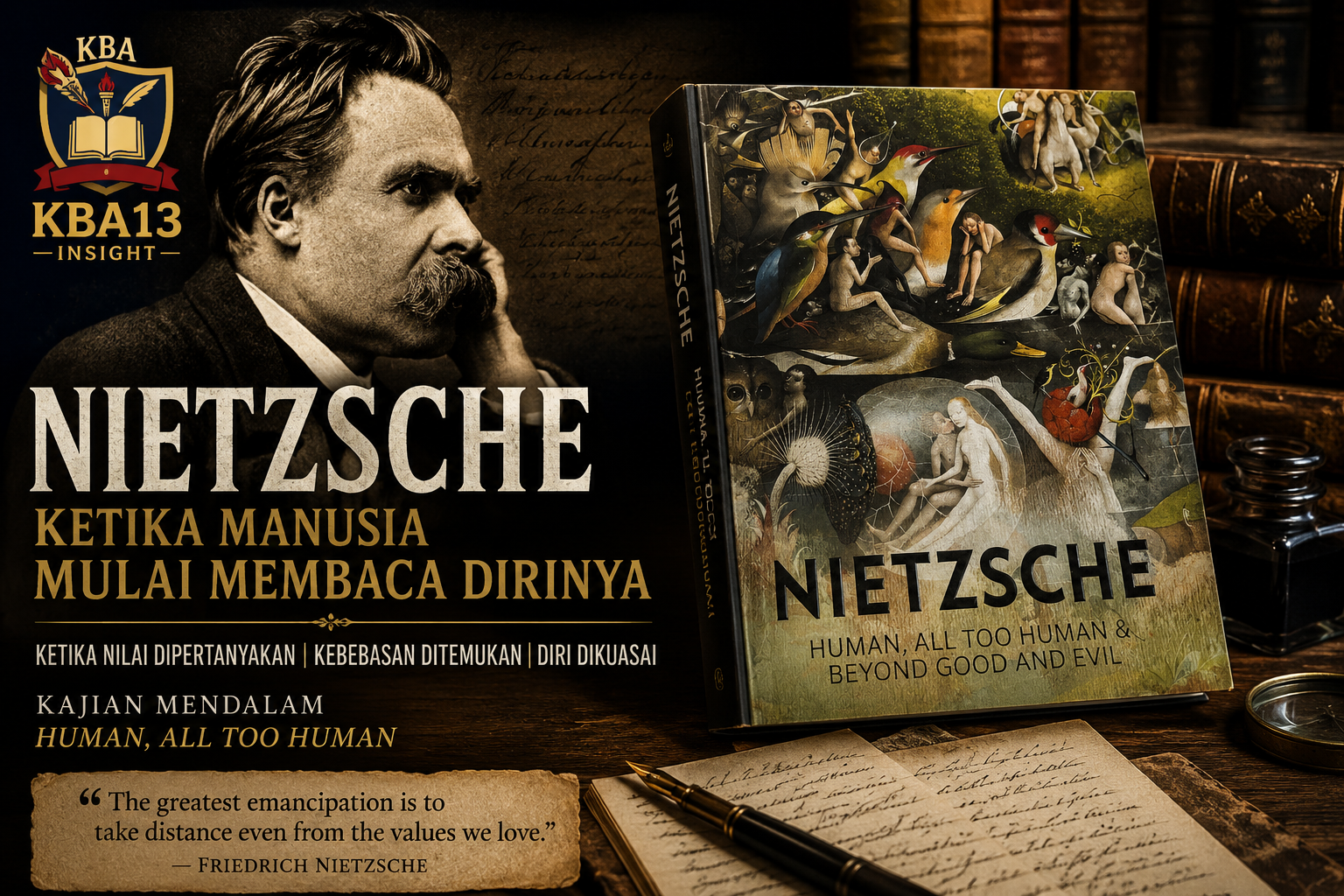
When a Human Being Begins to Suspect Their Own Values
There is an intellectual event that is often more decisive than any political or social change: the moment a human being begins to take distance from the very values that shaped them. Such a change is usually invisible from the outside. There is no great revolution, no transfer of power, no collapse of institutions. Yet within a person a far more fundamental shift is under way: they begin to ask whether everything they have long regarded as truth is truly the result of their own search, or merely something bequeathed to them.
Nietzsche leads the reader into that territory. In Human, All Too Human, Nietzsche does not begin by building a philosophy that offers new certainty. On the contrary, he opens a more difficult space: the space to reconsider all old certainties. For Nietzsche, humanity’s greatest problem is not only when people believe in something false, but when they no longer know why they believe in something at all. A conviction that is never examined can turn into a prison that does not feel like a prison.
Here Nietzsche places suspicion as a discipline of thought. Suspicion is not merely an attitude of refusal, nor the habit of doubting everything aimlessly. Suspicion is the ability to read the deepest layer of a value. When a person calls something true, good, noble, or honorable, Nietzsche poses another question: what process made human beings need those values? What experience lies hidden behind them? What psychological interest is at work behind the conviction?
Questions like these lead a person into uncomfortable territory, because what is being examined is no longer something distant from the self. It is easier to expose the errors of others than to dismantle the foundation that supports one’s own life. A person can be highly critical of power, ideology, or other civilizations, yet lose their courage when they must read the history of the formation of their own mind. Nietzsche instead begins from the nearest place: the human self.
For this reason, the birth of a free spirit in Nietzsche’s thought is not a story of swift victory. A free human being is not someone who suddenly escapes tradition and stands as the owner of a new truth. Nietzsche describes this process as a long, even painful experience. What is relinquished is often not something hated, but precisely something once loved, honored, and made a source of identity.
This is where Nietzsche’s depth emerges. Many people imagine the greatest liberation is fighting an enemy outside oneself. But Nietzsche shows that the hardest form of liberation is when a person must take distance from something that has long been a part of themselves. One does not merely leave behind an idea; one is re-examining the history of one’s own self. That is why the process of becoming free is often accompanied by solitude, a loss of orientation, even a sense of estrangement from a world that was once deeply familiar.
Yet Nietzsche does not make suspicion the final goal. This is the part often lost in reading Nietzsche. After a person succeeds in shaking old values, another danger remains: one can become a captive of the attitude of refusal itself. A person may feel free simply because they are able to destroy, when destruction without the ability to build a new distance is only another form of attachment. Hatred of the past still means the past rules over you.
In the end, the journey of a free spirit is not a journey toward a life without values. Nietzsche instead brings the human being to a heavier responsibility: to understand how values work, how values are born, and how a person can live without becoming the slave of something they never understood. The highest freedom is not when a person has no bonds, but when they consciously know their relationship to all the bonds that shape their life.
When Freedom Arrives Like an Earthquake
Nietzsche understood that the greatest changes in human life often do not come through neat decisions. People rarely leave behind something that has long shaped them through a calm and wholly rational process. There are moments when an inner event erupts suddenly, like a pressure stored up too long that finally opens a crack in the structure of a person’s life.
This is what Nietzsche describes as the great liberation. Liberation is not merely stepping outside external rules. The deeper liberation occurs when a person begins to take distance from something that has long been the center of meaning in their life. What was once regarded as home slowly becomes something that must be examined again.
The hardest part of this process is the fact that people often do not part from what they hate. If something was regarded as an enemy from the start, leaving it is not so difficult. But Nietzsche sees a far more complex experience: a person must take distance from something once loved, honored, even made a source of pride.
For this reason, liberation in Nietzsche’s view always contains an element of loss. Every human being is formed by certain bonds: a revered teacher, an intellectual environment, inherited values, a tradition that gives direction, and a way of thinking that makes the world feel stable. When all of this begins to be questioned, what collapses is not merely an idea. What is also shaken is a person’s image of who they are.
Nietzsche does not describe this phase romantically. There is no swift victory after a person succeeds in distancing themselves from the past. Precisely after the release occurs, one enters the most dangerous territory: the empty space between an old world that can no longer be inhabited and a new world not yet formed. Many people cannot endure a space like this, and rush to find new certainty as quickly as possible.
This is where Nietzsche differs from many thinkers of change. Nietzsche does not only ask how a person leaves a system of values. He asks what happens after a person succeeds in leaving. For the destruction of an old conviction does not automatically give birth to maturity. One can lose a single prison only to build the next prison under a different name.
So a free spirit must pass through a far heavier training: learning to live, for a time, without easy certainty. They must accustom themselves to seeing things from a certain distance. Not rushing back to seek shelter, but also not making the attitude of refusal into a new identity. Freedom requires discipline, not only courage.
In the end, Nietzsche shows that the greatest liberation always carries a psychological price. A person must be prepared to lose part of themselves in order to understand themselves more deeply. For often what prevents a person from seeing further is not something foreign, but something that has been far too close for far too long.
The Danger After Liberation: When Refusal Becomes a New Prison
There is one phase Nietzsche watched very closely after a person undergoes a great liberation. This phase is often invisible, because people regard the success of leaving something behind as a sign that the journey is complete. Yet for Nietzsche, the moment a person feels they have become free may in fact be the beginning of a subtler form of attachment.
When a person first succeeds in taking distance from an old value, a feeling of new strength emerges. Something once seen as absolute suddenly appears open to question. Something once thought untouchable turns out to have a history, weaknesses, and limits. At this point, a person discovers a highly tempting experience: the awareness that they are no longer controlled by what once ruled over them.
But Nietzsche sees a hidden danger within that experience. A person newly emerged from one world often has an urge to perform a total reversal. If something was once considered true, now everything is considered false. If something was once honored, now everything is suspected. If a person once believed too much, now they may fall into a state of being unable to believe in anything at all.
This is where Nietzsche reveals the depth of his psychological analysis. Freedom cannot be measured merely by a person’s ability to say “no.” Refusal is indeed needed to open up distance, but refusal is not the final goal. A person who continues to live in reaction to their past is in fact still controlled by that past. Its form changes, but its center of gravity remains the same.
Many people imagine they have left a system of values behind, when their entire life still moves in orbit around something they wish to reject. They define themselves by what they oppose, not by what they have understood. Nietzsche sees this condition as a temporary phase a free spirit must pass through, not a place to settle.
For this reason, the process of liberation, according to Nietzsche, requires a second capacity: not only the courage to destroy, but the courage to reassess. Once distance is created, a person must learn to see more calmly. Something from the past is not automatically true merely because it was inherited, but neither is it automatically false merely because it comes from the past.
At this point, Nietzsche begins to move from rebellion toward maturity of perspective. A person must be able to see the pros and cons, to accept complexity, and to understand that life cannot be reduced to two simple choices: accept everything or destroy everything. Maturity of thought is born when a person is able to stand between the two without losing direction.
Finally, Nietzsche brings the reader to one important lesson: the greatest enemy of a free human being is no longer the old value that has been left behind, but the arrogance that follows the feeling of having successfully left it. True freedom does not end when the first chain is broken. A new freedom begins when a person is able to ensure that they are not forging a new chain under a more beautiful name.
Learning to See Again After Everything Has Collapsed
There is one error in understanding Nietzsche: imagining that the end of the journey of thought is the ability to destroy old convictions. Yet Nietzsche saw destruction as only a temporary phase. After a person passes through a period of loss and distance, a far harder question arises: how does one go on living once one no longer depends on old certainties?
This phase is important because not everyone is able to return. Some stop at suspicion. They are able to dismantle, but unable to understand. They are able to find the weakness of a value, but lose the capacity to see why that value was once needed by human beings. Nietzsche did not want a free spirit to stop as a person who merely stands atop the ruins.
For this reason, after the period of release comes a process of healing. A person begins to see their past in a different way. What once bound them no longer has to be regarded as an enemy. What was once believed does not have to be hated merely because it has been surpassed. Distance grants a new capacity: to see without having to fully submit or fully refuse.
At this point Nietzsche begins to introduce maturity of perspective. A person no longer sees the world through only one door. The experience of loss makes one understand that every way of seeing has its limits. Every value is born of a particular condition. Every conviction carries a particular history. Therefore, understanding life requires the ability to shift one’s point of view.
The ability to hold many perspectives does not mean losing one’s footing. It is in fact a higher exercise of self-mastery. A person able to see from only one side often feels strongest, but is in truth easily controlled by their own point of view. Meanwhile, a mature person is able to approach something, take distance, then look again without becoming a captive of what they see.
For Nietzsche, this is where a free spirit begins to differ. Freedom is no longer merely freedom from something, but the freedom to govern one’s relationship with something. A person is no longer ruled by hatred of the past, nor does one return to being a follower without awareness. One learns to use old experience as material for understanding.
This stage shows that Nietzsche is not building a human being without roots. On the contrary, Nietzsche is searching for a human being strong enough to know their own roots without being enslaved by them. A person like this is not afraid to see the history of their own formation, because they have acquired the distance to understand how they were built.
Finally, the journey of a free spirit moves from suspicion toward the mastery of perspective. After losing much certainty, a person gains something more important: the ability to read life more broadly. Not because every question has been resolved, but because the person has learned to live without forcing the world to become simple.
When a Human Being Must Master Their Own Virtue
There is a stage harder than leaving errors behind: taking distance from what is regarded as good. Nietzsche saw that people often stop too soon in understanding freedom. Many feel free when they succeed in escaping something considered bad. Yet very few are able to ask: can something that has all along been called good also rule over a human being without their awareness?
Here Nietzsche carries the question of morality to a deeper level. The human problem is not only being ruled by weakness, fear, or error. A person can also be ruled by the very virtue they take pride in. Something that looks noble from the outside can turn into a force that governs the whole way a person understands themselves and others.
For Nietzsche, a person has not truly become a free spirit if they merely exchange one obedience for another. A person can leave an old tradition, then submit to a new idea. A person can leave one authority, only to create another authority within their own mind. The form differs, but the mechanism remains the same: the person has not yet become the governor of their own self.
For this reason, Nietzsche emphasizes the importance of the ability to stand “above” one’s own pros and cons. This does not mean living without direction or without values. On the contrary, a person must be strong enough to use a value without becoming an instrument of it. Virtue should be something understood and directed, not something that secretly takes control.
At this point the difference between possessing a value and being possessed by a value becomes visible. Many people regard the two as the same, yet Nietzsche sees a great distance between them. To possess a value means a person is aware of how that value works in their life. But to be possessed by a value means a person can no longer see themselves outside the framework of that value.
This view of Nietzsche cannot be read as an invitation to abandon all morality. What Nietzsche is doing is an examination of the human relationship with morality. His central question is not only: which value is true? But, more deeply: what kind of human being does that value shape? Does the value strengthen life, or does it in fact weaken the human capacity to grow?
At this stage, a free spirit no longer lives as a rebel. The period of rebellion is an early phase. Maturity emerges when a person is able to see various possibilities without losing self-control. A person like this is not easily ruled by fear, but also not easily ruled by the pride of having become free.
Finally, Nietzsche carries the idea of freedom into a far quieter territory: the mastery of oneself. The last enemy of a human being is not always something outside them. Sometimes the enemy hardest to recognize is precisely what is most honored within them. For this reason, the journey of a free spirit is not only a journey out of old shackles, but a long journey to ensure that no part of the self turns into a new ruler.
Life as a Long Experiment in Self-Formation
In the end, Nietzsche carries the journey of a free spirit toward one crucial awareness: the human being is not something already finished. Many systems of thought try to offer a final image of the ideal person, but Nietzsche is more interested in seeing the human being as a process in constant motion. A person is formed through experience, error, loss, new understanding, and the courage to keep assessing the self.
This is why the journey of a free spirit does not end by finding a single new place to settle forever. After leaving old certainty, a person is not asked to seek another form of certainty that merely replaces the previous position. Nietzsche understood that the greatest human need is often not truth itself, but the sense of security given by something regarded as truth.
This is where experience becomes essential. Nietzsche saw that the deepest understanding is not born of theory alone, but of the courage to live through change within oneself. A person must know what it feels like to be bound, what it feels like to lose that bond, how dangerous pride is after feeling free, and how difficult it is to see life again without anger toward the past.
For this reason, a free spirit is not a person who stands outside life as a cold observer. On the contrary, a person like this has entered more deeply into life, because they have experienced various forms of relationship with values. They have believed, doubted, drawn away, and returned to read again. All of these experiences become the laboratory of their self-formation.
Nietzsche shows that human depth is not born of perfection, but of the ability to work through one’s own journey. Wounds, failures, shifts of view, and periods of losing direction are not merely disturbances in life. All of them can become part of the process of understanding how a human being is formed and how a human being re-forms the self.
Yet this process requires a very difficult capacity: honesty toward oneself. People often find it easier to create a beautiful story about themselves than to read themselves as they are. Nietzsche invites us to see that many decisions, convictions, even great aspirations often have hidden psychological roots. Recognizing those roots is part of maturity.
Thus, Human, All Too Human is not merely a critique of old values. This book is a record of the human journey in confronting the self. Nietzsche asks not only what human beings believe, but also why they need something to believe in. It is this second question that keeps a reading of Nietzsche relevant.
In the end, Nietzsche leaves one important lesson: a free human being is not one who has found all the answers, but one who never stops examining the self. Freedom is not a final state possessed once and for all. Freedom is a long discipline of continually understanding how a human being becomes human.
About The Author

Rekomendasi Bacaan KBA13 INSIGHT
Jika tulisan ini bermanfaat, dukung jurnal ini dengan mencari bukunya melalui tautan berikut:
- Buku-buku Kamaruzzaman Bustamam Ahmad di Periplus
- Koleksi Islamic Studies di Periplus
- Koleksi Geopolitics & Politik Internasional di Periplus
- Cari buku & perangkat baca di Shopee
- Cari di Blibli
Daftar lengkap: Rekomendasi Buku, Alat Tulis & Layanan. Tautan di atas adalah tautan afiliasi — KBA13 INSIGHT dapat memperoleh komisi kecil tanpa biaya tambahan bagi Anda.
Artikel Terkait
 David Hume and the Origin of Ideas: How Experience Shapes the Human Mind
 Foucault, Power, dan Transformasi Subjek: Kajian Terhadap Essential Works 1954–1984
 Romantisisme Jerman dan Krisis Kesadaran Rusia: Memahami Russian Thinkers Karya Isaiah Berlin
 Helvétius dan Godaan Tirani yang Berniat Baik: Membaca Karya Isaiah Berlin tentang Bahaya Utilitarianisme Radikal
 Al-Futuhat al-Makkiyya: Understanding Ibn Arabi’s Architecture of Knowledge from Within
Leave a Reply