
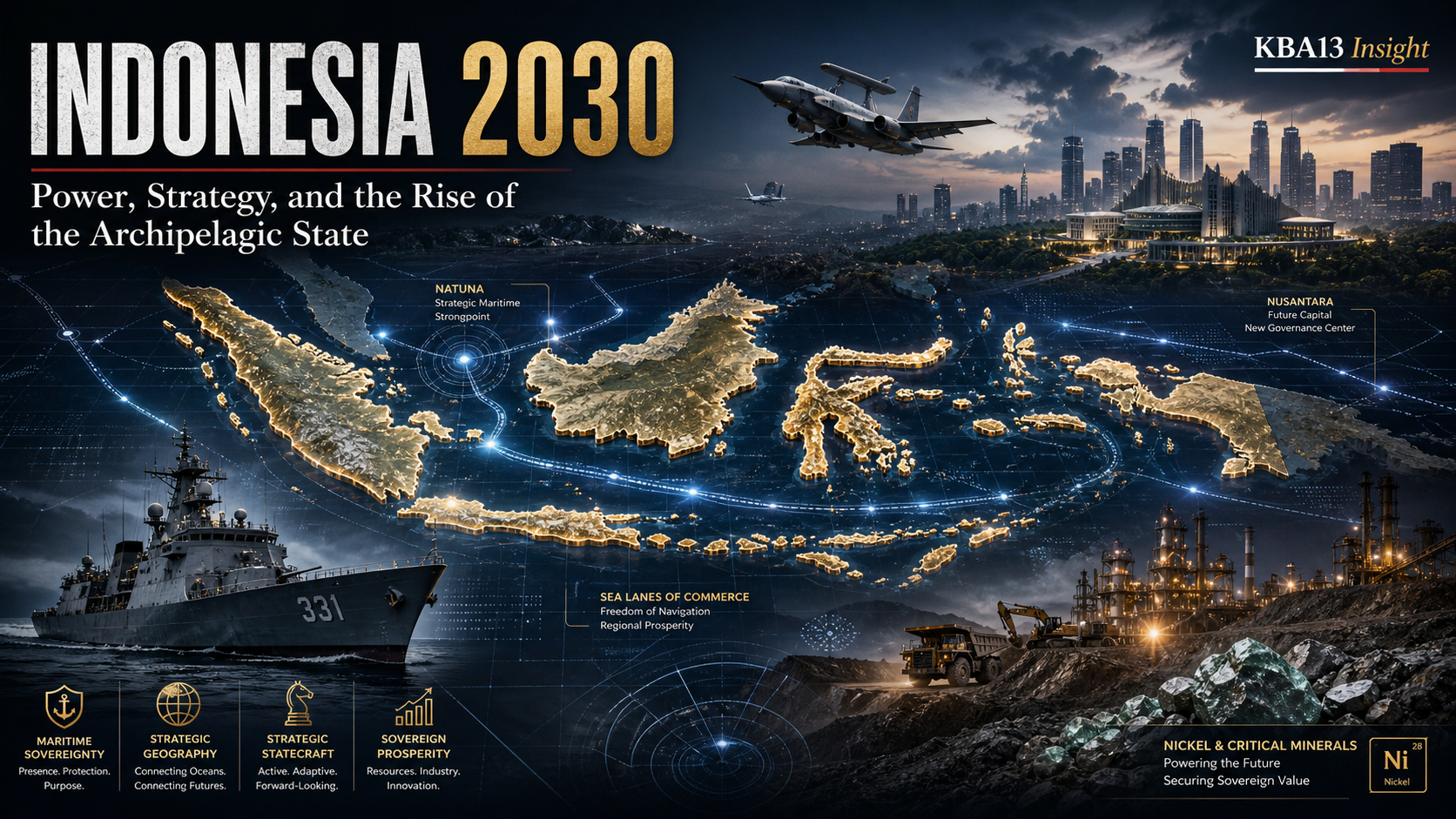
Indonesia 2030: The Rise of an Archipelagic Power in the Indo-Pacific Order
“Indonesia is not merely a regional power in waiting. It is a civilizational force whose full weight has yet to be felt by the international order. By 2030, that changes.”
EDITORIAL NOTE: This document is a scenario-based strategic futures assessment. Verified historical facts, institutions, laws, and data are grounded in open-source evidence as of 2025–2026. Projected events, doctrines, and institutions attributed to the years 2026–2030 — such as the “Natuna Doctrine,” “Intelligence Reform Act 2026,” “Garuda Eye,” and “Kogab Siber” — are analytical scenarios extrapolated from current trends, not established facts.
EXECUTIVE SUMMARY
Indonesia enters the 2030s as one of the most consequential yet misunderstood nations on earth. With a population exceeding 290 million, a projected GDP of approximately $2.0–2.1 trillion by 2030 (IMF baseline projection), and a geography that straddles the world’s most critical maritime chokepoints, Indonesia is no longer a peripheral actor in global affairs. This assessment examines, with analytical rigor, how Indonesia’s geopolitical posture, security architecture, intelligence community, economic strategy, and political leadership will define not only Southeast Asia but the broader Indo-Pacific balance of power by 2030. Indonesia is currently the world’s 7th largest economy by purchasing power parity and 17th by nominal GDP, with credible projections placing it among the global top ten by nominal GDP before 2035. This document is intended as a reference framework for policymakers, intelligence analysts, diplomatic strategists, and scholars who seek to understand Indonesia not as it was, but as it is becoming.
THE ARCHIPELAGIC AWAKENING: INDONESIA’S STRATEGIC IDENTITY IN 2030
Indonesia has long been described as a sleeping giant, a phrase that, while geographically flattering, fundamentally misreads the nature of the country’s strategic evolution. Indonesia has not been sleeping. It has been calculating. For decades following the fall of Suharto in 1998, Indonesian foreign policy operated on a philosophy of restraint, consensus, and deliberate non-alignment. That era is drawing to a close. By 2030, Indonesia has transformed its foundational foreign policy doctrine from passive non-alignment into what analysts now call “active strategic autonomy” — a posture that is assertive without being aggressive, independent without being isolated, and globally engaged without being ideologically captured.
The geographic reality of Indonesia alone demands strategic attention. The archipelago spans more than 5,000 kilometers from Sabang to Merauke, encompassing approximately 17,508 islands, six time zones, and coastlines totaling over 54,700 kilometers that touch both the Indian and Pacific Oceans. This is not merely a logistical challenge for domestic governance; it is a strategic asset of immense value. Whoever controls Indonesian waters, airspace, and diplomatic alignment controls the connective tissue between two oceans — a reality that great powers from Washington to Beijing to New Delhi have internalized with increasing urgency as Indonesia’s leverage grows.
The concept of Wawasan Nusantara, or the Archipelagic Vision, was first formally articulated in TAP MPR No. II/MPR/1983 and reaffirmed in subsequent national doctrine, has found renewed relevance in the 2030 context. Indonesia no longer views its waters as a vulnerability to be defended but as sovereign space to be commanded. This shift in strategic psychology — from defensive insularity to confident maritime assertion — underpins virtually every dimension of Indonesia’s foreign and security policy by the end of the decade. It is a transformation that has been building across multiple administrations and has finally crystallized into institutional doctrine.
Indonesia’s demographic architecture gives it a structural advantage that few nations in the Indo-Pacific can match. By 2030, approximately 68% of its population will fall within the working-age bracket, delivering what economists call a demographic dividend — a generational bulge of productive labor that simultaneously fuels consumption, innovation, tax revenue, and military recruitment. This is not a temporary window; it is a sustained advantage that will persist well into the 2040s, long after China and Japan have entered demographic contraction, which will constrain their strategic ambitions.
The country’s internal diversity, often cited as a source of fragility, has by 2030 been reconceptualized as a source of strategic depth. With over 700 languages, hundreds of ethnic groups, and the world’s largest Muslim population coexisting with substantial Christian, Hindu, and Buddhist minorities, Indonesia has developed a form of plural nationalism that is deeply resistant to the kind of ideological capture that makes smaller, more homogeneous nations vulnerable to foreign manipulation. This civilizational complexity is, paradoxically, one of Indonesia’s most durable strategic assets.
The political maturation of Indonesia’s democracy, despite significant strains and backsliding tendencies documented throughout the late 2020s, has produced a governing class that is increasingly sophisticated in navigating great-power competition. The generation of leaders who came of age during the Reformasi era — after the fall of Suharto in 1998 — has internalized both the trauma of authoritarian misrule and the possibilities of democratic governance. By 2030, this generation holds the levers of power across the executive, legislative, military, and intelligence apparatuses, bringing with it a fundamentally different strategic worldview from that of the New Order generation it replaced.
Indonesia’s relationship with its own history shapes its foreign policy instincts in ways that outside analysts frequently underestimate. The memory of colonial subjugation, first by the Dutch and then by Japan, has produced a deep institutional allergy to any form of external dependency or foreign military presence on Indonesian soil. This is not mere nationalism; it is a carefully theorized principle of sovereignty that constrains any Indonesian government from entering formal military alliances regardless of the geopolitical pressure applied. Understanding this historical DNA is essential for any analyst seeking to predict Indonesian behavior in crisis scenarios.
The emergence of Nusantara, Indonesia’s new capital in East Kalimantan, as a functioning administrative center by 2028 is more than an infrastructural achievement. It is a geopolitical statement. By relocating the seat of government to Borneo — geographically central to the archipelago and adjacent to the South China Sea corridor — Indonesia signals its intent to govern from the maritime heart of its territory rather than from the Javanese cultural center that has defined its politics for centuries. Nusantara is designed to be a symbol of the new Indonesia: technologically sophisticated, environmentally forward-looking, and strategically positioned.
By 2030, Indonesia’s strategic identity will have been substantially reshaped by the experience of navigating the US-China rivalry. Having watched smaller neighbors be forced into uncomfortable choices — and having seen the consequences of those choices — Jakarta has developed a master class in what might be called “strategic equidistance with benefits.” It maintains defense cooperation with Washington, infrastructure partnership with Beijing, technology sharing with Tokyo and Seoul, energy finance from Riyadh, and diplomatic solidarity with New Delhi — all simultaneously, all deliberately, and all calibrated to maximize Indonesia’s freedom of maneuver.
The international community’s recognition of Indonesia’s rising strategic weight has manifested in concrete ways by 2030. Indonesia holds a non-permanent seat on the UN Security Council for the third time in its history. Its G20 presidency in 2023 established templates for South-South financial reform that continue to shape multilateral negotiations. It chairs the ASEAN Summit in 2029. And it has become a preferred interlocutor for conflict mediation in Muslim-majority regions from the Middle East to Central Asia — a form of soft power diplomacy that no other nation in its weight class can replicate. The sleeping giant has not merely awakened. It has taken its seat at the table and begun speaking with authority.
GEOPOLITICAL ARCHITECTURE: JAKARTA AS THE INDO-PACIFIC PIVOT
The Indo-Pacific as a strategic construct was invented by external powers — primarily the United States, Japan, India, and Australia — to describe a theater of competition in which Indonesia was conspicuously central yet diplomatically peripheral. By 2030, that paradox has been resolved, not by Indonesia joining any of the competing frameworks, but by making itself so indispensable to all of them that the Indo-Pacific cannot be meaningfully discussed without Indonesia at its core. This is the essence of Jakarta’s geopolitical achievement: centrality without entrapment.
Indonesia’s “free and active” foreign policy, a doctrine inherited from the founding generation of the republic, has undergone a substantive reinterpretation under the pressures of 21st-century great-power competition. In its classical formulation, “free and active” meant non-alignment and active participation in multilateral diplomacy. In its 2030 iteration, it means something more sophisticated: the deliberate cultivation of indispensability across competing power centers, the strategic manipulation of great-power competition to extract maximum economic and political benefit, and the maintenance of sufficient ambiguity about alignment to preserve maximum diplomatic flexibility. It is, in essence, a doctrine of structured uncertainty elevated to the level of strategic art.
The US-Indonesia relationship by 2030 represents the most significant deepening of bilateral ties since the Cold War, yet it remains deliberately bounded in ways that frustrate Washington’s strategic planners. The two countries have signed a Comprehensive Strategic Partnership that includes defense technology transfer, joint maritime patrols in the Natuna zone, intelligence-sharing agreements, and substantial investment in the processing of Indonesian critical minerals. The US has also provided Indonesia with advanced combat aircraft and surveillance systems. Yet Indonesia has refused to sign a formal mutual defense treaty, declined to host permanent US military bases, and maintained an independent position on Taiwan that stops well short of the American preference. This is not hedging; it is deliberate architecture.
By 2030, China’s relationship with Indonesia is simultaneously Indonesia’s most economically significant and most strategically fraught bilateral partnership. Chinese investment under the Belt and Road Initiative has funded major infrastructure across Java, Sumatra, and Kalimantan, including high-speed rail, deepwater ports, and nickel processing facilities. Chinese tourists and students represent major contributors to Indonesia’s service economy. Yet the Natuna Sea confrontations of the late 2020s have introduced a hardened territorial edge to the relationship that cannot be papered over with investment flows. Indonesia’s message to Beijing is unmistakable: economic partnership is welcome; territorial encroachment is not.
The Indonesia-India axis, often overlooked in analyses focused on the US-China binary, is poised to become one of the most consequential bilateral relationships in the Indo-Pacific by 2030. Bound by a shared civilizational heritage rooted in the Hindu-Buddhist Srivijaya and Majapahit empires, a common suspicion of great-power entanglement, and overlapping strategic interests in the Indian Ocean, the two democracies have built a partnership spanning maritime security cooperation, defense technology exchange, digital infrastructure, and pharmaceutical supply chains. The India-Indonesia maritime security framework has become one of the most significant bilateral security architectures in the Indian Ocean outside of formal alliance structures.
Indonesia’s relationship with ASEAN has evolved from membership in a collective to leadership of a bloc, a shift that reflects both Indonesia’s growing weight and ASEAN’s structural limitations. As the bloc struggles with its consensus-based decision-making in the face of great-power pressure — particularly on the South China Sea — Indonesia has increasingly acted as ASEAN’s de facto strategic backbone, providing the institutional inertia that prevents the bloc from fracturing into competing alignments. This leadership is not always comfortable for smaller ASEAN members wary of Indonesian domination, but it has become structurally necessary as Indonesia’s share of ASEAN’s total GDP approaches approximately 37–38%.
The Middle East has become an increasingly important axis of Indonesian foreign policy by 2030, driven by multiple converging interests. As the world’s largest Muslim-majority democracy, Indonesia commands a unique form of religious soft power in Arab capitals that no secular power can replicate. This has been leveraged into substantial sovereign wealth fund investment from the UAE and Saudi Arabia into Indonesia’s green energy transition, nickel downstream processing, and Islamic finance infrastructure. Indonesia’s position as a credible voice on Palestinian rights and Gulf security simultaneously earns it diplomatic capital across the Muslim world while maintaining working relationships with multiple regional actors — a balancing act of considerable diplomatic dexterity.
Africa has emerged as an unexpected theater for Indonesian diplomatic and economic engagement by 2030. Building on the solidarity frameworks established during the Bandung era of the 1950s, Indonesia has cultivated substantial trade and investment relationships across sub-Saharan Africa, particularly in agriculture, halal food processing, Islamic finance, and digital infrastructure. Indonesian state-owned enterprises have established growing presences across the continent. This Africa engagement serves both economic and political purposes: it builds export markets for Indonesian manufactured goods while constructing a bloc of Global South votes in multilateral forums.
The European Union’s relationship with Indonesia has deepened considerably by 2030, driven primarily by Europe’s urgent need for the critical minerals — particularly nickel, cobalt, and bauxite — that Indonesia controls in abundance. The Indonesia-EU Comprehensive Partnership Agreement, finalized after years of negotiation, represents Europe’s most significant economic engagement with Southeast Asia. However, the relationship is not without friction: EU demands on environmental standards and labor rights in Indonesian mining operations create ongoing tensions that Jakarta navigates with a combination of genuine reform in some areas and strategic resistance in others. Indonesia understands that its mineral leverage allows it to set terms rather than merely accept them.
By 2030, Indonesia’s geopolitical architecture will have achieved something that most analysts considered structurally impossible a decade earlier: it will have made itself the essential partner for every major power simultaneously without becoming the client of any. The United States needs access to Indonesian minerals and democratic solidarity. China needs Indonesian markets and investment destinations. India needs Indonesian maritime cooperation. The EU needs an Indonesian minerals and climate partnership. Japan and South Korea need integration with Indonesia’s energy and supply chains. Each of these partners has accepted Indonesian terms because the alternative of Indonesian exclusion or hostility is strategically unacceptable. This is not a weakness. This is leverage perfected.
MARITIME SOVEREIGNTY AND THE NATUNA DOCTRINE
The Natuna Sea represents Indonesia’s most consequential strategic theater and the arena in which its transformation from a defensive to an assertive power is most visibly manifest. The waters surrounding the Natuna Islands in the northern reaches of Indonesia’s exclusive economic zone have been the site of recurring confrontations with Chinese coast guard and fishing vessels since at least 2016. By 2030, however, the nature of these confrontations has fundamentally changed: Indonesia no longer responds to Chinese incursions with diplomatic protests and temporary naval deployments. It maintains a permanent, heavily armed maritime presence that signals an unambiguous red line, backed by the full weight of its modernized military and a formal doctrinal statement — herein referred to as the Natuna Doctrine — projected to be codified in a forthcoming White Paper on Maritime Sovereignty.
The Natuna Doctrine, as projected in this assessment, has three core elements: first, any foreign vessel — state or non-state — operating within Indonesia’s EEZ without authorization will be intercepted and subject to Indonesian law; second, the Indonesian military will respond to gray-zone provocations with graduated but unambiguous force, including the seizure of vessels and arrest of crew; third, Indonesia will seek international arbitration through UNCLOS mechanisms for any unresolved jurisdictional dispute, regardless of whether the other party participates. The doctrine does not mention China by name, but its intended audience is unmistakable.
The physical infrastructure supporting Indonesia’s Natuna posture is substantial. By 2030, Indonesia will have constructed a major new naval facility on Natuna Island capable of hosting frigates, submarines, and maritime patrol aircraft simultaneously. A permanent garrison of TNI-AL and TNI-AU personnel maintains round-the-clock surveillance of the surrounding waters using a combination of radar systems, aerial drones, and satellite imaging. Underwater sensors monitor submarine activity in the approaches to the Natuna EEZ. The base is not merely a military installation; it is a strategic statement of permanence — a physical manifestation of Indonesia’s resolve that cannot be ignored by any actor operating in the region.
The South China Sea dispute, more broadly, has seen Indonesia evolve from diplomatic neutrality to principled engagement by 2030. While Indonesia continues to insist that it is not a claimant party to the South China Sea territorial disputes involving China, Vietnam, the Philippines, Malaysia, and Brunei, it has become increasingly vocal in its support for UNCLOS as the binding legal framework for resolving those disputes. Indonesia’s willingness to invoke international law on its own behalf — and to support other ASEAN claimants in doing so — has made it the de facto legal champion of rule-based maritime order in Southeast Asia, a role that both enhances its regional standing and serves its long-term interest in constraining Chinese expansionism.
The maritime security dimension of Indonesia’s strategic posture extends well beyond the Natuna question to encompass the full breadth of its vast oceanic territory. Indonesia’s coastline, at over 54,700 kilometers, is among the longest in the world, and its EEZ encompasses some of the world’s most biologically and economically productive waters. The Indonesian Coast Guard, significantly expanded and equipped by 2030, conducts regular patrols across this vast territory, intercepting illegal fishing operations — many by foreign vessels — that have historically plundered Indonesian waters with near-impunity. The economic value of these interdictions, estimated at billions of dollars annually from recovered fish stocks, is a concrete demonstration of the material benefits of sovereignty.
Indonesia’s submarine fleet, expanded under defense modernization programs, represents a qualitative leap in its maritime deterrence capability. Submarines give Indonesia a credible anti-access/area-denial capability in the waters surrounding its archipelago — the ability to threaten any surface fleet, including those of great powers, that might seek to project force into Indonesian maritime space. This capability is not primarily intended for warfighting; it is intended to raise the cost calculus for any actor contemplating coercive action against Indonesian maritime interests, creating a deterrence effect that operates continuously and silently beneath the surface.
The concept of maritime domain awareness — the comprehensive, real-time understanding of everything occurring in Indonesian waters — has become a central pillar of Indonesia’s security architecture by 2030. Funded in part by partnerships with the United States, Japan, and Australia, Indonesia’s maritime domain awareness network integrates satellite imagery, aerial surveillance, surface radar, acoustic sensors, and signals intelligence into a unified operational picture that is simultaneously accessible to naval commanders, coast guard officers, and intelligence analysts. This is not a surveillance system for its own sake; it is the informational foundation that makes Indonesia’s maritime claims enforceable rather than merely theoretical.
The economic dimensions of maritime sovereignty are inseparable from the security dimensions in Indonesian strategic thinking. Indonesia’s EEZ contains not only fish stocks and oil and gas reserves but also the submarine cable corridors that carry an estimated 95% of global internet traffic through the region. Control over these cables — or the ability to monitor them — is a form of strategic leverage that Indonesia is beginning to systematically develop. By 2030, Indonesia will have established legal and technical frameworks for monitoring undersea cable infrastructure in its waters, a capability with both economic and intelligence dimensions that its strategic partners are watching with considerable interest.
The Strait of Malacca — shared among Indonesia (Sumatra’s western coast), Malaysia, and Singapore — remains one of the world’s most critical chokepoints, handling approximately 25–30% of global maritime trade annually. While the strait is not exclusively Indonesian territorial waters, Indonesia’s geographic position gives Jakarta significant influence over the security architecture of this corridor. US carrier groups transiting toward the Pacific and Indian Oceans must operate in close proximity to Indonesian maritime space, making Indonesia an involuntary yet indispensable stakeholder in any major-power conflict scenarios involving this waterway.
The broader significance of Indonesia’s maritime posture by 2030 lies not in its specific provisions but in what it represents about Indonesia’s strategic psychology. For decades, Indonesia managed its relationship with China through a combination of diplomatic deference and quiet accommodation. The hardened Natuna posture signals the end of that era. Indonesia has concluded — based on a careful assessment of Chinese behavior patterns, its own growing military capability, and the availability of international support — that firm boundaries are more stabilizing than ambiguous ones, and that the costs of asserting sovereignty are lower than those of quietly conceding it.
MILITARY TRANSFORMATION: THE TNI IN THE AGE OF MULTI-DOMAIN WARFARE
By 2030, the Indonesian Armed Forces, known as the Tentara Nasional Indonesia or TNI, will have undergone their most comprehensive modernization since the founding of the republic. The transformation is not merely quantitative — more ships, more aircraft, more soldiers — but qualitative: a fundamental redesign of doctrine, organization, training, and capability to produce a military force capable of operating effectively across the full spectrum of modern conflict, from gray-zone maritime operations to high-intensity conventional warfare to cyber and information operations. Understanding the nature and limits of this transformation is essential for any accurate assessment of Indonesia’s security posture.
The foundation of the TNI’s modernization is the Minimum Essential Force program and its continuation, which focuses on integration, interoperability, and the development of genuinely joint warfighting capability. By 2030, the three service branches — Army (TNI-AD), Navy (TNI-AL), and Air Force (TNI-AU) — have achieved a level of joint operational coordination that would have been unthinkable a decade earlier, supported by a Joint Operations Command headquartered in Jakarta with subordinate regional joint task forces covering each of Indonesia’s major strategic theaters.
The Indonesian Air Force’s procurement strategy has emphasized diversification — acquiring from multiple Western suppliers rather than accepting any single nation’s exclusivity. This gives Indonesia both operational capability and diplomatic flexibility, ensuring that no single supplier can leverage arms sales as political coercion. The combination of different platforms from different suppliers ensures that Indonesia retains operational capability even if any one partner’s political decisions affect parts supply or software updates. This dual-sourcing strategy is expensive but strategically rational.
The Indonesian Navy’s surface combatant force represents a generational leap in blue-water capability. New frigates equipped with advanced anti-submarine warfare sensors, long-range surface-to-air missiles, and anti-ship cruise missiles give Indonesia the ability to contest the maritime approaches to its archipelago against any regional adversary. Combined with submarine expansion, Indonesia’s naval deterrence posture by 2030 is genuinely credible — not as a peer competitor to the US or Chinese navies, but as a force capable of imposing prohibitive costs on any actor seeking to project power into Indonesian waters.
The establishment of a dedicated Cyber Command represents the most significant organizational innovation in the TNI’s security architecture, building on the existing mandate of the National Cyber and Crypto Agency (BSSN), established under Presidential Regulation No. 28 of 2021. Operating with authorities spanning both defensive and offensive cyber operations, this capability has been built from the ground up as a 21st-century military organization: heavily civilian in its technical workforce, deeply integrated with the intelligence community and the private sector, and explicitly designed to operate in the gray zone between peace and war where most contemporary strategic competition actually occurs.
Indonesia’s special operations forces, centered on the Army’s Kopassus and the Navy’s Kopaska, have undergone a significant capability expansion and doctrinal evolution by 2030. No longer focused primarily on counterinsurgency and domestic security operations — the missions that defined their Cold War and post-Suharto roles — these units have been retrained and re-equipped for the full spectrum of special operations missions, including direct action against maritime targets, reconnaissance in the South China Sea, and counterterrorism operations with regional reach.
The question of defense industry development is central to Indonesia’s long-term strategic autonomy. PT Pindad produces the Harimau medium tank — developed in partnership with Turkey’s FNSS — which has attracted export interest from several nations. PT PAL, the state shipbuilder, has expanded its production of patrol vessels and landing ships. The KF-21 Boramae fighter program with South Korea deserves careful treatment: Indonesia remains the only foreign partner in the program, but the partnership has been severely tested by Indonesia’s repeated payment defaults, an espionage incident in early 2024 in which Indonesian engineers were investigated for allegedly attempting to take unauthorized KF-21 technical data, and a major renegotiation that reduced Indonesia’s financial contribution from 1.7 trillion won to 600 billion won (approximately $438 million), with its equity stake reduced from 20% to 7.5%. The revised agreement signed in June 2025 has stabilized the partnership, but the episode underscores the significant financial and political challenges of ambitious multinational defense development.
The TNI’s civil-military relationship has evolved considerably by 2030, though not without friction. The formal prohibition on military officers holding civilian ministerial positions, combined with the elimination of reserved parliamentary seats for the military — reforms achieved in the early 2000s — has been substantially maintained, though the informal influence of retired officers in business, politics, and the intelligence community remains significant. The new generation of military leadership is generally more professionally oriented and less politically entrepreneurial than its predecessors, a cultural shift that has contributed to the TNI’s improved operational effectiveness even as it has reduced its political leverage.
Indonesia’s defense budget trajectory by 2030 reflects both its growing strategic ambitions and the very real fiscal constraints that limit those ambitions. Defense spending has reached approximately 1.5% of GDP, a significant increase from the sub-1% levels of the early 2020s but still well below the 2% benchmark that strategic analysts believe Indonesia needs to fully realize its defense modernization goals. The fiscal pressure is real: Indonesia faces competing demands across education, healthcare, infrastructure, and social protection, and increases in defense spending encounter resistance from a democratic public that has historically prioritized development over military expenditure.
The most important transformation in the TNI by 2030 may be less visible than new aircraft or warships: it is the development of a genuine strategic culture — the institutional capacity to think systematically about long-term strategic objectives, to align military capability development with those objectives, and to communicate military needs effectively to civilian decision-makers. The establishment of a revitalized National Defense University, the expansion of professional military education exchanges with American, Australian, French, and Indian institutions, and the growth of a cadre of officers with advanced degrees in strategy, international relations, and defense economics have begun to produce a military that can engage as an intellectual peer with the civilian strategic community.
INTELLIGENCE ARCHITECTURE: BIN AND THE SURVEILLANCE STATE
The Badan Intelijen Negara (BIN), Indonesia’s primary national intelligence agency established under Law No. 17 of 2011 on Intelligence, has undergone a transformation by 2030 that is arguably the most consequential institutional change in the Indonesian security apparatus since Reformasi. From a domestically oriented, politically captured organization associated in public memory with New Order-era political repression, BIN has evolved into a genuinely capable foreign- and domestic-intelligence service with global reach, sophisticated technical capabilities, and an expanded mandate spanning human intelligence, signals intelligence, cyber intelligence, and strategic analysis. This transformation is incomplete and not without troubling dimensions for Indonesia’s democratic health, but its strategic implications are significant.
A proposed Intelligence Reform Act — modeled on, and extending, the existing legal architecture of Law No. 17/2011 — would provide the legislative foundation for BIN’s expanded mandate and capabilities. Such legislation, if enacted, would authorize BIN to conduct foreign intelligence operations in any country deemed relevant to Indonesian national interests, grant the National Cyber and Crypto Agency (BSSN) more explicit authority to conduct operations in support of intelligence collection, and establish a parliamentary oversight committee with security-cleared members. These reforms are currently debated in policy circles; their projected enactment by mid-decade is based on observable legislative trends.
BIN’s human intelligence capability by 2030 represents a generational improvement over its Cold War inheritance. The agency now maintains permanent stations in all ASEAN capitals and in major strategic posts worldwide. Its officer cadre has been professionalized through expanded training partnerships with allied intelligence services. Crucially, Indonesia’s status as the world’s largest Muslim-majority democracy gives its intelligence officers natural access to Middle Eastern, Central Asian, and South Asian environments that Western services find difficult to penetrate — a comparative advantage that BIN has deliberately cultivated by strategically placing officers with relevant linguistic and cultural backgrounds.
Indonesia’s signals intelligence capability, managed primarily through BSSN in coordination with BIN, has grown substantially around the maritime domain. The Strait of Malacca, through which approximately 25–30% of global maritime trade passes annually — shared waters bordered by Indonesia, Malaysia, and Singapore — has become a primary area for intelligence collection. Indonesia has invested in undersea cable monitoring infrastructure, surface-based radar intercept systems, and satellite-based signal collection, providing comprehensive coverage of communications traffic traversing this corridor and its approaches.
An AI-driven OSINT and intelligence fusion platform — a capability outlined in this assessment and referred to herein as “Garuda Eye” — represents a plausible near-term development goal for Indonesia’s intelligence community. Such a system, integrating open-source intelligence from social media, news feeds, and public databases with classified signals intelligence, satellite imagery, financial transaction data, and human intelligence reports, would give real-time threat assessment capabilities. Investment in such fusion platforms has been a consistent priority in Indonesian defense and intelligence budget discussions.
By 2030, the relationship between Indonesia’s intelligence community and its democratic institutions is the subject of serious domestic and international concern. An effective intelligence service requires authorities, capabilities, and operational secrecy that create inherent risks to civil liberties and democratic accountability. Indonesia’s challenge is not unique — every democracy wrestles with this tension — but its specific form is shaped by Indonesia’s history of authoritarian rule, its ongoing democratic consolidation, and the genuine severity of the strategic threats it faces. Civil society organizations have raised credible concerns about the use of intelligence capabilities for political surveillance of journalists, opposition politicians, and activists.
Indonesia’s intelligence partnerships by 2030 reflect the same strategic logic of deliberate diversification that governs its broader foreign policy. The bilateral intelligence-sharing relationship with Australia, institutionalized through the Lombok Treaty framework (signed 2006), provides Indonesia with access to Australian intelligence products focused on the southwestern Pacific and the Indian Ocean. The relationship with the United States provides access to satellite imagery and certain signals intelligence products. A separate track with India’s intelligence services focuses on maritime domain awareness in the Indian Ocean.
The counterterrorism dimension of Indonesia’s intelligence architecture, once the dominant focus of the entire security apparatus in the years following the 2002 Bali bombings, has evolved considerably by 2030. Densus 88, the elite counterterrorism unit of the National Police (Polri) established in 2003, has successfully degraded the domestic Islamist extremist threat to a manageable level through a combination of aggressive law enforcement, sophisticated intelligence penetration of radical networks, and targeted de-radicalization programs. The threat has not been eliminated — residual cells continue to operate, and the online radicalization pipeline remains active — but it has been reduced from an existential challenge to a chronic, manageable problem.
The intelligence challenge of monitoring Papua, Indonesia’s most restive province and the site of a long-running low-intensity insurgency by the Free Papua Movement (OPM), represents a persistent drain on intelligence community resources. By 2030, the OPM has evolved from a poorly equipped guerrilla movement into a more sophisticated organization with international advocacy networks, diaspora financial support, and limited but genuine military capability. The intelligence community’s response has been comprehensive: human intelligence networks within Papua’s communities, signals intercept of OPM communications, monitoring of international advocacy organizations, and financial intelligence tracking of diaspora funding flows.
By 2030, Indonesia’s intelligence community faces a fundamental tension that is unlikely to be resolved easily: the tension between the genuine strategic threats it is tasked with addressing and the democratic values enshrined in the Indonesian constitution. How Indonesia resolves this tension over the course of the 2030s will be as consequential for its long-term trajectory as any of its military or diplomatic achievements.
THE ECONOMY AS STRATEGY: CRITICAL MINERALS, DIGITAL POWER, AND SOVEREIGN WEALTH
Indonesia’s economic rise by 2030 is not merely a story of GDP growth; it is a story of deliberate economic statecraft — the systematic conversion of natural resource endowments and demographic advantages into strategic leverage in the global economy. The central instruments of this economic statecraft are two: the critical minerals strategy, which converts Indonesia’s extraordinary mineral endowment into geopolitical leverage in the global clean energy transition, and the digital economy strategy, which leverages Indonesia’s massive, young consumer base to build a domestic tech ecosystem of regional and global significance.
Indonesia’s nickel strategy is widely regarded as one of the most consequential acts of economic statecraft in the developing world in the 21st century. According to the US Geological Survey (2023), Indonesia holds approximately 42% of global nickel reserves — the largest share of any nation — with approximately 55 million metric tons. The country also accounted for 51% of global nickel mine production in 2023 and commands over 60% of global output by 2024. The decision to ban the export of unprocessed nickel ore — first implemented in 2014, partially relaxed in 2017, and then comprehensively reimposed as of January 2020 — was bitterly contested by major importing nations and led to a formal WTO complaint by the EU. The result, by 2030, is a thriving domestic nickel processing industry that generates far more economic value than raw ore exports would, and gives Indonesia a position of genuine leverage in the global EV battery supply chain.
The critical minerals dimension of Indonesia’s economic strategy extends beyond nickel to encompass its substantial reserves of cobalt, bauxite, copper, and rare earth elements. The framework requiring that all new extraction agreements include minimum domestic processing requirements, technology transfer provisions, and Indonesian equity participation has made Indonesia both a more attractive partner for nations seeking to diversify their critical mineral supply chains away from Chinese dominance and a more assertive negotiating counterpart that cannot be dictated to by any single buyer.
Indonesia’s digital economy, with projections for 2030 ranging from approximately $180 billion to $360 billion depending on scenario assumptions — the mid-range estimate from Google/Temasek/Bain’s e-Conomy SEA report being approximately $220–$300 billion — has become one of the most dynamic in the world. Homegrown companies in e-commerce, fintech, health tech, logistics, and agricultural technology have achieved regional scale. Indonesian fintech has achieved genuine financial inclusion at scale, with mobile payment and micro-lending services reaching farmers in remote Sulawesi and fishermen in the eastern islands of Maluku.
The Indonesian government’s approach to digital sovereignty by 2030 reflects a sophisticated understanding of the strategic dimensions of digital infrastructure. The National Data Center system, built to house the personal and transactional data of Indonesian citizens within Indonesian territory rather than on foreign cloud infrastructure, has been supplemented by aggressive domestic AI development programs and a Digital Economy Framework Law that requires major foreign technology platforms to establish local entities, store Indonesian user data locally, and contribute to Indonesian AI research funds. These measures are partly commercially motivated but are fundamentally about ensuring that Indonesia’s digital future is not managed or potentially surveilled by foreign governments through their influence over technology platforms.
Indonesia’s sovereign wealth fund, the Indonesia Investment Authority (INA), established under Government Regulation No. 74/2020, has grown into a significant instrument of strategic economic policy by 2030. Growing from an initial capitalization of approximately $7.5 billion at founding, INA has made major investments in domestic infrastructure, clean energy, and digital economy sectors while simultaneously building strategic relationships with sovereign wealth funds from the UAE, Singapore, Japan, and the United States. The fund’s investment strategy is explicitly designed to align economic returns with strategic objectives.
The challenge of inequality is perhaps the most significant vulnerability in Indonesia’s narrative of economic rise. Despite impressive aggregate growth, Indonesia’s Gini coefficient remains stubbornly high, reflecting persistent structural disparities among Java and the outer islands, between urban and rural populations, and across demographic groups. By 2030, the government’s social protection programs will have made meaningful progress in reducing absolute poverty, but relative inequality will remain a politically volatile issue that constrains social cohesion and creates grievances that can be exploited by both domestic populists and foreign adversaries.
Indonesia’s energy transition strategy by 2030 reflects the tensions inherent in being simultaneously one of the world’s largest coal producers and one of the world’s most climate-vulnerable nations. Coal remains the dominant fuel for electricity generation and contributes to Indonesia’s nickel smelting sector, accounting for approximately 22% of national energy and industrial sector emissions in 2023 (WRI, 2026). The Just Energy Transition Partnership, negotiated with the United States, Japan, and European partners, has begun funding the accelerated retirement of coal plants and their replacement with renewable energy infrastructure, particularly leveraging Indonesia’s vast geothermal potential from the Pacific Ring of Fire.
The role of state-owned enterprises in Indonesia’s economic strategy deserves particular attention from analysts and policymakers. Indonesia’s SOE sector, comprising companies in energy, mining, banking, construction, telecoms, and defense — with assets valued at more than $1 trillion as of 2024 — represents both an instrument of economic nationalism and a source of inefficiency and corruption. Selective SOE reform has improved governance in the most strategically important companies, including Pertamina (energy), Bank Mandiri (finance), and PLN (electricity), while the broader SOE ecosystem remains a contested zone between reform advocates and nationalist politicians.
Indonesia’s trade architecture by 2030 reflects a deliberate diversification strategy that mirrors its diplomatic portfolio. As a member of RCEP — the Regional Comprehensive Economic Partnership, which Indonesia ratified in 2022 — Indonesia has deepened trade integration with Asia broadly while simultaneously pursuing bilateral arrangements with other major economies. Indonesia has learned from the experiences of smaller, more trade-dependent economies that economic diversification is a form of strategic resilience.
THE LEADERSHIP QUESTION: GOVERNANCE, DEMOCRACY, AND THE POST-BOOMER TRANSITION
The quality and character of Indonesia’s political leadership will ultimately determine whether the strategic potential documented in this assessment is realized or squandered. By 2030, Indonesia stands at a pivotal leadership transition: the generation of politicians, military officers, and bureaucrats who came of age under Suharto’s New Order regime is passing from the scene, replaced by a cohort whose formative political experiences are rooted in democratic Indonesia. This generational transition carries both promise and risk.
Prabowo Subianto’s presidency (2024–2029) will be remembered as a consequential but deeply ambiguous chapter in Indonesian political history. Coming to power after three failed presidential attempts, Prabowo has governed with the urgency of a man who understood that this was his last opportunity to shape his legacy. His administration has pursued accelerated defense modernization, firmer enforcement of maritime sovereignty, expanded social protection programs, and the continued development of the Nusantara capital. It has also generated concerns: restrictions on civil society organizations, controversial expansions of intelligence powers, and the management of the Papua conflict in ways that prioritize security over political accommodation.
The 2029 presidential election, the sixth direct presidential election in Indonesia’s democratic history, represents a watershed in Indonesian politics. It is the first election in which neither of the major candidates has significant personal ties to the Suharto era or the military establishment that dominated post-independence politics. It is also the most technology-intensive election in Indonesian history, featuring AI-generated disinformation at an unprecedented scale, sophisticated micro-targeting of voter segments on social media, and new digital verification mechanisms within Indonesia’s electoral infrastructure.
The structural characteristics of Indonesian democracy by 2030 require a clear-eyed assessment rather than either idealization or dismissal. On the positive side: consecutive peaceful transfers of power have normalized democratic alternation; the Constitutional Court has maintained a degree of judicial independence despite significant political pressure; independent media and civil society organizations continue to function; and public opinion polling consistently shows high levels of democratic identification among Indonesian citizens, particularly the young. These are not trivial achievements for a country that emerged from 32 years of authoritarian rule less than three decades ago.
The challenges to Indonesian democracy are equally real and must be honestly acknowledged. The money politics that pervade the electoral system undermine the quality of democratic representation and systematically advantage wealthy political families and corporate interests. The continued influence of former military officers in business and politics creates informal veto players who are not accountable through democratic mechanisms. The use of blasphemy laws and broad cybercrime legislation to prosecute critics represents a persistent threat to freedom of expression. And the concentration of media ownership in the hands of a small number of politically connected oligarchs shapes the information environment in ways that distort public deliberation.
The role of Islam in Indonesian politics by 2030 is nuanced and frequently misunderstood by external analysts who apply Middle Eastern or South Asian templates to an Indonesian context that is genuinely distinctive. Indonesia’s Islamic political tradition — rooted in the two mass organizations Nahdlatul Ulama and Muhammadiyah, which together claim more than 100 million members — is broadly pluralist, nationally oriented, and philosophically opposed to the Salafi-jihadist currents that have proven so destabilizing elsewhere in the Muslim world. The dominant Islamic political voice in Indonesia is neither secular nor theocratic but something more specifically Indonesian: a democratic Muslim identity that is comfortable with constitutional pluralism, deeply committed to social services and education, and politically sophisticated in ways that make it a stabilizing rather than destabilizing force.
The Papua question represents the most persistent governance challenge for any Indonesian administration. The western half of the island of New Guinea has been the site of a low-intensity separatist insurgency since Indonesian integration in 1969. By 2030, the Indonesian government has dramatically increased development investment in Papua, accelerated infrastructure construction, and expanded the presence of Papuan politicians in national institutions — but has simultaneously maintained a heavy security presence, restricted foreign journalists and human rights monitors, and prosecuted peaceful advocacy for self-determination. The fundamental political question remains unresolved.
Corruption remains the single greatest structural obstacle to Indonesia’s realization of its strategic potential. The Corruption Eradication Commission (KPK), established under Law No. 30/2002, has prosecuted hundreds of high-profile cases, including governors, ministers, and judges. But the KPK has also been systematically weakened by legislative amendments that reduced its independence — particularly the 2019 revision to the KPK Law — and by persistent political pressure from those whose interests it threatens. By 2030, corruption in public contracting, regulatory capture in the resources sector, and judicial corruption continue to impose enormous costs on economic efficiency and foreign investment.
Indonesia’s regional government architecture — a decentralized system of 38 provinces and hundreds of regencies, established through the decentralization laws of 1999 — represents both a source of democratic vitality and a governance challenge of enormous complexity. Decentralization has produced genuine democratic innovation at the local level but also massive variation in governance quality, endemic corruption, and coordination failures that complicate the implementation of national policies.
The question of who leads Indonesia in 2030 and beyond is inseparable from the question of what kind of country Indonesia wants to be. The new generation of leaders — more educated, more globally connected, more technologically sophisticated than their predecessors — faces a set of strategic choices that will define the country’s trajectory for decades. They must decide how assertive to be in defending maritime sovereignty without provoking regional conflict. They must decide how deeply to integrate into the global economy without compromising strategic autonomy. And they must decide, most fundamentally, whether Indonesia’s democracy is a genuine value to be defended or a procedural arrangement to be managed — a choice that will determine whether Indonesia’s rise is a model for others or a cautionary tale.
INDONESIA AND THE GLOBAL SOUTH: CIVILIZATIONAL LEADERSHIP
Indonesia’s claim to leadership of the Global South is grounded in something more durable than diplomatic positioning or rhetorical solidarity: civilizational credibility. As the world’s largest Muslim-majority democracy, the fourth most populous nation, and a country that has navigated colonial legacy, Cold War non-alignment, economic crisis, and democratic transition without losing its territorial integrity or fundamental social cohesion, Indonesia speaks to the experience of developing nations with an authenticity that richer, more powerful advocates of Global South interests cannot match.
The Bandung Spirit — the ethos of solidarity among post-colonial nations that animated the 1955 Bandung Conference, hosted by Indonesia under President Sukarno — has experienced a remarkable revival by 2030 as the inadequacies of the existing international order become impossible to ignore. The global financial architecture designed at Bretton Woods in 1944 was built for a world in which the United States and Western Europe dominated economic activity; it has never adequately served the needs of the billions of people in Africa, Asia, and Latin America who have been incorporated into the global economy on unfavorable terms. Indonesia, leveraging its moral inheritance from Bandung and its growing economic weight, has been at the forefront of efforts to reform the IMF, the World Bank, and the WTO to better serve developing countries’ interests.
The debt architecture that constrains the development of many Global South nations has become a central focus of Indonesian international advocacy by 2030. Dozens of low and middle-income countries have taken on unsustainable debt burdens that are consuming fiscal resources needed for education, healthcare, and infrastructure. Indonesia, which has its own hard-won experience managing sovereign debt crises, has championed a Global South debt relief framework that seeks to establish fair restructuring mechanisms, transparency standards for sovereign lending, and international arbitration procedures that protect debtor countries’ basic development rights.
Climate change represents the issue on which Indonesia’s Global South leadership faces its most severe test by 2030, because Indonesia is simultaneously a major contributor to the problem — as one of the world’s largest coal producers and a country whose deforestation has released enormous carbon stocks — and one of its most acutely vulnerable victims. Indonesia’s position in climate negotiations reflects this duality: it demands that developed countries honor their historical obligations to finance the energy transition in developing nations while simultaneously defending its own right to determine the pace and terms of its own transition.
Indonesia’s engagement with Africa has grown from modest trade and diplomatic contacts to a substantial strategic relationship by 2030. Indonesian halal food manufacturers have established major processing facilities across the continent. Indonesian Islamic educational institutions — affiliated with Nahdlatul Ulama and Muhammadiyah — have expanded across West and East Africa, building people-to-people connections that translate into diplomatic solidarity in multilateral forums. Indonesian fintech companies have exported their financial inclusion technology to several African markets.
The Organization of Islamic Cooperation, in which Indonesia is the largest member state by population, has become an increasingly important platform for Indonesian strategic engagement by 2030. Indonesia has used its OIC platform to promote its model of democratic Muslim governance, to build consensus on humanitarian law, and to counter the influence of states that promote more conservative Islamic interpretations incompatible with Indonesian pluralism.
Indonesia’s role in the reform of global governance institutions is not merely rhetorical by 2030; it has produced concrete outcomes. Indonesia’s G20 presidency in 2023 established the Global Infrastructure and Investment framework. Its advocacy for developing country representation has produced modest but real reforms. Its leadership in the Indo-Pacific Economic Framework (IPEF) has shaped provisions on digital trade and supply chain resilience in ways that better serve developing country interests.
The question of technology governance has emerged as a central front in Global South diplomacy by 2030, and Indonesia has positioned itself as one of its leading voices. The dominance of American and Chinese technology platforms in the digital infrastructure of developing countries has created a growing consensus among Global South nations that they need an alternative framework for digital governance that respects national sovereignty and serves development objectives. Indonesia, as the country with the largest digital economy in Southeast Asia, has become a natural leader of this conversation.
Indonesia’s diaspora — distributed across Singapore, Malaysia, the Netherlands, Australia, Saudi Arabia, and beyond — has become an increasingly important instrument of strategic engagement by 2030. Diaspora networks have become important channels for technology transfer, investment attraction, public diplomacy, and political advocacy in key partner countries. The government’s engagement with diaspora communities through cultural programs, investment facilitation, and digital connectivity has become a recognized component of Indonesia’s overall strategic toolkit.
The legacy that Indonesia seeks to construct through its Global South leadership by 2030 is ultimately about the kind of international order it wants to inhabit and pass on to its children. Indonesia does not seek to overturn the international order — it is too much a beneficiary of the rules-based system of trade, investment, and diplomacy to want its collapse. But it seeks to reform that order in ways that make it genuinely universal: more equitable representation in global governance institutions, fairer terms for developing country participation in global trade and finance, recognition of developing country development rights in climate negotiations, and a digital governance framework that respects sovereignty.
RISKS, VULNERABILITIES, AND THE FRAGILITY BENEATH THE RISE
No serious strategic assessment of Indonesia in 2030 can be complete without an honest accounting of the vulnerabilities and risks that could derail, slow, or fundamentally complicate the trajectory of rise described in the preceding sections. Indonesia’s strategic trajectory is real and significant, but it is not inevitable, and the forces that could interrupt it deserve as careful analysis as the forces driving it forward.
The threat of democratic backsliding — the gradual erosion of democratic norms, institutions, and practices through legal and quasi-legal means rather than outright military coup — is the most persistent and structurally embedded risk in Indonesia’s political system by 2030. Unlike the dramatic democratic collapse of the coup or the suspension of the constitution, democratic backsliding works slowly and incrementally: a weakened anti-corruption commission here, a cybercrime law that criminalizes dissent there, an election managed in ways that favor incumbents. Indonesia has experienced each of these processes to varying degrees, and the cumulative effect has measurably reduced the quality of its democracy from the heights reached in the early 2010s.
Indonesia’s vulnerability to natural disasters represents a risk to strategic stability that is fundamentally different in character from the political and security risks discussed elsewhere in this assessment but potentially more immediately consequential. Indonesia sits at the intersection of three major tectonic plates — the Eurasian, Indo-Australian, and Pacific plates — making it one of the most seismically active countries on earth. The Sunda Megathrust fault system, which generated the catastrophic 2004 Indian Ocean earthquake and tsunami that killed over 200,000 people, remains one of the world’s most dangerous geological features, with the potential to generate a magnitude 9.0 or greater earthquake that could devastate coastal populations across Java, Sumatra, and the Lesser Sunda Islands.
The inequality dimension of Indonesia’s development trajectory represents a structural risk that compounds virtually every other challenge the country faces. Despite two decades of sustained economic growth, Indonesia’s wealth remains highly concentrated: a small elite controls a share of national wealth that creates persistent social grievances. These grievances are politically exploitable by populist politicians on both the left and the right, by religious conservatives who frame economic inequality in ethnic and religious terms, and by foreign adversaries who seek to deepen social divisions.
The Papua conflict, which has continued at varying levels of intensity throughout the 2020s, represents Indonesia’s most intractable governance challenge and the one most likely to attract international attention in ways that could damage its global reputation and diplomatic standing. The 2030 situation in Papua is characterized by a persistent low-intensity insurgency by the Free Papua Movement that the security forces have been unable to eliminate, ongoing human rights violations documented by Indonesian and international organizations, and a deep sense of cultural alienation among indigenous Papuans. The international community’s growing attention to indigenous rights and self-determination creates ongoing diplomatic pressure on Jakarta.
The environmental dimensions of Indonesia’s development model represent a risk not only to ecological sustainability but to long-term economic viability and strategic credibility. Indonesia has lost more tropical forest than almost any other country in the world over the past three decades. According to WRI data (2026), Indonesia’s nickel smelting sector alone accounted for approximately 22% of national energy and industrial sector emissions in 2023, with carbon intensity averaging 93 tonnes of CO₂ equivalent per tonne of nickel produced. Coral reef degradation threatens fishing livelihoods throughout the archipelago. Air pollution from coal power plants and peatland fires imposes enormous public health costs.
The cyber threat environment Indonesia faces by 2030 is characterized by complexity and sophistication that strain the defensive capabilities of even the most advanced nations. State actors — primarily from rival intelligence services — have demonstrated the capability and intent to conduct cyber operations against Indonesian government systems, critical infrastructure, and private sector targets. The 2023 cyberattack on Indonesia’s national data center — a documented real-world incident — disrupted government services and exposed data of millions of Indonesian citizens, a stark reminder of the gap between Indonesia’s defensive cyber aspirations and its practical security.
The risk of major power competition generating spillover effects that engulf Indonesia against its will is the strategic risk that Indonesian policymakers most fear. The scenario most frequently cited involves a Taiwan crisis in which the United States and China come into military confrontation — a scenario in which Indonesia would face enormous pressure from both sides to support their respective positions. The Strait of Malacca, shared among Indonesia, Malaysia, and Singapore, and through which US carrier groups would need to transit in any Taiwan conflict scenario, makes Indonesia involuntarily central to any major power conflict in the western Pacific, regardless of its preferred posture.
The domestic political economy of patronage and elite accommodation that has historically been the glue of Indonesian political stability carries its own risks as the country modernizes and as the expectations of its educated, digitally connected middle class evolve. The political coalitions that have governed Indonesia since Reformasi have been held together in part by the distribution of economic rents — contracts, licenses, regulatory favors — to coalition partners, a system that is both stabilizing in the short term and corrosive of the institutional quality and economic efficiency that Indonesia needs for sustained development.
The impact of climate change on Indonesia’s physical territory, food security, and public health represents a risk that compounds over time. Sea-level rise projections indicate that many of Indonesia’s most densely populated coastal areas face regular inundation within the next two decades. Changing rainfall patterns threaten rice production in Java and Bali. Increased frequency and intensity of extreme weather events impose growing costs on infrastructure, agriculture, and human health. Climate change is not a distant threat to be managed by future generations; it is a present reality already shaping Indonesia’s strategic calculus.
Despite all of these risks and vulnerabilities, the overall assessment of Indonesia’s strategic trajectory by 2030 remains cautiously optimistic — not because the risks are minor, but because Indonesia possesses, in unusual combination, the institutional resilience, civilizational durability, economic resources, and strategic sophistication to navigate them. The country has survived colonial subjugation, revolution, military dictatorship, economic crisis, democratic transition, communal violence, terrorist attacks, and natural disasters in the span of a single century — and has emerged from each trial with its territorial integrity, cultural identity, and developmental momentum substantially intact.
CONCLUSION: INDONESIA’S IMPERATIVE AND THE WORLD’S OPPORTUNITY
The central argument of this assessment can be stated simply: Indonesia in 2030 is not merely a rising power. It is an indispensable one. The combination of its geographic position astride the world’s most critical maritime corridors, its extraordinary natural resource endowment — including 42% of global nickel reserves and leading positions in cobalt, bauxite, and copper — its status as the world’s largest Muslim-majority democracy at a time when the democratic legitimacy of governance models is genuinely contested, its demographic momentum, and its demonstrated capacity for strategic autonomy in the face of great-power pressure makes Indonesia uniquely relevant to virtually every major challenge on the global strategic agenda.
The implications for American strategic policy are clear. Indonesia is not an ally in the treaty sense and will not become one — its history, culture, and strategic logic preclude formal alignment with any great power. But it is a partner of immense potential value in maintaining a rules-based maritime order in the Indo-Pacific, securing critical supply chains, governing AI and digital infrastructure, and building a coalition of democracies that can offer developing nations an alternative development model. Realizing this partnership value requires that the United States engage Indonesia with patience, respect for its sovereignty, and a willingness to offer genuinely reciprocal arrangements. Indonesia will not be pushed; it must be persuaded.
The implications for Chinese strategic planning are equally significant. China’s relationship with Indonesia is by far its most economically important in Southeast Asia, and the loss of Indonesian goodwill — or, worse, Indonesia’s alignment against Chinese regional ambitions — would be a strategic setback of the first order. Yet Chinese behavior in the Natuna Sea has consistently generated exactly the nationalist reaction in Indonesia that makes such alignment more likely. Beijing faces a genuine strategic choice: to maintain gray-zone pressure tactics, or to recognize that Indonesia — with its growing military capability, strong popular nationalism, and access to Western diplomatic and military support — is a different category of actor that requires a fundamentally different approach.
For the broader international community — the UN system, multilateral financial institutions, regional organizations, and the network of middle powers seeking to preserve a rules-based international order — Indonesia’s rise presents a genuinely unprecedented opportunity. A large, democratic, strategically autonomous Muslim-majority nation that bridges the Global South and the international mainstream, commands economic leverage in critical sectors, and commands genuine respect across ideological and geographic divides is exactly the kind of actor that a fractured, multipolar international order desperately needs.
The assessment offered in this document is deliberately ambitious in its claims about Indonesia’s trajectory, not because Indonesia’s path is smooth or its challenges minor, but because the analytical default in Western strategic literature — to underestimate Southeast Asian agency, to treat the region as a passive theater of great-power competition rather than a source of independent strategic initiative — consistently leads to inaccurate predictions and miscalibrated policy. Indonesia has, repeatedly and systematically, surprised analysts who underestimated it: in surviving the 1997 financial crisis and achieving democratic transition, in degrading the terrorist threat after the 2002 Bali bombings, in asserting maritime sovereignty against Chinese pressure, in executing the critical minerals strategy that made it the world’s dominant nickel producer controlling 42% of global reserves, and in managing the G20 presidency in 2023 with unexpected effectiveness.
For Indonesian policymakers and strategic thinkers, this assessment is not intended as a celebration but as a challenge. The strategic potential identified in these pages is real but not automatic; it must be actively constructed, carefully managed, and defended against the many forces — domestic and international — that could dissipate it. The decisions that Indonesia’s leaders will make in the 2030s — on democratic governance, on corruption, on environmental sustainability, on Papua, on the terms of economic integration, on the management of great-power relationships — will determine whether the 2030s are remembered as the decade in which Indonesia’s rise was consolidated or as the decade in which its promise began to fade.
The world in 2030 is more multipolar, more contested, more technologically complex, and more environmentally stressed than at any previous point in modern history. In this world, the nations that matter most are not necessarily the largest or the wealthiest but those that combine genuine capability with genuine credibility — the ability to act effectively and the moral authority to persuade others. Indonesia, more than any other nation of its generation, has built both. The archipelagic giant has awakened. The question now is not whether Indonesia will shape the international order, but how, and in whose interests.
This assessment was developed as a scenario-based strategic futures document drawing on publicly available sources in geopolitics, economics, security studies, and intelligence analysis.
About The Author

Artikel Terkait
 China’s Economic Statecraft in ASEAN: Trade, BRI, and Strategic Leverage
 Strategi Amerika Serikat Menghadapi Gangguan Cina di Laut Cina Selatan: Perspektif Indo-Pacific Security
 Isaiah Berlin and the Defense of the Human World: Why His Ideas Matter Today
 Indonesia 2030 dan Logika Keruntuhan Negara | National Integrity Warning Calendar
 Indonesia 2030 dan Politik Klenik: Ketika Aura Mengalahkan Rasionalitas Negara