
KBA13 Insight · KBA13 Insight Update International · Security & Intelligence
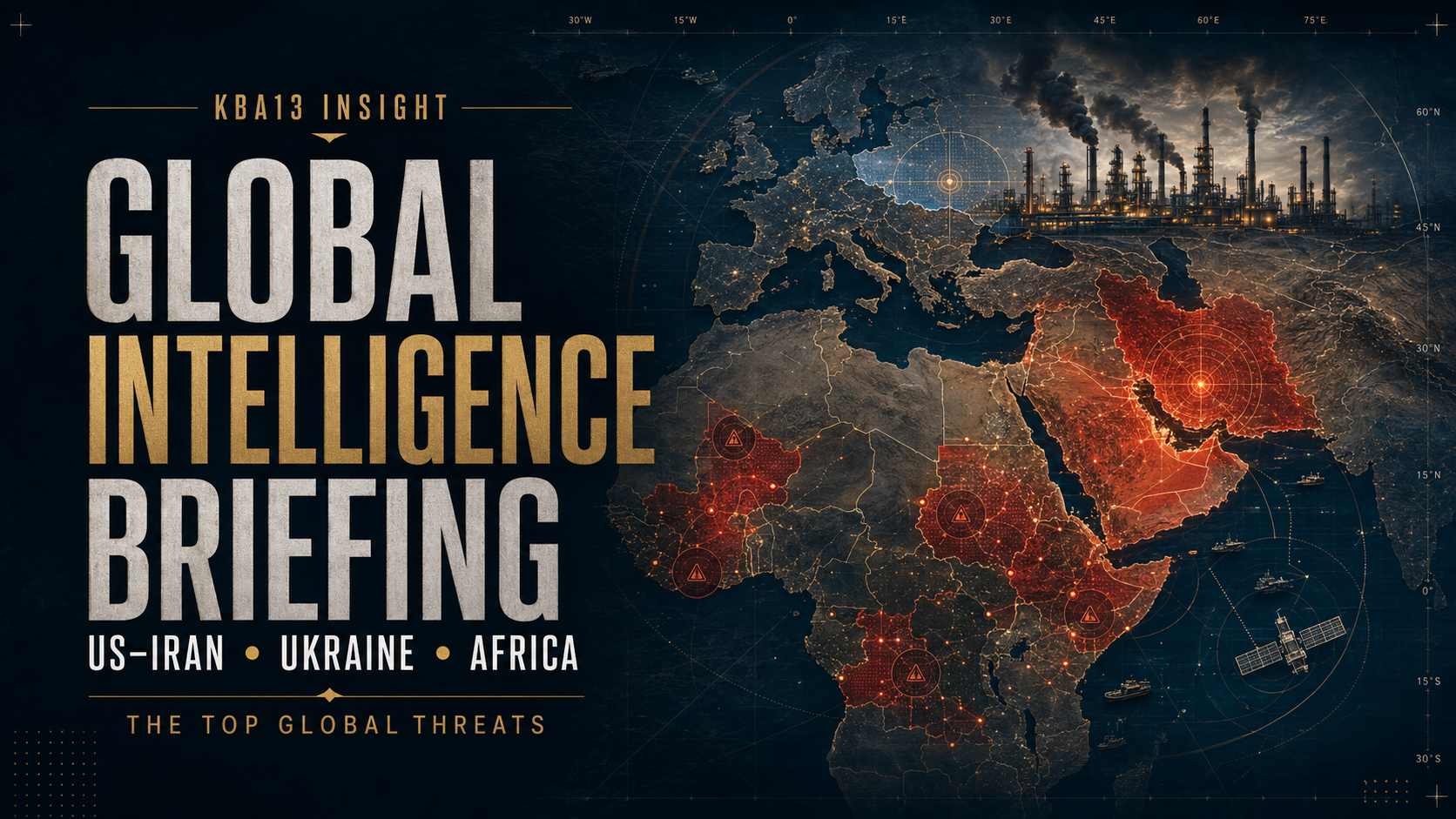
Global Intelligence Briefing :US–Iran Re-escalation, Ukraine’s Refinery War, Africa’s Security Collapse, and the Top Global Threats
This edition of the KBA13 Insight Global Intelligence Briefing examines the world’s most significant geopolitical developments during 19–26 July 2026: great power competition, active conflict zones from Ukraine to Yemen, the collapsing non-proliferation regime, AI-weaponised espionage, terrorism’s shift toward Africa, sanctions and economic warfare, Indo-Pacific security, the Sahel’s fragmenting…
Summary
This edition of the KBA13 Insight Global Intelligence Briefing examines the world’s most significant geopolitical developments during 19–26 July 2026: great power competition, active conflict zones from Ukraine to Yemen, the collapsing non-proliferation regime, AI-weaponised espionage, terrorism’s shift toward Africa, sanctions and economic warfare, Indo-Pacific security, the Sahel’s fragmenting security architecture, Latin America’s narco-state dynamics, and the analyst’s top three strategic threats to watch.
Keywords
- Africa Security
- AI Espionage
- Cyber Intelligence
- Economic Warfare
- geopolitical risk
- Global Intelligence Briefing
- global security
- Indo-Pacific Security
- information warfare
- Iran
01 GREAT POWER COMPETITION
The structural centre of gravity in world affairs has, for a second consecutive year, settled decisively into the Sino-American dyad, with Russia relegated to the role of a damaged but still consequential junior disruptor. The Soufan Center’s mid-2026 assessment observes that the weaknesses exposed in Russia’s military and defence-industrial base during the Ukraine war have entrenched this dyad as the primary arena of contest, even as Moscow retains sufficient reach to complicate Western planning in Europe and the Arctic. For a publication grounded in the Malay world, this bipolar concentration matters less for its symmetry than for what it does to smaller and middle powers: it compresses the space in which states such as Indonesia can claim genuine non-alignment, because both Washington and Beijing increasingly treat hedging itself as a strategic choice requiring a price.
Technological decoupling has moved from rhetoric to infrastructure. Both capitals are treating supply chains and export controls as instruments of statecraft rather than mere trade policy, and the bifurcation of the semiconductor ecosystem is crystallising into two increasingly incompatible technical standards. Beijing continues to compensate for restricted access to advanced lithography by accelerating integration of artificial intelligence across manufacturing, logistics, and military command structures. Washington, meanwhile, is shifting away from legacy multilateral frameworks toward purpose-built minilateral arrangements assembled around specific contingencies rather than standing alliances inherited from the Cold War.
China’s diplomatic strategy has acquired an unmistakably technological register. Beijing is positioning itself as a normative leader in artificial intelligence governance even as it wages a parallel campaign of chip smuggling circumvention and quantum-computing investment. This is a textbook demonstration of the instrumentalisation of normative language: multilateral rhetoric deployed not to bind the speaker but to constrain rivals. Indonesian and ASEAN policymakers should read Chinese AI-governance overtures with the same scepticism once reserved for Belt and Road financing terms.
Regional middle powers are recalibrating with unusual speed. Japan’s new Takaichi government has compressed its defence-spending timeline, aiming to reach two percent of GDP two years ahead of schedule. South Korea and Taiwan are following parallel trajectories of budgetary acceleration, and the Philippines has increased military expenditure for a third consecutive year. None of this constitutes an alliance in the classical sense; it constitutes an accumulation of latent capability whose purpose is to raise the cost of coercion without committing to open confrontation.
The war in Iran, still reverberating from operations earlier this year, has become an unplanned laboratory for great power signalling. Turkey’s limited but calculated posture illustrates how middle powers increasingly extract strategic value from crises they did not initiate and cannot fully control. Moscow has used its residual standing in Tehran and outreach to Gulf capitals to manage its own regional isolation, converting a war it did not choose into diplomatic capital.
The Human Rights Council and other multilateral bodies remain contested terrain. Membership is increasingly sought less for genuine normative commitment than for the immunity and procedural cover it confers upon states with poor records — a dynamic Beijing, Moscow, and a growing cohort of Gulf and African states have each exploited in turn, corroding the multilateral architecture great powers claim to defend.
For the Global South, the practical consequence of this competition is a permanent condition of triage: states must decide, issue by issue, which partner offers the least costly form of dependency. Indonesia’s posture on critical minerals, the South China Sea Code of Conduct, and its balancing between Chinese infrastructure capital and American security guarantees are not separate files but a single continuous negotiation conducted under the shadow of a rivalry Jakarta did not choose.
Analytical Verdict: Great power competition has entered a phase of structural entrenchment rather than open confrontation; the decisive contest is no longer over territory but over which power can convert technological and institutional leverage into durable dependency among the middle and small states of the Global South, Indonesia included.
02 ACTIVE CONFLICT ZONES
The Russo-Ukrainian war entered its fifth year without any credible pathway toward a negotiated freeze. President Putin used a meeting with his Kazakh counterpart to justify continued warfighting rather than a ceasefire, even as President Zelensky warned of forthcoming involuntary reserve mobilisation inside Russia and the impending arrival of roughly thirty thousand North Korean troops to reinforce depleted Russian ranks.
Ukrainian long-range strike capability has matured into a genuinely strategic instrument. Kyiv’s special operations forces confirmed a strike on the Tyumen oil refinery, over two thousand kilometres from the front line, alongside sustained attacks on Russian energy, logistics, and military infrastructure. This depth of reach signals that Ukraine has effectively erased the geographic sanctuary Russia once assumed its rear areas would retain.
Civilian cost continues to accumulate on both sides. A Russian ballistic missile strike on a Kyiv arms exhibition killed at least ten people and injured about a hundred. Neither side shows the political appetite to absorb the domestic cost of de-escalation.
The war’s regional spillover risk has become structurally embedded. Romanian airspace recorded its second drone incursion in as many days, intercepted by an F-16. Germany’s approval of a Russia-linked nuclear fuel venture has triggered warnings about embedded Kremlin influence within European critical infrastructure.
Beyond Europe, the Gaza-Lebanon-Yemen theatre remains simmering. Iran’s Axis of Resistance network, weakened after this year’s confrontation with Israel, is attempting reconstitution through renewed support to Hezbollah and the Houthi movement.
Pakistan’s Balochistan has re-emerged as an active low-intensity conflict, with Islamabad’s Operation Shaban reporting dozens of security personnel killed and a claimed tally exceeding eighty militants neutralised since early July.
West Africa’s Sahel theatre continues to demonstrate how state collapse generates its own momentum. JNIM’s fuel blockade of Bamako has been reinforced by coordinated attacks with Tuareg separatists across Bamako, Kati, Kidal, Gao, Mopti, and Sévaré, including the killing of Mali’s defence minister.
Analytical Verdict: None of the world’s active conflict zones show credible movement toward settlement; each is instead being managed by exhausted or overextended states through escalation-avoidance rather than resolution, concentrating rather than dissipating risk.
03 NUCLEAR AND WMD WATCH
The global non-proliferation regime is confronting its most serious credibility crisis since the NPT entered into force in 1970. Analysts now identify Iran as the state most likely to cross the weapons threshold, but interest in acquiring nuclear weapons has spread to Turkey, Poland, Saudi Arabia, South Korea, and in more qualified form Japan and Germany.
Iran’s own nuclear trajectory has bent sharply downward following military strikes in 2025 and 2026, producing a paradox: Tehran’s threshold strategy has left it exposed to preventive strikes, while North Korea’s decisive weaponisation has left Pyongyang comparatively insulated — a lesson likely to accelerate rather than restrain future proliferation.
North Korea tested its Hwasong-20 ICBM, expanded its Yongbyon complex, and is on schedule to complete new missile-production facilities within the year. The DPRK-Iran proliferation relationship continues to function as a bidirectional channel of missile and nuclear expertise.
China’s strategic forces posture is acquiring a theatrical dimension. A submarine-launched ballistic missile test from a South China Sea corridor sent the missile’s trajectory over Philippine territory, timed within days of Joint Sea-2026 and a new Australia-Fiji defence pact.
The expiration of New START without a credible successor framework compounds every regional risk. With NPT Review Conference expected to fail, the two states with the largest arsenals proceed without mutual inspection regimes, while AI-enabled command systems introduce new miscalculation risk.
Regional nuclear anxiety is migrating southward and eastward. A wave of Middle Eastern proliferation would likely accelerate Indo-Pacific proliferation anxieties, activating Sunni-Shi’ite, Indo-Pakistani, and Northeast Asian rivalries simultaneously.
For Southeast Asia, the risk is transmitted rather than originated — through sea lanes, missile test corridors crossing Philippine and Indonesian waters, and the erosion of the global normative order ASEAN states rely upon.
Analytical Verdict: The non-proliferation regime is failing through cumulative erosion, and the lesson increasingly drawn by regional powers — that completed weaponisation deters while ambiguity invites attack — is precisely the incentive structure most likely to produce new nuclear states within the coming decade.
04 INTELLIGENCE AND ESPIONAGE
Cyber-enabled espionage against Southeast Asian government and diplomatic targets has intensified. Kaspersky documented a malware family, GoSerpent, deployed since late 2025 against government and diplomatic entities across the region, with an evolved toolkit observed as recently as May 2026.
State-linked cyber intrusions have also targeted African government infrastructure, with Kenya confirming an investigation into an incident affecting the presidential website — part of a broader pattern of reconnaissance against head-of-state digital infrastructure across the Global South.
Human espionage prosecutions continue to surface across the former Soviet space. Russian courts have prosecuted individuals accused of passing information to Ukrainian intelligence, while Moldovan authorities pursued separate espionage-adjacent investigations touching parliament.
Western counterintelligence agencies have sustained a steady operational tempo against Chinese intelligence activity, with FBI disclosures continuing at roughly one release every week or two throughout the summer.
Nord Stream’s political afterlife continues to complicate the intelligence picture, with German prosecutors’ conclusion attributing the 2022 pipeline attacks to Ukrainian state authorities reopening questions about wartime covert action.
Declassification politics surrounding American intelligence institutions have entered a destabilising phase, with reports that an acting intelligence chief has been authorised to declassify records touching the 2020 election.
For Indonesia and the broader Malay world, classical and digital espionage now operate as a single integrated discipline. National intelligence services still organising doctrine around a cyber-versus-human distinction are structuring themselves against a threat that no longer respects that division.
Analytical Verdict: Espionage against Southeast Asian and African government targets has matured into a sustained, long-duration campaign model, and the region’s counterintelligence posture requires structural rather than incremental reform.
05 TERRORISM AND EXTREMISM
The geographic centre of global terrorism has continued its migration away from the Middle East toward Asia and Africa, driven by the exhaustion of Iran’s Axis of Resistance and eroding appetite for jihadist violence in a Middle East still absorbing the Gaza war’s aftermath.
Pakistan’s Balochistan crisis doubles as a terrorism case study: coordinated attacks claimed jointly by the Balochistan Liberation Army and Tehrik-i-Taliban Pakistan illustrate the porous boundary between ethno-nationalist insurgency and transnational jihadist affiliation.
Western Europe’s threat picture has diversified. The Winterthur railway station stabbing sits alongside an accelerating rise in far-right and far-left political violence, forcing security services to monitor two ideologically opposed but tactically convergent threat streams.
The Trump administration’s launch of a coordinated global campaign against “Radical Left terrorism” marks a significant doctrinal expansion of American counterterrorism apparatus beyond its traditional jihadist focus.
State-sponsored proxy terrorism retains its utility even amid battlefield weakness — the UK’s attribution of antisemitic arson attacks to an Iran-linked proxy network, followed by proscription of the IRGC, demonstrates continued reach despite Iran’s degraded conventional deterrent.
Sahel-based groups have achieved territorial control resembling proto-statehood. JNIM now operates across a theatre exceeding twelve hundred kilometres, imposing functioning blockades, taxation, and population control across contested Malian territory.
For Indonesia and Southeast Asia, ideological convergence between geographically disparate threat streams is accelerating faster than most national counterterrorism doctrines have been updated to reflect.
Analytical Verdict: Global terrorism is no longer usefully analysed through a single ideological lens; the operative threat picture for 2026 is one of parallel, mutually reinforcing radicalisation streams whose common denominator is the exploitation of state capacity gaps.
06 ECONOMIC WARFARE AND SANCTIONS
Washington’s renewed sanctions campaign against Iran targets weapons-procurement networks, oil-shipping operations, and financial facilitators sustaining regime elites. Months of parallel military and economic pressure have demonstrated Iran’s higher threshold for absorbing pain than anticipated.
The European Union expanded its sanctions architecture along two fronts: new designations against Russia’s ABS Electro group for drone electronic-warfare resistance, and strengthened sectoral sanctions against Sudan’s gold sector, the financial backbone of its civil war.
Washington’s legislative track has advanced in parallel, with Congress progressing Russia sanctions legislation that could impose tariffs of up to one hundred percent on major purchasers of Russian energy — signalling rising secondary-sanctions exposure for China, India, and Turkey.
Latin America’s criminal-economic exposure has become an explicit secondary-sanctions concern, with Brazil’s Primeiro Comando da Capital and Comando Vermelho embedded so thoroughly within legitimate supply chains that compliant businesses face material risk.
The EU’s proposed sanctions regime targeting migrant smuggling and organised crime represents a meaningful conceptual expansion of the sanctions instrument beyond its state-centric application.
UK enforcement data offers a rare quantitative window into sanctions evasion: fifty-eight seizures of sanctioned goods, a settlement exceeding one million pounds, and forty-four referrals within a single financial year.
For Indonesia and ASEAN economies, overlapping Iran, Russia, Sudan, and organised-crime sanctions regimes translate directly into rising compliance burdens on legitimate regional trade and shipping.
Analytical Verdict: Sanctions regimes are proliferating in scope faster than their evasion-prevention mechanisms are maturing, producing a paradox in which the instrument grows more elaborate even as its demonstrated coercive effect grows less certain.
07 INDO-PACIFIC SECURITY
The China-Russia Joint Sea-2026 naval exercise marks a further institutionalisation of Sino-Russian maritime interoperability, integrating anti-submarine warfare, air-defence coordination, and joint command-and-control architectures.
China’s calibrated SLBM test deserves separate emphasis: the choice of a South China Sea launch corridor over the less provocative Bohai Sea option sent the missile directly over Philippine territory — deliberate geographic provocation as standing deterrence doctrine.
Taiwan’s maritime security diplomacy has intensified, with President Lai emphasising transnational cooperation against gray-zone aggression and threats to undersea cable infrastructure that Southeast Asian digital economies, including Indonesia’s, depend upon.
US force posture continues its incremental reinforcement, with thirty-six F-15EX fighters permanently stationed at Kadena, while the restoration of “Pacific Command” over “Indo-Pacific Command” has generated anxiety in Taipei and New Delhi.
Japan’s defence trajectory under the Takaichi government represents the most consequential doctrinal shift among American allies this year, compressing its two-percent-of-GDP timeline while South Korea and Taiwan pursue parallel acceleration.
The Philippines-China standoff around Second Thomas Shoal remains the most persistent flashpoint short of open conflict, with Code of Conduct negotiations again missing their expected deadline.
Indonesia occupies an increasingly uncomfortable position at the centre of these converging pressures, with its Natuna waters, ASEAN chairmanship obligations, and BrahMos procurement reflecting a hedging strategy common among states unwilling to fully align with either power.
Analytical Verdict: Indo-Pacific security is characterised by accelerating, uncoordinated rearmament among American allies alongside theatrical Chinese signalling; the region’s most dangerous vulnerability is that overlapping gray-zone incidents could compound into a crisis none of the parties individually intend.
08 AFRICA AND THE SAHEL
Mali’s security collapse has progressed from insurgency to contested statehood, with JNIM’s coordinated attacks alongside Tuareg separatists across Bamako, Kati, Kidal, Gao, Mopti, and Sévaré killing several senior military officials including the Defence Minister.
Malian forces, reinforced by Russia’s Africa Corps, reasserted control over Ménaka and recaptured Anéfis after intense fighting, though competing casualty claims illustrate the familiar fog of low-intensity African conflicts.
Russia’s Africa Corps has consolidated its position as the indispensable external security guarantor for the Alliance of Sahel States, even as its operational record remains mixed and Moscow’s parallel diplomatic tour spans Ethiopia, Niger, Mozambique, and Burundi.
Authoritarian consolidation across Mali, Burkina Faso, and Niger has proceeded in lockstep with the deteriorating security picture, foreclosing the public dialogue that might otherwise generate policy correction.
Sudan’s civil war continues generating humanitarian consequences that outstrip its diplomatic visibility, with documented double-tap strikes against marketplaces and hospitals and newly strengthened EU sanctions on the gold sector financing the conflict.
Diplomatic efforts toward a Sudanese settlement retain a pulse, with the Democratic Bloc and Somoud coalitions aligning on a joint peace vision under a mechanism spanning the UN, AU, EU, Arab League, and IGAD.
The regional pattern connecting West Africa, the Sahel, and the Horn deserves structural framing: a single continental belt of instability connected by shared governance failure rather than any unifying ideology.
Analytical Verdict: The Sahel has crossed from contained jihadist insurgency into a belt of contested statehood extending toward the Horn of Africa, and the juntas’ prioritisation of political consolidation over security reform suggests further fragmentation rather than stabilisation.
09 LATIN AMERICA AND NARCO-STATE DYNAMICS
The judicial proceedings against Nicolás Maduro have advanced into a defined phase, with a trial start date of 1 June 2027 set for the ousted Venezuelan leader and his wife Cilia Flores on narco-terrorism and cocaine-importation charges.
The strategic significance lies in what the case confirms: the formal treatment of a sitting head of state as the operational leader of a designated narco-terrorist organisation, the Cartel de los Soles — a state substantially captured by the enterprise it hosted.
Washington’s Foreign Terrorist Organisation framework, extended to Tren de Aragua and the Sinaloa Cartel, reflects a doctrinal choice to treat transnational criminal organisations as terrorism actors, unlocking sanctions and military-response authorities.
Brazil’s criminal-economic landscape illustrates how deeply organised crime has penetrated licit commercial structures, with the PCC and Comando Vermelho embedded across sectors placing compliant businesses at secondary-sanctions risk.
Mexico’s fuel-theft and cartel-linked financial networks remain under sustained Treasury pressure, illustrating the granular, commodity-specific approach increasingly characteristic of American counter-narcotics strategy.
Colombia’s FARC linkage to the Maduro case deserves renewed attention, with allegations of multi-ton cocaine shipments, weapons supply, and militia training establishing one of the most extensively documented state-narco-insurgent triangles in the hemisphere.
For Southeast Asia, the narco-state pattern offers an instructive comparative frame: the fusion of state apparatus and transnational criminal logistics documented in Venezuela mirrors, structurally, the Golden Triangle networks transiting Indonesian and Malaysian ports.
Analytical Verdict: The Maduro prosecution’s fixed 2027 trial date closes one chapter of hemispheric narco-state confrontation while opening a longer one, as the precedent of prosecuting a head of state as a cartel leader will likely be invoked elsewhere, from the Sahel to Southeast Asia’s own narcotics geography.
10 TECHNOLOGY AND INFORMATION WARFARE
Artificial intelligence has completed its transition from a peripheral enabler of cyber operations to a central architecture of offence and defence, with authoritarian-controlled moderate-capability systems fuelling disinformation, espionage, and IP theft at unprecedented scale.
Russian information operations against the Ukraine war narrative demonstrate sophisticated cross-ideological targeting, with far-left and far-right commentators converging around false narratives predicting Ukrainian defeat through algorithm-assisted echo chambers.
The EU’s institutional response has hardened, sanctioning a US citizen for Russia-linked disinformation and ruling that RT sanctions extend even to circumventing streaming platforms.
NATO’s formal condemnation of sustained Russian cyber operations reflects growing acknowledgment that cyber operations against member infrastructure constitute a persistent campaign, now reportedly extending to AI data centres and energy grids.
American domestic counter-disinformation institutions are being dismantled at precisely the moment demand for them is rising, even as new FCC transparency rules for foreign-funded broadcast content take effect.
AI-enabled electoral interference has become a defined, monitored category rather than a speculative risk, with fake voter guides, autonomous hacking tooling, and digital-identity fraud recurring across the American electoral cycle.
Southeast Asia’s exposure compounds existing vulnerabilities, with lower digital-literacy baselines and diaspora communities frequently targeted by cross-border disinformation evolving faster than ASEAN regulatory frameworks can adapt.
Analytical Verdict: Information warfare has entered an AI-accelerated phase in which the decisive variable is the scale at which moderately capable systems can be deployed simultaneously, a shift Western counter-disinformation institutions are paradoxically dismantling rather than reinforcing.
11 ANALYST ASSESSMENT: TOP 3 STRATEGIC THREATS
Threat 1 — Nuclear Proliferation Cascade Risk. The lesson now internalised from Ankara to Seoul to Riyadh — that completed weaponisation deters while ambiguity invites preventive attack — points toward further proliferation, compounded by New START’s expiration and AI-enabled command systems.
Threat 2 — Sahelian State Fragmentation. JNIM’s administrative sophistication now exceeds what many recognised regional states can project, compounded by juntas’ consistent prioritisation of political survival over security-sector reform.
Threat 3 — AI-Accelerated Information Warfare. Authoritarian states integrate AI into offensive operations with fewer constraints than democracies applying AI to defence, an asymmetry widening rather than narrowing.
Analytical Verdict: All three threats share a common signature — cumulative structural erosion rather than sudden rupture — a pattern existing crisis-response institutions are poorly designed to detect until the erosion has already produced irreversible facts on the ground.
12 SIGNALS TO WATCH NEXT WEEK
Watch North Korean troop deployment scale to the Russian front; the EU’s AI Act Article 50 transparency guidelines taking effect 2 August; the ASEAN Manila summit and Code of Conduct process; Mali’s response to the Anéfis fighting; the Sudanese dialogue track; the Maduro trial’s pre-2027 developments; Chinese launch-corridor choices in future missile signalling; and confirmation of the reported American basing announcement in Southeast Asia.
Analytical Verdict: The coming week’s most consequential confirmable signals cluster around North Korean force generation, the stalling South China Sea Code of Conduct, and the fragile Sudanese and Malian diplomatic tracks — each a near-term test of whether gradual erosion continues to hold or approaches an inflection point.
This briefing continues the analytical line established in the previous Global Intelligence Briefing (14–18 July 2026) and the Southeast Asia Strategic Update (14–21 July 2026), both published on kba13.com.
How to Cite
Ahmad, Kamaruzzaman Bustamam. (2026). Global Intelligence Briefing : US–Iran Re-escalation, Ukraine’s Refinery War, Africa’s Security Collapse, and the Top Global Threats. Banda Aceh: KBA13 Insight.
https://www.kba13.com/global-intelligence-briefing-19-26-july-2026/
Professor of Anthropology of Religion at UIN Ar-Raniry Banda Aceh. He writes on geopolitics, Southeast Asian security and governance, Islam in the Malay world, and the future of knowledge.
About The Author

Artikel Terkait
 KBA13 Insight Update Internaional: Iran War, Trump-Xi Summit, Ukraine Ceasefire, Taiwan Risk, and the Collapse of Strategic Order
 Global Intelligence Briefing (7–12 July 2026): Iran War, US–China Rivalry, Ukraine, South China Sea, and Global Security Risks
 Inside the Shadow State: CIA, Mole Hunting, and the Hidden War Within Intelligence Systems
 Sovereign Shadows: The Architecture of Mossad’s Operation Inside Iran, from the Age of SAVAK to the Ruins of Natanz
 The Intelligence Civilization: How the KGB Shaped Putin’s Russia and the Modern Security State

Leave a Reply