
Bottom Line Up Front
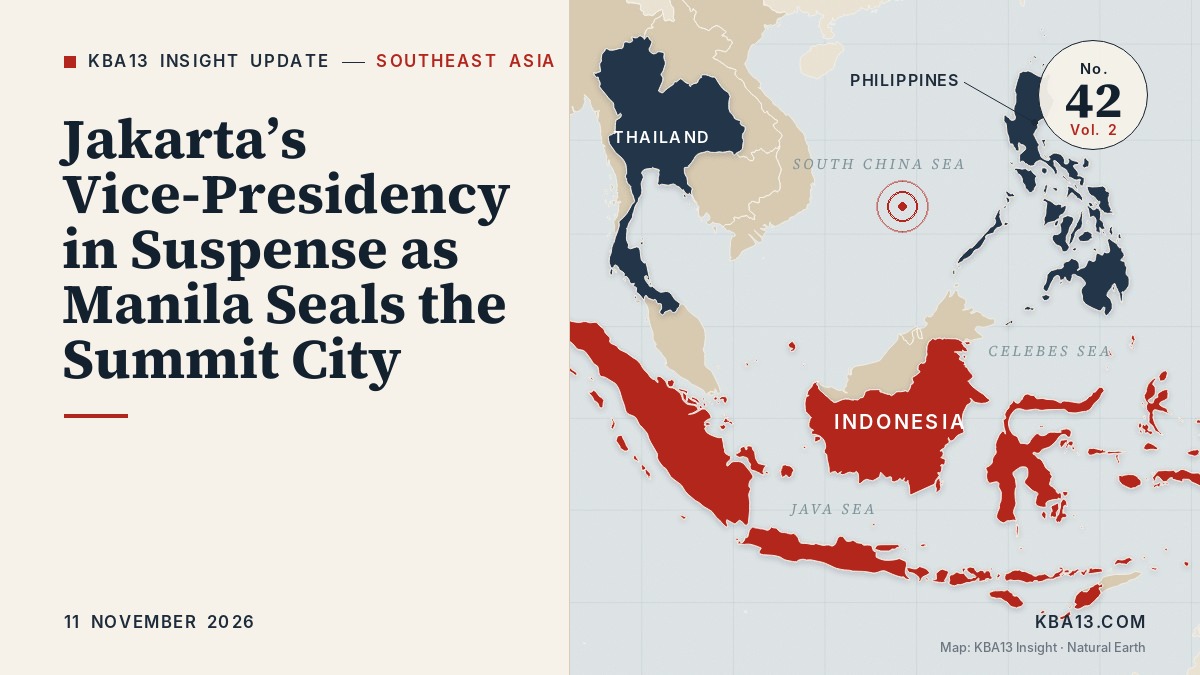
The defining event of the past 24 hours is that Indonesia’s vice-presidency has entered a state of suspense. On the morning of 10 November, Vice President Gibran Rakabuming Raka told President Prabowo Subianto during a meeting of about two and a half hours that he intended to resign “in light of the evolving dynamics” linked to rulings by the Constitutional Court and the Supreme Court on his school-equivalency certificate, as State Secretary Prasetyo Hadi confirmed (Tempo; The Jakarta Post). The palace denied that the president had rejected the offer, saying instead that he had offered advice, while Gibran asked for time to defend his documents before the Jakarta State Administrative Court. Hours later the two men walked side by side into the National Heroes Day ceremony at the State Palace (ANTARA). The result is a vice president who has publicly signalled his exit without formally leaving, at the very moment that dozens of lawmakers began signing a motion that could open the constitutional road to his removal. We judge with moderate confidence that this ambiguity is deliberate on both sides: it lets the president keep control of the timing while the parliament, rather than the palace, carries the political cost of any removal.
The second pattern is that two of the region’s long-running elite dramas reached decision points on the same day. In Kuala Lumpur, the High Court set aside the flawed discharge order of 6 November and ordered former prime minister Najib Razak to serve the rest of his SRC International sentence under house arrest at his Taman Duta residence until 23 August 2028 (The Sun). Within hours, Transport Minister Anthony Loke, secretary-general of the Democratic Action Party, resigned from the Cabinet with immediate effect, honouring a pledge he had made on 6 November (The Star). The constitutional clash between the palace and the Attorney General’s Chambers that dominated the previous update has therefore been closed by the court, but it has been replaced by a coalition wound inside Prime Minister Anwar Ibrahim’s government.
The third pattern is a host government in Manila that is sealing the capital and softening its voice five days before the 49th ASEAN Summit and Related Summits, which run at the Philippine International Convention Center from 15 to 18 November. Security forces began deploying around the venues, the United States Embassy warned of road closures from 9 to 20 November and of flight cancellations from 14 to 18 November (US Embassy Manila), and the palace said that finalising the South China Sea Code of Conduct is one of the president’s key goals (The Manila Times). At sea, the Armed Forces of the Philippines reported 29 Chinese vessels in the West Philippine Sea between 3 and 8 November but no new collision or water-cannon incident in the window. What intensified over the 24 hours was Indonesian political risk and street mobilisation; what eased was crude oil, which fell below US$92 a barrel on expectations of de-escalation in the Iran war; what is new is the vice-presidential resignation offer, Najib’s transfer home and the first ministerial casualty it has produced.
Indonesia: A Vice-Presidency in Suspense
The essential facts of Gibran’s position are now public, and they are less decisive than the headlines suggest. The Supreme Court ruled on 30 October that the certificate he submitted in place of a high school diploma when he ran in 2024 was invalid, and the Constitutional Court had earlier said it found no high-school-equivalent qualification among his overseas documents (The Jakarta Post; CNN Indonesia). On 10 November he told the president he intended to resign, but by his own account the president advised him to keep fighting in the State Administrative Court (Tempo). The Jakarta Post noted that it remained unclear whether a formal resignation had been submitted or accepted. Nikkei Asia framed the episode as a signal of the widening rift between Prabowo and Gibran’s father, former president Joko Widodo, a rift that has also run through the wiretapping affair (Nikkei Asia).
The constitutional mechanics matter more than the personalities. Golkar deputy chairman Ahmad Doli Kurnia pointed out that nothing in the 1945 Constitution requires the president to approve a vice president’s resignation; the matter falls under Article 8, which, when the vice-presidency falls vacant, requires the People’s Consultative Assembly to elect a replacement from two candidates proposed by the president (CNN Indonesia; Tempo). That provision gives Prabowo the decisive role in choosing a successor, which is the main reason the palace has no interest in rushing. In parallel, the House of Representatives opened its new sitting on 10 November with roughly 50 members from several factions reportedly signing a proposal for the right to state an opinion (hak menyatakan pendapat), the procedure that can lead to a Constitutional Court ruling on whether a vice president no longer meets the requirements of office (Investortrust). Speaker Puan Maharani said the proposal would be processed during the current sitting (Kompas), while Gerindra, the president’s party, said it had not yet taken a position and would hold internal meetings (CNN Indonesia). The motion needs 25 proposers to be tabled but approval at a plenary attended by at least two thirds of members to become the House’s position.
We read Gerindra’s hesitation as the key signal of the window (moderate confidence). If the president’s own party signs, the House route becomes a managed exit in which Gibran’s departure is presented as a constitutional outcome rather than a palace decision. If Gerindra continues to hold back while other factions push, the motion becomes a lever that Prabowo can use to set terms with Widodo’s camp. A further institutional detail strengthens the sense of preparation: Hidayat Nur Wahid resigned as deputy speaker of the People’s Consultative Assembly on 10 November and the Prosperous Justice Party named Mohamad Sohibul Iman to replace him (Tempo). Since the Assembly would elect any new vice president, changes to its leadership will be read in Jakarta for what they imply about the sequence ahead, although there is no public evidence that the two events are linked.
Heroes Day turned into a national day of dissent. Some 74 protests were among 83 public activities registered across Greater Jakarta on 10 November, with demands that included the dissolution of the state investment agency Danantara, an end to the deployment of military and police personnel in civilian roles, environmental accountability and free education (Latin Times). Demonstrators outside parliament carried banners demanding Gibran’s departure, and a lawmaker from the Prosperous Justice Party left the plenary carrying a sign that read “Mas Gibran Mundur atau Dimundurkan” (resign or be removed), as Kompas reported. Coordinating Minister Dudung Abdurachman had dismissed the planned rallies the day before as “just ordinary demonstrations”. In Jakarta the day passed without major disorder.
Yogyakarta did not. After student protesters dispersed from the Kilometre Zero area at around 7 p.m., a crowd of about 200 people whose affiliation remains unclear attacked the regional legislative council building on Malioboro Street, throwing firecrackers and stones and trying to pull down its fence; police responded with water cannon and tear gas and pushed the crowd north through the night (Tempo; Kompas). National Police Chief Suyudi Ario Seto personally inspected the handling of the unrest in the early hours of 11 November, and Kompas reported that hundreds of people had been detained (Kompas). This is the third night of violence at the same building in three weeks, after incidents on 20 and 28 October, and on each occasion the violence came from a separate group that arrived after the student rally had ended (Tempo). We assess with moderate confidence that the repeated pattern points to an organised group exploiting student mobilisation rather than to spontaneous escalation, but its sponsorship is not established in public reporting and we caution against attributing it.
The anti-corruption front added a second line of pressure on the political economy of the extractive sector. The Attorney General’s Office named PT Bumi Sentosa Jaya a corporate suspect in a nickel-governance corruption case in Southeast Sulawesi covering 2013 to 2025, identified the businessman Arif Kurniawan as its beneficial owner, and searched six company offices in Kendari, North Konawe and Central Buton (detik; Kompas). Prosecutors say the company’s licence expired in 2014 but mining continued until 2025, and Tempo reported earlier that Arif was believed to be abroad. Some Indonesian outlets have reported that prosecutors are examining alleged police protection for the business; we have not been able to confirm that claim and report it only as published. The case matters strategically because nickel is the core of Indonesia’s downstream industrial policy and of its relationship with Chinese processors, and enforcement on this scale signals a willingness to reorder the sector’s patronage networks.
Malaysia: House Arrest Executed, Coalition Bill Paid
The legal tangle that kept Najib in Kajang Prison after his RM50 million fine was paid has been resolved by the court rather than by the palace or the executive. On 10 November the Attorney General’s Chambers filed an application asking the High Court to review its 6 November discharge order and to issue a fresh order consistent with the King’s conditional pardon of 18 September (The Star). Judge Aslam Zainuddin then replaced the discharge order with one allowing Najib to serve the remainder of his six-year SRC International sentence under house arrest until 23 August 2028 (The Sun). The new order addresses the AGC’s concern that a simple discharge could have been read as completing the SRC sentence, with consequences for when Najib’s separate 15-year 1MDB sentence would begin. The palace’s demand that its decree be respected has been met, and the AGC has avoided the charge of defying the King.
The political price was paid by the Democratic Action Party. Anthony Loke said his resignation took effect immediately, in line with the position he had announced on 6 November, and thanked the prime minister for his trust since December 2022 (The Star; Malay Mail). The resignation is personal rather than a withdrawal of DAP from government, and other DAP figures have described it as Loke’s own decision. We judge it highly likely (high confidence) that DAP remains inside the coalition, because leaving would hand the initiative to UMNO and the opposition, but the episode reinforces the perception among Pakatan Harapan’s urban base that the anti-corruption agenda has been traded for coalition stability. The timing is awkward for Anwar: police reported 3,332 personnel on standby and 18 campaign-related cases ahead of the Melaka state election (The Star), where the Najib question will be a mobilising issue on both sides.
The window also brought a human tragedy that will feed debate on disaster warning. A sudden surge of river water, known locally as kepala air, swept away eight people at Sungai Pertak in Kuala Kubu Bharu, Selangor, on the afternoon of 9 November; by 10 November five bodies had been found and three people were still missing, with the search extended to the Sungai Selangor dam (The Star; Malay Mail). The victims were one Malaysian, one Yemeni, one Sri Lankan, one Nepalese and four Indian nationals. Flood evacuations in Selangor and Perak exceeded 1,000 people as the northeast monsoon set in.
Summit Eve in Manila and the South China Sea
The Philippines is turning Metro Manila into a security zone. The Philippine National Police said it would deploy nearly 20,000 personnel to secure venues, hotels, billeting areas and motorcade routes (Daily Tribune), the regional police office said it was maintaining heightened intelligence monitoring while stressing that there was no verified threat (PIA), and the armed forces began deploying personnel to provide close protection for visiting heads of delegation through the Presidential Security Command (Manila Bulletin). The palace defended its preparations against criticism over temporary billboards and the clearing of vendors, and appealed to progressive groups to reschedule planned rallies (Daily Tribune). We judge the risk of serious disorder during the summit as low, and the reputational risk from visible protest and complaints about the treatment of the urban poor as moderate (moderate confidence).
The guest list defines the summit’s strategic weight. United States President Donald Trump is due in Manila on 16 November before travelling to Shenzhen for the APEC leaders’ meeting (Mothership), and Chinese Premier Li Qiang is expected to lead China’s delegation rather than President Xi Jinping, in line with Beijing’s usual practice (The Manila Times; Rappler). The coincidence of the American and Chinese delegations, followed immediately by APEC in China, means that the chair’s statement on the South China Sea will be drafted with both capitals reading over Manila’s shoulder.
The palace said on 10 November that completing the Code of Conduct is one of the president’s key goals for the chairmanship, while Foreign Secretary Theresa Lazaro has insisted that the code must sit within the 1982 UN Convention on the Law of the Sea (The Manila Times). The gap between that legal standard and Beijing’s preferences, including its reported wish to restrict ASEAN exercises with outside powers, remains wide. We judge it unlikely (moderate confidence) that a legally binding text will be adopted in Manila; the realistic best case is an announcement that negotiations have concluded on a framework, with contentious provisions on scope and legal force deferred.
Domestic Philippine politics added a revealing exchange. Vice President Sara Duterte urged the government not to pick fights with China, asking how large the country’s own guns were, and the armed forces’ spokesperson for the West Philippine Sea, retired Rear Admiral Roy Vincent Trinidad, replied that the military agreed it was not fighting any country but would keep defending maritime entitlements under the 2016 arbitral award (BusinessMirror; The Manila Times). The military’s tone fits the discipline imposed by the foreign ministry on 8 November: firm on substance, soft on rhetoric.
At sea, the posture is watchful rather than kinetic. The armed forces said 29 Chinese vessels were monitored in the West Philippine Sea between 3 and 8 November, including one navy ship and nine coast guard vessels at Ayungin (Second Thomas) Shoal and three navy and five coast guard vessels at Bajo de Masinloc (Scarborough Shoal) (Abante). Trinidad also disclosed that the passage of the Liaoning carrier group through Philippine waters in October allowed the military to test its 360-degree maritime domain awareness for the first time, with near real-time tracking (The Chronicle). The disclosure is a deterrence message: it tells Beijing that Manila’s sensing network, reinforced by the Japanese radar and drone package signed on 9 November, now covers the archipelagic approaches. No collision, water-cannon or blockade incident was reported in the window.
Thailand, Myanmar and the Mainland
Thailand’s fuel protest has settled in for a long stay. Protesters led by the Krabi subdistrict headman Mano Khrueakaeo set up a stage in front of Government House, and their earlier notice to police declared a 30-day protest from 4 November to 7 December over fuel prices, narcotics and other grievances (Thai Enquirer; Thai Enquirer). Energy Minister Akanat Promphan pledged to bring fuel prices down as quickly as possible, promised further gradual reductions during the week and argued that there was no need to peg domestic prices to Singapore’s refined-product benchmark during the crisis (Nation Thailand). Prime Minister Anutin Charnvirakul has pointed to an excise cut of around nine baht on B20 diesel as an alternative to the across-the-board ten-baht cut demanded (Nation Thailand). We judge it likely (moderate confidence) that the government will keep conceding in small, targeted steps, which lowers the risk of escalation but keeps the protest alive as a platform for the opposition ahead of December’s censure debate.
Myanmar’s war produced competing claims of momentum. State media said on 10 November that the army had seized a key resistance command headquarters and ten other bases in jungle along the border between Mon State and Bago Region, a claim that could not be independently verified (Associated Press/The Washington Post). In the north, resistance forces captured three military outposts near the Sagaing-Kachin border amid airstrikes on villages around Maw Luu, and the National Unity Government said regime airstrikes on schools and homes in Kani and Taze townships killed 11 civilians, including young children, over the weekend (Myanmar Now). The pattern is consistent with the junta’s approach in recent months: concentrate ground forces to retake territory in the centre and south while using air power against communities in resistance-held areas. The International Court of Justice’s judgment in The Gambia v. Myanmar on 19 November, the day after the Manila summit closes, remains the decisive near-term diplomatic event.
On Thailand’s western border, Prime Minister Anutin said on 9 November that refugees from Myanmar would be admitted only if their lives were threatened (Khaosod English), a restrictive line that will be tested if the junta’s offensive along the Mon-Karen corridor pushes civilians toward Tak and Kanchanaburi.
Vietnam, Singapore, Cambodia and the Rest of the Region
Vietnam closed its leadership’s visit to Japan with a day of meetings in Tokyo on 10 November. General Secretary and President To Lam met former prime ministers Ishiba Shigeru, Kishida Fumio and Aso Taro (Government of Viet Nam), building on the Joint Vision Statement and the eleven cooperation agreements signed during the visit. Hanoi’s balancing was visible in the same window: the chairwoman of Russia’s Federation Council, Valentina Matvienko, begins an official visit to Vietnam from 11 to 13 November, and a third Vietnam–Russia marine scientific survey in Vietnamese waters is under way from 4 November to 12 December (VietnamPlus). Markets were buoyant, with the VN-Index rising 1.38 per cent to 1,737.96 on 10 November (The Sunday Guardian), while the prime minister had ordered eight central provinces to prepare for heavy rain, flash floods and landslides from 8 to 11 November (VietNamNet).
Singapore’s window was quiet in security terms and active in financial positioning. The city-state opened its national currency vault to foreign central banks for the storage of gold reserves, and health authorities said its blood bank systems were unaffected by a cyberattack in France, according to The Star’s regional digest (The Star). The gold-vault move is a small but telling signal: in a period of sanctions risk and geopolitical fragmentation, Singapore is offering itself as a neutral custodian for reserve assets. A heavy-rain warning produced a flash flood at West Coast Road on 10 November (AsiaOne).
Cambodia’s signals continued to centre on security and the cost of living. Prime Minister Hun Manet opened the first 2026 conscription training course on 9 November, telling 5,000 recruits beginning 24 months of service that discipline was essential to victory (Khmer Times), and the government said it had spent about US$600 million to curb fuel prices. Conscription, announced in 2025 amid the border conflict with Thailand, is becoming an instrument of nation-building as much as of defence. The monitor recorded low signal volumes for Laos (41), Brunei (31) and Timor-Leste (42) over the 24 hours, and none of them produced a development of regional significance in the window.
Markets, Energy and Disasters
Energy prices extended their decline. Brent crude briefly fell below US$90 a barrel and settled below US$92 on 10 November after President Trump said further extensive strikes on Iran would be unnecessary if Tehran signed a strong deal (Bloomberg). Brent has fallen by about 14 per cent over the past month but remains around 40 per cent higher than a year ago (Trading Economics). For Southeast Asian importers this eases subsidy budgets in Jakarta, Bangkok and Phnom Penh, but the relief reaches households slowly, which is why the Thai protest persists even as prices fall.
Indonesian markets read Gibran’s resignation offer as a reduction of political uncertainty rather than an increase. The Jakarta Composite Index rose 1.02 per cent to 5,125 and the rupiah strengthened by 23 points to Rp18,062 per US dollar on 10 November, with traders also citing the anticipated protests and weaker September retail sales (Tempo). The monitor’s latest exchange-rate readings per US dollar from ExchangeRate-API were: Indonesian rupiah 18,084 (−0.10 per cent on the previous day); Malaysian ringgit 4.059 (+0.01 per cent); Singapore dollar 1.280 (−0.26 per cent); Thai baht 33.48 (−0.25 per cent); Philippine peso 63.16 (+0.10 per cent); Vietnamese dong 25,528 (−0.33 per cent); Myanmar kyat 2,099 (unchanged); Cambodian riel 4,057 (−0.02 per cent); Lao kip 22,406 (+0.39 per cent); Brunei dollar 1.280 (−0.27 per cent); and Chinese yuan 6.687 (+0.10 per cent). The broad, modest strengthening of regional currencies against the dollar is consistent with the oil move.
The northeast monsoon is now the dominant hazard. In Aceh, the Pidie Jaya regency declared a 14-day emergency response from 4 to 17 November (Tempo), and after renewed flooding that began on the night of 8 November the regional disaster agency reported 32,272 people affected across 39 villages (ANTARA). South Aceh has declared a separate 14-day emergency for Trumon Tengah. For an area still recovering from the hydrometeorological disasters of 2025, repeated inundation raises the risk that recovery funds are diverted to emergency relief. Seismic activity remained concentrated in eastern Indonesia: the US Geological Survey recorded an M5.2 event 140 kilometres east-southeast of Labuha in North Maluku, an M5.0 event northeast of Fef in Southwest Papua, an M5.4 event in the Tanimbar Islands and an M4.7 event near Sukabumi in West Java, none of which caused reported damage. GDACS issued a green-level alert for a forest fire in Indonesia that ran from 6 to 8 November.
Forecast: The Next 24 Hours
The forecast window runs from 07:00 WIB on 11 November to 07:00 WIB on 12 November 2026. Probabilities express our judgement on the basis of the reporting cited above and should be read as estimates rather than predictions of certainty.
On Indonesia’s vice-presidency, we judge it unlikely (about 20 per cent) that Gibran will deliver a formal resignation letter to the People’s Consultative Assembly within the next 24 hours; the more likely course is that he remains in office while his lawyers prepare the State Administrative Court case and the palace lets the parliamentary process take shape. It is likely (about 60 per cent) that the proposal for the right to state an opinion will be formally submitted to the House leadership with signatures from at least four factions, and roughly even (about 45 per cent) that Gerindra will announce its position within the window. Any statement by Joko Widodo, or a meeting between him and Prabowo, would be the most important signal that a negotiated exit is under way; we put the probability of such a meeting becoming public in the window at about 25 per cent.
On Indonesian security, further demonstrations in Jakarta and university cities are almost certain, but a repeat of the Yogyakarta violence on the same scale within 24 hours is unlikely (about 25 per cent), because police are likely to saturate Malioboro and make examples of those detained. It is likely (about 65 per cent) that police will announce suspects or charges from the Yogyakarta unrest and claim that provocateurs were involved; whether they identify any organised sponsor is a different question, and we judge that unlikely in the window. Markets should remain orderly: we expect the rupiah to trade between 17,950 and 18,200 per US dollar (about 70 per cent), with renewed weakness only if the vice-presidential process turns into an open confrontation between the president’s and the former president’s camps.
In Malaysia, it is roughly even (about 40 per cent) that Anwar will name a new or acting transport minister within 24 hours, and highly likely (about 90 per cent) that DAP will reaffirm that it remains in the government. UMNO will celebrate Najib’s return home, and opposition figures will continue to demand further resignations; we expect these exchanges to sharpen campaigning in Melaka without threatening the coalition’s majority in the near term. The search for the three people still missing at Sungai Pertak will continue, with afternoon monsoon rain likely to interrupt operations.
In the Philippines, a physical confrontation between Chinese and Philippine vessels at Second Thomas Shoal or Scarborough Shoal in the window is unlikely (about 15 per cent), because both governments have an interest in a quiet run-up to the summit. It is likely (about 60 per cent) that further security announcements, road closures and protest-related statements will dominate Manila’s news, and roughly even (about 50 per cent) that Beijing’s foreign ministry will formally confirm Li Qiang’s attendance within 24 hours. Any Chinese statement criticising the Philippine chairmanship or the 2016 arbitral award would raise the temperature of the summit’s maritime session.
On the mainland, the Bangkok fuel protest will almost certainly continue (about 95 per cent), and it is likely (about 55 per cent) that the energy ministry will announce another targeted price reduction within the window as promised for the week. In Myanmar, further junta airstrikes on resistance-held areas are almost certain, and resistance forces are likely to dispute the army’s claims in the Mon-Bago border area. On energy, we judge it likely (about 70 per cent) that Brent will remain below US$95 a barrel, with the main upside risk coming from any breakdown in the Iran talks or new attacks on Gulf shipping. In Aceh and the wider northern Sumatran coast, further flooding is likely while monsoon rains persist, and the Pidie Jaya emergency is likely to be extended if rainfall continues beyond 17 November.
Indicators to Watch
In Jakarta, the signposts are whether Gerindra signs the House motion, whether the House leadership schedules a Consultative Body meeting to place it on the agenda, whether Gibran files his State Administrative Court case, and whether Widodo speaks publicly. A palace statement that the president has “received” a resignation letter would mark the transition from suspense to succession, and attention would then shift immediately to the two names Prabowo would send to the Assembly. On the street, watch whether Yogyakarta police identify the group behind the attacks and whether student alliances distance themselves from it; a fourth incident at the same building would point to a deliberate campaign.
In Kuala Lumpur, watch the appointment to the transport portfolio, the language DAP uses about its place in government, and any move by Najib’s lawyers on the 1MDB appeal. In Manila, the signposts are the formal confirmation of China’s delegation, any Chinese coast guard action in the run-up to 15 November, and the first leaks of the chair’s draft statement on the South China Sea and Myanmar. In Bangkok, watch for the size of the protest crowd over the coming days and for whether the opposition begins to share the stage. Across the region, crude prices remain the variable that most directly links Middle Eastern diplomacy to Southeast Asian politics.
Method and Sources
This update covers the 24 hours from 07:00 WIB on 10 November to 07:00 WIB on 11 November 2026 and provides a forecast for the following 24 hours. It draws on 2,395 signals collected over the window by the KBA13 ASEAN Intelligence Monitor, which recorded activity in all 11 member states, led by Indonesia (390 signals), Singapore (368), the Philippines (361) and Malaysia (304). Key facts were checked against the original publishers’ reporting, exchange rates are per US dollar from ExchangeRate-API, seismic data are from the US Geological Survey and disaster alerts from GDACS. Items that could not be independently confirmed are marked as reported. The previous edition, published on 10 November, set out the Manila summit preparations and Indonesia’s wiretap affair in greater detail (KBA13 Insight Update, 10 November).
About The Author

- Series · Seri
- KBA13 Insight Update, Southeast Asia Edition
- Volume · Number
- Vol. 2, No. 42 (November 2026)
- Cumulative issue · Edisi ke-
- 54
- Reference · Nomor rujukan
KBA13-IU-2026-02-042- Author · Penulis
- KBA13 Insight Research Team
- Published · Terbit
- 11 November 2026
- Section · Rubrik
- KBA13 Insight Update, KBA13 Insight Update Regional
- Keywords · Kata kunci
- ASEAN, energy security, Indonesia, Malaysia, Maritime Security, Philippines, Regional Security, South China Sea, Southeast Asia, Thailand
- Language · Bahasa
- English
- Length · Panjang
- 4,399 words · ±20 min read
- Publisher · Penerbit
- KBA13 Insight, Banda Aceh, Indonesia
- Permalink
- www.kba13.com/kba13-insight-update-2026-11-11-southeast-asia/
- How to cite · Cara mengutip
- KBA13 Insight Research Team. (2026, November 11). KBA13 Insight Update, 11 November 2026, Southeast Asia: Jakarta’s Vice-Presidency in Suspense as Manila Seals the Summit City. KBA13 Insight Update, 2(42). https://www.kba13.com/kba13-insight-update-2026-11-11-southeast-asia/
- Rights · Hak cipta
- © 2026 KBA13 Insight. Quotation permitted with full attribution and link.
Artikel Terkait
 KBA13 Insight Update, 10 November 2026: Manila Lowers Its Voice and Raises Its Guard on the Eve of the ASEAN Summit
 Southeast Asia Strategic Outlook 2026: ASEAN, Indonesia, Myanmar, and South China Sea Tensions
 Southeast Asia Strategic Intelligence Update July 2026: Indonesia, Myanmar, South China Sea, and ASEAN Under Pressure
 KBA13 Insight Regional Update: Southeast Asia Under Pressure (Hormuz Shock, ASEAN Crisis, Myanmar, Indonesia, and the South China Sea in 2026)
 Southeast Asia Intelligence Brief: ASEAN, Myanmar & South China Sea
Leave a Reply