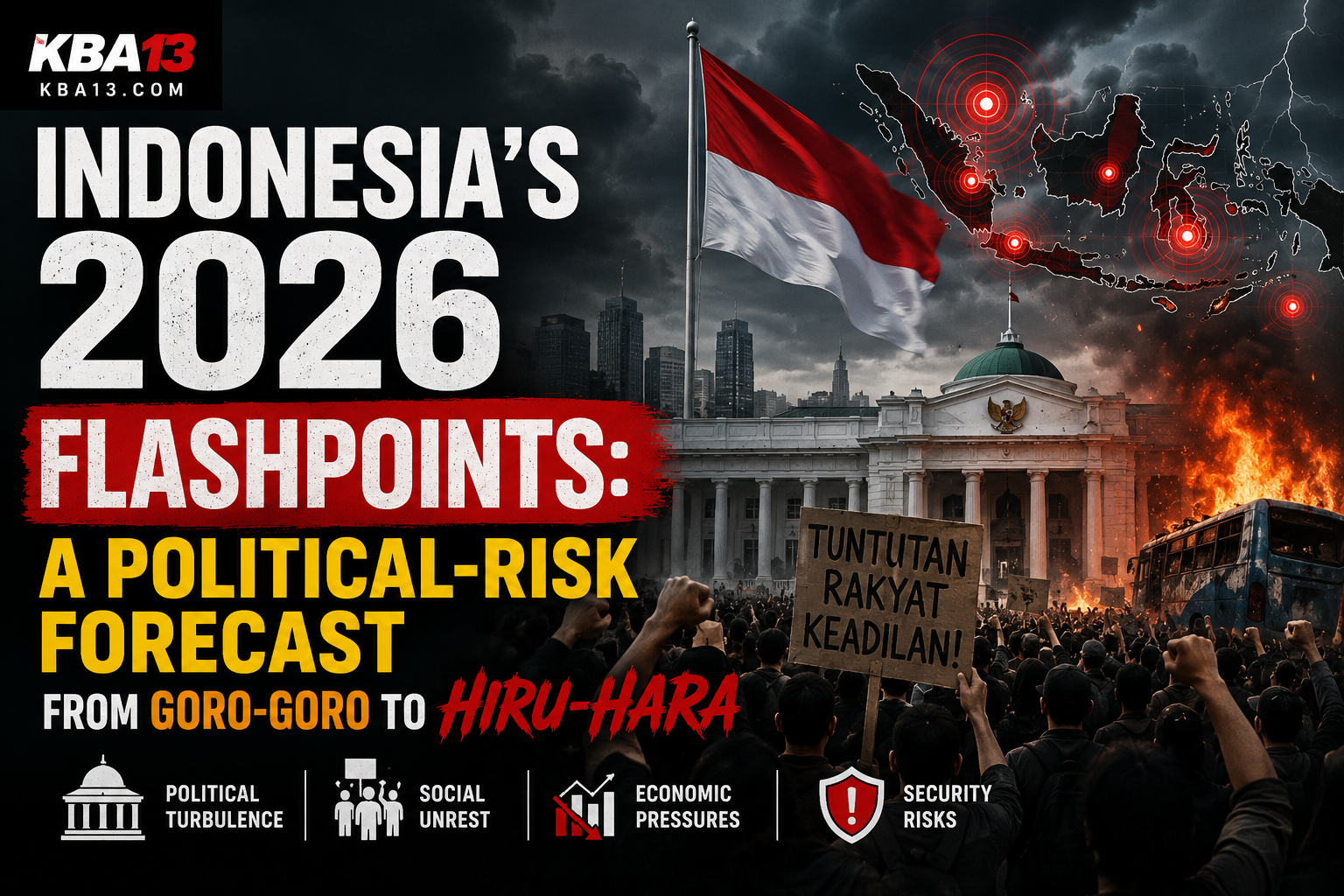
This analysis and projection is a continuation of the “layered calendar” framework developed in earlier work. It is an analytical prediction—not an official government warning, and not a deterministic prophecy. Its purpose is singular: to map the points of vulnerability so that the public and policymakers possess a roadmap rather than mere anxiety.
The Standby Calendar as Methodology: Reading Time, Not Merely Events
Every nation carries its own rhythm of time. In Indonesia, political time does not move in a straight line but revolves in layered cycles: a civil calendar dense with symbolic momentum, an economic calendar that marks the pressure points of fiscal strain, and a legitimacy calendar that measures how far public trust in power has eroded. The national standby calendar proposed here is not a superstitious almanac but an analytical instrument for reading when these layers stack upon a single point in time.
Its basic premise is simple yet frequently overlooked: great crises rarely arise from a single cause. They are the product of confluence—the meeting of several pressures, each perhaps manageable on its own, that becomes explosive when they occur simultaneously. A fuel price increase in a quiet month may generate only grumbling. That same increase, in a month heavy with symbolic weight, amid a weakening currency and fracturing elite legitimacy, can become the spark that ignites a fire.
For this reason, the standby calendar methodology does not ask “whether a crisis will occur,” but “when the layers of pressure will converge, and how prepared the system is to absorb them.” This question is more honest because it acknowledges that some pressures are already present today—not as a future threat, but as a documented, ongoing reality.
The strength of the layered approach lies in its capacity to distinguish signal from noise. In a torrent of information, it is easy to be captured by dramatic events that go viral for a moment yet carry no structural force. The standby calendar compels the analyst to ask: does this event stand alone, or is it a node in a larger network of pressure? Only the latter deserves to have its status elevated to standby.
This approach also demands epistemic humility. A responsible analyst does not claim to know the future; he claims only the ability to map probabilities based on observable patterns. The standby calendar is not a crystal ball—it is a weather map. It can say that pressure is rising and a storm may be forming, but it cannot pinpoint the exact place and hour of the first bolt of lightning.
What separates the standby calendar from alarmism is the discipline of its verification. Every indicator whose status is raised must be traceable to documented data: exchange-rate figures, the number of layoffs, recorded official statements, openly announced schedules of action. Without this discipline, the standby calendar degenerates into speculation—and speculation dressed as analysis is far more dangerous than anxiety that honestly admits its own ignorance.
It is within this framework that the entire article is arranged. It moves from the most verified toward the most projective, from the layers already active today toward the scenarios that may yet form. Each chapter is one layer of the calendar, and the reader is invited to see how these layers interlock—forming a coherent map of vulnerability rather than fragmented, disconnected news items.
Reading the national standby calendar, then, is not an exercise in fortune-telling but an exercise in measured vigilance. It invites us to regard time as terrain with texture—there are flat months, and there are steep ones. The analyst’s task is to mark that steepness far in advance, so that the nation has the chance to slow its pace before it slips.
From Goro-Goro to Huru-Hara: The Anatomy of a Transition
In the tradition of shadow-puppet theatre, the Goro-Goro is the act in which cosmic order is shaken: the sky dims, the earth trembles, and the punakawan clowns appear to voice the unease of the common people. It is a phase of intense tension, full of turbulence, yet it does not yet mean the collapse of order. Goro-Goro is a warning—not the disaster itself. It signals that something fundamental is wavering and demands attention.
Huru-Hara is something qualitatively different. It is not merely an intensification of Goro-Goro but a leap into physical dislocation: when unease that was once symbolic and verbal turns into clashes in the streets, when the state’s capacity to manage conflict is exceeded, and when the chain of cause and effect moves faster than anyone’s ability to halt it. Huru-Hara is rupture—a fracturing of the system, not merely a crack in it.
This distinction is not a game of words. It determines the entire way we read the situation. To call the present condition “huru-hara” when it is in fact still “goro-goro” is an error that triggers baseless panic. Conversely, to deny that goro-goro is underway—on the pretext that “there has been no major rioting anyway”—is an error that actually accelerates the transition toward huru-hara, because it delays the response that should be taken while there is still time.
What determines whether Goro-Goro will transition into Huru-Hara is the presence of a catalyst. The catalyst is not the cause—the structural causes were already there long before. The catalyst is the emotional trigger that transforms diffuse unease into focused anger. In history, the catalyst has often been a single event that symbolically condenses all the grievances long held in silence: a death that goes viral, an insult deemed intolerable, a policy that touches the very nerve of the people’s subsistence.
The transition mechanism works in hours, not months. When a catalyst appears, it spreads through digital networks at a speed that conventional apparatus cannot manage. An event in one city can spark simultaneous solidarity in dozens of others before the government has had time to construct a counter-narrative. This is precisely why the window for preventing huru-hara lies before the catalyst emerges—not after it.
The elite’s response is the second distinguishing variable. In Goro-Goro, the elite still has room to make de-escalating concessions: replacing an official who has become a symbol of anger, withdrawing a policy that provokes unease, or opening a sincere dialogue. In Huru-Hara, that room narrows drastically because the anger has moved beyond specific issues and turned into a rejection of the legitimacy of power itself. Concessions that arrive too late are read as weakness, not wisdom.
For this reason, reading Indonesia’s position on the Goro-Goro–Huru-Hara spectrum is a decisive diagnostic exercise. Based on the indicators discussed in the following chapters, this author argues that Indonesia has today entered the Goro-Goro phase analytically—the pressure is real, the unease is articulated, and the warning signals are lit. What has not yet occurred is the catalyst that triggers the transition. And it is precisely at this point that there is room for intervention.
Recognizing that we stand in the Goro-Goro phase, not Huru-Hara, should be a source of both relief and urgency. Relief, because the rupture has not occurred and the window for de-escalation remains open. Urgency, because that window will not stay open forever. Every mistaken policy, every denial, every elite arrogance narrows the distance between where we are now and where we least want to be. The standby calendar is an invitation to act while the word “not yet” still holds.
The Economic Layer: When Numbers Become Collective Trauma
The economic layer is the most objective foundation in the standby calendar because it can be measured, tracked, and compared across time. Yet the strength of this layer lies not merely in its figures but in the psychological meaning attached to them. An exchange rate is not only a monetary statistic—it is a symbol that, at a certain threshold, awakens collective memory of past crises and transforms individual fear into shared anxiety.
A weakening rupiah that breaks through new psychological thresholds works in exactly this way. When the currency reaches a level never recorded before, its impact extends beyond purchasing power. It revives the historical parallel with the 1998 monetary crisis, a trauma embedded in the memory of one generation and passed down as a story to the next. The number becomes a narrative anchor: no longer simply “prices are rising,” but “are we repeating history?”
Comparison with 1998 must be made with analytical caution. There are significant structural differences: a thicker cushion of foreign reserves, a reformed banking system, and a floating exchange-rate regime distinct from that of the New Order era. To equate these two situations outright is an error. Yet to ignore its psychological dimension is the opposite error—because in social dynamics, perception often matters more than fundamental reality.
The next layer is the wave of layoffs. When the number of terminations spikes sharply within a matter of months, it is not merely labor data—it is a map of the spread of economic anxiety into households. Each figure represents a family that has lost income, an installment under threat, and a future suddenly blurred. It is this accumulation of uncertainty that turns economic unease into social fuel.
Cost-push inflation completes the picture. When fuel prices rise, the effect does not stop at the petrol pump. It ripples into transport costs, food prices, and the production costs of nearly every essential good. For the urban lower-middle class, this transmission of inflation is felt instantly and strikes directly at the nerve of subsistence. And as classic studies of popular resistance teach, a threat to subsistence is among the most powerful triggers for mobilization—because it is no longer a matter of political morality but a matter of survival.
What is most relevant for the standby calendar is not the absolute poverty figure but the rate of change and the direction of perception. A society can tolerate stable poverty far better than rapid decline. When people feel that conditions are worsening—and worsening at a speed they cannot control—collective patience thins. Disappointed hope is more explosive than long-accepted suffering.
Within the layered framework, economic pressure operates on the civil calendar layer and interacts with the legitimacy layer. A worsening economy alone does not automatically produce hurly-burly—Indonesia has passed through many difficult periods without collapse. What is dangerous is when economic decline meets the public conviction that their suffering is caused by the indifference or incompetence of those in power. At that point, the number turns into an accusation.
Therefore, the economic layer must be read not as a list of statistics but as a barometer of collective emotion. Every psychological threshold that is crossed—the exchange rate, food prices, the unemployment rate—is a rise of one degree on the standby thermometer. The task of policy is not only to repair the numbers but to restore the conviction that a capable hand is at the helm. Without that conviction, even improved figures will arrive too late to ease the anxiety.
The Legitimacy Layer: When the Center Loses Its Radiance
In the tradition of Javanese political thought analyzed by a number of scholars, power is imagined not as a contract but as radiance. A legitimate leader is a center that radiates authority to every corner, and the people’s obedience flows not from coercion but from recognition of the center’s legitimacy. When the radiance weakens, what occurs is not an instant rebellion but something subtler and more dangerous: the quiet erosion of recognition.
The legitimacy deficit, within this framework, is not primarily a matter of mistaken policy. A government can make many technical errors and still endure so long as the center is still acknowledged as legitimate. What is deadly is when those errors accumulate into the conviction that the center has lost its right to rule—that it holds power through the instruments of coercion, not through recognition. At that point, obedience changes form into what might be called “cold compliance.”
Cold compliance is the condition in which the people still obey the rules, pay their taxes, and carry out their routines—but without inner conviction in the legitimacy of those who rule. On the surface, everything appears stable. Yet this stability is fragile because it is rooted not in legitimacy but in inertia and fear. Compliance of this kind can suddenly collapse the moment fear diminishes or a catalyst appears that grants social permission to resist.
The distinction between domination and hegemony becomes crucial here. A hegemonic power rules through consent—the people accept the order as natural and just. A merely dominant power rules through coercion—the people submit because they have no choice. When a regime slips from hegemony toward mere domination, it may still appear strong, but it has in fact entered a zone of vulnerability, because coercion is far more expensive and far more fragile than consent.
The most serious signal of a weakening of the center’s radiance comes not from the streets but from within the circle of power itself. When figures who have long been part of the establishment—senior retired officers, respected statesmen, loyal party cadres—begin to voice open criticism, it is a sign that the crack has reached the heart of the system. Popular protest can be suppressed; a fracture within the elite cannot.
This is what makes the legitimacy layer so decisive in the standby calendar. A bad economy can be repaired with policy; security can be maintained with apparatus. But eroded legitimacy cannot be restored through the instruments of power alone—it demands something far more difficult: the humility to admit error, the courage to correct course, and the sincerity to listen. These qualities are precisely rare when they are most needed.
Epistemic overconfidence—the ruler’s excessive belief that they understand the people’s will better than the people themselves—accelerates the legitimacy deficit. When the elite reads cold compliance as genuine support, they misinterpret the people’s silence as consent. This misreading emboldens them to pursue policies that drift further from the public will, which in turn further erodes legitimacy. A self-reinforcing loop.
Thus, to read the legitimacy layer is to attend not to how loud the voice of opposition is, but to how cold the silence of the majority has become. Anger that speaks can still be brought into dialogue; cold compliance that goes mute is a reservoir waiting for a catalyst. What is most alarming for stability is not the presence of a group that opposes, but the shrinking of the group that genuinely believes. When the reservoir of conviction runs dry, the system loses the cushion that has long absorbed its shocks.
Mapping the Ranks of the Aggrieved: A Coalition in Formation
Every great crisis is preceded by the formation of a coalition—the joining of groups that, under normal circumstances, hold differing and even conflicting interests, but are united by one thing: the sense of being wronged by the same power. The ranks of the aggrieved are not a single organization with centralized command, but a loose network that, at a certain moment, can move as though coordinated. Mapping these ranks is an essential part of the standby calendar.
The first layer of this map consists of actors who have already moved openly and are documented. They are the groups that have issued formal statements, drawn up demands, or staged actions. Their presence matters not because of the individual strength of each, but because they supply legitimacy and infrastructure for broader mobilization. When a respected figure speaks out, they grant social permission for others to follow.
The second layer consists of actors who maintain an ambiguous position—not yet formally in opposition, but no longer sincerely supportive. This group is the most decisive, because its movement becomes the marker of transition. So long as they remain in the position of “balancer,” the system still has a cushion. The moment they step out of ambiguity and choose a side, the balance shifts sharply. They are the most sensitive barometer in the standby calendar.
The third layer consists of latent groups: those not formally organized but possessing a large capacity for mobilization should a catalyst appear. This includes identity-based networks, religious communities, labour unions, and student groups. In calm times, they appear passive. Yet history shows that it is these latent groups that often become the greatest driving force once unease reaches its boiling point.
What is analytically most significant about this map is not the individual size of each group but the potential for their convergence. A labour union demonstrating over wages, a cluster of students demanding reform, a religious community that feels marginalized, and retired officers uneasy about the direction of leadership—each alone can be managed. But when they find a common enemy and a common momentum, their numbers multiply in effect.
The history of social movements teaches that this convergence is rarely planned from the outset. It forms organically when a symbolic event supplies a shared frame that unites grievances once separate. A death, a scandal, an insult—events of this kind function as a “focal point” that aligns energies long scattered. This is why the catalyst is so decisive: it not only triggers but also unites.
Yet the standby calendar also demands honesty about limits. Not every rank of the aggrieved moves, and not every coalition that is theoretically possible actually forms. Many groups have reasons for mutual suspicion, historical rivalries, or interests that do not fully align. This fragmentation often becomes the safety valve that prevents escalation. A responsible analyst must not overstate a solidarity that has yet to be tested.
Therefore, reading the ranks of the aggrieved is not a matter of counting the number of dissatisfied groups, but of assessing the probability of their convergence. The key questions are: is there a shared frame strong enough to overcome the differences among them? Is there a calendar momentum that brings their agendas together? And is there a catalyst that might grant them a focal point? When all three answers lean toward “yes,” the standby status must be raised—not because a crisis is certain, but because the fuel has gathered and awaits only a spark.
The Tiered Warning System: Yellow, Orange, and Red
Responsible analysis does not stop at describing risk—it provides measurable indicators that allow anyone to monitor developments independently. For this reason, the national standby calendar adopts a three-color tiered warning system: Yellow for goro-goro conditions already underway, Orange for an intensification that brings huru-hara within reach, and Red for triggers that, should they occur, make huru-hara nearly certain. This system borrows the logic of disaster preparedness and applies it to socio-political risk.
The Yellow category marks indicators that, by this author’s reading, have largely been met. These include exchange-rate pressure breaking through psychological thresholds, a documented wave of layoffs, fuel-price increases that trigger cost-push inflation, and the emergence of critical statements from within the elite. When these indicators light up simultaneously, they signal that the goro-goro phase is no longer a future threat but an ongoing reality.
| Yellow Indicator | Analytical Meaning |
|---|---|
| Exchange rate breaks its record low | Revives the 1998-crisis narrative anchor in public consciousness |
| A sharp spike in layoffs | Economic anxiety spreads into households; social fuel accumulates |
| Fuel-price increases | Cost-push inflation strikes the subsistence of the urban lower-middle class |
| Critical statements from the elite | The crack reaches the heart of the system; a sign of weakening central radiance |
| Planned actions announced openly | Mobilization infrastructure is already active and scheduled |
The Orange category marks indicators that have not yet occurred but are within reach—conditions that, if they appear, would intensify goro-goro and narrow the distance toward huru-hara. These include simultaneous, coordinated multi-city actions, students joining the labour movement, the physical presence of senior figures on opposition platforms, and the movement of actors who have thus far maintained an ambiguous position. Each Orange indicator that lights up is a rise of one degree on the standby thermometer.
| Orange Indicator | What It Means If It Occurs |
|---|---|
| Simultaneous actions across many cities | The nervous system of demonstration is active; hard to quell from a single point |
| Students join the labour movement | Replication of the escalation pattern: one group opens the way, another takes over |
| Senior figures appear physically on opposition platforms | Elite legitimacy is opened up to mass mobilization |
| Ambiguous actors leave the balancer position | The balance shifts sharply; the system’s cushion thins |
The Red category marks critical triggers that, if they occur, make the transition to huru-hara nearly unavoidable. The most dangerous among them is a viral emotional catalyst—a single event that condenses all unease into focused anger. Other Red indicators include the physical presence of retired officers in the field, a sudden surge in food prices that threatens subsistence, and, most decisive of all: the fracturing of the solidity of the security apparatus’s chain of command.
| Red Indicator | Escalation Mechanism |
|---|---|
| A viral emotional catalyst | Spreads within hours to dozens of cities before a counter-narrative is built |
| Retired officers appear physically in the field | The elite fracture becomes undeniable; the apparatus enters an institutional dilemma |
| A sudden surge in food prices | Resistance shifts from a moral issue to a matter of survival |
| The apparatus chain of command is not solid | The strongest signal; it marks the loss of the system’s final instrument of control |
What must be emphasized about this tiered system is that it is cumulative, not alternative. The Red category does not replace Yellow—it stacks upon it. The more layers that light up simultaneously, the higher the standby status. A Red indicator standing alone amid a quiet Yellow layer carries a different meaning from a Red indicator that appears when the entire Yellow and Orange layers are already lit. Context is everything.
This system is also designed for two-way honesty. It not only raises the status when pressure rises but also lowers it when pressure eases. If the government makes substantial concessions, if a figure who symbolizes anger is replaced, if a policy that provokes unease is withdrawn—then the indicators can dim again, and the standby status can be lowered. The standby calendar is not a verdict; it is an instrument responsive to action.
In this way, the tiered warning system functions as a bridge between analysis and action. It translates a complex reading into a language that can be monitored and acted upon. For policymakers, it offers a checklist to identify where intervention is most urgent. For the public, it offers a framework to understand the situation without being swept into either panic or denial. And for analysts, it offers the discipline to stay honest to the data.
Three Scenarios and the Window of Transformation: Reading a Future Not Yet Determined
Responsible projection does not determine what will certainly happen—it maps the possibilities together with the conditions that usher each in. Based on a reading of all the layers discussed above, this author offers three scenarios for the vulnerable points ahead. All three are not forecasts but branches of a road, chosen or avoided by decisions taken from now on.
The first scenario is de-escalation. In this scenario, the government makes substantial concessions before pressure reaches its peak: replacing an official who has become a symbol of anger, revising a policy that provokes unease, and opening sincere dialogue with critical groups. Large actions still occur, but they do not erupt into violence. Legitimacy is eroded yet endures. The nation passes the vulnerable point with wounds, but without rupture. This author estimates its probability as moderate—because it demands a rare kind of elite courage.
The second scenario is controlled huru-hara. In this scenario, an emotional catalyst appears and triggers rioting in a number of cities, but the state manages—through a mixture of coercion and belated concession—to prevent it from becoming total collapse. Economic losses are significant, casualties fall, and the government’s legitimacy is severely damaged, yet the system formally endures. This author estimates this scenario carries the highest probability, not because it is the most desirable, but because it is most consistent with the observed pattern of pressure.
The third scenario is uncontrolled huru-hara. In this scenario, several Red indicators light up at once: a viral catalyst appears, ambiguous actors leave the balancer position, retired officers take to the field, and, most decisive of all, the apparatus’s solidity fractures. When this happens, the government loses control of the narrative and possibly of the institutions. Although its probability is lower, its risk asymmetry is extraordinary—because its consequences are systemic and difficult to reverse.
| Scenario | Triggering Conditions | Projection |
|---|---|---|
| A — De-Escalation | Substantial concessions granted in time | Large actions occur but do not erupt; legitimacy eroded yet endures |
| B — Controlled Huru-Hara | Viral catalyst + a mixed coercion-concession response | Rioting in a number of cities; significant losses; system endures with severe wounds |
| C — Uncontrolled Huru-Hara | Several Red indicators light up at once | Loss of narrative and institutional control; systemic consequences |
What is important to understand about these three scenarios is that they are not destiny. A future not yet determined is a future that can still be shaped. Every determining variable—the presence or absence of a catalyst, the solidity of the apparatus, the position of ambiguous actors, the quality of the government’s response—is a point of decision, not a point of fate. The standby calendar does not close the future; it opens it precisely by showing where human influence matters most.
History teaches that crisis does not always end in collapse. Sometimes it becomes a window of transformation—a moment when a nation is forced to confront the structural problems it has long postponed, and from that confrontation a healthier order is born. Yet such transformation is not automatic. It demands leadership capable of reading crisis as an invitation to change, not merely a threat to be extinguished with force.
What is needed to pass through the vulnerable points without permanent trauma is not the addition of instruments of coercion, but the restoration of legitimacy. And legitimacy can only be restored through the things most difficult for power: the humility to admit error, the courage to correct course, and the sincerity to listen to those who have long felt unheard. The window to do this remains open—though it grows ever narrower.
This analysis, then, closes not with a prophecy of destruction but with a reminder. The national standby calendar is not a prophecy to be fulfilled, but a map that can be used to choose a different road. The vulnerable points charted here have not yet occurred—and precisely because they have not yet occurred, they can still be prevented. Our shared task, both those who rule and those who are ruled, is to ensure that this warning is read as an invitation to slow our pace, not as a scenario we allow to become reality.
Related analysis: political-risk forecast for Indonesia in 2026.
About The Author

Rekomendasi Bacaan KBA13 INSIGHT
Jika tulisan ini bermanfaat, dukung jurnal ini dengan mencari bukunya melalui tautan berikut:
- Buku-buku Kamaruzzaman Bustamam Ahmad di Periplus
- Koleksi Islamic Studies di Periplus
- Koleksi Geopolitics & Politik Internasional di Periplus
- Cari buku & perangkat baca di Shopee
- Cari di Blibli
Daftar lengkap: Rekomendasi Buku, Alat Tulis & Layanan. Tautan di atas adalah tautan afiliasi — KBA13 INSIGHT dapat memperoleh komisi kecil tanpa biaya tambahan bagi Anda.
Artikel Terkait
 August 2026: A Prediction of Indonesia’s Political Crisis — Goro-Goro, Huru-Hara, and the Future of Governance
 Membaca Arah Geopolitik dan Geostrategi Pemerintahan Prabowo: Suatu Perspektif Intelijen Strategis
 Aceh sebagai Theatre of Deception: Bagaimana Negara Mengelola Konflik Tanpa Perang
 Indonesia’s August 2026 Risk Forecast: An Early Warning Assessment of All 38 Provinces
 Fenomena Muslim Jawa Kontemporer: Dakwah, Kewalian, dan Karisma di Era Media Sosial
Leave a Reply