
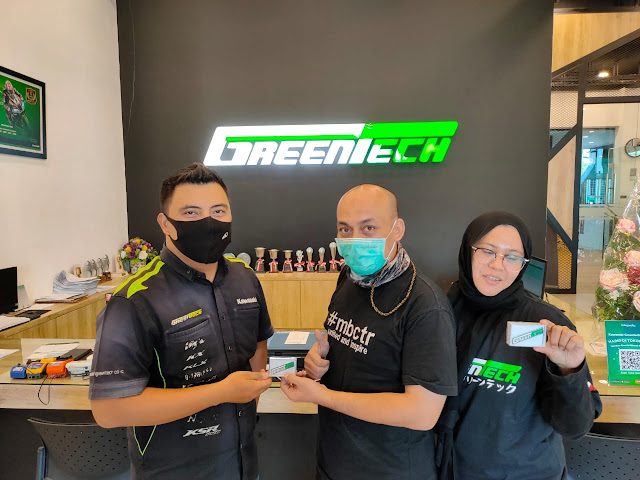

At night, I also studied the Palembang–Jambi route. This route is fairly busy, because there is no toll road between the two provinces. Buses, trucks, and other vehicles are certain to crawl along this East Coast route of Sumatra. For that reason, we chose to set off before Palembang’s traffic began to crawl. But before starting the journey, we first had breakfast at a roadside stall. After that we headed straight for the city of Jambi. The trip went smoothly enough, although it was occasionally halted by queues of vehicles whenever there was road repair work or an accident on the highway.
Tackling this route really demands extra caution, because besides the fairly narrow highway, there are quite a few sections that are badly damaged. The inclines are sometimes unfriendly as well, especially when large trucks are not strong enough to climb them. At times those vehicles stop suddenly in the middle of the road. For that reason, while travelling the Trans-Sumatra Highway (Jalinsum), Nyak Ver had to be ridden according to the traffic conditions, which could be quite dangerous if one had any intention of riding recklessly.
Toward late afternoon, we had already reached the city of Jambi. Before approaching the city, we first stopped to perform the afternoon prayer. Jambi is a city set among hills. It is not overly busy, but it is quite densely packed. That night we decided to stay in an area with a good number of residents. A few other guests asked about the direction and purpose of our journey. By then, the accent of their speech had clearly taken on the Jambi dialect. We told them about our journey plainly, while waiting for the key to our room.

At night, I began calculating the distance between Jambi and Pekanbaru. The view of oil palm plantations from satellite images showed that we would have to decide where to stop and rest the next day. On top of that, the road conditions, which were frequently rainy, meant we always had to plan carefully so as not to be caught at dusk in the middle of a palm forest. Come morning, we decided not to set off too early, because the distance between Palembang and Jambi had already drained a fair amount of my riding energy.
I decided to reach the city of Pekanbaru that day. If we forced the pace, it was very likely we would arrive at night, and that was something we strongly avoided throughout Touring Indonesia Harmoni. From the satellite view, I could see there were a few guesthouses around Batu Ampar. It was clear that when lodging is located outside a major city, we inevitably would not be able to use online booking apps. Because the scenery was palm plantation after palm plantation, I decided not to ride too fast. The gap between the lodging that appeared available and the surrounding palm forest meant we had to search carefully for the safest spot to spend the night that afternoon.

Understanding the Trans-Sumatra Highway (Jalinsum)
The Trans-Sumatra Highway, known locally as Jalinsum, is the backbone of overland travel across the island, and the Palembang–Jambi–Pekanbaru corridor is one of its most demanding stretches. Unlike the newer toll roads that now bypass some provinces, large sections of this route remain single-carriageway roads shared by everything from heavily loaded cargo trucks to local motorcycles. For a rider, this means constant vigilance: the road width leaves little margin for error, and the mix of vehicle speeds creates unpredictable situations, particularly on the inclines where slower trucks can grind to a near halt.
What makes Jalinsum so different from riding in a city is the rhythm it forces upon you. You cannot simply set a pace and hold it. Instead you read the traffic ahead, anticipate where a truck might stall on a rise, and choose overtaking moments with real care. Riding recklessly here is not just discourteous; it is genuinely dangerous. The safest riders on this route are the patient ones who treat every blind corner and every damaged section as a reason to slow down rather than push through.
The Endless Palm Plantations
One of the defining visual experiences of the eastern Sumatra route is the sheer scale of the oil palm plantations. For kilometre after kilometre, the same neat rows of palm trees line both sides of the road, creating a landscape that is at once orderly and strangely monotonous. From satellite imagery, the plantations stretch far beyond what the eye can see from the saddle, and this has a very practical consequence for touring riders: long stretches of road pass through areas with few houses, few services, and little in the way of emergency support.
This is why planning where to stop becomes so important. Being caught at dusk in the middle of a palm forest, far from any settlement, is a scenario every experienced overlander tries to avoid. The plantations offer no lodging, limited mobile signal in places, and an unsettling emptiness after dark. Reading the map carefully the night before, identifying the realistic distance you can cover, and building in a safety margin are all essential habits when the scenery offers so little shelter.
Planning Rest Stops Without Online Apps
Modern touring often relies on booking apps to secure a room in advance, but on routes like this one that convenience quickly disappears. Guesthouses in smaller towns such as those around Batu Ampar frequently do not appear on online platforms at all. This forces a more traditional approach: arriving in daylight, asking locals for recommendations, and inspecting a room in person before committing. It is slower and less certain, but it is also part of what makes overland travel feel authentic.
The practical rule we followed was simple. Aim to arrive at a potential stopping point well before evening, so that if the first option is unsuitable there is still time and daylight to find an alternative. When lodging sits isolated between plantations, choosing the safest location matters more than choosing the cheapest or most comfortable. A place with neighbours, some activity, and a sense of community is always preferable to an isolated building surrounded by silent rows of palm.
Jambi and the Road to Pekanbaru
Jambi itself offered a welcome contrast to the long hours on the highway. Set among gentle hills, the city is compact and densely populated without feeling chaotic, and the shift in local dialect was an immediate reminder of how much cultural variety exists within a single island. Small interactions, such as fellow guests asking where we were headed, are among the quiet pleasures of long-distance riding; they turn an anonymous journey into a series of brief human connections.
From Jambi, the next target was Pekanbaru, and the decision-making followed the same disciplined logic that guided the whole expedition. Rather than gambling on covering the distance in a single hard push that risked a night-time arrival, we weighed our energy, the weather, and the availability of rest points. This measured approach, prioritising safety and sustainability over speed, is what allowed us to keep riding day after day without burning out. On a journey the length of Touring Indonesia Harmoni, the riders who finish are rarely the fastest; they are the ones who manage their energy and their risks most wisely.
Lessons for Riders on the East Coast Route
For anyone planning to ride the eastern corridor of Sumatra, a few principles stand out. Start early to beat the worst of the truck traffic around major cities. Respect the condition of the road, which can change from smooth asphalt to badly broken surface without warning. Never ride to arrive after dark if it can be avoided, and always keep a mental buffer of daylight for finding safe lodging. Above all, treat the journey as a marathon rather than a sprint. The palm plantations may look endless and the trucks may test your patience, but with careful planning and a calm hand on the throttle, this stretch of the Trans-Sumatra Highway becomes a genuinely rewarding chapter of any cross-island adventure.
About The Author

Artikel Terkait
 Sumatra Route Diaries #20: Riding Through Chaotic Medan to the Gateway of Aceh
 Sumatra Route Diaries #18: A Warm Welcome at Greentech Kawasaki Pekanbaru
 Sumatra Route Diaries #16: The Tense East Coast Ride from Bakauheni to Palembang
 Sumatra Route Diaries #15: Crossing the Sunda Strait from Bakauheni to Java
 Sumatra Route Diaries #14: From Padang to Lampung, Battling Rain, Rough Roads, and Illness
Leave a Reply