
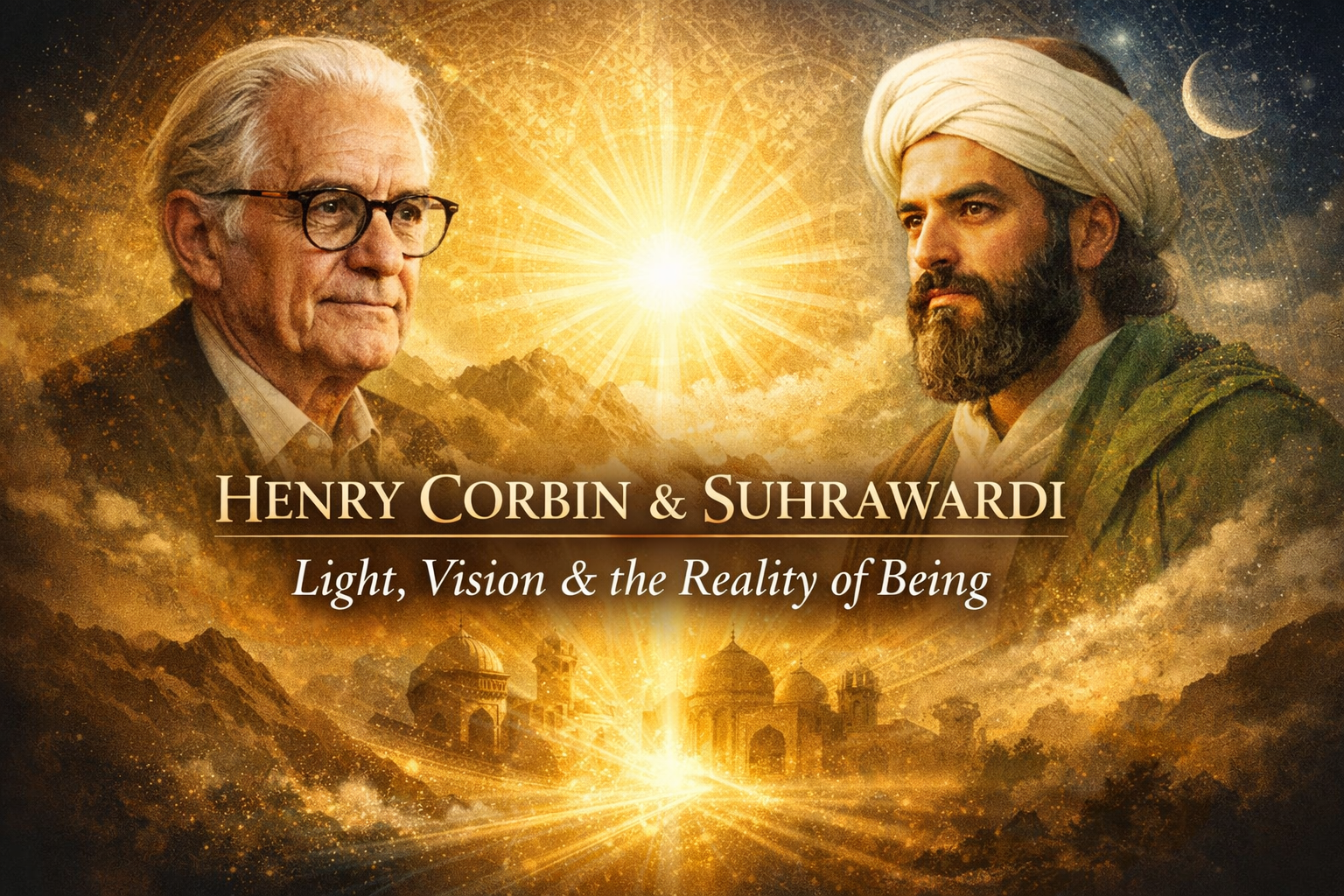
Beyond Representation
Modern philosophy rarely announces its assumptions. It operates within them so completely that they disappear from view. One of the most decisive among these is the belief that reality must be approached indirectly—that it must be mediated, translated, and reconstructed before it can be known. To know, in this framework, is to represent. We do not encounter what is; we produce a form that stands in its place.
This habit has shaped not only theoretical inquiry but the very texture of experience. We no longer trust what appears unless it can be processed, categorized, or explained. The immediate is treated as insufficient, as if it were only the surface of something deeper that must be extracted. Yet in this movement toward depth, something paradoxical occurs: the more we analyze, the less we encounter. Reality becomes intelligible, but no longer present.
The distance introduced by representation is subtle, but persistent. It does not feel like distance because it is filled with concepts, models, and images that seem to bring us closer. But they do not close the gap; they conceal it. We move through layers of mediation without noticing that what we seek has already receded behind them. Knowledge grows, yet proximity diminishes.
To question this condition is not to reject knowledge but to interrogate its form. It is to ask whether there is a mode of knowing that does not depend on distance—one in which what is known is not replaced by representation, but encountered in its own presence. This question does not dismantle philosophy; it reopens it.
Light as Presence
The philosophy of Suhrawardi begins precisely at this point of reopening. It does not start from objects or concepts but from a more immediate intuition: that there is something whose very nature is to appear. Light, in this sense, is not first a physical phenomenon. It is the condition of manifestation itself.
What distinguishes light is not simply that it can be seen but that it reveals itself. It does not require another to make it visible. It is present through itself. In this self-presence lies its ontological privilege. It is not hidden behind what appears; it is the appearing. To think of that being as light is to affirm that reality is not concealed, but given.
This affirmation shifts the entire orientation of philosophy. The search for what lies behind appearance gives way to an attention to how appearance discloses itself. There is no deeper layer beyond manifestation; there is only a deeper engagement with it. What appears is not the surface of reality—it is its unfolding.
In this unfolding, presence becomes the central category. To be is to be present, not as an object before a subject but as a mode of manifestation. Light is not something added to being; it is the way being is. And once this is recognized, the task of philosophy changes. It is no longer about uncovering hidden structures but about learning to see what is already given.
The World as Gradation
If reality is light, then it cannot be uniform. Light varies—it intensifies, diminishes, concentrates, disperses. This variation introduces a structure that is neither arbitrary nor imposed. It is intrinsic to manifestation itself. Reality unfolds not as a collection of equal entities, but as a continuum of degrees.
Gradation, in this sense, is not a secondary feature. It is the very articulation of being. Some things appear with force and clarity, others with faintness and ambiguity. These differences are not merely subjective impressions; they belong to the way reality discloses itself. To exist is to participate in a certain degree of light.
This redefines the meaning of difference. It is no longer grounded in categorical distinction, but in intensity. The question is not simply what something is, but how fully it is present. A being is not defined only by its essence, but by the degree to which it manifests. Reality becomes a spectrum, not a set of isolated units.
Within this spectrum, continuity replaces fragmentation. Each degree flows into another, without rupture. What is less present is not disconnected from what is more present; it is a diminished participation in the same light. The world becomes a field—layered, dynamic, and unified through gradation.
The Loss of Vision
Yet such a world cannot be perceived without a corresponding transformation in perception. The modern condition, as Henry Corbin observed, is defined by the loss of this very capacity. We have not lost sight, but we have lost vision.
The difference is crucial. Sight registers what is visible; vision encounters what is present. One can see endlessly without ever entering into depth. The proliferation of images in modern life has not restored vision; it has obscured it. Everything is shown, but nothing reveals itself.
This obscuration is not the result of ignorance but of saturation. The world becomes so available that it loses resistance. Nothing demands attention, because everything is equally accessible. The hierarchy of presence collapses into a flat field of visibility. What is more real no longer appears as such.
In this condition, the human being becomes a spectator. It observes, analyzes, consumes—but does not participate. Its relation to reality is mediated at every level. What is lost is not information, but immediacy. The world is there, but it is no longer encountered.
Imagination as an Organ of Reality
The recovery of vision requires the recovery of a faculty long misunderstood: imagination. Not imagination as fantasy, but as perception. For Corbin, imagination is not a distortion of reality; it is an organ through which a certain dimension of reality becomes visible.
This claim challenges one of the deepest assumptions of modern thought—that what is real must either be sensed or conceptualized. Imagination belongs to neither category. It perceives forms that are neither physical nor abstract. These forms appear, but in a mode that cannot be reduced to objecthood.
To imagine, in this sense, is not to invent, but to receive. It is to encounter a domain of reality that requires participation rather than observation. The imaginal does not fabricate; it discloses. What appears within it is not subjective projection but a different order of presence.
Without this faculty, entire dimensions of reality remain inaccessible. The world is reduced to what can be measured or defined. Depth collapses into surface. The recovery of imagination is therefore not an addition to knowledge but a restoration of its scope.
The Imaginal World
This restored faculty corresponds to a real domain: the mundus imaginalis. Neither material nor abstract, this world occupies an intermediate space that modern philosophy has largely forgotten. It is a realm in which forms appear with meaning inherent in them.
These forms are not symbols pointing beyond themselves. They are themselves manifestations of meaning. To encounter them is not to interpret but to see. Appearance and intelligibility coincide. What is given does not require translation; it is already present as meaningful.
The imaginal world is often dismissed because it does not conform to empirical criteria. It cannot be measured or verified in conventional ways. Yet this does not diminish its reality. It reveals instead the limitations of the frameworks used to define what is real.
To recover this world is to restore continuity within reality. It bridges the gap between the sensible and the intelligible, allowing for a form of presence that is both visible and meaningful. Without it, reality remains divided. With it, it becomes whole.
To See Again
What emerges from this journey is not a new system, but a new possibility. Philosophy, once confined to representation, becomes a practice of seeing again. To see, not more, but more deeply—to encounter reality as it discloses itself.
This transformation does not reject modern thought; it exceeds it. It preserves its clarity while restoring its depth. Reason remains, but it is no longer isolated. It becomes part of a broader field of perception in which knowledge is grounded in presence.
To see again is to reenter the world—not as spectator, but as participant. It is to recognize that reality is not distant but reveals itself if one learns to attend.
And in this act of attention, philosophy finds its beginning again.
If you are ready to move beyond representation,
If you seek a philosophy that restores presence to reality,
and if you are willing to see differently—
This book is your entry point.
Available now on Amazon.
About The Author

Artikel Terkait
 The Imaginal World of Iran: Henry Corbin and the Esoteric Heart of Shi’ism
 Mundus Imaginalis and Henry Corbin: Imaginal Reality Beyond Modern Ontology
 Tajalli and the Ontological Structure of Manifestation: Toward a Luminous Metaphysics
 Henry Corbin and the Future of Illumination | Imaginal Philosophy & Spiritual Futures
 From Clearing to Imaginal Depth: Rethinking Ontology After the End of Metaphysics