
Geopolitics as the Study of Power Across Time
Geopolitics is not only about borders, wars, armies, or the rivalry between great powers. It is the study of how power moves across geography, institutions, memory, trade routes, states, empires, corporations, and human fear. A serious reader of geopolitics must understand that the world is not shaped by a single event, a single leader, or a single ideology. The global system is formed through long chains of action and reaction, where piracy, imperial commerce, diplomatic failure, disease, and historical memory may all become forces of world transformation.
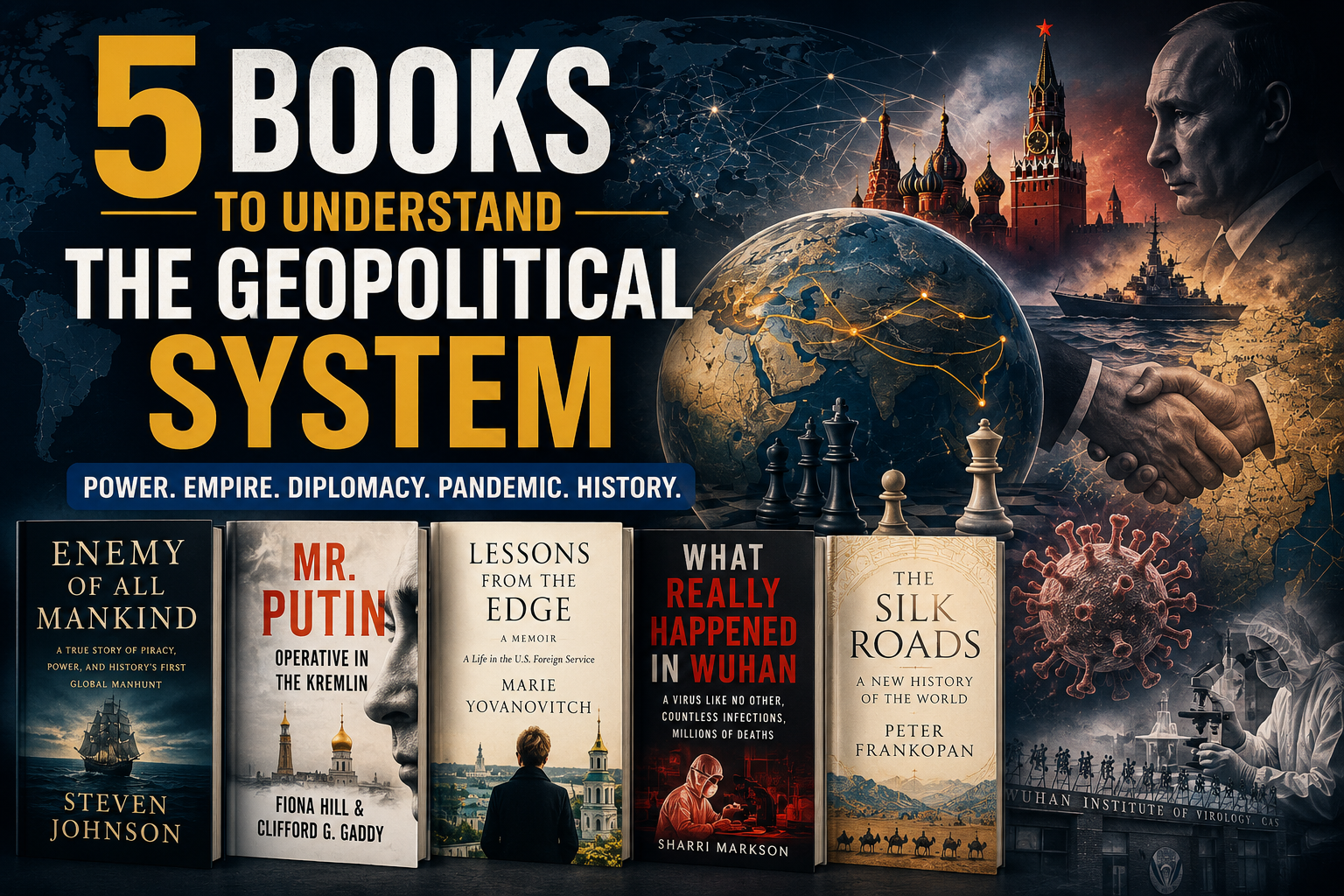
The five books discussed in this essay offer different windows into that system. At first glance, they seem unrelated. One book examines a pirate in the seventeenth century. Another study of Vladimir Putin and the Russian state. A memoir recounts the life of an American diplomat in Ukraine and the post-Soviet world. One book investigates the origins and politics of the Covid-19 pandemic. Another reconstructs the Silk Roads’ centrality in world history. Yet when read together, these books reveal one large lesson: global order is never stable, innocent, or purely rational.
Each book shows that power is often born in crisis. Henry Every’s attack on an Indian treasure ship became more than an act of maritime crime. It exposed the vulnerability of commerce, empire, and corporate expansion. Putin’s rise shows how a political figure may embody not only personal ambition but also the deeper memory of a wounded state. Marie Yovanovitch’s memoir shows how diplomacy becomes a battlefield when corruption, authoritarian influence, and domestic politics collide. Sharri Markson’s investigation into Wuhan shows how a pandemic can become a geopolitical event. Peter Frankopan’s history of the Silk Roads shows that the map of civilization has always been larger than the Western imagination.
These books also teach that geopolitics is not only about what happens in official capitals. Power may begin in a pirate ship, a laboratory, a trade corridor, an embassy, a security service, or a diplomatic cable. The global system is built from visible and invisible structures. Some are written into treaties. Others are hidden inside intelligence networks, corporate interests, scientific institutions, and historical grievances. To understand geopolitics, one must read beyond headlines.
The modern world often presents itself as new, technological, and unprecedented. Yet the books in this essay suggest the opposite. Many contemporary crises repeat older patterns. Maritime piracy in the Indian Ocean anticipated later struggles over global trade. The East India Company foreshadowed the rise of corporate power in international politics. Russia’s warlike posture toward the West reflects older anxieties about encirclement, humiliation, and imperial memory. The Covid-19 crisis exposed the fragility of global health governance. The Silk Roads remind readers that Asia was never peripheral to world history.
A mature geopolitical reading requires movement between microhistory and world history. A single crime may illuminate the rise of empire. A single leader may reveal the psychology of state power. A single diplomat’s experience may uncover the fragility of democratic foreign policy. A single virus may expose the weakness of global institutions. A single trade route may revise the history of civilization. The value of these books lies in their ability to connect the small scene to the large structure.
They also warn against simplistic explanations. It is easy to say that one leader caused a crisis, one country created instability, or one event changed the world. But geopolitics rarely works in such a simple manner. Leaders operate inside historical structures. States act under pressure from memory, geography, and insecurity. Corporations reshape sovereignty. Diplomatic institutions struggle against corruption and disinformation. Scientific debates can become national security debates. Trade routes become civilizational arteries.
The books also show that the global system is shaped by misreading. Misreading an adversary can lead to war. Misreading a trade route can distort history. Misreading corruption can weaken democracy. Misreading a pandemic can damage public trust. Misreading corporate power can hide the true architecture of empire. In geopolitics, ignorance is never harmless. It creates blind spots, and blind spots become strategic vulnerabilities.
For this reason, these books are useful not only for general readers but also for analysts, students, policymakers, researchers, and intellectuals who want to understand how the world order actually works. They do not offer one theory, but they offer something more important: a set of lenses. Through these lenses, the reader can see the connection between violence, commerce, intelligence, diplomacy, disease, geography, and memory.
This essay, therefore, reads the five books not merely as book recommendations but as a map of geopolitical thinking. Each book becomes a point of entry into a larger question: how does the world become ordered, disrupted, and reordered? The answer is not found in a single discipline. It requires history, political analysis, strategic thinking, anthropology, security studies, and moral reflection.
Henry Every and the Rise of Globalized Disorder
Steven Johnson’s Enemy of All Mankind begins with a pirate, but its deeper subject is the making of a global system. Henry Every was not simply a criminal of the sea. His attack on an Indian treasure ship exposed the fragile relationship between piracy, imperial ambition, corporate power, and international diplomacy. The event became a crisis because it touched more than private wealth. It threatened trade, legitimacy, and the political future of the empire.
The importance of Henry Every lies in the scale of consequence. A pirate attack could have remained a maritime episode, remembered only as a spectacular crime. But the world of the seventeenth century was already becoming interconnected. Trade routes linked Europe, India, the Middle East, and the oceans. Corporate actors such as the East India Company were expanding their influence. Political authority was no longer contained within royal courts. It was moving across ships, ports, contracts, and distant markets.
Johnson’s book shows that globalization did not begin as a clean story of progress. It emerged from violence, theft, speculation, and coercion. The modern global marketplace was not created only by merchants and diplomats. It was also shaped by pirates, privateers, smugglers, imperial agents, and companies that blurred the line between commerce and sovereignty. Henry Every’s crime became historically significant because it revealed the instability beneath early global capitalism.
The East India Company appears here as one of the most important institutions in modern history. It was not merely a business. It became a political actor with military capacity, diplomatic importance, and imperial ambition. Through this lens, the reader sees that modern geopolitics cannot be understood if corporations are treated as secondary actors. From the seventeenth century to the twenty-first century, corporate power has repeatedly entered the domain of sovereignty.
Every attack also shows how an empire depends on credibility. The British government had to respond not only because a crime had occurred but also because imperial authority had been embarrassed. The Mughal world, Indian merchants, and global trade networks had to be reassured. The manhunt for Henry Every, therefore, became more than a pursuit of a pirate. It became a performance of state power before an international audience.
This is one of the book’s most important geopolitical lessons. States do not act only to defend territory. They also act to defend reputation. Reputation is a form of currency in international politics. When a state cannot protect trade, punish criminals, or reassure partners, its authority weakens. Every crime forced Britain to prove that it could discipline violence committed under the shadow of its expanding maritime world.
The story also reveals the deep connection between information and power. Reports about Henry Every’s adventures were exaggerated, distorted, and consumed by a fascinated public. The press created a myth around crime. This matters because geopolitics is never formed only by facts. It is also shaped by stories. Public imagination can turn a criminal into a legend, a crisis into a symbol, and an event into a political pressure point.
In this sense, Enemy of All Mankind is not only a history of piracy. It is also a history of media, myth, and state response. Modern readers can see clear parallels with contemporary crises. Terrorism, cybercrime, financial fraud, maritime disruption, and transnational networks all operate in spaces where law, sovereignty, and public fear intersect. The pirate ship becomes an early model of non-state disruption.
The deeper lesson is that the global system has always produced actors who operate between legal orders. Pirates exploited the gaps between empires. Today, similar gaps are exploited by hackers, traffickers, private military companies, sanctioned oligarchs, and illicit financial networks. The form changes, but the logic remains: wherever global circulation expands, new forms of disorder emerge.
Johnson’s work, therefore, allows readers to see the birth of global disorder inside the birth of global order. Empire, capitalism, law, piracy, media, and corporate expansion developed together. This is why Henry Every matters. His story is not a romantic adventure from the age of sail. It is a warning that the modern world was built from the beginning on fragile arrangements between profit, violence, and authority.
Putin, the State, and the Strategic Psychology of Russia
Mr. Putin: Operative in the Kremlin by Fiona Hill and Clifford Gaddy offers a different kind of geopolitical lesson. This book is not simply about one man. It is about how a leader becomes the expression of state memory, institutional culture, personal formation, and strategic worldview. Vladimir Putin cannot be understood only as a president, a former intelligence officer, or an authoritarian ruler. The book presents him as a composite figure shaped by Russian history, Soviet collapse, intelligence training, and the psychology of power.
The central question of the book is not merely what Putin does but how Putin thinks. This distinction is crucial. Geopolitical failure often begins when states misread their rivals’ intentions. A leader’s statements may be dismissed as rhetoric. Military movement may be interpreted as a bluff. Historical grievances may be treated as propaganda. Yet in strategic affairs, what appears theatrical may also reveal a serious worldview.
Hill and Gaddy emphasize that Putin’s background matters. His experience in the KGB shaped his understanding of loyalty, secrecy, vulnerability, and control. The intelligence world teaches a particular view of politics. It sees weakness as danger, compromise as risk, and information as a weapon. This does not explain everything about Putin, but it helps explain why security thinking sits at the center of his political imagination.
The book also situates Putin within deeper Russian patterns of thought. Russia’s geography has historically produced anxiety about borders, invasion, and encirclement. Its political tradition has often placed strong authority above liberal pluralism. Its imperial history created a sense of civilizational mission. Its Soviet collapse produced humiliation, economic trauma, and geopolitical contraction. Putin’s worldview draws from these layers.
This is why the book is useful for understanding Russia’s confrontation with the West. It does not reduce the conflict to one cause. It shows how NATO expansion, post-Soviet instability, energy politics, domestic authoritarian consolidation, and historical memory interact. Whether one agrees with Putin’s claims or rejects them, a serious analyst must understand the structure of his perception. Strategic analysis begins by understanding how the other side defines threat.
The danger of misreading Russia is not theoretical. The twentieth century showed repeatedly that wars may begin when leaders underestimate each other’s fears, ambitions, or red lines. In the current era, the stakes are higher because Russia remains a nuclear power. The existence of nuclear weapons means that misunderstanding is not only a diplomatic problem. It is a survival problem.
The book also helps readers understand the relationship between personal rule and institutional power. Putin is powerful, but he is not isolated from the system that produced him. The security services, oligarchic networks, state media, energy interests, and nationalist narratives all form the environment of Russian power. A leader can dominate institutions while also depending on them. This creates a system that is both personalized and structural.
Putin’s Russia also demonstrates how authoritarian states use ambiguity. War may be denied while being conducted. Disinformation may blur truth and falsehood. Corruption may become a tool of foreign influence. Energy dependency may become a strategic lever. Cyber operations may operate below the threshold of open war. This is not traditional geopolitics in the old sense. It is hybrid statecraft.
For readers in Asia, the Middle East, and the Global South, the book also raises a broader question: how should smaller and middle powers read great-power behavior? The answer is not by moral slogans alone. They must understand history, security doctrine, resource politics, elite networks, and strategic culture. Russia’s behavior toward Europe is not separate from global questions about sovereignty, influence, and the limits of Western power.
Mr. Putin is therefore important because it teaches disciplined interpretation. It reminds readers that world leaders are not abstract actors. They are formed by institutions, personal experiences, historical wounds, and strategic calculations. To study Putin is not to justify him. It is to understand how power thinks when it believes that history, geography, and survival are on its side.
Diplomacy at the Edge: Ukraine, Corruption, and Democratic Fragility
Marie Yovanovitch’s Lessons from the Edge moves geopolitical analysis from the palace of power to the life of a diplomat. This memoir is valuable because it shows how international politics is experienced by those who operate inside embassies, negotiations, institutions, and crises. Diplomacy is often imagined as ceremonial, polite, and distant from conflict. Yovanovitch’s account shows the opposite. Diplomacy is a frontline profession.
Her career in the post-Soviet world placed her at the center of some of the most important transformations after the Cold War. The collapse of the Soviet Union did not produce a simple victory of democracy. It produced contested states, fragile institutions, oligarchic wealth, corruption, nationalist revival, and geopolitical competition. In that environment, diplomats did not merely represent their countries. They observed the birth of new political orders.
Ukraine becomes especially important in this memoir. Long before the full-scale Russian invasion of 2022, Ukraine was already a battleground of influence. Russia used political pressure, energy dependency, disinformation, military intervention, and corruption networks to shape Ukraine’s direction. The struggle was not only about territory. It was about whether Ukraine would remain vulnerable to Moscow’s orbit or build institutions capable of democratic independence.
Yovanovitch’s memoir shows that corruption is not a domestic issue alone. In weak states, corruption becomes a geopolitical weapon. It allows foreign powers to buy influence, weaken trust, discredit reform, and capture elites. A corrupt system is easier to manipulate from the outside because loyalty becomes transactional. This is one of the most important lessons of the book.
The memoir also reveals the personal cost of public service. Yovanovitch was targeted by a smear campaign and recalled from Kyiv during a period of intense political conflict in the United States. Her experience shows how foreign policy can become vulnerable when domestic politics turns against professional institutions. Diplomacy depends on trust, expertise, and continuity. When those are undermined, a state weakens its own strategic capacity.
Her testimony during the impeachment process became a symbol of institutional courage. Yet the deeper significance is not personal drama. It is the exposure of a dangerous pattern: when foreign policy becomes entangled with private political interests, national credibility suffers. Allies become uncertain. Adversaries become emboldened. Professional diplomats become vulnerable to factional attacks.
The book also invites reflection on gender and authority in diplomacy. Yovanovitch rose through a profession historically dominated by men. Her career shows the difficulty of building credibility in institutions where women often face additional scrutiny. This dimension matters because geopolitical institutions are not neutral machines. They are human structures shaped by culture, hierarchy, and bias.
Yovanovitch’s account also deepens the reader’s understanding of Ukraine. Ukraine is not merely a place where Russia and the West compete. It is a society struggling over sovereignty, identity, law, and dignity. The Ukrainian question is therefore not only geopolitical. It is also moral and institutional. Can a state build democracy while facing external pressure and internal corruption? Can reform survive when oligarchic power and foreign interference work together?
This memoir also helps readers understand why diplomacy requires memory. A diplomat must remember patterns: how authoritarian influence works, how corruption spreads, how reformers are isolated, how propaganda prepares the ground for aggression. Without memory, each crisis appears new. With memory, the analyst can recognize recurrence.
Lessons from the Edge is important because it humanizes geopolitics without making it sentimental. It shows that world order depends on people who defend institutions when institutions are under attack. The book reminds readers that diplomacy is not a weakness. At its best, diplomacy is disciplined courage under pressure.
Wuhan, Pandemic Politics, and the Geopolitics of Uncertainty
Sharri Markson’s What Really Happened in Wuhan brings the discussion into one of the most consequential crises of the twenty-first century: the Covid-19 pandemic. The book is investigative, controversial, and politically charged. It examines the origins of the pandemic, the role of Chinese institutions, the debate over laboratory research, and the struggle over public truth. Whatever position one takes on its conclusions, the book shows that pandemics are never only medical events.
A pandemic becomes geopolitical when the disease crosses borders, disrupts economies, exposes state weakness, and triggers competition for information. COVID-19 did all of this. It shut down cities, disrupted supply chains, eroded public trust, intensified rivalry between the United States and China, and forced governments to make decisions amid uncertainty. The virus moved biologically, but the crisis moved politically.
Markson’s book argues that the origins of COVID-19 were obscured by secrecy, institutional caution, censorship, and political pressure. This argument must be approached carefully because the original question remains sensitive and contested. Yet the broader geopolitical issue is clear: when a global crisis begins, transparency becomes a matter of international security. Delay, concealment, or confusion can multiply harm.
The book also raises important questions about scientific authority. Science depends on openness, peer review, and debate. Yet during a crisis, scientific discussion may become entangled with state interests, media pressure, platform moderation, and public fear. When scientific questions are politicized too quickly, trust can collapse. When uncertainty is hidden, suspicion grows.
COVID-19 also showed the fragility of global governance. Institutions designed to manage health emergencies faced enormous pressure. States competed for masks, vaccines, data, and narratives. Borders closed. Supply chains are fractured. Public health became a matter of national security. The pandemic revealed that globalization had created interdependence without sufficient resilience.
From a geopolitical perspective, the Wuhan question is not only about where the virus came from. It is about how the world manages risk created by advanced science, biological research, urban density, authoritarian secrecy, and global mobility. Modern civilization has produced extraordinary knowledge but also new forms of vulnerability. A laboratory, a market, a transport hub, or an administrative failure can become the starting point of global disruption.
The book also shows how information warfare operates during health crises. Competing narratives emerged quickly. Some actors emphasized natural origin. Others emphasized laboratory possibilities. Some governments used the crisis to deflect blame. Social media intensified confusion. Public debate became polarized. In such an environment, truth becomes difficult not only because evidence is incomplete but also because every claim enters a battlefield of interests.
For strategic analysts, the pandemic offers a lesson about preparedness. National security can no longer be defined only by military strength. It must include public health, supply chains, scientific ethics, biosecurity, data transparency, and social trust. A state with powerful weapons but weak health systems remains vulnerable. A state with advanced laboratories but poor oversight may create risks beyond its borders.
The Covid-19 crisis also exposed the moral tension between sovereignty and responsibility. States protect their own interests, but pandemics require shared information. When governments prioritize image over transparency, the cost is global. This is why pandemic governance is now part of geopolitics. Disease reveals the limits of nationalism while also strengthening nationalist reflexes.
What Really Happened in Wuhan matters because it forces readers to confront uncertainty. The most dangerous crises are often those in which evidence, politics, fear, and secrecy overlap. In such moments, the task of analysis is not to shout the loudest conclusion. It examines power, incentives, institutions, and the consequences of silence.
The Silk Roads and the Re-centering of World History
Peter Frankopan’s The Silk Roads is perhaps the broadest book in this selection. It does not focus on one leader, one crisis, or one event. It challenges the entire map through which many readers understand world history. Frankopan argues that the story of civilization cannot be told honestly if the East is treated as peripheral and the West as the natural center of progress.
The Silk Roads were not merely trade routes. They were corridors of power, faith, disease, language, empire, technology, and imagination. Across these routes moved silk, spices, horses, metals, ideas, religions, armies, and diplomatic missions. The world was connected long before modern globalization. The difference is that earlier forms of connectivity moved through caravans, ports, oases, imperial roads, and sacred networks.
Frankopan’s work is important because it shifts the reader’s gaze. Instead of seeing Europe as the origin of world history, the book points toward the vast region stretching from the Mediterranean through Persia, Central Asia, South Asia, and China. This region was not a passive bridge between civilizations. It was a generator of wealth, knowledge, conflict, and transformation.
The spread of religions across the Silk Roads shows that belief itself has a geography. Buddhism, Christianity, Islam, and other traditions moved through merchants, monks, scholars, conquerors, and pilgrims. The movement of faith was tied to the movement of goods and people. This reminds readers that religion is not separate from geopolitics. It shapes identity, law, legitimacy, and civilizational memory.
The Silk Roads also reveal the relationship between trade and empire. Empires expanded to control routes, taxes, resources, and strategic nodes. Cities rose because they sat at points of exchange. Others declined when routes shifted. Geography created opportunity, but power determined who could benefit from it. This remains true today. Ports, straits, pipelines, railways, and digital cables are modern Silk Roads.
Frankopan’s history also helps readers understand why Central Asia, the Middle East, and the Indian Ocean remain strategically important. These regions are not accidental zones of crisis. They sit at the crossroads of energy, religion, migration, military competition, and economic ambition. Contemporary instability in these regions has deep historical roots.
The book also destabilizes Western triumphalism. It shows that Europe’s rise was not inevitable. It was connected to access, extraction, maritime expansion, colonial violence, and the shifting balance of global trade. To understand the modern West, one must also understand the East. Western power was built through engagement with regions it later described as backward or peripheral.
For Asian readers, The Silk Roads offers a powerful intellectual correction. It restores dignity to regions that were often reduced to objects of conquest or crisis. It shows that Asia was a center of historical production, not merely a space acted upon by Europe. This matters because geopolitical imagination is shaped by historical memory. A region that forgets its centrality may accept intellectual dependence.
The book is also relevant to China’s contemporary rise. Modern infrastructure projects, trade corridors, ports, and continental connectivity can be read as attempts to revive older patterns of Eurasian centrality. The past does not repeat mechanically, but it provides symbolic resources. The idea of the Silk Roads has become part of twenty-first-century strategic language.
Frankopan’s book, therefore, teaches that geopolitics requires historical reorientation. The world cannot be understood through a narrow Atlantic lens. The future may once again be shaped by corridors connecting Asia, Europe, Africa, and the Middle East. To read the Silk Roads is to understand that history has always moved along routes, and whoever controls routes shapes worlds.
Reading the Five Books Together: Toward a Strategic Literacy of the World
When read together, these five books create a powerful framework for geopolitical literacy. They do not belong to one genre. They include history, political biography, memoir, investigation, and civilizational narrative. Yet this diversity is precisely their strength. Geopolitics itself is not one discipline. It is a way of reading the world across multiple scales.
Enemy of All Mankind teaches that global order can be disrupted by non-state actors. A pirate could shake imperial credibility because he struck at the nervous system of trade. This lesson remains relevant in an age of cybercrime, maritime insecurity, private military actors, and transnational illicit networks. The state remains powerful, but it is never alone in shaping history.
Mr. Putin teaches that strategic psychology matters. Leaders do not act from abstract rationality alone. They interpret the world through memory, institutions, fear, and ambition. Misreading those interpretations can produce disastrous policy. To understand an adversary is not to admire that adversary. It is to reduce strategic blindness.
Lessons from the Edge teaches that diplomacy is a fragile defense line. Democracies depend on institutions that can be weakened from within and pressured from outside. Diplomats do not merely attend ceremonies. They defend law, credibility, and national interest in unstable environments. Their work is often invisible until a crisis reveals its importance.
What Really Happened in Wuhan teaches that modern security includes biological risk, information control, scientific uncertainty, and institutional trust. The pandemic showed that a virus can become a global political event. It also showed that secrecy and confusion can be as damaging as the biological threat itself.
The Silk Roads teaches that history must be read from the center of movement, not from the comfort of inherited maps. Trade routes, religious corridors, imperial highways, and energy pathways shape world order. The future will not be understood by those who look only at Washington, London, Moscow, or Beijing. It must be read across corridors, ports, chokepoints, and civilizational memory.
Together, the books show that the geopolitical system is built from five major forces: violence, memory, diplomacy, uncertainty, and connectivity. Violence appears in piracy, war, state coercion, and imperial expansion. Memory appears in Russian strategic thinking and civilizational history. Diplomacy appears in the struggle for Ukraine and democratic credibility. Uncertainty appears in pandemic politics. Connectivity appears in the Silk Roads and global capitalism.
They also show that power is never purely material. Ships, armies, laboratories, embassies, and trade routes matter. But so do stories, myths, fears, reputations, and historical narratives. The world is governed not only by weapons and money, but also by interpretation. Whoever controls interpretation can shape legitimacy.
For readers of KBA13 Insight, these books can be read as instruments of strategic education. They train the mind to move from event to structure, from biography to system, from local crisis to global consequence. They encourage the reader to ask deeper questions: who benefits, who controls routes, who shapes narratives, who hides information, who remembers history, and who pays the price of disorder?
The most important lesson is that geopolitics is not distant from ordinary life. Piracy affects trade. War affects food and energy. Diplomacy affects sovereignty. Pandemic policy affects the body. Trade routes affect culture, wealth, and belief. The global system enters homes, markets, universities, mosques, ports, hospitals, and screens. To study geopolitics is therefore to study the architecture of modern existence.
These five books should not be read as final answers. They should be read as gateways. Each opens a path into a larger world of inquiry. The serious reader will leave them not with certainty, but with sharper questions. That is the beginning of strategic literacy: the ability to see beneath events, beyond slogans, and across the long movement of history.
About The Author

Rekomendasi Bacaan KBA13 INSIGHT
Jika tulisan ini bermanfaat, dukung jurnal ini dengan mencari bukunya melalui tautan berikut:
- Buku-buku Kamaruzzaman Bustamam Ahmad di Periplus
- Koleksi Islamic Studies di Periplus
- Koleksi Geopolitics & Politik Internasional di Periplus
- Cari buku & perangkat baca di Shopee
- Cari di Blibli
Daftar lengkap: Rekomendasi Buku, Alat Tulis & Layanan. Tautan di atas adalah tautan afiliasi — KBA13 INSIGHT dapat memperoleh komisi kecil tanpa biaya tambahan bagi Anda.
Artikel Terkait
 Global Intelligence Briefing (7–12 July 2026): Iran War, US–China Rivalry, Ukraine, South China Sea, and Global Security Risks
 The Beijing Variable: A Geopolitical Analysis of US-China Relations After the Trump-Xi Summit, May 2026
 The Kremlin School of Negotiation: Silence, Psychological Pressure, and the Politics of Power
 One World in the Planetary Era: Kishore Mahbubani, Global Convergence, and the Future of Civilization
 Asia’s Cauldron: Laut Cina Selatan, Perebutan Hegemoni, dan Masa Depan Asia-Pasifik
Leave a Reply