
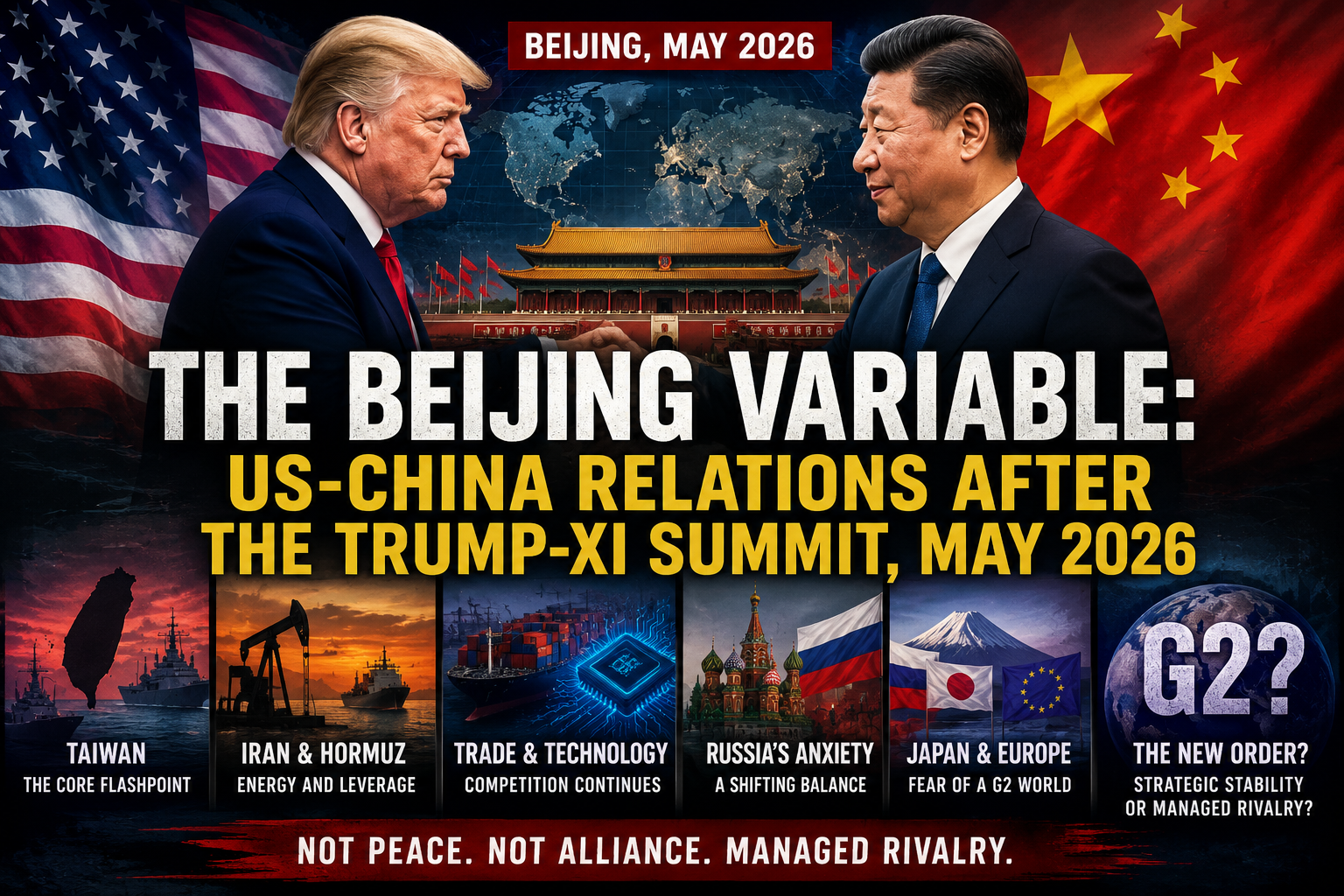
The Road to Beijing: Origins, Delays, and the Weight of Mutual Necessity
The May 2026 Trump-Xi summit in Beijing marked one of the most consequential moments in contemporary US-China relations. Presented publicly as a diplomatic reset, the meeting was in fact a deeper geopolitical negotiation over power, leverage, strategic stability, Taiwan, energy security, trade, technology, and the future of the global order. The summit did not resolve the structural rivalry between Washington and Beijing. Instead, it exposed the fragile architecture of managed competition in a world increasingly shaped by the uneasy coexistence of American and Chinese power.
The May 2026 Trump-Xi summit did not emerge from diplomatic goodwill. It was the product of two years of escalating punishment — tariff wars that briefly pushed bilateral levies past 100%, rare earth threats, technology bans, and the kind of mutual mistrust that rarely resolves itself without a direct meeting between the two leaders at the center of it. When Donald Trump won his second term in January 2025, the US-China relationship was in a condition best described as managed hostility: both sides were still talking, but the structure of that conversation was adversarial by default. The summit in Beijing was the culmination of a slow, painful effort to find a floor beneath that hostility before it became something worse.
The first significant turn came at the APEC summit in Busan, South Korea, in October 2025, where Trump and Xi met in person for the first time since 2019 — their first face-to-face in six years, and Trump’s first since returning to office. That meeting produced a trade truce — an agreement to reduce tariffs by ten percentage points and suspend China’s rare earth export controls for one year — that gave both economies a temporary reprieve. The truce was fragile, set to expire, and deliberately non-binding on the core issues dividing the two countries. But it mattered because it established a working rhythm: the two leaders could meet, find a common register of interest, and prevent their teams from letting tensions spiral out of control. Busan was the proof of concept for Beijing.
The path from Busan to Beijing, however, was immediately complicated by the most disruptive geopolitical event of 2026: the US-Israeli war on Iran, which began on February 28. The original plan had been for Trump to visit Beijing in late March or early April — an ambitious timeline that would have made him the first American president to travel to China since his own first term in 2017. Within days of the strikes on Iran, Washington asked Beijing to delay the summit. The reason was both logistical and political: Trump could not travel to China to seek trade deals and diplomatic warmth while simultaneously running a military campaign that China publicly opposed and that disrupted the energy supply chain on which Beijing heavily depended.
The delay was not neutral. Every week that the Iran war dragged on shifted the power dynamics heading into Beijing. China is Iran’s largest trading partner and the primary buyer of Iranian crude oil, accounting for roughly 90% of Iran’s oil exports. The crisis centered on the Strait of Hormuz—through which roughly 25% of the world’s seaborne oil trade and 20% of global LNG had previously moved freely. Iran formally announced the Strait closed to hostile shipping on March 4, and from April 13 the United States added its own naval blockade of Iranian ports, creating what analysts described as a dual blockade. The closure hit China’s energy imports directly and gave Beijing both grievance and leverage simultaneously. China was suffering from the economic consequences of an American war it had nothing to do with, which meant it could walk into any summit meeting as an aggrieved party rather than a supplicant. Washington, by contrast, needed Beijing’s cooperation to pressure Tehran, which left Trump entering the meeting in a weaker position than he had anticipated.
The delay also became a window through which China demonstrated its own negotiating discipline. Rather than pressing for an earlier date or making conciliatory gestures that might be read as desperation, Beijing sat back and let the Iran war consume American political capital. By the time Trump finally arrived in Beijing on May 14, the conflict was in its 77th day with no clean resolution. A US intelligence report — reported by the Washington Post days before the summit — assessed that the Iran war was weakening Washington’s strategic edge against Beijing. China had effectively turned America’s military adventure into a strategic argument for why Washington needed Chinese cooperation, not the reverse.
What brought Trump to Beijing despite these disadvantages was something simpler than strategy: economic necessity and political optics. The October 2025 trade truce was approaching the limits of its shelf life. American farmers and exporters were watching nervously as Chinese market access remained uncertain. The US technology sector — companies like Apple, Nvidia, and Tesla — had enormous exposure in China and needed regulatory clarity. Trump, whose domestic popularity had taken hits from rising gasoline prices caused by the Hormuz blockade, needed to walk out of Beijing with something he could describe as a win. For all the asymmetry in leverage, both leaders needed the meeting to succeed, just for different reasons.
Xi, for his part, was operating from a position of greater confidence than at any previous Trump-Xi encounter. China had spent the preceding year systematically demonstrating that it could impose costs on the American economy — through rare earth export suspensions that disrupted global auto supply chains, through targeted bans on American semiconductor companies, and through its refusal to join Washington’s sanctions regime against Iranian oil. This was not the China of 2017, arriving at a Trump summit somewhat deferential and eager to avoid confrontation. This was a China that had spent years building buffers against American economic pressure — stockpiling reserves, electrifying its energy base, and diversifying its supply chains — and was prepared to play a longer game than Washington.
The guest list Trump brought to Beijing was itself a political statement. Seventeen of America’s most powerful corporate leaders accompanied the president, including Apple’s Tim Cook, Nvidia’s Jensen Huang, Tesla’s Elon Musk, and Boeing’s CEO, Kelly Ortberg. Trump walked these executives directly into his bilateral meeting with Xi—a move that was not originally on the schedule—framing the encounter as a display of American economic muscle. “We asked the top 30 in the world; every single one of them said yes, and I wanted only the top,” Trump told Xi of the delegation. The performance landed well on Chinese social media, where the image of American business titans paying court to Beijing attracted millions of impressions. But the symbolic weight cut in multiple directions: it also confirmed that American business needed access to the Chinese market badly enough to fly to Beijing at the president’s request.
The summit’s opening ceremony at the Great Hall of the People was deliberately choreographed for maximum weight. An honor guard lined up as Trump arrived, a 21-gun salute was fired on Tiananmen Square, and the two presidents reviewed the troops of the People’s Liberation Army together. Xi took Trump to the Temple of Heaven — a 600-year-old structure where Chinese emperors once performed rituals invoking Heaven’s mandate to rule. The symbolism was not accidental. Xi was situating the meeting within a longer arc of Chinese civilization and power, implicitly positioning himself as the contemporary steward of an ancient tradition of authority, hosting a foreign leader who had come to him. Trump, for his part, called Xi “my friend” and a “great leader” and told him, “We are going to have a fantastic future together.” The warmth was genuine and transactional in equal measure. These were two men who understood each other well enough to know that flattery was the lubricant of their relationship and that what happened after the ceremony would be decided by leverage, not affection.
Inside the Room: What Two Leaders Actually Said
The bilateral meeting itself lasted two hours and fifteen minutes. That is a long time for two heads of state to sit together, and the duration signaled that neither side was treating this as a symbolic photo opportunity. The formal talks were followed by a state banquet on the first evening and a second day of meetings at the Zhongnanhai compound — the seat of Chinese political power, where the Communist Party’s leadership has governed since 1949. Trump and Xi walked together through centuries-old gardens, ate lunch together, and conducted what both sides described as substantive exchanges. The question of what was actually substantive, as opposed to what was described as substantive for domestic consumption, is the more difficult matter to untangle.
The most striking feature of the summit was not what was agreed but what the two sides said afterward. The divergence between the American and Chinese readouts was so pronounced that the two statements appeared, at times, to be describing different conversations. The White House emphasized trade cooperation, expanding market access for American businesses, increasing Chinese purchases of American agricultural products, and a shared commitment to keeping the Strait of Hormuz open. The Chinese Foreign Ministry’s statement emphasized Taiwan as the central issue in bilateral relations, the importance of the “constructive strategic stability” framework, and the historical significance of the meeting as a turning point in how the two countries would relate. Fentanyl, which the White House said both presidents highlighted, received no mention in the Chinese statement. The Boeing jet deal, which Trump announced to Fox News, was not confirmed by China’s foreign ministry or by Boeing itself.
This asymmetry in readouts is not an accident or a miscommunication. It is a deliberate feature of how both governments manage the domestic politics of summits with ideological and strategic opponents. Trump needed to go home and tell American audiences that he had extracted commercial commitments from China. Xi needed to go home and tell the Chinese public — and the broader world — that China had set the terms of engagement, that Taiwan had been front and center, and that America had come to Beijing seeking China’s goodwill, not the reverse. Both narratives are politically necessary. Neither is fully accurate. The real conversation was almost certainly a negotiation between two positions that are too far apart to reconcile in two days, producing a series of vague agreements that each side could read as a vindication of its own approach.
Trump’s opening remarks in the Great Hall were effusive to the point of surprising some observers. He told Xi that the US-China relationship was among “the most consequential” in the world, that China had done a great job under Xi’s leadership, and that he had “tremendous respect” for both Xi and the Chinese people. At the state banquet, he invited Xi to visit the White House on September 24 — a gesture that both reinforced the personal character of their relationship and committed Trump to a future encounter before the October trade truce formally expired. Xi responded by calling the relationship one of “strategic stability” and expressing his willingness to make 2026 “a historic, landmark year that opens up a new chapter” in bilateral relations. Both men were performing with confidence. The performance required no particular honesty about the difficulty of what they were actually trying to manage.
Xi’s most consequential intervention in the room was his framing of Taiwan. According to China’s foreign ministry, Xi told Trump directly that mishandling the Taiwan issue would cause “clashes and even conflicts, putting the entire relationship in great jeopardy.” He placed Taiwan at the center of the summit’s agenda, calling it “the most important issue” in bilateral relations. This was not a diplomatic formality. It was a calculated decision to establish, for the record and for the international audience, that Beijing’s primary concern was not trade or Iran but the future status of Taiwan — and that any attempt to use other issues as a bargaining chip would come at the cost of the entire relationship. Xi was drawing a line in diplomatic language precise enough to be understood as a warning but vague enough not to require an immediate American response.
The White House readout, notably, made no mention of Taiwan at all. This silence was itself a form of communication. Secretary of State Marco Rubio was quick to clarify afterward that US policy on Taiwan remained unchanged. But Trump’s own statements were more ambiguous. He told reporters he had made “no commitment either way” on future arms sales to Taiwan, that he wanted the situation to “stay the way it is,” and that Taiwan was “the most important issue for Xi.” He did not repeat the standard American formulation opposing unilateral changes to Taiwan’s status. CNN’s chief national security analyst described Trump’s failure to commit to continued arms sales as “a win for China.” Whether that assessment is correct depends on what actually happens next, but the perception itself has consequences, particularly in Taipei and Tokyo.
Wang Yi, China’s foreign minister, was explicit in the aftermath of the meeting. He told Chinese state media that Beijing had sensed during the talks that Trump understood China’s position on Taiwan and “does not support or accept Taiwan moving toward independence.” This was a significant statement — not because it necessarily reflected what Trump agreed to, but because China put it on the record as a characterization of American understanding. Whether Washington disputes that characterization formally will be one of the key tests of the coming months. Taiwan’s foreign minister responded cautiously, reaffirming that US policy had not changed and that Taipei was “maintaining good communication” with Washington. But the communications problem is precisely that the two sides’ readouts are so divergent that third parties—including Taiwan — are left to interpret what the summit actually decided.
On Iran, both sides acknowledged that the war and the Strait of Hormuz blockade were discussed, but their accounts of the conversation differed in telling ways. The White House said both countries agreed that Iran can never possess a nuclear weapon and that the Strait of Hormuz must remain open to global energy flows. It also said Xi expressed opposition to the militarization of the Strait and interest in purchasing more American oil, partly to reduce China’s trade surplus. The Chinese foreign ministry said the Middle East was discussed but pointedly did not confirm that China agreed Iran should never have a nuclear weapon. Xi told Trump, according to Fox News, that he would like to see a deal made and that he was willing to help—but when Trump was asked whether he had asked for China’s help on Iran, he said: “I’m not asking for any favors, because when you ask for favors, you have to do favors in return.” This was a public refusal to acknowledge the extent to which the war in Iran had weakened America’s negotiating position — a refusal that told analysts everything they needed to know about the gap between Trump’s stated confidence and the actual state of play.
The business dimension of the summit introduced a different kind of ambiguity. Trump brought Jensen Huang into the room with the apparent hope of unlocking some kind of deal on AI chip sales to China — a significant commercial issue given that Nvidia chips are subject to US export controls targeting China. No announcement followed. Tim Cook and Elon Musk emerged from their meetings with China’s Premier Li Qiang and described the conversations as “wonderful” and productive, but without specifics. The visible presence of American corporate power in Beijing was a signal that the US business community’s need for access to China had not been diminished by years of decoupling rhetoric. It also gave Xi something to show his domestic audience — that American capitalism, whatever the political relationship between the two governments, still needed Chinese consumers, Chinese manufacturing, and Chinese market access. That is a form of leverage that outlasts any single summit.
Taiwan: China’s Ultimatum and America’s Calculated Silence
Taiwan has always been the structural center of the US-China relationship — the issue that neither side can fully resolve and that neither side can afford to let explode. What changed at the May 2026 summit was the directness with which Beijing brought Taiwan to the surface. In past meetings, the Taiwan discussion was handled through diplomatic indirection: each side restated its position, acknowledged the other’s, and moved on. Xi’s warning in Beijing—that mishandling Taiwan could cause “clashes and even conflicts”—was more pointed than standard diplomatic language permits. It was designed to land as a warning, and it did.
The context for that warning is important. In the months leading up to the summit, Beijing had been applying systematic pressure on the Taiwan question from multiple directions. Chinese state media had described Taiwan as “the first red line” of any summit conversation. China had welcomed the chairwoman of Taiwan’s opposition Kuomintang party to Beijing, with Xi telling her that China would never tolerate the island’s independence. Beijing had also been pressing Washington — reportedly with some success — to scale back its security commitments to Taipei and to revise official US policy language. The Trump administration had delayed a major arms package to Taiwan. Trump had publicly acknowledged that he had discussed arms sales with Xi. These were not developments that happened by accident.
The American position on Taiwan is defined by what foreign policy scholars call “strategic ambiguity” — a deliberate refusal to state explicitly whether the United States would militarily defend Taiwan if China attacked. This ambiguity has served as a deterrent for decades: it prevents Taiwan from moving toward formal independence by making American protection uncertain while simultaneously preventing China from assuming that an attack would go unanswered. The system works only as long as all parties believe the ambiguity is genuine. What the May summit did, at minimum, was raise the question of whether the ambiguity is shifting — not through any formal policy change, but through the accumulation of signals: Trump’s warmth toward Xi, his non-commitment on arms sales, his preference for the status quo over clarity.
Wang Yi’s post-summit statement that Washington “does not support or accept Taiwan moving toward independence” was a deliberate reframing of longstanding US policy. American policy is that Washington does not “support” Taiwanese independence — a formulation that implies passive non-endorsement. Wang Yi used the stronger formulation “does not support or accept” — implying active opposition. This is precisely the kind of linguistic shift that Chinese officials prize, because it allows Beijing to claim, for the record, that the American position has evolved in their direction. Whether the Trump administration disputes this on the record will reveal how seriously it takes the distinction.
Taiwan’s response to the summit was a study in controlled anxiety. Foreign Minister Lin Chia-lung emphasized that Taipei was “maintaining good communication” with Washington and that US policy had not changed—citing Secretary Rubio’s assurances as evidence. The cabinet spokesperson expressed gratitude for firm American support. But these statements had the quality of reassurance-seeking rather than reassurance. Taiwan was not in the room when decisions about its future were being gestured at, and the best it could do was interpret the readouts and hope that the ambiguity still worked in its favor. The island’s government has watched Trump’s second term with particular vigilance, aware that the president’s transactional approach to foreign policy makes Taiwan’s security a variable rather than a constant.
The deeper problem is structural. Beijing has spent years — and significantly accelerated that effort in the last three — building the military capacity to make a Taiwan operation plausible. The People’s Liberation Army has developed advanced anti-access and area denial capabilities specifically designed to deter American naval intervention in the Taiwan Strait. The US military, in a May 2026 assessment, acknowledged serious challenges in fighting a protracted war with China due to insufficient long-range munitions, air defense systems, and unmanned systems, as well as vulnerable infrastructure in the Indo-Pacific. This gap does not mean war is likely — it means that China’s military posture is becoming a credible deterrent against American intervention, which shifts the strategic calculus for Taiwan in ways that no summit can fully reverse.
The Taiwan arms sales question is the most operationally significant issue left unresolved by the Beijing summit. Trump told reporters he was still deciding whether to proceed with a new package and would “make a determination over the next fairly short period.” China wants these sales to stop. The US Congress, which plays a role in the Taiwan arms sales process, is unlikely to approve a cessation. The Trump administration has delayed a package but has not formally halted the program. This ambiguity — about whether the ambiguity itself is changing — is exactly what creates instability in the Taiwan Strait. Both Beijing and Taipei are left trying to read deliberately unclear signals, and in that environment, miscalculation becomes a genuine risk.
For China, the Taiwan dimension of the summit was its most important success. Beijing got an American president to sit across the table, hear the warning, and not respond with a firm public reaffirmation of US commitment to Taiwan’s defense or to continued arms sales. That silence, whatever its internal justification, is a data point in Beijing’s ongoing effort to erode the coherence of American deterrence in the Western Pacific. It does not mean China is about to move militarily. It means China has successfully moved the Overton window of what America is willing to say publicly about Taiwan — and in the long game that Beijing has historically been better at playing, these incremental shifts matter.
The geopolitical community’s reading of the Taiwan dimension was largely pessimistic. Bonnie Glaser, managing director of the Indo-Pacific program at the German Marshall Fund, had said before the summit that any rhetorical softening from Trump, even an ambiguous one, would be “the most destabilizing outcome.” CNN’s chief national security analysts called Trump’s non-commitment on arms sales a win for Beijing. Jack Lee of China Macro Group observed that Beijing appeared to be converting Trump’s transactional willingness to stabilize ties into a longer-term operating framework — one that could become the baseline for the next American president as well. If that analysis is correct, what happened in Beijing in May 2026 is not just about today’s relationship but about the structural conditions within which the Taiwan question will be managed for years to come.
The Iran War and the Strait of Hormuz: Energy as the New Battlefield
The Iran war was the uninvited guest at the Beijing summit—the event that delayed it, complicated it, and ultimately defined its limits. When the US and Israel struck Iran on February 28, 2026, they triggered what the International Energy Agency described as the worst energy crisis in modern history. Iran responded by closing the Strait of Hormuz to hostile shipping from March 4; the US then added a naval blockade of Iranian ports from April 13, creating a dual blockade of the world’s most critical energy chokepoint—through which roughly 25% of the world’s seaborne oil trade and 20% of global LNG had previously moved freely. The closure created a global supply shock, drove energy prices to levels that were politically damaging for governments from Tokyo to London, and placed China—which receives 37.7% of all oil exports passing through the Strait, the largest share of any country—in the uncomfortable position of suffering material harm from an American military decision it had no part in making.
China’s exposure to the Strait of Hormuz crisis was immediate and significant. Before the blockade, a substantial portion of China’s oil imports passed through the Strait. Iran specifically was supplying China with an average of 1.69 million barrels per day in 2025, accounting for the vast majority of Iranian crude exports. When the US began interdicting tankers bound for China as part of its naval blockade strategy, Beijing was being asked, in effect, to absorb economic pain caused by Washington’s war. This created a condition that few strategists anticipated: China was simultaneously a victim of American military action and the only party with enough leverage over Tehran to potentially facilitate a resolution. That position gave Xi an extraordinary amount of room to maneuver heading into the summit.
Washington had been pressing Beijing for weeks before the summit to lean on Iran — to use China’s economic relationship with Tehran to encourage a peace settlement that would reopen the Strait. The logic was straightforward: China is Iran’s most important economic partner, and any serious Iranian recalibration would require Chinese pressure or at least Chinese acquiescence. But Beijing was unwilling to be recruited as an instrument of American foreign policy on this point, particularly when the American policy being advanced had created the energy crisis in the first place. China publicly called for the war to end and repeatedly called for the Strait to reopen, while stopping short of sanctioning Iranian oil or formally pressuring Tehran. This was a position of principled opposition dressed in the language of stability advocacy.
At the summit, Trump confirmed that the Strait of Hormuz was “strongly” discussed. The White House readout said both sides agreed that the Strait must remain open. Xi, according to Trump, expressed willingness to help if he could. But when reporters pressed Trump on whether he had formally asked China for assistance, the president backed away: “I’m not asking for any favors, because when you ask for favors, you have to do favors in return.” This statement revealed the bind that the Iran war had created for the American position. Trump needed Chinese pressure on Iran badly enough to include it prominently in summit discussions, but acknowledging that need would have undermined the transactional logic he relies on—where you never appear to need anything you cannot get yourself. The result was a public performance of self-sufficiency masking a genuine dependence on Chinese cooperation that Trump could not explicitly request.
Beijing’s position on Iran was similarly structured to project leverage while minimizing formal commitment. Xi’s offer to help, “if I can be of any help at all,” was the diplomatic equivalent of an open hand with nothing in it — a gesture of goodwill that committed China to nothing while allowing both sides to claim the conversation had been productive. China’s foreign ministry did not confirm that both sides agreed Iran can never have a nuclear weapon, as the White House claimed. It said the Middle East was discussed. This discrepancy is significant: if China is not willing to go on record opposing Iranian nuclear acquisition, then the most significant potential area of US-China cooperation on Iran — preventing a nuclear-armed Tehran — is not actually agreed upon, whatever Trump told Fox News.
The energy dimension of the summit extended beyond Iran directly. One of the more tangible outcomes — still unconfirmed at the time of writing — was a Chinese commitment to purchase more American oil and LNG, partly to reduce China’s trade surplus with the US and partly to create an alternative supply line that would reduce Beijing’s dependence on Gulf routes vulnerable to blockade. This would be commercially significant for American energy producers and symbolically useful for Trump’s domestic audience. But analysts at CFR noted that China’s broader energy strategy is moving away from oil dependence through aggressive electrification—Chinese exports of electric vehicles, batteries, and energy goods were soaring precisely because the global oil crisis created demand for alternatives. Any oil purchase deal would be more show than a structural shift.
The deeper strategic point about Iran and the summit is that the war created a test case for the limits of American power that China observed closely and drew conclusions from. The main US-Israeli strike campaign — Operation Epic Fury — concluded on May 5, nine days before the summit opened, leaving behind a fragile ceasefire and an ongoing US naval blockade of Iranian ports. When Al Jazeera noted the conflict was in its “77th day” on May 15, it was counting from the February 28 opening strikes to the final day of Trump’s stay in Beijing — a period that encompassed active combat, a ceasefire, and a continued blockade. At no point during the summit did the Strait of Hormuz reopen to normal commercial traffic. Iran had proven able to close a critical global waterway and absorb enormous military pressure without capitulating on the terms Washington demanded. A US intelligence assessment was already suggesting that the war was weakening Washington’s strategic edge against Beijing. These are not abstract observations in Beijing. They are data points in China’s ongoing assessment of American military staying power and political will—information relevant to every future decision. Beijing’s views on Taiwan, the South China Sea, and the broader balance of power in Asia.
China also drew a lesson from Iran’s success in using economic leverage. Iran had effectively weaponized the Strait of Hormuz — a physical chokepoint — to impose costs on the global economy and specifically on the United States’ political standing. China had already demonstrated through rare earth export restrictions that it understood the same logic that applies to supply chains: control over critical inputs creates leverage over parties that depend on them. The Iran war validated the chokepoint strategy as a geopolitical tool, and China’s own inventory of potential chokepoints — rare earths, semiconductor components, port access, financial connectivity — is far larger than Iran’s. The summit in Beijing took place in the shadow of this demonstration, and both sides understood what it meant.
The failure to produce any substantive agreement on Iran was, in the end, the summit’s most revealing outcome. The Strait remained subject to Iran’s restrictions and the US blockade when Trump departed Beijing. There was no joint statement, no coordinated diplomatic initiative, no announced mechanism for Chinese mediation. The White House said Trump and Xi agreed the Strait must stay open. China’s foreign ministry said the Middle East was discussed. Between those two statements lies the practical reality that the world’s two most powerful countries — the only parties with enough combined weight to potentially force an Iranian de-escalation — left Beijing without a plan to do so. The energy crisis they both had reasons to end will continue to exact costs on the global economy until something more concrete emerges.
What Was Agreed — and What Was Not
The May 2026 Beijing summit produced a set of outcomes that range from the genuinely significant to the diplomatically cosmetic, and the task of distinguishing between them requires more care than either side’s public communications encourage. The most substantive and structurally meaningful output of the summit was the framework that Xi described as “constructive strategic stability” — an agreed characterization of the bilateral relationship intended to guide US-China ties for the next three years and beyond. This is not a treaty or a formal agreement, but it matters because it establishes a shared vocabulary and a shared aspiration. Both sides agreeing on terminology is, in diplomacy, a form of agreement about the direction of the relationship — a signal to each government’s bureaucracy about what register to operate in.
Xi broke down the meaning of “constructive strategic stability” in carefully chosen components. It means, according to his formulation, positive stability with cooperation as the primary mode, healthy competition within defined limits, manageable differences handled consistently, and lasting stability with predictable peace. Each of those elements is a concept that has to be agreed upon in practice, not just in language, but the articulation of the framework is itself meaningful. Jack Lee of China Macro Group observed that Beijing appeared to be strategically converting Trump’s transactional willingness to stabilize ties into a longer-term operating framework that could outlast the Trump administration. If successful, China would have established, through a series of bilateral agreements with a transactional American president, a set of baseline terms for US-China relations that the next administration would inherit as the default.
Trade and investment councils were the most concrete institutional output of the summit. Wang Yi confirmed that both sides agreed to establish a Board of Trade and a Board of Investment—mechanisms for managing commercial differences between the two economies in a more structured way than the ad hoc tariff negotiations of the past two years. Treasury Secretary Scott Bessent confirmed the discussions of these bodies. These councils would provide forums for resolving disputes before they escalate into tariff wars — or at least that is the intention. Whether they would function effectively depends on the willingness of both governments to use them as genuine problem-solving mechanisms rather than as delay tactics. Given the structural depth of the trade and technology disputes between Washington and Beijing, the councils are likely to face difficult early tests.
Boeing was the most widely reported specific deal of the summit. Trump told Fox News that China had agreed to order 200 Boeing jets — more than the 150 units Boeing had reportedly anticipated. If confirmed, this would be the first Chinese purchase of American aircraft in nearly a decade, a commercially significant development for a company whose market access in China had been blocked amid the broader bilateral deterioration. But the deal has a significant credibility problem: China’s foreign ministry did not mention it in its post-summit statements. Boeing itself had not confirmed the order at the time of writing. The divergence between Trump’s confident announcement and China’s silence is a pattern that has recurred across multiple summit conversations, and it raises the possibility that what Trump described as a firm agreement was, in the room, more like an expression of interest or intent. That gap matters commercially and politically.
Agricultural purchases were discussed and appear to have more substance than the Boeing announcement, though specifics remain unclear. The White House statement said both sides highlighted the need to increase Chinese purchases of American agricultural products. Fentanyl precursor flows — a persistent American grievance about China’s role in the US drug crisis — were also described by the White House as a shared concern. China’s foreign ministry mentioned neither of these issues. The asymmetry suggests that these were primarily American asks, discussed but not co-owned by the Chinese side as mutual commitments. Farmers watching the summit were hoping for clear import commitments. What they got was language about increasing purchases, without a timeline, volume, or enforcement mechanism.
The semiconductor question — one of the most consequential technology issues between the two countries — produced no announced outcome. NVIDIA’s Jensen Huang was present at the summit with what appeared to be an expectation of some movement on chip sales to China, given that US export controls on advanced AI chips have been a source of bilateral friction and a significant revenue constraint for American companies. No deal emerged. This was not a surprise to analysts — the US government’s position on AI chip exports to China is driven by national security concerns that are not easily traded away at a bilateral summit, regardless of how much corporate pressure exists. But the absence of any outcome on semiconductors meant that one of the technology relationship’s most combustible issues remained exactly where it was before Trump boarded the plane to Beijing.
On energy and the Strait of Hormuz, the only formally stated agreement was that both sides recognized the need for the Strait to remain open. Xi expressed interest in buying more American oil. China opposed the militarization of the Strait and any toll system. These positions were not new — China has consistently called for free navigation and opposed Iranian toll proposals. The White House’s claim that China agreed Iran should never have a nuclear weapon was not confirmed by Beijing. What the summit did not produce was any concrete mechanism for moving from words about open waterways to a plan for achieving them. The Strait remained under Iran’s restrictions and the US naval blockade when Trump boarded Air Force One — a ceasefire was in place, but commercial shipping had not returned to anything close to normal.
Xi’s invitation to visit the United States was accepted—Trump said Xi would come to Washington on September 24. This is geopolitically important for reasons that go beyond the calendar. The October 2025 trade truce has a finite lifespan, and the September meeting was implicitly framed as the next checkpoint before its expiration. By agreeing to a fall visit, both sides were committing to maintain a minimum level of diplomatic engagement through the period when the trade relationship faces its next structural test. The September meeting also creates an incentive for both sides to produce more substantive outcomes—Beijing will not want to arrive in Washington without concrete deliverables, and Washington will want the Xi visit to generate the kind of headline agreement that Trump can point to as a political accomplishment.
The most honest assessment of what the summit produced is that it established a floor rather than a ceiling. The relationship is not better, in any structural sense, after two days in Beijing — the underlying disputes over Taiwan, technology, trade imbalances, and geopolitical orientation have not changed. But both sides confirmed their preference for managing those disputes rather than letting them erupt, and that preference has been institutionalized to a limited extent in the new bilateral framework and the proposed councils. The summit was less a turning point than a reaffirmation that both parties want to avoid the kind of catastrophic breakdown that their respective domestic political pressures might otherwise push them toward. In a relationship this consequential, avoiding catastrophe is not a small achievement. It is also not the same thing as progress.
Russia: The Nervous Neighbor and Its Strategic Calculation
Russia had no seat at the Beijing table, but it was arguably the most attentive external observer of the summit. The reason is structural: Russia’s war in Ukraine has made it depend on Chinese economic support to a degree that was unimaginable before 2022. China has become Russia’s most important trading partner, its primary source of dual-use technology, its political shield in multilateral forums, and the country whose continued purchase of Russian energy keeps the Russian economy from collapsing under the weight of Western sanctions. Any improvement in US-China relations that comes at Russia’s expense — such as a reduction in China’s material support for Russia’s war effort — would be strategically catastrophic for Moscow.
The signal that concerned Moscow most was the timing. Russian President Vladimir Putin was reportedly scheduled to visit Beijing in the week immediately following Trump’s departure. The speed of that visit suggests that the Kremlin was watching the summit closely enough to want an urgent conversation with Xi about what had been agreed. This is not an idle diplomatic rhythm — when two allies need to talk immediately after one has met with a common adversary, it signals concern about what might have changed. The October 2025 summit in Busan had already produced a similar Russian reflex: Chinese state media reported at the time that Russian officials moved quickly to reaffirm Moscow’s alliance with Beijing in the days after the Busan meeting, apparently anxious about the direction of the Xi-Trump relationship.
Dennis Wilder, a former US intelligence official and Georgetown University professor, was direct about Russia’s anxiety: “Russia would be nervous about an overall improvement in US-China relations.” He added that one possible outcome of the summit could be a reduction in China’s support for Russia’s war effort in Ukraine. The linkage is not hypothetical. Xi and Trump discussed Ukraine, according to Chinese state media. The White House did not include Ukraine in its public readout, but China’s foreign ministry statement confirms it was on the agenda. If Xi has signaled, even privately, that China might reduce its support for Russian military supply chains as part of a broader stabilization of US-China ties, that would represent one of the most significant geopolitical outcomes of the entire summit — one that neither side has any incentive to publicize.
China’s position on Ukraine has always been more ambiguous than Russia’s public supporters would like. Beijing has formally maintained a position of neutrality, calling for negotiations while providing diplomatic cover for Moscow and economic lifelines that sustain Moscow’s war. But China is also uncomfortable with the war’s consequences: it destabilizes European supply chains that feed Chinese manufacturing, it keeps global attention on Europe rather than Asia, and it has complicated China’s relationships with countries that have traditionally been sympathetic to Beijing but find it harder to maintain that sympathy while China enables an invasion of a sovereign state. Xi has never endorsed Russia’s actions in Ukraine. He has simply refused to condemn them — a posture that carries its own costs.
The Trump-Xi summit created a new dynamic in this calculation. If Washington and Beijing are committed to “constructive strategic stability” as a three-year operating framework, then the logic of that framework argues against China continuing to enable a war that America is trying to end. The connection is not automatic — Trump has his own complicated relationship with Russia, having sought to negotiate an end to the war while stopping short of imposing additional pressure on Moscow. But if stabilizing US-China relations becomes a Chinese priority, Russia’s war becomes a source of friction in that stabilization effort rather than a geopolitically neutral matter. This is the arithmetic that Putin will be discussing with Xi during his Beijing visit — whether China’s improving relationship with Washington has changed or will change the terms of the Sino-Russian alignment.
The Sino-Russian relationship is inherently unstable because of its asymmetry. China has leverage over Russia that Russia does not have over China. Chinese demand for Russian energy keeps Russian finances alive. Chinese technology keeps Russian industry running under sanctions. Chinese diplomatic support keeps Russia from being entirely isolated internationally. Russia offers China a politically aligned major power that absorbs Western attention and pressure, a large nuclear arsenal that complicates American strategic planning, and access to energy resources and Arctic routes. But China can survive without Russia in ways that Russia cannot survive without China. This asymmetry means that if China decides its interests are better served by a warmer relationship with Washington than by a maximally close relationship with Moscow, Russia has limited tools to change that calculation.
The summit did not produce a formal Chinese distancing from Russia. There was no announcement that China would reduce support for Moscow, no joint statement from Trump and Xi criticizing Russian actions in Ukraine, no Chinese commitment to join Western sanctions. But the framework of “constructive strategic stability” — three years of managed cooperation between Washington and Beijing — creates an implicit tension with the logic of Sino-Russian strategic solidarity. A China committed to stable relations with the United States has less room to enable Russia, which is actively destabilizing the international order. Whether that tension produces a tangible policy shift depends on what Xi and Putin agreed during their post-summit meeting, and on how seriously Beijing is committed to the bilateral framework it announced in Beijing.
Russia’s other anxiety about the summit was more immediate and commercial. China’s purchasing more American oil would, at the margins, reduce China’s demand for Russian crude — a direct economic consequence of US-China rapprochement that Moscow would feel in its state revenues. The displacement might be modest in the near term, but the direction matters: every barrel of American LNG China buys instead of Russian oil is a financial argument for Moscow that the Sino-Russian partnership has limits. China has strategic reasons to reduce its dependence on Russian energy, including the geopolitical risk of being too closely identified with a sanctioned state. A deal to buy American oil serves that purpose while also giving Trump a concrete deliverable — making it one of the rare summit outcomes that serves both sides’ interests without requiring them to explicitly address the Russian dimension.
Russia’s response to all of this will be calibrated to avoid panic while applying pressure. Putin will publicly reaffirm the strategic partnership with China, seek private assurances from Xi that the Sino-Russian alignment has not been compromised, and accelerate whatever economic and military arrangements make Russia more indispensable to Beijing in the short term. The Russian calculation has always been that it can make itself useful enough to China — as an energy supplier, as a strategic distraction for the West, as a co-member of the China-led multipolar world order — to avoid being traded away in a Washington-Beijing bargain. The May 2026 summit tested that assumption without breaking it. The next test will come from what China actually does, rather than what it says, about Ukraine and about Russian military supply chains in the months ahead.
Japan, Europe, and the Fear of Being Left Outside the Room
The most revealing metaphor for Japan and Europe’s experience of the May 2026 summit comes from the Center for European Policy Analysis: they were the two actors watching the spectacle at the Temple of Heaven from offstage, as the leaders of America and China celebrated their supremacy as the century’s two economic superpowers. The image is precise. Japan and the European Union were not passive bystanders — they were anxious witnesses to a conversation about the international order that will affect them profoundly, conducted by two governments that did not consult them beforehand and were not obligated to consider their interests during the negotiations. This is the structural condition of the “G2” — a world in which the two largest economies make decisions that the rest of the world lives with.
Japan’s anxiety about the summit was acute for reasons that go beyond general geopolitical discomfort. Japan and China share a maritime neighborhood already defined by competing territorial claims in the East China Sea, the presence of Chinese coast guard and naval vessels near the Senkaku Islands, and the fact that any military conflict involving Taiwan would likely draw Japan into its orbit regardless of Tokyo’s preferences. Japanese Prime Minister Takaichi had visited Trump at the White House in March — a trip partly aimed at reinforcing the US-Japan alliance and encouraging Trump to hold firm on Taiwan before heading to Beijing. Whether that lobbying had any effect on how Trump conducted the summit is impossible to know from the outside, but the effort itself reveals how much Tokyo understood to be at stake.
Japan’s specific economic fears were also immediate. China’s suspension of rare earth exports and related magnets — a move Beijing made earlier in the year in retaliation for US tariffs — had disrupted supply chains central to Japanese automakers, who depend on rare earth components for electric vehicles and advanced manufacturing. Any deal at the Beijing summit that included China lifting those restrictions would directly benefit Japanese manufacturers. But any deal that favored American companies in Beijing at the expense of Japanese market share — through Chinese commitments to buy American goods rather than Japanese goods, or through Chinese investment directed toward the US rather than third-party markets — would impose a commercial cost on Tokyo without any compensating benefit. Japan was watching for trade outcomes that could reshape competition in sectors where it is already fighting for market position.
Matt Gertken, chief strategist at BCA Research, identified the commercial competition concern precisely: any Chinese commitment to purchase more American oil and LNG could drive up global commodity prices, squeezing energy importers like Japan and European economies. Chinese commitments to direct investment into the US economy could displace Japanese and European market share in manufacturing and technology sectors. A bilateral US-China trade framework could formalize competitive advantages for American exporters in the Chinese market at the expense of their Japanese and European counterparts. These are not abstract concerns — they are the practical consequences of two governments negotiating bilateral commercial arrangements while the rest of the world’s export-dependent economies look on from the outside.
Europe’s position was structurally similar to Japan’s but geographically and strategically different. The EU had spent the post-2022 period attempting to define an autonomous geopolitical posture—neither fully aligned with Washington’s confrontational approach to China nor fully dependent on Beijing’s economic connectivity. The concept of “de-risking” from China — reducing strategic dependencies without severing commercial ties — was the EU’s attempt to manage a relationship with China that it could not afford to sacrifice but also could not sustain on China’s terms. The Beijing summit complicated this posture by potentially clarifying a US-China bilateral relationship that the EU was trying to position itself between. If Washington and Beijing move toward stable, institutionalized cooperation, the EU’s leverage as a potential swing partner is diminished.
The CEPA analysis framed this with historical force: these two leaders were making decisions at the Temple of Heaven “for which the Europeans and Japan can only watch and wait.” The formulation carries a weight that goes beyond diplomatic metaphor. The post-World War II international order was built on the premise that major decisions about global stability would be made within multilateral frameworks—the UN Security Council, the G7, the WTO—where medium and large powers had some voice and some ability to shape outcomes. The emergence of the G2 dynamic — two countries so dominant that their bilateral relationship effectively sets the terms for everyone else — represents a fundamental challenge to that premise. Japan and Europe are not powerless, but they are less powerful than the postwar order’s structure was designed to suggest.
For Japan, the Taiwan dimension of the summit was the most alarming single element. The combination of Xi’s warning about Taiwan conflict, Trump’s non-commitment on arms sales, and the White House’s silence on Taiwan in its readout created a scenario that Japanese strategists had been warning about for years: an American president signaling flexibility on Taiwan as part of a transactional arrangement with China, leaving American allies in the region to recalibrate their own security postures with less certainty about American commitment. Japan has been gradually expanding its defense capabilities precisely in anticipation of a Taiwan contingency, but that expansion assumes American engagement. A United States that is managing the Taiwan issue quietly, without clarity about its commitments, is a less reliable anchor for regional security than Japan’s defense planning has historically assumed.
The European response to the summit was colored by a different set of concerns. Brussels had been navigating its own difficult relationship with Beijing — managing the dual reality that China is both the EU’s largest trading partner and a systematic rival whose trade practices, technology ambitions, and geopolitical orientation challenge European interests at multiple levels. A stable, normalized US-China relationship could reduce pressure on Beijing to make concessions to Europe on trade practices, market access, and intellectual property protections, since Beijing’s need to manage American pressure would be reduced. Alternatively, a US-China framework that includes expanded market access and regulatory cooperation could provide models for Europe to improve its own relationship with China. The direction depends on the framework’s content, which is still being defined.
What the summit confirmed for both Tokyo and Brussels is that the era of reliable multilateral consultation on questions of US-China policy has effectively ended. The Trump administration consults its allies selectively and on its own timeline. Beijing does not consult anyone outside its own circle of strategic partners. The two governments most capable of shaping global economic and security conditions are now managing their relationship bilaterally, with framework agreements that bind everyone else without asking for their input. For Japan and Europe, the strategic response is neither acquiescence nor withdrawal — it is the development of independent capacities and coalitions that give them enough leverage to be consulted rather than merely informed. That is a long-term project, and the Beijing summit made it more urgent.
The Geopolitical Aftershock: What the Summit Changes, and What It Doesn’t
The question that matters most about the May 2026 Beijing summit is not what was announced in the readouts, but what has actually shifted in the structural conditions of global politics. Summits are not policy — they are performances of intent that may or may not translate into behavioral change. The history of US-China summitry is full of announced frameworks that dissolved on contact with the hard realities of strategic competition. The “constructive strategic stability” framework announced in Beijing is more carefully specified than most such formulations, and both leaders have personal reasons to make it work. But the forces pulling the two countries apart — technological competition, military rivalry, ideological incompatibility, and the zero-sum character of their competition for influence in Asia — have not been altered by two days of conversation and a state banquet.
What the summit did change, with more durability than a single meeting usually achieves, is the baseline from which the bilateral relationship operates. Before the Busan meeting in October 2025, the trajectory of US-China relations was openly adversarial — both governments were imposing escalating costs on each other, with no clear endpoint or framework for de-escalation. The Busan truce created a floor, and the Beijing summit reinforced and institutionalized that floor with a three-year framework and the promise of regular leadership contact. This matters not because it eliminates tensions, but because it makes a catastrophic breakdown less likely in the short term. A relationship with a functioning floor—regular meetings, standing councils, agreed-upon frameworks—is more stable than one without, even if the fundamental disputes remain.
The geopolitical aftershock on Taiwan will be the most closely watched in the months ahead. The summit resulted in China publicly characterizing the American position on Taiwan as more sympathetic to Beijing’s concerns than the formal US position acknowledges, and the Trump administration has not clearly disputed that characterization. The September Washington visit by Xi will be the next opportunity to clarify what was and was not agreed, and both sides will arrive with competing versions of what the Beijing summit meant for the island’s future. In the meantime, Taiwan must navigate a period in which the terms of American commitment are genuinely uncertain and in which Beijing has successfully framed that uncertainty as a shift in its direction.
The global energy system was not resolved by the summit, but it was influenced by it. Chinese interest in purchasing more American oil — and the US-China joint statement that the Strait of Hormuz must remain open — creates a shared interest in energy stability that could, over time, produce more coordinated pressure on Iran than was visible in Beijing. China is not going to help the United States impose its terms on Iran. But China does have an interest in a functioning global energy market, and that interest aligns with American pressure for Hormuz normalization in ways that could produce incremental Iranian de-escalation without requiring explicit Sino-American coordination. The conflict’s trajectory — ceasefire, blockade, and eventual negotiated settlement — will determine how much of this latent convergence of interest becomes operational policy.
For global trade, the summit’s most significant effect is the restoration of something approaching predictability in the world’s most important bilateral commercial relationship. The tariff wars of 2025, which briefly pushed levies to over 100% on both sides, created a kind of commercial chaos that disrupted supply chains across Asia, Europe, and Latin America. The October truce reduced that chaos; the Beijing summit’s proposed trade and investment councils suggest a preference for channeling disputes into institutional frameworks rather than unilateral economic weapons. Whether those councils function effectively is the next test, but the mere existence of an agreed-upon institutional mechanism for managing commercial disputes represents a step away from the weaponized uncertainty that characterized the tariff war.
The technology competition between the US and China was not resolved, but it was quietly delineated. The absence of any announcement on AI chips, semiconductor exports, or advanced technology transfer means that the existing restrictions remain in place and the existing framework of technological rivalry continues. This is not a neutral outcome — it is a confirmation that both governments have decided the technology competition is too strategically fundamental to trade away in a bilateral deal, even one as symbolically significant as a state visit to Beijing. The world’s AI and semiconductor industries will continue to operate amid geopolitical uncertainty because both Washington and Beijing regard technological leadership as a national security matter that supersedes commercial logic.
The global financial system will feel the effects of the summit through commodity markets and currency dynamics. Oil prices rose after Trump’s Fox News announcement that China agreed to buy American oil—the prospect of Chinese demand reduction for Gulf crude and increased demand for US production altered market expectations. The Boeing deal, if confirmed, would be the largest single commercial order in recent US-China trade history, with cascading effects on the aerospace supply chain. Chinese investment commitments to the American economy — described in general terms but not specified — could shift capital flows in ways that affect exchange rates, asset prices, and the competitive position of manufacturing sectors in third countries. These are not dramatic singular events, but their aggregate effect on global financial conditions will be real.
For the developing world — the countries of Africa, Southeast Asia, South Asia, and Latin America that have spent the past decade navigating between American and Chinese influence — the Beijing summit confirms and deepens the G2 dynamic they have been managing. A stable US-China relationship at the top of the international hierarchy reduces the space for these countries to play the two great powers against each other for concessions, aid, infrastructure investment, or diplomatic cover. But it also reduces the risk of a catastrophic great-power conflict that would impose devastating costs on weaker states. The net effect depends on whether the G2 stability is used to produce global public goods — climate cooperation, pandemic preparedness, and financial stability — or simply ratifies a bilateral arrangement that leaves smaller countries as objects rather than participants.
The Russia-China relationship after the summit is in a period of strategic adjustment that Moscow has not publicly acknowledged, and Beijing has not publicly explained. Whether China moves toward reducing its military and economic support for Russia’s war effort in Ukraine — or whether it maintains the Sino-Russian alignment as a structural counterweight to American power — will be one of the defining geopolitical questions of the second half of 2026. The September Xi visit to Washington will be the next major data point: if Xi arrives offering substantive movement on Ukraine, it will signal that the Beijing framework has begun to reshape the Sino-Russian relationship. If he arrives with no movement on Ukraine, it will signal that “constructive strategic stability” has been walled off from the most consequential active conflict in the international system.
The May 2026 Beijing summit will be remembered as the moment when the world’s two most powerful countries stepped back from the edge of a relationship that had been descending toward structural hostility and chose, with some deliberateness, to build a floor instead. It did not resolve the disputes that are driving competition between them: Taiwan, technology, trade, geopolitical orientation, and the future of the global order. But it established that both governments prefer managed competition to unmanaged conflict, that both leaders have a sufficient personal relationship to maintain communication when tensions rise, and that both countries’ economies are too intertwined to sustain the kind of wholesale decoupling that their domestic political discourse sometimes demands. In a world defined by the intersection of American and Chinese power, that preference for management over rupture is the most consequential thing either government can choose. Beijing, in May 2026, was the moment they chose it again, with all the ambiguity that a genuinely complex relationship requires.
About The Author

Rekomendasi Bacaan KBA13 INSIGHT
Jika tulisan ini bermanfaat, dukung jurnal ini dengan mencari bukunya melalui tautan berikut:
- Buku-buku Kamaruzzaman Bustamam Ahmad di Periplus
- Koleksi Islamic Studies di Periplus
- Koleksi Geopolitics & Politik Internasional di Periplus
- Cari buku & perangkat baca di Shopee
- Cari di Blibli
Daftar lengkap: Rekomendasi Buku, Alat Tulis & Layanan. Tautan di atas adalah tautan afiliasi — KBA13 INSIGHT dapat memperoleh komisi kecil tanpa biaya tambahan bagi Anda.
Artikel Terkait
 Global Intelligence Briefing (7–12 July 2026): Iran War, US–China Rivalry, Ukraine, South China Sea, and Global Security Risks
 KBA13 Insight Update Internaional: Iran War, Trump-Xi Summit, Ukraine Ceasefire, Taiwan Risk, and the Collapse of Strategic Order
 Southeast Asia Strategic Outlook 2026: ASEAN, Indonesia, Myanmar, and South China Sea Tensions
 KBA13 Insight Regional Update: Southeast Asia Under Pressure (Hormuz Shock, ASEAN Crisis, Myanmar, Indonesia, and the South China Sea in 2026)
 ASEAN’s Hormuz Dilemma: Why Southeast Asia’s Energy Dependence Has Become a Strategic Crisis
Leave a Reply