In this essay, I would like to discuss how digital life and digital culture can create a concept of Global ethics. Perhaps many want to know what would happen when the power of science can compete with God’s technology. Human science has almost reached the point of dominating this world. Almost everything can be manipulated by humans today. Science in the field of genetics seeks to extend human life for a very long time. Humans try to look younger as they age. However, the aging population is increasing worldwide; many people choose not to have families.
Technology seeks to bring moments that cannot be enjoyed with family. Currently, humans have families virtually. They have spouses, children, and grandchildren, virtually all of them. The virtual empire has been established as a form of realizing human imagination. Digital life has become a fantasy that humans will enjoy in the future.
I am concerned that our children will live only by maximizing their mental abilities but forget how to live peacefully. They will live in a fantasy world. Now, money is digital. All turned into a digital country or digital civilization. Therefore, the generation born in 2040 will truly enjoy a digital civilization. Today, traditional ways of life will increasingly be removed from children’s imaginations. They become human beings who are controlled by technology. Alternatively, even technology prevents them.
Therefore, my worries will not be taken into account in the digital age. Traditional life is deemed inappropriate at the moment. However, in some of the references I read, the global mind or global brain will certainly override the values and norms established by previous generations. The speed to abandon old norms and ethics requires new norms, values, and ethics.
Scholars may complain or hope that the new generation will establish new norms, values, and ethics. Nevertheless, what rationale will hold when a life of imagination becomes necessary? Perhaps the old books will be abandoned or used as a new foothold to create new scenarios in the universe. Maybe developed countries face no difficulty because their thinkers are always ahead of any desired change. This is the underlying understanding of how to create global norms, values, and ethics.
However, this change certainly requires deep reflection for countries that are still underdeveloped or developing. At the same time, they must follow good changes introduced by developed countries. However, once they are already in the process of development, they continue to strive to become developed countries. Can they do that?
I assume that every seven centuries, the world’s civilization will begin a new era in its rotation. The era is now the result of the Age of Enlightenment in the 17th century. However, the 21st century is the middle point, as the world’s civilization heads into the 24th century. It can be predicted that planetary civilization started in the 21st century. Various scholars argue that the displacement of Type 0 civilizations by Type I marks the birth of planetary civilizations.
As described above, it is undeniable that the world of imagination has become so important in this era. This condition is seen in digital life. There is always a shift from one civilization to another every seven centuries. Planetary civilization is the result of the global revival of human science. Nevertheless, the 21st century has encapsulated human life as centralistic, mechanical, and connected.
The question is, what is the end of this planetary civilization? If humans lived in a completely automated society, what would happen at the end of the civilization’s life? The war once destroyed one civilization by another. One civilization shifts to another. It is even said that war is a conflict over the interests of one civilization against another.
Therefore, norms, values, and ethics are born together with the end of human war. In other words, what unites humans today? Universal values are always the basis for living together in this world. However, are there universal values that will apply in digital life? It is necessary to find a specific way to produce universal values, not just a global, artificial one. The Internet has united human thoughts and memories. Of course, this unification process begins because there is a common interest among fellow human beings.
Suppose technological progress has destroyed the old ways of thinking in human life. In that case, the next task is to explore new ideas to provide reasons that anyone can align with planetary civilization. This unification creates a space for ideas about norms, values, and ethics.
This planetary civilization is where the new generation lives. Suppose they are not given a way to understand true life. Technological advancement will not make humans essentially happier but will make them unhappy for new reasons. These unknown reasons will emerge in the coming decades. These “new reasons” appear when human civilization is at the top.
The destruction of some civilizations worldwide is due more to the generation of civilizers, who are unable to think of “new reasons” that could later harm them. It must be our collective task to investigate these “new reasons,” and then we must seek an answer on how to anticipate them. Babies of the First World War became scientists in the 20th century. Babies after World War 2 became leaders in the 21st century. Babies born after the Cold War will also be something in the middle of the 21st century.
They live in historical aisles conditioned by the previous generation. Forecasters are always giving directions about what will happen in the future. Most of their predictions, sometimes proven, are adapted to their imagination because of the passage of time. The thinkers then help the government run predictions based on forecasters’ forecasts. In essence, forecasts and future policies go hand in hand. Generations born in predicted time periods will undergo changes in line with the visions of forecasters and policymakers.
Therefore, thinking about the future is about the space and time a new generation allocates to living. I assume that if the current generation is born into or equipped with internet devices without being provided with norms, ethics, and values, “new reasons” will likely become a future issue. Therefore, when something has become global, we have to think about what happens if global itself ends.


 One World in the Planetary Era: Kishore Mahbubani, Global Convergence, and the Future of Civilization
 Virtual Ethnography on YouTubers’ Social Experiments: A Step-by-Step Guide
 Planetary Civilization: Ketika Teknologi, Informasi, dan Algoritma Membentuk Masa Depan Manusia
 The Warung as World: Coffee, Power, and Social Life in Aceh
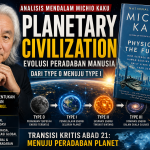 Planetary Civilization: Analisis Michio Kaku tentang Evolusi Peradaban dari Type 0 ke Type I



Leave a Reply