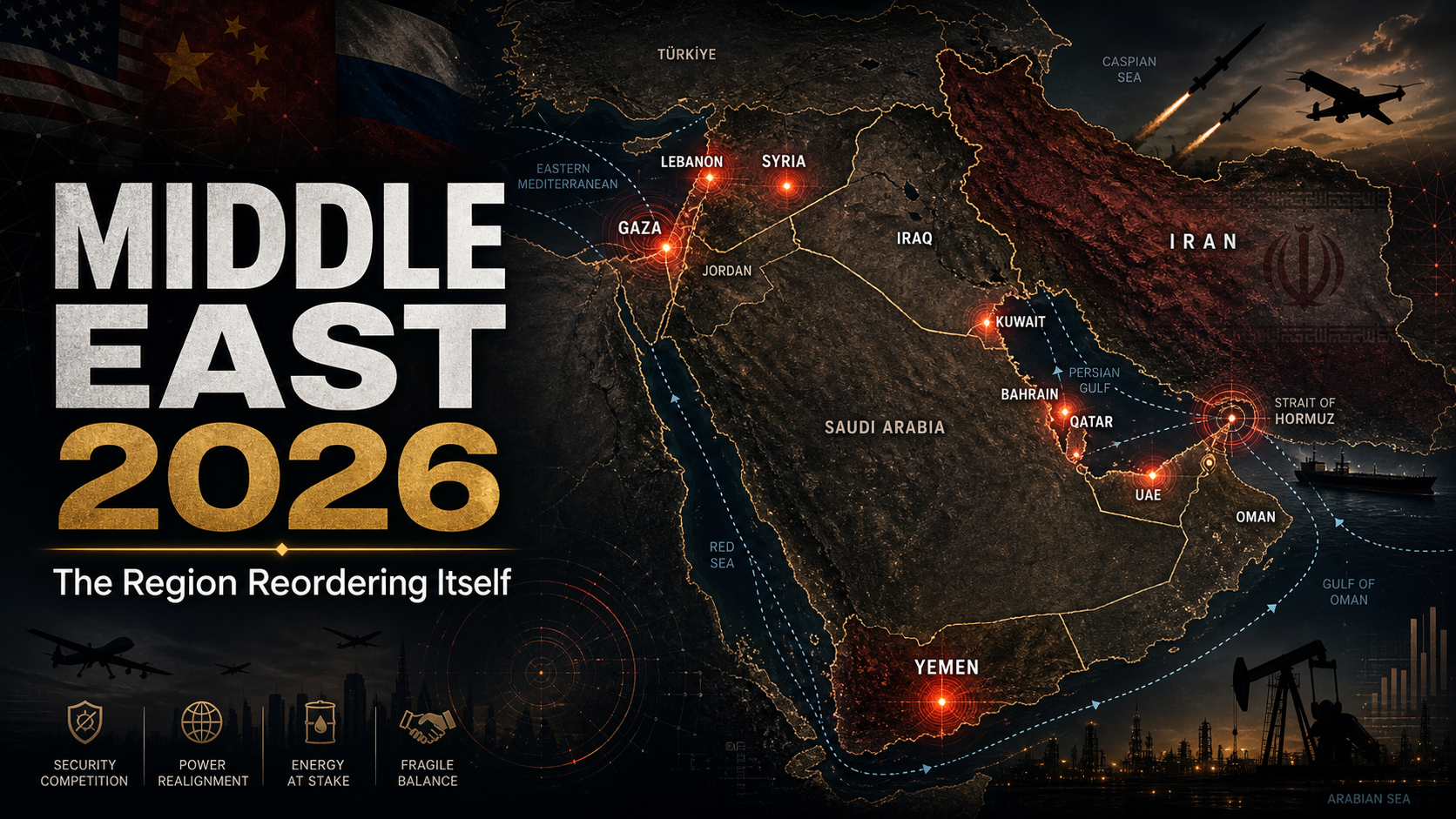
The geopolitical map of the Middle East in 2026 reveals a region reordering itself through war, energy disruption, great-power rivalry, the Gaza crisis, Iran’s pressure, Gulf instability, and the strategic contest over the Red Sea and the Strait of Hormuz.
Introduction: The End of the Old Order
For the better part of seven decades, the Middle East’s geopolitical architecture rested on a set of durable if deeply uncomfortable arrangements: American security guarantees for the Gulf monarchies in exchange for stable oil flows; Iran’s containment through sanctions and proxy counterpressure; the Palestinian question frozen in a state of managed denial; and Israel’s nuclear monopoly enforced by strategic ambiguity. Those arrangements have not simply frayed — they have collapsed. The period between October 2023 and May 2026 has delivered a cascade of events that have shattered nearly every assumption underpinning the regional order: the Hamas-led assault on Israel on October 7, 2023; the subsequent Gaza war; the October 2024 Israeli invasion of Lebanon; the fall of Assad’s Syria in December 2024; the Twelve-Day War between Israel and Iran in June 2025; and, most seismically, the February 28, 2026, launch of Operation Epic Fury — the coordinated U.S.-Israeli strike campaign that killed Iranian Supreme Leader Ali Khamenei and unleashed a regional conflagration of historic proportions.
The region entering 2026 is not the same as the one entering 2024. The Iran-led “Axis of Resistance” — the web of proxy forces stretching from Hezbollah in Lebanon to Hamas in Gaza, the Houthis in Yemen, and militias in Iraq — has been either destroyed or severely degraded as a coherent strategic network. In its place, however, is not peace but a more fragmented and unpredictable security landscape, one defined by leaderless insurgencies, contested state authority, and a power vacuum that multiple actors are racing to fill. The transition from interstate conventional warfare to high-stakes proxy competition and resource-driven civil unrest is now the dominant security paradigm.
What makes the current moment particularly consequential is the simultaneity of crises. Analysts and policymakers are accustomed to managing one major regional fire at a time; the architecture of American engagement in the Middle East was built on the premise that crises could be sequenced and managed. Today, there is no such luxury. The Gaza ceasefire is tenuous and contested. Lebanon is in an active war. Syria’s transitional government teeters. Yemen’s conflict has resumed new dimensions. Iran is simultaneously negotiating under duress and reconstituting its military capacity. The Gulf states are absorbing Iranian strikes while frantically recalibrating their security doctrines. And the Strait of Hormuz, through which approximately 20 percent of the world’s traded oil passes, has been intermittently closed — an act without modern precedent.
The United States, which for decades served as the region’s indispensable security anchor, has shifted from institutional leadership to what analysts describe as “Strategic Agility” — a more transactional, less predictable posture that has left longstanding allies uncertain and adversaries emboldened. Washington instigated the current war with Iran, yet its ability or willingness to manage the war’s consequences has been called deeply into question. The Trump administration’s withdrawal from over sixty international organizations, its embrace of “gunboat diplomacy,” and its erratic communication of red lines have created a credibility gap that competitors, most notably China and Russia, are actively exploiting.
Within this chaotic environment, new power arrangements are emerging. Saudi Arabia is pursuing what its own strategists describe as “aggressive strategic autonomy” — a proactive assertion of sovereignty that positions Riyadh as the economic and diplomatic hub of a new multipolar Middle Eastern order, rather than a dependent client of Washington. The UAE, meanwhile, has charted its own course, deepening ties with Israel even as Saudi Arabia maintains distance from normalization. Turkey has positioned itself as one of the few regional powers capable of functioning simultaneously as a NATO ally, a regional mediator, and an independent security actor. And China, though moving cautiously, is steadily expanding its footprint — economic, diplomatic, and increasingly technological — across the region.
The human cost of this reordering has been staggering. The Gaza war has produced one of the most severe humanitarian catastrophes in the Middle East since at least the Lebanese civil war. Lebanon has suffered mass displacement — over one million people, nearly twenty percent of the country’s population — from the resumed Israel-Hezbollah conflict. The closure of the Strait of Hormuz has rippled through global energy markets, threatening recession-level disruptions to economies from Germany to Japan to South Korea. Iran itself has experienced a catastrophic economic shock: around one million Iranians have been rendered unemployed by the conflict, while an internet shutdown has cost the economy tens of millions of dollars daily.
Crucially, the breakdown of the old order has not produced a clear successor architecture. There is no regional security organization with the legitimacy or capacity to impose order. The Arab League remains divided between states that tacitly supported or acquiesced to the U.S.-Israeli strikes on Iran and those that condemned them. The United Nations Security Council, paralyzed by competing vetoes from Russia and China on one side and the United States and its allies on the other, has been unable to pass binding resolutions on the war’s most urgent dimensions. The IAEA — the body responsible for monitoring Iran’s nuclear program — has been unable to resume inspections in the country since the June 2025 strikes, leaving the international community unable to verify the extent of damage to Iran’s nuclear infrastructure.
The philosophical stakes of this moment extend beyond the immediate security crisis. The question of whether the rules-based international order — already strained by Russia’s invasion of Ukraine and China’s assertiveness in the Indo-Pacific — can survive a major regional war launched without UN Security Council authorization, in which a nuclear-threshold state has had its supreme leader assassinated, is not merely academic. The precedents being set in the Middle East in 2026 will shape how states around the world calculate the costs and benefits of developing nuclear deterrents, aligning with or hedging against great powers, and engaging in or abstaining from multilateral institutions.
Understanding the current Middle East requires dispensing with several categories of outdated analysis. The “peace process” framing for the Palestinian question, premised on the viability of a negotiated two-state solution in the near term, has been rendered effectively moot by facts on the ground in both Gaza and the West Bank. The “axis versus moderates” framework — which positioned Iran and its proxies against pro-American Arab states — has been complicated by the reality that the “moderate” Gulf states have themselves come under sustained Iranian attack while simultaneously seeking to limit the war’s scope. And the assumption that American power would serve as the ultimate stabilizing force must be revisited in light of Washington’s own role as a co-instigator of the region’s most destabilizing recent event.
This article undertakes a comprehensive, section-by-section analysis of the major security and geopolitical dynamics reshaping the Middle East as of May 2026. It draws on the most recent reporting, official statements, and analytical assessments to provide a rigorous account of where the region stands, how it arrived at this point, and where the most significant fault lines and opportunities for stabilization lie. The analysis proceeds through ten thematic domains — from the Iranian nuclear crisis to the competition among external powers — and concludes with a synthetic assessment of the prospects for regional order in the years ahead.
The Iran Crisis: War, Succession, and the Nuclear Endgame
The Iran crisis of 2026 is best understood not as a sudden eruption but as the culmination of an escalatory cascade that began with the Hamas attack on Israel on October 7, 2023. That attack, which Iran enabled through decades of strategic investment in the Axis of Resistance, set in motion a chain of events whose ultimate logic pointed toward direct Israeli-Iranian confrontation. The June 2025 “Twelve-Day War” — in which Israel struck Iranian nuclear facilities and military infrastructure in a campaign widely described as unprecedented in scope — was itself a product of this logic. But even that dramatic escalation proved insufficient to deter either party. On February 28, 2026, the United States and Israel launched Operation Epic Fury, a coordinated campaign of nearly 900 airstrikes executed in twelve hours, targeting Iran’s nuclear sites, ballistic missile infrastructure, military command, and senior leadership. Within the conflict’s opening hours, Supreme Leader Ali Khamenei was killed.
The assassination of Khamenei — the most consequential act of political violence in the Middle East since the killing of Anwar Sadat in 1981 — sent shockwaves through not just the region but the entire international system. Iran appointed Khamenei’s son, Mojtaba Khamenei, as his successor, a move that appeared to satisfy constitutional requirements while deepening questions about the new leadership’s legitimacy and coherence. U.S. Director of National Intelligence Tulsi Gabbard stated on March 18 that the U.S. intelligence community assessed the Iranian regime to be “intact, but largely degraded,” noting that internal tensions were likely to increase as the country’s economic situation worsened. The regime’s survival has not translated into strategic coherence: Secretary of State Marco Rubio acknowledged in late April that Iran’s leadership was “deeply fractured,” complicating negotiations.
Iran’s retaliatory response to the U.S.-Israeli strikes has been extensive and consequential. Tehran launched ballistic missiles and drone strikes against all six GCC states, targeting civilian and energy infrastructure as well as U.S. military bases. The UAE received the largest volume of Iranian strikes of any country, including Israel. Saudi Arabia intercepted and destroyed multiple ballistic missiles launched toward Riyadh, while attacks on its eastern oil-producing region created immediate energy market disruptions. Iranian drones struck infrastructure in Fujairah, setting fire to oil installations. Qatar’s Al-Udeid air base — the largest U.S. Air Force installation in the Middle East — was also targeted. Kuwait and Bahrain sustained strikes that killed soldiers and civilians alike. The Arab Center DC assessed these attacks as the most serious threats to GCC physical security since Iraq’s occupation of Kuwait in 1990-91.
The closure of the Strait of Hormuz has been the single most economically consequential act of the conflict. Iran, in retaliation for the U.S.-Israeli strikes, moved to exert control over the strait — through which approximately 20 percent of the world’s oil and liquefied natural gas normally passes, primarily from Gulf producers to markets in Asia. Traffic through the strait has largely been at a standstill since early March. The U.S. has simultaneously imposed a naval blockade on Iranian ports, creating a dual chokehold on Persian Gulf maritime traffic. Secretary of State Rubio stated unequivocally that the U.S. would not tolerate a system “in which the Iranians decide who gets to use an international waterway and how much you have to pay them to use it.” Australia’s foreign minister undertook a diplomatic tour of Japan, China, and South Korea specifically to address “shared energy security” amid the crisis. A UN Security Council resolution demanding the strait’s reopening was vetoed by Russia and China in April.
Nuclear negotiations have been the central diplomatic arena of the conflict’s second phase. The U.S. has articulated a fifteen-point framework that includes, among other demands, Iran ending its use of armed proxies across the region, surrendering enriched nuclear material, and definitively abandoning its nuclear weapons ambitions. Iran submitted a proposal in late April that, according to U.S. officials, set aside discussion of the nuclear program until after the war’s end — a formulation that Trump described as unsatisfactory. “That fundamental issue still has to be confronted. That still remains the core issue here,” Rubio stated. The IAEA remains unable to resume inspections inside Iran, meaning the international community has no verified picture of how much damage was done to Iran’s enrichment infrastructure or how much fissile material may have been dispersed.
The ballistic missile question is equally unresolved and perhaps more immediately dangerous. Prior to the February strikes, Iran had been pursuing a strategy of “deterrence through volume” — acquiring new solid-fuel propellant mixing equipment and scaling production of ballistic missiles with the explicit aim of overpowering Israeli and American missile defenses in a future conflict. Contrary to early optimistic assessments, Tehran successfully acquired planetary mixers for solid-fuel propellant from external partners even after the June 2025 strikes. The IRGC’s emphasis on missile production as a survivable deterrent reflects a strategic logic that will not be easily extinguished even by the most comprehensive military campaign. Iran’s reconstitution capacity — drawing on dispersed facilities, dual-use technology, and foreign procurement networks — represents a long-term proliferation challenge that extends well beyond the current conflict.
Trump had set multiple deadlines for a negotiated deal — March 21, then March 23, then April 7 — each of which passed without agreement, while threatening that the U.S. would attack Iranian energy infrastructure and bridges if a deal was not reached. These threats have been partially acted upon: strikes on Iranian power plants have been reported, and satellite imagery has confirmed damage to nuclear-related sites, including a yellowcake plant. The pattern of extended deadlines, partial military action, and inconclusive negotiations reflects the fundamental difficulty of the U.S. position: Washington wants Iran to capitulate on nuclear weapons while simultaneously managing a war whose regional escalation is already beyond its preferred parameters.
Iran’s domestic situation adds another layer of complexity. The government has cracked down severely on internal dissent since the February strikes, making mass arrests on charges of spying for Israel and links to foreign opposition networks. A sustained internet shutdown — which has cost the economy an estimated £28 million per day according to RUSI — has hindered coordination among potential protest movements. The government has gone so far as to threaten the confiscation of assets from Iranians abroad who express support for Israel or the United States. These measures suggest a leadership that is simultaneously embattled and determined: the regime appears to have calculated that internal repression is preferable to the political risks of genuine accommodation with Washington.
The regional consequences of a weakened but surviving Iran are, paradoxically, more dangerous in some respects than those of a strong, coherent Iran. A fractured Iranian leadership, facing enormous economic pressure, domestic unrest, and military degradation, may calculate that escalation is a better survival strategy than de-escalation. The IRGC in particular — whose institutional interests are tied to military power and external projection — has the capacity to act independently of any diplomatic process, whether through resumed proxy operations, cyber attacks on Gulf infrastructure, or efforts to reconstitute nuclear capabilities at dispersed or hardened sites. The window for diplomatic de-escalation, as analysts at SpecialEurasia have noted, narrows with each passing month of military reconstitution.
The ultimate question—whether Iran will be permitted to rebuild toward a nuclear threshold, or whether the current campaign will produce a durable halt—remains unanswered. Rubio’s remarks suggest that Washington views denuclearization as the sine qua non of any settlement. Iran’s history as a negotiator suggests it will seek any deal that allows it to preserve latent nuclear capacity, even if under nominal constraints. The gap between these positions is vast. What fills that gap—whether a negotiated framework, continued military pressure, or the implosion of one or both negotiating parties—will determine the Middle East’s security trajectory for the next decade.
To help anticipate and plan for critical contingencies, it is crucial to outline plausible future scenarios and their policy implications. Three such scenarios can be sketched:
1. Negotiated Settlement with Partial Constraints: In this outcome, sustained international pressure and drawn-out talks eventually yield an agreement that falls short of complete denuclearization but imposes tight verification and temporary caps on Iranian nuclear activity. Iran retains some latent capacity, while the United States and its allies secure enhanced inspection rights and a phased reduction of sanctions. Policy implication: This scenario would stabilize the region in the short term but leave unresolved uncertainties about Iran’s long-term intentions, requiring ongoing vigilance and a robust deterrence posture from regional and international actors.
2. Extended Military Stalemate: Here, diplomatic efforts fail, and both sides resort to tit-for-tat military and covert actions. Iran continues a gradual reconstitution of its capabilities, while the United States and its partners use intermittent strikes or hybrid pressure, but without restoring the previous regional equilibrium. The Hormuz and Red Sea corridors remain periodically disrupted. Policy implication: Chronic instability prevails, regional actors accelerate hedging behavior, and the risk of miscalculation leading to wider conflict remains high. The international community is forced to manage crises reactively, at high cost to global energy and trade.
3. Regime Crisis and Regional Escalation: In this scenario, internal pressure within Iran—driven by economic collapse and social unrest—leads to a power vacuum or chaotic leadership change. Competing factions battle for control, and the IRGC or other hardline elements accelerate nuclear and asymmetric programs to assert authority. Policy implication: The resulting disorder could trigger widespread proxy violence, create opportunities for extremist actors, and increase the prospect of regional arms races, prompting urgent international intervention to prevent proliferation or state collapse.
Each scenario demands tailored policy responses—from investing in diplomatic leverage and arms control mechanisms, to enhancing crisis management frameworks, to preparing for humanitarian contingencies and multilateral stabilization efforts.
The Gaza Conflict and the Palestinian Question
The Gaza conflict, which began with the Hamas-led assault on Israel on October 7, 2023, has by May 2026 entered its third year as an active security crisis and an ongoing humanitarian catastrophe. The arc of the conflict has passed through multiple phases: the initial Israeli ground offensive; the erosion of Hamas’s military capacity; the October 2025 ceasefire brokered through sustained U.S., Egyptian, Qatari, and Turkish diplomatic pressure; the establishment of a UN Security Council-endorsed governance framework; and the chronic violation of that framework by multiple parties. The ceasefire was formalized through Resolution 2803, adopted by the Security Council in November 2025, which endorsed a “Comprehensive Plan to End the Gaza Conflict” and authorized an international Board of Peace, chaired by U.S. President Donald Trump, to oversee Gaza’s political transition. Despite this architecture, the situation on the ground has remained deeply unstable.
Since the October 2025 ceasefire took effect, Israeli forces have reportedly carried out over 730 violations, including air and artillery strikes and direct shootings. As of the UN’s March 27 update, 13 Palestinians had been killed between March 17 and 25 alone, while since the ceasefire’s announcement, a total of 689 Palestinians had reportedly been killed. The “Yellow Line” established by Israeli security forces as a division within Gaza has remained a persistent point of contention, functioning as a de facto partition of the strip. Israel’s stated justification for continuing strikes — the targeting of Hamas remnants and their infrastructure — has been disputed by international observers who note that many of the casualties are civilian.
The governance vacuum in Gaza is perhaps the most acute structural problem facing the territory’s future. The shift to a reformed Palestinian Authority, envisioned as the eventual successor to Hamas governance, has effectively stalled. The first phase of the Comprehensive Plan established the ceasefire and secured the return of the last hostages — the final hostage was returned to Israel on January 26, 2026. The second phase — the formation of an interim technocratic government and the eventual cession of control to a reformed PA — has been impeded by a combination of Israeli resistance, Hamas obstructionism, and the PA’s own institutional weaknesses. Residual Hamas factions and local clans have moved into the governance vacuum, competing for control over aid distribution and effectively creating a parallel power structure that undermines reconstruction.
The humanitarian situation in Gaza remains catastrophic. The Rafah border crossing — the only crossing not bordering Israel, which had been closed since May 2024 — was briefly reopened for pedestrian passage in January 2026 following the return of the last hostage. It was closed again in late February as regional hostilities flared with the onset of Operation Epic Fury, blocking all humanitarian aid entry. The sustained restriction of humanitarian access has prompted urgent appeals from international organizations, with the UN Secretary-General launching a major humanitarian appeal from a war-torn Lebanon in March while simultaneously addressing Gaza’s needs. The absence of a large-scale reconstruction initiative is not merely a humanitarian failure; it is generating the conditions for what analysts describe as a “perpetual insurgency,” one that could escalate into intense urban combat at any moment.
The West Bank situation, often overshadowed by the Gaza crisis, has been deteriorating independently and at a pace that alarms regional security analysts. The monthly average of Palestinians injured in Israeli settler attacks has risen to 105 in 2026, up from 69 in 2025 and 30 in 2024. The number of Palestinians displaced by settler violence and access restrictions has reached 1,697 — already surpassing the total for all of 2025. A series of Israeli government measures have accelerated settlement activity, deepened Israeli administrative control, and facilitated land expropriation. The UN’s Office of the High Commissioner for Human Rights published its annual report on Israeli settlements in the Occupied Palestinian Territory in March, documenting a systematic expansion that renders the contiguous territorial basis for a future Palestinian state increasingly implausible.
The Palestinian Authority, theoretically positioned as the designated successor governance structure in Gaza and the anchor of any future Palestinian state, faces a profound crisis of legitimacy and capacity. Hamas remains broadly popular in the West Bank, in large part due to public frustration with the absence of any credible political horizon under PA leadership. The PA’s reform efforts have been described by analysts as “baby steps”—insufficient to restore the institutional credibility and security capacity required to govern post-war Gaza. Without a credible Palestinian governance partner, the international community’s ambitions for a political transition in Gaza rest on a foundation that does not exist.
The Trump peace initiative — the “Comprehensive Plan to End the Gaza Conflict” — has produced real if limited achievements: the ceasefire framework, the hostage releases, and the establishment of the Board of Peace. But the plan’s deeper ambitions — ultimately transitioning Gaza to a reformed PA and creating conditions for broader Israeli-Arab normalization — have collided with multiple obstacles simultaneously. Trump’s stated priority of Hamas’s demilitarization has not been clearly operationalized. The relationship between demilitarization and reconstruction sequencing remains contested. Israel’s track record of exploiting diplomatic ambiguity to continue military operations in Gaza — and Netanyahu’s own coalition-management imperatives, which require maintaining a hawkish posture — have created a structural impediment to meaningful Phase Two implementation.
The prospect of a viable Palestinian state — long discussed but never realized — appears more remote than at any point since the Oslo Accords. Israeli policies of settlement expansion, demographic consolidation in the West Bank, and the refusal to permit a unified Palestinian governance structure across Gaza and the West Bank together constitute a de facto annexationist project. International condemnation has not translated into meaningful pressure, in part because the United States under the Trump administration has declined to condition its security relationship with Israel on settlement activity or West Bank governance. The only lever that has historically induced Israeli flexibility — credible American pressure — is currently absent.
Regional actors remain deeply invested in the outcome in Gaza, though their influence is constrained. Turkey, Egypt, and Qatar were instrumental in securing the October 2025 ceasefire. Saudi Arabia’s willingness to normalize relations with Israel — the grand prize that Netanyahu and Trump have identified as the reward for a Gaza settlement — remains contingent on meaningful progress toward Palestinian statehood, which Israel’s current government is unwilling to provide. This creates a strategic deadlock in which the most significant diplomatic incentive available — Saudi normalization — is precisely the outcome that current Israeli policies are making least attainable. The paradox is characteristic of the broader Middle Eastern security environment: the most important agreements are structurally prevented by the parties who would benefit most from them.
Looking ahead, the most realistic scenarios for Gaza do not include either a decisive Israeli military victory over Hamas’s remaining elements or a genuine political transition to PA governance in the near term. The more probable trajectory is a prolonged state of “suspended resolution,” neither war nor peace, but a grinding cycle of periodic Israeli military operations, sporadic Hamas resistance, humanitarian crisis management, and governance vacuum. This perpetual instability will serve as a persistent incubator of regional radicalization, a drain on international diplomatic bandwidth, and an ongoing source of friction between Israel and its regional partners. The cost of this stalemate, measured not just in Palestinian lives but in regional stability and the coherence of international law, is being paid daily, while the political will to end it remains conspicuously absent.
To translate analysis into actionable recommendations, a set of evidence-based policy interventions is essential for regional and international actors to mitigate the risks of this prolonged impasse:
1. Establish a robust international monitoring mission mandated to document and verify ceasefire violations and facilitate unimpeded humanitarian access. This could be under the auspices of the United Nations or a consortium of trusted regional actors (such as Egypt, Qatar, and Turkey), aiming to restore international credibility to the ceasefire framework and reduce civilian harm.
2. Create a sustained mechanism for humanitarian aid delivery that decouples the entry of essential goods from political negotiations, possibly through the appointment of a high-level regional humanitarian envoy empowered by a Security Council mandate. This would leverage precedents from other conflict zones in ensuring aid continuity.
3. Incentivize incremental steps toward Palestinian governance reform by establishing conditional international reconstruction funding. Funds would be disbursed in stages, linked to clearly defined milestones in administrative capacity-building, corruption reduction, and security sector accountability in both Gaza and the West Bank.
4. Encourage regional stakeholders, particularly Egypt, Qatar, and Saudi Arabia, to form a joint stabilization working group focused on local security arrangements and cross-border economic development in southern Gaza. Such a forum could build trust and facilitate pragmatic de-escalation steps in the absence of a comprehensive settlement.
5. Urge international partners, especially the United States and the European Union, to condition diplomatic and economic incentives for Israel on measured restraint in military operations and credible engagement with a defined political horizon for Palestinian self-determination.
6. Support civil society initiatives and local conflict mediation networks to address grassroots grievances and prevent the resurgence of radicalization within affected Palestinian communities. This should be coupled with sustained investment in education, psychosocial support, and job creation to mitigate the centrifugal force of violence and despair.
While no single intervention can resolve the underlying conflict, a coordinated portfolio of these policies can reduce the human cost, preserve the conditions for future diplomacy, and prevent the Gaza stalemate from evolving into a permanent source of regional volatility.
Lebanon and the Hezbollah Dilemma
Lebanon entered 2026 in a state of extraordinary vulnerability — politically fragile, economically broken, and geopolitically exposed between two of the region’s most powerful military actors. The November 2024 cessation of hostilities between Israel and Hezbollah had created a tentative window for Lebanese state reconstruction, with the Lebanese Army completing the first phase of its plan to disarm Hezbollah south of the Litani River by the end of 2025. Lebanese military officials announced in January 2026 that Hezbollah had been largely disarmed in the southern zone between the Israeli border and the Litani — a potential milestone that represented more than a year of painstaking, and contested, security work. The International community had praised the Lebanese Army’s efforts even as Israel continued near-daily airstrikes on Lebanese territory, citing ongoing Hezbollah violations.
The fragile progress was shattered on March 2, 2026, when Hezbollah renewed its attacks on Israel in direct response to the U.S.-Israeli war on Iran that began on February 28. Hezbollah issued 124 statements claiming responsibility for attacks on military, security, and civilian targets in Israel and IDF forces in southern Lebanon between March 2 and 9 alone, firing rockets, launching missiles, and deploying UAVs. These included the first rockets fired at central Israel since the November 2024 ceasefire — a dramatic escalation that demonstrated Hezbollah’s retained capacity despite the southern disarmament process. Israel responded with airstrikes across Lebanon, including the capital, Beirut, killing at least 31 people and wounding 149 in the opening days. By March 16, the Israeli army had begun ground operations in southern Lebanon, eventually deploying five divisions. By March 24, the Israeli defense minister announced Israel’s intention to demolish Lebanese border settlements and permanently occupy southern Lebanon up to the Litani River.
The 2026 Lebanon war, now in its third month as of this writing, has resulted in more than 2,000 militant and civilian deaths and displaced over one million people — approximately 20 percent of Lebanon’s entire population. The humanitarian crisis is severe: reports from Beirut document a 400 percent increase in rent in some areas as displaced persons compete for housing, while municipalities have imposed registration requirements and some communities have refused to rent to the displaced. The UN Secretary-General launched a major humanitarian appeal from war-torn Lebanon in March. The main bridges on the Litani River have been blown up by Israel to cut off southern Lebanon from the rest of the country, creating a de facto siege of the conflict zone.
Hezbollah’s strategic position in this war is complex and internally contested. The group has resumed rocket and drone attacks on Israel, claiming 124 attacks in the first week of the resumed conflict. As of late April, the IDF reported that it has struck more than 20 Hezbollah-linked infrastructure sites across the Beqaa Valley and southern Lebanon in a single day, targeting weapons manufacturing and storage facilities and rocket launch sites. The IDF found caches of Hezbollah weapons in southern Lebanon, including FPV drones, anti-tank explosive devices, RPGs, and remote detonation systems — confirming that Hezbollah’s rearming proceeded far more rapidly than the southern disarmament process could contain. Al Jazeera’s reporting from Beirut noted that the Israeli military had been taken aback by Hezbollah’s ability to resist Israel’s occupation of Lebanon’s southern territories and the group’s increasing tempo of operations.
The Lebanese state itself is in an extraordinarily difficult position. Prime Minister Nawaf Salam publicly condemned Hezbollah’s resumption of rocket fire as “irresponsible,” ordered the arrest of those responsible for the launches, and stated that the Iranian IRGC was “directing Hezbollah in its war on Israel,” using operatives with fake passports who had entered the country illegally. On March 24, the Lebanese government declared the Iranian ambassador persona non grata — an unprecedented step that reflects the degree to which Hezbollah’s actions are being experienced by the Lebanese state as an externally imposed war rather than a domestic political choice. Lebanon’s President Joseph Aoun accused those who drew Lebanon into war of “treason,” while simultaneously engaging in direct talks with Israel to seek an end to the hostilities.
The disarmament process — already at Phase One when the conflict resumed — has been thrown into disarray. Hezbollah leader Naim Qassem has condemned the Lebanese government’s decision to criminalize Hezbollah’s military activities, stating that “to demand exclusive arms control while Israel is committing aggression…means you are not working in Lebanon’s interest.” Analysts have noted that Hezbollah will not accept the second phase of disarmament — which extends north of the Litani — as long as Israel continues striking Lebanon. The Lebanese Army, which lacks both the equipment and the political mandate to forcibly disarm Hezbollah, is caught between international pressure to complete the disarmament and the practical impossibility of doing so in an active war zone. Civil-military relations have been strained, with the army facing potential internal friction and localized resistance if it presses ahead.
Israel’s stated security objectives in Lebanon have expanded with the conflict’s resumption. Netanyahu has asserted Israel’s freedom to strike Hezbollah targets throughout Lebanon — not only in the south but north of the Litani as well. He has declared the “elimination” of Hezbollah’s rocket array as a core achievement, while establishing what he describes as a “security zone” in southern Lebanon that prevents the possibility of invasion and anti-tank missile fire into northern Israel. Israeli Defense Minister Katz has threatened to “burn all of Lebanon” if Hezbollah continues to defy peace talks, while simultaneously threatening catastrophic consequences if the Lebanese government continues to provide cover for Hezbollah. These threats reflect both genuine military intent and political theater — Netanyahu’s domestic audience demands visible security achievements, while his international partners demand restraint.
The UNIFIL peacekeeping force in southern Lebanon — present since 2006 under UN Security Council Resolution 1701 — has been placed in an impossible position by the resumed conflict. UNIFIL stated that both Hezbollah’s rocket fire and Israel’s attacks crossing the Blue Line constitute violations of Resolution 1701. Russia condemned Israeli post-ceasefire strikes in Lebanon and attacks on journalists and UNIFIL peacekeepers, calling on Israel to withdraw from the occupied territories and return to diplomacy. International condemnation from Canada, Brazil, and Germany has been vocal, with German Chancellor Friedrich Merz expressing that he had become “disillusioned” with the U.S.-Israeli approach to Iran. These diplomatic pressures have not, however, produced any operational constraint on Israeli military activity.
The deeper structural problem in Lebanon is that Hezbollah’s disarmament cannot be fully achieved through external military pressure as long as the group retains political legitimacy within Lebanon’s Shia community. Hezbollah’s relationship to the Lebanese state is not simply that of an armed non-state actor; it is a deeply embedded social, political, and military institution that provides services, employment, and security to a substantial segment of the population. Any durable resolution of the Hezbollah problem requires a political settlement that addresses Shia political representation, economic marginalization, and the community’s security anxieties — none of which are addressed by Israeli airstrikes or forced disarmament. The Lebanese state’s capacity to provide alternative governance is itself profoundly limited by decades of sectarian power-sharing, corruption, and economic collapse.
The trajectory of the Lebanon war points toward a protracted conflict with no clear military resolution. Israel cannot achieve the permanent disarmament of Hezbollah through airstrikes alone; Hezbollah cannot defeat Israel militarily; and Lebanon’s civilian population continues to bear the catastrophic costs of a conflict imposed on it by larger regional forces. Northern Israeli communities have been forced to suspend classes and impose independent security restrictions as Hezbollah drone attacks persist despite the ceasefire framework, with former Prime Minister Naftali Bennett accusing the government of “returning to the policy of containment.” The cycle of Israeli military pressure, Hezbollah resilience, Lebanese civilian suffering, and inconclusive diplomacy that has characterized Israel-Lebanon relations since 2006 is repeating itself at a higher and more destructive pitch — and there is no credible diplomatic mechanism currently positioned to break it.
Syria: The Fractured Transition
Syria’s political transition, which began with the collapse of Bashar al-Assad’s regime in December 2024, represents one of the most consequential and perilous state transformations in the contemporary Middle East. The fall of the Ba’athist government — the product of a sudden military offensive by the Hayat Tahrir al-Sham-led coalition that swept from Idlib to Damascus in a matter of days — ended more than five decades of Assad family rule and a civil war that had killed over 500,000 people and created the largest refugee crisis since the Second World War. As of June 2025, the UN High Commissioner for Refugees reported 6.5 million internally displaced people and an additional 4.3 million Syrian refugees still registered in neighboring countries. President Ahmed al-Sharaa, who led the HTS-associated transitional government that took power in Damascus, initially promised an inclusive political process and engagement with Syria’s diverse ethnic and religious communities.
Eighteen months into the transition, the promise of inclusive governance has been substantially unfulfilled. Internal divisions within HTS — between pragmatic elements willing to engage internationally and hardline religiously conservative officials from Idlib — have impeded the consolidation of state authority. What observers describe as a “shadow cabinet” of hardline HTS members has increasingly sidelined the formal transitional government’s bureaucratic apparatus, creating a parallel power structure that undermines the administration’s credibility and governing capacity. Religiously conservative officials from Idlib have provoked a significant cultural and political divide with Damascus’s more diverse urban residents, generating social friction that complicates the construction of national identity beyond the common cause of ending the Assad regime.
Turkey has emerged as the most significant external actor in Syria’s transition, with a military presence in the north and substantial political influence over the HTS-dominated government. Alongside Saudi Arabia and Qatar, Turkey played a crucial role in persuading the Trump administration to lift sanctions on Syria — a significant diplomatic achievement that gave the new Syrian government an opportunity to reintegrate into the international community and begin economic reconstruction. However, this Turkish role is itself a source of tension: Turkey’s interests in Syria are not purely altruistic, encompassing the suppression of Kurdish autonomy in the northeast, the management of Syrian refugee return, and the projection of Ankara’s regional influence in competition with other powers.
Israel’s posture toward post-Assad Syria is one of the most destabilizing elements of the transition. Having conducted extensive strikes on Syrian military infrastructure immediately following Assad’s fall — targeting arms depots, air defense systems, and other military assets with the explicit aim of ensuring no new Syrian government could rapidly reconstitute offensive capabilities — Israel has maintained a high operational tempo inside Syria. Israeli forces have established a buffer zone or “security zone” southwest of Damascus and continue to strike perceived threats inside the country. According to analysts, Israel’s ultimate goal is to ensure that Syria remains weak, fragmented, and incapable of constituting a security threat — precisely the opposite of what Syria’s transitional government and its international backers are trying to achieve. This creates a direct and ongoing collision between Israel’s security doctrine and Syria’s state-building aspirations.
The Islamic State has exploited the transitional government’s consolidation difficulties to reestablish a presence inside Syria. Mobile operational bases have been detected in the Badia desert region, Syria’s vast central and eastern desert, which has historically served as an IS sanctuary. The group has drawn on the security vacuum created by the absence of effective state authority in eastern Syria, the demobilization of former Assad-era security forces, and the difficulties of integrating diverse armed factions into a coherent national army. The IS threat is not yet existential for the transitional government, but it represents a persistent security drain and a potential inflection point: if the transitional government’s cohesion deteriorates further, the conditions for IS reconstitution across a broader territorial base will improve dramatically.
Syria’s ethnic and sectarian fault lines have never been resolved by the political transition — they have merely been temporarily subordinated to the common cause of ending the Assad regime. The Alawite community, which provided the social base for Assad’s rule and staffed much of the military and security apparatus, faces acute anxieties about its security and status under the new order. Reports of reprisals against Alawite communities have been documented, and armed Alawite resistance along the coastal region represents a potential flashpoint for renewed sectarian conflict. The Kurdish community in the northeast — organized around the Autonomous Administration of North and East Syria and its military wing, the Syrian Democratic Forces — has been engaged in fraught negotiations with the transitional government over a political settlement that would recognize Kurdish self-governance without fully endorsing formal autonomy, which both Turkey and the central government oppose.
The Syrian economy is in a state of near-total collapse. Decades of war, international sanctions, regime predation, and now the disruptions of transition have left infrastructure destroyed and industrial capacity decimated. The lifting of some U.S. sanctions following the transition has opened channels for economic engagement, but international investment will not flow into Syria without a credible security environment and rule of law — neither of which currently exists. The humanitarian situation remains dire: millions of Syrians depend on international aid, and the capacity of the transitional government to deliver basic services outside Damascus and a few other major cities is severely limited. The large refugee populations in Turkey, Lebanon, Jordan, Iraq, and Egypt have been returning to Syria in modest numbers, but the pace is constrained by the absence of physical infrastructure, economic opportunity, and confidence in the new government’s durability.
The international diplomatic environment for Syria’s transition has been complicated by the onset of the U.S.-Iran war in February 2026. The U.S. withdrawal from Syria — announced in April 2026 and described by analysts at CSIS as “a pivotal moment for the region” — creates a significant power vacuum in the northeast, where U.S. forces had been the primary guarantor of the Kurdish-controlled Autonomous Administration’s security against both Turkish military pressure and potential HTS encroachment. The withdrawal leaves the SDF in a particularly exposed position and is likely to accelerate Turkish pressure on Kurdish-held areas. It also removes the most significant American leverage point in Syria’s political transition, precisely at the moment when that leverage might have been most usefully deployed.
Unless the transitional government can convene a genuinely inclusive national dialogue, form a national unity government that incorporates representatives from Syria’s political, ethnic, and sectarian spectrum, and draft a new constitution through a broadly participatory process, the prospects for sustainable stabilization are poor. The timeline is not indefinite: analysts have noted that if President al-Sharaa has not meaningfully broadened his coalition by mid-2026, the risk of a “counter-revolution” or renewed sectarian civil war between Sunnis and Alawites becomes substantially higher. Turkish and Israeli forces are likely to intervene further in such a scenario — on opposite sides, potentially — turning Syria once again into a theater of competing external interventions.
The Syrian case illustrates a fundamental challenge of post-authoritarian transition in the contemporary Middle East: the removal of a dictator creates a power vacuum that external actors, internal power brokers, and non-state armed groups all rush to fill, and the institutional capacity required to manage this competition — a professional civil service, an independent judiciary, a non-partisan military — has been destroyed by decades of authoritarian rule. Syria’s path from the collapse of the Assad regime to a stable, functioning state is measured not in years but in decades, and the current trajectory suggests that the early years of that journey will be characterized by fragmentation rather than consolidation. The international community’s attention — already stretched across multiple simultaneous crises — is not sufficient to the scale of the challenge.
Yemen and the Red Sea Security Crisis
Yemen’s multidimensional conflict represents one of the most complex security environments in the contemporary Middle East, combining a civil war of more than a decade’s duration with a maritime security crisis of global consequence, a humanitarian catastrophe of staggering proportions, and an increasingly fractious intra-Gulf rivalry that is reshaping the Arabian Peninsula’s political geography. The Houthi movement — formally known as Ansarallah and Iran-backed since its takeover of the capital Sana’a in 2014 — controls most of northwestern Yemen, including the capital, while Yemen’s internationally recognized Presidential Leadership Council (PLC) governs the country’s remaining territories with Saudi Arabian support. This basic territorial division has been complicated since late 2025 by the emergence of a new intra-anti-Houthi conflict: between the Saudi-backed PLC and the UAE-backed Southern Transitional Council (STC), which has been seeking to establish de facto autonomy or formal partition of the country’s south.
The Red Sea crisis — which began in October 2023 when the Houthis launched missile and drone attacks against Israel in solidarity with Palestinians in Gaza and expanded into attacks on international shipping — reached its peak in the period from late 2023 to mid-2025. By the height of the campaign, Houthi attacks had diverted global shipping around the Cape of Good Hope, more than doubled the operating costs of commercial vessels in the area, and disrupted the free flow of roughly twelve percent of global trade through the Suez Canal corridor. The U.S. launched an expanded campaign of strikes against Houthi positions in Yemen from March to May 2025, seeking to compel a lasting end to maritime attacks. The campaign ended under an Oman-brokered agreement in which the Houthis agreed to cease targeting U.S. vessels in exchange for a halt to American strikes. The Houthis then renewed attacks on some non-U.S. ships in July 2025, while continuing long-range strikes against Israel.
The Houthis suspended their maritime and aerial attacks following the October 2025 Gaza ceasefire but explicitly signaled their willingness to relaunch them if war in Gaza resumed. When the U.S.-Israeli strikes on Iran began on February 28, 2026, the Houthis immediately threatened to escalate, issuing statements of support for Iran and the Axis of Resistance. On March 28, the Houthis launched a ballistic missile at Israel, formally joining the wider regional war. Houthi military spokesman Yahya Sarea warned that the closure of the Bab el-Mandeb strait was “likely” if the conflict against Iran and Lebanon escalated sharply or if Gulf Arab states formally joined the war. Approximately 30 tankers near the Saudi port city of Yanbu — within Houthi strike range — have been monitoring developments. The USS Gerald R. Ford aircraft carrier’s deployment to the Red Sea has been closely tracked by Houthi forces, with military figures affiliated with Sanaa warning of potential strikes against U.S. naval assets.
Western naval architecture in the Red Sea has shifted from reactive escort operations to what analysts describe as “semi-permanent deterrence architecture.” This includes layered missile defense at sea, preemptive intelligence, surveillance, and reconnaissance monitoring of Houthi launch sites, rapid retaliatory strike frameworks, and European naval coordination alongside U.S. military assets. The UN Security Council adopted Resolution 2812 in January 2026, extending the Secretary-General’s monthly reporting requirement on Houthi attacks in the Red Sea for six additional months, with China and Russia abstaining. ACLED data records 84 percent fewer Houthi attacks in the Red Sea during 2025 compared to 2024 — a significant reduction attributable to the combined effect of U.S. military pressure, the Gaza ceasefire, and the Oman-brokered agreement. Whether this reduction represents a durable strategic shift or a temporary pause will be determined by the trajectory of the broader regional conflict.
The intra-Yemeni conflict between the Saudi-backed PLC and the UAE-backed STC has introduced a new and destabilizing dimension to the Yemen crisis. In early December 2025, STC forces moved eastward from their base in Aden and northward along the coast into the governorates of Hadramawt and Mahra, seeking to consolidate control over Yemen’s oil-producing and strategically located southern territories. Saudi Arabia responded with direct military intervention in December 2025 and January 2026, reversing the STC’s seizure of the eastern governorates and Aden, the seat of the internationally recognized government. Saudi Arabia publicly accused the UAE of providing military support to the STC — an extraordinary public rebuke between two countries that had nominally been allied for a decade. The UAE hit back, and the remaining UAE forces left Yemen. This public fracture between Riyadh and Abu Dhabi over Yemen represents a fundamental shift in Gulf political dynamics with implications that extend far beyond the Yemeni theater.
Saudi Arabia’s assessment of Emirati behavior in Yemen reflects a broader strategic anxiety that has been building for years. Riyadh has come to interpret UAE actions — in southern Yemen, Sudan, the Horn of Africa, and Libya — not as tactical interventions but as part of a deliberate pattern of structural reconfiguration of weak states that risks reshaping the geopolitical map surrounding the Kingdom. Saudi doctrine has long treated Yemeni territorial unity, however imperfect, as preferable to a patchwork of externally aligned entities with competing loyalties and military capabilities. From Riyadh’s perspective, the normalization of governance fragmentation in a neighboring state that historically served as a buffer represents an unacceptable strategic precedent. Saudi decision-makers increasingly assess that Emirati actions are “unilateral, insufficiently coordinated, and dismissive of Saudi red lines.”
The humanitarian situation in Yemen remains among the worst in the world. More than a decade of civil war, a Saudi-led blockade, and the destruction of the country’s economy have produced conditions that have contributed to what the UN has described as one of the worst famines in the world since 2016. Yemen’s GDP has contracted by approximately half since the conflict began. Millions of Yemenis depend on international humanitarian assistance for survival. The periodic closure of the Red Sea trade corridor — whether by Houthi maritime attacks or now by the Iranian Strait of Hormuz closure — compounds Yemen’s humanitarian crisis by disrupting the supply chains through which essential goods reach the country. The overlap between the maritime security crisis and the humanitarian emergency is not incidental: it reflects the degree to which Yemen has become a theater for geopolitical competition at the cost of its civilian population.
The arms trafficking dimension of the Yemen conflict adds a transnational security threat that extends beyond the country’s borders. Recent reporting has documented operational coordination between the Houthis, al-Qaeda in the Arabian Peninsula (AQAP), al-Shabaab, and Islamic State Somalia, centered initially on arms exchanges but potentially evolving into a strategic Iran-backed network capable of heightening regional instability across the Red Sea basin. The Houthis have been issuing regulatory decrees — including banning U.S. crude oil exports and imposing sanctions on American entities — that assert a quasi-state authority over international maritime commerce, a development that illustrates the group’s ambitions well beyond the immediate Yemeni conflict.
The question of how the Yemen conflict resolves — if it does — is deeply entangled with the broader regional trajectory. A comprehensive Yemeni settlement would require, at a minimum, a negotiated ceasefire between the Houthis and the PLC; a political framework that addresses the STC’s aspirations for southern autonomy while preserving nominal territorial unity; a withdrawal or reduction of foreign military forces; and a sustained international effort for reconstruction and economic stabilization. None of these conditions is currently in place. The Oman peace process, which had generated cautious optimism in 2022-2024, has been set back by the resumption of conflict triggered by the U.S.-Iranian war. Saudi Arabia’s stated interest in concluding a Yemen settlement is genuine — the war has been enormously costly for the Kingdom in financial, reputational, and strategic terms — but its capacity to deliver a settlement is constrained by the collapse of the Saudi-Emirati axis that was the nominal foundation of the anti-Houthi coalition.
Looking ahead, Yemen’s security trajectory for the remainder of 2026 is likely to be determined by two variables: the outcome of the U.S.-Iran conflict and the durability of the Saudi-Houthi de facto accommodation. If the Iran war produces a negotiated settlement that constrains Iranian support for the Houthis, the group’s strategic calculus may shift toward accommodation with Riyadh. If the war continues or intensifies, Houthi maritime operations are likely to resume, triggering another cycle of international naval intervention, economic disruption, and Yemeni civilian suffering. The Saudi-UAE rivalry, meanwhile, ensures that even under the most optimistic scenarios, Yemen’s political settlement will be contested by regional powers whose interests in the country’s future are fundamentally divergent. For the Yemeni population — already among the most impoverished in the Arab world — the prospect of durable peace remains a distant aspiration.
Gulf Dynamics: Rivalry, Recalibration, and the Saudi-UAE Fracture
The Gulf Cooperation Council has entered 2026 in an unprecedented state of internal stress. The organization, founded in 1981 as a platform for political, economic, and security cooperation among the six Arab Gulf monarchies — Bahrain, Kuwait, Oman, Qatar, Saudi Arabia, and the United Arab Emirates — has historically maintained a degree of cohesion sufficient to present a unified front on major regional security questions. That cohesion has been fundamentally undermined by the collision of two trends: the dramatic escalation of intra-Gulf rivalry between Saudi Arabia and the UAE, and the exposure of all GCC states to Iranian retaliation as a result of the U.S.-Israeli war on Iran. The February 28, 2026, strikes on Iran — which no GCC state had requested, and which several had explicitly cautioned against — drew every Gulf monarchy into a war not of their making and not in their interests.
Iran’s retaliatory strikes on GCC states following Operation Epic Fury constituted the most serious security shock to the Gulf in over three decades. Iran targeted all six GCC states, launching thousands of drones and missiles against civilian and energy infrastructure. The UAE received the most attacks of any country, including Israel — a reflection of Iran’s assessment that Abu Dhabi’s warm relationship with Israel and its proximity to Iranian interests made it a priority target. Saudi Arabia intercepted multiple ballistic missiles aimed at Riyadh and sustained strikes on its eastern oil-producing region. Qatar, Bahrain, and Kuwait also came under fire. The attacks destroyed the comfortable assumption that had underpinned Gulf security calculus for years: that Iran’s proxy warfare would be directed primarily at Israel and U.S. forces, and that Gulf states could maintain a kind of studied neutrality that would insulate them from direct Iranian retaliation.
In the immediate aftermath of the strikes, the U.S. announced a $16.5 billion arms package for the UAE, Kuwait, and Jordan, recognizing the gap between Gulf defensive needs and available capabilities. However, this support has clear limits: the Gulf states’ repeated appeals to Washington to avoid targeting Iranian civilian infrastructure were not heeded, leaving them vulnerable to continued retaliatory strikes even while receiving American defensive support. As the Atlantic Council has noted, this epitomizes the dual role the U.S. is playing in the war: its military systems have been indispensable to Gulf defense while Washington’s instigation of the war and reluctance to manage its regional consequences have contributed to the very crisis the Gulf now faces. Gulf states have pledged some two trillion dollars in U.S. investment and worked assiduously to cultivate the Trump administration, yet this proximity to Washington did not yield a veto over the decision to launch the war.
The strategic response of Gulf states to this exposure has been to accelerate their efforts to develop autonomous defensive capabilities. Saudi Arabia, Qatar, and the UAE signed defense agreements with Ukraine in late March 2026 — an extraordinary development that reflects both the scale of the Iranian drone threat and the Gulf states’ willingness to seek technical assistance from non-traditional partners. Ukraine’s experience countering Iranian-derived drone variants has made Kyiv an unexpected source of relevant expertise, and the potential integration of Ukrainian interceptor systems into Gulf defense architectures represents a novel form of security collaboration. Beyond Ukraine, the broader push is toward indigenous defense industrialization — building domestic defense-sector capacity rather than relying indefinitely on imports from the United States, the United Kingdom, or France.
The Saudi-UAE rupture over Yemen has made the prospect of a unified GCC security response to the Iranian threat significantly more difficult. The public fracture between Riyadh and Abu Dhabi — which began with Saudi military strikes on a UAE-linked weapons shipment in Yemen and escalated into reciprocal public accusations unprecedented in the history of the two countries’ relationship — has exposed the depth of strategic divergence between the two most powerful Gulf states. Analysts at the Baker Institute and the Soufan Center have described the divergence as rooted in fundamentally different threat perceptions, regional ambitions, and visions for the Red Sea and MENA region. Saudi policymakers view Emirati activities in Sudan, Somalia, Yemen, and elsewhere as a pattern of structural reconfiguration of weak states, reshaping the geopolitical map surrounding the Kingdom in ways that threaten Saudi strategic depth. The UAE, for its part, has “antagonized other stakeholders,” including Egypt and Turkey, and faces the prospect of an unprecedented regional coalition against its policies.
The question of how to engage with Israel has become another major fault line within the Gulf. The UAE, which normalized relations with Israel in 2020 under the Abraham Accords, has deepened its cooperation with Israel even as other Gulf states have faced political pressure from their own populations — increasingly anti-Israel in sentiment in the context of the Gaza war — to maintain distance. Saudi Arabia’s willingness to normalize with Israel, which had been the centerpiece of the Trump administration’s regional diplomacy in 2025, has been made effectively politically impossible by Israel’s conduct in Gaza and Lebanon. Crown Prince Mohammed bin Salman faces a domestic environment in which normalization with Israel would be politically costly, even as Trump continues to seek the diplomatic prize of a Saudi-Israeli accord. Carnegie’s analysis suggests that if the UAE deepens its alignment with Israel, this could force MBS to seek accommodations with Tehran — a paradoxical outcome in which American pressure for normalization produces greater Iranian-Saudi rapprochement.
The economic dimension of Gulf security is increasingly inseparable from the geopolitical. Saudi Arabia, the UAE, and Qatar have collectively committed roughly $2.5 trillion to U.S. technology investments as a form of geopolitical insurance — making themselves essential to American economic interests in the AI race and thereby ensuring that Washington’s adversaries become their adversaries. This strategy, described by analysts as transforming commercial relationships into security guarantees, has produced tangible results: Google’s $10 billion investment in Saudi AI infrastructure makes the company a direct stakeholder in Saudi stability, as does Microsoft’s $7.9 billion in the UAE and Amazon’s $5.3 billion in Saudi data centers. But the strategy’s limits were exposed by the February 2026 war: Gulf financial commitments to American tech did not prevent Washington from launching a conflict whose consequences they are now absorbing.
Oman occupies a distinctive and increasingly valuable position within the Gulf security architecture. The only Arab Gulf state to directly criticize the U.S.-Israeli strikes on Iran and to welcome the selection of the new Iranian Supreme Leader, Oman has maintained a calculated middle road between Iran, the U.S., and the Arab Gulf — a posture that has made it the indispensable channel for back-channel U.S.-Iran communications and the most likely venue for any negotiated settlement. Qatar, which noted that “we will be neighbors with Iran for the future of humankind,” has similarly sought to position itself as a forum for dialogue. These diplomatic stances reflect a recognition — shared among the smaller Gulf states — that the maximalist positions of both Washington and Tehran, if maintained, would lead to catastrophic outcomes for the entire region.
The institutional cohesion of the GCC itself is under stress. Analysts at Carnegie have noted that new pressures stemming from the Iran war can encourage zero-sum thinking between Saudi Arabia and the UAE. If the two powers are not aligned, they could engage in a bidding war for scarce U.S. air defense stockpiles, driving up prices for both, while other Gulf states are priced out. The possibility that the UAE will strengthen security ties with Israel while Saudi Arabia prioritizes regional diplomacy could divide the GCC into effectively two camps — one aligned with Washington and Tel Aviv, the other seeking accommodation with the broader regional environment, including, eventually, Tehran. Such a division would fundamentally undermine the GCC’s function as a security organization.
Looking ahead, the Gulf’s strategic trajectory will be defined by several key questions: whether the U.S.-Iran war produces a settlement that stabilizes the regional security environment or extends into a prolonged low-grade conflict; whether the Saudi-UAE rivalry can be managed below the threshold of irreversible rupture; and whether Gulf states can develop sufficient autonomous defensive capabilities to maintain their security without dependence on a U.S. that may not always be a reliable patron. Saudi Arabia’s “security through prosperity” strategy — positioning Riyadh as the economic hub of a peaceful, integrated Levant and Gulf — represents the most ambitious of the Gulf visions, but its realization depends on regional stability that the current conflict is making more distant. For now, the Gulf monarchies are navigating a storm of their neighbors’ making, drawing on decades of accumulated wealth and diplomatic capital to survive a geopolitical upheaval they neither sought nor endorsed.
The United States: From Policeman to Pragmatist
The United States’ role in the Middle East in 2026 represents one of the most significant departures from the post-Cold War American strategic posture in the region’s history — not a retreat from engagement, but a radical transformation in its character. For seven decades, American power in the Middle East rested on a set of interlocking commitments: security guarantees for the Gulf monarchies, unconditional support for Israel, a commitment to freedom of navigation, and a general disposition to maintain regional order rather than remake it. The Trump administration’s approach has retained the security relationship with Israel and the commitment to freedom of navigation while jettisoning the broader architecture of multilateral engagement, treaty obligations, and alliance management that gave those commitments their strategic weight.
The decision to launch Operation Epic Fury on February 28, 2026 — co-authorizing the U.S.-Israeli strikes that killed Khamenei and initiated the most consequential regional war since at least the Gulf War — was the defining act of this transformed posture. The strikes were not preceded by sustained multilateral consultation, were not authorized by the UN Security Council, and were explicitly opposed by multiple American allies and partners. The Trump administration calculated that a decisive military blow against Iran’s nuclear and leadership infrastructure would produce a favorable settlement more rapidly than any diplomatic process — an assessment that, four months into the conflict, has not been borne out. The war has instead produced a sustained regional conflagration, the closure of the Strait of Hormuz, Iranian strikes across GCC states, and a diplomatic stalemate in which no deal has been reached.
American military power in the region remains formidable. The United States maintains the largest military footprint in the Middle East, operating from bases across the Gulf, including Al-Udeid Air Base in Qatar (the largest U.S. Air Force installation in the region), naval assets throughout the Persian Gulf and Red Sea, and a residual advisory force in the Kurdistan Region of Iraq until September 2026. The USS Gerald R. Ford carrier strike group’s deployment to the Red Sea in early March 2026 demonstrates Washington’s continued capacity for power projection. The $16.5 billion arms package announced in March for the UAE, Kuwait, and Jordan reflects the ongoing American commitment to Gulf partners’ defensive capacity. But translating military hardware into political outcomes has proven elusive: Iran has not capitulated, Hormuz remains contested, and the negotiating stalemate persists.
The Trump administration’s sequential deadline-setting and partial military action — threatening to attack Iranian bridges and power plants, setting and missing deadlines of March 21, March 23, and April 7 — has created a perception of negotiating incoherence that has complicated the U.S. diplomatic position. When Trump declared on March 6 that only Iran’s “unconditional surrender” would be acceptable, this maximalist framing hardened Iranian positions without producing the desired capitulation. The subsequent modulation — responding to Iranian proposals even while rejecting their terms — suggests that Washington recognizes the limits of a purely coercive strategy but has not yet articulated a credible diplomatic off-ramp that could satisfy both its stated security requirements (denuclearization, end of proxy support) and Iran’s minimum survival requirements (regime continuity, some economic relief).
The broader “America First” strategic posture has reshaped the U.S. role in the Middle East in ways that extend beyond the Iran conflict. Washington’s withdrawal from over sixty international organizations has reduced its capacity to orchestrate multilateral responses to regional crises. The credibility of American security guarantees — long the bedrock of Gulf states’ strategic calculations — has been significantly undermined by the revelation that Gulf allies had no effective veto over a decision that exposed them to devastating Iranian retaliation. As the CSIS Middle East Program notes, the U.S. withdrawal from Syria marks a pivotal moment for the region, removing American leverage over the Syrian transition at a critical moment. The announced drawdown from Iraq — leaving only a residual force in Kurdistan through September 2026 — reflects a broader pattern of reducing the U.S. footprint, creating vacuums quickly filled by less stabilizing actors.
American policy toward the Gaza conflict reflects similar tensions. The Trump administration’s “Comprehensive Plan to End the Gaza Conflict” — endorsed by the UN Security Council through Resolution 2803 — represented a genuine diplomatic achievement in establishing a ceasefire framework. But the plan’s implementation has been hamstrung by Israel’s continued military operations, Hamas’s obstruction of governance transition, and the absence of credible mechanisms for moving from Phase One to Phase Two. Trump’s statements praising Netanyahu’s adherence to the Gaza plan while simultaneously threatening Hamas have not been matched by effective pressure on either party to fulfill the plan’s requirements. The demilitarization of Hamas — identified as the priority — has not been achieved, while the reconstruction that would provide the incentive structure for Palestinian political cooperation has not begun.
Congress represents a distinct variable in U.S. Middle East policy, with the 119th Congress, in the 2026 National Defense Authorization Act, authorizing the U.S. military to treat weapons seized from Houthi shipments as U.S. stocks available for drawdown. Broader congressional oversight of the Trump administration’s military operations in Yemen and Iran has been contested, with some members questioning the president’s constitutional authority to direct military operations without congressional authorization. The War Powers Resolution, long tested but never definitively resolved in its application, has been invoked by critics of the Iran campaign — but without sufficient political coalition to compel a meaningful executive response.
The international reaction to U.S. policy has been notably critical, even among close allies. German Chancellor Merz stated that he had become “disillusioned” with the U.S.-Israeli approach to Iran. Canada’s Prime Minister Mark Carney condemned the Israeli invasion of Lebanon as illegal and a violation of Lebanese territorial sovereignty. Brazil condemned Israeli post-ceasefire strikes in Lebanon as a breach of international law. Russia and China called on Israel to “abandon the use of force alone” and return to diplomacy. These international responses reflect a broader erosion of the legitimacy of American regional leadership — not because of American military weakness, but because of a perceived gap between Washington’s stated commitment to a rules-based international order and its own willingness to act outside that order when deemed necessary.
The strategic consequences of this posture will outlast the current administration. States in the Middle East and beyond are drawing lessons from the 2026 crisis about the reliability of American security guarantees, the utility of nuclear deterrence, and the costs of alignment with Washington. Iran’s experience — in which its Supreme Leader was assassinated despite decades of investment in deterrence and proxy networks — will accelerate proliferation pressures across the region and beyond. States that previously relied on American extended deterrence to forgo nuclear programs of their own — Saudi Arabia, Turkey, Egypt — are reconsidering. The geopolitical insurance strategy that Gulf states have pursued through massive financial investments in American technology has proven insufficient to protect against the most consequential U.S. decision of recent years.
Looking forward, the U.S. strategic position in the Middle East will be defined by whether the Iran conflict produces a stable — if coercive — settlement or metastasizes into a prolonged confrontation that drains American military resources and diplomatic capital while accelerating the region’s multipolar shift. A negotiated settlement that demonstrably constrains Iran’s nuclear program — even short of full denuclearization — would allow Washington to claim a strategic success. A stalemate in which Iran reconstitutes, Hormuz remains contested, and GCC states hedge toward China would represent a strategic setback of historic proportions. The window for achieving the former appears to be narrowing; the trajectory toward the latter appears to be gaining momentum as of May 2026.
China, Russia, and the Multipolar Contest
The Middle East has become the most consequential arena of great-power competition outside of Europe and the Indo-Pacific, and the trajectories of both China and Russia in the region since 2024 reflect distinct but complementary challenges to the American-led security architecture. Neither Beijing nor Moscow instigated the current crisis; both have exploited it. Russia’s position in the Middle East has been substantially weakened by the fall of Assad — its most significant client in the Arab world — and by the demands of the Ukraine war on its military and economic resources. China, by contrast, has pursued a patient, economically anchored strategy of engagement that has made it an indispensable economic partner for virtually every major regional state while carefully avoiding the entanglements of direct military involvement. As the U.S.-Iran war has unfolded, both powers have positioned themselves as critics of Western military action and advocates of diplomatic resolution — a posture that yields diplomatic benefits without requiring material commitments.
Russia’s stake in the Middle East has been fundamentally altered by the Assad regime’s collapse. Moscow had invested decades in its Syrian relationship, using the country as a platform for projecting power into the Eastern Mediterranean, maintaining naval access at Tartus and air access at Hmeimim, and demonstrating its capacity to sustain a beleaguered ally — in direct contrast to what it characterized as the United States’ abandonment of its partners. The fall of Assad in December 2024 was therefore not merely a geopolitical loss but a reputational blow, undermining Russia’s claim to be a more reliable patron than the United States. Moscow has scrambled to maintain some foothold in the new Syrian reality, engaging the HTS-dominated transitional government with offers of continued access to the bases and economic cooperation — with limited success. The new Syrian government has been cautious about continuing arrangements that symbolize the old regime’s foreign entanglements.
In the context of the U.S.-Iran war, Russia has adopted a position of sharp public criticism of Western military action — condemning the U.S.-Israeli strikes, opposing UN Security Council resolutions that would legitimize the campaign or pressure Iran to reopen the Strait of Hormuz, and characterizing the conflict as a product of American and Israeli aggression rather than Iranian provocation. Russia and China jointly vetoed the April 2026 Security Council resolution demanding the reopening of Hormuz, framing their veto as a principled defense of Iranian sovereignty rather than a technical judgment on maritime law. This posture has earned Russia diplomatic credit in Tehran and in segments of Arab public opinion hostile to American intervention, while costing it relatively little. Russia’s practical capacity to shape the conflict’s outcome is limited by its Ukraine commitments and the degradation of its military-industrial complex.
China’s approach to the Middle East in 2026 exemplifies the strategy of “strategic patience combined with economic depth” that analysts have identified as Beijing’s defining characteristic in the region. China has become the primary trading partner for most Middle Eastern states, the largest consumer of Gulf oil, and an increasingly significant source of infrastructure investment, technology, and now AI capabilities. The Gulf states’ $2.5 trillion in U.S. technology investment has been matched by deepening Chinese economic engagement — Huawei’s 5G infrastructure deployment across the Gulf, Chinese-built ports and logistics facilities, and the integration of Gulf energy supplies into China’s strategic planning. Saudi Arabia’s Vision 2030 has deliberately incorporated Chinese participation as a hedge against exclusive dependence on Western economic partnerships.
China’s most consequential Middle Eastern diplomatic achievement prior to 2026 was the 2023 China-brokered normalization of Saudi-Iranian relations — a deal that briefly held before being overtaken by the June 2025 Twelve-Day War and the 2026 conflict. That deal demonstrated Beijing’s capacity to achieve diplomatic outcomes in the region that Washington had been unable or unwilling to pursue. It also revealed China’s fundamental interest in regional stability — not because Beijing is a status quo power, but because regional instability threatens Chinese energy supplies, disrupts trade routes through which Belt and Road projects flow, and complicates the management of China’s expanding regional economic presence. The current U.S.-Iran war is, from Beijing’s perspective, primarily a threat to Chinese interests — in Hormuz-dependent energy supplies, in Gulf state stability, and in the credibility of Chinese claims to be an alternative to American-led order.
In the context of the U.S.-Iran war, China has pursued a carefully calibrated position: publicly criticizing the strikes, calling for a diplomatic resolution, maintaining channels of communication with Tehran, and quietly working with Gulf states to manage the economic consequences of the closure of the Strait of Hormuz. China’s Foreign Ministry issued a statement following Israeli strikes on Lebanon that the country’s sovereignty should not be violated. Chinese representatives to the UN Security Council have consistently framed the conflict as a product of American and Israeli aggression rather than Iranian nuclear ambition. At the same time, China has not provided material military support to Iran and has been careful not to directly challenge American military operations in ways that would risk direct U.S.-China confrontation.
The energy dimension of great-power competition in the Middle East is of paramount importance. China is the world’s largest importer of oil, and a substantial share of its supplies transit the Persian Gulf and Strait of Hormuz. The closure of Hormuz has created what might paradoxically be described as a shared Chinese-American interest in a negotiated resolution — both countries are harmed by the strait’s closure, even if they assign responsibility differently. China has significant leverage with Iran through its status as a major purchaser of Iranian oil, which has continued despite U.S. sanctions, and through its role as a supplier of technology and industrial equipment that Iran requires. Whether Beijing will exercise this leverage toward a settlement — or calculate that a prolonged U.S.-Iran conflict, which drains American credibility and attention, serves Chinese strategic interests — is one of the critical unknowns of the current moment.
Turkey occupies a distinctive position in the regional great-power competition, functioning as a NATO member with independent strategic ambitions that do not align consistently with either the American or the Russian or the Chinese agenda. Turkey’s Syria footprint, its role in securing the HTS-dominated transition in Damascus, its mediation between Saudi Arabia and the new Syrian government over sanctions relief, and its ongoing competition with Israel in regional influence represent a coherent if aggressive strategic vision: Turkey as the indispensable regional power of a multipolar Middle East, leveraging its geographic centrality, military capacity, and historical connections to project influence across the Arab world. Turkey’s positioning has antagonized Israel — with Syria and Gaza among the central points of contention — while building constructive relationships with Saudi Arabia, Qatar, and Egypt.
The Russia-China coordination on Middle East issues, while not a formal alliance, has been consistent enough to represent a functional diplomatic bloc within the Security Council. Russia and China have jointly vetoed or abstained from resolutions on the Gaza conflict, the Iran war, and the Hormuz crisis in ways that have prevented the international community from adopting unified positions. This coordination serves both countries’ interests in demonstrating that the “rules-based international order” they are accused of undermining is itself a contested and politically deployed concept rather than a neutral framework. For regional states, Russia’s and China’s blocking position in the Security Council has reduced the perceived legitimacy of multilateral mechanisms for conflict resolution, further encouraging bilateral and transactional approaches to security that characterize the current environment.
Looking ahead, the trajectory of great-power competition in the Middle East will be shaped by whether the U.S.-Iran conflict produces a stable outcome, a prolonged stalemate, or an Iranian collapse. An Iranian collapse would eliminate China’s major strategic interlocutor in the region and create a power vacuum that no single external actor is positioned to fill — a scenario far more threatening to regional stability than Iran under pressure. A prolonged stalemate would likely accelerate the multipolar transition, as Gulf states hedge more aggressively between Washington and Beijing and Russia and Turkey consolidate their respective regional positions. The most stabilizing outcome — a negotiated settlement that constrains Iran’s nuclear program while allowing the regime to survive — would require a degree of U.S.-China coordination on Iran that has not been evident in the current conflict. Whether Beijing is willing to exercise its leverage with Iran in service of such an outcome depends on its calculation of whether a stable Middle East or a weakened America better serves its long-term strategic interests.
Energy, Trade, and the Global Stakes
The Middle East’s strategic importance has never been reducible to the conflicts that dominate its headlines; it is also, and perhaps most fundamentally, the hinge of the global energy system and a critical nexus of international trade routes whose stability determines the economic welfare of billions of people far from the region’s borders. This reality has never been more starkly apparent than in 2026. The closure of the Strait of Hormuz — through which approximately 20 percent of global oil and liquefied natural gas normally passes — has triggered energy market disruptions of a severity not seen since the 1973 oil embargo, demonstrating once again that the Middle East’s geopolitical instability is not a regional problem but a global one. The costs of this disruption are being borne not only by the parties to the conflict, but by economies and populations across Asia, Europe, and the developing world.
The Strait of Hormuz has been the central energy security flashpoint of the 2026 crisis. Iran’s move to exert control over the strait in retaliation for the U.S.-Israeli strikes was a calculated escalation designed to maximize economic pressure on Washington and its Gulf allies. The U.S. naval blockade of Iranian ports, imposed simultaneously, has created a dual chokehold that has effectively suspended normal Persian Gulf maritime commerce. For Japan — the world’s fifth-largest economy and the second-largest importer of LNG, surpassed only by China — the disruption represents an acute economic emergency. South Korea, which depends heavily on Gulf oil, faces similar pressures. European economies, already battered by high energy prices since the Russia-Ukraine war, face a new inflationary shock from disruptions to Gulf supply.
Beyond Hormuz, the Red Sea crisis — which predates the current Iran war but has been reactivated by it — represents a second major chokepoint under pressure. Before November 2023, approximately 12 percent of global trade and 30 percent of global container traffic traversed the Suez Canal, transporting more than $1 trillion worth of goods annually. The diversion of commercial shipping around the Cape of Good Hope has added weeks to transit times and substantially increased freight costs. The Greek representative to the UN Security Council noted in January 2026 that shipping companies were “increasingly forced to divert vessels towards safer yet significantly more costly and longer alternative routes,” warning that restoring trust along critical international maritime routes remains essential. The compounding effect of Hormuz closure and Red Sea disruption represents an unprecedented simultaneous stress on the global maritime trade system.
The consequences for the energy market have been immediate and severe. Iran — paradoxically — has benefited from the Hormuz closure in one respect: as Bloomberg reported in March 2026, Iran’s oil revenue has soared as it has become the only exporter able to operate outside the strait via the Caspian and overland routes. The broader market, however, has experienced sharp price spikes, supply shortfalls, and the activation of strategic petroleum reserves by major consuming nations. Saudi Arabia’s pipeline infrastructure — including the East-West Pipeline that bypasses Hormuz through the port of Yanbu on the Red Sea — has become critically important as an alternative supply route, though these pipelines represent only a partial solution and do not serve all Gulf producers. The Hormuz-bypassing infrastructure investment has been validated by the crisis, accelerating GCC discussions about the long-proposed GCC Rail project that would link existing rail networks across the Gulf.
The intersection of energy security and AI investment has produced one of the more unexpected geopolitical storylines of 2026. Gulf sovereign wealth funds and governments have committed roughly $2.5 trillion to U.S. technology investments — a sum that has made Gulf states essential players in the American AI ecosystem and created a web of economic interdependence that supplements traditional security guarantees. Saudi Arabia’s $100 billion sovereign AI fund, its $10 billion Google-Humain deal, and its $600 billion total investment pledge to the U.S. economy have made Google, Amazon, and Microsoft direct financial stakeholders in Saudi stability. The disruption of Gulf infrastructure by Iranian strikes has therefore become not merely a regional security problem but a threat to the commercial interests of some of America’s largest technology companies — a development that could, over time, create new constituencies for Gulf security within American corporate and political circles.
OPEC+ energy policy has been another dimension of the geopolitical competition playing out through the Middle East’s energy sector. Saudi Arabia’s management of OPEC+ production decisions — which have frequently placed it at odds with both the United States (which prefers lower oil prices) and Russia (which prefers higher prices for its own fiscal needs) — has become an instrument of its “aggressive strategic autonomy.” Saudi oil policy in 2025 and 2026 has been shaped by the dual imperatives of Vision 2030 — which requires sustained oil revenues to fund the Kingdom’s economic transformation — and the desire to maintain influence over global energy markets even as the long-term trajectory of hydrocarbon demand becomes increasingly uncertain. The Iran crisis has created new OPEC+ dynamics, as Saudi production decisions must now factor in disruptions to Iranian and Gulf production capacity alongside traditional market considerations.
The global financial implications of the Middle East crisis extend beyond energy markets. The Gulf sovereign wealth funds — Saudi Arabia’s Public Investment Fund, the Abu Dhabi Investment Authority, the Qatar Investment Authority, and others — collectively manage trillions of dollars in assets across global capital markets. Their stability and investment capacity are directly tied to the security of the Gulf states themselves. A prolonged Iranian threat to Gulf energy infrastructure, which has undermined confidence in the safety of the Gulf’s mega-projects — NEOM, Abu Dhabi’s industrial zones, Qatar’s LNG expansion — would have cascading effects on the global investment landscape. Goldman Sachs estimated that Big Tech committed $50 billion to Gulf infrastructure between 2022 and 2026; that capital is now tied to Gulf stability, creating direct linkages between Middle Eastern security and global financial markets.
The Middle East’s role in global trade flows extends beyond energy. The Suez Canal and Red Sea corridor, the Gulf’s role as a global aviation hub, the region’s position as a growing digital and logistics center — all of these functions depend on a baseline of regional security that is currently being severely disrupted. Dubai and Abu Dhabi have invested heavily in positioning themselves as global financial and logistics hubs, competing with Singapore, London, and New York to manage global trade flows. The Iranian strikes on UAE infrastructure have directly threatened these ambitions, creating economic losses that extend far beyond the immediate damage to buildings and equipment. The broader question — whether the Gulf can sustain its economic modernization agenda amid recurrent military threats — will be one of the defining strategic questions of the coming decade.
The green energy transition adds another dimension to the Middle East’s economic future. Saudi Arabia’s Vision 2030 explicitly anticipates a diversification away from oil dependency even as the Kingdom continues to maximize oil revenues in the near term. Gulf states have become major investors in solar, hydrogen, and other clean energy technologies, positioning themselves as potential future global energy exporters, even beyond hydrocarbons. The disruption caused by the current crisis has paradoxically reinforced the urgency of this transition — for the Gulf states themselves, who recognize the long-term vulnerability of a hydrocarbon-dependent economy, and for global energy consumers, who have been reminded of the political risks inherent in dependence on Middle Eastern energy.
The World Bank’s projections of MENA economic growth in the 2.6 to 2.8 percent range for 2025 reflect the structural constraints on regional economic development: sluggish growth, high youth unemployment, fiscal pressures from the energy transition, and the economic costs of conflict. These economic pressures feed the social frustrations that authoritarian governments are managing through a combination of repression and selective modernization, a model whose long-term sustainability is questionable, particularly as the demographic bulge of young Arabs enters the labor market. The absence of genuine political liberalization, combined with economic modernization that benefits primarily the connected few, creates the conditions for the kind of social instability that has historically preceded regional upheaval.
Addressing these risks will require bolder social and economic reforms that move beyond superficial modernization. Policy options could include substantially expanding investment in education reform, with a focus on preparing youth for private-sector employment and digital economies rather than just public-sector jobs. Labor market liberalization and strengthened support for entrepreneurship can help absorb the region’s large youth cohort. Implementing stronger social safety nets, such as targeted cash transfers, unemployment insurance, and universal basic services, would help cushion vulnerable populations during periods of economic transition. Reforms to improve governance, ensure more equitable distribution of benefits from economic growth, and gradually increase civic participation can also help defuse popular grievances. The integration of women and marginalized communities into the workforce remains a vital lever for unlocking new sources of growth and reducing long-term instability across the region.
Looking ahead, the Middle East’s economic trajectory will depend heavily on the resolution of the current security crisis. A negotiated settlement that reopens Hormuz, restores security of Red Sea shipping, and creates conditions for meaningful Gulf reconstruction investment could spur a resumption of economic growth and a renewed push toward the economic transformation ambitions of Vision 2030 and its UAE and Qatari equivalents. A prolonged conflict, by contrast, would inflict lasting damage on the Gulf’s attractiveness as an investment destination, accelerate the diversification strategies of energy-importing nations, and generate the kind of regional economic deterioration that historically produces political instability on a regional scale. The economic stakes of the security decisions being made in Washington, Tehran, Riyadh, Abu Dhabi, and Jerusalem in 2026 extend to every corner of the global economy — a fact that the current conflict has made impossible to ignore.
Conclusion: Managing the Unmanageable
The Middle East in May 2026 presents an international community ill-equipped for the scale and simultaneity of the challenges it faces. The region’s crises are not discrete or manageable in isolation; they are profoundly interconnected, each feeding the others in feedback loops of instability that defy the sequential, compartmentalized approach that international crisis management typically employs. The U.S.-Iran war has reactivated the Lebanon conflict, threatened to draw in the Houthis, exposed Gulf states to unprecedented direct attack, and effectively paused the Gaza governance process. The Gaza ceasefire’s fragility creates risks that could, in turn, reignite Houthi maritime operations and undermine whatever momentum exists toward a U.S.-Iran settlement. Syria’s transitional fragility creates opportunities for IS reconstitution that would, if realized, impose a new security burden on a region already overwhelmed. These interconnections are not accidental; they reflect the degree to which the Middle East’s conflicts share common roots in state fragility, external interference, sectarian division, economic deprivation, and the absence of legitimate governance.
The old analytical frameworks are no longer adequate to the region’s complexity. The “axis of resistance versus moderate Arabs” paradigm, which dominated Middle Eastern security analysis for two decades, has been shattered by Iran’s strikes on the “moderate” Gulf states — demonstrating that the categories of ally and adversary are far more fluid than the framework assumed. The “two-state solution” framework for the Palestinian question has been rendered operationally moot by facts on the ground, even as it retains formal diplomatic currency. The “American order” framework — which positioned Washington as the indispensable security guarantor whose presence, however imperfect, prevented the region’s worst impulses from becoming catastrophic outcomes — has been complicated by the revelation that Washington can itself be the instigator of the region’s most destabilizing events.
What is emerging in the Middle East is a multipolar security architecture whose contours are still being shaped by the ongoing conflicts. Saudi Arabia is positioning itself as the economic and diplomatic hub of a new regional order — a “sovereign peace” premised on economic integration, reduced proxy warfare, and strategic autonomy from both Washington and Beijing. The UAE is charting a more technologically sophisticated and militarily assertive course, deepening its Israel relationship and building an autonomous defense capacity. Turkey is asserting its role as the indispensable regional power for a Sunni Arab world that has lost faith in both American reliability and Arab institutional capacity. China is steadily expanding its economic footprint and positioning itself as an alternative to the American-led order. Iran, battered and internally fractured, retains the capacity to disrupt the region even if its hegemonic ambitions have been severely set back.
Against this backdrop, the prospects for genuine regional stabilization in the near term are limited. The more realistic horizon is not stability but “managed instability” — a condition in which the most acute crises are contained below the threshold of systemic collapse, diplomatic engagement continues even amid active conflict, and regional actors develop the adaptive capacity to survive in a permanently volatile environment. This is not an inspiring vision, but it is an honest one. The Middle East has demonstrated, over centuries of tumultuous history, a remarkable capacity to absorb violence, adapt to transformed circumstances, and eventually generate new orders from the ruins of collapsed ones. The current crisis, for all its severity, is not unprecedented in the region’s history — and its eventual resolution, whenever it comes, will be shaped by the same fundamental forces of power, interest, identity, and aspiration that have always defined the Middle Eastern condition.
The international community’s most immediate and important tasks must be prioritized to prevent the current conflict from escalating beyond the point of no return. Based on urgency and potential impact, the following policy actions should be prioritized and sequenced as follows:
First, pursue an urgent, negotiated settlement of the U.S.-Iran conflict that verifiably constrains Iranian nuclear capacity and secures the reopening of the Strait of Hormuz, even if this requires concessions that do not meet Washington’s maximalist demands. This is the single most important stabilizing intervention available and is essential for containing regional escalation and averting a wider war.
Second, implement a robust, internationally coordinated effort to reinforce and monitor the Gaza ceasefire while making a serious commitment to Palestinian state-building capacity. This should replace symbolic diplomacy with concrete resource and governance support to reduce the risk of Gaza remaining a source of perpetual instability and regional radicalization.
Third, maintain sustained international engagement—political, economic, and security—in Syria and Lebanon to safeguard ongoing transitional processes. This engagement is critical to prevent the collapse of fragile post-conflict transitions that could otherwise devolve into renewed authoritarianism, civil war, or enable a resurgence of extremist threats.
Each of these actions should be supported by close diplomatic coordination among relevant international actors, increased humanitarian support where needed, and vigilant monitoring for emerging risks across all regional theaters. Sequencing and prioritizing these interventions will help focus international resources and attention on the highest-impact levers for stabilization.
The Middle East’s future will be determined not by external powers — whose interests, however significant, are secondary to those of the region’s own peoples — but by the choices made by regional governments, social movements, and civil society in the years ahead. The emergence of a genuine regional security architecture — one owned and operated by regional states rather than imposed by external powers — remains a distant but not impossible aspiration. The current crisis, for all its devastating costs, has demonstrated beyond doubt that the old arrangements are insufficient and that a new regional order must be built. What that order looks like, who builds it, and at what cost — these remain the defining open questions of the contemporary Middle East.
About The Author

Artikel Terkait
 China’s Economic Statecraft in ASEAN: Trade, BRI, and Strategic Leverage
 China’s Debt Dilemma and Its Global Consequences
 China’s Strategic Calculations in Indonesia’s 2024 Political Year: Investments, Elections, and Geopolitical Stakes
 A Family Affair in the Kingdom: Javanese Nepotism from Court to Republic
 Has China Won? Kishore Mahbubani on America’s Strategic Dilemma in the 21st Century