
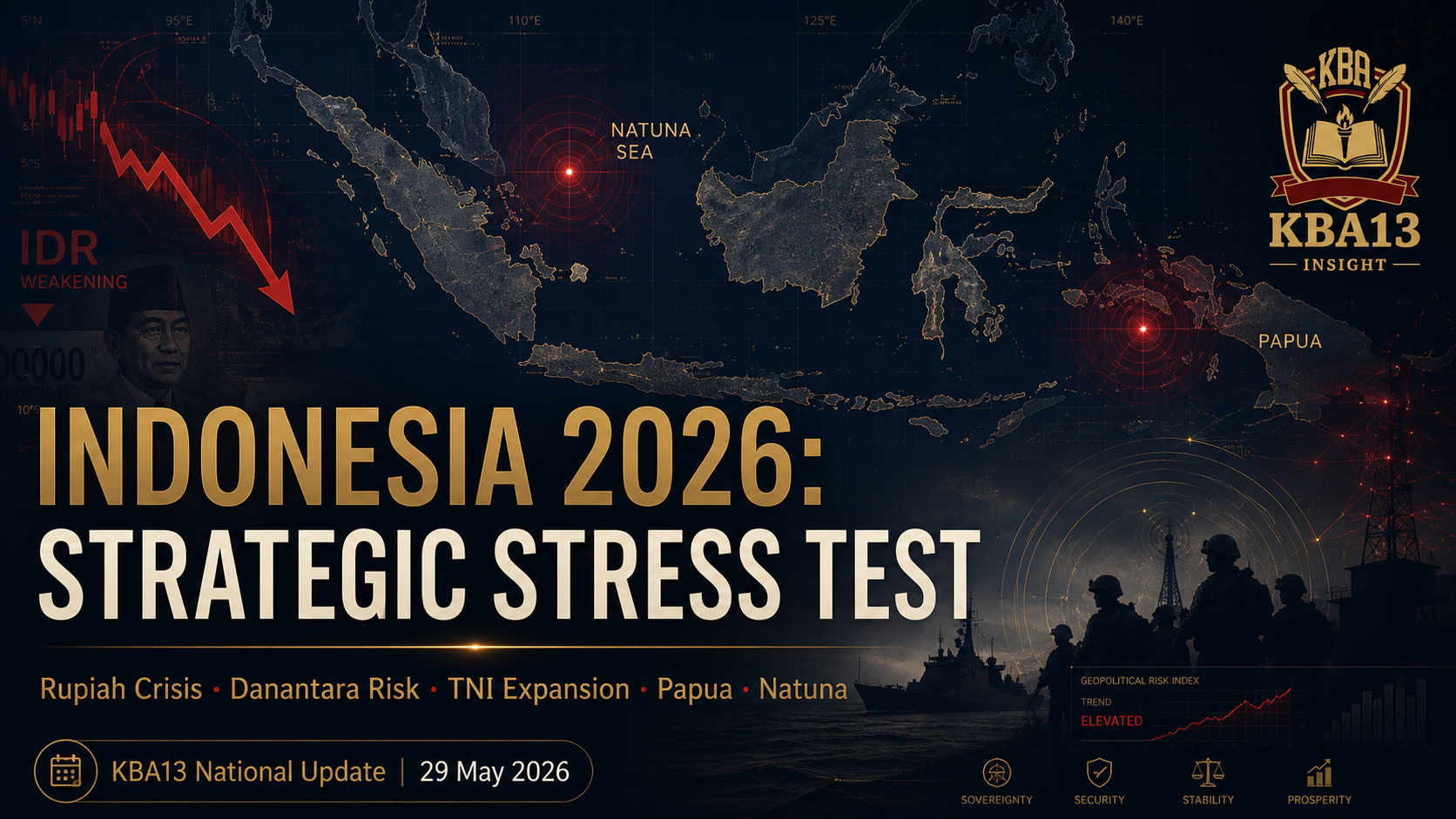
Indonesia enters the last week of May 2026 under compounding pressures: a currency in freefall, a sovereign wealth fund under international scrutiny, a military expanding its domestic footprint, and a geopolitical pivot that has alarmed Beijing and divided the Jakarta establishment. This edition delivers ten field-grade assessments across every dimension of national power.
The Rupiah at the Precipice: Indonesia’s Currency Crisis and the Anatomy of a Perfect Storm
ECONOMIC SECURITY |
The rupiah’s collapse to Rp17,513 against the US dollar in mid-May 2026 is not a random market event — it is the compounded output of structural fiscal frailty, a loss of investor confidence in governance, and a volatile global environment shaped by the Iran-Gulf war and a fractious US–China rivalry. Capital outflows reached US$1.6 billion in the first three weeks of January 2026 alone, and the trend has only accelerated. Every data point narrates the same story: Indonesia is caught in what informed observers have called a “perfect storm,” where global headwinds are brutally amplifying domestic vulnerabilities rather than being buffered by them.
Bank Indonesia, under Governor Perry Warjiyo, has been fighting rearguard actions — tightening dollar purchase rules, deploying foreign exchange reserves, and offering elevated bond yields to attract skittish investors. These are holding measures, not structural remedies. The central bank’s credibility is intact for now, but the longer the rupiah remains under siege, the higher the risk that market psychology hardens into a self-fulfilling narrative of decline. The memory of 1998 — when the rupiah lost 80% of its value and toppled a 32-year government — remains a visceral specter in Indonesian financial markets.
On the fiscal side, the government has front-loaded its 2026 financing through global bond issuances at yields as high as 5.5% for long tenors — a defensive strategy that signals distress more than confidence. The projected fiscal deficit of 2.9% of GDP, while formally below Indonesia’s 3% statutory ceiling, masks a constellation of off-budget liabilities, contingent exposures through state enterprises, and a ballooning debt service schedule that the IMF has already flagged as unsustainable in its current trajectory.
The rating agencies have spoken without ambiguity. In February 2026, Moody’s assigned a negative outlook to Indonesia’s sovereign rating, citing policy uncertainty, weak governance, and deteriorating revenue collection. Fitch followed days later with its own negative outlook, specifically naming Danantara as an off-budget vehicle that poses governance risks. Fitch simultaneously downgraded its outlook on Indonesia’s four largest state-owned banks. This dual-agency salvo was a severe blow to Jakarta’s credibility in international capital markets.
The structural rot is in taxation. Indonesia’s tax-to-GDP ratio has hovered stubbornly below 11% for years — far below the OECD average of 34% and even below regional peers like Thailand and Vietnam. Without a clear and measurable improvement in revenue collection, debt becomes an intergenerational burden, not a cyclical tool. The government’s addiction to populist spending — the free meals program alone is budgeted at Rp335 trillion, nearly 9% of the state budget — creates fiscal commitments that outlast any given political cycle.
Compounding the fiscal picture is the external account. The Iran-Gulf war has driven global oil prices to levels that significantly increase Indonesia’s fuel import bill, widening the current account deficit. Indonesia remains a net energy importer despite its vast resource wealth — a paradox of geography and refinery underinvestment that successive governments have failed to resolve. The commodity windfall from coal and nickel has provided partial buffer, but with global demand forecasts softening amid a Chinese economic slowdown, that buffer is narrowing by the quarter.
Domestic demand — the economy’s traditional shock absorber, accounting for 53–55% of GDP — is showing signs of fatigue. Consumer confidence indices have retreated from post-pandemic highs. Inflation, while officially measured at 2.86%, is experienced far more acutely by low-income households, where food and transportation costs dominate expenditure. The government’s social assistance programs are politically popular but fiscally expensive, and their effectiveness in stimulating durable growth rather than consumption-led dependency is sharply contested by independent economists.
On the bright side, Indonesia achieved rice self-sufficiency in 2025 — producing 34.71 million tonnes with a surplus of 3.52 million tonnes, the highest in the nation’s history. This reduces food import pressure and insulates a critical political constituency from the worst of external price volatility. The KSSK — the Financial System Stability Committee — issued its quarterly assessment in May affirming systemic stability, though critics note that this assessment carries the same institutional optimism bias that preceded every past crisis.
The fundamental question for Indonesia’s economic future is whether Prabowo’s government possesses the political courage to confront structural reform — revenue mobilization, subsidy rationalization, and genuine competition policy — or whether it will continue administering fiscal narcotics that defer pain into the next presidential cycle. The verdict of international markets, already delivered through currency depreciation and rating agency downgrades, is unambiguous. History in Indonesia — and across the developing world — teaches one lesson above all others: crises that are denied eventually demand answers that no government can control.
Danantara: Sovereign Wealth Fund or Sovereign Risk?
POLITICAL ECONOMY | 29 May 2026
Danantara — formally the Daya Anagata Nusantara Investment Management Agency — was inaugurated as President Prabowo’s marquee economic institution, a sovereign investment vehicle that would channel state resources into downstream industrialization, infrastructure, and human capital. Its ambition is sweeping: to mobilize up to Rp500 trillion into strategic projects that would accelerate Indonesia’s goal of becoming the world’s fourth-largest economy by 2045. The vision is compelling. The execution, governance architecture, and political economy surrounding it are generating alarms at the highest levels of international financial institutions.
The IMF has issued explicit warnings against allowing Danantara to accumulate quasi-fiscal liabilities outside the government’s official balance sheet. This concern is not hypothetical. If Danantara raises debt through instruments such as Patriot Bonds or medium-term notes — as is currently under discussion — and if the projects financed by those instruments fail, the contingent liabilities would cascade back onto the sovereign balance sheet. In the worst scenario, Danantara’s ambition becomes Indonesia’s fiscal time bomb, detonated by project failures, commodity price reversals, or a global growth slowdown.
The governance concerns are equally serious. Danantara’s enabling legislation granted the president the power to assign SOEs monopoly rights without the customary oversight of KPPU, Indonesia’s competition regulator. This provision — embedded quietly in the revised law — has profound anti-competitive implications. When a sovereign institution backed by the full faith and credit of the Indonesian state can be granted monopoly rights in sectors ranging from nickel processing to palm oil exports, the space for private capital and healthy market competition contracts precipitously.
The export nationalization strategy — placing commodity exports under Danantara-controlled intermediaries — is the most dramatic expression of this economic philosophy. Indonesia contributes approximately 60% of global nickel production, 48.7% of global palm oil exports, and 19.3% of global coal exports. The decision to route these flows through a politically managed entity by January 2027 has sent shockwaves through the global commodity trading community. Trading houses, international buyers, and sovereign purchasers are already diversifying their supply chains — a long-term consequence that no policy reversal can easily undo.
“Danantara mistakes the economy for a machine, poverty for a distribution problem, and growth for a spending programme.” — Indonesia Strategic & Economic Action Institution, May 2026
The appointments within Danantara tell their own political story. The institution has absorbed senior economists and technocrats from the Finance Ministry — including former Director General Masyita Crystallin — giving it the appearance of institutional credibility while simultaneously draining the Finance Ministry of some of its most capable talent. Danantara’s leadership is drawn disproportionately from figures with close ties to the Prabowo political network and, crucially, military circles. The absence of independent external oversight mechanisms is glaring against comparable sovereign wealth funds in Norway, Singapore, or Abu Dhabi.
The political economy of Danantara must also be understood in the context of Prabowo’s 2029 re-election calculus. The institution creates a vast patronage architecture — project contracts, board appointments, intermediary roles, and regional development funds — that can be distributed to political allies across the archipelago. Critics describe this not as conspiracy but as the natural logic of power: institutions designed to advance national development are invariably also designed to advance the political interests of those who created them. Indonesia’s history — from Pertamina in the 1970s to BPIP in the Jokowi era — is replete with examples.
Foreign investors are watching with mounting unease. The capital flight that began in January 2026 is not solely driven by external conditions — significant portions represent deliberate divestment by institutional investors uncomfortable with Indonesia’s governance trajectory. The MSCI’s decision-making processes on index inclusion and weighting are sensitive to rule-of-law and governance metrics. Indonesia’s deteriorating scores on these dimensions, at precisely the moment it needs maximum foreign investment, represent a deeply counterproductive spiral.
The government’s defense of Danantara rests on the argument that Indonesia needs a patient capital institution capable of making long-horizon investments that private markets chronically underprovide. This is a legitimate argument in theory — it is essentially the rationale behind Temasek in Singapore or Khazanah in Malaysia. The difference is governance. Temasek publishes comprehensive annual reports; its board is genuinely independent; political interference is structurally constrained. Danantara, as currently constituted, has none of these features.
What Indonesia needs from Danantara is not abolition but transformation: mandatory publication of audited accounts, an independent supervisory board with genuine investigative powers, clear firewalls between investment decisions and political appointments, and alignment with international sovereign wealth fund standards under the Santiago Principles. Whether Prabowo’s administration — which views Danantara as its signature institutional achievement — will accept these constraints before a crisis forces the issue remains the central question of his economic legacy.
The MDCP Fault Line: How the US–Indonesia Defense Pact Is Reshaping Jakarta’s Strategic Identity
GEOPOLITICS & DEFENSE | 29 May 2026
When the US–Indonesia Major Defense Cooperation Partnership (MDCP) was formalized on 13 April 2026, Jakarta crossed a threshold it had spent decades carefully avoiding. The agreement — which encompasses defense technology transfers, intelligence-sharing protocols, access arrangements, and joint operational frameworks — is the most expansive bilateral security commitment Indonesia has entered into since its founding foreign policy principle of bebas aktif (free and active) was codified. The strategic logic from Washington’s perspective is transparent: Indonesia’s geographic position — straddling the Strait of Malacca, the Strait of Sunda, and the approaches to the South China Sea — makes it the pivotal node in any Indo-Pacific deterrence architecture aimed at Chinese maritime expansion.
The immediate controversy centers on overflight access. Concerns have emerged that the MDCP may include provisions granting US military aircraft access to Indonesian airspace in ways that would be perceived by Beijing as an implicit forward basing arrangement. Jakarta has been deliberately opaque on this question, and that opacity is itself a significant intelligence and diplomatic signal. Under bebas aktif, Indonesia has historically refused to allow its territory to be used for military operations by third powers against other countries. If the MDCP crosses that line — even in nuanced or deniable form — it represents a fundamental shift in Indonesia’s strategic identity.
China’s reaction has been predictably calibrated but unmistakably tense. Beijing’s diplomats have communicated displeasure through established back-channels while avoiding the public confrontation that would only validate Jakarta’s case for hedging. Chinese state media commentary on the MDCP has been pointed, characterizing it as evidence of US efforts to encircle China through the “Indo-Pacific alliance web.” For Indonesia, which relies on China as its largest trading partner and a key source of investment, the economic exposure from Beijing’s potential retaliatory measures is not academic.
The broader context is the reconfiguration of global maritime chokepoints since early 2026. The destabilization of the Strait of Hormuz by the Iran-Gulf war has elevated the Strait of Malacca — which Indonesia partially controls — from a passive transit corridor to a potential instrument of geopolitical leverage. US strategic planners have been explicit: Indonesia’s cooperation in managing the Malacca chokepoint is indispensable to any scenario in which Washington might seek to restrict Chinese naval and commercial access. This gives Jakarta enormous leverage — but also places it in the crosshairs of Beijing’s worst-case planning scenarios.
Within Indonesia, the MDCP has divided the strategic elite. Proponents — concentrated in the Prabowo inner circle and segments of the TNI’s joint staff — argue that a deeper partnership with the US provides Indonesia with advanced military capabilities, intelligence access, and deterrence credibility it cannot generate unilaterally. Critics — found in the Foreign Ministry’s career corps, academic strategic studies communities, and opposition political networks — argue that the agreement sacrifices Indonesia’s prized strategic autonomy for benefits that are uncertain and asymmetric.
MDCP Key Dimensions — April 2026:
- Signed: 13 April 2026, Jakarta — “Major Defense Cooperation Partnership”
- Scope: Technology transfer, intelligence sharing, joint exercises, access frameworks
- Strategic concern: Potential US overflight access — implications for bebas aktif doctrine
- Beijing’s response: Diplomatic back-channel displeasure; no public confrontation
- Context: Malacca Strait elevated in strategic importance following Hormuz disruption
- Domestic split: Prabowo-TNI in favor; Foreign Ministry career corps and opposition skeptical
Indonesia’s defense relationship with China, meanwhile, remains structurally limited despite years of diplomatic warmth. As Brookings Institution analysis published in March 2026 observed, Beijing’s aggressive behavior in the South China Sea — including continuous grey-zone pressure on the Natuna EEZ — has made Jakarta structurally cautious about deep military alignment with China. The MDCP essentially codifies and deepens a pre-existing asymmetry in Jakarta’s real security relationships.
The Natuna dimension deserves separate emphasis. China’s demand that Indonesia halt drilling and military exercises in Natuna waters — an extraordinary assertion of extraterritorial authority over Indonesia’s undisputed EEZ — has hardened segments of the TNI and the Defense Ministry against accommodation with Beijing. The establishment of a new military base on the Natuna Islands, manned by over 1,000 personnel, signals precisely this hardening. The MDCP is partly a strategic hedge against exactly the kind of grey-zone coercion that Chinese maritime militia and coast guard vessels have practiced with increasing sophistication.
The diplomatic challenge for Jakarta is managing both Washington and Beijing simultaneously — a task that requires exceptional precision, credibility with both capitals, and domestic political consensus that currently does not exist. Decisions about intelligence data sharing, the scope of US operational access, and the visibility of joint military exercises will each send signals that both superpowers will read carefully. Any perception of irrevocable alignment will collapse Indonesia’s strategic leverage; any perception of bad faith will damage the alliance’s deterrent value.
The deepest question is whether bebas aktif remains a viable framework in a world where the US–China rivalry is becoming zero-sum. The MDCP marks the point at which Indonesia began the process — perhaps irreversibly — of leaning toward one pole while maintaining the rhetoric of equilibrium. How that tension is managed will define Indonesian strategic identity for the next decade and beyond.
Panglima Agus Subiyanto’s Strategic Chessboard: Decoding the May 2026 TNI Officer Rotations
DEFENSE & MILITARY AFFAIRS | Jakarta, 29 May 2026
On the morning of Thursday, 21 May 2026, the Aula Gatot Subroto at TNI Headquarters in Cilangkap witnessed the latest in a series of major officer inauguration ceremonies under the Prabowo administration. Among the most significant changes was the appointment of Brigadir Jenderal TNI Muhammad Nas as the new Kepala Pusat Penerangan (Kapuspen) TNI — replacing Mayjen TNI Aulia Dwi Nasrullah, who was transferred to the position of Deputy Chief of the Strategic Intelligence Agency (Wakabais) TNI.
This single transfer carries layers of strategic significance. The movement of Aulia Dwi Nasrullah from the highly visible Kapuspen role to Wakabais — the intelligence dimension of the armed forces — suggests a deliberate integration of experienced media management personnel into the intelligence architecture. In an era of information warfare, the skills of narrative management and the skills of intelligence analysis are increasingly intertwined. The appointment signals that TNI leadership understands this convergence and is structurally responding to it.
The March 2026 rotation had already signaled the depth of restructuring underway. Twenty-one Panglima Komando Daerah Militer (Pangdam) positions across Indonesia were simultaneously rotated — an extraordinarily large single-round change of regional command. In Papua, Mayjen TNI Febriel Buyung Sikumbang was installed as the new Pangdam XVII/Cenderawasih, while Mayjen TNI Frits Wilem Rizard Pelamonia took command of Pangdam XXIV/Mandala Trikora — both reflecting the intensified security focus on eastern Indonesia.
The political economy of TNI promotions under Prabowo deserves analysis beyond the operational frame. Presidential Regulation No. 84 of 2025, which expanded the number of high-ranking TNI officer positions from 371 to 420, created structural space for Prabowo to reward loyalists and fill the expanding civil-military integration posts. Since the revision of TNI Law No. 34/2004 through Law No. 3/2025, active military officers have expanded their presence in civilian government ministries, state enterprises, and strategic agencies. This re-militarization of the Indonesian bureaucracy — described by critics as “pretorianisme baru” — has revived concerns about the dwifungsi doctrine formally abandoned in the post-Suharto reform era.
The Panglima TNI himself is a figure of considerable political significance. General Agus Subiyanto — born 1967 in Cimahi, West Java — has a background in the Presidential Security Force under Jokowi, giving him institutional familiarity with the dynamics of palace politics. His scheduled retirement in 2026 — he turns 59 in August — means that the question of his succession is already becoming a latent political dynamic within the military establishment.
The succession question at Panglima TNI has profound implications. The traditional rotation between Army, Navy, and Air Force would suggest a naval officer — such as KSAL Laksamana Muhammad Ali — as a leading candidate. But Prabowo’s personal preferences, shaped by decades in the Army’s special forces, consistently favor Army figures. The lobbying within Istana Merdeka, Mabes TNI, and the DPR’s Commission I over the next months will be intense and will reveal the real power geometry of the Prabowo administration’s civil-military relations.
The expansion of Kodam structures — adding six new regional military commands through Perpres No. 84/2025 — is the most concrete expression of TNI’s institutional growth under Prabowo. Each new Kodam creates a full command structure: a Pangdam, staff officers, subordinate Korem and Kodim units, and the associated intelligence, logistics, and civil affairs apparatus. TNI’s physical presence across the archipelago — particularly in eastern Indonesia and border regions — has expanded significantly since October 2024.
The civilian oversight architecture has struggled to keep pace. The DPR’s Commission I, which is constitutionally responsible for defense oversight, has been largely deferential to the executive’s military expansion agenda. Civil society organizations — including Imparsial, KontraS, and academic security studies networks — have maintained critical commentary, but their institutional capacity to constrain military expansion is limited.
International observers are watching the TNI’s trajectory with a mixture of admiration for its professionalism and concern about its political role. The US–Indonesia MDCP will deepen military-to-military ties, but these same ties also increase the TNI’s institutional confidence and international prestige — a double-edged dynamic for a military simultaneously being asked to re-enter civilian governance roles it exited 25 years ago. The consolidation of Prabowo’s control over both the presidency and the military command represents the most comprehensive concentration of civil-military power Indonesia has seen since the transition from Suharto’s New Order.
Kapolri’s 108-Officer Rotation: Reading the Power Map Behind Indonesia’s National Police Reshuffle
INTERNAL SECURITY | 29 May 2026
On 7 May 2026, Kapolri Jenderal Polisi Listyo Sigit Prabowo issued Telegram Nomor ST/960/V/KEP./2026 — a document that reshuffled 108 personnel across Indonesia’s National Police, including promotion of 16 officers to Inspektur Jenderal, 43 to Brigadir Jenderal, and 16 to Komisaris Besar. Nine Regional Police Chiefs (Kapolda) across the country were simultaneously replaced, with the most strategically significant appointments concentrated in eastern Indonesia. The scale and scope of the reshuffle makes it the largest Polri rotation of 2026 and demands systematic analysis.
The appointment of Komjen Pol R. Z. Panca Putra S. as Kalemdiklat Polri — the head of police education and training — is among the reshuffle’s most consequential decisions. Kalemdiklat is the institution that shapes the next generation of Polri officers, defines curriculum, and determines which ideological and operational frameworks future police leaders will internalize. Whoever controls Kalemdiklat exercises enormous influence over Polri’s institutional culture over the medium to long term.
In eastern Indonesia, the appointments of new Kapolda for Sulawesi Tengah and Sulawesi Utara attracted considerable attention. Brigjen Nasri — formerly Deputy Kapolda Sulawesi Selatan — took command in Sulawesi Tengah, replacing Irjen Endi Sutendi. Sulawesi Tengah is a region of persistent security complexity: it contains communities previously associated with jihadist networks, and remains economically volatile due to the rapid expansion of nickel mining operations in the Morowali industrial corridor.
The rotation of Kapolda Sumatera Barat to Irjen Pol Djati Wiyoto Abadhy reflects the continued sensitivity of West Sumatra as a region with distinct religious and political dynamics. West Sumatra’s historically strong Islamic identity, its tradition of political autonomy rooted in the Minangkabau adat system, and its periodic tensions with Jakarta require a commander capable of navigating both formal law enforcement and complex inter-institutional diplomacy with local ulama and adat leaders.
The inclusion of a Polwan promotion — Brigjen Pol Dra. A.A. Sagung Dian Kartini, appointed to Karolemtala Stamarena Polri — is a notable symbolic gesture. Polri has historically been a deeply male-dominated institution, with female officers systematically underrepresented in command positions. Kartini’s appointment to a strategic staff role is meaningful as a signal, even if the structural barriers facing Polwan in operational command remain largely intact.
The political dimensions of the Kapolri’s position under Prabowo require careful examination. Listyo Sigit Prabowo — no relation to the President — is a Kapolri who was appointed by Jokowi and has navigated the transition to the Prabowo presidency with visible care. His institutional survival reflects both his genuine professional capacity and his success in demonstrating political deference to the new presidential order. But as Prabowo consolidates his grip on the broader security apparatus, the space for an independent Polri is narrowing.
The Polri’s relationship with the Attorney General’s Office (AGO) and the Corruption Eradication Commission (KPK) has been a persistent fault line in Indonesia’s law enforcement architecture. Officers who have demonstrated compatibility with the current political order are being promoted; those who have pursued investigations perceived as threatening to elite interests face lateral transfers or early retirement. This pattern is particularly consequential in a period when Danantara’s financial flows create new opportunities for high-value corruption.
The Polri’s counterterrorism division, Densus 88, remains outside the formal reshuffle framework. But the overall health of Polri’s leadership directly affects Densus 88’s operational environment, budgetary priorities, and inter-agency relationships with BIN and the prosecutor’s office. In a period when ISIS-affiliated networks in Indonesia have shown evidence of reconstitution — particularly in Sulawesi and segments of the Poso corridor — the quality of Polri leadership in affected regions carries life-and-death operational implications.
The 108-officer reshuffle, viewed at sufficient altitude, is not simply personnel management. It is the exercise of political authority through institutional architecture — a process in which the Kapolri distributes positions that simultaneously serve as loyalty tests, patronage rewards, operational mandates, and political surveillance functions. The question for Indonesia’s rule of law is whether those expectations align with the public interest or merely with the interest of those who hold power in this particular political moment.
Papua’s Protracted War: Damai Cartenz 2026 and the Enduring Limits of Indonesia’s Highland Strategy
REGIONAL CONFLICT ANALYSIS | 29 May 2026
The Damai Cartenz 2026 Task Force — Indonesia’s premier multi-agency security operation in Papua, combining TNI elite units with Polri tactical teams — entered its most intense phase following the successful interdiction of three high-value TPNPB commanders in Yahukimo Regency in February 2026. The transfer of these commanders — under heavy special forces escort, by air from Wamena to Jayapura — was necessitated by the security failure of 25 February 2025, when Penihas “Kopi Tua” Heluka escaped from Wamena Prison. Heluka, the commander of the Yamue Battalion of the West Papua National Liberation Army (TPNPB), is the kind of educated, charismatic insurgent commander who poses maximum institutional challenge: technically sophisticated, ideologically committed, and capable of maintaining operational command across complex mountainous terrain.
The January 2026 threat by Heluka against Vice President Gibran Rakabuming Raka — unprecedented in the conflict’s history for targeting a sitting constitutional officeholder — escalated the political stakes of Papua security management to a level not previously seen. The threat was credible enough to prompt immediate additional security protocols and accelerate the operational tempo of Damai Cartenz. Papua has moved from the periphery to the center of Indonesia’s national security agenda.
The conflict’s geographical heartland remains the highlands of Central Papua, Pegunungan Bintang, Yahukimo, and Puncak Jaya regencies — terrain so rugged that helicopter is often the only viable means of resupply and medevac. The TPNPB’s organizational structure — divided into regional commands (Kodap) with substantial operational autonomy — makes the elimination of individual commanders a limited-impact strategy. Indonesia’s military planners are acutely aware of this structural resilience; the debate within Mabes TNI concerns how to shift from attrition to political settlement without appearing to legitimize TPNPB claims.
Simultaneously, a separate but interrelated conflict dynamic has emerged in the Kapiraya area of Central Papua, where a border dispute between Mee and Kamoro indigenous communities escalated dramatically after the discovery of gold deposits in 2023. The violence increased sharply in late 2025 and continues into 2026, with injuries and fatalities reported and government intervention still insufficient to produce durable stabilization. This is the intersection of indigenous land rights, illegal artisanal mining, and state administrative capacity failure — a combustible combination that the security-first approach of Damai Cartenz is structurally ill-equipped to address.
International pressure on Papua remains a persistent diplomatic irritant for Jakarta. Pacific Island nations — Vanuatu, the Solomon Islands, Tuvalu — continue to raise Papua at UN Human Rights mechanisms. The ULMWP maintains advocacy networks in Geneva, Canberra, and London that amplify every credible human rights report into diplomatic pressure on Indonesian missions. Jakarta’s standard response — asserting sovereignty, emphasizing development programs, and restricting independent journalist access — has maintained the formal status quo but has not extinguished the international campaign’s energy.
The development argument from Jakarta is genuine in aspiration if contested in implementation. Since the special autonomy law revision and the proliferation of new provinces in Papua, the government has increased budget transfers to the region substantially. But the governance capacity to translate budget transfers into effective public services remains deeply inadequate, and the new provincial governments are struggling with institutional inexperience and elite capture of development funds.
The Damai Cartenz approach — framed explicitly as “law enforcement” rather than military counterinsurgency — is strategically significant. By classifying the TPNPB as a terrorist organization and prioritizing individual capture and prosecution over kinetic engagement, Indonesia attempts to delegitimize the movement legally while limiting the collateral damage that alienates the broader Papuan population. The approach has yielded tactical results: 272 TPNPB personnel eliminated and 1,384 captured through 2025. But the movement’s ability to recruit from a population that perceives the Indonesian state as an occupying force continues to regenerate its operational capacity at roughly the same rate as attrition removes it.
The TNI’s positioning of two new Pangdam commands in Papua — Cenderawasih and Mandala Trikora — with freshly appointed officers in March 2026 signals an intention to maintain elevated force levels indefinitely. This is not a counterinsurgency strategy oriented toward political resolution; it is a containment strategy oriented toward preventing escalation beyond manageable thresholds. The distinction matters enormously for Papuan civilians caught between TPNPB coercion and security force operations.
The path to durable peace in Papua runs through political dialogue, not military attrition. Every credible analyst of the Papua conflict — from IPAC to the International Crisis Group — converges on this conclusion. Prabowo’s administration, despite its military origins, has signaled no meaningful openness to political dialogue with TPNPB-affiliated political organizations. Without that opening, the Damai Cartenz task force will remain indefinitely necessary — a standing expenditure of blood, treasure, and international reputation that resolves nothing while containing everything.
Natuna Under Pressure: China’s Grey-Zone Playbook and the Malacca Chokepoint’s New Strategic Weight
MARITIME SECURITY & GEOPOLITICS | 29 May 2026
China’s grey-zone strategy in the Natuna EEZ operates on a logic of cumulative coercion: no single incident is severe enough to justify a formal military response, but the aggregate pattern — sustained fishing incursion backed by coast guard escorts, periodic seabed mapping activities in contested waters, diplomatic demands that Indonesia halt drilling — constitutes a systematic campaign to establish behavioral precedents that erode Indonesian sovereignty without triggering the legal and diplomatic consequences of open aggression. Indonesian naval and coast guard (Bakamla) commanders are under political pressure to respond assertively without escalating to a level that Beijing can use to justify a stronger counter-response. It is a delicate and exhausting equilibrium.
The new military base on the Natuna Islands — manned by over 1,000 personnel and including expanded naval patrol capabilities — is Indonesia’s most concrete physical assertion of sovereignty in the disputed zone. Jakarta’s legal position is unimpeachable: the Natuna EEZ falls entirely within Indonesia’s undisputed territorial claims, and China does not formally contest Indonesian sovereignty over the Natuna Islands themselves — it merely asserts “historic rights” for Chinese fishing vessels that are legally incoherent under UNCLOS.
The strategic context has been fundamentally altered by the Hormuz crisis. With the Strait of Hormuz disrupted by the Iran-Gulf conflict, approximately 30–35% of global oil trade previously passing through Hormuz is being rerouted through alternative pathways — including, significantly, the Malacca Strait. The volume increase has transformed the Malacca Strait from an important transit corridor into a geopolitical chokepoint of the first order. Indonesia, as the riparian state controlling the strait’s southern approaches through Sumatra, now holds leverage it has not held since the Cold War era.
The US–Indonesia MDCP, viewed through this maritime lens, takes on a distinctly operational character. Washington needs Jakarta’s cooperation in any scenario where the US might seek to exploit the Malacca chokepoint strategically. Chinese maritime strategists are equally aware of this dynamic: the “String of Pearls” network of Chinese-affiliated port facilities across the Indian Ocean was designed precisely to mitigate Malacca dependency, but that mitigation is partial and does not eliminate the fundamental strategic vulnerability.
The defense partnerships Jakarta has been developing with Australia, Japan, India, and France provide an alternative architecture for maritime security cooperation — one that strengthens EEZ surveillance and interoperability without the formal alliance commitments of the MDCP. The 2025 Japan-EU maritime coordination framework demonstrated that security collaboration can deter grey-zone pressure without triggering the “bloc alignment” optics that Jakarta has historically avoided.
Bakamla — Indonesia’s maritime security agency — has been the operational frontline of the Natuna response. Its operational mandate is constrained by budget limitations, vessel capability gaps, and jurisdictional tensions with the TNI AL over authority in EEZ enforcement. In a fast-moving grey-zone incident, clarity of command and rules of engagement are decisive; ambiguity creates hesitation that adversaries can exploit. The institutional friction between Bakamla and TNI AL is a security vulnerability that the MDCP partnership may paradoxically help to resolve.
The domestic political dimension of the South China Sea posture is significant for Prabowo’s government. Nationalist sentiment in Indonesia has become increasingly hostile to Chinese maritime incursions, creating political pressure on the government to demonstrate toughness. But Indonesia’s economic dependency on China — in trade, investment, and the nickel processing sector — creates incentives for accommodation that nationalist rhetoric cannot override. This contradiction between popular anti-Chinese maritime sentiment and structural economic interdependence is one of the most acute tensions in Indonesian foreign policy.
The first quarter of 2026 saw Indonesian naval vessels and coast guard units deploy with greater frequency and assertiveness in Natuna waters, including several documented confrontations in which Chinese fishing vessels were escorted from the EEZ. Satellite imagery analysis confirmed continued Chinese activity, suggesting that Indonesia’s enhanced presence has reduced but not eliminated incursions. China can absorb this pressure indefinitely; the question is whether Indonesia’s defense budget expansion will allow it to sustain the maritime posture that this equilibrium requires.
Indonesia’s maritime diplomacy as a strategic pillar — aligned with Prabowo’s Global Maritime Fulcrum vision — requires resources, institutional capacity, and political resolve simultaneously. The gap between vision and capability is closing, but it is closing slowly against a China that has invested in maritime modernization at a pace and scale without historical precedent. The Natuna front will remain hot throughout 2026 and beyond, demanding precisely the combination of diplomatic finesse and credible operational deterrence that Indonesia is still learning, under considerable pressure, to master.
The Court of Istana Merdeka: Elite Conflicts and the Architecture of Power Under Prabowo
POLITICAL INTELLIGENCE | 29 May 2026
Prabowo Subianto’s political architecture is built on three interlocking pillars: the Gerindra party network that delivered his electoral coalition, the military and intelligence community that forms his professional identity and primary institutional loyalty, and the business elite that has calculated correctly that proximity to this particular president offers superior returns to any alternative alignment. The interaction of these three networks — their competition over state resources, their respective access to presidential attention, and their divergent interests on key policy questions — constitutes the real government of Indonesia in 2026.
The Gerindra network operates through a combination of formal party structures and informal patronage channels. Prasetyo Hadi, the Secretary of State who doubles as Presidential Spokesperson since April 2025, represents the Gerindra political apparatus embedded within the executive palace. His dual role — managing government communications and the institutional machinery of the State Secretariat — gives Gerindra significant influence over what information reaches the President and how presidential decisions are formally documented. This structural position is more powerful than any cabinet portfolio because it shapes the informational environment within which Prabowo makes decisions.
The military network around Prabowo is the most opaque and least publicly legible dimension of his power architecture. His personal relationships within the Army’s special forces community — forged over decades in Kopassus and Kostrad — provide a parallel loyalty network that operates outside formal military chain of command. Retired officers with personal bonds to Prabowo serve in advisory capacities, board positions in state enterprises, and as informal interlocutors in sensitive negotiations.
The economic elite calculations in 2026 are complex and shifting. The nationalist economic policy threatens the interests of trading houses, commodity exporters, and multinational corporations accustomed to operating in a more open market environment. But these same policies create enormous opportunities for well-connected Indonesian conglomerates willing to serve as the “national champions” that Prabowo’s economic vision explicitly envisions. The business elite is therefore fragmented along lines of who benefits from the new nationalist dispensation and who is threatened by it.
“Prabowo’s government is consolidating rather than experimenting — and the officers promoted understand precisely what that consolidation requires of them.” — KBA13 Political Analysis Desk, May 2026
The Jokowi factor remains the most delicate variable in Indonesia’s elite dynamics. Former President Joko Widodo retains enormous informal authority through his personal networks and his son Gibran’s constitutional position as Vice President. The Jokowi-Prabowo relationship is a complex mutual dependency in which each holds significant leverage over the other. Prabowo needs Gibran to maintain the coalition’s appeal to Jokowi’s constituent base; Jokowi needs Prabowo to protect his legacy projects — particularly the Nusantara capital city — and to insulate his family from political accountability.
The PDI-P’s trajectory under Megawati Sukarnoputri is one of the most consequential variables in Indonesian politics over the next three years. Indonesia’s largest party entered a deliberate opposition posture after Prabowo’s victory, maintaining principled distance while avoiding existential confrontation. PDI-P’s 2029 strategy will be shaped by the economy: if the rupiah crisis deepens, if Danantara becomes a scandal, if public living standards deteriorate, the party is positioned to capitalize on grievance.
The 2029 presidential polling tells an interesting story about elite dynamics. Prabowo leads at 32.9% in Poltracking’s March 2026 survey — a strong but not dominant position, with 28.8% undecided. Dedi Mulyadi, the Governor of West Java, polls at 13.5% — a remarkable showing for a figure without presidential-level institutional backing. Anies Baswedan maintains a persistent 9.2% base. Gibran, despite his constitutional position, polls at only 4.2% — suggesting the Vice Presidential role has not significantly enhanced his political capital. The 2029 race is genuinely open, which means succession positioning has already begun in the strategic calculations of every major faction.
The intelligence community — BIN under its current leadership — is the final piece of the elite power architecture. BIN’s relationship with Prabowo is one of direct presidential supervision. This has implications for the quality and independence of intelligence assessment: when the agency most responsible for providing unvarnished analysis is also structurally subordinate to presidential political preferences, the danger of analytical capture becomes real. The ability to shape public opinion through coordinated digital campaigns, while documented, carries long-term risks: the erosion of public trust in information and the chilling of genuine political debate.
The cybersecurity dimension of elite conflict has emerged as a new frontier. Amnesty International’s 2026 report documenting allegations of organized digital influence operations points toward the instrumentalization of digital tools in the competition between political factions. Indonesia’s rapidly expanding digital population — the world’s fourth-largest — makes social media both an extraordinary political asset and a structural vulnerability that no faction, including the government, can fully control.
The Digital Surveillance State: Cybersecurity, Influence Operations, and the Democracy-Security Tension
INTELLIGENCE & DIGITAL SECURITY | 29 May 2026
The intersection of digital technology and political power in Indonesia in 2026 presents one of the starkest illustrations of what academics call the “dual-use dilemma” of cybersecurity: the same surveillance capabilities that protect national security can be — and evidence suggests are — deployed to suppress political dissent, monitor opposition figures, and shape the information environment in ways that benefit incumbents. Amnesty International’s 2026 report on Indonesia’s cyber crackdown documented allegations of coordinated digital activity including manipulated narratives, coordinated social media messaging designed to suppress legitimate political expression, and online intimidation tactics targeting independent journalists and civil society organizations.
The Indonesian government’s response has been consistent with its standard narrative management approach: the cybersecurity and digital monitoring efforts are necessary for maintaining national stability, reducing harmful misinformation, and protecting public order. These are not fabricated justifications — Indonesia’s digital environment does contain genuine security threats, including IS-affiliated radicalization networks, organized financial crime, and foreign influence operations. The problem is institutional: when the same apparatus that monitors genuine threats is also directed against political opponents and critical voices, the distinction between security function and political instrument collapses.
The Ministry of Communication and Information Technology (Kominfo) has used the Electronic Information and Transactions Law (UU ITE) with increasing frequency against online speech critical of the government. The UU ITE’s provisions on “defamation” and “spreading false information” are drafted with sufficient breadth to capture political criticism alongside genuinely harmful content. The chilling effect on online political discourse is measurable: journalists, academics, and civil society actors who document their own self-censorship on sensitive topics represent the most direct evidence that surveillance awareness is reshaping the contours of democratic debate.
The social media landscape has become a political battlefield of extraordinary complexity. Indonesia’s approximately 210 million active social media users — dispersed across TikTok, Instagram, X, WhatsApp, and YouTube — constitute an electorate that can be reached, mobilized, and manipulated at a speed and scale unavailable to previous political generations. The rise of political buzzers — organized networks of accounts that amplify preferred narratives and attack opponents — is a documented feature of Indonesian political competition rather than a fringe phenomenon. Multiple academic studies and investigative journalism pieces have traced these networks to the operational planning structures of major political parties and presidential campaigns.
The government’s response to the buzzer phenomenon is politically convenient: when pro-government buzzers operate, they are treated as organic citizen expression; when anti-government networks are identified, they become evidence of foreign interference or destabilizing intent. This asymmetric application of the regulatory framework is not unique to Indonesia — it is a pattern visible across democracies navigating the collision of digital technology and political competition — but its consistency in Indonesia is particularly notable.
The KPU and Bawaslu have developed nascent capacities for monitoring digital political content in the context of election regulation. Their resources, however, are inadequate to the scale of the challenge: Indonesia’s 2029 presidential campaign is already beginning in social media terms, with candidate narratives, opponent attack lines, and issue framing actively under development by all major political forces.
The BAIS (TNI Strategic Intelligence Agency) and BIN have developed cyber units whose capabilities and mandate boundaries are opaque. The placement of Aulia Dwi Nasrullah — the former TNI spokesman with expertise in military communications — into the Wakabais position signals an integration of information environment management expertise into the strategic intelligence community. Whether this integration is purely defensive or extends to offensive influence activities is a question that civilian oversight mechanisms are not currently positioned to answer with confidence.
The international dimension of Indonesia’s cybersecurity politics is significant. Southeast Asia has become a major theater of Chinese and Russian digital influence operations, and Indonesia — as the region’s largest democracy and most populous Muslim nation — is a primary target. BIN’s warnings about foreign influence operations are credible and documented. The challenge is ensuring that the legitimate defensive response to genuine foreign interference does not become the justification for a domestic surveillance architecture that primarily serves political consolidation.
The path forward requires both stronger cybersecurity and stronger civil liberties protections. Reforming the UU ITE to remove overly broad defamation provisions; establishing an independent digital rights ombudsperson with real investigative authority; mandating transparency in government digital communications contracts — these measures are technically straightforward and internationally supported. The reason they have not been implemented is not technical. It is political. Digital surveillance is a tool of power, and no political actor voluntarily surrenders tools of power without commensurate pressure from a counterbalancing force. In Indonesia in 2026, that counterbalancing force is present but not yet sufficient.
Indonesia at the Inflection Point: KBA13’s Strategic Assessment
STRATEGIC OUTLOOK | 29 May 2026
In May 2026, Indonesia is a country where every major dimension of national power is under simultaneous, compounding stress. The most comprehensive stress test of the post-reformasi era: a currency at historic lows, a sovereign wealth institution under international fire, a military expanding into civilian governance, a protracted insurgency in its eastern territories, a defense alignment shift that has alarmed its most important trading partner, and a domestic information environment increasingly captured by political manipulation. Any one of these pressures would challenge a mature institutional system. All of them simultaneously, compounding each other, constitute a genuine inflection point for the Republic.
The currency crisis is the most visible indicator but not the most structurally dangerous. Exchange rate pressures, while painful, are manageable through the standard toolkit of monetary policy, fiscal adjustment, and external communications — provided the fundamentals of governance and institutional credibility remain intact. It is precisely the erosion of these fundamentals — through Danantara’s governance concerns, ratings agency downgrades, and investor perception of political capture — that has transformed a manageable currency pressure into a systemic risk event. The rupiah at Rp17,513 is not the problem; the governance deficit that drove it there is.
The geopolitical bet on the US partnership represents the highest-stakes strategic gamble of the Prabowo presidency. If the MDCP delivers the promised technology transfers, intelligence capabilities, and deterrence credibility — and if Indonesia manages to prevent the agreement from triggering serious economic retaliation from China — the wager will have paid off handsomely. If China responds with targeted economic pressure, the costs could be severe. The administration’s calculation appears to be that US technological and military benefits outweigh Chinese economic exposure. That is a defensible strategic judgment. It is also an irreversible one.
The military’s expanding domestic role is the dimension with the longest shadow. The institutional reforms of the post-Suharto era — civilian control of the military, TNI withdrawal from civilian governance, and police separation from the armed forces — were hard-won achievements of the reformasi movement. Their gradual erosion under Prabowo, through the revised TNI law, expanded officer positions, and military placement in civilian agencies, is happening incrementally enough that no single step triggers the democratic alarm it would deserve if taken all at once.
Papua represents the irreducible question of accountability for the Indonesian state. A conflict that has lasted nearly six decades, consumed enormous security resources, generated persistent international criticism, and failed to produce a political resolution despite every combination of military pressure and development investment demands a strategic rethink. The evidence from comparable prolonged insurgencies globally — from the GFA in Northern Ireland to the CPA in Colombia — consistently demonstrates that political settlements, not military victories, produce durable peace.
KBA13 Four Critical Variables — Indonesia Strategic Outlook H2 2026:
- VARIABLE 1 — Fiscal: Can Prabowo implement meaningful revenue reform (tax/GDP ratio) before the debt wall hits in 2027?
- VARIABLE 2 — Geopolitics: Will China retaliate against the MDCP economically, and can Jakarta absorb the impact?
- VARIABLE 3 — Civil-Military: Will DPR Commission I assert genuine oversight of TNI’s expanded domestic role?
- VARIABLE 4 — Papua: Does Jakarta signal political dialogue willingness before TPNPB regeneration exceeds Cartenz attrition capacity?
The economic nationalism project — Danantara, export intermediation, downstreaming mandates — reflects a coherent development philosophy. The problem is context: South Korea’s chaebols, Malaysia’s Petronas, and Singapore’s Temasek succeeded in state-led development environments with dramatically stronger governance institutions than Indonesia currently possesses. Transplanting the economic philosophy without transplanting the governance infrastructure produces not East Asian developmental success but the kind of resource nationalism that has historically produced boom-bust cycles, crony capitalism, and capital flight.
The social dimensions of Indonesia’s current pressures deserve more attention than the security and economic discourse typically affords them. Indonesia’s Gini coefficient — 34.4 in 2025 — masks enormous regional disparities between Java and the eastern archipelago, between urban and rural communities, between those integrated into the formal economy and those surviving in the subsistence margins. The free meals program addresses a real nutrition deficit, but nutrition programs are inputs to human capital formation, not outputs of economic policy. The connection between program spending and the educational, health, and productivity outcomes that justify that spending is long, indirect, and dependent on implementation quality that is far more heterogeneous than budget allocations suggest.
Indonesia’s democratic trajectory is the deepest and most consequential question of the Prabowo era. Democracy is not measured by election frequency alone — it is measured by the quality of contestation, the independence of institutions, the protection of minority rights, and the accountability of power. On each of these dimensions, Indonesia in 2026 shows regression from the high watermark of the reformasi era, even as formal democratic processes continue to function. The risk is not a dramatic democratic collapse; it is the slow, institutional erosion of democratic substance while democratic form is maintained.
KBA13’s integrated assessment for the remainder of 2026 identifies the third quarter as the critical juncture. By September, the government will have had to make substantive decisions on Danantara’s export intermediation rollout, the implementation details of the MDCP, and the fiscal framework for 2027. Indonesia has the resources, the talent, and the institutional heritage to navigate this inflection point successfully. Whether it has the political leadership to make the decisions that navigation requires is the question that only the next 18 months will answer.
About The Author

Rekomendasi Bacaan KBA13 INSIGHT
Jika tulisan ini bermanfaat, dukung jurnal ini dengan mencari bukunya melalui tautan berikut:
- Buku-buku Kamaruzzaman Bustamam Ahmad di Periplus
- Koleksi Islamic Studies di Periplus
- Koleksi Geopolitics & Politik Internasional di Periplus
- Cari buku & perangkat baca di Shopee
- Cari di Blibli
Daftar lengkap: Rekomendasi Buku, Alat Tulis & Layanan. Tautan di atas adalah tautan afiliasi — KBA13 INSIGHT dapat memperoleh komisi kecil tanpa biaya tambahan bagi Anda.
Artikel Terkait
 Indonesia at the Crossroads 2026: Rupiah Crisis, Prabowo’s Power Architecture, Papua Conflict, and the Future of the Republic
 Southeast Asia Strategic Outlook 2026: South China Sea, Indonesia’s Economy, Myanmar Crisis, and ASEAN Energy Security
 Indonesia on the Brink of a Great Reckoning in 2026: The Rupiah Crisis, Power Consolidation, Papua, and the Geopolitical Contest over Natuna
 Indonesia’s August 2026 Risk Forecast: An Early Warning Assessment of All 38 Provinces
 Southeast Asia Strategic Outlook 2026: ASEAN, South China Sea Tensions, Prabowo’s Economic Doctrine, and the Future of Regional Order
Leave a Reply