
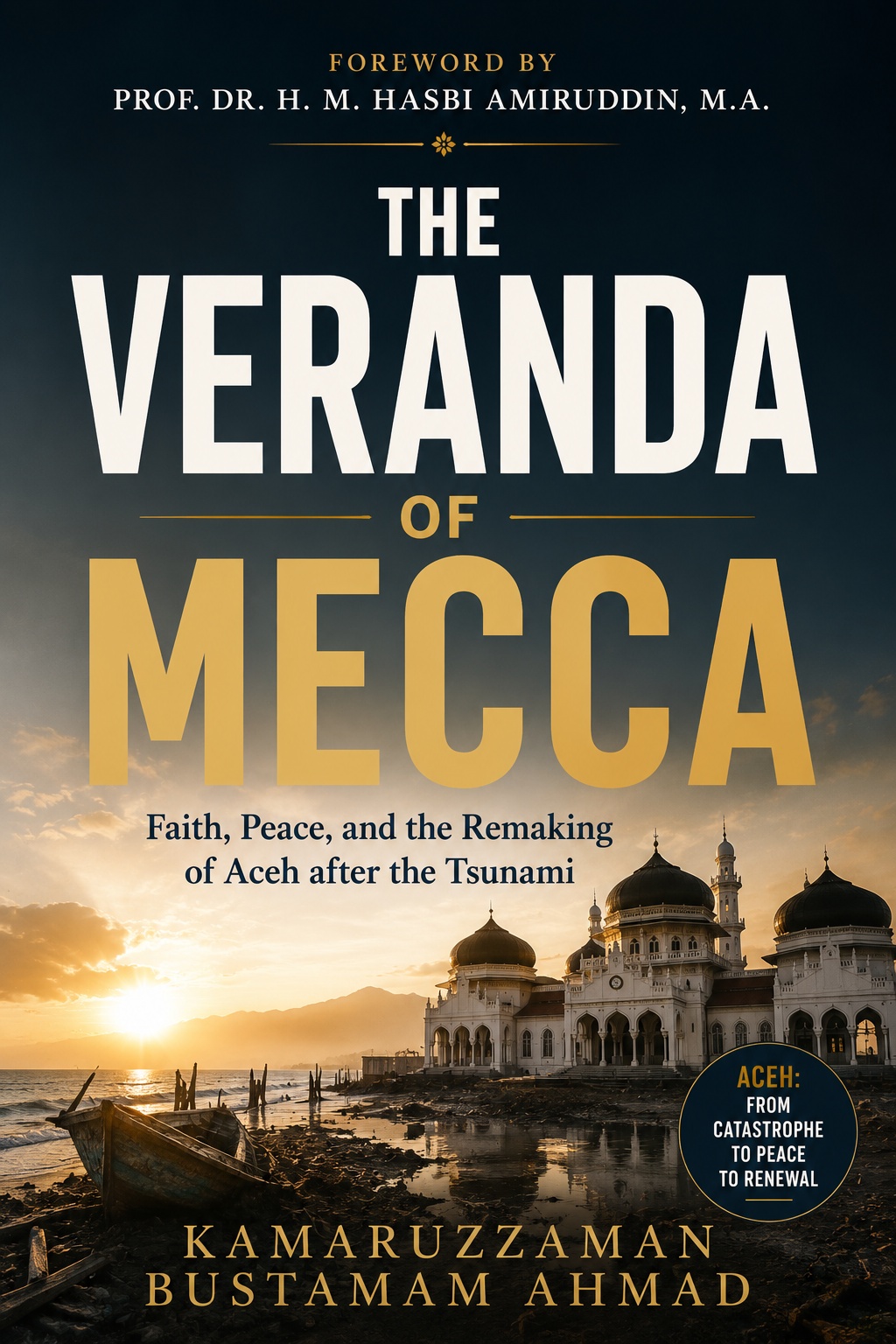
Coming Soon
The Veranda of Mecca: Faith, Peace, and the Remaking of Aceh after the Tsunami
For centuries, Aceh has been known as The Veranda of Mecca—a crossroads of Islamic scholarship, trade, political struggle, and cultural resilience in the heart of Southeast Asia. It was here that Islam first took root in the Malay Archipelago, here that ulama shaped a civilisation, and here that a proud people learned to carry their faith through every storm that history could send their way.
Yet the early twenty-first century transformed Aceh forever. On the morning of 26 December 2004, the sea rose without warning and swept away entire communities in a matter of minutes. Months later, in Helsinki, decades of armed conflict were brought to an end through a peace agreement that few had believed possible. Within a single year, Aceh had passed through both its darkest catastrophe and its most hopeful new beginning.
A Society Remade by Catastrophe and Peace
The devastating Indian Ocean tsunami of 2004 and the historic Helsinki Peace Agreement of 2005 reshaped the political, social, and religious landscape of one of the Muslim world’s most remarkable societies. More than 160,000 lives were lost in Aceh alone, and yet from that unimaginable grief emerged an opening for reconciliation between the Free Aceh Movement and the Indonesian government. Disaster and diplomacy, mourning and mediation, became intertwined in ways that no one could have scripted.
In this forthcoming book, Kamaruzzaman Bustamam Ahmad explores how faith, memory, peacebuilding, humanitarian intervention, and local identity contributed to the remaking of Aceh in the aftermath of conflict and catastrophe. Rather than treating the tsunami and the peace process as two separate stories, the book reads them together—as a single, entangled moment in which an entire society was compelled to rethink who it was and who it wished to become.
Faith at the Centre of Recovery
At the heart of this account stands the question of faith. How does a deeply religious society make sense of a catastrophe of such scale? For many Acehnese, the tsunami was not only a natural disaster but a spiritual event—an occasion for reflection, repentance, and renewal. Mosques that survived the waves became powerful symbols of endurance, and the language of faith gave people a vocabulary with which to grieve, to rebuild, and to hope again.
This book listens carefully to the ulama who reinterpreted religious meaning in the shadow of loss, to the communities who rebuilt their prayer houses before their own homes, and to the ordinary believers for whom recovery was inseparable from devotion. It shows how Islamic values of patience, solidarity, and mutual aid shaped the reconstruction not merely as a technical project of roads and houses, but as a moral and spiritual undertaking.
From War to a Fragile Peace
The Helsinki Peace Agreement did not simply silence the guns; it opened a long and delicate process of reintegration. Former combatants had to exchange the language of weapons for the fragile grammar of peace. Communities that had been divided by years of conflict had to learn, once again, how to live together. Special autonomy, local political parties, and the implementation of Islamic law all became part of the new Acehnese settlement—each carrying its own promises and its own tensions.
Drawing on anthropology, Islamic studies, and political analysis, the book examines how peace was not a single event but an ongoing negotiation. It considers the achievements of the peace process honestly, while refusing to look away from its unfinished business: the disappointments, the unmet expectations, and the questions of justice that still linger beneath the surface of a reconciled society.
Memory, Identity, and the Unfinished Work of Peace
Bringing together perspectives from anthropology, Islamic studies, political analysis, and lived experience, The Veranda of Mecca offers a rare and deeply grounded account of contemporary Aceh and its continuing journey toward peace and renewal. It pays close attention to memory—how a society chooses to remember its dead, its struggles, and its survival—and to identity, asking what it means to be Acehnese in a world reshaped by disaster, reconstruction, and global attention.
A Continuing Story
Aceh has never been a land that surrenders easily to a single reading. It is a place where the call to prayer rises over rebuilt shorelines, where the memory of loss lives quietly beside the determination to begin again. To write about Aceh after the tsunami and after the war is, in truth, to write about a people who refused to let catastrophe have the final word.
In the pages that follow, this book moves beyond the familiar images of destruction and reconstruction. It listens instead to the voices seldom recorded in official histories: the ulama who reinterpreted faith in the shadow of grief, the survivors who turned mourning into meaning, the former combatants who exchanged the language of weapons for the fragile grammar of peace, and the ordinary men and women who carried their communities back to life one prayer, one house, and one harvest at a time.
I have tried to write not as a distant observer but as a son of this land—one who has walked its coastal villages, sat in its meunasah, and felt both the weight of its wounds and the strength of its recovery. What emerges is not a tidy narrative of triumph, but a more honest portrait of a society still negotiating between tradition and modernity, between remembrance and reconciliation, between the Aceh that was and the Aceh yet to come.
This is, above all, a story of faith tested and faith renewed. It is my hope that readers everywhere will find in these pages not only the particular history of one Muslim society, but a wider human testament to resilience, dignity, and hope.
Why Aceh’s Story Matters Beyond Aceh
The remaking of Aceh is not only a local story. It speaks to some of the most pressing questions of our time: how communities recover from mass disaster, how peace is built after prolonged violence, and how religious tradition can become a resource for healing rather than division. The billions of dollars in humanitarian aid that flowed into Aceh after the tsunami turned the province into one of the largest reconstruction laboratories the world had ever seen. What worked, what failed, and what was quietly transformed in the encounter between global aid agencies and local Islamic society offers lessons far beyond Southeast Asia.
At the same time, the book resists the temptation to reduce Aceh to a case study or a policy lesson. Behind every statistic there is a family, a village, a mosque, a grave. By grounding its analysis in ethnographic detail and lived experience, The Veranda of Mecca restores the human face to a history too often told in the abstract language of donors and diplomats.
Who Should Read This Book
This book will be of interest to scholars and readers of:
• Aceh Studies
• Southeast Asian Studies
• Islamic Studies
• Peace and Conflict Studies
• Post-Disaster Reconstruction
• Political Anthropology
• Religion and Society
It is written for academics and students, but also for general readers who wish to understand how faith and resilience can carry a society through catastrophe toward renewal.
Featuring a Foreword by Prof. Dr. H. M. Hasbi Amiruddin, M.A.
A story of faith, resilience, memory, and the unfinished work of peace.
The Veranda of Mecca will be published on Amazon and made available to readers around the world.
Coming soon on Amazon worldwide.
About The Author

Artikel Terkait
 Islam, Violence, and Acehnese Identity: A Socio-Historical Reading of Conflict, Faith, and the Idea of Musoh
 Acehnology as an Intellectual Journey: Aceh, Islam, Southeast Asia, and the Malay World
 The Imaginal World of Iran: Henry Corbin and the Esoteric Heart of Shi’ism
 Acehnology and the Social Sciences: Reclaiming Aceh’s Place in Knowledge
 Arabic Influence in Aceh Identity: History, Culture, and Islamic Legacy
Leave a Reply