
Introduction
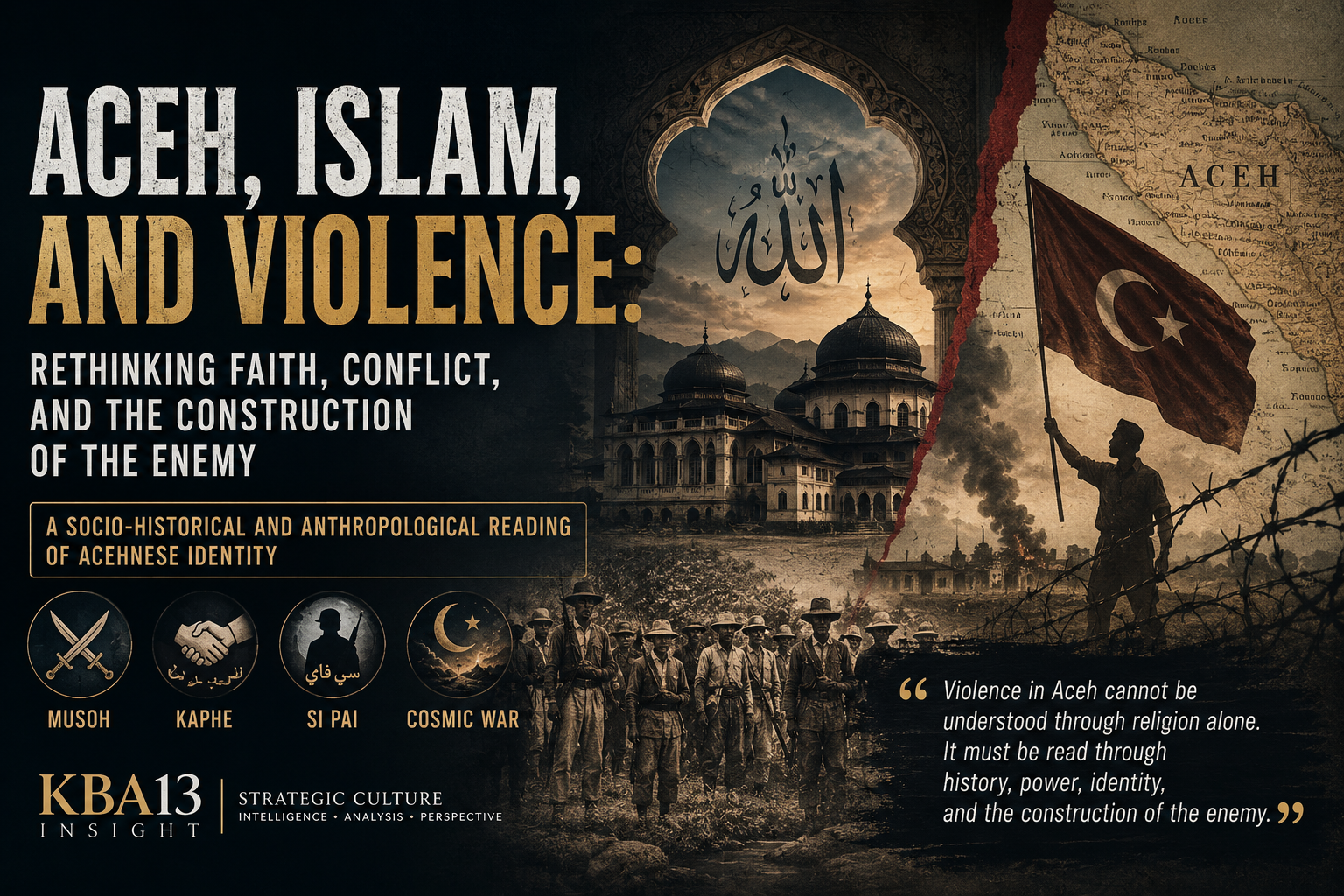
Violence in Aceh cannot be understood through a single religious explanation. It must be read through the lens of history, colonial encounter, political struggle, social fragmentation, and the changing construction of the enemy. This essay argues that Islam has been central to Acehnese identity, but violence in Aceh has moved through multiple layers: from anti-colonial resistance, the concept of “musoh,” the category of “kaphe,” and the emergence of Si PAI to the tragic condition in which Acehnese violence turns inward against fellow Acehnese. This essay aims to discuss the Acehnese people and violence. There have been many studies on violence in Aceh, especially with Aceh’s experience in joining the Republic of Indonesia. In almost every historical niche, violence has occurred in this province.
Therefore, a study on violence is the same as looking into the eyes of Aceh’s history, which has been permanently affected by violence. The discourse on violence is no longer understood as a study at the public level but has also reached the household level. For example, there has been violence due to conflict, socio-political situations, problems with understanding religion, violence over cultural issues, and domestic violence. Likewise, violence is no longer understood in physical form but also in the form of non-physical or symbolic violence. This realm of violence applies in Aceh and outside Aceh, even in several countries that have experienced violence. It can be said that almost every country has always experienced violence. However, this violence may take the form of conflict or war.
This study examines the meaning of violence and its relationship to belief or din al-Islam. After that, the form of violence in Acehnese society will be seen. Is the violence that occurred in Aceh due to religious factors or caused by other things, such as ideology? Alternatively, the violence in Aceh is one result of the application of social science theories, which assume that religion should not be involved in people’s daily lives. Of course, this assumption still needs to be reviewed because Aceh has a very long history of violence. [1]However, this study wants to explore claims about the relationship between Islam and violence, both conceptually and from socio-historical and socio-anthropological aspects.
The Definition
The word “violence” is often termed “violence,” which means “violent behavior” or “extreme natural force, often causing great damage .” [2]The adjective word for violence is “violent,” which has four meanings: “involving the use of physical force, with the deliberate intention of causing damage to property or injury or death to people,” “painful and difficult to control”; “showing very strong and angry emotions or opinions”; and “a violent color is very bright and almost too much too much to look at.” [3] Some interpret the word “violence” as “the unlawful exercise of physical force or intimidation by the exhibition of such force.”
The term comes from Old French and means “powerful effect” in English. Historically, this Old French term comes from the Latin “violentia.” From some of these definitions, it can be stated that violence is related to behavior, natural disasters, using physical force to cause injury or death to someone, not being easy to control, uncontrollable emotions, and a color image that has a powerful light. It is fascinating when the term ‘violence’ is attached to ‘violence.’
Religious Violence
Therefore, when attaching the words, Islam and violence are two very opposite things. Islam is a supernatural belief, while violence is a human activity, as described above, a physical impact on humans or the universe. Moreover, when it is stated that Islamic beliefs lead to violence or that this din teaches violence, as many scholars have written. [4] There is another term often studied by scholars, namely, religious violence. [5] The words that indicate that religion seems to be so active in promoting violence in this world are radicalism, fundamentalism, and terrorism. Let us take an example of the word, namely, “terrorist.” This term was used around the beginning of the 19th century.
At that time, the state carried out acts of terror to spread fear. At that time, the state was a terrorist. Furthermore, the word “terror” is used for groups that spread fear in society so that the government does what the terrorists want. The terrorist is attached to the individual who carried out the bombing, as was the case in 1881–6 against the British by the Fenian group. [6]
Cavanaugh states that
“The idea that religion tends to promote violence is part of the conventional wisdom of Western societies, and it underlies many of our institutions and policies, from limits on the public role of churches to efforts to promote liberal democracy in the Middle East.” [7]
Appleby said that
The secularization theory, held in one form or another by the founders of the modern social sciences from Karl Marx, John Stuart Mill, and Auguste Comte to Emile Durkheim, Max Weber, and Sigmund Freud, predicted that one powerful consequence of modernity would be the institutional differentiation of the religious and secular spheres, accompanied not only by the privatization of religion but also by its marginalization and decline. [8]
Religion in the West has been considered the cause of the emergence of violence. This understanding then became the paradigm of Western society, placing religion not in the public domain. Not only that, religion is seen as a problem that causes conflict in Western society’s culture itself. This accusation of religion bringing violence has become the paradigm of Western society’s thinking. However, religion remains significant in everyday life in certain contexts. [9]
Although basically, the spirit of war waged by Western societies against non-Westerners is for the spread of Christian teachings. The main driving force behind the development of the Jewish community’s efforts to establish its state in Palestine was the concept of Zionism. [10]In this case, the concepts of violence that initially appeared in the Christian-European tradition were later embedded in the behavior of Muslims.
Therefore, the idea of secularization in principle has made religion in the West a weapon in the form of nation-state ideology. Although on a conceptual level, it seems as if it says that religion has promoted violence through packaged concepts such as democracy and human rights, it turns out that within and behind these concepts, there is a religious spirit. Therefore, the issue of violence does not belong to Islam alone. Some other religious systems also, to some extent, have faith-based acts of violence. [11]
When Islam is associated with violence, then as one of the Semitic beliefs, Islam will oppose the other two religions, Judaism and Christianity. The two religions have been united, both geopolitically and geo-economically. Mark Juergensmeyer, in his study of the rise of religious violence globally, mentions the concept of “cosmic war” (cosmic war). The meaning of this concept is that each of the belief systems of Judaism, Christianity, and Islam leaves a biblical legacy that there is an eternal enemy that must be crushed.
Some Israelis view Arabs as having to be exterminated from the face of the earth. Therefore, the Islamic war in Arab countries is a legacy war with cosmic roots. The following is an explanation of the cosmic war in the Jewish community against Arabs who are Muslim:
Religious struggles in other parts of the world –even those that seem more rational, relate to contentions over the control of the land to which both sides have legitimate claims-nonetheless have employed images of warfare on a grand scale … The war with the Arabs did not begin with the intifada in the 1980s. Or even with the establishment of the state of Israel. It goes back “to biblical times,”… indicating that the present-day Arabs are simply the modem descendants of the enemies of Israel described in the Bible for whom God has unleashed wars of revenge. Ultimately the warfare could end, but only when Arabs leave the land and Israel is … complete. … The violence of the present day is to be explained as warfare: “It has written in the Bible … that until the Messiah comes there will be a big war, and the fight will be in Jerusalem. [12]
The Christian Identity scenario of cosmic war is also a self-fulfilling prophecy. Contemporary social struggles can be traced back to a conflict as old as the creation of the universe, when Lucifer, the satanic anti-God of the underworld, became jealous of God’s order and conspired to seize the world and yearned to establish his kingdom of the devil. Christianity was a significant effort by God to counteract Lucifer, but Lucifer’s forces plagued it. According to the Identity doctrine, some of Lucifer’s agents came in the guise of people who claimed to be Jews but were not; the faithful Jews were Aryans.
Those who called themselves Jews were Lucifer’s henchmen out to confound Christians. Even the apostle Paul was suspect. The emergence of Roman Catholicism as the dominant form of European Christianity was a “fraud.” Freemasons were also implicated in this conspiracy. In recent years, the “Jewish-Catholic- Freemason agents of Satan” were thought to have received powerful allies in the form of communists and liberal democrats. [13]
The face of hostility between Christianity and the existence of Judaism. Muslims also experience feelings of hatred against Jews, especially the state of Israel. The following is the understanding of the Christian sect towards Judaism, which is also more or less felt by Muslims:
Followers of Christian Identity offer a book proof that all of these forces are allied against `the relatively small band of pure white Protestant Christians. This spurious manual, Tile Protocols of the Learned Elders of Zion, is alleged to be the handiwork of a Zionist Congress held at Basel, Switzerland, in 1897 under the leadership of Theodor Herzl.’ According to James Aho, a sociologist who has shown a copy of the document, it contains twenty-four specific steps necessary for the Jewish-communist conspiracy to take over the world. They itemize global societal trends that presumably occurred when the fictional paper was written but are presented as prophetic, as if they had been written at the time alleged, at the end of the nineteenth century.
These trends include the establishment of corporate monopolies, arms races, the promotion of civil rights for minorities, the advocacy of free speech, the encouragement of pornography, progressive income taxes, and the establishment of a national bank (such as the Federal Reserve Corporation, widely thought by Christian Identity followers to be an instrument of sinister economic control). Credit cards that could be electronically traced and social security numbers for identification purposes were cited as further indications of governmental control. The fact that all of these items are part of modern society and are promoted or protected by the government constitutes simple proof to identity activists that such a conspiracy exists and is succeeding. [14]
The two views above imply what the process of developing the concept of hostile propaganda among Semitic religions or Abrahamic religions is. Therefore, the issue of violence is not only a monopoly of Islamic history alone, but each religion has a system of thinking about cosmic war, which causes violence in the name of religion, not least in the history of Muslims, in dealing with Christians and Jews.
The History of Violence
The arrival of Islam in the land of Aceh was not in the face of violence. Therefore, there is no experience of violence in the name of the early history of the Acehnese with Islam. Because Islam came peacefully and has provided concrete evidence of the unity of the Acehnese, the Acehnese do not regard Islam as a source of problems in matters of violence. When Islam became the basis of life, this religious system carried out the ideological occupation of all aspects of royal life. Even on a socio-cultural level, some elements of pre-Islamic cultural heritage are still practiced by Muslims in Aceh. This factor causes the Islamic system to become a socio-political system in the Islamic kingdom. At that time, the concept of musoh (enemy) was those who were not Muslim.
One historical fact is the story of the Acehnese troops expelling the Portuguese from Melaka. This historical context indicates that the infidel should not hold power in the land of Aceh. To this day, the graves of the Acehnese martyrs who drove the Portuguese out can still be seen in the land of Melaka.
The Concepts
Likewise, the concepts of khaphe and prang sabi became the ideology of war when the Acehnese expelled the Dutch from Aceh. [15]In the tradition of Acehnese, those who must be fought are those who do not believe in themselves and disturb the lives of the Acehnese. Thinking constructs like this are, in order, the concept of an enemy to anyone who helps Kaphe, which then led to the story of a social revolution or civil war in Aceh because a group of Acehnese wanted to cooperate with the Dutch.
The other concept of enemy is one who disturbs the din al-Islam. During the conflict between Aceh and the Government of the Republic of Indonesia, this ideology played a significant role. Especially when Aceh was not given the right to implement Islamic Sharia in the post-independence era, the enemy was no longer a kaphe but a Muslim who had hindered some of the implementation of Islamic law in Aceh.
After that, the concept of enemy related to violence is the idea of Si PAI. Although there has been no study on this concept, the enemy’s construction here is included in the category of PAI (Destroyer of Islamic Religion). Even though they are still Muslim, anyone who works for Si PAI will be killed during the conflict. The phenomenon of violence in helping the PAI has not been appropriately resolved.
After that, the enemy’s construction no longer deals with the concept of belief, evidenced by the Acehnese being more intimate with the infidel and “Si PAI” rather than with fellow Acehnese themselves. The process of terror and threats from Acehnese to Acehnese is no longer in religion but because of the concept of “jama’ah.”
People become victims of violence not because of mistakes in religious interpretation but because of different views on socio-political and socio-economic issues. This process of shifting the enemy’s paradigm takes place under threat. So, secretly, the Acehnese have designated themselves as enemies, even though this is not resolved through violence or war. The Acehnese’s intimacy with kaphe and the former “Si PAI” has shifted the concept of brotherhood among the Acehnese themselves.
The explanation above is a brief review of how the form of violence in Aceh is unrelated to religion. When there is a view that Islam has sown violence in Aceh, then this issue needs to be studied carefully. When there is violence based on religion, it is necessary to examine where the gunpowder of the conflict came from. There have been several phenomena of communal violence among Acehnese because of differences in the understanding of Islam. Sociologically, the lives of the Acehnese people have always been marked by conflict and violence, which has become the character of several community groups, preventing the concept of tasamuh from appearing. For this reason, building the idea of tasamuh among Acehnese takes a long time because the form of violence in the lives of the Acehnese is so ingrained.
One concept to consider is that the glue of Acehnese identity is Islam. The bond of the Acehnese cosmological system is adat. The adhesive of the Acehnese ideology is Islam. At this level, the concept of a single Aceh and a single identity needs to be put forward. It is necessary to reformulate the concept of Acehnese identity in light of the cosmological system of the real Acehnese. The tradition of learning to be Acehnese has never been taught in schools, from kindergarten to university. To build a collective memory in a unified cultural entity, the tradition of learning about Acehnese identity is necessary. All the great nations in this world have experienced violence, either from wars against enemies or civil war. The thinkers select which ones can give the spirit of struggle for progress and which events are only to be remembered and commemorated. These traditions are carried out collectively by the community and the government.
The religious system can help seed a new, non-violent ideology. Cultural systems can play a role in creating people’s thinking systems. Knowledge systems can take actions to construct the best and most creative brain. The journey of these three systems seems to be what needs to be done in Aceh. In this case, violence will continue to occur. However, when the three systems work well together, violence will gradually disappear on its own. Aceh’s human development progress will be achieved when the three systems combine to provide a new form of Acehnese people.
Conclusion
From the description above, several things need to be underlined. First, the discourse of religion and violence is not a monopoly of Islam alone. In this context, the Abrahamic religious system has inherited a cosmic war against violence; even the concept of eternal hostility has had a substantial impact to this day.
Second, one paradigm that makes Western society rely on the established idea of secularization is the assumption that religion has promoted violence. This experience has spread worldwide: that religion and the public sphere must be separated. However, the spirit of hostility and violence was also motivated by religious beliefs held by Western society itself.
Third, in the context of Aceh, the issue of Islam and violence is not a core issue in social life. However, Islam has made an essential contribution to the spirit of the Muslims in Aceh in facing the enemy.
Fourth, the construction of the concept of “musoh,” namely “kaphe” and “Si PAI, has shown that the point of intersection of the conflict in Aceh, for several centuries, has shown a very tragic history of violence.
Fifth, this study found that the Aceh ureung poh ureung Aceh construction was situated in the context of violence due to differences in socio-political views. As for the socio-religious realm, the discourse on violence also shows that people can no longer live with one core understanding of Islamic teachings, but there are already symptoms of not being ready to have different opinions in religious life. Of course, this requires a more in-depth discussion of the phenomenon of violence in Aceh in the name of differences of view on the religious system.
[1] (Reid 2006)
[2] (Rundell 2002, 1598)
[3] (Rundell 2002, 1598)
[4] (Juergensmeyer, Terror in the Mind of God: the Global Rise of religious violence 2000) (Akbarzadeh and Mansouri 2007) (Fadl 2003)
[5] (Aspinnall 2006) (Appleby 2000) (Cavanaugh 2009)
[6] (Kearns 2007, 20-23)
[7] (Cavanaugh 2009, 3)
[8] (Appleby 2000, 3)
[9] (Leege 2006)
[10] (Sela 2002) (Armstrong 2005)
[11] (Stern 2005) (McCommik 2006)
[12] (Juergensmeyer 2000, 153)
[13] (Juergensmeyer 2000, 152)
[14] (Juergensmeyer 2000, 152)
[15] (Alfian 2006) (Amiruddin 1995) (Muhammad 2013)
About The Author

Rekomendasi Bacaan KBA13 INSIGHT
Jika tulisan ini bermanfaat, dukung jurnal ini dengan mencari bukunya melalui tautan berikut:
- Buku-buku Kamaruzzaman Bustamam Ahmad di Periplus
- Koleksi Islamic Studies di Periplus
- Koleksi Geopolitics & Politik Internasional di Periplus
- Cari buku & perangkat baca di Shopee
- Cari di Blibli
Daftar lengkap: Rekomendasi Buku, Alat Tulis & Layanan. Tautan di atas adalah tautan afiliasi — KBA13 INSIGHT dapat memperoleh komisi kecil tanpa biaya tambahan bagi Anda.
Artikel Terkait
 Acehnology as an Intellectual Journey: Aceh, Islam, Southeast Asia, and the Malay World
 How to Understand Cosmopolitanism Among the Acehnese
 Aceh, Mecca, and the Sacred Networks That Shaped Islamic Reform in Southeast Asia
 What are the important lessons from the success of Teuku Umar University in Meulaboh, West Aceh
 The Warung as World: Coffee, Power, and Social Life in Aceh
Leave a Reply