Indonesia, China, and the Architecture of Strategic Pressure in the Indo-Pacific: A Geopolitical Analysis of Maritime Sovereignty, Gray-Zone Pressure, Economic Dependency, and Archipelagic Deterrence
China is unlikely to invade Indonesia directly. The cost would be too high, the geography too complex, and the diplomatic consequences too severe. Yet Indonesia must not be complacent. The real threat may come through silent pressure: gray-zone operations near Natuna, maritime intimidation, economic dependency, cyber vulnerability, infrastructure leverage, strategic minerals, data control, and elite influence. This essay argues that Indonesia must think as an archipelagic power in the Indo-Pacific. Sovereignty today is not defended only by soldiers, but also by law, intelligence, technology, economic resilience, and national discipline.
A geopolitical reading of Indonesia’s archipelagic sovereignty in the Indo-Pacific, where the challenge is not only the possibility of invasion, but the steady rise of maritime pressure, gray-zone operations, economic leverage, cyber vulnerability, and strategic competition around Natuna and the wider regional order.
Indonesia, China, and the Strategic Question of Invasion in the Indo-Pacific
Asking whether China could invade Indonesia is not indulging in fantasy. It is to test the seriousness of Indonesian strategic thinking in an age where geography, resources, sea lanes, technology, and great-power anxiety are once again shaping the destiny of nations. The question must not be answered with panic, hatred, or emotional nationalism. It must be answered with discipline. Indonesia is not a small state helplessly waiting in the shadow of a great power. Indonesia is an archipelagic civilization located at one of the world’s most important maritime crossroads. Its islands, straits, seas, population, resources, and diplomatic position make Indonesia not merely a country in Southeast Asia, but a strategic system inside the Indo-Pacific order.
The original concern begins from a simple but important premise: Indonesia is vast, surrounded by critical seas, and exposed to the movements of major powers. From that premise, the question of invasion emerges. But a serious essay must immediately move beyond the surface of that question. Modern power does not always arrive as an invasion. It may arrive through ports, cables, loans, minerals, data, coast guard vessels, survey ships, infrastructure contracts, digital platforms, elite networks, and information campaigns. A state may remain formally independent while its room for decision-making is slowly narrowed. This is why the Indonesian question cannot be limited to the question of whether foreign troops will land on Indonesian shores. The deeper question is whether Indonesia can preserve sovereignty when pressure comes through many doors at once.
China must be analyzed in this framework. China is not only a military power. China is an industrial giant, a technological actor, a maritime trader, a party-state, a civilizational power, and a country haunted by the vulnerability of its own rise. Its economy depends on energy flows, raw materials, export routes, sea lanes, supply chains, and regional stability. This dependence creates ambition, but also anxiety. China’s strategic behavior in the Indo-Pacific is shaped by the need to secure access, reduce vulnerability, expand influence, and prevent encirclement. Therefore, Indonesia matters to China not because Indonesia is an easy target, but because Indonesia sits near the routes, resources, and regional structures that shape China’s long-term security.
Yet a direct Chinese invasion of Indonesia remains strategically unlikely. The cost would be immense. Indonesia’s archipelagic geography would complicate every stage of military operation. Distance would stretch logistics. Thousands of islands would fragment the battlefield. Maritime chokepoints would internationalize the crisis. The population would turn occupation into a political disaster. ASEAN, Australia, India, Japan, South Korea, the United States, and global markets would all be forced to respond in one way or another. An attack on Indonesia would not be a local military event. It would be a shock to the maritime order of the Indo-Pacific.
However, the unlikelihood of invasion must not become an excuse for complacency. The most likely pressure against Indonesia will not take the form of a frontal assault. It will come through gray-zone operations in maritime areas, especially around sensitive waters such as the Natuna Sea. It will come through the normalization of foreign presence, the testing of law enforcement, the use of coast guard vessels, fishing fleets, research ships, and legal ambiguity. It will come through economic dependence, leverage over infrastructure, cyber vulnerability, and the slow capture of strategic sectors. This is the battlefield that Indonesia must understand with greater seriousness.
Indonesia’s real challenge is therefore not only military defense. It is strategic resilience. The country must protect its waters, but also its ports. It must protect its borders, but also its data. It must protect its islands, but also its minerals, food systems, energy transition, digital infrastructure, public narratives, and decision-making autonomy. Sovereignty in the twenty-first century is no longer defended only by soldiers. It is defended by law, intelligence, economy, technology, diplomacy, education, media literacy, social cohesion, and national discipline.
This essay argues that Indonesia should not fear China irrationally, but must read China intelligently. Indonesia should cooperate where cooperation strengthens national development, but resist any arrangement that weakens sovereignty. Indonesia should welcome investment, but not dependency. Indonesia should maintain friendship, but not strategic blindness. Indonesia should uphold a bebas-aktif foreign policy, but must not confuse non-alignment with passivity. In the Indo-Pacific century, neutrality without power is vulnerability. Balance without preparedness is rhetoric. Diplomacy without deterrence is fragile.
The central argument is clear: China is unlikely to invade Indonesia directly, but Indonesia will face strategic pressure in subtler and more persistent forms. The danger lies not in a sudden conquest of Jakarta, but in the gradual erosion of maritime authority, economic independence, technological control, and political confidence. A serious state must recognize that pressure below the threshold of war can be more effective than war itself. Invasion is visible and unifying. Gray-zone pressure is slow and confusing. Occupation provokes resistance. Dependency often disguises itself as development.
Therefore, Indonesia must think in terms of an archipelagic power. Its seas are not empty spaces between islands. They are the connective tissue of national sovereignty. Its outer islands are not peripheries. They are forward gates. Its resources are not merely commodities. They are instruments of bargaining power. Its people are not merely population statistics. They are the social foundation of national resistance. Its diplomacy is not merely protocol. It is the art of preserving room for maneuver between competing powers.
This essay is written to move the discussion from fear to clarity. It does not claim that war is inevitable. It does not promote hostility toward China or any other power. It insists on something more important: Indonesia must become intellectually prepared before pressure becomes a crisis. A country that understands geography, maritime law, economic leverage, cyber risk, infrastructure dependency, and information warfare will not be easily manipulated. A country that fails to understand these things may remain large on the map, but small in strategic behavior.
In the end, the question is not simply whether Indonesia can be invaded. The deeper question is whether Indonesia can organize itself as the archipelagic power that history and geography have already made possible. If Indonesia remains fragmented, reactive, and dependent, its sovereignty will be tested repeatedly. If Indonesia becomes disciplined, maritime, technologically aware, economically resilient, and diplomatically balanced, then the archipelago will not merely survive the Indo-Pacific century. It will shape it.
Indonesia as an Archipelagic Fortress in the Indo-Pacific Order
Indonesia cannot be understood merely as a country composed of islands. Such a description is geographically correct, but strategically incomplete. Indonesia is a maritime civilization spanning one of the most decisive regions in the modern world. Its territory lies not only between continents and oceans but also serves as a living hinge among the Indian and Pacific Oceans, Southeast Asia, Australia, and the wider Indo-Pacific system. Any discussion about invasion, coercion, military pressure, or regional competition must begin from this fact. Indonesia is not a passive space waiting to be crossed by a foreign power. Indonesia is a strategic gateway, a maritime wall, and a political civilization whose geography itself serves as a deterrent.
It is rightly begins by emphasizing Indonesia’s vastness, its many islands, and its exposure to major seas, including the South Pacific, the Indian Ocean, and the Andaman Sea. This opening is important because geography is not background scenery in strategic analysis. Geography is the first layer of national defense. Before a foreign power can think about controlling Indonesia, that power must first confront distance, water, weather, straits, ports, islands, reefs, population centers, local resistance, and the impossibility of reducing the Indonesian archipelago into a single military target. Indonesia’s defense problem is complex, but the same complexity becomes a strategic advantage against any external aggressor.
An invasion of Indonesia would never resemble a simple land campaign. A continental country can sometimes be penetrated through a land border, with armored formations, logistics roads, and concentrated military corridors. Indonesia does not offer such simplicity. Its geography breaks military ambition into thousands of operational fragments. A foreign force would have to cross maritime space, secure sea lanes, neutralize air defenses, seize ports, control islands, maintain supply chains, manage local resistance, and prevent simultaneous counterattacks from multiple directions. This is why Indonesia’s archipelagic condition must be read as a fortress, not because every island is militarized but because the country’s entire structure complicates the enemy’s movement.
The strategic significance of Indonesia lies in its control of maritime chokepoints. The Strait of Malacca, Sunda Strait, Lombok Strait, Makassar Strait, and other sea passages are not ordinary waterways. They are arteries of global trade, energy movement, naval mobility, and geopolitical access. Whoever pressures Indonesia is not only pressuring Jakarta. Such a move would disturb Singapore, Malaysia, Australia, India, Japan, the United States, ASEAN, and the broader global economy. This is why Indonesia’s sovereignty carries international weight. A military crisis in Indonesian waters would immediately become a crisis of maritime order, supply chain security, energy routes, and regional balance.
For China, or any major power, invading Indonesia would involve more than projecting military force across the sea. It would require the capacity to dominate an entire maritime theater while absorbing diplomatic, economic, and military retaliation. The cost would be enormous. Even before the first landing, an aggressor would need to calculate the reaction of neighboring states, the disruption of commercial shipping, the possible involvement of external powers, and the long-term consequences of occupying a country whose identity has been shaped by anti-colonial memory. Indonesia is not a vacant strategic space. Indonesia is a postcolonial state with a strong sense of sovereignty, historical suspicion toward foreign domination, and a population capable of turning occupation into prolonged resistance.
This is where many invasion scenarios become intellectually weak. They imagine an attack as a military act, but fail to imagine occupation as a political nightmare. Capturing a port, damaging a naval base, or landing troops on one island would not mean controlling Indonesia. Indonesia’s strategic depth is not only territorial; it is social, cultural, and psychological. The state may face bureaucratic weaknesses, uneven infrastructure, and challenges in defense modernization, but Indonesian society has a deep reservoir of nationalist reaction when sovereignty is threatened. An aggressor would not merely fight armed forces. An aggressor would confront a national consciousness formed by revolution, anti-imperial struggle, religious networks, local identities, and the memory of resisting foreign control.
Indonesia’s location also makes the country impossible to isolate cleanly. A conflict involving Indonesia would spill into multiple strategic circles. In the west, the Indian Ocean connects Indonesia to India, the Middle East, and East Africa. In the north, the South China Sea links Indonesia to China, Vietnam, the Philippines, Malaysia, and Taiwan, related to tensions. In the east, the Pacific opens toward Papua, Australia, and American strategic positions. In the south, Australia would immediately read any major conflict in Indonesia as a direct security concern. This layered geography means that aggression against Indonesia would not remain contained. The geography itself internationalizes the crisis.
Therefore, Indonesia’s greatest strategic strength is not simply the number of islands, but the difficulty of converting military power into political control. A major power may possess aircraft carriers, missiles, submarines, cyber capability, and long-range strike systems. Yet such instruments do not automatically solve the problem of governing an archipelago. Modern war is not won only by destroying targets. Modern war requires control over time, space, legitimacy, supply, communication, and perception. Indonesia’s geography attacks the enemy’s logistics. Its population attacks the enemy’s legitimacy. Its maritime position attacks the enemy’s diplomatic room. Its regional centrality attacks the enemy’s economic calculation.
This does not mean Indonesia is invulnerable. No state is invulnerable. Indonesia has weaknesses in maritime surveillance, the defense industry, cyber resilience, naval modernization, air defense coverage, and inter-island logistical integration. These weaknesses must be recognized honestly. A serious strategic analysis cannot romanticize geography. Geography provides an advantage only when the state knows how to organize it. If Indonesia neglects ports, coast guards, radar systems, submarine detection, satellite intelligence, drone reconnaissance, and rapid response forces, the archipelagic fortress can become an archipelagic vulnerability. The same waters that protect Indonesia can also be used for smuggling, infiltration, surveillance, and gray-zone pressure.
However, the central point remains firm: a direct invasion of Indonesia would be strategically irrational for any great power unless that power was prepared for a long, costly, and politically destructive conflict. Indonesia’s geography does not make invasion impossible in a technical sense, but makes strategic victory extremely difficult. This distinction is crucial. Military operations can be imagined. Strategic success cannot be assumed. The archipelago forces any aggressor to fight not one battle, but many battles at once: a naval battle, an air battle, a logistics battle, a diplomatic battle, an economic battle, an information battle, and a legitimacy battle.
Indonesia, then, stands as one of the most important archipelagic fortresses in the Indo-Pacific order. Its power is not always visible through conventional military metrics. Its power lies in position, depth, chokepoints, population, diplomatic centrality, and the ability to turn aggression into a regional crisis. Any foreign planner who looks at Indonesia only as a map of islands will misunderstand the country. Indonesia is not a chain of scattered territories. Indonesia is a maritime system. To attack Indonesia is to attack a system that connects oceans, markets, states, histories, and identities. That is why the question is not simply whether Indonesia can be invaded. The deeper question is whether any rational power could survive the consequences of trying to conquer Indonesia.
China’s Strategic Anxiety: Resources, Sea Lanes, and Regional Influence
China’s strategic behavior in the Indo-Pacific cannot be understood only through the language of aggression. It must be read through the lens of the deeper structure of anxiety. Great powers do not move merely because they are strong. They move because they are both strong and insecure. China has become an industrial, technological, military, and financial power, but its rise has produced a permanent strategic fear: the fear that its access to energy, raw materials, maritime routes, export markets, and regional influence can be constrained by rival powers. This is why China views the Indo-Pacific not only as a geographical region but also as a strategic environment that must be managed, penetrated, secured, and, where possible, shaped in line with Chinese interests.
It begins from the possibility of invasion, but the more serious question is not whether China would simply invade one country after another. The more serious question is how China seeks to reduce vulnerability across multiple strategic theaters. India, South Korea, Japan, and Indonesia are mentioned in the draft as possible targets or pressure points within a broader Chinese security imagination. Yet these countries should not be treated as identical cases. Each represents a different kind of obstacle. India is a continental and maritime rival. Japan is an advanced maritime power tied to the United States. South Korea is part of the tense architecture of the Korean Peninsula. Indonesia is an archipelagic power controlling maritime corridors that matter deeply to China’s economic survival.
China’s greatest vulnerability is not simply military. Its vulnerability lies in dependence. China depends on imported energy, imported raw materials, maritime trade, export markets, and technological supply chains. This dependence creates a strategic paradox. The more China grows, the more China needs the outside world. The more China needs the outside world, the more China fears disruption. This is why sea lanes become central to Chinese grand strategy. Oil, gas, minerals, food commodities, industrial inputs, and manufactured goods move through maritime arteries. If those arteries are blocked, pressured, monitored, or controlled by hostile powers, China’s rise becomes exposed.
In this framework, Southeast Asia becomes indispensable. Indonesia lies along the maritime routes connecting China to the Indian Ocean, the Middle East, Africa, Europe, and Australia. The Strait of Malacca has often been discussed as a vulnerability for China because much of China’s maritime trade and energy flows pass through or near this corridor. But the issue is wider than Malacca alone. The Sunda Strait, Lombok Strait, Makassar Strait, and eastern Indonesian sea lanes provide alternative pathways. These routes do not merely connect ports. They connect China’s industrial system to the world economy. Therefore, Indonesia’s geography becomes part of China’s strategic calculation, even when China has no intention of launching a direct invasion.
This is why the language of invasion must be refined. Modern great powers often prefer influence before invasion, pressure before occupation, dependency before military confrontation. Direct invasion is noisy, expensive, and diplomatically destructive. Influence is quieter. It can move through investment, infrastructure, loans, ports, industrial zones, digital networks, telecommunications, political access, elite relationships, academic exchanges, media narratives, and supply-chain integration. China does not need to occupy territory to gain leverage. Sometimes strategic influence is achieved when a country becomes too economically dependent, too technologically exposed, or too diplomatically cautious to resist pressure.
Indonesia must understand this distinction. The real danger is not necessarily a Chinese armada suddenly appearing to conquer Jakarta. That scenario is dramatic, but strategically crude. The greater danger is the slow formation of dependency in critical sectors. Ports, nickel, energy, digital infrastructure, undersea cables, industrial estates, financial agreements, surveillance technology, and data systems can become instruments of influence. When critical infrastructure is tied too deeply to one external power, sovereignty becomes more complicated. The flag may remain national, but strategic decision-making can become constrained by economic fear, contractual pressure, technological dependence, and political hesitation.
China’s search for raw materials is especially relevant to Indonesia. Indonesia possesses minerals, energy resources, maritime space, demographic scale, and industrial potential. In the age of electric vehicles, batteries, green technology, and strategic minerals, Indonesia’s nickel and downstream industries have become more than economic assets. They become geopolitical assets. A great power capable of shaping mineral processing, investment flows, industrial standards, and export direction can influence the future of technology supply chains. Therefore, Indonesia’s resources are not merely commodities. They are instruments of national power. If managed wisely, they strengthen sovereignty. If managed carelessly, they create dependency.
China’s regional influence also operates through diplomacy. Beijing understands that Southeast Asia is not only a market, but a political space where great-power rivalry can be softened or resisted. ASEAN centrality gives Southeast Asian states diplomatic language, but not always strategic unity. China often benefits when ASEAN countries respond separately rather than collectively. Indonesia, because of its size and diplomatic weight, becomes central in this equation. If Indonesia remains strategically autonomous, ASEAN has more room to resist domination. If Indonesia becomes too cautious, too divided, or too dependent, the regional balance becomes easier for China to shape.
This is why Indonesia matters more than its military budget alone suggests. Indonesia is not a formal military ally of the United States. Indonesia is not a direct border rival like India. Indonesia is not locked into a peninsula conflict like South Korea. Indonesia is not a treaty-based frontline state like Japan. Indonesia’s importance lies in its ability to preserve strategic balance without fully entering any bloc. This makes Indonesia valuable and difficult. China would prefer an Indonesia that remains friendly, economically open, politically cautious, and unwilling to internationalize disputes too aggressively. Other powers would prefer an Indonesia that strengthens maritime security and prevents any single power from dominating regional waters. Indonesia’s task is to avoid becoming an instrument of either side.
Strategic anxiety also explains China’s gray-zone behavior in maritime spaces. A great power that does not want open war may still test boundaries. It may send coast guard vessels, research ships, fishing fleets, survey platforms, or diplomatic signals to measure the reaction of neighboring states. These actions are not always war, but they are not innocent either. They create facts, test response time, normalize presence, and slowly reshape perception. For Indonesia, the lesson is clear: sovereignty is not lost only through invasion. Sovereignty can also be weakened through repeated small pressures that are tolerated, normalized, and eventually treated as unavoidable.
Indonesia must therefore read China with discipline, not emotion. China is not a cartoon enemy. China is a civilization-state, a party-state, a market power, a military power, and a strategic actor driven as much by insecurity as by ambition. To underestimate China would be foolish. To demonize China without analysis would also be weak. The correct approach is strategic clarity. Indonesia should cooperate with China where cooperation strengthens national development, but must resist any arrangement that reduces decision-making autonomy. Friendship is useful only when sovereignty remains intact. Investment is beneficial only when dependency does not become political leverage.
The most important conclusion of this section is that China’s strategic anxiety makes Indonesia important, but does not automatically make invasion likely. China’s interests in Indonesia are more likely to appear through access, influence, infrastructure, minerals, maritime routes, and diplomatic positioning. This is precisely why Indonesia must not prepare only for conventional war. Indonesia must prepare for strategic pressure below the threshold of war. The future conflict will not always begin with missiles. It may begin with contracts, cables, ports, apps, narratives, loans, data, and quiet diplomatic pressure. In the Indo-Pacific order, the battle for sovereignty often begins long before the first shot is fired.
Why a Direct Chinese Invasion of Indonesia Is Strategically Unlikely
A direct Chinese invasion of Indonesia is strategically unlikely, not because China lacks military power, but because military power does not automatically produce strategic victory. This is the first discipline of serious geopolitical analysis. A state may possess missiles, ships, aircraft, satellites, cyber units, and long-range strike capabilities, yet still face an impossible equation when trying to conquer a large archipelagic country. Indonesia is not a small island that can be seized with a single decisive landing. Indonesia is a vast political-maritime system. To invade Indonesia means entering a battlefield where geography, distance, logistics, international reaction, economic disruption, and national resistance converge into an enormous strategic burden.
I raise the question of whether China could invade Indonesia and suggest that such an action would bring severe international consequences. This is the correct starting point, but the argument must be sharpened. The problem is not simply that China would face sanctions. The deeper problem is that China would have to convert expeditionary military action into sustainable political control. That is the real test. Many military thinkers fail because they confuse the ability to strike with the ability to govern. China may be able to pressure, intimidate, or disrupt parts of the region. But invading Indonesia would require China to dominate sea lanes, suppress air resistance, control ports, secure supply lines, manage political shock, and prevent a long insurgent-nationalist backlash across a huge territory.
The first barrier is distance. China’s major military bases and industrial centers are separated from Indonesia by a wide maritime environment populated by other states, contested waters, surveillance systems, commercial shipping routes, and potential interception points. A large-scale invasion force cannot move invisibly. It must gather, load, sail, protect itself, refuel, coordinate, and maintain communication. Every stage creates vulnerability. Unlike a border war, in which forces can move across land from one side to the other, an invasion of Indonesia would require massive maritime projection. This is one of the most difficult forms of warfare. Amphibious war is not merely about landing troops. It is about keeping those troops alive after landing.
The second barrier is logistics. War is often decided not by the first explosion, but by the second week, the second month, and the second year. An invading force must continuously deliver fuel, ammunition, food, spare parts, medical support, replacement troops, engineering equipment, and command systems. Indonesia’s geography would stretch any external supply chain. If an aggressor landed on one island, that force would still need to defend the beachhead, expand control, protect nearby waters, prevent counterattack, and maintain communication with the homeland. Every mile of sea becomes a logistics problem. Every port becomes a potential target. Every strait becomes a possible trap.
The third barrier is Indonesia’s geographic fragmentation. This fragmentation is often seen as a weakness for Jakarta because it complicates governance and defense coordination. But for an invader, the same fragmentation becomes a nightmare. There is no single center whose fall automatically means the fall of Indonesia. Jakarta is politically important, but Indonesia is not reducible to Jakarta. Java matters, but so do Sumatra, Kalimantan, Sulawesi, Papua, Maluku, Bali, Nusa Tenggara, and the surrounding maritime corridors. An enemy that takes one point has not taken the system. In an archipelagic country, conquest must be repeated again and again, island by island, port by port, airport by airport, administrative node by administrative node.
The fourth barrier is population. Indonesia is not an empty maritime zone. It is one of the world’s largest nations by population, with dense urban centers, rural networks, religious organizations, local communities, universities, pesantren, civil society groups, business networks, and political actors. Occupying territory is not the same as controlling society. A foreign invasion would likely produce a wave of national resistance that crosses ideological, ethnic, religious, and class divisions. In ordinary political life, Indonesians may disagree sharply. But under foreign aggression, the memory of colonialism and the language of sovereignty would become mobilizing forces. This is a political cost that no invader can easily neutralize.
The fifth barrier is legitimacy. China, or any other power, would struggle to justify an open invasion of Indonesia before the international community. Indonesia does not pose an existential military threat to China. Indonesia is not a state attacking Chinese territory. Indonesia is not a failed state, inviting foreign occupation. Therefore, any invasion would appear as naked aggression. This matters because modern war is fought not only on land and sea, but also in the court of global legitimacy. The aggressor would face condemnation, sanctions, diplomatic isolation, possible asset freezes, technological restrictions, and the formation of counter-coalitions. The cost would not stop at the battlefield. The cost would strike finance, trade, insurance, shipping, investment, and reputation.
The sixth barrier is the regional reaction. An attack on Indonesia would unsettle every state in Southeast Asia. Malaysia, Singapore, the Philippines, Vietnam, Thailand, Brunei, and Cambodia would read the event through the lens of their own vulnerability. Australia would see the crisis as a direct strategic shock to its northern approaches. India would read the conflict through the lens of the Indian Ocean balance. Japan and South Korea would be concerned about sea-lane security and regional escalation. The United States would be forced to calculate whether the Indo-Pacific order could survive such aggression. Even states that avoid open confrontation with China would be compelled to reassess their security posture. An invasion of Indonesia would not isolate Indonesia. It would isolate the aggressor.
The seventh barrier is economic self-damage. China’s power is deeply connected to global trade. Its factories, ports, shipping companies, technology firms, financial institutions, and energy imports depend on stability. A war against Indonesia would disrupt the very maritime routes China needs. It would raise insurance costs, frighten investors, destabilize supply chains, invite sanctions, and accelerate decoupling pressures. China would not merely be attacking Indonesia. China would be damaging the environment that allows Chinese power to function. This is why rational great powers often prefer coercion below the threshold of war. Direct invasion may satisfy a hardline fantasy, but it can destroy the strategic foundation of national prosperity.
The eighth barrier is military uncertainty. No invasion plan survives contact with the political and geographic realities of the target state. Indonesia’s military may have weaknesses, but defense does not require perfect symmetry. Indonesia does not need to defeat China in a conventional total war to make an invasion irrational. Indonesia only needs to make the cost intolerable. Coastal defense missiles, submarines, mines, drones, mobile air defense, cyber disruption, intelligence sharing, irregular resistance, and denial of port access can make an aggressor bleed. In this kind of conflict, the defender’s goal is not a spectacular victory. The defender’s goal is to deny the aggressor a clean victory.
This is why the concept of strategic denial is more important than the fantasy of equal power. Indonesia does not need to become another China. Indonesia needs to make itself impossible to digest. A porcupine does not defeat a tiger by becoming a tiger. A porcupine survives by making itself painful to swallow. Indonesia’s defense posture should be built around this principle. The archipelago must be organized so that any invading force faces uncertainty at every stage: uncertainty at sea, uncertainty in the air, uncertainty at landing points, uncertainty in ports, uncertainty in local politics, uncertainty in logistics, and uncertainty in the information domain.
The ninth barrier is the problem of escalation. Once a great power invades a major regional state, the war can expand beyond the original plan. Cyber retaliation may hit infrastructure. Naval encounters may occur in nearby waters. External powers may provide intelligence, weapons, or logistical support to Indonesia. Sanctions may widen. Nationalist sentiment may harden. Domestic politics inside China may become tied to battlefield performance. A limited operation could become a long war. A long war could become a strategic humiliation. The aggressor may then face the dangerous choice between retreat and escalation. This is how wars escape the control of those who started them.
The tenth barrier is Indonesia’s diplomatic position. Indonesia has historically maintained a non-aligned and bebas-aktif foreign policy orientation. This gives Indonesia a certain moral and diplomatic capital. Indonesia is not easily portrayed as a hostile military outpost of one great-power bloc. If Indonesia were attacked, many states would find it easier to sympathize with Jakarta than with the aggressor. This matters. A state that avoids becoming a formal military satellite can sometimes gain wider diplomatic support when threatened. Indonesia’s strategic autonomy, therefore, is not a weakness. It can become a shield.
For this reason, direct invasion is the least elegant and least rational option for China. Pressure is cheaper. Influence is quieter. Economic leverage is more flexible. Maritime gray-zone operations are more deniable. Cyber intrusion is less visible. Political influence can be cultivated over time. Infrastructure dependency can be disguised as development. Diplomatic pressure can be framed as a partnership. These tools are more compatible with China’s long-term interests than a frontal invasion would be, which would unite Indonesia, alarm ASEAN, mobilize external powers, and damage China’s own economy.
The serious conclusion is not that Indonesia can relax. The serious conclusion is that Indonesia must prepare for the most probable forms of pressure, not only the most dramatic forms of war. Direct invasion is unlikely, but strategic coercion is possible. Missile attacks are less likely than maritime intimidation. Occupation is less likely than infrastructure leverage. Amphibious assault is less likely than cyber penetration. Open conquest is less likely than elite influence, data dependency, mineral control, and diplomatic conditioning. A mature national security doctrine must distinguish between spectacle and probability.
Indonesia’s task is therefore double. First, Indonesia must maintain enough conventional defense capability to make direct military aggression irrational. Second, Indonesia must build resilience against non-military forms of coercion. The first protects territory. The second protects sovereignty. A country can lose strategic autonomy without losing one inch of land. This is the danger of the twenty-first century. The flag may still fly, the anthem may still be sung, the constitution may still exist, but the state’s strategic choices may be narrowed by dependency, fear, and pressure.
Thus, a direct Chinese invasion of Indonesia is strategically unlikely because the costs exceed the benefits. Geography resists it. Logistics complicates it. The population politicizes it. International law delegitimizes it. Regional reaction widens it. Economic consequences punish it. Escalation risks consume it. But precisely because direct invasion is unlikely, Indonesia must not become lazy in strategic thinking. The absence of invasion does not mean the absence of threat. The modern contest for Indonesia will be fought in the gray spaces between peace and war, between investment and influence, between cooperation and dependency, between maritime presence and the erosion of sovereignty. A serious state must read that space before it becomes too late.
The South China Sea, Natuna, and the Logic of Gray-Zone Pressure
The most realistic strategic challenge facing Indonesia is not a sudden large-scale invasion, but the gradual pressure that happens below the threshold of declared war. This is the terrain of gray-zone strategy. It is neither peace in the pure sense nor war in the formal sense. It is a space where a major power can test another state’s will, measure response time, normalize presence, create confusion, and slowly alter the strategic environment without triggering a full military confrontation. For Indonesia, this logic is most visible in the maritime space around the South China Sea and the waters near Natuna.
Natuna is not merely a distant frontier. Natuna is a strategic nerve of Indonesian sovereignty. It sits near one of the most contested maritime zones in Asia. It is linked to fisheries, energy potential, maritime law, national dignity, and regional balance. Any repeated presence of foreign vessels around Natuna should not be read as an isolated incident. It must be read as part of a wider pattern in which maritime space becomes the testing ground of power. In this kind of arena, the question is not always who fires first. The question is who stays longer, who patrols more often, who maps the seabed, who intimidates fishermen, who normalizes legal ambiguity, and who forces the other side to accept a new routine.
Gray-zone pressure works because it avoids dramatic escalation. A warship entering a disputed zone may trigger an alarm. But a coast guard vessel, fishing fleet, research ship, or survey platform can operate under a more ambiguous identity. It can claim administrative purpose, scientific activity, fishing protection, or routine patrol. This ambiguity is strategic. It allows the sending state to deny hostile intent while still creating pressure. The targeted state then faces a dilemma: respond too strongly and risk escalation, or respond too weakly and allow sovereignty to erode. This is the anatomy of gray-zone coercion.
For Indonesia, the challenge is particularly complex because Indonesia officially does not present itself as a claimant state in the same way as several other South China Sea actors. Yet Indonesia’s exclusive economic zone around Natuna overlaps with China’s expansive maritime claims. This creates a strategic contradiction. Indonesia may reject the legal basis for such claims, but the foreign presence can still exert operational pressure. Law may be on Indonesia’s side, but maritime facts are shaped by presence, patrol, enforcement, and administrative persistence. Sovereignty at sea must be defended not only through legal statements but through daily state presence.
This is why the draft’s broader concern about China’s possible military pressure must be refined into a sharper analysis of probability. A direct invasion of Indonesia is unlikely, but gray-zone pressure is much more plausible. It requires fewer resources, creates lower diplomatic costs, and can be sustained over time. It does not require China to defeat the Indonesian military in open war. It only requires China to make Indonesia repeatedly adjust, hesitate, protest, negotiate, and absorb pressure. Over time, repeated small pressures can produce strategic fatigue. A state may still reject foreign claims verbally, but operationally become less willing to confront them.
Gray-zone strategy often follows the logic of salami slicing. No single action appears large enough to justify major retaliation, but each action cuts a small piece from the target’s freedom of action. One vessel enters. Then several vessels appear. A patrol becomes routine. A protest is ignored. A survey ship returns. Fishermen are escorted. Coast guard vessels remain longer. Maps are published. Diplomatic language hardens. Local actors become accustomed to uncertainty. After years of repetition, what once appeared abnormal begins to look normal. This is how strategic space changes without formal war.
Indonesia must be careful not to underestimate this pattern. The danger is not only territorial loss in the formal sense. The danger is psychological adaptation. When repeated violations are tolerated, the bureaucracy may become tired. Political leaders may avoid confrontation. Business elites may fear economic consequences. Local fishermen may feel abandoned. Security agencies may respond without coordination. The public may become confused because no war has been declared. This creates a dangerous gap between legal sovereignty and lived sovereignty. A state may possess rights under international law, but fail to translate those rights into effective control.
Natuna, therefore, should be treated as a laboratory of Indonesian strategic seriousness. If Indonesia can manage Natuna with clarity, discipline, and continuity, the state sends a message that maritime sovereignty is not symbolic. If Indonesia responds inconsistently, external actors learn that pressure can be applied at low cost. The response does not need to be reckless. Indonesia does not need to militarize every incident. But Indonesia must maintain a credible pattern: regular patrols, integrated maritime surveillance, rapid diplomatic protest, public communication, legal clarity, support for fishermen, and coordination between the navy, coast guard, air force, intelligence agencies, and civilian ministries.
One of Indonesia’s weaknesses is institutional fragmentation. Maritime governance often involves multiple agencies with overlapping mandates. In normal times, this may be bureaucratic inefficiency. In a gray-zone confrontation, it becomes a strategic vulnerability. An external actor can exploit confusion between the military, the coast guard, the fisheries enforcement, the foreign ministry, the local government, and the intelligence structures. If one agency sees an incident as a fisheries matter, another as a diplomatic issue, another as a security problem, and another as an economic inconvenience, national response becomes diluted. Gray-zone pressure thrives when the target state cannot produce a unified interpretation.
This is why Indonesia needs a national maritime intelligence architecture. Surveillance is not enough if data does not inform decision-making. Radar, satellites, drones, patrol aircraft, ship-tracking systems, underwater sensors, and local reports must be integrated into a single operational picture. The state must know not only where foreign vessels are, but what pattern they form over time. Which vessels return repeatedly? Which routes are used? Which fishing fleets are escorted? Which survey activities correlate with diplomatic pressure? Which incidents appear before major negotiations? Intelligence is not the collection of scattered facts. Intelligence is the interpretation of patterns before those patterns become strategic losses.
The information domain is equally important. Gray-zone actors often seek to create confusion in public perception. They may frame their presence as normal, legal, historical, peaceful, or misunderstood. They may accuse the target state of overreacting. They may use economic language to soften strategic pressure. They may cultivate local narratives that reduce public anger. Indonesia must respond with disciplined strategic communication. The public does not need propaganda. The public needs clarity. Citizens must understand why Natuna matters, why maritime law matters, why the repeated presence of foreign forces is not a small issue, and why defending sovereignty does not mean seeking war.
At the same time, Indonesia must avoid emotional militarism. Strategic maturity is not measured by shouting louder than the opponent. A strong state does not need theatrical anger. A strong state responds consistently. Indonesia should avoid language that traps the country into unnecessary escalation, but also avoid language that makes weakness appear as prudence. The correct posture is firm calmness. Calmness without firmness becomes passivity. Firmness without calmness becomes recklessness. In gray-zone confrontation, the winning posture is disciplined persistence.
Indonesia’s diplomacy must also be precise. ASEAN remains important, but Indonesia should not hide behind ASEAN when its national waters are pressured. Regional diplomacy can strengthen Indonesia’s position, but cannot substitute for Indonesian presence. International law can strengthen Indonesia’s claim, but it cannot patrol the sea. Strategic partnerships can improve capacity, but cannot replace national will. Indonesia must combine legal diplomacy, maritime enforcement, defense modernization, and regional coalition-building without surrendering strategic autonomy. The country must neither become a pawn of anti-China containment nor a silent absorber of Chinese pressure.
The Natuna question also reveals a wider truth about the Indo-Pacific. The future of regional order will not always be determined by one grand battle. It may be determined by the accumulation of small maritime incidents. A coast guard standoff, a survey mission, a fishing dispute, a delayed response, a softened statement, or an unclear patrol pattern can gradually shape the balance of power. The state that understands accumulation will survive. The state that waits only for formal war will wake up late. This is the discipline Indonesia must develop: reading small events as part of a larger strategic grammar.
In this sense, Natuna is not peripheral. Natuna is a mirror. It reflects whether Indonesia understands itself as a maritime power or merely as a land-centered state with many islands. If Indonesia treats maritime sovereignty as secondary, then external actors will treat Indonesian waters as negotiable space. If Indonesia treats maritime sovereignty as a central pillar of national security, then every agency, budget, doctrine, port, radar, patrol vessel, and diplomatic statement must be aligned with that principle. Natuna is where Indonesia’s archipelagic doctrine must become an operational reality.
The greatest danger of gray-zone pressure is that it teaches the target state to live with erosion. No city is bombed. No capital is occupied. No formal surrender is signed. Yet the state slowly loses confidence in its own authority. Fishermen avoid traditional waters. Officials speak carefully. Patrols become symbolic. Foreign vessels return with greater confidence. Public attention moves elsewhere. This is how sovereignty weakens in the twenty-first century: not always through invasion, but through habituation to pressure.
Therefore, Indonesia must build a doctrine of anti-gray-zone resilience. This doctrine should include persistent maritime presence, legal firmness, integrated surveillance, national maritime intelligence, rapid interagency coordination, economic protection for coastal communities, cyber monitoring, and strategic communication. It should also include diplomatic flexibility, because not every incident requires the same response. The state must know when to protest, when to patrol, when to expose, when to negotiate, when to mobilize ASEAN, and when to quietly strengthen capability. Strategic wisdom lies in calibration.
The original question about invasion must therefore be transformed. The more urgent question is not whether China will invade Indonesia tomorrow. The more urgent question is whether Indonesia can prevent slow coercion from becoming normal. Invasion is visible. Gray-zone pressure is subtle. Invasion unites the nation. Gray-zone pressure divides attention. Invasion creates international outrage. Gray-zone pressure creates legal arguments, diplomatic ambiguity, and bureaucratic fatigue. That is why gray-zone pressure may be more dangerous than invasion: not because it destroys quickly, but because it erodes patiently.
Indonesia’s answer must be equally patient. Sovereignty is not defended only in moments of crisis. Sovereignty is defended through routine, budget, doctrine, institutional memory, maritime culture, and national seriousness. Natuna must be watched not as a remote frontier, but as a strategic classroom. From Natuna, Indonesia can learn how future pressure will operate: quiet, repeated, ambiguous, deniable, and cumulative. If Indonesia masters this lesson, the archipelago will remain a fortress. If Indonesia ignores it, the fortress will still exist on the map, but its gates will be tested every day.
India, Japan, South Korea, and Indonesia: Four Different Strategic Theaters
A rigorous geopolitical analysis must avoid categorizing India, Japan, South Korea, and Indonesia as a monolithic group. Each nation occupies a distinct strategic theater, shaped by its unique historical experiences, security architecture, and perspective on China. The original draft references all four as potential arenas of Chinese military pressure, but this approach requires greater nuance. China’s relationship with India is fundamentally different from its relationship with Japan, and its strategic calculus regarding South Korea is distinct from that concerning Indonesia. Treating these nations as interchangeable targets undermines the analysis. True strategic intelligence begins by distinguishing theaters, not by compressing them into a single narrative.
India represents the continental-maritime theater. It shares a contested land frontier with China, possesses nuclear weapons, maintains a formidable army, and increasingly regards the Indian Ocean as its natural sphere of strategic influence. The China–India rivalry extends far beyond border incidents; it is a contest over Asian hierarchy and regional order. India resists subordination to China’s ambitions, while China seeks to prevent India from emerging as a counterweight, particularly with support from the United States, Japan, Australia, and other powers. This produces a persistent structural tension. Nevertheless, a full-scale Chinese invasion of India would be exceptionally perilous: India is simply too vast, too militarized, too deeply nationalistic, and too capable of nuclear retaliation to be treated as a conventional target.
The Indian case teaches Indonesia one important lesson: size matters, but strategic organization matters more. India’s geography gives depth. Its population gives endurance. Its nuclear capability gives deterrence. Its defense industry gives partial autonomy. Its diplomacy gives room for maneuver. Indonesia does not share the same land-border problem with China, but Indonesia can learn from India’s insistence on strategic autonomy. India cooperates with several powers without fully surrendering its independent judgment. Indonesia also needs this discipline. A large country becomes weak when its elites think like clients. A large country becomes strong when its diplomacy is flexible, but its sovereignty is non-negotiable.
Japan represents the advanced maritime-alliance theater. Its territory consists of islands, but its strategic posture differs from Indonesia’s. Japan is deeply tied to the United States security architecture. Its defense planning is shaped by the East China Sea, Taiwan, North Korea, maritime supply lines, missile defense, and technological superiority. China’s pressure on Japan is not simply about invasion. It is about testing maritime presence, airspace response, historical memory, alliance credibility, and regional hierarchy. A Chinese attack on Japan would immediately prompt the United States to recalculate its alliances. Therefore, China’s approach toward Japan is likely to remain a mixture of military signaling, maritime pressure, diplomatic tension, and strategic patience.
Japan’s case shows how maritime states survive through technology, alliance, readiness, and institutional seriousness. Japan does not rely solely on geography. It organizes its geography around sensors, naval capabilities, air power, command systems, industrial capacity, and alliance networks. Indonesia should observe this carefully. An archipelago is not automatically secure. Islands can serve as shields only when the state integrates them into a defense system. Without surveillance, logistics, mobility, and coordination, islands become isolated points. With doctrine and technology, islands become nodes in a national defense grid.
South Korea represents the theater of the peninsula crisis. Its security environment is dominated by North Korea, nuclear weapons, missile threats, artillery proximity to Seoul, alliance dependence on the United States, and the unresolved legacy of the Korean War. The original draft describes South Korea in relation to China and North Korea, but it overstates South Korea’s role as a proxy for China. That formulation is strategically inaccurate. South Korea is not a proxy of China. South Korea is a highly developed state, a major technological economy, and a treaty ally of the United States. China may influence regional dynamics involving the Korean Peninsula, but South Korea cannot be reduced to an instrument of Chinese military design.
This correction is essential because a credible essay must distinguish between proxy, ally, partner, rival, and pressured state. North Korea may depend heavily on China in economic and diplomatic terms, but even North Korea has its own regime logic, survival instinct, and coercive agenda. South Korea, meanwhile, faces a dual challenge: deterring North Korea while managing economic ties with China. This is not proxy politics. This is strategic entanglement. Many Asian states are caught up in such an entanglement. They trade with one power, rely on another for security, and try to preserve national autonomy between competing pressures.
Indonesia represents a different theater altogether: the archipelagic non-aligned maritime theater. Indonesia does not share a land border with China. Indonesia is not a treaty ally of the United States. Indonesia is not locked in a peninsula war. Indonesia is not an advanced island-alliance state like Japan. Indonesia’s strategic identity is built around sovereignty, non-alignment, ASEAN centrality, maritime geography, demographic scale, natural resources, and the bebas-aktif doctrine. This makes Indonesia neither a frontline proxy nor a passive neutral. Indonesia is a balancing state whose power lies in its refusal to be owned by any bloc.
The Indonesian theater is therefore more nuanced. China does not need to invade Indonesia to exert influence, nor does the United States need to establish a military presence to encourage alignment. Other powers can shape Indonesia’s policy options without overt confrontation. The contest unfolds through investment, infrastructure projects, maritime access, diplomatic rhetoric, elite networks, technology standards, defense cooperation, energy transitions, and control over mineral supply chains. Indonesia’s challenges are not limited to the threat of war; rather, the country is courted, pressured, financed, flattered, tested, and closely observed. This is the reality of a middle power situated at a strategic maritime crossroads.
The comparison among these four theaters reveals that China does not operate with one single template. Against India, China must calculate land borders, nuclear deterrence, and Asian rivalry. Against Japan, China must calculate maritime contestation and the American alliance system. Around the Korean Peninsula, China must calculate instability, North Korea, American military presence, and regional escalation. Toward Indonesia, China must calculate sea lanes, ASEAN diplomacy, resources, public opinion, maritime law, and the risks of pushing a large non-aligned country too far. This variation matters. It shows that Indonesia should not blindly copy India, Japan, or South Korea. Indonesia must develop its own doctrine.
Indonesia’s doctrine should begin from the fact that the country’s strategic value lies in geography and autonomy. India has continental depth. Japan has technological readiness and an alliance structure. South Korea has industrial power and alliance deterrence. Indonesia has maritime centrality, demographic weight, diplomatic legitimacy, and resource leverage. These are different forms of power. The mistake would be to imitate another country’s posture without understanding Indonesia’s own conditions. Indonesia does not need to become Japan. Indonesia does not need to become India. Indonesia must become a more serious version of itself.
This means Indonesia should strengthen its defense without abandoning diplomacy. It should cooperate with China without becoming dependent. It should work with the United States, Japan, Australia, India, South Korea, the European Union, and ASEAN partners without becoming a forward base for any great-power confrontation. Indonesia’s strength lies in maintaining multiple doors while keeping the core room of sovereignty locked. A state may welcome investment, but must not sell strategic control. A state may accept technology, but must protect data. A state may participate in exercises, but must protect its diplomatic independence. A state may speak of peace, but must prepare for coercion.
The comparison among these four theaters also reveals varying levels of escalation risk. A China–India war could rapidly intensify due to their status as nuclear-armed continental rivals. A China–Japan crisis could escalate due to alliance commitments and the proximity of the two countries’ maritime borders to Taiwan. A crisis on the Korean Peninsula could spiral due to North Korea’s weaponry and Seoul’s vulnerability. By contrast, a China–Indonesia confrontation would likely develop more subtly, manifesting through maritime presence, resource competition, infrastructure pressure, or diplomatic coercion. This subtlety does not diminish the importance of the Indonesian theater; rather, it makes it more complex and difficult to discern. The gravest dangers are not always dramatic—sometimes, the most perilous theater is one where pressure appears routine.
Indonesia must also recognize that its actions serve as signals to other countries. If Indonesia remains resolute in Natuna, consistent in maritime law, disciplined in infrastructure policy, and prudent in digital sovereignty, other Southeast Asian states will view Jakarta as a credible regional anchor. Conversely, if Indonesia appears hesitant, fragmented, or overly transactional, regional actors will adjust their expectations accordingly. Indonesia’s stance directly affects ASEAN’s strategic confidence: a weak Indonesia undermines Southeast Asia, while a serious and steadfast Indonesia bolsters regional equilibrium without needing to raise its voice.
This is why comparisons with India, Japan, and South Korea are valuable only insofar as they help Indonesia gain a clearer understanding of itself. India demonstrates autonomy under pressure; Japan exemplifies maritime readiness and institutional discipline; South Korea reveals the complexities of enduring a persistent security dilemma while sustaining technological prowess. Indonesia, in turn, offers a unique lesson: a large archipelagic state can shape regional order by avoiding both submission and recklessness. Its path is not passive neutrality, but active sovereignty.
A sophisticated analysis must avoid dramatic exaggeration. China is unlikely to engage these countries in identical ways. The critical reality is that China encounters distinct constraints in each theater and will adapt its methods accordingly. War with India would differ fundamentally from pressure on Japan; a crisis on the Korean Peninsula would contrast with maritime coercion near the Natuna Islands; influence in Indonesia would not resemble military confrontation in Taiwan or the East China Sea. Strategy is not about uniformity across theaters—it is about differentiation.
The final lesson of this analysis is both simple and decisive: Indonesia must not view China merely through borrowed anxieties. Instead, it must assess China through the lens of its own geography, economy, political culture, maritime exposure, and diplomatic position. India, Japan, and South Korea offer useful comparisons, but not ready-made templates. Indonesia’s task is to craft a doctrine suitable for an archipelagic civilization at the heart of the Indo-Pacific. The nation must remain open but not exposed; friendly but not dependent; peaceful but not defenseless; non-aligned but not strategically adrift. This is the essence of the Indonesian theater—the arena where sovereignty will be tested.
Deterrence, International Law, and the Cost of Aggression
A state does not survive only because it owns weapons. A state survives because aggression against it becomes too expensive, too uncertain, too illegitimate, and too dangerous for the attacker. This is the essence of deterrence. Deterrence is not noise. Deterrence is not emotional language. Deterrence is not the public performance of anger. Deterrence is the creation of a strategic condition in which the enemy concludes that an attack will not produce a clean victory. For Indonesia, this principle is central. The archipelago does not need to threaten anyone. The archipelago must make itself impossible to subdue at an acceptable cost.
The draft already states that self-defense and military activities are permitted under international law when states protect their territories, populations, and resources . This point must be developed with precision. International law does not abolish war, but it creates a framework of legitimacy. A state that attacks another sovereign state without legal justification does not merely start a military conflict. It enters a field of legal condemnation, diplomatic isolation, reputational damage, sanctions, countermeasures, and possible collective response. In modern international politics, legitimacy is not decoration. Legitimacy is strategic capital.
Indonesia’s strongest legal position stems from its status as a sovereign archipelagic state, with its territorial integrity recognized under international law. Its waters, exclusive economic zones, airspace, islands, and maritime rights are not empty areas waiting for great-power interpretation. They are embedded in a legal order that gives Indonesia standing, vocabulary, and diplomatic tools. If a foreign power attacks Indonesia, Jakarta does not stand alone as an emotional victim. Jakarta stands as a legally recognized state with the right to self-defense, which it can exercise before the international community. This transforms aggression into a legal and diplomatic liability for the attacker.
The cost of aggression must therefore be understood in layers. The first layer is the military cost. An attacker must pay for ships, aircraft, missiles, troops, logistics, intelligence, command systems, fuel, ammunition, and operational risk. The second layer is diplomatic cost. The attacker must face protests, condemnations, emergency meetings, coalition formation, and the loss of trust. The third layer is economic cost. Sanctions, export controls, shipping disruptions, investment withdrawals, insurance spikes, currency pressure, and supply-chain shocks can damage the attacker’s economy. The fourth layer is political cost. Domestic legitimacy can erode if the war becomes longer, more expensive, and less successful than promised.
For China, or any major power, these layers matter. A great power may calculate that its military can strike, but must also calculate whether its economy can absorb punishment. Modern China is powerful because it is deeply connected to the global economy. That connection is a strength in peacetime, but a vulnerability in a major war. Export markets, energy imports, financial flows, access to technology, shipping routes, overseas investments, and industrial supply chains can become pressure points. A war against Indonesia would not occur in a sealed military laboratory. It would enter ports, banks, insurance markets, shipping companies, commodity prices, diplomatic forums, and global public opinion.
This is why deterrence is not only Indonesia’s military problem. Deterrence is a national ecosystem. Military readiness is necessary, but not sufficient. Indonesia also needs economic resilience, food security, energy security, digital sovereignty, diplomatic networks, legal expertise, intelligence coordination, and public unity. A country that depends too heavily on a single external power cannot effectively deter that power. A country whose critical infrastructure is exposed cannot negotiate from a position of strength. A country whose elites are divided by external influence cannot respond coherently. A country whose people do not understand the meaning of sovereignty cannot sustain long pressure.
The logic of deterrence also requires Indonesia to avoid two mistakes. The first mistake is fatalism: the belief that, because China is powerful, Indonesia has no meaningful options. This is intellectually weak. Power is never absolute. Even smaller or less militarily advanced states can deter stronger powers when geography, alliance networks, law, public resistance, and cost imposition are properly organized. The second mistake is fantasy: believing that national pride alone can defeat a major power. This is also dangerous. Courage without capability becomes rhetoric. Capability without strategy becomes waste. Strategy requires the fusion of will and instrument.
International law provides Indonesia with a diplomatic shield, but it must be held by a serious state. Legal documents do not patrol the sea. Court decisions do not prevent foreign vessels from entering. Treaties do not automatically secure fishermen. The law must be accompanied by presence. Presence means patrol ships, coast guard activity, naval readiness, radar, satellites, drones, port infrastructure, trained officers, legal documentation, diplomatic speed, and public communication. A state that invokes law but does not appear in its own waters sends mixed signals. In maritime politics, absence can be interpreted as a sign of weakness.
This is especially important in gray-zone situations. If a foreign coast guard vessel or survey ship enters sensitive waters, Indonesia must respond in a way that is legally precise and operationally credible. The state should document, communicate, protest, escort, monitor, and, where necessary, block without reckless escalation. Every response must create a record. Every incident must become part of a legal archive. Every archive must support future diplomacy. In this way, law, intelligence, and maritime operations become one system. Deterrence is strengthened when the attacker knows that every move will be observed, recorded, analyzed, and responded to.
Sanctions are another important dimension of deterrence, but Indonesia must not depend entirely on the hope that others will punish the aggressor. International sanctions are political instruments, not automatic moral reactions. Some states may condemn aggression but avoid strong measures because of economic interests. Others may act only when their own strategic interests are threatened. Therefore, Indonesia should treat sanctions as an additional layer, not the foundation of defense. The first foundation must be national capacity. The second foundation must be regional diplomacy. The third foundation must be international coalition-building. Sanctions come after these, not before them.
The economic cost of aggression against Indonesia would be enormous because Indonesian waters are connected to global commerce. Disruption in the Indonesian maritime domain would affect energy routes, commodity flows, shipping schedules, port networks, and investor confidence across the Indo-Pacific. This gives Indonesia leverage. But leverage exists only when the state knows how to speak strategically. Indonesia must be able to tell the world that defending Indonesian sovereignty is not merely an Indonesian issue. It is a matter of maritime order, commercial stability, regional security, and international law. The world listens more carefully when national interest is framed as systemic interest.
Deterrence also depends on uncertainty. The attacker must not be able to predict that Indonesia will respond weakly or slowly. This does not mean Indonesia must be reckless. It means Indonesia must cultivate credible ambiguity in certain areas and credible clarity in others. The clarity should be legal: Indonesian sovereignty and maritime rights are non-negotiable. The ambiguity should be operational: the attacker should not know exactly when, where, or how Indonesia can impose costs. Predictable weakness invites pressure. Disciplined uncertainty discourages adventurism.
Indonesia’s military doctrine should therefore be built around denial, not conquest. Indonesia does not need an expansionist doctrine. Indonesia needs a doctrine to prevent others from using its waters, ports, airspace, and islands against Indonesia’s will. Maritime denial, air defense, cyber defense, coastal missile systems, submarine capability, unmanned surveillance, electronic warfare, and reserve mobilization are part of this logic. The purpose is not to match a great power ship for ship or missile for missile. The purpose is to make aggression operationally painful and politically unattractive.
Public morale is another underestimated element of deterrence. An attacker studies not only weapons, but also society. A fragmented society looks vulnerable. A corrupt elite looks purchasable. A confused public looks manageable. A cynical population looks unlikely to resist. Therefore, national resilience is not an abstract slogan. It is a security asset. Indonesia must cultivate a sober public understanding of sovereignty, not paranoid nationalism, not empty militarism, but a mature awareness that national independence must be defended in law, economy, technology, culture, and territory.
The information domain must also be defended. Before physical aggression, there may be narrative aggression. A foreign actor can sow doubt, amplify internal divisions, manipulate social media, sponsor misleading analyses, weaken trust in state institutions, or frame resistance as irrational hostility. In this environment, deterrence requires narrative discipline. Indonesia must explain its position clearly to domestic and international audiences. The message should be simple: Indonesia seeks peace, welcomes cooperation, respects international law, but will not permit coercion against its sovereignty. This language is firm without being hysterical.
The deeper function of deterrence is to preserve peace. This point is often misunderstood. Deterrence is not preparation for war because war is not desired. Deterrence is preparation so war becomes irrational. A weak state may invite pressure because the aggressor assumes the cost will be low. A serious state prevents war by increasing the expected cost of aggression. Indonesia’s best defense is not to provoke confrontation, but to make confrontation unattractive. Peace without preparedness becomes dependency. Preparedness without diplomacy becomes dangerous. Indonesia needs both.
International law, then, should be treated as a weapon of civilization, not as a substitute for power. It gives Indonesia legitimacy, but legitimacy must be organized. It gives the Indonesian language, but the language must be backed by presence. It gives Indonesia claims, but claims must be defended through institutions. It gives Indonesia allies, but allies must be cultivated through diplomacy. The state that understands this will not separate law from strategy. It will use law to strengthen deterrence and use deterrence to protect law.
The final point is that aggression against Indonesia would produce consequences beyond the battlefield. It would damage the attacker’s economy, disturb maritime trade, alarm ASEAN, invite external balancing, activate international law, and awaken Indonesian nationalism. These are not minor variables. They are strategic barriers. This is why a direct invasion remains unlikely. But deterrence must not be allowed to decay. The enemy’s calculation can change if Indonesia becomes internally weak, diplomatically isolated, economically dependent, or militarily hollow. Deterrence is not inherited forever. It must be maintained.
Indonesia must therefore build deterrence as a national habit. Every port policy, every defense budget, every maritime patrol, every cyber regulation, every infrastructure contract, every diplomatic statement, and every educational narrative should contribute to one larger message: Indonesia is open to the world but not to coercion. Indonesia is peaceful, but not passive. Indonesia is friendly, but not purchasable. Indonesia is non-aligned, but not unprotected. In the Indo-Pacific order, this is the grammar of survival. Sovereignty endures when aggression becomes too costly to imagine.
Indonesia’s Defense Challenge: From Territorial Defense to Maritime Denial
Indonesia’s defense challenge cannot be solved by repeating old formulas about territorial integrity. Territorial integrity remains sacred, but the method of defending it must change. A continental state defends its territory by guarding borders, roads, plains, rivers, mountains, and major cities. An archipelagic state must defend movement. It must defend sea lanes, straits, ports, air corridors, undersea cables, outer islands, fishing grounds, energy zones, and digital infrastructure. Indonesia’s geography demands a defense doctrine that moves beyond static territorial thinking toward maritime denial. The aim is not to conquer others. The aim is to prevent others from freely using Indonesian territory in ways that undermine Indonesian sovereignty.
Maritime denial is different from maritime domination. Indonesia does not need to control the entire Indo-Pacific. Indonesia does not need to become a blue-water empire. Indonesia does not need to match China ship by ship, missile by missile, or aircraft by aircraft. Such thinking would exhaust the national budget and produce a strategic illusion. Indonesia’s task is more focused: to make any hostile movement through Indonesian waters costly, uncertain, slow, exposed, and politically dangerous. A state that can deny access to its strategic waters possesses deterrent power even when its military is smaller than that of a great power.
This principle is crucial because Indonesia’s territory is too wide to be defended by symbolism alone. A flag on an island does not automatically produce control. A legal claim over waters does not automatically create security. A speech about sovereignty does not stop a foreign vessel. Defense requires presence, and presence requires a system. The Indonesian state must know what moves in its waters, who owns the vessel, what route it follows, what data it collects, what cargo it carries, what pattern it repeats, and what strategic meaning the pattern reveals. Without maritime domain awareness, an archipelago becomes blind inside its own body.
The first pillar of maritime denial is surveillance. Indonesia needs a layered surveillance architecture that combines coastal radar, satellites, drones, patrol aircraft, naval sensors, automatic identification systems, underwater monitoring, fishing-community reporting, and intelligence fusion. The point is not simply to collect data. The point is to convert data into a warning. Many states drown in information but fail in interpretation. A serious maritime state must know the difference between an innocent commercial passage, illegal fishing, covert survey activity, gray-zone signaling, military reconnaissance, and preparation for coercive action. Surveillance becomes strategic only when it produces judgment.
The second pillar is mobility. Indonesia’s forces must be able to move quickly across dispersed maritime space. A large country with a slow response becomes vulnerable. If a foreign vessel violates Indonesian waters and the nearest response unit arrives too late, sovereignty becomes ceremonial. Mobility requires forward bases, fuel depots, maintenance facilities, patrol vessels, helicopters, drones, transport aircraft, amphibious units, and reliable communication. In an archipelago, logistics is strategy. The state that cannot move across its own territory cannot defend its own territory.
The third pillar is coastal defense. Indonesia’s outer islands, straits, and key maritime approaches should not be treated as empty margins. They are strategic gates. Mobile coastal missile batteries, air-defense systems, anti-ship capabilities, radar coverage, hardened shelters, and small but resilient bases can transform vulnerable coastlines into denial zones. The purpose is not escalation. The purpose is to make hostile planning difficult. An aggressor should look at Indonesian waters and see uncertainty, not opportunity. Every approach should raise questions: where are the sensors, missiles, submarines, drones, reserve forces, and hidden logistics nodes?
The fourth pillar is submarine and undersea capability. In maritime denial, submarines have psychological and operational value because they create uncertainty. A surface ship can be seen, tracked, and targeted more easily. A submarine forces the enemy to allocate resources to detection, protection, and caution. Indonesia’s waters, with their depth variation, straits, and acoustic complexity, can become favorable for undersea denial if developed seriously. This does not require fantasy. It requires training, maintenance, doctrine, crew quality, undersea mapping, sonar networks, and disciplined operational secrecy. Undersea power is not only about buying platforms. It is about mastering an invisible battlespace.
The fifth pillar is air control and air denial. No maritime defense can survive without air awareness. Ships are vulnerable when the sky is blind. Indonesia needs radar coverage, airborne surveillance, fighter readiness, air refueling capacity, integrated air defense, and command systems that connect air and sea operations. The purpose is not to dominate the entire regional sky. The purpose is to prevent hostile aircraft and missiles from operating freely over Indonesian strategic zones. Maritime denial without air defense becomes fragile. Air defense without maritime awareness becomes disconnected. The future doctrine must join both.
The sixth pillar is cyber and electronic warfare. Modern invasion does not begin with landing craft alone. It may begin with the disruption of command networks, ports, airports, satellites, banking systems, power grids, logistics software, customs databases, and public communication channels. If Indonesia’s defense system is digitally exposed, a hostile actor may paralyze the response before any visible attack. Cyber defense must therefore be treated as part of territorial defense. A hacked port is a strategic breach. A compromised radar system is a maritime wound. A manipulated logistics network is a silent attack. A data leak from critical infrastructure is not merely a technical incident; it is a national security problem.
The seventh pillar is the protection of critical infrastructure. Ports, refineries, power plants, undersea cables, data centers, airports, industrial zones, nickel processing facilities, and maritime logistics hubs must be mapped as strategic assets. In peacetime, they are economic infrastructure. In crisis, they become targets, pressure points, and bargaining chips. Indonesia must know which assets are nationally critical, who owns them, who finances them, who operates their software, who maintains their equipment, and who can shut them down. Sovereignty in the twenty-first century is not only about territory. It is about control over the systems that make the state function.
The eighth pillar is reserve and civil defense. A large archipelagic state cannot rely only on professional forces. In a crisis, local communities, fishermen, port workers, transport operators, engineers, medical workers, communication specialists, cyber experts, and local governments contribute to national resilience. This does not mean militarizing society in a crude way. It means preparing society to remain functional under pressure. Foreign coercion becomes harder when the population is trained, informed, connected, and resistant to panic. A society that collapses psychologically before the enemy arrives weakens the state. A society that understands its role strengthens deterrence.
Indonesia must also overcome the old habit of Java-centric strategic thinking. Java is politically and demographically central, but Indonesia’s security frontier is maritime and outer-island based. Natuna, Maluku, Papua, Sulawesi, Nusa Tenggara, Kalimantan, Sumatra, and the eastern sea lanes are not peripheral. They are the forward edges of sovereignty. A state that sees the periphery as distant will always respond late. A maritime state must think from the edge inward, not only from the capital outward. The outer island is not the end of the state. It is the first line of strategic contact.
This shift requires budget discipline. Defense modernization often fails when procurement becomes fragmented, prestige-driven, or politically transactional. Indonesia does not need weapons that look impressive in parades but cannot be integrated into doctrine. Indonesia needs systems that talk to each other, platforms that can be maintained, sensors that feed command centers, missiles that fit operational geography, ships that suit Indonesian waters, aircraft that can be sustained, and personnel who can operate under pressure. A smaller but integrated force is more useful than a larger but disconnected collection of equipment.
The defense industry must also be treated strategically. Indonesia cannot import sovereignty forever. Imported weapons may be necessary, but overdependence creates vulnerability. Spare parts, software access, maintenance contracts, ammunition supply, upgrade permissions, and political conditions can limit national freedom in crisis. A serious state develops domestic capacity where possible, diversifies suppliers where necessary, and protects critical defense knowledge. The defense industry is not only an economic project. It is a sovereignty project. The state that cannot repair, adapt, or sustain its own systems becomes dependent at the very moment independence matters most.
Maritime denial also requires interagency unity. The navy, coast guard, air force, police, fisheries authorities, customs, intelligence services, foreign ministry, transportation ministry, local governments, and port authorities must operate within a shared strategic picture. If each institution guards its own ego, the sea becomes administratively fragmented before being geopolitically pressured. Indonesia’s enemies do not care about bureaucratic boundaries. Foreign vessels do not stop because ministries disagree. Gray-zone pressure exploits institutional gaps. Therefore, coordination is not an administrative luxury. Coordination is national defense.
The legal dimension must be embedded in operations. Every patrol should understand the legal basis of action. Every interception should produce documentation. Every foreign violation should be archived. Every diplomatic protest should be supported by evidence. Every maritime claim should be communicated consistently. Law and force must not be separated. A patrol without legal clarity can create confusion. A legal protest without operational presence can look weak. The strongest posture combines law, presence, evidence, and restraint.
Indonesia’s defense posture should also protect economic life. Fishermen are not merely economic actors. In frontier waters, fishermen are witnesses of sovereignty. If Indonesian fishermen feel unsafe in Indonesian waters, then sovereignty is already psychologically weakened. The state must protect them through patrols, communication systems, insurance mechanisms, port facilities, fuel access, emergency reporting, and legal assistance. Maritime defense is not only about warships. It is about ensuring that citizens can live, work, and move under the protection of their own state.
This is why the doctrine of maritime denial must be national, not merely military. It must involve education, infrastructure, technology, diplomacy, budget, industry, and public culture. Indonesians must be trained to see the sea not as a separator, but as the core of national existence. The sea is not empty between islands. The sea is the connective tissue of Indonesia. When that tissue is controlled by others, the nation’s body becomes vulnerable. When that tissue is defended, the archipelago becomes coherent.
The most dangerous weakness for Indonesia is not the absence of power, but the absence of strategic organization. Indonesia has geographic, demographic, and resource advantages, as well as diplomatic weight and historical legitimacy. These are raw materials of power. But raw materials do not defend themselves. They must be organized into doctrine, institutions, capabilities, and habits. A country can be rich in strategic potential and still act poorly in strategic discipline. This is the gap Indonesia must close.
From territorial defense to maritime denial, the shift is ultimately a shift in consciousness. Indonesia must stop imagining defense only as the protection of land from invasion. Indonesia must imagine defense as the control of movement across water, air, data, finance, infrastructure, and narrative. The future enemy may not land troops first. The future enemy may map the seabed, enter the data system, finance the port, control the mineral chain, escort illegal vessels, influence local elites, and wait until the Indonesian response becomes hesitant. Maritime denial must therefore deny not only ships, but also coercive access.
The final principle is simple: Indonesia should make itself impossible to pressure cheaply. Any foreign power that considers coercion must see a country that is alert, coordinated, legally prepared, economically resilient, technologically aware, and militarily capable of imposing costs. This is not militarism. This is the architecture of peace. Weakness invites testing. Confusion invites manipulation. Dependency invites pressure. Seriousness invites respect.
Indonesia’s geography has already given the country a fortress. But geography alone is an unfinished strategy. The state must build the gates, sensors, roads, doctrines, institutions, and national will that make the fortress real. Maritime denial is the method by which Indonesia turns its archipelago from a map into a shield. In the Indo-Pacific century, that shield will determine whether Indonesia remains merely a large country or becomes a decisive maritime power.
People-to-People Relations as a Strategic Safety Valve
People-to-people relations are often treated as soft issues, as if exchanges between students, traders, tourists, scholars, workers, religious communities, and business actors belong outside the hard world of geopolitics. This is a mistake. In a region as dense as the Indo-Pacific, human contact is not merely cultural decoration. It is one of the mechanisms through which suspicion can be softened, information can circulate, economic interests can be humanized, and political hostility can be restrained before becoming open confrontation. The original draft rightly notes that exchanges among Chinese, Indian, Japanese, and Indonesian societies have long existed and remain important for regional peace. This point must be deepened because people-to-people relations can serve as a strategic safety valve when state relations become tense.
A safety valve does not eliminate pressure. It prevents pressure from exploding too quickly. In geopolitical terms, people-to-people relations can create layers of familiarity between societies. A Chinese student studying in Indonesia, an Indonesian scholar conducting research in China, a business network connecting Jakarta, Guangzhou, Surabaya, Shenzhen, Medan, and Shanghai, or a tourism relationship among citizens may not, by itself, stop a military crisis. But these networks create social memory. They remind societies that the other side is not only a military category. The other side is also made of families, workers, intellectuals, entrepreneurs, pilgrims, artists, and ordinary citizens. This matters because war becomes easier when societies are reduced into abstract enemies.
However, people-to-people relations must not be romanticized. Cultural exchange does not automatically prevent conflict. Before many wars in history, states traded, exchanged ideas, hosted delegations, and maintained diplomatic relations. Economic interdependence can reduce the desire for war, but cannot abolish strategic ambition. Tourism can build familiarity, but cannot neutralize maritime claims. Academic exchange can create understanding, but can also be used for influence. Business networks can stabilize relations, but can also produce dependency. Therefore, people-to-people relations must be placed in their proper strategic position: important, useful, stabilizing, but never sufficient as the sole foundation of national security.
Indonesia needs this balanced understanding. Anti-China hysteria is intellectually poor and strategically dangerous. But strategic naivety is equally dangerous. China is not only a foreign government. China is also a civilization, a society, a market, a source of technology, a destination for students, a trading partner, and a major actor in global affairs. Indonesia must be able to engage China at multiple levels without losing analytical discipline. The state should distinguish between Chinese people, Chinese culture, Chinese business, Chinese diaspora communities, and the strategic behavior of the Chinese state. Failure to distinguish these layers can lead to racism, confusion, and poor policy.
This distinction is especially important in Indonesia, where ethnic Chinese communities have long been part of the national social fabric. Any geopolitical tension involving China must never be allowed to become suspicion toward Indonesian citizens of Chinese descent. That would be morally wrong and strategically self-damaging. A serious state protects all citizens equally. It does not allow foreign-policy anxiety to become an internal social fracture. External actors may even benefit if Indonesian society turns against itself. Social cohesion is therefore part of national security. Indonesia’s sovereignty is stronger when all citizens feel protected by the same republic.
People-to-people relations can also help Indonesia avoid a crude civilizational reading of geopolitics. The Indo-Pacific is not a battlefield between races or civilizations. It is a strategic space where states pursue interests, elites calculate power, economies seek resources, and societies interact across borders. If Indonesia frames the issue as a conflict between people, the analysis becomes primitive. If Indonesia frames the issue as a contest over state behavior, maritime law, sovereignty, economic resilience, and strategic autonomy, the analysis matures. The difference matters. Strategic clarity prevents public anger from being misdirected.
The educational dimension is particularly important. Indonesian students studying in China, Japan, South Korea, India, Australia, Europe, the Middle East, and the United States represent more than personal mobility. They are future interpreters of global power. If they return with language skills, technological knowledge, strategic awareness, and intellectual independence, Indonesia benefits. But if education abroad produces dependency of mind, admiration without criticism, or elite capture, Indonesia becomes vulnerable. The state should encourage global education while cultivating national analytical capacity. A student may learn from China without becoming an instrument of China. A scholar may study the West without becoming intellectually colonized by the West. This is the meaning of sovereign learning.
Business networks also function as stabilizers, but they require regulation. Trade between Indonesia and China can support development, industrialization, infrastructure, and employment. But when a sector becomes too dependent on a single market, investor, technology provider, or financing structure, business ties can become political leverage. People-to-people commerce must therefore be supported by diversification. Indonesian entrepreneurs should engage with China, as well as India, Japan, South Korea, ASEAN, the Middle East, Europe, Africa, and the Americas. Strategic autonomy in foreign policy begins with diversification in economic life.
Tourism offers another layer of contact. Visitors carry impressions back to their countries. They shape perception through stories, media, business interests, and cultural memory. Indonesia can benefit from tourism diplomacy, but must avoid reducing its national strategy to hospitality. Welcoming foreign visitors does not mean surrendering regulatory control. Tourism infrastructure, digital payment systems, property ownership, local labor, environmental protection, and cultural representation must be managed carefully. A country that welcomes the world must still govern its own doors.
Religious and cultural exchanges are equally significant. Indonesia, as the largest Muslim-majority country and a plural civilizational space, has a unique ability to speak across worlds. It can interact with China, India, Japan, Korea, the Arab world, Europe, Africa, and the Pacific through cultural diplomacy. This gives Indonesia a soft-power advantage. But soft power must not be confused with weakness. Cultural openness should strengthen Indonesian confidence, not produce strategic passivity. A civilization that knows itself can welcome others without being absorbed.
People-to-people relations can also serve as an early warning system. Scholars, traders, diaspora communities, students, fishermen, journalists, technology workers, and civil society actors often detect shifts before official institutions respond. They may notice changes in public mood, business regulation, media narratives, local hostility, academic restrictions, or unusual forms of influence. A serious state should listen to these signals without turning society into a paranoid surveillance machine. The goal is not suspicion toward ordinary contact. The goal is sensitivity to patterns. Strategic intelligence is often built from small human observations before crises become official.
Yet this field is vulnerable to influence operations. Foreign states may use cultural associations, scholarships, media partnerships, business councils, think tanks, academic grants, digital platforms, or elite networks to shape opinion. This is not unique to China. All great powers do this in different ways. The United States, China, Russia, European states, Gulf states, and others operate through various forms of public diplomacy and influence. Indonesia should not respond with panic. Indonesia should respond with transparency. Funding sources, institutional partnerships, data access, and policy advocacy networks should be clear. Influence becomes dangerous when it is hidden.
This is why Indonesia needs civic literacy in geopolitics. The public should understand that not all foreign engagement is dangerous, but not all foreign engagement is innocent. Some exchanges are genuinely educational. Some are commercial. Some are cultural. Some are strategic. Some are mixed. The task of the state is not to close society, but to improve discernment. A closed society becomes backward. An undiscerning society becomes penetrated. A mature society remains open while knowing how influence works.
People-to-people relations are also useful during a crisis. When state rhetoric hardens, human networks can preserve channels of communication. Former students, business communities, scholars, religious leaders, and cultural figures can reduce misunderstanding. They can explain domestic sensitivities, prevent demonization, and keep dialogue alive. This does not replace official diplomacy, but it supports it. In moments of tension, informal bridges may help prevent misperception-driven escalation. In this sense, people-to-people relations are not sentimental. They are part of crisis management.
However, Indonesia must ensure that these networks do not become tools for silencing legitimate national concerns. Sometimes, economic actors who benefit from foreign partnerships may pressure the government to avoid firm responses to maritime violations, labor problems, environmental damage, or unfair contracts. This is where people-to-people and business ties can become double-edged. Peaceful contact is valuable, but sovereignty cannot be outsourced to those who profit from silence. National policy must balance economic interest with strategic dignity.
The relationship between Indonesian society and Chinese society should therefore be built on respect, not dependency; curiosity, not submission; cooperation, not blindness. Indonesia can admire Chinese technological achievements, learn from China’s infrastructure capacity, engage with Chinese markets, and welcome Chinese visitors. But Indonesia must also protect labor rights, environmental standards, data sovereignty, maritime law, local communities, and strategic industries. True friendship between nations requires boundaries. Without boundaries, friendship becomes leverage.
This section also helps correct the emotional weakness often found in invasion narratives. War analysis can easily produce fear, anger, or fantasy. People-to-people relations remind the analyst that states are not the same as societies, and societies are not the same as armies. A disciplined strategic essay must be able to criticize state behavior without dehumanizing people. This is particularly important for Indonesia, whose national philosophy emphasizes unity amid diversity. Indonesia should not imitate the hatred of great-power propaganda. Indonesia should build a more intelligent nationalism: firm in sovereignty, humane in social relations, and precise in identifying threats.
In the Indo-Pacific, future stability will depend not only on warships, missiles, and alliances, but also on whether societies can keep communication open while states compete. Indonesia has a role here. It can become a bridge, but only if it remains strong. A weak bridge is stepped on. A strong bridge connects without collapsing. Indonesia’s people-to-people diplomacy must be grounded in national confidence. The country should welcome exchanges from China, India, Japan, South Korea, Australia, Europe, the Middle East, Africa, and the Americas, but every exchange should deepen Indonesia’s capacity, not dilute it.
The final point is that people-to-people relations are a safety valve, not a security guarantee. They reduce heat, but do not remove fire. They build familiarity, but do not erase interests. They encourage peace, but do not abolish coercion. Therefore, Indonesia should invest in them and build deterrence seriously. Soft connection and hard preparedness are not contradictions. They are two sides of strategic maturity. A country that only prepares for war becomes rigid. A country that only celebrates exchange becomes exposed. Indonesia must do both: speak to societies and prepare against coercion.
Thus, in the wider essay, this heading performs an important function. It prevents the analysis from becoming militaristic. It shows that the Indo-Pacific order is shaped by human movement as much as naval movement. Yet it also prevents romantic liberalism from weakening strategic judgment. People-to-people relations matter because they can delay escalation, reduce misunderstanding, preserve dialogue, and humanize the other side. But sovereignty still requires law, defense, intelligence, economic resilience, and political will. Peace is built by people. Sovereignty is guarded by the state. Indonesia needs both if it wants to remain free in a century of great-power pressure.
The Real Battlefield: Economy, Cyber, Information, and Infrastructure
The future conflict over Indonesia will not always appear as a military crisis. It may not begin with fighter jets, naval formations, missiles, or amphibious landing forces. It may begin with contracts, data, ports, mineral supply chains, financial dependency, political narratives, digital platforms, undersea cables, and infrastructure ownership. This is the real battlefield of the twenty-first century. A country can be weakened without being invaded. A state can be pressured without a single foreign soldier entering the capital. Sovereignty can be narrowed not only by occupation but by dependency.
This is the central correction that must be made to any invasion scenario. The question is not only whether China, or any major power, could invade Indonesia. The deeper question is whether Indonesia can protect its strategic autonomy in sectors that quietly determine national power. Military invasion is visible. Economic dependency is often presented as development. Cyber penetration is invisible until a crisis. Information operations are disguised as public opinion. Infrastructure control is framed as an investment. This is why modern coercion is difficult to detect. It enters through the language of cooperation before revealing its strategic weight.
Indonesia’s economic structure is both an asset and a vulnerability. The country has minerals, maritime routes, energy resources, agricultural potential, a large population, and a large domestic market. These are foundations of power. But they also attract external competition. Major powers do not look at Indonesia with empty eyes. They see nickel, coal, palm oil, gas, ports, digital consumers, industrial zones, labor, maritime access, and political influence. Whoever shapes these sectors gains leverage over Indonesia’s future direction. This is why economic policy can no longer be treated as separate from national security.
Nickel is one of the clearest examples. In the age of electric vehicles, batteries, renewable energy storage, and industrial transformation, nickel is no longer merely a commodity. It is a strategic mineral. Indonesia’s nickel reserves give the country bargaining power, but only if Indonesia controls the value chain. If foreign companies dominate extraction, processing technology, financing, export markets, and industrial standards, Indonesia may own the soil while others control the future. Resource nationalism without technological capacity becomes shallow. Downstreaming without strategic control becomes another form of dependency.
The same logic applies to ports. A port is not merely an economic facility. A port is a strategic node where trade, logistics, customs, surveillance, labor, shipping data, and maritime access converge. Foreign involvement in port development can be useful, especially when Indonesia needs capital and technology. But port governance must remain under strong national control. Whoever controls port systems may understand cargo flows, shipping schedules, supply vulnerabilities, and economic patterns. In a crisis, such knowledge can become leverage. A state that loses control over critical logistics weakens its ability to respond to pressure.
Digital infrastructure is even more sensitive. Data centers, telecommunications networks, cloud systems, payment platforms, satellite services, fiber-optic cables, and undersea cable landing stations are now part of national sovereignty. A country may defend its borders while allowing its data to be harvested, stored, processed, and analyzed through systems it does not control. This is a silent strategic danger. Data is not merely information. Data is behavioral intelligence, economic mapping, political profiling, consumer prediction, social influence, and security vulnerability. The state that loses control over data loses part of its ability to understand itself.
Cyber vulnerability can paralyze Indonesia before a military crisis begins. Ports can be disrupted. Airports can be confusing. Banking systems can be targeted. Electricity grids can be attacked. Government databases can be stolen. Military communication can be jammed. Public trust can be damaged through leaks, false documents, manipulated videos, and coordinated disinformation. In such a situation, the attacker may not need to destroy Indonesian territory. The attacker only needs to create confusion, delay response, undermine confidence, and force political hesitation. Cyber power turns time into a weapon.
This is why cyber defense must be elevated to the level of national defense. It cannot remain a technical department buried inside bureaucracy. Cyber defense requires doctrine, budget, talent, legal authority, interagency coordination, private-sector cooperation, and crisis simulation. Indonesia must know which systems are critical, which systems are vulnerable, who maintains them, where the servers are located, who has administrator access, which software is foreign-controlled, and what happens if systems fail simultaneously. A state that has not rehearsed a cyber crisis will improvise under attack. Improvisation under attack is dangerous.
The information battlefield is equally decisive. Indonesia’s public sphere is large, emotional, digital, and easily accelerated by social media. This creates an opportunity for democratic expression, but also vulnerability to manipulation. External actors can amplify distrust, ethnic tension, religious anxiety, regional resentment, anti-government anger, or elite factionalism. They do not always need to create new divisions. They can exploit existing ones. Information operations rarely begin from nothing. They ride on real grievances, then redirect them toward strategic confusion. A divided society is easier to pressure than a society that knows how to argue without breaking itself.
This does not mean every criticism of government is foreign manipulation. That would be a dangerous and authoritarian conclusion. Democracies need criticism. Citizens must be free to question state policy. But strategic literacy requires the ability to distinguish organic criticism from coordinated manipulation. When certain narratives appear suddenly, spread through suspicious networks, use identical language, target strategic issues, and coincide with foreign pressure, the state must investigate. The answer is not censorship as a reflex. The answer is transparency, digital forensic capacity, public education, and trusted communication.
Elite capture is another battlefield. Foreign influence often enters through elites before it reaches policy. Politicians, business actors, consultants, academics, retired officials, media figures, and local power brokers can serve as channels for external preferences. This does not always happen through crude bribery. It can happen through business incentives, scholarships, advisory roles, speaking invitations, investment opportunities, research grants, think-tank partnerships, or access to international networks. Influence becomes dangerous when elites translate foreign interests into national policy and present them as neutral expertise.
Indonesia must handle this with intelligence, not paranoia. Foreign cooperation is normal. International networks are useful. Academic exchange is necessary. Investment is needed. But transparency must be strict. Who funds a policy proposal? Who benefits from a regulation? Who owns a project? Who supplies the technology? Who stores the data? Who controls maintenance? Who writes the feasibility study? Who shapes the public narrative? These questions are not anti-foreign. These questions are pro-sovereignty. A serious state asks them before dependency becomes irreversible.
Infrastructure financing also carries strategic meaning. Loans, investment packages, construction contracts, and industrial projects can accelerate development. But they can also create long-term obligations. The danger is not debt alone. The danger is asymmetric dependency: when the borrower needs the lender more than the lender needs the borrower. Under such conditions, economic decisions can become diplomatic constraints. A government may hesitate to speak firmly on maritime issues because it fears investment retaliation. A ministry may soften regulation because a strategic project is tied to foreign financing. A local government may prioritize investor demands over community resilience. This is how sovereignty is quietly negotiated.
The energy sector is another domain of vulnerability. Indonesia’s energy transition requires investment, technology, grids, batteries, minerals, and industrial policy. If this transition is dominated by a single foreign ecosystem, Indonesia may move from old dependency to new dependency. The future of energy should not be reduced to importing technology packages. Indonesia must build capacity in research, manufacturing, regulation, storage, grid management, and environmental governance. Energy sovereignty in the twenty-first century means more than owning coal, oil, or gas. It means controlling the technological pathway of transition.
Food security also belongs in this analysis. A state under pressure must feed its population. If Indonesia depends too heavily on imported food, fertilizer, seeds, logistics technology, or external supply chains, pressure can enter through the stomach. Food insecurity can become political instability. Political instability can become a strategic vulnerability. Therefore, national security must include agricultural resilience, maritime protein security, local supply chains, storage systems, climate adaptation, and protection of farmers and fishermen. A hungry society cannot sustain sovereignty with confidence.
The military domain itself depends on these civilian systems. A navy cannot operate if the fuel supply is disrupted. An air force cannot fly if maintenance chains collapse. A government cannot coordinate if communication networks are compromised. A port cannot support defense logistics if its operating system is hacked. A society cannot mobilize if public trust is destroyed by disinformation. This is why the boundary between civilian and military security has collapsed. National defense is no longer only the business of soldiers. It is the architecture of the entire state.
Indonesia’s greatest vulnerability may be fragmentation. Economic ministries think about growth. Defense institutions think about military procurement. Digital agencies think about technology. Local governments think about investment. Intelligence agencies think about threats. Universities think about knowledge. Business actors think about profit. Each domain may act rationally within its own narrow frame, but the state as a whole may become strategically incoherent. A major power can exploit this incoherence. One sector opens the door, another sector complains, another sector does not know, and the strategic consequence appears years later.
Therefore, Indonesia needs a national strategic screening mechanism for critical sectors. This does not mean closing the economy. It means evaluating foreign involvement in ports, energy, minerals, telecommunications, artificial intelligence, data centers, defense supply chains, financial technology, undersea cables, satellites, and industrial zones through a national security lens. The purpose is not to reject investment. The purpose is to classify risk. Some investments are ordinary. Some are sensitive. Some are critical. Some require joint control. Some require exclusion. A mature state knows the difference.
The private sector must also be brought into national security thinking. Many critical assets are owned or operated by private companies. If companies treat cyber defense as an expense rather than a survival requirement, the state becomes exposed. If companies sign foreign technology contracts without a security review, national vulnerability grows. If industrial zones become foreign enclaves disconnected from local capacity, development becomes hollow. The state must establish standards, audits, incentives, and penalties to prevent private profit from undermining public sovereignty.
Universities and research institutions have a strategic role. Indonesia cannot defend itself intellectually if it depends entirely on foreign analysis to understand its own vulnerabilities. The country needs scholars who can study supply chains, maritime security, cyber threats, technology standards, mineral geopolitics, information operations, and infrastructure finance with independence. Knowledge is part of sovereignty. A country that cannot analyze itself will be analyzed by others. A country that cannot produce strategic knowledge will consume strategic narratives made elsewhere.
The media must also understand its responsibility. In a democratic society, the media should investigate corruption, expose abuse, and criticize power. But the media should also develop literacy about strategic issues. Sensational reporting can create panic. Shallow reporting can normalize danger. Paid narratives can distort public judgment. The public needs journalists who can explain why a port matters, why data sovereignty matters, why Natuna matters, why nickel matters, why undersea cables matter, why cyberattacks matter, and why not every foreign investment is equal. Strategic journalism is part of national resilience.
At the heart of this battlefield is one question: who controls the systems that Indonesia depends on? If Indonesia depends on foreign platforms to communicate, foreign capital to build, foreign technology to process resources, foreign markets to sell, foreign experts to maintain infrastructure, and foreign narratives to interpret events, then sovereignty becomes thin. The country may still be formally independent, but its choices are constrained by systems outside its control. This is the quiet danger of the modern era. Colonization no longer needs to be carried out by soldiers. It can arrive through dependency architecture.
Yet Indonesia should not respond by closing itself. Isolation is not sovereignty. Isolation can produce backwardness, inefficiency, and fear. Indonesia needs the world. Indonesia needs investment, technology, trade, education, and cooperation. The issue is not openness versus closure. The issue is governed by openness versus uncontrolled exposure. A sovereign state opens doors with locks, rules, and cameras, and can close them when necessary. An exposed state opens doors and forgets who holds the keys.
This is why the real battlefield requires strategic discipline. Every agreement must be read beyond its economic value. Every technology must be examined beyond its convenience. Every platform must be assessed beyond its popularity. Every loan must be evaluated beyond its short-term benefit. Every infrastructure project must be studied beyond its inauguration ceremony. Development is necessary, but development without sovereignty can become a dangerous trap. Indonesia must build, but must know who benefits, who controls, who maintains, who can interrupt, and who gains leverage.
In this framework, the threat from China must be analyzed carefully but not exclusively. China is a major actor, but not the only actor capable of influence. The United States, Japan, South Korea, Australia, Europe, Gulf states, global corporations, financial institutions, and technology giants can also shape Indonesian sovereignty. A serious strategic essay should avoid reducing all risks to one country. The problem is larger: Indonesia must manage all external power in ways that strengthen national autonomy. The method applied to China should also apply to others: cooperation with scrutiny, openness with safeguards, friendship with boundaries.
The conclusion of this section is sharp. Indonesia is unlikely to be conquered through direct military invasion, but Indonesia can be weakened through systems it does not control. The battlefield is already here. It is in ports, clouds, cables, mines, apps, contracts, banks, industrial parks, news feeds, classrooms, think tanks, and policy circles. The enemy is not always a foreign soldier. Sometimes the enemy is dependency without awareness. Sometimes the danger is not occupation, but voluntary surrender through poorly governed development.
Indonesia must therefore build a doctrine of strategic resilience. This doctrine should integrate economic security, cyber defense, information integrity, infrastructure sovereignty, mineral control, food security, energy transition, legal screening, intelligence coordination, and public literacy. The aim is not to create fear of the outside world. The aim is to make Indonesia strong enough to engage the outside world without being absorbed by it. The strongest country is not the country that refuses all foreign influence. The strongest country is the country that can cooperate widely while remaining internally sovereign.
The twenty-first century will test Indonesia not only at sea but also within the systems that organize national life. If Indonesia understands this, the archipelago can become more than a fortress. It can become a sovereign platform of regional power. If Indonesia fails, the archipelago may remain geographically large but strategically penetrated. The choice is not between peace and war. The choice is between conscious sovereignty and unconscious dependency. In that choice, Indonesia’s future will be decided.
Conclusion: Indonesia’s Strategic Future Between Sovereignty, Balance, and Preparedness
Indonesia’s strategic future will not be determined by fear, slogans, or dramatic invasion scenarios. It will be determined by the discipline to understand power before it arrives as pressure. The draft begins with a provocative question: what would happen if another country wanted to invade Indonesia? That question is useful, but only as an entry point. The deeper question is not simply whether China, or any other great power, will invade Indonesia. The deeper question is whether Indonesia can remain sovereign in an age when power operates not only through armies, fleets, and missiles but also through markets, infrastructure, technology, data, finance, minerals, ports, narratives, and elite networks.
The answer must be sober. A direct Chinese invasion of Indonesia is strategically unlikely. The distance is too wide, the maritime environment too complex, the logistics too costly, the international consequences too severe, and the political burden of occupation too heavy. Indonesia is not a small, isolated island. Indonesia is a vast archipelagic civilization located at the intersection of global maritime routes. Any attack against Indonesia would immediately disturb the Indo-Pacific order. It would affect ASEAN, Australia, India, Japan, South Korea, the United States, global shipping, energy markets, insurance systems, commodity flows, and diplomatic alignments. The attacker would not only face Indonesia. The attacker would face the consequences of shaking a central pillar of regional stability.
Yet this conclusion must not produce complacency. The fact that an invasion is unlikely does not mean Indonesia is safe from strategic pressure. The most dangerous threats are often the ones that do not look like war. Foreign vessels can test the waters without declaring hostility. Investments can create dependency without appearing coercive. Digital systems can collect data without appearing to be espionage. Infrastructure projects can reshape control without raising alarms. Media narratives can weaken national confidence without firing a shot. Elite relationships can redirect policy without public debate. In the twenty-first century, sovereignty can be eroded while the flag still flies.
Indonesia must therefore move beyond the old binary of peace and war. Between peace and war lies a wide field of pressure. This field includes gray-zone operations, cyber intrusions, disinformation, economic leverage, legal ambiguity, diplomatic intimidation, resource dependency, supply chain manipulation, and infrastructure control. A state that only prepares for open war may fail to detect slow coercion. A state that relies solely on diplomacy may fail to prepare for hard pressure. Indonesia must develop a strategic mind capable of reading the space between friendship and hostility. That is where future power will operate.
The central doctrine for Indonesia should be active sovereignty. Active sovereignty means that Indonesia does not wait until a crisis becomes visible. It maps vulnerabilities before they are exploited. It protects maritime zones before foreign presence becomes routine. It screens investments before dependency becomes irreversible. It secures data before a cyberattack becomes paralyzing. It educates citizens before disinformation becomes a source of division. It strengthens the law before legal ambiguity becomes political weakness. Active sovereignty is not paranoia. It is disciplined national awareness.
Balance remains essential. Indonesia should not become a reckless anti-China state, nor a passive economic client of China. Indonesia should not become a military instrument of the United States, nor should it foolishly distance itself from partners that can strengthen national capacity. Indonesia’s tradition of bebas-aktif remains relevant, but only if interpreted with strategic seriousness. Non-alignment does not mean strategic emptiness. Neutrality without power becomes vulnerability. Autonomy without preparedness becomes rhetoric. Balance must be supported by capability.
This is where Indonesia’s diplomacy must mature. Indonesia should cooperate with China in trade, infrastructure, education, technology, and regional dialogue where such cooperation serves Indonesian interests. But every cooperation must be governed by transparency, reciprocity, national control, and long-term sovereignty. Indonesia should also deepen relations with India, Japan, South Korea, Australia, the European Union, the United States, ASEAN partners, the Middle East, and Africa. Diversification is not diplomatic decoration. Diversification is strategic insurance. A country that depends too much on one external power narrows its own choices.
Indonesia’s maritime doctrine must also be taken more seriously. The sea cannot remain a poetic symbol. The sea is the core of national defense. Natuna, Malacca, Sunda, Lombok, Makassar, Maluku, Papua, and the eastern sea lanes must be understood as living strategic spaces. Maritime security requires patrols, radar, satellites, drones, submarines, coastal defense, air surveillance, intelligence fusion, port security, legal documentation, and protection for fishermen. A country that calls itself an archipelagic state must appear daily in its own waters. Sovereignty at sea is not proven by maps alone. Sovereignty is proven by presence.
Economic policy must be integrated into national security. Nickel, energy, food, ports, data centers, undersea cables, digital platforms, industrial zones, artificial intelligence systems, and financial networks are not merely sectors of development. They are strategic domains. Indonesia must stop treating economic growth as separate from sovereignty. Growth that creates dependency can become a trap. Investment that transfers knowledge, strengthens domestic industry, protects workers, preserves environmental standards, and keeps national control can become a power. Development must be measured not only by how much money enters, but by how much sovereignty remains.
Cyber and information resilience must become national priorities. Indonesia’s public sphere is large and open. This is a democratic asset, but also a vulnerability. The state must protect citizens from manipulation without suffocating freedom. The answer is not crude censorship. The answer is digital literacy, platform accountability, cyber defense, forensic capability, public trust, and fast, credible communication from state institutions. In strategic crises, confusion can be as dangerous as missiles. A society that cannot distinguish fact from manipulation becomes easier to pressure.
National unity is also a strategic asset. Indonesia’s diversity can be a source of strength if governed with justice, dignity, and inclusion. But diversity can become a vulnerability if exploited by external narratives, internal corruption, sectarian politics, or regional resentment. A serious defense doctrine must include social cohesion. Soldiers defend borders, but citizens defend legitimacy. A foreign power may hesitate to pressure a country whose people are united in protecting sovereignty. A divided country invites calculation from outside. Therefore, good governance is not separate from national security. Corruption, inequality, elite capture, and institutional distrust weaken deterrence from within.
Indonesia must also produce its own strategic knowledge. The country cannot depend forever on foreign think tanks, universities, media, or intelligence agencies to explain Indonesian security. Indonesia needs scholars, analysts, journalists, military thinkers, diplomats, technologists, economists, and religious intellectuals who can read global power from an Indonesian standpoint. Strategic independence begins in the mind. A country that borrows all its concepts may eventually borrow its decisions. Indonesia must learn from the world, but interpret the world through its own civilizational and national interests.
The military dimension remains necessary, but it must be realistic. Indonesia does not need to imitate great powers. Indonesia needs a defense posture tailored to its geography. Maritime denial, integrated surveillance, coastal defense, mobile forces, cyber resilience, air defense, undersea capability, reserve preparation, and interagency coordination are more important than prestige weapons without doctrine. A smaller force that is coherent, mobile, and integrated can deter better than a larger force that is fragmented and symbolic. The purpose of defense modernization is not spectacle. The purpose is cost-imposition.
The final strategic formula is clear: Indonesia must be peaceful, but not passive; open, but not exposed; friendly, but not dependent; non-aligned, but not empty; democratic, but not naïve; maritime, but not blind; rich in resources, but not extractive without control; connected to the world, but not absorbed by the world. This is the grammar of sovereignty in the Indo-Pacific century. It is not enough for Indonesia to be large. Many large countries have been pressured, divided, manipulated, or weakened. Indonesia must become strategically organized.
The invasion scenario, therefore, should end not with fear, but with clarity. China is unlikely to invade Indonesia directly because the cost would be too high and the strategic reward too uncertain. But China, like other great powers, will continue to seek influence wherever possible. This is normal in international politics. Indonesia’s task is not to hate great powers. Indonesia’s task is to understand them. A state that understands power can cooperate without surrendering, resist without hysteria, and balance without losing direction.
Indonesia’s future will be shaped by the quality of its strategic statecraft. If Jakarta views the archipelago as merely an administrative burden, Indonesia will remain vulnerable. If Jakarta sees the archipelago as a geopolitical system, Indonesia can become one of the decisive powers of the Indo-Pacific. The difference lies in doctrine, institutions, leadership, knowledge, and national will. Geography has already given Indonesia the map of greatness. Strategy must now turn that map into power.
Thus, the final conclusion is not that Indonesia should prepare for an inevitable war. The conclusion is that Indonesia must prepare so that war remains irrational, coercion becomes costly, dependency becomes limited, and sovereignty becomes resilient. The best future for Indonesia is not isolation from China, nor submission to China, nor blind alignment with any rival power. The best future is one of strategic autonomy, supported by maritime strength, economic resilience, technological sovereignty, diplomatic balance, and national unity.
In the Indo-Pacific order, Indonesia stands between oceans, markets, civilizations, and competing powers. That position is a gift and a burden. If managed poorly, Indonesia becomes an arena for others. If managed wisely, Indonesia can become a stabilizing power whose sovereignty strengthens the region. The real question, then, is not whether Indonesia can be invaded. The real question is whether Indonesia can think, organize, and act like the archipelagic power that history and geography have already made possible.
Prof. Kamaruzzaman Bustamam Ahmad (KBA) has followed his curiosity throughout life, which has carried him into the fields of Sociology of Anthropology of Religion in Southeast Asia, Islamic Studies, Sufism, Cosmology, and Security, Geostrategy, Terrorism, and Geopolitics. Prof. KBA is the author of over 30 books and 50 academic and professional journal articles and book chapters. His academic training is in social anthropology at La Trobe University, Islamic Political Science at the University of Malaya, and Islamic Legal Studies at UIN Sunan Kalijaga Yogyakarta. He received many fellowships: Asian Public Intellectual (The Nippon Foundation), IVLP (American Government), Young Muslim Intellectual (Japan Foundation), and Islamic Studies from Within (Rockefeller Foundation). Currently, he is Dean of Faculty and Shariah, Universitas Islam Negeri (UIN) Ar-Raniry, Banda Aceh, Indonesia.
Used to monitor number of Google Analytics server requests when using Google Tag Manager
1 minute
_gid
ID used to identify users for 24 hours after last activity
24 hours
_gali
Used by Google Analytics to determine which links on a page are being clicked
30 seconds
_ga
ID used to identify users
2 years
__utmx
Used to determine whether a user is included in an A / B or Multivariate test.
18 months
__utmv
Contains custom information set by the web developer via the _setCustomVar method in Google Analytics. This cookie is updated every time new data is sent to the Google Analytics server.
2 years after last activity
__utmz
Contains information about the traffic source or campaign that directed user to the website. The cookie is set when the GA.js javascript is loaded and updated when data is sent to the Google Anaytics server
6 months after last activity
__utmc
Used only with old Urchin versions of Google Analytics and not with GA.js. Was used to distinguish between new sessions and visits at the end of a session.
End of session (browser)
_gac_
Contains information related to marketing campaigns of the user. These are shared with Google AdWords / Google Ads when the Google Ads and Google Analytics accounts are linked together.
90 days
__utmb
Used to distinguish new sessions and visits. This cookie is set when the GA.js javascript library is loaded and there is no existing __utmb cookie. The cookie is updated every time data is sent to the Google Analytics server.
30 minutes after last activity
__utmt
Used to monitor number of Google Analytics server requests
10 minutes
__utma
ID used to identify users and sessions
2 years after last activity
SourceBuster is used by WooCommerce for order attribution based on user source.
Name
Description
Duration
sbjs_migrations
Technical data to help with migrations between different versions of the tracking feature
session
sbjs_current_add
Timestamp, referring URL, and entry page for your visitor’s current visit to your store
session
sbjs_first_add
Timestamp, referring URL, and entry page for your visitor’s first visit to your store (only applicable if the visitor returns before the session expires)
session
sbjs_current
Traffic origin information for the visitor’s current visit to your store
session
sbjs_first
Traffic origin information for the visitor’s first visit to your store (only applicable if the visitor returns before the session expires)
session
sbjs_udata
Information about the visitor’s user agent, such as IP, the browser, and the device type
session
sbjs_session
The number of page views in this session and the current page path
30 minutes
Marketing cookies are used to follow visitors to websites. The intention is to show ads that are relevant and engaging to the individual user.
Facebook Pixel is a web analytics service that tracks and reports website traffic.

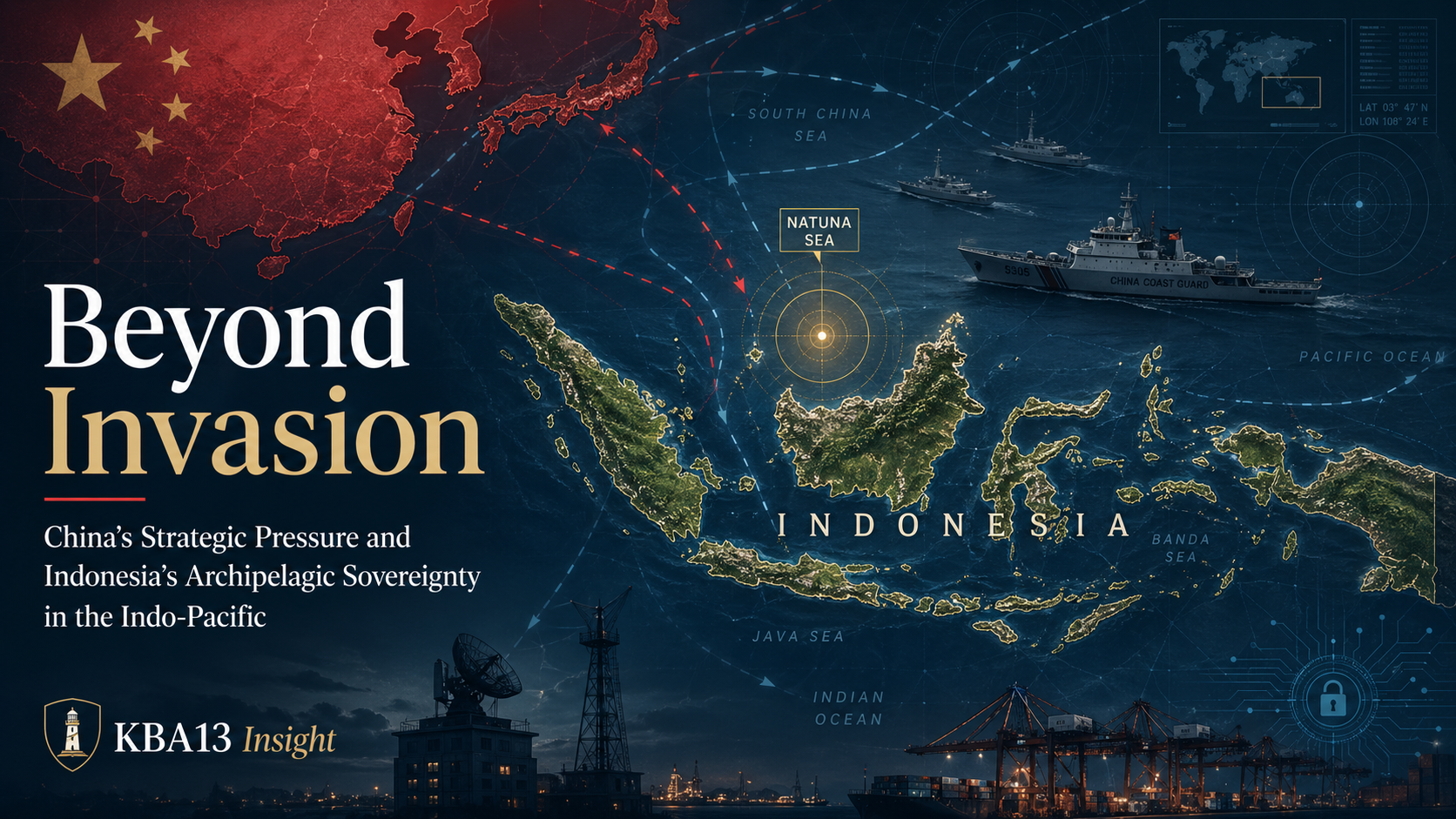

 Indonesia’s Anarchic Protest Wave: Security & Strategic Analysis, Triggers, Actors, and Policy Fallout
 Terrorism in Southeast Asia: Networks, Field Research, and New Updates 2025
 The Intelligence Dilemma in Indonesia: Between Security and Strategy
 US–China Trade Tensions and Indonesia’s Strategy under Prabowo Subianto
 US–China Trade Tensions and Indonesia’s Strategy under Prabowo Subianto