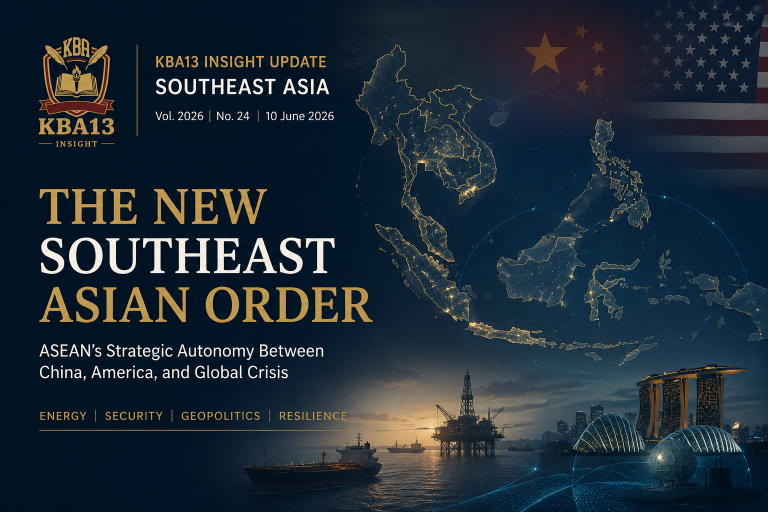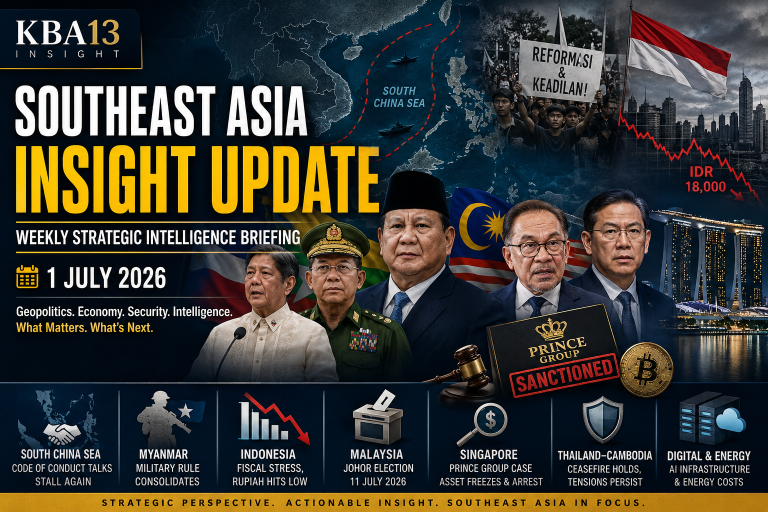
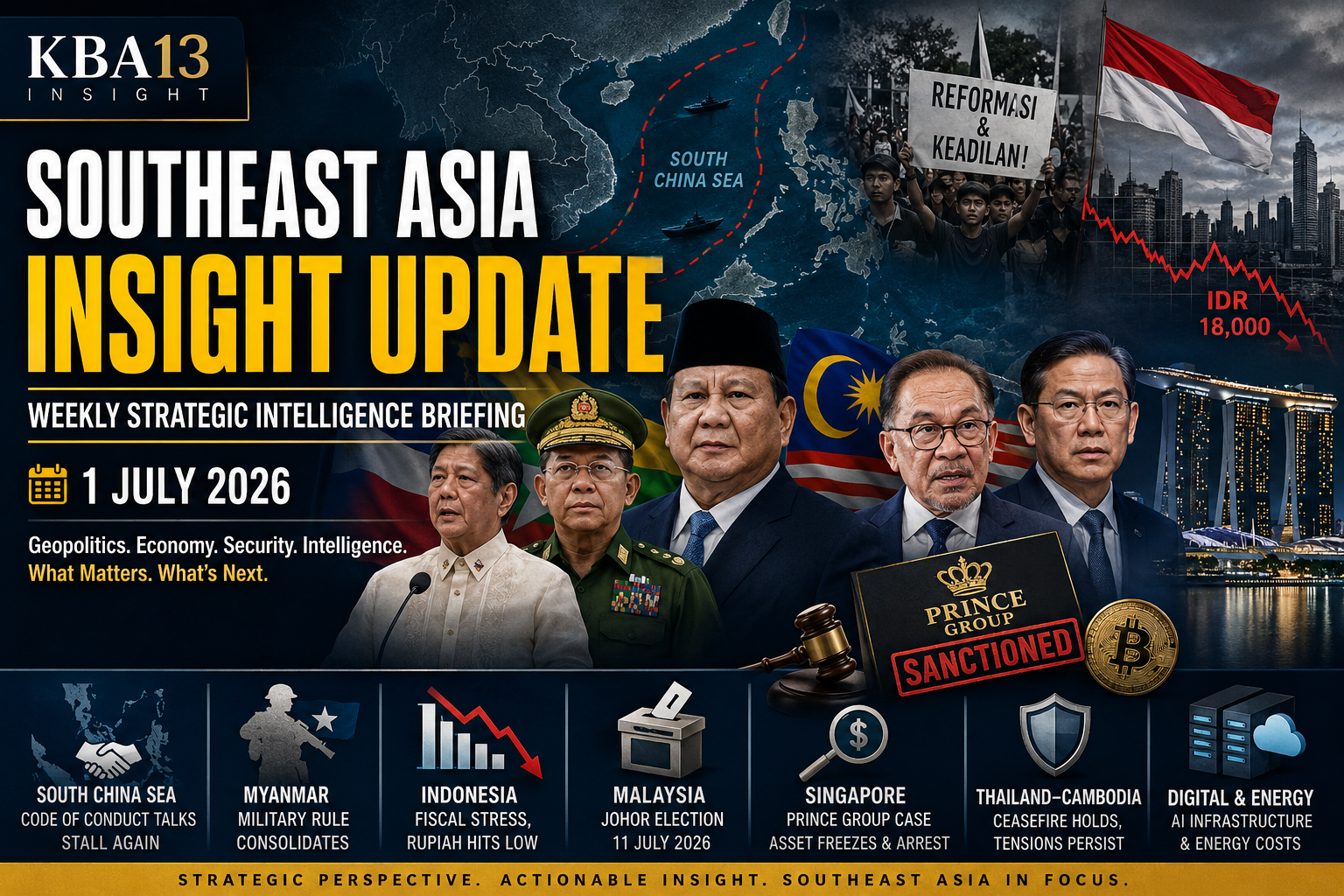
Southeast Asia Strategic Intelligence July 2026
Executive Summary
Southeast Asia enters July 2026 carrying the cumulative weight of five overlapping pressures: a stalled but still-contested South China Sea code of conduct negotiation, a Myanmar political order that has formally consolidated under Min Aung Hlaing without resolving the underlying civil war, an Indonesian state confronting fiscal exhaustion and street-level legitimacy questions, a Malaysian electoral cycle that will test the durability of the Anwar-Madani coalition model at sub-national level, and a regional financial-crime enforcement wave triggered by the Prince Group sanctions that has implicated Singapore, Cambodia, Hong Kong and beyond.
The Philippines, as 2026 ASEAN chair, has placed the conclusion of the South China Sea code of conduct at the center of its diplomatic agenda, with Foreign Secretary Maria Theresa Lazaro publicly targeting a year-end deal while privately acknowledging that even the definition of basic terms such as self-restraint remains unresolved after nearly a decade of negotiation. Analysts close to the process regard a binding 2026 agreement as unlikely given the gap between Manila’s insistence on UNCLOS-consistent, legally binding language and Beijing’s preference for a looser, non-binding framework.
Myanmar’s post-election order has hardened rather than softened. Min Aung Hlaing’s transition from junta commander to nominally civilian president has not altered the military’s command over the security and economic apparatus, while United Nations monitors continue to document mass civilian casualties at the hands of the security forces. ASEAN remains internally split, with Thailand pressing for pragmatic re-engagement with Naypyitaw and the Philippines maintaining that the election conferred no legitimacy.
Indonesia’s domestic picture has shifted from episodic protest to sustained fiscal retrenchment. The Prabowo administration has moved to cut its flagship free nutritious meals programme by roughly fifteen percent, suspending distribution through the school holiday period, after weeks of student mobilization tied to fuel price increases and a rupiah that touched historic lows near 18,000 to the dollar. The retrenchment reflects both budgetary necessity and an attempt to defuse a protest movement that has begun to question the military’s expanding role in civilian governance.
Malaysia’s Johor state election, scheduled for 11 July with nomination day completed on 27 June, has emerged as the most closely watched sub-national contest in the country’s recent political history. All fifty-six seats face contests with no walkovers, Barisan Nasional is defending a supermajority won in 2022, and the entry of Rafizi Ramli’s breakaway Bersama party into fifteen seats introduces a genuine wildcard into what was previously assumed to be a comfortable BN-PH arrangement under the federal unity government.
Singapore has become the operational epicenter of the region’s largest transnational financial-crime enforcement action in years. The United States Treasury’s expanded sanctions against Cambodia’s Prince Group network, announced 23 June, named Hu Xiaowei as the organization’s second-in-command and triggered Singaporean asset freezes exceeding half a billion Singapore dollars, alongside the arrest of Hu in Osaka and a Justice Department forfeiture action covering more than 127,000 bitcoin. The episode underscores Singapore’s dual exposure as both a financial hub vulnerable to laundering infiltration and a jurisdiction now central to multilateral enforcement cooperation.
The Thailand-Cambodia border remains formally under a December 2025 ceasefire that both governments continue to describe as holding, even as localized violence in Thailand’s deep south persists independently of the bilateral dispute, illustrated this week by truck arson that shut the Yala-Betong route and the killing of a defence volunteer in Pattani. The structural dispute over colonial-era demarcation lines remains unresolved and continues to constrain cross-border economic activity along an 800-kilometre frontier.
Energy and trade conditions across the region remain shaped by the lingering aftershocks of the United States-Israel war against Iran and the associated Strait of Hormuz disruption earlier in 2026. Fuel-import-dependent economies, Indonesia and the Philippines foremost among them, continue to absorb elevated energy costs that have fed directly into currency pressure, inflation and the political backlash visible in Jakarta’s streets. The Philippines has explicitly framed the South China Sea code of conduct push as an effort to prevent a second Hormuz-style chokepoint from emerging in Southeast Asian waters.
Digital and technology developments continue to accelerate beneath the geopolitical headlines. Data center capacity in Malaysia is on track to roughly double by year-end, driven substantially by Singapore-based investors seeking expansion room across the Causeway in Johor, a trend that links this week’s Johor election directly to the region’s artificial intelligence infrastructure build-out. Thailand’s central bank is meanwhile preparing rules for a baht-denominated stablecoin, signaling continued regional experimentation with sovereign digital currency frameworks.
Taken together, the week’s developments point to a region managing simultaneous stress on three fronts: maritime and great-power security, domestic fiscal and political legitimacy, and transnational financial-crime governance. None of these pressures is new, but their concurrence this week — a contested code-of-conduct push, a consolidating Myanmar junta, Indonesian austerity under protest, a high-stakes Malaysian state poll, and a landmark Singapore-anchored sanctions case — illustrates the structural fragility beneath ASEAN’s institutional continuity narrative for 2026.
ASEAN Architecture and Regional Governance
The Philippines’ chairmanship of ASEAN in 2026 has been defined almost entirely by the South China Sea code of conduct file, with Manila proposing to compress what were once quarterly working-group meetings into a monthly cadence in order to meet the July 2026 deadline that ASEAN and China set for themselves under the 2023 Guidelines for Accelerating the Early Conclusion of the Code. Four issues remain unresolved at the core of the negotiation: the geographic scope of application, whether the instrument will be legally binding, its relationship to the non-binding 2002 Declaration on the Conduct of Parties, and the terms of reference governing dispute resolution.
Independent assessments of the negotiation remain skeptical. Wu Shicun of China’s National Institute for South China Sea Studies has described a 2026 signing as effectively impossible under Philippine chairmanship, arguing that Manila’s insistence on referencing the 2016 arbitral tribunal ruling against China’s claims will be a recurring point of friction that Beijing will not accept. The practical effect is that ASEAN enters the second half of 2026 with its flagship maritime governance project likely to slip into 2027, even as the underlying incidents the code is meant to manage continue to multiply.
ASEAN’s internal cohesion has also been strained by divergent national positions on Myanmar. Thailand has pushed within ASEAN councils for a more accommodating posture toward the new Naypyitaw administration, citing practical necessities around refugee management, cross-border crime, and the scam-compound crackdown along the Thai-Myanmar frontier. The Philippines, by contrast, has maintained that the recent junta-run election conferred no legitimacy and that the bloc’s five-point consensus framework remains the only acceptable basis for engagement, leaving the grouping without a unified line heading into the second half of the year.
The bloc’s broader institutional workload this year includes managing the geoeconomic fallout of the Iran war and the Hormuz disruption, advancing the regional fight against online scam syndicates following the Prince Group sanctions wave, and absorbing China’s continued courtship through energy, fertilizer and trade offers extended at the Russia-ASEAN summit context in Kazan earlier this year. Vladimir Putin used that setting to project continued relevance despite sanctions and battlefield strain, an overture that several Southeast Asian governments have quietly explored as a hedge against Middle Eastern supply volatility.
ASEAN’s mineral and critical-supply-chain cooperation also advanced this week with planning underway for the ASEAN Mineral Investment Forum, intended to position the bloc collectively in negotiations with external powers over rare earths and battery-metal supply chains, an area where China’s dominant processing capacity continues to give it outsized leverage over Southeast Asian producers including Indonesia and the Philippines.
Transboundary haze and urban heat have re-emerged as a Mekong-region governance concern, with regional environment ministries placed on alert this week amid rising agricultural burning and elevated temperatures, a recurring seasonal stress test for ASEAN’s environmental cooperation mechanisms that have historically struggled to enforce compliance against member states’ domestic agricultural interests.
ASEAN’s relationship with external dialogue partners showed friction this week when a United States delegation declined to attend an APEC-adjacent meeting in Macau over a visa-requirement dispute with China, a minor incident in isolation but indicative of the broader great-power friction that increasingly intrudes on multilateral gatherings nominally hosted within the broader Asia-Pacific architecture.
On the humanitarian and diplomatic courtesy front, ASEAN governments extended condolences across the bloc following the death of Timor-Leste’s former president Francisco Guterres, with Singapore’s leadership among those issuing formal statements, a reminder that Timor-Leste’s eventual full ASEAN membership remains an unresolved institutional question even as ceremonial diplomatic engagement continues.
The bloc’s economic integration agenda continues to move on a separate, quieter track from its security file, with incremental progress on digital economy framework agreements and continued negotiation around an ASEAN-wide payment connectivity system intended to reduce dependence on dollar-clearing infrastructure for intra-regional trade, an initiative that gains strategic salience given the currency pressures visible in Indonesia and elsewhere this year.
Overall, ASEAN’s 2026 governance trajectory under Philippine chairmanship illustrates a structural pattern familiar from prior chairmanships: ambitious agenda-setting on the flagship security file, genuine but uneven progress on technical and economic cooperation, and persistent inability to forge unified positions on the bloc’s two most divisive internal issues, Myanmar and the South China Sea, because consensus-based decision-making structurally privileges the lowest common denominator among member states with sharply divergent interests vis-à-vis China.
Malaysia: Johor Polls as a National Bellwether
Malaysia’s political attention this week has concentrated almost entirely on the Johor state election, called a year early by incumbent Menteri Besar Onn Hafiz Ghazi and now scheduled for 11 July following a nomination day on 27 June that produced contests in all fifty-six seats with no walkovers, a outcome the Election Commission described as unprecedented in recent Johor electoral history. Early voting is set for 7 July, and the Election Commission has registered just under 2.73 million eligible voters.
The contest’s structural fragmentation is its most significant feature. Barisan Nasional and Pakatan Harapan are each fielding candidates in all fifty-six constituencies, while Perikatan Nasional is distributing thirty-two contested seats among Bersatu, PAS, and the Malaysian Indian People’s Party. Thirty-two seats will see three-cornered BN-PH-PN fights, twenty-seven are three-cornered in other configurations, twelve are four-way contests, and three seats will see five candidates, a level of fragmentation that increases the probability of vote-splitting outcomes difficult to forecast from historical voting patterns.
The entry of Bersama, the breakaway party led by Rafizi Ramli and Nik Nazmi Nik Ahmad following their departure from PKR and the Pakatan Harapan fold, adds a further variable. Bersama is contesting fifteen seats concentrated in southern Johor’s more urban, progressive-leaning constituencies, explicitly targeting UMNO-held and Pakatan-held seats alike, and has framed the election as a test of appetite for a reformist alternative to the existing unity-government arrangement between BN and PH at the federal level.
Barisan Nasional enters the contest defending the two-thirds supermajority of forty seats it won in 2022, a result analysts attribute to the personal popularity of Sultan Ibrahim Iskandar’s royal household alignment with BN-aligned governance in Johor as much as to UMNO’s own organizational strength. Menteri Besar Onn Hafiz Ghazi is himself defending his Machap seat, while former Menteri Besar and Johor Bersatu chief Sahruddin Jamal defends Bukit Kepong for Perikatan Nasional, making both races closely watched bellwethers within the broader contest.
Beyond the immediate electoral mechanics, Johor’s significance extends to the data center and digital infrastructure investment story that increasingly defines the state’s economic identity. Malaysia’s data center capacity is projected to roughly double to over 2,100 megawatts by the end of 2026, with much of that growth driven by Singaporean investors pushed across the Causeway by Singapore’s own land and power constraints, a dynamic that makes the political stability and investment-friendliness of whichever coalition governs Johor after 11 July a matter of direct interest to regional technology and capital markets.
Whatever the Johor outcome, the result will be read nationally as an early signal of voter sentiment toward the Anwar-led unity government’s economic management, including diesel subsidy rationalisation measures the federal government estimates will save up to two billion ringgit annually, fuel price adjustments effective into July, and ongoing engagement with Bangladesh over migrant labor governance and the Rohingya refugee question following recent ministerial-level talks in Naypyitaw.
Singapore: Financial Crime Enforcement and Domestic Governance
Singapore has been thrust into the center of the region’s largest transnational financial-crime case of 2026 following the United States Treasury’s 23 June expansion of sanctions against Cambodia’s Prince Group network, founded by Chen Zhi. The action named Hu Xiaowei, described by Treasury as the group’s second-in-command, alongside eight other individuals and twenty-six entities, and was accompanied by a Justice Department forfeiture action targeting more than 127,000 bitcoin tied to the network’s fraud and laundering operations, the largest such forfeiture in the department’s history.
Singaporean enforcement exposure is substantial. The Singapore Police Force has now seized or placed under prohibition orders more than half a billion Singapore dollars in cash, properties, a yacht, luxury vehicles and other assets connected to the Prince Group investigation, building on earlier seizures dating to late 2025. Police are separately investigating Hu Xiaowei and his Singapore-incorporated family office, Future Oasis, whose ultimate ownership structure runs through a British Virgin Islands holding company, illustrating how Singapore’s family-office regime has been exploited as a laundering conduit despite the city-state’s regulatory reputation.
The case gained an added international dimension when Tokyo’s Metropolitan Police arrested Hu Xiaowei in mid-June in connection with a fraudulent residency filing, after surveillance tracked his movements between London, Tokyo and Osaka. The coordination between Singaporean, Japanese and American authorities in this case represents one of the more developed examples of multilateral enforcement cooperation against Southeast Asia-based scam-compound financial networks, a sector the U.S. Treasury estimates cost American victims at least ten billion dollars in 2024 alone, a sixty-six percent increase year-on-year.
Beyond the Prince Group case, Singapore authorities issued Internal Security Act orders this month against two Singaporean nationals, including a nineteen-year-old student, over radicalization linked to the Gaza conflict, underscoring continued domestic vigilance over online extremist content alongside the financial-crime enforcement push. Separately, Singaporean authorities seized over one hundred unauthorized active mobility devices and unlicensed motor vehicles in a nine-day operation, part of an ongoing tightening of transport and public-safety regulation.
Workplace safety has become a parallel domestic governance concern, with the Ministry of Manpower announcing enhanced safety measures after a spate of workplace deaths, including seven fatalities among workers over a four-week period, prompting renewed scrutiny of safety compliance in the construction and marine sectors that rely heavily on foreign labor. A new speed-detection camera system is also being introduced on the Bukit Timah Expressway from 1 July, part of incremental road-safety enforcement upgrades.
Singapore’s regional economic positioning continues to be defined by the digital infrastructure dynamic noted above: with over 1,400 megawatts of existing data center capacity and plans to add a further 2,000 megawatts domestically, the city-state faces genuine physical and political constraints on further expansion, reinforcing its strategic interest in Johor’s investment climate and, by extension, in the outcome of Malaysia’s 11 July state election as a proxy indicator of cross-border regulatory stability.
3. Energy, Economics & Trade
Energy markets across Southeast Asia remain in a state of elevated but stabilizing stress following the earlier-2026 United States-Israel war against Iran and the associated Strait of Hormuz disruption. Fuel-import-dependent ASEAN economies have not fully unwound the price increases absorbed during the height of the crisis, and the political consequences are most visible in Indonesia, where a 32 percent diesel and subsidized fuel price increase in June directly precipitated the largest wave of student protest the country has seen since August 2025.
Indonesia’s Finance Ministry confirmed this week that the country’s planned Panda Bond issuance, denominated in Chinese yuan, remains on schedule for a late-June or early-July launch, a financing instrument that reflects Jakarta’s deliberate diversification away from dollar-denominated sovereign debt amid ongoing rupiah weakness. The currency touched a historic low near 18,000 to the U.S. dollar earlier in June, down from approximately 16,000 in March, a depreciation directly linked to the energy-cost shock and to broader capital-flow sensitivity around Indonesian fiscal credibility.
Vietnam’s trade relationship with Washington continues to be complicated by the optics of the Trump Organization’s 1.5 billion dollar golf resort and residential development project in Hung Yen province, where Vietnamese authorities this week began formally seizing farmland from displaced households, with police moving into the Chau Ninh commune site shortly after dawn. The project proceeded against a backdrop of an earlier threatened 46 percent U.S. tariff on Vietnamese exports, and critics continue to highlight the conflict-of-interest optics of a foreign government approving a presidential family business venture amid live trade negotiations with that same president’s administration.
Thailand’s export sector posted May growth slightly below forecast, with shipments to China specifically declining, a data point consistent with broader signs of softening Chinese demand for Southeast Asian intermediate and consumer goods even as China continues to position itself as the region’s indispensable trade and investment partner. The Bank of Thailand is concurrently preparing regulatory rules for a baht-denominated stablecoin, positioning the kingdom among the more proactive Southeast Asian regulators experimenting with sovereign-currency-linked digital asset frameworks.
Malaysia’s domestic fuel pricing continues to move in the opposite direction from Indonesia’s, with diesel and unsubsidized RON97 and RON95 prices easing into the 25 June to 1 July pricing window, providing the incumbent Barisan Nasional government a modest tailwind heading into the Johor state election. The federal government’s diesel subsidy rationalisation programme is projected to save up to two billion ringgit annually, a fiscal consolidation measure that has proceeded with comparatively less domestic backlash than Indonesia’s parallel subsidy adjustments.
Japan’s announcement of a growth strategy envisioning more than 370 trillion yen in combined public and private investment across seventeen sectors by fiscal 2040, including 102 trillion yen earmarked for artificial intelligence and semiconductors, carries direct implications for Southeast Asia as a downstream beneficiary of Japanese supply-chain diversification away from China. Prime Minister Sanae Takaichi’s parallel investment framework, financed through multi-year government bond issuance, is expected to channel additional Japanese capital into ASEAN manufacturing and digital infrastructure over the coming decade.
Cambodia’s tourism sector continues to register an early-year slump, compounding the reputational damage inflicted by the Prince Group scam-compound revelations and the lingering effects of the Thailand border conflict, both of which have depressed regional travel demand into Cambodia specifically. The convergence of security, reputational and financial-crime pressures represents a meaningful drag on what had been one of the region’s fastest-recovering post-pandemic tourism economies.
Indonesia’s broader investment and resource diplomacy continues to diversify, with Jakarta advancing nuclear cooperation discussions with both China and Russia on small modular reactor technology, and its earlier fighter-jet procurement decision favoring France’s Rafale and Turkish platforms over Chinese alternatives, signaling a deliberate hedging strategy across both energy and defense-industrial procurement that avoids overreliance on any single great-power supplier.
Myanmar’s economic ties with India are deepening through a bilateral currency swap arrangement now being drafted between the Reserve Bank of India and the Central Bank of Myanmar, intended to facilitate trade and investment between the two countries despite Myanmar’s continued international isolation on political grounds, illustrating how regional powers with practical economic and security interests, India foremost among them, continue pragmatic engagement with Naypyitaw regardless of the junta’s contested legitimacy.
The cumulative economic picture for Southeast Asia in the second half of 2026 is one of divergent national trajectories within a shared external shock environment: Indonesia and the Philippines absorbing the costliest adjustment from energy-price volatility and currency pressure, Malaysia and Thailand managing more moderate fiscal stress, Vietnam navigating an increasingly fraught trade relationship with Washington complicated by presidential-family business interests, and the region collectively continuing to deepen digital infrastructure and critical-minerals linkages that will shape its longer-term position in the global artificial intelligence supply chain.
Myanmar Crisis Watch
Myanmar’s political transformation from military junta to nominally civilian government has formally concluded, but the substance of military control remains unchanged. Min Aung Hlaing was inaugurated as president on 10 April 2026 following an indirect presidential election held on 3 April in which a parliament dominated by military-aligned parties, elected through a multistage process running from December 2025 through January 2026, served as the electoral college. He stepped down as commander-in-chief immediately prior to the nomination process, a constitutionally required formality that the International Crisis Group has characterized as military consolidation behind a civilian façade rather than genuine transition.
The election itself excluded the country’s principal pro-democracy opposition by design. The National League for Democracy, which won eighty-eight percent of parliamentary seats in the 2020 election under detained leader Aung San Suu Kyi, was formally dissolved in 2023 after refusing to register under junta-imposed electoral laws it considered illegitimate. International observers including the United Nations, the United Kingdom and the European Parliament have characterized the resulting vote as lacking any credible claim to free and fair status, conducted amid an ongoing civil war with junta control extending over less than half of national territory.
United Nations human rights monitoring continues to document an extraordinarily high civilian casualty rate under the new administration, with the UN reporting that the Myanmar military killed more than seven hundred civilians over a six-month period extending into June 2026, a figure that indicates no meaningful de-escalation accompanied the formal political transition. UN Special Rapporteur Tom Andrews has described the entire electoral process as a theatrical performance designed to manufacture international legitimacy rather than to reflect genuine political change.
International recognition of the new government remains sharply divided along familiar geopolitical lines. China has played a central enabling role throughout the process, balancing engagement with both the junta and resistance groups while ultimately concluding that the military represents the only actor capable of maintaining even minimal stability sufficient to protect Chinese strategic interests, including the China-Myanmar Economic Corridor connecting Yunnan province to the Indian Ocean via Rakhine State and continued access to Myanmar’s rare-earth deposits.
India has moved toward effective recognition, with Prime Minister Narendra Modi inviting Min Aung Hlaing to New Delhi for what was characterized as an official visit and India’s Ministry of External Affairs explicitly referring to him as Myanmar’s civilian president, a formulation that confers a degree of diplomatic legitimacy several Western governments have pointedly withheld. The visit became Min Aung Hlaing’s first foreign trip following his inauguration, underscoring the priority India places on practical engagement over normative objection.
The United States has adopted a position of deliberate non-comment, following Secretary of State Marco Rubio’s 2025 policy decision that the State Department would no longer publicly assess the legitimacy of other countries’ elections. This represents a marked departure from the more critical posture of prior administrations and raises the prospect, noted by multiple analysts, that Washington may ease sanctions on Myanmar to allow American natural resources firms to compete against Chinese and other foreign interests already embedded in the country’s extractive sector.
Within ASEAN, the Myanmar question continues to produce the bloc’s sharpest internal division. Thailand has pressed for a more pragmatic, accommodating posture toward Naypyitaw, citing the practical necessities of managing refugee flows, cross-border crime, and the joint crackdown on scam compounds along the shared frontier. The Philippines, as 2026 chair, has held firm that the five-point consensus framework remains the only legitimate basis for ASEAN engagement and that the recent election does not alter that calculus, even as Malaysia’s foreign minister noted after talks in Naypyitaw that the new administration appears comparatively more open to discussion.
Those Naypyitaw talks, led by Malaysian Foreign Minister Mohamad Hasan, covered the five-point consensus, the status of political prisoners, and the situation of Rohingya refugees currently in Malaysia, with Malaysian officials suggesting that ASEAN leaders may eventually consider adjustments to the peace plan’s terms if consensus among all member states can be achieved, a notable softening of language from a bloc that has historically refused any formal recalibration of its post-coup position.
Legal accountability efforts continue in parallel to the diplomatic track, with rights groups having filed a genocide complaint against Min Aung Hlaing, raising at least the theoretical prospect that an ASEAN member state could eventually indict the leader of another, an outcome the International Crisis Group regards as unlikely to materialize into an actual arrest but consequential enough to curtail Min Aung Hlaing’s travel within parts of the bloc.
The structural outlook for Myanmar remains one of frozen conflict rather than resolution. The new administration has secured the procedural trappings of civilian governance and a degree of selective international engagement, principally from China, India, Russia, Belarus and other non-Western states, while the underlying drivers of the 2021 coup-triggered civil war, ethnic armed organization resistance, territorial fragmentation, and the absence of any credible political settlement, remain entirely unaddressed heading into the second half of 2026.
Philippines Political Dynamics
The Philippines enters the second half of its ASEAN chairmanship year balancing an ambitious external diplomatic agenda, centered on the South China Sea code of conduct, against a series of difficult domestic developments that have tested the Marcos administration’s bandwidth and political capital simultaneously.
The most acute domestic shock this month has been a school shooting in Tacloban City, Leyte province, on 22 June, in which two students opened fire at San Jose National High School, killing three classmates and wounding several others before being taken into custody. President Ferdinand Marcos Jr. ordered an immediate investigation, and police have indicated the suspects may have been targets of bullying, while a subsequent magnitude 6.6 earthquake near the municipality of Sarangani on 26 June added a natural-disaster dimension to an already difficult news cycle, with aftershocks expected to continue.
In response to the shooting, Philippine authorities moved to temporarily block a gaming application reportedly used by one of the suspects, an action that has reopened a broader domestic debate over youth access to violent online content and the adequacy of the country’s digital-platform regulatory framework, an issue likely to feature in upcoming legislative sessions.
On the diplomatic front, Manila’s South China Sea code of conduct push remains the centerpiece of its chairmanship legacy ambitions, with Foreign Secretary Lazaro explicitly framing the urgency of the negotiation in terms of preventing the South China Sea from becoming, in her words, a second Strait of Hormuz, a comparison intended to underscore the global economic stakes of unresolved maritime tension in waters through which a substantial share of world trade transits.
China-Philippines relations have shown a notable, if cautious, normalization signal with the resumption of previously suspended private bilateral maritime consultations between Manila and Beijing, even as public friction over incidents in the West Philippine Sea continues largely unabated. The coexistence of resumed quiet diplomacy and continued public confrontation reflects the layered, often contradictory character of the bilateral relationship under the current Philippine administration.
The Philippines’ continued embrace of its alliance relationship with the United States and security partnerships with Japan was reinforced this week through joint maritime security training, with a Japan Coast Guard Mobile Cooperation Team conducting an instructor-certification programme for Indonesia’s BAKAMLA in Jakarta, part of a wider Japanese regional capacity-building effort spanning twenty-three countries that indirectly reinforces the broader coalition of regional actors pushing back against Chinese assertiveness in contested waters.
Domestically, the Marcos administration continues to navigate the political aftermath of earlier impeachment proceedings touching both the presidency and vice presidency, an institutional strain that, while not dominating headlines this particular week, remains an unresolved background factor shaping the administration’s capacity to project unified authority both domestically and in its ASEAN chairmanship role.
The Philippines also secured a minor diplomatic win this week when detained overseas Filipino workers were able to return home after President Marcos personally raised their case with Russian President Vladimir Putin, illustrating the administration’s continued willingness to engage directly with Moscow on consular matters even amid broader Western alignment on most other strategic questions.
Typhoon preparedness has remained an active operational concern for Philippine authorities, with police placed on alert against Typhoon Mekkhala earlier in the reporting period, a recurring seasonal demand on security and disaster-response resources that competes directly with the bandwidth required for the country’s ASEAN chairmanship responsibilities and ongoing South China Sea diplomacy.
Taken together, the Philippines’ political trajectory this week illustrates the structural tension inherent in holding the ASEAN chair during a year of acute domestic strain: Manila’s international agenda-setting ambition on the code of conduct file continues largely undiminished, even as school violence, natural disaster response, and lingering institutional friction at the presidential level consume significant domestic political attention and administrative capacity.
Indonesia Strategic Affairs
Indonesia’s domestic political economy has entered its most consequential stress test since the August 2025 protests, driven by the convergence of currency depreciation, energy-price shocks, and mounting public skepticism toward the fiscal sustainability of President Prabowo Subianto’s signature social programmes.
The Free Nutritious Meals programme, known by its Indonesian acronym MBG, has become the central flashpoint. Originally budgeted at 268 trillion rupiah, approximately fifteen billion dollars, for 2026 and intended to reach eighty-three million schoolchildren and pregnant women, the programme is now being scaled back by at least fifteen percent, with the National Nutrition Agency confirming distribution will be suspended during the school holiday period from 22 June to 13 July and during all future school holidays going forward, a structural rather than temporary adjustment.
The trigger for the most recent and largest wave of student protest was a 32 percent increase in fuel prices implemented in mid-June, the first such increase since the United States launched its war against Iran more than three months prior. Approximately 1,500 protesters attempted to march toward Jakarta’s Hotel Indonesia traffic circle on 12 June under the banner of what organizers called the ‘Heading to Bankrupt Indonesia’ movement, prompting a deployment of more than six thousand police and soldiers around the presidential palace and key government buildings.
Protest demands extend beyond the immediate fuel and food price issues to encompass a broader critique of governance structure, including objections to the role played by BPI Danantara, the state’s strategic investment vehicle chaired by senior cabinet figures including Rosan Roeslani, Erick Thohir and Sri Mulyani, with demonstrators arguing that ministerial involvement in Danantara’s governance structure violates Indonesia’s law on state ministries. Former president Joko Widodo’s continued advisory role at Danantara has also drawn specific protester criticism.
A parallel and more politically sensitive demand concerns the expanding role of the Indonesian military in civilian affairs, a grievance protesters frame as a direct threat to the country’s post-Reformasi democratic institutions. This demand carries particular weight given Indonesia’s history of military dominance under the New Order period, and its persistence across successive protest waves since 2025 suggests a durable, rather than episodic, civil-society concern rather than a one-off response to fuel pricing.
Indonesia’s rupiah depreciation, reaching approximately 18,000 to the U.S. dollar in June compared with roughly 16,000 in March, reflects both the direct cost of energy-import dependence amid global supply disruption and broader investor sensitivity to Indonesia’s fiscal trajectory, including the corruption investigation that led Prabowo to dismiss the head of the MBG programme earlier in June, a development that has further undermined public confidence in the programme’s administration even among those who support its underlying nutritional objectives.
Indonesia’s response to the currency and fiscal pressure includes a planned Panda Bond issuance denominated in Chinese yuan, scheduled for late June or early July, representing a deliberate diversification of Indonesia’s sovereign financing base away from dollar-denominated debt at a moment of dollar strength and elevated U.S. interest-rate uncertainty, a strategy that also deepens Jakarta’s financial relationship with Beijing.
On the defense and strategic procurement front, Indonesia’s continued nuclear power exploration with both China and Russia for small modular reactor technology, alongside its earlier decision to acquire French Rafale fighters and Turkish platforms rather than Chinese alternatives, reflects a consistent hedging posture that avoids strategic dependence on any single external power across both energy and defense-industrial domains.
Indonesia has also signaled regional solidarity through humanitarian channels, with the National Search and Rescue Agency, Basarnas, preparing to deploy a team to assist earthquake-response efforts in Venezuela following that country’s declaration of a national emergency after a series of deadly earthquakes, a gesture consistent with Jakarta’s longstanding effort to project an active, humanitarian-oriented foreign policy profile within the Global South even while managing acute domestic fiscal strain.
The strategic picture for Indonesia heading into the second half of 2026 is one of a government attempting to manage a genuine fiscal and legitimacy crisis through incremental policy adjustment rather than wholesale reversal, betting that targeted cuts to the MBG programme and continued currency-diversification measures will be sufficient to defuse protest momentum before it metastasizes into the kind of sustained, large-scale mobilization seen in August 2025, a bet that remains, as of this week, unresolved.
South China Sea & Maritime Security
The South China Sea code of conduct negotiations remain the defining maritime security file of 2026, with the Philippines, as ASEAN chair, pushing for a conclusion by year-end against a backdrop of persistent skepticism from independent analysts and continued operational friction at sea. Four unresolved milestone issues, scope, legal bindingness, the relationship to the 2002 Declaration, and terms of reference, continue to anchor negotiations that began formally in 2018 and trace their origin to a 2002 political commitment.
Foreign Secretary Lazaro’s acknowledgment that even the definition of self-restraint, arguably the most basic conceptual building block of any code of conduct, remains unresolved after nearly a decade of talks illustrates the depth of the underlying disagreement. China’s reported preference for provisions limiting joint military exercises with non-regional powers and restricting oil and gas exploration to partnerships involving Chinese participation represents, from the Philippine and broader claimant-state perspective, an attempt to use the code itself as a vehicle for cementing rather than constraining Chinese influence over contested resources.
Beyond the code of conduct track, Western concern over Chinese Coast Guard activity near Taiwan has intensified, with the United States, Britain, France and Germany jointly raising alarm this week over Chinese Coast Guard patrols off eastern Taiwan. Beijing characterized the criticism as an infringement on its legitimate jurisdictional authority, while Taipei thanked the four governments and argued that the patrols constitute maritime harassment violating international law and threatening both freedom of navigation and global trade flows, a framing that closely parallels Philippine rhetoric regarding West Philippine Sea incidents.
Japan’s continued investment in regional maritime security capacity-building was visible this week through a Japan Coast Guard training programme for Indonesia’s BAKAMLA personnel in Jakarta, part of a broader twenty-three-country Mobile Cooperation Team initiative that reflects Tokyo’s strategic interest in strengthening the coast guard and maritime law enforcement capabilities of Southeast Asian states most directly exposed to Chinese assertiveness.
Chinese naval activity beyond the South China Sea proper continues to draw regional attention, with Japan’s Ministry of Defence having reported aircraft carrier drills conducted by the Chinese navy in the Pacific Ocean east of the Philippines, a pattern of power projection that extends China’s operational reach beyond its immediate near-seas claims and reinforces Philippine and Japanese threat assessments regarding the trajectory of Chinese maritime ambition.
The four ASEAN claimant states with overlapping claims against China, Brunei, Malaysia, the Philippines and Vietnam, continue to approach the code of conduct negotiation with varying degrees of urgency and risk tolerance, reflecting their differing levels of direct confrontation with Chinese vessels. The Philippines has borne the most sustained and visible pressure in recent years, a fact that shapes its uncompromising insistence on legally binding language that other claimant states have been comparatively more willing to soften in pursuit of an achievable, if weaker, agreement.
Indonesia, while not a formal claimant in the dispute over the nine-dash line’s core contested features, maintains its own friction points with China over the Natuna Islands exclusive economic zone, an issue that continues to inform Jakarta’s broader hedging strategy across defense procurement and energy partnerships even though it received limited specific attention in this week’s reporting cycle.
Maritime law enforcement cooperation continues to deepen at the technical level even as high-level political negotiation stalls, illustrated by the joint Japan-Indonesia coast guard training noted above and by continuing, if uneven, information-sharing arrangements among Southeast Asian coast guards regarding Chinese vessel movements, an institutional layer of cooperation that tends to outlast the volatility of any single diplomatic negotiating cycle.
The broader strategic context shaping South China Sea dynamics in 2026 includes the lingering precedent of the Strait of Hormuz disruption, which Philippine officials have explicitly invoked as a cautionary parallel: a contested chokepoint through which enormous volumes of global trade transit, vulnerable to disruption by state or proxy action, with consequences that extend far beyond the immediate disputants to the global economy as a whole.
The maritime security outlook for the remainder of 2026 points toward continued incremental, technical-level cooperation among claimant and partner states, persistent and likely unresolved high-level negotiation over the code of conduct’s core legal architecture, and an elevated baseline risk of incident escalation given the combination of intensified Chinese Coast Guard activity, continued joint Western statements of concern regarding Taiwan, and the unresolved nature of the underlying territorial and resource disputes that no procedural agreement, however eventually concluded, is likely to fully resolve.
Mainland Southeast Asia (Thailand, Vietnam, Mekong)
Thailand and Cambodia’s border relationship remains formally governed by the ceasefire agreement signed by the two countries’ defense ministers on 27 December 2025, following months of escalating armed conflict that began in May 2025 and produced more than a hundred deaths and the displacement of roughly eight hundred thousand people across both sides of the frontier at the conflict’s peak. The ceasefire has held in its broad outlines through the first half of 2026, though both governments continue to accuse each other of incremental violations along the contested 800-kilometre border.
Independent of the bilateral Cambodia dispute, Thailand’s separate and longer-running insurgency in its three southernmost provinces, Pattani, Yala and Narathiwat, continues to generate periodic violence. This week, arson attacks shut down the Yala-Betong route after trucks were set ablaze, and a defence volunteer was killed in Pattani province, incidents consistent with the decades-long pattern of attacks by separatist groups including the Runda Kumpulan Kecil network targeting security, government and infrastructure targets in the deep south.
Thailand’s domestic political and economic management continues alongside these security concerns, with May export growth coming in slightly below forecast and shipments to China specifically declining, a signal of softening Chinese demand that compounds the broader regional trade headwinds stemming from elevated energy costs and currency volatility across import-dependent Southeast Asian economies.
The Bank of Thailand’s preparation of regulatory rules for a baht-denominated stablecoin represents a notable digital-currency policy development, positioning Thailand among the more proactive Southeast Asian central banks experimenting with sovereign-currency-linked digital asset infrastructure, a move that could have implications for cross-border payment efficiency within the Mekong subregion if eventually extended to facilitate trade settlement with neighboring states.
Vietnam’s relationship with the Trump administration remains entangled with the controversial 1.5 billion dollar Trump-branded golf resort and residential development project outside Hanoi in Hung Yen province, where Vietnamese police this week began the formal seizure of farmland from local households as part of land clearance for the project, a process that Vietnamese officials reportedly expedited outside normal legal procedure in order to mitigate the risk of a threatened 46 percent U.S. tariff on Vietnamese exports during the height of bilateral trade tension.
The optics of the Vietnam golf resort project continue to generate scrutiny in Western media regarding potential conflicts of interest involving the sitting U.S. president’s family business interests operating in direct proximity to live bilateral trade negotiations, even as the White House has consistently denied any improper connection between the Trump Organization’s commercial activities and official U.S. trade policy toward Hanoi.
Vietnam’s broader diplomatic engagement this week included a wreath-laying ceremony in Havana led by Foreign Minister Le Hoai Trung alongside Cuban officials, reflecting Hanoi’s continued maintenance of its historic socialist-bloc diplomatic relationships even as its economic orientation tilts increasingly toward integration with Western and Japanese supply chains. Vietnam also offered earthquake-response assistance to Venezuela following that country’s national emergency declaration, mirroring Indonesia’s parallel humanitarian gesture and reflecting a broader pattern of Southeast Asian Global South solidarity diplomacy.
Cambodia’s domestic governance picture this week included the Supreme Court’s decision to uphold jail sentences for two journalists accused of revealing military secrets, a ruling that continues to draw criticism from press freedom advocates and that occurs against the backdrop of Cambodia’s separate effort to rebuild relations with Washington, illustrated by a January visit of the USS Cincinnati to Ream Naval Base, a gesture intended to counterbalance years of perceived over-alignment with China.
Border security cooperation along the Laos-Vietnam frontier continued routinely this week with joint patrols aimed at managing and protecting border markers and territorial sovereignty under existing bilateral arrangements, a comparatively low-friction example of mainland Southeast Asian border management that contrasts with the persistent volatility characterizing the Thailand-Cambodia relationship.
The mainland Southeast Asia security and economic picture for the remainder of 2026 suggests continued fragile stability along the Thailand-Cambodia frontier contingent on both governments’ continued restraint, persistent low-level insurgent violence in southern Thailand independent of the bilateral dispute, and a Vietnam-United States trade relationship increasingly shaped by non-economic political and reputational factors tied to the Trump family’s direct commercial interests in the country, a dynamic without clear precedent in the history of U.S.-ASEAN economic diplomacy.
Strategic Outlook: Signals to Watch
The South China Sea code of conduct negotiation will remain the single most consequential diplomatic indicator to monitor through the remainder of 2026. The original July 2026 target date set under the 2023 Guidelines has already effectively lapsed without resolution of the four core milestone issues, and the realistic question for observers is no longer whether a 2026 conclusion is achievable but whether the Philippines can secure even a face-saving partial framework before its chairmanship concludes at year-end, with any failure likely to be interpreted in Manila as a missed strategic opportunity given the rare alignment of chairmanship and acute national interest in the file.
Myanmar’s trajectory bears watching for two distinct signals: first, whether China’s calculus toward Min Aung Hlaing’s administration shifts in response to any acceleration or deceleration of progress on the China-Myanmar Economic Corridor and rare-earth access arrangements, and second, whether any Western government breaks from the current pattern of non-recognition to extend even limited diplomatic engagement, a shift that would mark a meaningful erosion of the post-coup international isolation strategy that has persisted, with India’s notable exception, since 2021.
Indonesia’s fiscal and political trajectory will hinge substantially on whether the MBG programme cuts succeed in defusing protest momentum or instead generate a backlash from beneficiary communities who depend on the programme, potentially producing a second, distinct protest dynamic running parallel to the existing fiscal-austerity-focused movement. The Panda Bond issuance outcome and subsequent rupiah stability will serve as the clearest near-term market signal of whether Jakarta’s currency-diversification strategy is gaining investor confidence.
Malaysia’s 11 July Johor election result will be read as the most immediate bellwether for the durability of the federal unity government model ahead of the next general election cycle. A strong Bersama showing, even without outright seat wins, would signal genuine erosion of Pakatan Harapan’s claim to the reformist vote, while any unexpected Barisan Nasional underperformance would raise questions about UMNO’s organizational strength independent of royal household alignment, a factor that has insulated BN from broader national anti-incumbency trends in recent Johor contests.
The Prince Group enforcement case will continue to generate downstream effects across Singapore, Cambodia, Hong Kong and Japan, with the key signal to watch being whether further individuals tied to the network’s leadership are apprehended or sanctioned, and whether the FinCEN action against the rebranded H-Pay entity succeeds in genuinely severing the network’s access to U.S.-linked financial infrastructure or merely prompts a further rebranding cycle, a pattern already observed once with the transition from Huione Pay to H-Pay.
Thailand-Cambodia border stability will remain contingent on the durability of the December 2025 ceasefire, with any significant escalation likely to be triggered, as in prior cycles, by a localized incident, a landmine detonation, a mortar exchange attributed to operational error, or a skirmish near a contested temple site, rather than by any deliberate strategic decision on either side, a pattern that argues for close monitoring of low-level incident reports rather than high-level diplomatic statements alone.
Vietnam’s trade relationship with Washington will be shaped significantly by how the Trump-branded golf resort controversy evolves, particularly whether the land seizure process generates sustained domestic backlash within Vietnam serious enough to affect the ruling Communist Party’s broader economic management credibility, and whether the project’s progress correlates visibly with the trajectory of bilateral tariff negotiations in a manner that further substantiates conflict-of-interest concerns already raised by international media.
Energy price trajectories tied to the lingering aftermath of the Iran-Hormuz disruption remain the single most important external variable shaping the fiscal and political stability of import-dependent ASEAN economies, with any renewed escalation in the Gulf carrying the potential to reproduce, in sharper form, the currency and protest dynamics already visible in Indonesia over the past month, an outcome that would test the political resilience of multiple regional governments simultaneously.
The region’s digital infrastructure build-out, evidenced by Malaysia’s projected doubling of data center capacity, Singapore’s continued capacity constraints, and Thailand’s stablecoin regulatory development, represents a structural trend likely to persist regardless of the political and security volatility documented elsewhere in this briefing, and merits continued tracking as a distinct, longer-horizon strategic indicator of the region’s positioning within the broader global artificial intelligence and digital-finance infrastructure competition.
In aggregate, Southeast Asia’s strategic outlook for the third quarter of 2026 is best characterized as one of managed fragility across multiple simultaneous fronts rather than acute crisis on any single front: each of the developments tracked in this briefing, the code of conduct stall, Myanmar’s frozen consolidation, Indonesia’s fiscal retrenchment, Malaysia’s electoral test, Singapore’s enforcement exposure, and the mainland’s border and trade frictions, remains individually containable, but their concurrence raises the structural risk that a shock in any one domain could cascade into renewed instability across the others, a dynamic this briefing will continue to track on a weekly basis.
About The Author

Artikel Terkait
 Southeast Asia Strategic Outlook 2026: ASEAN, Indonesia, Myanmar, and South China Sea Tensions
 KBA13 Insight Regional Update: Southeast Asia Under Pressure (Hormuz Shock, ASEAN Crisis, Myanmar, Indonesia, and the South China Sea in 2026)
 Southeast Asia Strategic Outlook 2026: ASEAN, South China Sea Tensions, Prabowo’s Economic Doctrine, and the Future of Regional Order
 Southeast Asia Strategic Outlook 2026: Hormuz Crisis, ASEAN Security Shift, China-US Rivalry, and the Future of Regional Order
 Southeast Asia Strategic Outlook 2026: South China Sea, Indonesia’s Economy, Myanmar Crisis, and ASEAN Energy Security