
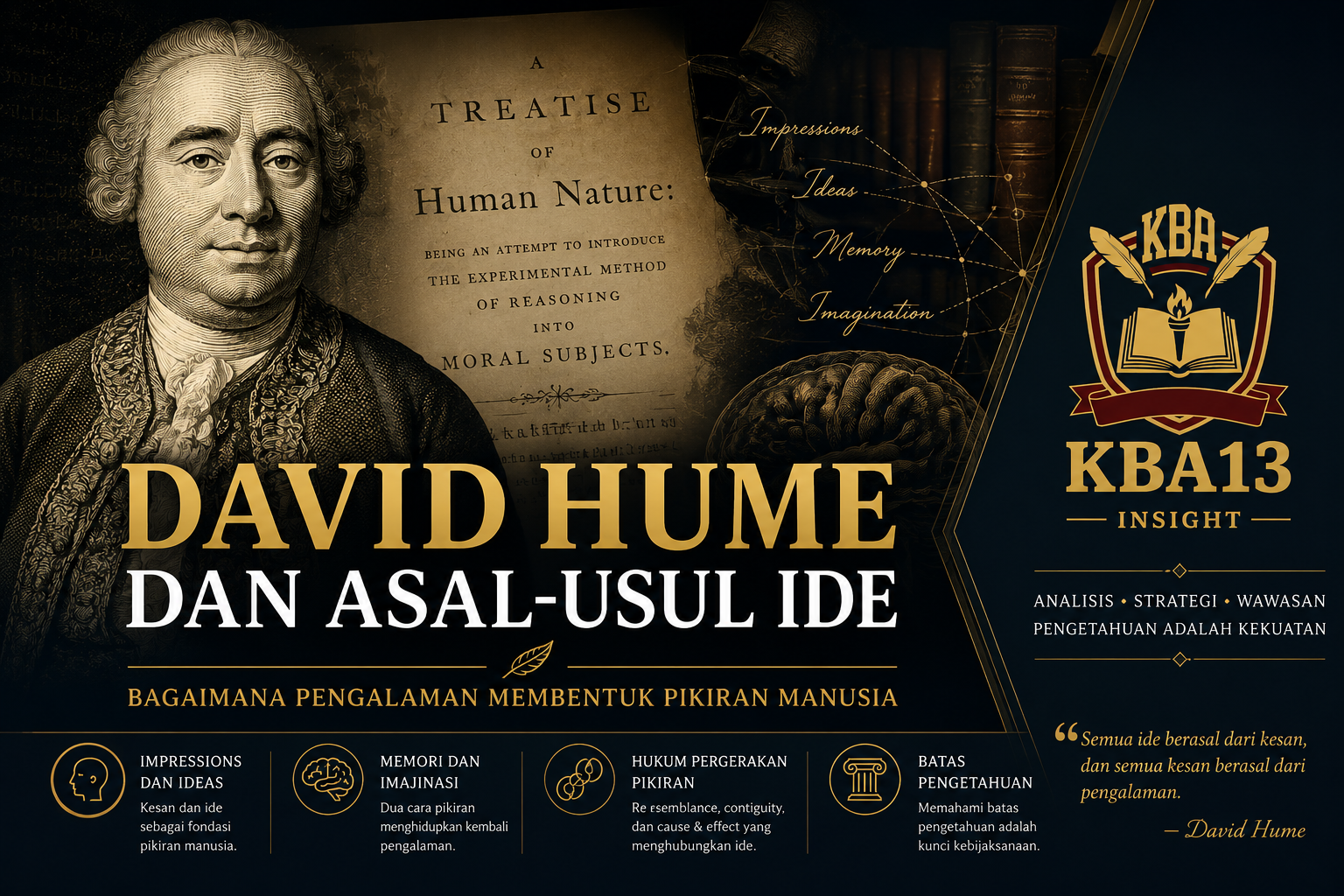
Entering the Architecture of Hume’s Mind: Perception, Impressions, and the Origin of Human Ideas
David Hume opens A Treatise of Human Nature with a step that appears simple yet carries enormous consequences for the history of philosophy: before human beings speak of truth, reality, or knowledge, they must first understand what is actually present in the mind. Hume returns philosophical inquiry to its earliest point, namely the way the mind receives, stores, and processes the various forms of perception.
For Hume, the entire content of the human mind can be traced back to a single broad category he calls perception. This term encompasses everything that appears in the mind: the sensations that are felt, the emotions that stir, the desires that arise, the memories that return, and the images formed through the process of thinking. In this way, Hume does not immediately construct a theory about the external world but first examines the elements that make it possible for human beings to understand that world.
Out of all these perceptions, Hume identifies the most fundamental division: impressions and ideas. The two are not different substances but rather two forms in which the mind’s contents are present, distinguished by their degree of force and vividness. Impressions arrive with greater strength and greater liveliness. All the sensations, feelings, drives, and emotions that arise directly belong to this domain because they enter the mind with greater intensity.
An idea, by contrast, is a fainter form of that impression when the mind remembers, imagines, or reasons. The experience of seeing a color, feeling heat, or undergoing an emotion arrives first as an impression. When it reappears in the mind without the direct presence of that object or state, what is present is an idea. An idea is not something that arises without cause but a faded image of the impression that preceded it.
For this reason, in Hume’s view, there is a fundamental difference between feeling something and thinking about it. When a human being experiences a feeling directly, the mind receives something with a certain force. But when a human being merely remembers or imagines that feeling, what appears is only a representation at a lower level of vitality. The difference between the two lies not in wholly different content but in the degree of force with which something is present in the mind.
Yet Hume does not understand the boundary between impressions and ideas mechanically. Under certain conditions, the distance between them can become very close. When a person sleeps, is ill, suffers a disturbance of the mind, or is under extremely powerful emotional pressure, an idea can acquire a force almost resembling a direct impression. Conversely, some impressions can arrive so faintly that they are difficult to distinguish from the shadows of thought.
From this initial analysis, Hume builds a solid foundation for the inquiry into human understanding. The central question is no longer merely “what do human beings know,” but “how does something first come to be present so that it can become material for knowledge.” By distinguishing impressions and ideas, Hume shows that to understand the human mind, we must trace the origin of an idea back to the first form of its appearance. It is here that Hume’s philosophical project begins: reading the human being through the most basic traces that form the mind.
Why an Idea Always Bears the Trace of a Prior Impression
After distinguishing between impressions and ideas, and between simple and complex perceptions, Hume enters the heart of his inquiry: the relationship between the two. The question he seeks to answer is not merely whether the mind holds various kinds of ideas, but where those ideas come from. It is here that Hume advances one of the most important principles in his philosophy, namely that every simple idea bears a relation to the simple impression it resembles.
For Hume, when a human being examines the mind carefully, it becomes clear that a simple idea does not come first. A simple idea is something that follows a simple impression. Before a person can have an idea of a particular color, a particular sound, or a particular taste, there must be an initial form that once appeared as an impression. The mind does not generate that raw material on its own without something preceding it.
This relation is not only one of resemblance but also of order of appearance. The simple impression appears first, and then the mind can bring back its form through an idea. Someone who has once seen a color can remember that color. Someone who has once heard a sound can imagine that sound again. That memory may be weaker than the first experience, but it still carries the trace of its original impression.
To reinforce his argument, Hume asks human beings to test this principle by examining their own thinking. Each time a person discovers a simple idea, Hume claims, that person will find a simple impression corresponding to it. Conversely, when a person has never had a particular impression, the mind likewise has no idea related to it. The absence of an impression produces the absence of material for the emergence of an idea.
Hume demonstrates this through the example of a human being who has lacked one of the senses since birth. Someone who has never been able to see color will have no genuine idea of that color. Someone who has never undergone a certain kind of sensation will be unable to form an idea of that sensation in the same way as one who has experienced it. A deficiency at the source of impressions produces a deficiency in the domain of ideas.
This argument carries great consequences for how we understand human knowledge. Hume is limiting the claim that the mind can discover everything through abstract thought alone. The mind does possess an extraordinary capacity to process ideas, but that capacity still depends on the initial material received through impressions. An idea is not the first foundation; an idea is something born after an impression exists.
With this principle, Hume builds an extremely solid foundation for empiricism. Every concept a human being uses must be testable by a simple question: from what impression does this idea derive? If an idea cannot be traced back to its original impression, then a human being must be cautious about the status and meaning of that idea. For Hume, understanding the origin of an idea is the first step toward knowing the limits of the human mind’s capacity.
The Exception That Tests the Theory: Hume and the Problem of an Idea Without a Direct Impression
After establishing the principle that every simple idea derives from a simple impression, Hume does something intriguing: he himself presents a possibility that appears to be an exception to his theory. This move reveals Hume’s highly careful way of thinking. Hume does not merely seek examples that support his argument; he also tests whether the principle holds up when confronted with a difficult case.
The example he gives is of a person who has come to know various shades of a color but has missed one particular gradation within that range. Imagine someone who has seen almost every shade of blue, from the darkest to the lightest, except for one specific shade never seen before. The question is whether that person’s mind is able to imagine the missing color without ever having received a direct impression of it.
Hume acknowledges that in such a case it seems possible for the mind to form an idea of a color never supplied through a direct impression. By observing the relationship among the various shades already known, the mind can fill in that gap and produce an image of a color never previously experienced. This looks like an exception to the principle that every simple idea must derive from a simple impression.
For Hume, however, this exception is not strong enough to demolish the general rule that has been discovered. The case is highly particular and rare. The mind’s ability to complete a missing part in a series of experiences does not mean that the mind is generally capable of creating an entire idea without a prior basis in impression. Hume views it as a limited exception, not as proof that the basic principle must be abandoned.
This section is important because it displays the character of Hume’s method. Hume does not build his philosophy by defending a system absolutely. Hume is willing to acknowledge a difficulty within his own theory. Yet a small exception does not automatically invalidate the larger pattern consistently found in the workings of the human mind.
Through this discussion, Hume in fact reveals a balance between conviction in the empirical principle and philosophical caution. The human mind does possess a certain capacity to process the relations among ideas, but that capacity still operates within limits very close to prior experience. Imagination can fill an empty space, but that space itself is shaped by the structure of impressions already present.
For this reason, the example of the missing shade is not a rejection of Hume’s empiricism but a test of its limits. Hume wishes to show that the inquiry into the human mind must follow what is genuinely found in the operations of the mind, rather than being forced to conform to a theory constructed beforehand. The strength of Hume’s philosophy in fact emerges from his courage to test his own principle before using it to judge the more complex ideas of human beings.
Memory and Imagination: Two Ways the Mind Revives an Idea
After explaining that ideas derive from impressions, Hume extends his inquiry to the next problem: what happens once an impression is no longer directly present in the human mind. An experience arrives, leaves a trace, and then vanishes. Yet human beings remain able to bring back something once experienced. It is here that Hume begins to distinguish two important faculties of the mind: memory and imagination.
For Hume, when an impression reappears as an idea, that reappearance does not always take the same form. There are ideas that return with greater force and a closer connection to the original impression. This is the domain of memory. Through memory, the mind brings back something previously received while preserving the arrangement and order of the first experience.
Memory has a stronger attachment to its original impression. When a person remembers an event, the mind is not free to alter the entire arrangement of that event. Memory brings back the idea while preserving the sequence and position in which the impression was once received. For this reason, memory still retains a strong trace of the experience that served as its source.
Unlike memory, imagination possesses a far wider freedom. Imagination can take various ideas, separate them, recombine them, or place them in a new arrangement. Something that never appeared as a complete experience can arise through the faculty of imagination, because the mind is able to rework the materials it already possesses.
Yet the freedom of imagination does not mean the mind can create something without limit. Hume still upholds his initial principle: the raw material of imagination derives from the impressions and simple ideas it already holds. Imagination can alter the form of the building, but it does not create the building’s initial materials. The mind works with something that has already entered beforehand through perception.
This distinction between memory and imagination becomes important because Hume is explaining the internal structure of the human mind. Human beings do not merely receive impressions and store them passively. The mind possesses mechanisms that allow the past to reappear, whether in a more faithful form through memory or in a freer form through imagination.
From here Hume opens the way toward a larger question. If imagination has the freedom to arrange and connect ideas, why does the human mind remain orderly? Why does one particular idea so often lead a human being to another idea connected with it? This is the very question that brings Hume to his next discussion: the principles that govern the relations among ideas in the human mind.
The Laws of the Movement of the Mind: Why Human Ideas Are Connected to One Another
After distinguishing between memory and imagination, Hume confronts an important problem. If human imagination has the freedom to separate, combine, and rearrange various ideas, why does the human mind not move at random? Why does one particular idea so often lead a human being to another idea in an orderly way? This question brings Hume to an analysis of the principle that connects the various ideas in the mind.
For Hume, although imagination has a wide space of freedom, the movement of the mind still follows a certain pattern. Ideas do not always appear chaotically without connection. When an idea is present, the mind often moves to another idea related to it. There is a kind of natural tendency that makes one notion draw another notion into appearance.
Hume then identifies three principal principles that make human ideas connect with one another: resemblance, contiguity, and cause and effect. These three are not rules imposed from outside the mind but the natural way the mind passes from one idea to another. Through these principles, human mental life acquires its orderliness.
The first principle is resemblance. The mind moves easily from one idea to another when the two share a similarity. A picture can bring a person to a memory of the one depicted. A sign can lead the mind to something it resembles. Resemblance becomes one of the paths that connect one perception with another.
The second principle is contiguity, that is, closeness in space or time. The human mind tends to connect things that were once present near one another. When a person thinks of a place, the mind may be directed toward the events that occurred there. When recalling one event, the mind may move to another event lying within a consecutive sequence of time.
The third principle is cause and effect. For Hume, this becomes the strongest relation, because human beings often move from one idea to another through the supposition of a causal connection. On seeing an effect, the mind moves to search for its cause. On seeing a cause, the mind imagines the effect that may follow it. This is the very principle that later becomes one of the central discussions in Hume’s philosophy.
By explaining these three principles, Hume shows that the human mind stands between two sides: it possesses freedom, but also orderliness. Imagination can construct an immensely vast world, yet its movement still follows a certain pattern. From the analysis of the origin of ideas, Hume finally opens the way toward a deeper question: how human beings build conviction about the world, the relations among events, and the limits of knowledge regarded as certain.
Memory and Imagination: Two Ways the Mind Revives an Idea
After explaining that ideas derive from impressions, Hume extends his inquiry to the next problem: what happens once an impression is no longer directly present in the human mind. An experience arrives, leaves a trace, and then vanishes. Yet human beings remain able to bring back something once experienced. It is here that Hume begins to distinguish two important faculties of the mind: memory and imagination.
For Hume, when an impression reappears as an idea, that reappearance does not always take the same form. There are ideas that return with greater force and a closer connection to the original impression. This is the domain of memory. Through memory, the mind brings back something previously received while preserving the arrangement and order of the first experience.
Memory has a stronger attachment to its original impression. When a person remembers an event, the mind is not free to alter the entire arrangement of that event. Memory brings back the idea while preserving the sequence and position in which the impression was once received. For this reason, memory still retains a strong trace of the experience that served as its source.
Unlike memory, imagination possesses a far wider freedom. Imagination can take various ideas, separate them, recombine them, or place them in a new arrangement. Something that never appeared as a complete experience can arise through the faculty of imagination, because the mind is able to rework the materials it already possesses.
Yet the freedom of imagination does not mean the mind can create something without limit. Hume still upholds his initial principle: the raw material of imagination derives from the impressions and simple ideas it already holds. Imagination can alter the form of the building, but it does not create the building’s initial materials. The mind works with something that has already entered beforehand through perception.
This distinction between memory and imagination becomes important because Hume is explaining the internal structure of the human mind. Human beings do not merely receive impressions and store them passively. The mind possesses mechanisms that allow the past to reappear, whether in a more faithful form through memory or in a freer form through imagination.
From here Hume opens the way toward a larger question. If imagination has the freedom to arrange and connect ideas, why does the human mind remain orderly? Why does one particular idea so often lead a human being to another idea connected with it? This is the very question that brings Hume to his next discussion: the principles that govern the relations among ideas in the human mind.
The Laws of the Movement of the Mind: Why Human Ideas Are Connected to One Another
After distinguishing between memory and imagination, Hume confronts an important problem. If human imagination has the freedom to separate, combine, and rearrange various ideas, why does the human mind not move at random? Why does one particular idea so often lead a human being to another idea in an orderly way? This question brings Hume to an analysis of the principle that connects the various ideas in the mind.
For Hume, although imagination has a wide space of freedom, the movement of the mind still follows a certain pattern. Ideas do not always appear chaotically without connection. When an idea is present, the mind often moves to another idea related to it. There is a kind of natural tendency that makes one notion draw another notion into appearance.
Hume then identifies three principal principles that make human ideas connect with one another: resemblance, contiguity, and cause and effect. These three are not rules imposed from outside the mind but the natural way the mind passes from one idea to another. Through these principles, human mental life acquires its orderliness.
The first principle is resemblance. The mind moves easily from one idea to another when the two share a similarity. A picture can bring a person to a memory of the one depicted. A sign can lead the mind to something it resembles. Resemblance becomes one of the paths that connect one perception with another.
The second principle is contiguity, that is, closeness in space or time. The human mind tends to connect things that were once present near one another. When a person thinks of a place, the mind may be directed toward the events that occurred there. When recalling one event, the mind may move to another event lying within a consecutive sequence of time.
The third principle is cause and effect. For Hume, this becomes the strongest relation, because human beings often move from one idea to another through the supposition of a causal connection. On seeing an effect, the mind moves to search for its cause. On seeing a cause, the mind imagines the effect that may follow it. This is the very principle that later becomes one of the central discussions in Hume’s philosophy.
By explaining these three principles, Hume shows that the human mind stands between two sides: it possesses freedom, but also orderliness. Imagination can construct an immensely vast world, yet its movement still follows a certain pattern. From the analysis of the origin of ideas, Hume finally opens the way toward a deeper question: how human beings build conviction about the world, the relations among events, and the limits of knowledge regarded as certain.
The Legacy of Hume’s Thought on the Origin of Ideas and the Workings of the Human Mind
Hume’s discussion of the origin of ideas is not merely a theory about how human beings think. Hume is dismantling one of the greatest questions in philosophy: does the human mind possess ideas that stand on their own before experience, or does the entire edifice of human thought have its roots in something that is first present in the mind?
Hume’s answer moves through a gradual analysis. First, the entire content of the human mind is called perception. Then that perception is divided into two principal forms: impressions, which appear with greater force, and ideas, which are the weaker form when the mind remembers or reflects on something again. From this simple division, Hume builds a grand framework for understanding the relationship between direct experience and the world of human thought.
Yet Hume’s strength lies not only in the claim that ideas derive from impressions. More important is his method of examination. Each time a human being uses an idea, especially a complex and abstract one, Hume invites the person to ask: is there an initial impression that serves as the source of that idea? This question becomes a tool for distinguishing between a notion grounded in human experience and a notion that has lost its connection to its source.
With this approach, Hume changes the direction of philosophy. The human mind is no longer treated as a space that freely produces concepts without limit. The mind possesses an extraordinary capacity to remember, combine, compare, and build various new forms of thought. But all of these processes still proceed from the initial material obtained through impressions.
This is why the seemingly simple discussion of impressions and ideas becomes so decisive. Behind the difference between seeing and remembering, feeling and imagining, experiencing and thinking, lies a far greater problem: how human beings can know something, and to what extent the mind can be trusted when it speaks of reality.
Hume does not destroy the human capacity to think. On the contrary, Hume imposes discipline on the mind. It is not enough for a notion merely to appear profound or sound convincing. A notion must have its origin examined. In this way, philosophy becomes an activity of tracing how human beings form their convictions, rather than merely defending convictions already held.
From the opening pages of A Treatise of Human Nature, it is clear that Hume’s project is a vast inquiry into the human being itself. To understand the world, a human being must first understand how his own mind works. For before the world is explained by the human being, the world is already present through impression, processed into idea, and built up into the entire structure of knowledge that shapes the way human beings view reality.
About The Author

Rekomendasi Bacaan KBA13 INSIGHT
Jika tulisan ini bermanfaat, dukung jurnal ini dengan mencari bukunya melalui tautan berikut:
- Buku-buku Kamaruzzaman Bustamam Ahmad di Periplus
- Koleksi Islamic Studies di Periplus
- Koleksi Geopolitics & Politik Internasional di Periplus
- Cari buku & perangkat baca di Shopee
- Cari di Blibli
Daftar lengkap: Rekomendasi Buku, Alat Tulis & Layanan. Tautan di atas adalah tautan afiliasi — KBA13 INSIGHT dapat memperoleh komisi kecil tanpa biaya tambahan bagi Anda.
Artikel Terkait
 How John Locke Explains the Origin of Simple Ideas: A Close Reading of An Essay Concerning Human Understanding
 Nietzsche and Human, All Too Human: The Human Journey to Break Free from the Illusion of Values
 Acehnology: Menyelami Kembali Kosmos Pengetahuan dari Tanah Aceh
 Planetary Civilization: Ketika Teknologi, Informasi, dan Algoritma Membentuk Masa Depan Manusia
 Paradigma Frikatifisasi Ilmu: Hembusan Kosmik dalam Arsitektur Keilmuan Islam
Leave a Reply