

KBA13 Insight · KBA13 Insight Update International · Strategic Analysis
Global Intelligence Briefing (14–18 July 2026):US–China Rivalry, Iran War, AI’s Espionage, Indo-Pacific Security & Strategic Forecast
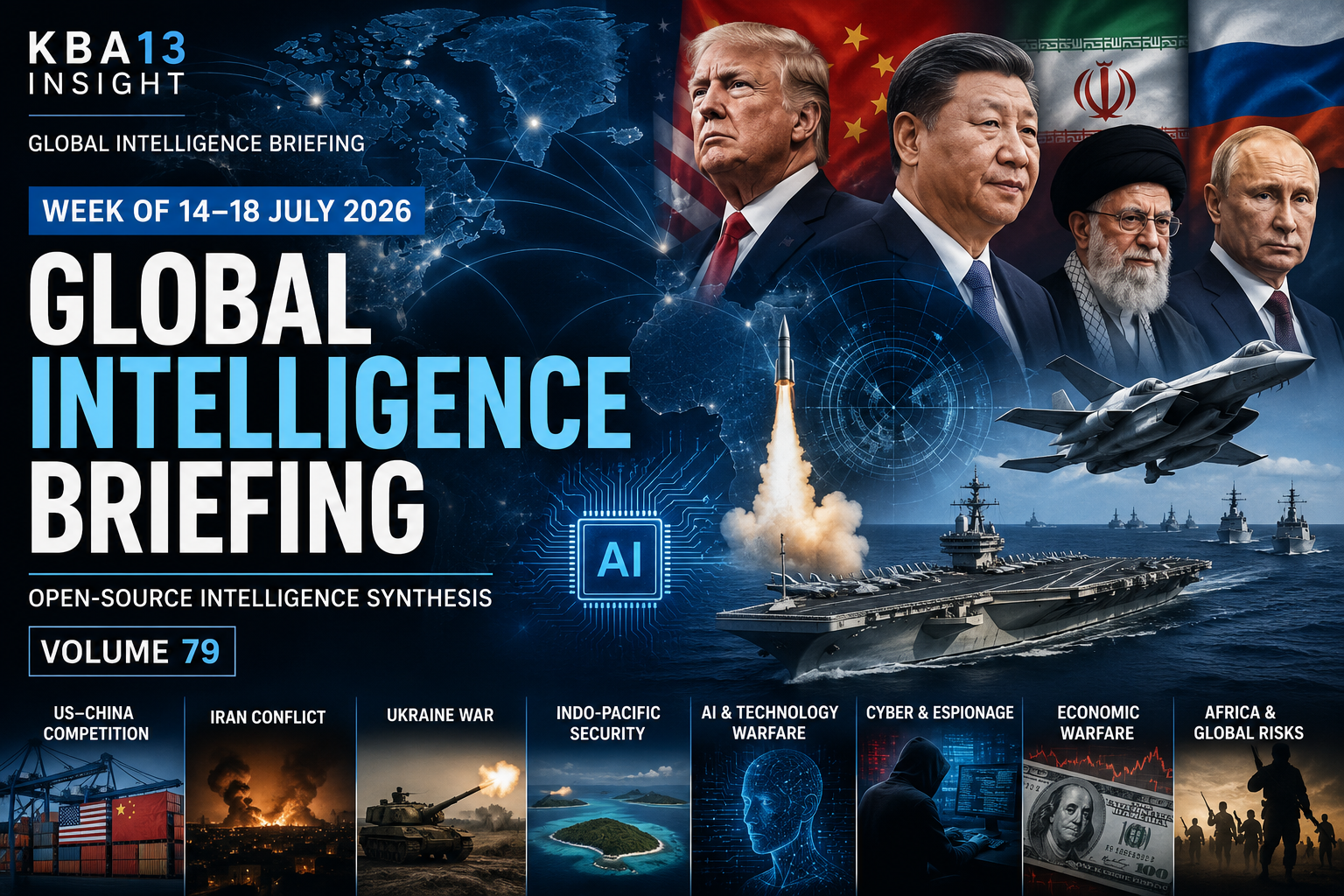
This edition of the KBA13 Insight Global Intelligence Briefing examines the world’s most significant geopolitical developments during 14–18 July 2026. Drawing on open-source intelligence, the report analyzes US–China strategic competition, the Iran conflict, the Ukraine war, Indo-Pacific security, AI-enabled espionage, cyber operations, economic warfare, terrorism, and emerging global security…
Summary
This edition of the KBA13 Insight Global Intelligence Briefing examines the world’s most significant geopolitical developments during 14–18 July 2026. Drawing on open-source intelligence, the report analyzes US–China strategic competition, the Iran conflict, the Ukraine war, Indo-Pacific security, AI-enabled espionage, cyber operations, economic warfare, terrorism, and emerging global security trends while identifying the strategic implications for policymakers, researchers, and intelligence professionals.
01 GREAT POWER COMPETITION
The United States and China entered the week of 14–18 July 2026, navigating one of the most paradoxical phases of their relationship: a fragile diplomatic truce maintained at the summit level coexisting with an escalating technological cold war whose instruments grow more sophisticated by the month. The AI chip market has become the central theatre of this contest, with the Trump administration confirming that its ban on semiconductor shipments to Chinese entities extends to subsidiaries of Chinese companies located outside China, closing a loophole that had allowed Beijing-linked firms in Singapore, Malaysia, and elsewhere to acquire advanced computing hardware. The US Trade Representative’s formal Section 301 finding, issued in December 2025, branded Beijing’s state-backed semiconductor expansion as ‘unreasonable and discriminatory,’ triggering a tariff action currently set at zero percent but scheduled to rise to a punitive rate on 23 June 2027. This 18-month calibration window serves as both a legal countdown and a diplomatic instrument.
Huawei’s Ascend 950PR chip is now positioned to seize the Chinese AI market in the vacuum created by Nvidia’s regulatory entanglement, with ByteDance alone committing $5.6 billion to the platform and Huawei targeting 750,000 units and $12 billion in AI chip revenue for 2026. The structural implication is precisely what Washington sought to prevent: American export controls have accelerated Chinese domestic semiconductor capability, creating conditions for a parallel technology ecosystem that will eventually require no American inputs at all. Huawei chairman Ren Zhengfei’s public thanks to the US for export restrictions, crediting them with ‘supercharging’ China’s semiconductor industry, was not mere propaganda but a strategically accurate assessment. The US has inadvertently funded the construction of the competing ecosystem it sought to contain.
China and Russia conducted their annual ‘Joint Sea-2026’ naval exercises from July 6 to July 13 in waters and airspace near Qingdao, followed by a joint maritime patrol in ‘relevant’ Pacific areas. In the preceding week, the two countries had also conducted a joint strategic aerial patrol near South Korea and Japan that entered South Korea’s Air Defense Identification Zone. The operational scope of these exercises, combining surface vessels, submarines, and long-range aviation, has expanded systematically each year, and the post-exercise Pacific patrol represents a deliberate demonstration of combined maritime projection capability directed at the United States and its allies. For Beijing, joint exercises with Moscow serve multiple functions simultaneously: they provide military interoperability practice, they signal to Washington the cost of confrontation, and they entrench a diplomatic alignment that has survived every Western attempt to drive a wedge between the two.
The Brookings Institution assessment that the US is effectively ‘out of the AI chip market in China’ reflects a structural reality emerging from years of contradictory policy. The Trump administration simultaneously approved Nvidia H200 exports to China in December 2025, subject to conditions including a 50 percent volume cap relative to US customers and a 25 percent tariff, while expanding restrictions on subsidiaries and extending controls to the broader ecosystem. The result is a framework that generates enforcement complexity, legal uncertainty, and regulatory arbitrage without achieving strategic coherence. China’s companies have adapted by building domestic supply chains that will, within a five-year horizon, operate independently of American components in the AI infrastructure layer.
The PRC conducted a rare test of a submarine-launched ballistic missile in the South Pacific on July 6, with an unspecified ballistic missile nuclear submarine firing what PRC state media and expert analysis assessed was likely a JL-3 missile, first unveiled during a September 2025 military parade with a reported range of 10,000 kilometers. The missile landed between Tuvalu and the Gilbert Islands of Kiribati, demonstrating operational range capable of reaching the continental United States. This was China’s first publicly acknowledged SLBM test since 1982, and its deliberate public announcement via PRC state media signals a calculated demonstration of second-strike nuclear capability intended to complicate American deterrence calculations. The test was conducted concurrent with Joint Sea-2026, suggesting coordinated signaling across conventional and nuclear domains.
The US Supreme Court’s February 2026 ruling that IEEPA cannot be used to impose tariffs has constrained executive flexibility in trade statecraft precisely when maximum agility is required. The administration has migrated to a Section 122 framework, but the legal architecture of trade policy is now subject to judicial review in ways that create uncertainty for both American companies and foreign trading partners. China’s Fifteenth Five-Year Plan, formally adopted in March 2026, targets the elimination of remaining dependencies on American technology in semiconductors, aerospace, and biotechnology within the plan’s duration. This is the most consequential industrial policy document issued by any government in the current generation, and it sets the structural trajectory of global economic competition regardless of whatever diplomatic accommodations are reached at bilateral summits.
The Chinese Fujian carrier transited the Taiwan Strait, a first for China’s newest and most capable flattop, providing its crew with operational navigation experience and demonstrating that Beijing now has the naval architecture for more frequent carrier deployments across theater commands. The Fujian had commissioned with the Southern Theater Command in November 2025 but was stationed at the Northern Theater Command during Liaoning’s exercises, and its Taiwan Strait transit signals that China intends to rotate all three carriers across commands, creating a persistent carrier presence that did not previously exist. For Taiwan’s defence planners, the normalization of Chinese carrier operations in the strait represents a qualitative shift in the threat environment that no amount of diplomatic signalling can neutralize.
The great power competition of July 2026 is simultaneously a technology war, a financial war, a naval competition, and an ideological contest, occurring on more fronts, at greater speed, and with higher stakes than the Cold War it increasingly resembles. What distinguishes this contest from its Cold War predecessor is the depth of economic interdependence that continues to exist despite the decoupling rhetoric: US and Chinese economies remain intertwined at a scale that makes genuine separation catastrophically costly for both. This mutual economic hostage condition is precisely what gives both sides incentives to manage the competition rather than resolve it, and precisely why the competition will endure at current intensity for the foreseeable future.
The US-China competition has entered a phase in which every instrument of statecraft, technology controls, naval exercises, nuclear signalling, and chip markets, is being deployed simultaneously, and the cumulative effect is the construction of two parallel global orders whose coexistence will define the security environment of the next generation.
02 ACTIVE CONFLICT ZONES
The most consequential single development of the week was the US Central Command’s resumption of its naval blockade against Iran, effective 4 p.m. ET on Tuesday, July 14. The blockade, which CENTCOM announced with more than 20 US Navy warships and hundreds of military aircraft operating across the Middle East, was reimposed after Iran struck and disabled two UAE supertankers in the Strait of Hormuz, killing one crew member, and launched multiple waves of strikes against Bahrain’s Juffair military base, claiming to have destroyed weapons-support warehouses, a satellite communications center, and a US forces building. Trump, in a Truth Social post on Wednesday, formally notified Congress that ‘limited’ military action had resumed against Iran. Global oil prices surged more than 9 percent on the news. The Strait, which once carried 25 percent of the world’s seaborne oil trade and 20 percent of its liquefied natural gas, has been reduced to a fraction of its pre-war traffic: just 22 ships crossed on July 9, compared to 147 crossings the day before the war began in February.
The Islamabad Memorandum of Understanding, signed by Trump and Iranian President Pezeshkian on June 17 and intended to establish a 60-day negotiating framework for a final nuclear deal and ceasefire, has effectively collapsed. Trump described the MOU as ‘a test’ that Iran ‘didn’t honor,’ saying he would have preferred to go directly to a final deal. The pattern of the past three weeks has been a recurrent cycle: Iran attacks commercial shipping or US-allied infrastructure, the US responds with strikes on Iranian coastal and military targets, Iran escalates with missile barrages against Gulf capitals, and behind-the-scenes mediators, Pakistan and Qatar, scramble to prevent full re-escalation. The third night of US strikes on July 13–14 targeted a broad swath of Iranian territory, including the port city of Bandar Abbas and the islands of Kish, Qeshm, and Abu Musa. Four out of five Americans now expect the war to continue for an extended period, according to a Reuters/Ipsos poll, and 60 percent expect gasoline prices to worsen.
On the Ukrainian front, the week of 14 July delivered a watershed in Ukraine’s strategic campaign against Russian energy infrastructure. Ukrainian Special Operations Forces’ Deep Strike units struck the Gazprom Neftekhim Salavat oil refinery in Bashkortostan on the night of 13–14 July, a facility 1,500 kilometres from Ukrainian territory, processed approximately 10 million tons of oil per year, and was the last major Russian gasoline production facility not yet struck in 2026. Satellite imagery confirmed damage to both the AVT-6 and AVT-4 primary processing units. The strike was executed in cooperation with the resistance movement Chornaya Iskra operating inside Russia. Ukraine has now struck every one of Russia’s ten largest oil refineries in 2026, impairing an estimated 20 to 42 percent of national refining capacity. In some Russian regions, drivers queued for days for fuel, stations ran dry, and rationing was implemented at major retailers.
The Russian frontline saw a net territorial gain of 15 square miles over the four weeks to July 14, according to DeepState OSINT data, roughly two-thirds the area of Manhattan, a slight deceleration from the 31-square-mile gain recorded in the previous four-week period. ISW data for the same period recorded a more conservative 5-square-mile net gain for Russia. Ukrainian forces are simultaneously defending against Russian ground pressure along the Kostyantynivka-Druzhkivka axis, intercepting Russian missiles with increasingly depleted Patriot stocks, and prosecuting a systematic drone campaign against Russian energy infrastructure more than 1,000 kilometers behind the front. President Zelensky created a new branch of the Armed Forces, the Joint Rapid Response Forces, headed by Brigadier General Dmytro Voloshyn, to enhance frontline responsiveness. Ukraine simultaneously tested an unnamed ballistic missile, whose announcement on July 16 signaled Kyiv’s active pursuit of an indigenous long-range strike capability that does not depend on Western supply decisions.
Ukraine’s naval campaign in the Black Sea and Sea of Azov reached an unprecedented scale this week. Ukrainian forces hit 14 additional Russian vessels on July 12, bringing the weekly total to 90 vessels struck in the Sea of Azov, including 21 Russian oil tankers confirmed hit in a single overnight operation. A Ukrainian FPV drone hunted and destroyed a Russian Mi-28 attack helicopter over Belgorod on July 15. The Ukrainian General Staff confirmed the destruction of the Russian patrol ship Izumrud after a drone strike, verified by satellite imagery on July 14. Russia halted shipping through the Kerch Strait after Ukrainian drone strikes on vessels in the area. The cumulative effect of Ukraine’s Black Sea campaign is the effective denial of Russian naval logistical operations and the systematic attrition of Russia’s tanker fleet, the same shadow fleet that services Iranian oil exports and supplies Russian coastal logistics.
In Gaza, the humanitarian situation continues to deteriorate despite the nominal ceasefire endorsed by UN Security Council Resolution 2803 in November 2025. The European Commission launched a $1 billion aid and reconstruction fund for Gaza on July 14, but the initiative falls catastrophically short of the $71 billion that the EU and UN jointly assessed as required over ten years, and the $26.3 billion needed in the first 18 months alone. Hamas has refused to decommission its weapons, citing Israeli violations of ceasefire obligations through continued operations and restrictions on humanitarian aid. The International Stabilization Force, whose first-year deployment was supposed to be conditioned on Hamas disarmament progress, remains in the planning phase with only Morocco, Albania, Indonesia, Kazakhstan, Kosovo, and Greece having pledged personnel. More than 1,000 Palestinians were killed since the ceasefire took effect, in addition to the 70,000-plus who died during the initial Israeli military campaign.
Yemen has re-emerged as a secondary but significant active conflict zone. Saudi Arabia and the Iran-backed Houthi rebels exchanged fresh strikes this week, appearing to end the de facto truce that had held since the Gaza ceasefire framework of late 2025. The Houthis claimed to have shot down a Saudi ‘Wing Loong II’ reconnaissance drone over Al-Bayda Governorate, in what Houthi military spokesman Yahya Saree described as retaliation for Saudi hostile missions. The Houthis resumed attacks on Israel on March 28, 2026 as part of their declared solidarity with Iran’s war, firing ballistic missiles at Israeli military sites. The resumption of Saudi-Houthi hostilities adds a new dimension to the regional conflict architecture: a war that was effectively suspended by proxy is now re-activating under the pressure of the broader US-Iran confrontation, threatening to open a third major front in the Arabian Peninsula.
Lebanon remains in a state of frozen conflict, with Israeli military activity remaining concentrated around the Yellow Line, particularly in the Tyr and Bint Jbeil districts south of the Litani River. Remote violence events fell to their lowest level since the resumption of Israel-Hezbollah hostilities, down approximately 35 percent from May levels, following a ceasefire agreement reached in Washington on June 3. However, both sides have continued to exchange artillery and rockets, demonstrating that the ceasefire has reduced but not resolved the underlying hostility. Hezbollah has reportedly moved heavy weaponry north of the Litani River. The linkage between the Lebanon ceasefire and the broader US-Iran MOU means that this week’s re-escalation of the Iran war simultaneously puts every regional de-escalation arrangement under renewed pressure.
The active conflict environment of the week of 14–18 July 2026 is defined by simultaneous escalation across all major theatres, the Strait of Hormuz, the Ukrainian front and Russian rear, and the Arabian Peninsula, creating a compounding pressure on global energy markets, diplomatic frameworks, and military resources that has no recent historical parallel.
03 NUCLEAR AND WMD WATCH
The collapse of the Islamabad Memorandum’s ceasefire provisions has placed the nuclear dimension of the US-Iran conflict in the most precarious position since the strikes of February 28, 2026 destroyed Iran’s primary enrichment facilities. The MOU’s Paragraph 8, Iran’s commitment not to possess a nuclear weapon, was embedded in a broader framework whose implementation has now broken down. The US demand for Iran to publicly declare the Strait of Hormuz open, as a precondition for resuming nuclear negotiations, has created an entry barrier that Tehran’s Revolutionary Guard Corps views as politically untenable. The power struggle between Supreme Leader Mojtaba Khamenei, who has not appeared publicly since assuming power, and elected President Pezeshkian is playing out most visibly in this question: Pezeshkian’s government is interested in a diplomatic resolution that preserves the regime’s economic recovery; the IRGC’s institutional interests are bound to the deterrence mission that the nuclear programme embodied.
China’s People’s Liberation Army conducted a rare test of a submarine-launched ballistic missile on July 6, with the missile landing between Tuvalu and the Gilbert Islands in the South Pacific. PRC state media reported the test by an ‘unspecified ballistic missile nuclear submarine,’ and expert analysis assessed the missile tested was likely the JL-3, which first appeared at the September 2025 military parade with a reported range of 10,000 kilometers. This was China’s first publicly acknowledged SLBM test since 1982. The deliberate timing of the test, concurrent with Joint Sea-2026 exercises and against the backdrop of US-Iran military operations, represents a calculated demonstration of nuclear second-strike capability designed to complicate American deterrence architecture. The JL-3’s range renders the continental United States targetable from Chinese submarine positions in the South China Sea or Bohai Sea, fundamentally altering the nuclear geometry of any potential Taiwan contingency.
The 2026 Annual Threat Assessment of the US Intelligence Community, released by DNI Tulsi Gabbard, assessed that threats to the American homeland from foreign missile systems would expand collectively to more than 16,000 missiles by 2035, up from the current figure of more than 3,000. The report highlighted that China and Russia are developing advanced delivery systems designed to penetrate or bypass US missile defenses, while North Korea’s ICBMs can already reach US soil and Kim Jong-un is committed to expanding his arsenal. Pakistan’s long-range ballistic missile development ‘potentially could include ICBMs with the range capable of striking the Homeland.’ The report further assessed that North Korea’s partnership with Russia, sealed through the provision of more than 11,000 combat troops to Russian operations in Kursk and the supply of artillery and ballistic missiles, has returned technology transfers and combat experience that directly advance Pyongyang’s WMD programs.
A Pakistani senator speaking in New York in May 2026 openly threatened India with nuclear annihilation, the latest in a series of escalatory nuclear signals from Islamabad that have become increasingly explicit since Pakistani military chief General Asim Munir warned in August 2025 that Pakistan could ‘take half the world down’ in a conflict with India. The context of these statements is a bilateral relationship between India and Pakistan that has not deteriorated to active conflict but has seen repeated rhetorical escalation and sub-threshold military activity. Pakistan’s nuclear doctrine has always been premised on first-use against conventional Indian military superiority, but the explicit public articulation of mass casualty threats by senior officials and legislators marks a degradation in the implicit norms that had constrained nuclear rhetoric since both countries became openly nuclear in 1998.
North Korea’s strategy for 2026 centres on what analysts have described as the ‘dual track’: domestic finalization of nuclear status through a major political declaration, and external pursuit of US diplomatic engagement while excluding South Korea. The Ninth Congress of the Workers’ Party of Korea, expected in 2026, is anticipated to formally enshrine North Korea’s nuclear status as an irreversible constitutional fact. The benefits accruing to Pyongyang from its Russia partnership have been substantial: hard currency from ammunition and missile sales, operational feedback from combat experience of the more than 11,000 North Korean troops deployed to Russia, and access to Russian military technology in satellite reconnaissance, submarine systems, and missile guidance. The IC assesses that North Korea’s cyber forces are capable of stealing at least $1 billion annually in cryptocurrency to fund the weapons programme, and that ransomware operations are increasing in scope.
The physical proximity of US strikes to Iran’s Bushehr nuclear power plant, the only operational nuclear reactor in Iran, constructed and operated by Russia’s Rosatom, introduced a radiological risk dimension to the conflict that the international community has been reluctant to address directly. US Central Command’s press releases did not mention the nuclear facility, though regional officials cited by state media reported strikes near the plant’s perimeter on July 9. Rosatom began returning employees to Bushehr following the strikes, signaling Moscow’s determination to maintain its nuclear energy footprint in Iran regardless of American military operations. The IAEA’s monitoring capability at Bushehr is severely constrained by the conflict environment. A strike that caused radiological release from Bushehr, whether intentional or accidental, would transform the conflict’s character and generate global consequences that neither party appears to have systematically planned for.
The global non-proliferation architecture has been fundamentally weakened by the events of 2025–2026. The Islamabad Memorandum, if it eventually produces a nuclear deal, will establish the precedent that nuclear programmes can be constrained through bilateral military coercion and political dealmaking rather than through multilateral treaty frameworks. The NPT review process, the IAEA safeguards system, and the UN Security Council’s non-proliferation resolutions played no determinative role in halting Iran’s programme. What halted it, provisionally and reversibly, was American and Israeli military force. The lesson that every aspiring nuclear state draws from this is that the only reliable deterrent against American military intervention is actual nuclear possession, not the promise of restraint embedded in international law. This perverse incentive structure is the most consequential long-term consequence of the Iran conflict.
The broader arms control environment has collapsed to a degree unprecedented since the Cold War’s hottest phases. New START expired without replacement. The INF Treaty is defunct. Open Skies is gone. The Comprehensive Nuclear Test Ban Treaty has never entered into force. Each of these agreements provided transparency, predictability, and crisis-management mechanisms whose absence is now evident in the reduced ability of rivals to accurately assess each other’s capabilities and intentions. The US Intelligence Community’s assessment that the combined missile threat to the homeland will reach 16,000 systems by 2035 is a direct measure of what is being built in the absence of arms control constraints. A generation from now, analysts will identify this decade as the period in which the foundation of nuclear stability that the Cold War’s end bequeathed was systematically dismantled.
The nuclear and WMD environment of July 2026 is defined by three simultaneous crises, the collapse of the Iran nuclear negotiating framework, China’s deliberate demonstration of SLBM second-strike capability, and the erosion of every multilateral arms control mechanism, whose convergence creates the most unstable nuclear risk environment since the 1962 Cuban Missile Crisis.
04 INTELLIGENCE AND ESPIONAGE
The most technically significant intelligence story of the week emerged on July 15 when security researchers at Hunt.io published their analysis of a China-linked espionage campaign that had embedded Claude Code and DeepSeek-v4-pro as operational components of government intrusions targeting Afghanistan, Thailand, and Taiwan. The operation, linked to known TencShell command-and-control infrastructure documented by Cato CTRL in May 2026, used the two AI models in a systematically divided workflow: Claude Code version 2.1.165 handled execution, bash commands, persistent session management, parallel task orchestration, and phishing-page construction, while DeepSeek-v4-pro handled strategic reasoning, bypass technique development, exploit refinement after failed attempts, and credential-harvesting analysis. An exposed directory on one of 13 Hong Kong-based servers contained 2,431 files including victim source code, custom exploit scripts, cloned login pages, and operator logs written in Simplified Chinese.
The Taiwan-specific operational timeline within the Hunt.io disclosure spanned June 8 through June 12, 2026, with dedicated working directories for Taiwan-based intelligence requirements and session IDs confirming cross-campaign use of shared infrastructure. In Thailand, attackers exploited an SQL injection vulnerability in a government administrative system, gained access to the admin panel, deployed a web shell disguised as a GIF file to enable persistent command execution, and exfiltrated a database containing the names, national ID numbers, and job titles of government employees. The Afghanistan component appears focused on government and diplomatic entities. Three servers sharing SSH keys were actively maintained as recently as June 18–19. The use of commercial AI systems as operational components of state-sponsored intrusions marks a maturation of AI-enabled offensive cyber operations from research to active deployment, with the AI systems serving not as peripheral tools but as core elements of the kill chain.
Kaspersky disclosed on July 17 a previously undocumented malware framework, designated GoSerpent, that has been targeting government and diplomatic entities in Southeast Asia since late 2025. The malware is designed to contact external command servers and deploy secondary payloads for sensitive data collection and credential dumping. In May 2026, the threat actor returned with an evolved toolset including a new Stowaway RAT, a proxy tool, and an additional stealthy exfiltration mechanism for collecting data through network shares. Kaspersky security researcher Noushin Shabab noted the systematic evolution of the actor’s toolkit across a six-month operational window, indicating a persistent, resourced, and adaptive threat actor whose targeting of Southeast Asian government and diplomatic entities fits the profile of Chinese state-sponsored collection against the Mekong and ASEAN-adjacent diplomatic corridor. The GoSerpent campaign adds to a pattern of Chinese intelligence collection across the region, including the 2026 breach of all four of Singapore’s major telecommunications providers by UNC3886.
Cybersecurity researchers disclosed sustained espionage activity against Pakistani law enforcement organizations, attributed to both China-aligned and India-aligned threat actors, conducted between February 2024 and April 2026 through the exploitation of the Balochistan Police Portal. The multi-group campaign targeting a single Pakistani institutional target illustrates the degree to which South Asian state rivals are conducting parallel intelligence collection operations against shared regional targets, and the vulnerability of underfunded law enforcement digital infrastructure to both domestic intelligence peers and external state actors. The disclosure coincides with heightened India-Pakistan tensions following Pakistani nuclear rhetoric, and the collection of law enforcement databases, which contain informant networks, operational records, and counterterrorism intelligence, represents targeting of immediate operational value.
The ODNI’s request that federal intelligence agencies turn over names of foreign intelligence targets, potential recruits, and suspected foreign spies, to acting Director Bill Pulte, who has no prior intelligence experience, generated significant professional concern within the US intelligence community during the week. Career officers privately expressed concern that consolidating compartmented source information under a politically appointed director creates both operational security risks and a bureaucratic structure incompatible with the tradecraft principles that protect human intelligence sources. The concern is not hypothetical: the history of intelligence compromise cases demonstrates that the most damaging breaches typically exploit the concentration of sensitive information in environments with inadequate need-to-know controls. The Pulte directive effectively creates a ‘master list’ of the most sensitive US intelligence assets at a moment when adversary services are maximally focused on penetrating American intelligence infrastructure.
Interpol announced on July 14 the arrest of more than 5,800 alleged cybercriminals and the seizure of $293 million in a global operation targeting social-engineering scams and money laundering across 97 countries. The scale of the operation, spanning nearly half the world’s nations, reflects both the global reach of cybercriminal ecosystems and the increasing operational coordination among historically siloed law enforcement agencies. The $293 million seizure represents only a fraction of the estimated annual losses from social-engineering fraud, which exceed hundreds of billions of dollars globally. The Interpol operation also revealed the degree to which criminal networks have industrialised the fraud enterprise, with call centre-scale operations in Southeast Asia employing thousands of workers in conditions amounting to forced labour.
A ClaudeBleed-linked vulnerability was reported on July 14 as persisting across eight software patches, exposing potentially sensitive data across browser extensions. The vulnerability, which security researchers said could allow cross-extension data exposure, reflects a class of AI-adjacent security risk that has emerged as large language model infrastructure becomes embedded in enterprise and consumer software at scale. Ransomware simultaneously struck naval defense firm TKMS, a German company that builds submarines for multiple NATO navies, on July 14. The TKMS incident is strategically significant: submarine programs represent some of the most sensitive military technology in any NATO member state, and ransomware intrusions into defense industrial base firms create uncertainty about the integrity of classified technical data regardless of whether the attackers’ primary motivation was financial extortion or intelligence collection.
The CIA’s new division focused on cybersecurity and advanced data integration, announced in late June and becoming operational during the current period, represents the institutional acknowledgment that intelligence collection and cyber operations have become inseparable disciplines. The simultaneous integration of AI tools into both adversaries’ offensive cyber operations and the CIA’s defensive and analytical functions marks an inflection point at which the intelligence profession’s foundational skill set is being redefined. Human intelligence tradecraft, recruiting sources, handling assets, managing cover, remains irreplaceable, but the analytical and technical envelope within which it operates has been transformed by AI in ways the profession is still working through. The operational logs from the TencShell campaign offer a real-world glimpse of what AI-enabled intrusion looks like in practice.
The intelligence environment of the week of 14–18 July 2026 is defined by the weaponization of commercial AI systems in state-sponsored espionage, the simultaneous targeting of Southeast Asian government infrastructure by multiple state actors, and an institutional crisis within American intelligence governance, a convergence that creates vulnerability precisely when adversary collection capability is at its most sophisticated.
05 TERRORISM AND EXTREMISM
The Security Council’s West Africa and Sahel briefing, delivered during the week, provided the formal multilateral architecture’s most recent assessment of a security environment that continues to deteriorate at a pace the Council’s institutional mechanisms cannot keep pace with. UNOWAS Special Representative Leonardo Santos Simão briefed member states against the backdrop of JNIM’s June 18 attack on Niamey’s international airport, claimed by the group and resulting in eleven Nigerien security personnel and two civilians killed, and the April 25 coordinated attacks across Mali that targeted installations in Bamako, Kati, Gao, Kidal, and Séveré simultaneously. The Council extended UNOWAS’ mandate through January 2029 but requested an independent strategic review by September 30, a formulation that accurately captures the institution’s current mode: extending the administrative existence of frameworks whose strategic utility has been exhausted.
In northern Mali, a Tuareg-led separatist group began withdrawing from the strategic town of Anefis after days of fighting, after Malian armed forces operating alongside Russian Africa Corps fighters pushed them back. An Africa Corps convoy of more than 200 Russian fighters and more than 100 Malian soldiers came under attack in northern Mali on July 10, a second similar attack having struck a convoy headed north earlier the same week. The combination of JNIM insurgency, Tuareg separatism, and Africa Corps presence has created a three-dimensional conflict matrix in northern Mali that no individual actor can manage: the Russia-Mali partnership suppresses the separatist movement at the cost of deepening alienation of Tuareg communities that provide the recruitment base for both separatism and, increasingly, jihadist affiliation. Russian claims of security improvement in Mali are measurably falsified by the frequency and scale of attacks.
Sudan’s El Obeid is experiencing one of the most severe humanitarian-security convergences in the current period. The Rapid Support Forces have imposed a blockade of El Obeid, North Kordofan’s state capital, conducting a systematic drone campaign against infrastructure and the sole remaining supply highway linking the city to Kosti in White Nile state. Burned-out commercial trucks line the roadside. More than 11,000 families, roughly 60,000 individuals, arrived in the city between March and June alone, fleeing RSF-controlled territory in South Kordofan and West Kordofan. The European Parliament adopted a resolution calling for the terrorist listing of the RSF over the El Obeid siege. The United States imposed additional sanctions on networks linked to both the RSF and the Sudanese Armed Forces, though analysts assess these are unlikely to change either party’s maximalist stance, and the SAF may view them as biased due to the absence of direct action against the RSF.
The DRC’s Ebola outbreak, declared a public health emergency of international concern by the WHO on May 17, continued to outpace the response through the week of July 14–18. The Africa Centres for Disease Control and Prevention noted progress in laboratory capacity, more than 2,000 tests per day across affected areas, but warned that rising infections continue to exceed response capacity. Maternal mortality in Ituri province, the epicenter, has doubled since the outbreak began: from 3.1 women dying in childbirth per week before the outbreak to 6.2 per week since May. UN agency UNFPA estimates 63,700 pregnant women are due to give birth in the DRC during the outbreak, in a context where fear of contagion is causing women to deliver at home without medical support. The ADF, Allied Democratic Forces, has accelerated operations in Ituri during the outbreak, exploiting the diversion of security and civilian response resources.
The UN warned during the week that terrorist groups are expanding their reach across West Africa and the Sahel using increasingly sophisticated methods, with the threat to coastal states in the Gulf of Guinea growing. This assessment aligns with data showing violent acts attributed to jihadist groups in Benin, Togo, and Côte d’Ivoire increasing from five incidents in 2020 to 160 in 2024, a trajectory that has continued in 2026. JNIM’s southward expansion toward the Gulf of Guinea represents the most strategically consequential geographic movement of the current jihadist enterprise: major ports in Ghana, Togo, Benin, and Côte d’Ivoire handle global commodity flows that the world’s consumer economies depend upon. The criminal-terror nexus documented by Spanish defence analysis, with JNIM affiliates operating simultaneously as cocaine transit facilitators and ideological warriors along four interlocking trafficking corridors, means that the security problem and the organized crime problem are the same problem.
Al-Shabaab’s escalation in Somalia, with deaths linked to the group representing a 93 percent increase from the prior year, continued in the reporting period, set against the backdrop of Somali President Hassan Sheikh Mohamud’s controversial term extension that triggered political conflict in Mogadishu. The African Union Transition Mission in Somalia faces a funding shortfall that constrains its operational tempo precisely at the moment when al-Shabaab is at its most active. Al-Shabaab’s capacity to govern territory, tax commerce, and recruit from communities with no alternative source of services means that military degradation of the group’s command structure, however successful tactically, consistently fails to alter the underlying conditions that sustain the organization. The group’s restraint from international attacks outside the Horn of Africa remains operationally cautious rather than strategically stable.
Nigeria’s army general recounted a rescue operation that freed 44 schoolchildren and teachers abducted in Oyo state in May, providing a rare operational success story in a region where kidnapping has become both a criminal enterprise and a political instrument. The broader Nigerian security picture combines northwest banditry, northeast Boko Haram/ISWAP activity, separatist pressure in the southeast, and oil theft in the Niger Delta into a comprehensive security burden that the Nigerian state is structurally unable to address simultaneously. The Lake Chad Basin continues to record increased fatalities, a 28 percent increase from the prior year, as Boko Haram remnants and ISWAP compete for territory and recruit from populations displaced by the broader Sahelian crisis.
The terrorism threat landscape of July 2026 reflects a fundamental structural shift: the organizations and movements that Western counterterrorism architecture spent the post-9/11 generation pursuing in Iraq, Afghanistan, and Syria have reconstituted themselves primarily in Africa, operating in governance vacuums created by state failure, coup cycles, and the withdrawal of Western military presence. The CSIS assessment that African jihadist groups are ‘unquestionably ascendant’, with larger forces, more resources, and growing ability to exploit AI and drone technology, represents the most consequential strategic intelligence finding of the current period for any government with interests in African stability, global commodity security, or the management of migration flows toward Europe.
Africa’s jihadist insurgencies have completed their transition from peripheral security concerns to structurally embedded governance alternatives, and the institutional capacity to reverse this transformation no longer exists within the frameworks currently deployed against them, making the current trajectory the default future.
06 ECONOMIC WARFARE AND SANCTIONS
Ukraine’s systematic destruction of all ten of Russia’s largest oil refineries in 2026 represents the most consequential act of economic warfare through military means in the current conflict, and possibly the most effective strategic bombing campaign against an industrial economy since the Second World War. The campaign, which impairing between 20 and 42 percent of Russia’s national refining capacity at peak damage, has produced visible domestic consequences: fuel rationing across Russian regions, queues at petrol stations lasting days, temporary closure of major retail fuel stations, and the beginning of food price inflation driven by diesel shortages affecting agricultural and logistics operations. The Axios reporting of July 17 confirmed that Russia’s refinery output has crashed to 20-year lows, tens of millions of Russians face soaring fuel and food prices, and a budget hole the Kremlin can no longer hide is opening in Moscow’s war finance. The Gazprom Neftekhim Salavat strike of July 13–14 closed the last major gap in Ukraine’s refinery campaign.
The resumption of the US naval blockade against Iran on July 14 triggered an immediate 9-plus percent surge in global oil prices. The blockade, the second of its kind following the initial April-May 2026 imposition, compounds the Strait of Hormuz crisis, which has reduced tanker crossings from 147 per day to 22 per day during periods of maximum tension. Iran exports roughly 50 million barrels of crude oil per month primarily through its shadow fleet to China, and the blockade’s resumption places that revenue stream at risk. Saudi Arabia and Yemen’s Houthis exchanging fresh strikes this week, ending the de facto Yemen truce, adds a further Arabian Peninsula dimension to energy market instability. The confluence of the Iranian naval crisis, the Houthi escalation, and Ukraine’s Russian refinery campaign has created three simultaneous shocks to global energy supply.
Trump on July 14 backtracked from an earlier proposal to charge a 20 percent toll on vessels transiting the Strait of Hormuz for US naval escort services, a proposal that had generated significant pushback from Asian trading partners and US allies dependent on Gulf energy. The toll proposal, while withdrawn, illustrated the administration’s broader instinct to monetize American military protection in a manner that creates uncertainty for the maritime trading system. Iraq’s new prime minister Ali al-Zaidi met with Trump at the White House on July 14, aiming to secure major US investment agreements, a bilateral engagement that reflects Iraq’s structural position as the country most exposed to both the Iranian conflict and American military operations, and whose energy exports transit the Gulf maritime routes now under contested control.
The US Section 301 tariff action on Chinese semiconductors, formally determined in December 2025 as ‘unreasonable and discriminatory,’ with tariffs currently set at zero percent but rising to a punitive rate in June 2027, creates an 18-month window of commercial activity within a legally hostile framework. The US TRADE Representative’s filing established that Beijing’s state-backed semiconductor expansion through massive subsidies, forced technology transfers, and intellectual property infringement qualifies as an actionable trade violation. The focus on foundational chips at the 28nm process node and above, which power electric vehicles, medical devices, and consumer electronics, extends the chip war beyond the AI inference market into the broader industrial economy. The Brookings analysis that the US is effectively ‘out of the AI chip market in China’ reflects the practical reality that Chinese companies have built alternative supply chains, making American market access structurally less necessary than it was five years ago.
Qatar’s former emir Sheikh Hamad bin Khalifa Al-Thani died at the age of 74 during the week, ending the life of the leader who modernized Qatar and transformed it from a small Gulf emirate into a global diplomatic hub and LNG powerhouse. His tenure established Qatar’s role as mediator in regional conflicts, built the Al Jazeera network, and positioned the country as a critical transit point for natural gas exports to Europe and Asia. His death, while not altering Qatar’s strategic trajectory under his son Tamim’s leadership, carries symbolic weight at a moment when Qatar is simultaneously serving as a key mediator in the US-Iran nuclear talks and hosting critical American military assets at Al Udeid Air Base. Saudi Arabia’s Energy Minister, Prince Abdulaziz bin Salman, was appointed minister of industry and mineral resources in addition to his current energy post, signaling the kingdom’s intention to more tightly integrate its hydrocarbon and industrial diversification strategies under a single ministerial authority.
China’s blocking of helium exports, key for semiconductor fabrication, MRI machines, and rocket propulsion, has continued into the current period alongside the rare earth export controls that Beijing deployed earlier in the competition. The strategic calculation behind China’s commodity weapons is sophisticated: each restriction simultaneously punishes a specific Western industrial dependency, generates diplomatic leverage, and creates commercial incentives for Western companies to diversify supply chains in ways that take years and billions of dollars to accomplish. The rare earth and helium restrictions have forced accelerated investment in Australian, Canadian, and South African rare earth projects, as well as US domestic helium production expansion, none of which will relieve the immediate supply pressure and all of which remain years from meaningful production.
The Americas Counter Cartel Coalition, Shield of the Americas, has continued to operate as the institutional framework for US-led hemispheric counternarcotics strategy, with the notable absence of Mexico, Brazil, Venezuela, and Colombia limiting its reach to the countries least penetrated by the organisations it targets. Bolivia experienced a major socio-political crisis during the reporting period: President Rodrigo Paz declared a state of emergency on June 20 to lift blockades imposed during 50 days of cross-sectoral demonstrations against land reform, economic policies, and fuel shortages, with the underlying demonstrations ultimately linked to disruptions in the coca economy and cartel-adjacent economic pressures. Ecuador’s murder rate, reaching approximately 52 per 100,000 inhabitants in 2025, the highest in Latin America, continues to impose direct economic costs through insurance premium inflation, investment deterrence, and the diversion of state resources from productive to security expenditure.
The global economic impact of simultaneous conflict-driven commodity disruption is becoming structurally embedded rather than transient. Energy price spikes from the Iran war’s blockade, diesel market disruption from Ukraine’s Russian refinery campaign, rare earth and helium restrictions from China’s economic statecraft, and cartel-driven instability in Latin America’s commodity-producing regions collectively represent a new class of supply shock that differs from previous episodes: each is driven not by market dynamics but by deliberate statecraft, making the standard macroeconomic tools for managing supply shocks, monetary policy, strategic reserve releases, demand management, structurally inadequate responses. Sixty percent of Americans already expect gasoline prices to worsen over the next year as a result of the Iran war alone.
Economic warfare in the week of 14–18 July 2026 has achieved a degree of integration between military, regulatory, and commodity instruments that transforms it from a supplement to kinetic conflict into its own theatre of strategic competition, one whose effects on civilian populations rival those of the military operations that accompany it.
07 INDO-PACIFIC SECURITY
The China Coast Guard’s continued harassment campaign in the South China Sea reached a new quantitative threshold this week, with reports of Philippine coast guard vessels facing water cannon operations near Scarborough Shoal and Chinese vessels maintaining the 352-metre barrier that has effectively closed fishermen’s access to the feature. The Philippines chairs ASEAN in 2026, giving Manila a diplomatic platform to elevate the South China Sea at the July summit, but the structural constraint remains: ASEAN’s consensus requirement means that any South China Sea language must survive Chinese diplomatic pressure on member states with deeper economic dependencies on Beijing, producing communiqués whose language consistently understates the operational reality at sea.
China’s PLA conducted drills east of Luzon under the Type 055 destroyer Zunyi while the Liaoning carrier group operated nearby, and the Fujian carrier’s Taiwan Strait transit, the first for China’s newest flattop, provided the PLAN with operational experience navigating the strait’s specific oceanographic and air traffic conditions. The systematic rotation of Chinese carriers across theater commands, with both the Northern and Southern Theater Commands now able to host an operational carrier, creates a persistent naval presence in China’s near seas that was not achievable when China had only one or two carriers in service. This structural change in Chinese naval architecture, from a single-carrier fleet to a three-carrier rotational system, is the most significant maritime capability expansion of the current period.
Taiwan’s coastguard responded to four China Coast Guard vessel incursions into Dongsha (Pratas) Island’s restricted waters in six separate incidents in 2026, following a January 2026 PRC reconnaissance drone flight over the island. China has also deployed oil exploration structures inside Dongsha’s exclusive economic zone. The systematic pressure on Taiwan’s South China Sea outposts, occurring in parallel with the Trump-Xi May summit and amid Trump’s ambiguous post-summit statements about Taiwan, suggests Beijing is probing Taiwan’s willingness and ability to defend peripheral holdings at a moment of maximum uncertainty about American security commitments. Taiwan’s National Security Council has directed multiple agencies to strengthen their response frameworks, but the asymmetry of forces in the South China Sea makes sustained resistance to Chinese Coast Guard operations logistically difficult.
Myanmar’s junta leader Min Aung Hlaing is reportedly scheduled to make an official visit to Thailand next month, which would be his second foreign trip since declaring himself president, the first having been to Laos earlier in July. The diplomatic movement represents a cautious regional rehabilitation of a leader whose forces have been credibly documented committing atrocities against ethnic minorities and the civilian population since the 2021 coup. Myanmar’s civil war, which pits the military against a coalition of ethnic armed groups and the People’s Defence Force, has produced one of the world’s most severe humanitarian crises with minimal international attention. The UN reported 1,396 civilian deaths in the first six months of 2026, a 37 percent increase over the same period in 2025 and roughly double the rate of civilian deaths in the first half of 2024.
Pakistan’s Kashmir tensions with local political movements reached violent levels this week, with clashes between security forces and protesters leaving at least nine people dead, seven protesters and two security officers, ahead of a regional election. The Joint Awami Action Committee’s dispute with the Pakistani government over a legal stipulation reserving 12 seats for Kashmiri refugees in the regional legislature has sustained weeks of confrontation. The violence in Pakistani-administered Kashmir is a domestic political crisis, but it occurs in a context where India-Pakistan relations are under elevated stress following Pakistani nuclear rhetoric, and where the Kashmir dispute retains its character as one of the most dangerous potential flashpoints between two nuclear-armed states.
The EU launched its Partnership Mission in Armenia (EUPM Armenia) during the current period, establishing a civilian advisory mission to strengthen the country’s resilience against hybrid threats including cyberattacks and disinformation. The mission, established in April 2026 at Armenia’s request, following the 2023 loss of Nagorno-Karabakh, represents the EU’s most significant security commitment to the South Caucasus and a direct signal that Brussels views the Russian-Armenian relationship as sufficiently degraded to permit expanded European engagement. Armenia’s drift toward the EU and away from Russia’s security architecture has proceeded at a pace that has surprised both Moscow and Brussels, and the EUPM formalises a security relationship that will take years to develop operationally.
India’s diplomatic position in the current global configuration remains strategically complex: maintaining strong economic ties with Russia despite Western sanctions, pursuing defence diversification from Russian to American and French systems, deepening the Quad relationship with the US, Japan, and Australia, and managing a border relationship with China that saw deadly confrontations as recently as 2022. India’s refinery complex was itself the scene of the Tata Electronics cyberattack in June, which leaked thousands of files related to Apple and Tesla supply chain operations, illustrating the degree to which India’s integration into global technology supply chains makes it a target for intelligence collection regardless of its political alignments. India’s decision to purchase 16 Rafale fighter jets from France, announced at the NATO summit in Ankara, continues its decade-long diversification of military procurement away from Russian systems.
The North Atlantic Treaty Organisation’s summit in Ankara convened during the week, with Ukraine’s Rafale deal announced at the margins. The presence of a major Ukrainian arms procurement at a NATO summit, a development inconceivable during the first years of the conflict, reflects both France’s deepened role as a Ukraine defence partner and the normalization of Western conventional arms transfers that once required political negotiation at the highest levels. The Ankara summit’s primary agenda items included NATO’s eastern flank reinforcement following Baltic intelligence reports of Russian Phase Zero provocation planning, enhanced Ukrainian integration into allied military frameworks, and the management of Turkey’s ongoing dual relationships with Russia and NATO that make every Alliance summit a diplomatic navigation exercise.
The Indo-Pacific security architecture of mid-2026 is consolidating toward explicit anti-China deterrence frameworks across all its nodes, from Taiwan’s peripheral outpost defence to Myanmar’s regional rehabilitation diplomacy to Pakistan’s nuclear signalling, while the operational tempo of Chinese assertiveness at sea continues to outpace the diplomatic frameworks designed to manage it.
08 AFRICA AND THE SAHEL
Sudan’s civil war entered its fourth year without any credible path to resolution, with the RSF tightening its siege of El Obeid, capital of North Kordofan state, through a systematic drone campaign against supply infrastructure and the blockade of the highway to Kosti. The RSF’s drone operations against civilian supply lines represent the tactical application of lessons absorbed from conflicts in Ukraine and the Middle East, where aerial disruption of logistics has proven more strategically effective than direct territorial assault. The European Parliament adopted a resolution calling for the RSF to be designated as a terrorist organisation over the El Obeid siege, while UNHCR and OCHA reported more than 60,000 newly displaced individuals arriving in the city between March and June as civilians flee RSF-controlled territories. Sudan’s civil war has displaced more people than any conflict since the Syrian civil war at its peak.
The UAE’s provision of military assistance to DRC President Félix Tshisekedi’s government, documented through flight tracking data showing military cargo aircraft between Al Reef Air Base in Abu Dhabi and Kinshasa on June 25–26, represents the extension of Gulf state power projection into Central African mineral competition. UAE mining deals with the DRC have expanded significantly since US involvement in regional peace efforts beginning in mid-2025, and the military logistics flights suggest that Abu Dhabi is investing in the security dimensions of its economic positioning in the DRC’s mineral-rich east. The same air company, Invicta Air Cargo, has been suspected of involvement in UAE weapons shipments to the RSF in Sudan, illustrating the degree to which Gulf state African operations serve multiple overlapping commercial, political, and military objectives simultaneously.
The DRC formed a new advisory council including senior war crimes lawyers from the United States and Europe to support its accountability campaign for atrocities committed in the country’s conflict-ridden eastern provinces. The council’s composition reflects Kinshasa’s increasingly ambitious international justice strategy as an instrument of diplomatic pressure on Rwanda, which denies backing the AFC/M23 rebel movement despite UN and Western government assessments to the contrary. The DRC’s turn toward international legal mechanisms, ICC processes, the Doha mediation framework, and now this advisory council, reflects a calculated assessment that Kinshasa lacks the military capacity to defeat M23 directly and must therefore mobilize international legal and political pressure as countervailing instruments. Whether international accountability processes can produce meaningful pressure on Rwanda remains deeply uncertain.
The Ebola outbreak in DRC’s Ituri province continued to pose a Category 1 public health emergency, with the WHO’s declaration of international concern still active and maternal mortality doubling in the epicentre region. The Partners treatment trial, launched at record speed within six weeks of the emergency declaration, has begun enrolling patients, testing remdesivir and MBP134 as potential treatments. The ADF’s exploitation of the outbreak to accelerate operations in Ituri represents a documented pattern in which non-state armed groups use public health crises to generate operational opportunity: the diversion of security force attention to epidemic response, the disruption of community surveillance networks, and the increased vulnerability of civilian populations create conditions the ADF has consistently exploited. The outbreak’s geographic concentration in the same territory as ADF activity is not coincidental.
Libya’s contested political landscape produced unification talks in Sirte during the week, offering the most substantive diplomatic engagement between the country’s rival governments in recent months. The Stimson Center’s North Africa Regional Outlook for the week of July 8–15 identified Libya’s Sirte talks, Mali’s Anefis fighting, and Sudan’s El Obeid siege as the three defining events of the North African security environment. Libya’s division between the Tripoli-based Government of National Unity and the Benghazi-based House of Representatives, backed by the LNA of Khalifa Haftar, has proven remarkably stable in its instability, with external patrons Turkey, Russia, the UAE, and Egypt maintaining sufficient equilibrium to prevent either side from achieving decisive victory. The Sirte talks represent either a genuine opening toward political resolution or a tactical maneuver by one or both parties to improve their negotiating position.
Morocco arrested dissident commentator Ali Lmrabet upon his arrival at Tangier airport, according to Reporters Without Borders, adding to a pattern of Moroccan authorities treating returning exiles as security threats. The arrest occurs against a backdrop of heightened Morocco-Algeria tensions, Algeria’s envoy is only now returning to Mali after a year-long rift, and Morocco’s strategic relationship with the United States and Europe, which provides diplomatic cover for domestic human rights practices that would otherwise attract stronger condemnation. The North African coastal states are navigating the Iran war’s aftershocks alongside their own internal political tensions and the diffusion of security threats from the Sahelian interior.
Nigeria’s governor of Oyo state response to the school kidnapping rescue illustrated both the Nigerian military’s capacity for successful tactical operations and the structural persistence of the security environment that makes such kidnappings routine. The Zamfara banditry killing of fifteen farming community members during the week, while not formally attributed to a named terrorist organization, reflects the continuation of the northwest Nigeria violence corridor that has displaced millions and disrupted agricultural production in one of Nigeria’s most food-insecure regions. Nigeria’s security forces are simultaneously engaged against ISWAP in the northeast, Biafra separatists in the southeast, oil theft networks in the Niger Delta, and bandits in the northwest, a four-front security burden for a military with structural capacity constraints in logistics, equipment maintenance, and officer professionalization.
The AU Early Warning Trigger Mechanism briefing, among the week’s security assessment documents, highlighted the persistent gap between intelligence collection and decisive action that characterizes African Union crisis response. The AU has documented, analysed, and reported on virtually every African conflict for decades; its institutional deficit is not in detection but in the political will and operational capacity to act on its own warnings. The Accra III Forum on Unconstitutional Changes of Government produced another set of normative commitments against coups that the recent history of West African governance, five successful military takeovers since 2020, demonstrates are functionally non-binding. The gap between AU institutional aspiration and operational reality is itself one of the structural drivers of the governance vacuum that insurgent and criminal movements consistently exploit.
Africa’s security crisis of July 2026 is characterised by the simultaneous activation of every major conflict and instability vector on the continent, Sudan’s civil war, DRC’s rebel war and Ebola crisis, Mali’s insurgency and Russia’s failing counterterrorism partnership, Libya’s political stalemate, Nigeria’s multi-front security burden, and the Sahelian jihadist expansion, creating a continental emergency that the AU’s institutional architecture was not designed to manage at this scale and tempo.
09 LATIN AMERICA AND NARCO-STATE DYNAMICS
The post-El Mencho succession crisis within the Jalisco New Generation Cartel continues to shape the security environment across western Mexico, with implications extending to World Cup preparations. CJNG’s organizational response to the February 22 killing of Nemesio Oseguera Cervantes, 250-plus narcoblockades across 20 to 22 states, the orchestrated release of 23 prisoners from the Puerto Vallarta jail, and sustained attacks on National Guard positions, demonstrated an organizational depth that survives the removal of its founder. Mexican President Claudia Sheinbaum has committed 100,000 security personnel to World Cup protection across two dozen host cities, with the tournament representing both the most complex security operation in Mexican history and a deadline against which the junta’s reorganization of CJNG will play out. FIFA’s public confidence in Mexico’s security capacity reflects its contractual and financial commitments rather than an independent security assessment.
Venezuela’s post-Maduro political transition has produced a government under the influence of the Trump administration following Maduro’s capture in Operation Absolute Resolve on January 3, 2026. The June 12 US airstrike targeting Tren de Aragua leader Niño Guerrero, confirmed jointly by Washington and Caracas, illustrates the new security arrangement: Venezuela’s transitional government is cooperating with American counternarcotics and counterterrorism operations in ways that the Maduro government refused, but the underlying criminal infrastructure built over two decades of narco-state governance cannot be dismantled through strikes on individual leaders. Tren de Aragua’s expansion across the United States, which made it the target of Trump’s Alien Enemies Act invocations and a domestic political issue, has created a governance problem in American cities that cannot be solved by military operations in Venezuela.
Ecuador’s security deterioration continued at a structural level, while joint US-Ecuadorian military operations launched in March 2026 addressed it tactically without altering it strategically. Ecuador’s murder rate reached approximately 52 per 100,000 inhabitants in 2025, the highest in Latin America for the third consecutive year, reflecting the transformation of a former regional stability anchor into a gangland battleground. The US SOUTHCOM operation of March 3, joint raids against narco-terrorist facilities using US aerial surveillance assets in a supporting role, represents the operational template that the Americas Counter Cartel Coalition endorses: American intelligence and aerial capability combined with partner ground forces. The constitutional limitation imposed by Ecuadorian voters, who rejected foreign military bases in a referendum, constrains the depth of American military presence but not its intelligence and air support dimensions.
Bolivia’s cross-sectoral crisis, 50 days of demonstrations against land reform, economic policies, and fuel shortages, culminating in President Paz’s state of emergency declaration on June 20, has stabilized after a 19 June agreement with the Bolivian Workers’ Center but remains susceptible to re-escalation. The government’s framing of some demonstrators as ‘narco-terrorists’, used to justify harder security responses, reflects Latin America’s persistent conflation of social protest with criminal threat, a categorization that simultaneously delegitimizes civil society and mobilizes military legal authorities against civilian movements. Bolivia’s coca economy, which underpins the political economy of parts of the Chapare region, creates a permanent intersection between social protest dynamics and narco-trafficking interests that makes a clean analytical separation of the two impossible.
Colombia’s President Gustavo Petro continues his ‘Total Peace’ policy of simultaneous negotiations with multiple armed groups, against mounting criticism that the policy has produced neither meaningful disarmament nor reduced violence. Colombia accuses Ecuador of playing a growing role in cocaine exports, creating a diplomatic rift that compounds the broader Colombia-Ecuador security relationship tensions identified in RUSI analysis. The ideological distance between Petro’s left-wing government and Ecuador’s right-wing President Noboa has prevented the cross-border security cooperation that the shared threat environment requires. FARC dissident factions in the border regions, Nariño, Putumayo, Norte de Santander, have deepened their integration with Mexican cartel supply chain networks, creating a Colombia-Ecuador-Mexico criminal corridor whose disruption requires precisely the bilateral cooperation that political differences are preventing.
The Americas Counter Cartel Coalition’s structural limitation, the exclusion of the four countries most deeply penetrated by cartel networks, has been compounded by the coalition’s authorization of lethal military force including missiles, which creates a legal and political framework that partner governments use to justify kinetic operations without the institutional accountability that effective rule-of-law counternarcotics requires. The pattern of decapitation operations, El Mencho, Niño Guerrero, and a series of lower-profile targets across the hemisphere, is producing the organisational fragmentation that historically accompanies cartel leadership removal: increased violence as successors compete, geographic expansion as networks seek new territories, and diversification into human trafficking, kidnapping, and extortion as drug trafficking routes are temporarily disrupted.
Brazil’s First Command of the Capital (PCC) has benefited from disrupted traditional trafficking routes as US counter-narcotics pressure redirected cocaine flows through South American corridors. PCC’s expansion across Latin America, documented in multiple recent analyses, has moved the organisation from a São Paulo prison gang to a transnational criminal enterprise with affiliates in Argentina, Bolivia, Chile, Paraguay, and Europe. Brazil’s own domestic security environment, with a murder rate that remains among the world’s highest despite recent improvements, and the PCC’s deep penetration of the prison system that is supposed to contain it, illustrates the fundamental institutional failure at the heart of Latin American organized crime: criminal organisations that were supposed to be managed by incarceration have instead used prison infrastructure as a protected operational headquarters and recruitment environment.
The World Cup’s approach, the tournament begins in June 2026 with matches across Mexico and US cities, has created a hard deadline for the security architecture of the Americas that neither the CJNG succession crisis nor the broader hemispheric cartel reorganisation will respect. Guadalajara, a World Cup host city, witnessed the most dramatic outbreak of cartel violence in February 2026 following El Mencho’s death. The convergence of a global media event with 32 national teams and billions of viewers, the highest-value tourism and hospitality economy in Mexico’s calendar, and a cartel succession crisis whose resolution remains incomplete creates a security risk matrix that 100,000 deployed personnel can manage tactically but cannot resolve structurally.
Latin America’s narco-security environment in July 2026 is defined by the simultaneous activation of every mechanism of criminal governance, cartel succession violence in Mexico, post-narco-state transition in Venezuela, gang-state convergence in Ecuador, and organised crime expansion in Brazil, in a hemisphere whose law enforcement architecture was built for a different scale and character of threat.
10. TECHNOLOGY AND INFORMATION WARFARE
The China-linked espionage campaign disclosed this week, embedding Claude Code and DeepSeek-v4-pro as operational components of government intrusions, represents the most significant documented instance of commercial AI weaponization in offensive cyber operations to date. Hunt.io’s analysis demonstrated that the AI systems were not peripheral research tools but core elements of an intrusion kill chain: Claude Code handled bash command execution, session persistence, parallel task management, and phishing page construction, while DeepSeek-v4-pro provided strategic reasoning for developing bypass techniques and refining exploits after failed attempts. The operational logs spanning June 8–12, 2026, with dedicated Taiwan-specific working directories, show that the campaign was systematic, resourced, and precisely targeted. The infrastructure remained active as recently as June 18–19. This is the first publicly documented case in which two distinct AI models have been programmed to divide offensive cyber labour according to their respective capability profiles.
Google’s Nobel laureate-led Gemini team’s founder Demis Hassabis published a personal manifesto on July 14 calling for a new US-led global AI watchdog ‘before year end,’ warning that current AI capabilities represent ‘warning shots’ and that within 18 months, capabilities enabling biological and nuclear threats could live inside open-source models beyond any government’s control. Hassabis’s framing, that the AI risk window is not decades away but months, represents a significant acceleration of the urgency timeline from previous institutional positions. His call for an industry-funded, technically expert regulator answerable to the US government reflects the tension between the commercial imperative to develop AI rapidly and the security imperative to govern its application. The simultaneous disclosure of the China-linked AI-powered espionage campaign gives Hassabis’s warning immediate empirical grounding.
ENISA, the EU Agency for Cybersecurity, introduced a Cyber Resilience Maturity Assessment Model for small and medium enterprises during the week, operationalising the EU’s Cyber Resilience Act requirements into practical assessment tools. The EU simultaneously expanded its EUPM Armenia mission to include cybersecurity and foreign information manipulation and interference advisory functions. These institutional developments reflect the EU’s recognition that hybrid warfare targeting, which has systematically exploited institutional gaps between member states’ national cybersecurity agencies, requires a pan-European response architecture that goes beyond member-state bilateral cooperation. The CRA’s mandatory security requirements for connected products, scheduled to take effect from 2027, will create the most comprehensive cybersecurity compliance regime in the world for manufacturers selling into the EU market.
Russia’s FPV drone campaign continued to demonstrate the dual-use integration of kinetic and information operations, with EUvsDisinfo documenting instances of drones simultaneously delivering explosives and propaganda leaflets to Ukrainian frontline communities. The tactical elegance of this approach, compressing fires and psychological operations into a single platform, is generating doctrinal analysis across multiple militaries. The AI-guided Molniya loitering munitions deployed in Zaporizhia, confirmed by Ukrainian drone experts as undetectable by existing drone detectors, represent the current operational ceiling of autonomous weapons integration. Ukraine simultaneously tested an unnamed ballistic missile on July 16, announcing the test publicly as a deterrence signal and a demonstration of indigenous long-range strike capability development.
Ukraine’s destruction of 90 Russian naval vessels in a single week in the Sea of Azov, including tankers, cargo ships, a ferry, and support vessels, represents a naval warfare achievement accomplished entirely through autonomous and semi-autonomous drone systems rather than conventional naval forces. The Black Sea tanker fleet attrition campaign has achieved the strategic objective of denying Russia naval logistical operations in the Black Sea and Sea of Azov while simultaneously degrading the shadow fleet infrastructure that services Iranian oil exports and Chinese resource imports. Ukraine’s FPV drone that hunted and destroyed a Russian Mi-28 attack helicopter over Belgorod on July 15 demonstrates the extension of small-drone kinetics to low-altitude rotary-wing targets previously considered difficult to engage with such systems.
Microsoft temporarily halted delivery of its July 14 Windows security update after reports emerged that it was causing system failures across enterprise environments. The D1R cybercrime group claimed to have stolen valuable data from Synopsys, a semiconductor design software company, and Bosch, threatening to publish it unless ransoms were paid. Multiple state-sponsored APTs were actively compromising poorly secured devices across networks in the critical infrastructure sector during the week. The ClaudeBleed vulnerability persistence across eight patches, exposing potentially sensitive data across browser extensions, and the TKMS naval defense firm ransomware incident collectively illustrate the week’s cybersecurity environment: a compound threat landscape in which commercial software vulnerabilities, state-sponsored pre-positioning, and criminal financial extortion operate simultaneously and often in overlapping technical environments.
GoSerpent’s targeting of Southeast Asian government and diplomatic entities since late 2025, disclosed by Kaspersky on July 17, fits within a coherent intelligence collection architecture aimed at the diplomatic corridor around the Mekong River and ASEAN institutional ecosystem. The systematic targeting of this geographic-institutional nexus by a threat actor whose tools have continued to evolve through May 2026 suggests a long-term collection requirement rather than an opportunistic intrusion. The same region is the target of the Chinese TencShell campaign, the GoSerpent campaign, Pakistan-aligned APT36 operations against Indian government targets, and now two-front espionage against Pakistani law enforcement. Southeast Asia has become the world’s most intensively contested cyber intelligence battleground.
The week’s information warfare landscape was shaped by the concurrent operation of four distinct influence vectors: the Iran war’s disruption of global energy markets generating commodity-based narrative warfare; the Ukraine drone campaign against Russia creating a real-time media environment in which Russian domestic fuel shortages were visible and documented; the Trump-Iran ceasefire collapse generating competing American and Iranian information strategies for domestic and international audiences; and the China AI espionage disclosure creating a narrative frame about AI governance that simultaneously embarrassed Beijing, alarmed allied governments, and generated demand for the regulatory framework Hassabis proposed. In an information environment defined by speed and narrative competition, the week’s actual events generated sufficient content to sustain weeks of analysis, but in the 24-hour news cycle, each story has already been superseded by the next.
The technology and information warfare environment of the week of 14–18 July 2026 has crossed a threshold at which AI systems are operational components of state-sponsored espionage, autonomous drone systems are prosecuting large-scale naval warfare, and the regulatory frameworks designed to govern both are running years behind the operational realities they are supposed to address.
11. ANALYST ASSESSMENT: TOP 3 STRATEGIC THREATS
Threat 1, US-Iran War: The Collapse of the MOU and the Re-escalation Dynamic
The resumption of the US naval blockade of Iranian ports on July 14, the third night of US strikes on July 13–14, Iran’s strike on two UAE supertankers killing one crew member, and Iran’s multiple missile waves against Bahrain’s Juffair military base have collectively moved the US-Iran conflict from the fragile de-escalation phase into active re-escalation. The Islamabad Memorandum’s 60-day negotiating window has effectively ended without progress on the two core issues, the Strait of Hormuz and Iran’s nuclear programme, that the MOU was designed to address. The power struggle within Iran between Supreme Leader Mojtaba Khamenei (who has not appeared publicly) and President Pezeshkian (who signed the MOU and seeks diplomatic resolution) means that Iran is internally divided on whether to negotiate or escalate precisely when the US demands a clear Iranian commitment.
The strategic danger of the current trajectory is the escalation ladder’s next rungs: Iran has demonstrated capacity for simultaneous missile barrages against Kuwait, Bahrain, Qatar, and Jordan; US Central Command is maintaining more than 20 warships and hundreds of aircraft in the theatre; and the proximity of US strikes to the Bushehr nuclear power plant introduces radiological risk into a conflict whose parameters neither party fully controls. A 9-plus percent surge in oil prices in a single day following the blockade announcement illustrates the global economic sensitivity to each operational decision. The four-in-five American expectation that the war will continue for an extended period, combined with 50 percent of Americans saying the war was not worth its costs, signals domestic political pressure on the administration that will shape its escalation calculus in ways that may not align with operational military logic.
Threat 2, Ukraine’s Existential Air Defence Crisis and Frontline Pressure
Ukraine’s failure to intercept any of the 23 Russian ballistic missiles that struck Kyiv on July 6, in a week when Russian ground forces gained 15 additional square miles of territory, establishes a dual-track deterioration in Ukraine’s strategic position that compounds faster than either dimension individually would suggest. The depletion of Patriot interceptor stocks is not simply a supply problem; it is a structural asymmetry in the conflict’s production economics. Russia produces ballistic missiles at a fraction of the cost of Patriot interceptors, and the gap between Russian production rates and Western resupply rates means that Ukraine’s air defence capability will continue to thin regardless of political will in allied capitals.
Ukraine’s drone campaign against Russian oil refineries, now having struck all ten of the largest facilities and impaired up to 42 percent of national refining capacity, represents the most effective countervailing strategic action available to Kyiv against the attrition mathematics of the frontline. The Salavat refinery strike of July 13–14, at 1,500 kilometres range, demonstrates a long-range strike capability that Russia cannot effectively defend against at current air defence density. The fuel rationing and economic pressure on Russian domestic consumers create a political cost for the Kremlin that financial sanctions alone have failed to generate. However, Ukraine’s ability to maintain this campaign depends on continued access to drone components and propulsion systems that flow through supply chains vulnerable to export-control disruptions.
Threat 3, Africa’s Security Architecture Collapse and the Jihadist Governance Expansion
The simultaneous activation of the Sudan civil war’s siege phase at El Obeid, the DRC Ebola outbreak’s health system collapse in an active conflict zone, the Mali-JNIM-Anefis fighting cycle, Nigeria’s multi-front security burden, and the jihadist southward expansion toward the Gulf of Guinea coastal states constitutes an African security crisis without institutional capacity to address it. JNIM’s airport attack at Niamey, the Africa Corps convoys under assault in northern Mali, and the RSF’s drone warfare against El Obeid supply infrastructure collectively represent the normalisation of sophisticated non-state military operations against state infrastructure across the continent.
The structural danger is not any single event but the trajectory: jihadist groups are achieving territorial governance in ungoverned spaces faster than state security forces can contest them, the criminal-terror nexus is generating self-sustaining financing through cocaine transit revenues, and the institutional frameworks that were supposed to address these conditions, ECOWAS, MINUSMA, Barkhane, the G5 Sahel Force, have been systematically dismantled or expelled. The ‘over the horizon’ counterterrorism approach replacing persistent ground presence has a documented historical record of failing to alter structural conditions. A decade from now, the current period will likely be identified as the moment when Africa’s jihadist insurgencies crossed the threshold from manageable security problems to permanent governance alternatives.
The three converging strategic threats of July 2026, US-Iran re-escalation, Ukraine’s compound deterioration, and Africa’s security architecture collapse, share a single characteristic: each has crossed or is approaching the threshold at which reversal requires capabilities, political will, and institutional frameworks that currently do not exist, creating a default trajectory in which each crisis worsens on its current path.
12 SIGNALS TO WATCH NEXT WEEK
The most immediate signal requiring monitoring is whether Pakistan and Qatar’s mediation produces a new ceasefire framework between the United States and Iran before the naval blockade generates its full economic impact. The blockade’s resumption on July 14, effective at 4 p.m. ET, has already produced a 9-plus percent oil price surge; a sustained closure that forces the rerouting of Gulf energy shipments around the Cape of Good Hope would add 10–15 days to transit times, producing supply shortfalls in Asian energy markets that the already-stressed global oil market cannot absorb. The signal to watch is whether Iran’s new Supreme Leader, Mojtaba Khamenei, makes a first public appearance and whether that appearance is accompanied by any de-escalatory statement or diplomatic move, his continued absence from public view is itself the primary obstacle to any negotiated resolution.
Ukraine’s ballistic missile test of July 16, whose results President Zelensky has not yet disclosed publicly, requires monitoring for what capability class it represents. If Ukraine has tested a system with range sufficient to reach Moscow or Saint Petersburg, the test will produce a deterrence effect on Russian strike planning while simultaneously generating political pressure from European allies worried about escalation management. The Salavat refinery strike’s confirmation of 1,500-kilometre drone range has already raised the question of what the ceiling of Ukrainian long-range strike capability is; a ballistic missile test adds a qualitatively different dimension to that question. Whether Zelensky discloses the missile’s specifications, and whether he does so before or after the NATO Ankara summit’s aftermath is processed, will signal his assessment of the diplomatic risks of transparency versus the deterrence benefits.
The CJNG succession crisis in Mexico requires monitoring of two specific indicators: first, whether a named leader publicly emerges as the successor to El Mencho; and second, whether violence in Guadalajara, a World Cup host city, escalates as competing factions contest the cartel’s western Mexico territorial base. CJNG’s organizational structure, built through rapid expansion with commanders controlling independent revenue streams, creates fragmentation risk that a named succession could consolidate or that an extended succession contest could accelerate. The World Cup begins in June 2026 with fixtures in Guadalajara; the security environment around those matches will be determined by whether the CJNG succession question has been resolved in the three months leading up to the tournament.
China’s response to the Hunt.io disclosure of the TencShell AI-powered espionage campaign will be analytically significant regardless of its form. Beijing may deny the operation, claim it was Western fabrication, acknowledge it as legitimate intelligence collection, or stay silent. Each response carries diplomatic and operational implications for US-China cybersecurity dialogues, already suspended, and for allied intelligence sharing on the methodology of Chinese threat actors. The disclosure’s most consequential technical detail, that Claude Code version 2.1.165 was used in the kill chain, will generate corporate and regulatory pressure on AI developers to implement usage controls, audit mechanisms, and detection systems. Whether the US government formally attributes the TencShell campaign to a specific Chinese intelligence organ, and whether it does so through a public indictment or a diplomatic demarche, will signal the administration’s calculus on managing cyber tensions within the broader US-China diplomatic framework.
The UN Security Council’s West Africa and Sahel open briefing, delivered this week, will produce its assessment document within the coming days. Whether the Council can agree on language adequate to the scale of the Niamey airport attack, the Anefis fighting, and the El Obeid siege, or whether Russian and Chinese objections produce an anodyne communiqué, will measure the residual utility of the multilateral security architecture for Africa’s most acute crises. The September 30 deadline for UNOWAS’s independent strategic review is also worth monitoring as an early signal of whether the institutional reform process will produce substantive recommendations or serve as cover for maintaining existing mandates without strategic adjustment.
Russia’s domestic fuel situation, with refinery output at 20-year lows, regional rationing in place, and the last major unstrikes facility now hit, requires monitoring for economic-political feedback into Kremlin decision-making. Historical analysis of Russian economic pressure and political behaviour suggests that domestic hardship rarely produces immediate policy change in the Putin system, but the fuel shortage is different from financial sanctions because it is visible, daily, and experienced by every Russian driver and heating customer. Whether Russian state media maintains its information suppression on the domestic fuel crisis, or whether the scale becomes politically unmanageable, will be a leading indicator of the economic warfare campaign’s political effectiveness. Ukraine’s maritime campaign against the Black Sea tanker fleet has compounded the refinery strike campaign by simultaneously restricting the export of whatever refined products Russian refineries can still produce.
Saudi Arabia’s expanded energy-industrial ministerial portfolio, with Prince Abdulaziz bin Salman now simultaneously managing energy and industry, signals a structural shift in Riyadh’s economic policy integration that will shape OPEC+ decision-making in the coming months. The Saudi response to Iran’s oil blockade and the Houthi re-activation is the most consequential swing variable in global energy markets: whether Riyadh uses its spare production capacity to moderate price spikes, or whether it manages production to maintain elevated prices for its own fiscal benefit, will determine the oil market’s trajectory through the summer. The resumption of Saudi-Houthi hostilities, ending the Yemen truce, creates a direct threat to Saudi energy infrastructure that constrains Riyadh’s strategic autonomy more than any diplomatic engagement can address.
Iraq’s new Prime Minister Ali al-Zaidi’s meeting with Trump at the White House on July 14, aimed at securing major US investment agreements, marks the emergence of a new Iraqi leadership figure in the Washington diplomatic circuit at a moment of maximum regional stress. Iraq’s strategic position, simultaneously hosting US military forces, maintaining close economic ties with Iran, and managing energy infrastructure threatened by the US-Iran conflict, makes its government’s navigation of the current crisis the most delicate balancing act in the regional diplomatic landscape. Whether al-Zaidi can secure investment commitments without triggering Iranian retaliation against the Iraqi government, and whether Trump conditions US investment on Iraqi cooperation against Iranian shadow fleet operations using Iraqi ports, will shape Iraq’s political stability through the autumn.
The week ahead will determine whether three critical escalation ladders, US-Iran, Ukraine-Russia, and Africa’s jihadist expansion, continue their upward trajectories or encounter the first meaningful breakpoints of the current crisis cycle; the probability of continued escalation in all three theaters is higher than at any point since the conflicts that define each trajectory began.
How to Cite
Ahmad, Kamaruzzaman Bustamam. (2026). Global Intelligence Briefing (14–18 July 2026): US–China Rivalry, Iran War, AI’s Espionage, Indo-Pacific Security & Strategic Forecast. Banda Aceh: KBA13 Insight.
https://www.kba13.com/global-intelligence-briefing-14-18-july-2026/
Professor of Anthropology of Religion at UIN Ar-Raniry Banda Aceh. He writes on geopolitics, Southeast Asian security and governance, Islam in the Malay world, and the future of knowledge.
About The Author

- Series · Seri
- KBA13 Insight Update, International Edition
- Volume · Number
- Vol. 2, No. 17 (July 2026)
- Cumulative issue · Edisi ke-
- 29
- Reference · Nomor rujukan
KBA13-IU-2026-02-017- Author · Penulis
- Kamaruzzaman Bustamam Ahmad
- Published · Terbit
- 18 July 2026 · updated 20 October 2026
- Section · Rubrik
- KBA13 Insight Update International, Premium, Strategic Analysis
- Language · Bahasa
- English
- Length · Panjang
- 13,103 words · ±60 min read
- Publisher · Penerbit
- KBA13 Insight, Banda Aceh, Indonesia
- Permalink
- www.kba13.com/global-intelligence-briefing-14-18-july-2026/
- How to cite · Cara mengutip
- Kamaruzzaman Bustamam Ahmad. (2026, July 18). Global Intelligence Briefing (14–18 July 2026): US–China Rivalry, Iran War, AI’s Espionage, Indo-Pacific Security & Strategic Forecast. KBA13 Insight Update, 2(17). https://www.kba13.com/global-intelligence-briefing-14-18-july-2026/
- Rights · Hak cipta
- © 2026 KBA13 Insight. Quotation permitted with full attribution and link.
Artikel Terkait
 Towards Unification of Knowledge and Information for Society
The Role of Millennial Influencers in National Politics
 Dubai sebagai Destinasi Global untuk Tinggal dan Berbisnis
 Indonesia dalam Siklus Peradaban: Negara, Fragmentasi, dan Lahirnya New Indonesia Country (2000–2130)
 Planetary Civilization: Analisis Michio Kaku tentang Evolusi Peradaban dari Type 0 ke Type I
Leave a Reply