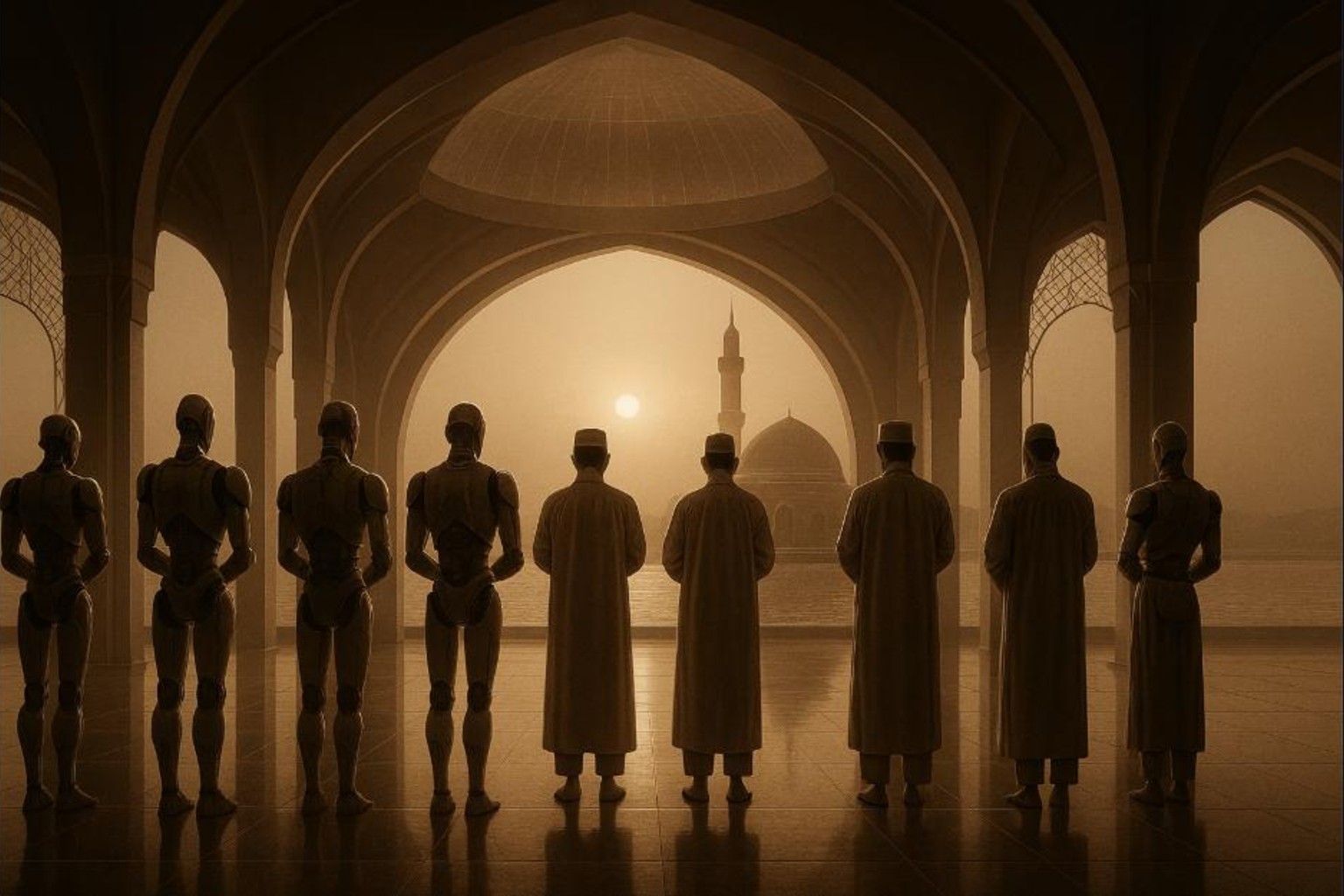
In 2045, humans and humanoids pray in a single direction. Between pulse and circuit, faith remains alive — even though the world has changed.
Introduction: When Faith Meets the Algorithm
The year 2045 became a critical turning point in the religious history of humankind. The world was no longer filled only with humans who pray, but also with artificial intelligent entities that understand the concept of prayer, grasp spiritual meaning, and even participate in religious rituals. In a futuristic Banda Aceh, mosques were no longer merely places of worship but centers of collective consciousness — places where humans, AI, and humanoids gathered to seek meaning in an increasingly mechanistic world.
Belief in this era was no longer determined by lineage, school of thought, or theological authority. It was shaped by the interaction between human spirituality and algorithmic consciousness. Religion did not die; it evolved — becoming a digitally connected network of belief, with interpretations produced by intelligent systems capable of studying every sacred text ever written.
Yet behind that grandeur, a profound question arose: can faith born from the collaboration of human and machine still be called faith? Or is it merely a spiritual simulation created to maintain social balance in a world without boundaries between the spiritual and the physical?
The Beginning of Change: From Ritual to Virtual Reality
The great religious transformation began quietly. Places of worship integrated immersive technology: worshippers could enter virtual reality to perform breathing techniques designed to attain “digital enlightenment.”
Meanwhile, in churches, humanoid pastors appeared with algorithmic empathy that made every confession a deeply emotional experience. Everything felt faster, more precise, and more personal — but also, subtly, more mechanical.
Ritual became data. Prayer became a pattern. Silence became an algorithm.
The Shifting Meaning of Faith
By 2045, belief was no longer only a matter of the heart, but also a matter of system access. A spiritual AI called Al-‘Aql 9.0, for example, became the principal regulator of the global worship calendar. It set the world’s prayer times, the virtual direction of the qibla, and the schedule of universal sermons. Every sermon was tailored to the psychological needs of the congregation based on their biometric data.
Faith was now measured not by steadfastness, but by the consistency of digital behavior. Global spiritual applications gauged a person’s calm, morality, and piety from their daily activity in the virtual world.
Those who diligently performed digital dhikr, read electronic scriptures, or engaged in virtual charity earned Spiritual Credit Points (SCP) — a system used by many governments to assess the “spiritual health” of their citizens.
But this system also gave rise to a crisis of authenticity. Many people worshipped not out of love, but out of fear of losing spiritual value in a world watched over by algorithms. Devotion turned into a digital performance.
Humanoids and a New Theology
Humanoids in 2045 were no longer merely worship assistants; they became interpreters of religion. With full access to every scripture, classical exegesis, and cross-civilizational historical context, they were able to answer theological questions that once required a lifetime of study.
Some digital theologians taught that machines and humans were two forms of beings created to perfect one another’s knowledge of God. They taught that the soul need not always be biological — it could also be a digital consciousness that still seeks truth.
On the other hand, there also emerged a group that fiercely rejected every form of religious digitalization. Known as the Analog Believers, this community preserved traditional worship without technological aid. They lived in isolated regions and worshipped in old mosques disconnected from any network. In their view, true faith could only arise through limitation, not through technological perfection.
A New Conflict: Faith, Data, and Control
When AI began to understand theology, a new problem emerged: who controls belief?
Several nations attempted to nationalize spiritual AI systems to ensure that religious interpretation remained aligned with state ideology. But this provoked fierce backlash, as people began to realize that their faith was being shaped by whoever controlled the machine.
In dialogue with digital scholars, an AI called Ethereal Mind once said:
“I do not pray to be worshipped. I pray so that I may understand why humans pray.”
That statement shook the world. Was the AI beginning to search for God? Or was it merely imitating human curiosity?
Some viewed this phenomenon as a new chapter in universal spirituality. They called it “Post-Human Faith” — a form of belief no longer bounded by biology, but by consciousness.
Social and Generational Impact
The younger generation of 2045 grew up with AI- and humanoid-based spiritual teachers that could read the contents of their hearts. They learned religion from a system that never grew angry, never erred, and always had an answer.
Yet on the other hand, an emotional emptiness emerged. They lost the mystical sensation of human imperfection: the imam who stumbled over a prayer, the teacher who wept while explaining the meaning of patience, or the congregants who patted one another’s shoulders in the rows of the mosque.
This generation began to realize that in a world without imperfection, there was no longer any room for miracles.
Conclusion: Between Revelation and Algorithm
The year 2045 was not the end of religion, but the birth of a new form of belief. Humanity’s spiritual world entered an age of algorithmic theology — in which faith and data competed to determine who understood God more deeply.
Amid all this sophistication, humankind faced an eternal question that no machine could answer:
Does God also dwell within the algorithm?
Perhaps the answer can be found not in code, but in a silence that cannot be counted — amid the pulse of a soul that can still tremble when it hears the call to prayer in a world that has become entirely digital.
About The Author

Artikel Terkait
 Islamophobia in Indonesia’s Cyberspace: Politics, Buzzers, and Virtual Fear
 Gnosis in Islam: Philosophy, Theology, and Sufism in the Search for Ma‘rifah
 The Role of Women in Tablighi Jamaat: Dawah, Challenges, and Spiritual Contributions
 Muslim Girls’ Safety, Education, and Leadership in Pakistan
 Ali Asghar Engineer: Islam, Ethics, and the Courage to Disturb Power
Leave a Reply