
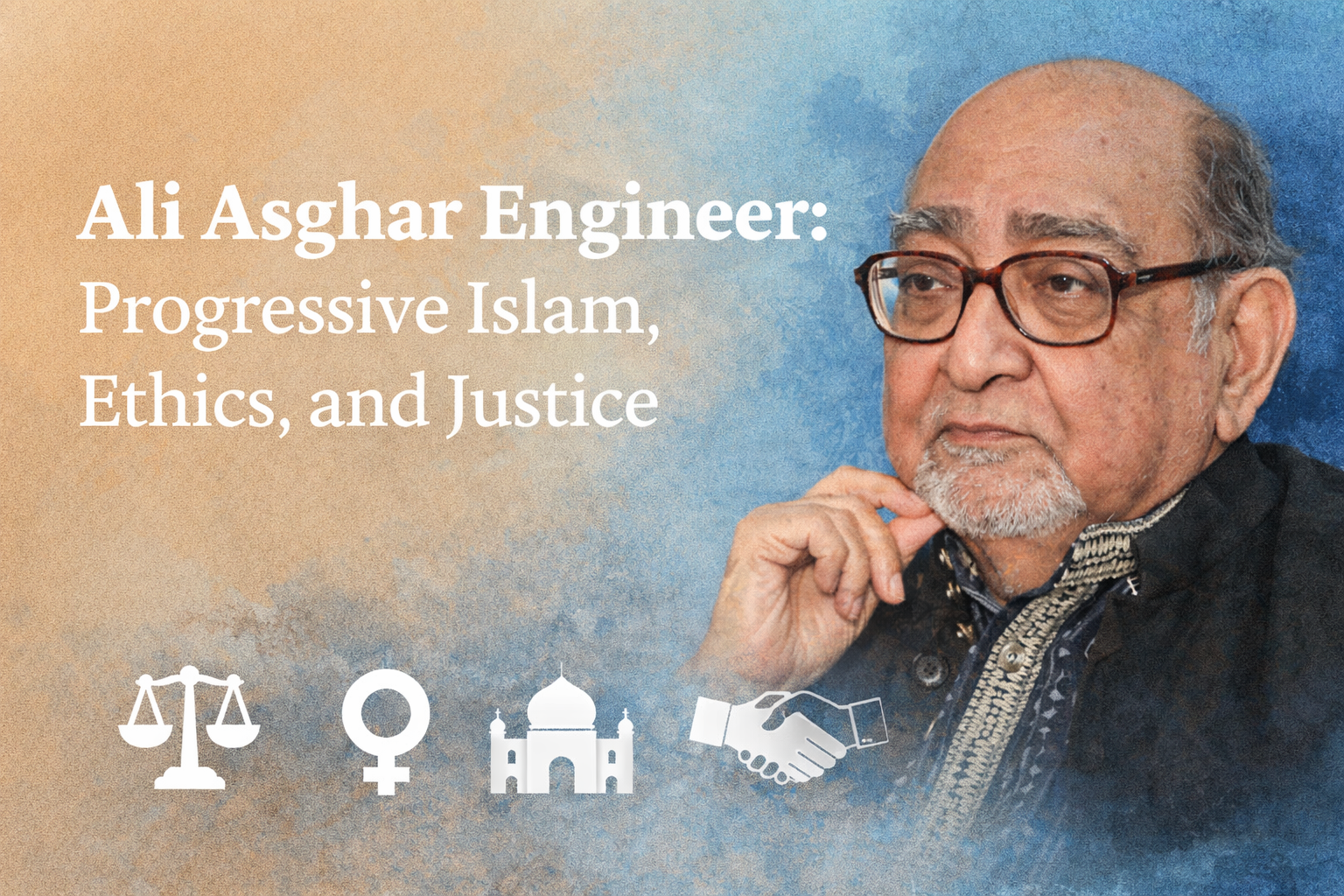
Faith, Conscience, and the Making of a Dissident Thinker
Ali Asghar Engineer never set out to become a rebel within Islam. He was born in 1939 in India into the Dawoodi Bohra community, a tightly organized Shi‘a Muslim group where religious authority was centralized and obedience was treated as a virtue. From an early age, he was immersed in Qur’anic learning and religious discipline, absorbing Islam not as an abstract system but as a lived communal reality. This early formation gave him an insider’s understanding of how faith operates within structures of power.
At the same time, Engineer was trained not as a cleric, but as a civil engineer. This professional distance from religious institutions would later prove decisive. It allowed him to think without dependence on clerical approval and to speak without fear of doctrinal disqualification. He remained a believing Muslim, but one whose legitimacy came from moral reasoning rather than institutional sanction.
For Engineer, conscience was never opposed to faith. On the contrary, he believed conscience was demanded by faith. The Qur’an, as he read it, repeatedly calls human beings to think, reflect, and take responsibility. Blind obedience, therefore, was not piety but moral abdication. This conviction placed him on a collision course with any form of religious authority that demanded silence over accountability.
This combination—deep religious grounding and intellectual independence—shaped Engineer into a dissident thinker. His dissent was not emotional or reactionary. It was principled, ethical, and sustained. From the beginning, he framed his work not as an attack on Islam, but as a defense of its moral core.
Ethical Pillars: Re-centering Islam on Moral Responsibility
At the heart of Ali Asghar Engineer’s intellectual project were what can be called ethical pillars—foundational principles that guided how religion should be interpreted and practiced. These pillars were not abstract ideals but practical criteria against which every religious claim had to be tested. For Engineer, theology without ethics was not incomplete; it was dangerous.
The first and most fundamental pillar was justice. Engineer insisted that justice is the supreme value in Islam, not one principle among many. Any interpretation of scripture that resulted in injustice—toward women, minorities, or dissenters—had already failed, regardless of how old or authoritative it appeared. Law, he argued, must always be subordinate to justice, never the reverse.
The second pillar was human dignity. Engineer believed dignity is inherent in every human being and does not depend on gender, religion, or social status. Religion, therefore, does not grant dignity conditionally; it is obligated to protect it. When religious interpretations normalize humiliation, exclusion, or discrimination, they represent a theological failure, not merely a social problem.
Alongside justice and dignity stood equality and compassion. Engineer rejected the assumption that hierarchy is divinely ordained and argued that compassion is not sentimental charity but ethical seriousness. A religion that lacks compassion easily becomes a tool of cruelty. These ethical pillars formed the moral lens through which he evaluated all aspects of Islamic thought and practice.
Progressive Islam: Ethics Before Tradition, Justice Before Authority
Ali Asghar Engineer’s understanding of Progressive Islam was frequently misunderstood as an attempt to modernize Islam by imitating Western values. In reality, his project was far more demanding. Progressive Islam, for him, meant returning Islam to its ethical nerve, not updating its outward appearance. It was about moral accountability, not cultural adaptation.
Placing ethics before tradition meant that inherited practices could not claim immunity simply because they were old. Engineer respected tradition and understood its role in shaping communal memory, but he refused to treat it as sacred when it caused harm. Tradition, in his view, must always be examined in the light of justice, dignity, and compassion.
Justice before authority was the second core principle. Engineer’s confrontation with clerical power in the Dawoodi Bohra community illustrated this clearly. When religious authority relied on social boycott, intimidation, and exclusion to maintain control, he argued that such authority had forfeited its moral legitimacy. No leader, however revered, was above ethical scrutiny.
The third principle was conscience before conformity. Engineer understood how powerful the pressure to belong can be within religious communities. Yet he chose conscience, even at the cost of violence, excommunication, and decades of social isolation. Progressive Islam, in his vision, required moral courage—the willingness to stand alone rather than compromise ethical integrity.
Gender Justice: Marriage, Divorce, and Inheritance Revisited
Few areas of Engineer’s work were as consequential as his engagement with gender justice. He argued consistently that patriarchy in Muslim societies was not revealed but inherited. The Qur’an, in his reading, affirms women as full moral agents, yet interpretation had often reduced them to dependents or symbols of honor.
Engineer exposed how divorce laws in many Muslim contexts granted men unilateral power while leaving women economically and socially vulnerable. Although the Qur’an permits divorce, he emphasized that it frames it as a last resort, surrounded by ethical safeguards such as deliberation, mediation, and fairness. When divorce became an instrument of domination, it violated the Qur’anic spirit.
Marriage norms also came under his critique. Engineer rejected practices where women’s consent was symbolic rather than real, where marriages were arranged through pressure or silence rather than informed agreement. For him, marriage was a moral partnership between equals, not a transaction of control.
Inheritance rules, he argued, must be understood historically and ethically. While Qur’anic inheritance laws represented a radical improvement in their original context, freezing them without regard to changing social realities could produce injustice. The ethical direction of the Qur’an, he insisted, points toward economic justice, not permanent inequality.
Religion, Violence, and the Dehumanization of the Other
Living in India, Ali Asghar Engineer witnessed repeatedly how religion was mobilized to justify communal violence. He rejected the claim that such violence was rooted in theology. Instead, he demonstrated how it was politically engineered, economically incentivized, and only later clothed in religious language.
Engineer’s extensive documentation of communal riots revealed a consistent pattern: violence begins with dehumanization. Once entire communities are reduced to stereotypes—dangerous, impure, or inferior—cruelty becomes thinkable. Religion, when stripped of ethics, becomes a powerful tool in this process.
He was equally critical of majoritarian nationalism and minority communalism. For Engineer, victimhood did not excuse self-critique. Religious identity could never justify collective blame, nor could it exempt a community from ethical responsibility.
This perspective shaped his commitment to secularism, which he defined not as hostility to religion but as equal respect for all faiths. Citizenship, he argued, must never depend on religious conformity. The ethical task of religion in a plural society is coexistence, not domination.
From Ideas to Action: Institutions, Activism, and Interfaith Work
Ali Asghar Engineer did not believe ideas belonged only in books. He believed that thought which does not enter social reality risks becoming morally sterile. This conviction led him to found institutions designed to translate ethical reflection into public engagement.
He established the Institute of Islamic Studies in Mumbai as a space where theology could meet social reality, and later co-founded the Centre for Study of Society and Secularism in response to the communal violence of the 1990s. These institutions were not monuments to personal legacy but tools for sustaining ethical responsibility beyond individual presence.
Engineer also devoted significant energy to training activists, educators, and even police officers. He believed communal violence escalates not only because of hatred, but because institutions fail ethically. Activism, in his view, was not emotional reaction but disciplined moral practice.
His interfaith work reflected the same seriousness. He rejected ceremonial dialogue that avoided uncomfortable truths. For him, genuine dialogue required self-critique, accountability, and the courage to confront injustice within one’s own community.
A Global Voice from the Global South
Although Engineer never occupied elite academic centers in the Arab world, his work resonated globally. He demonstrated that Islamic reform does not belong exclusively to Arab intellectual traditions. Ethical critique, he showed, can and must emerge from the Global South.
Living as a Muslim minority in India gave his thought a distinctive realism. Islam, in his work, was not a civilization defending itself, but a moral voice negotiating coexistence. This perspective resonated deeply with Muslims living as minorities in Europe, Southeast Asia, and beyond.
His influence can be traced among reformist thinkers, Muslim feminists, and peace activists worldwide. They did not necessarily adopt his conclusions, but they adopted his method: ethical accountability as the standard of religious truth.
In this way, his work traveled without spectacle. It moved quietly, through books, study circles, activist networks, and interfaith initiatives, because it addressed universal struggles over power, dignity, and responsibility.
An Unfinished Legacy
Ali Asghar Engineer died in 2013. He did not leave behind an institution powerful enough to domesticate his ideas, and perhaps that was intentional. He left behind questions—questions that refuse comfort and resist closure.
As long as religion is used to justify discrimination against women, his work remains unfinished. As long as authority hides behind sacred language to avoid accountability, his work remains unfinished. As long as minorities are dehumanized in the name of identity, his work remains unfinished.
Engineer did not offer answers designed to end debate. He offered responsibilities designed to begin it. His legacy is not a doctrine to be defended, but a moral disturbance that insists faith must answer to ethics—or lose its soul.
That disturbance remains. And in a world where religion is still too often invoked to protect power rather than people, it remains urgently necessary.
About The Author

Rekomendasi Bacaan KBA13 INSIGHT
Jika tulisan ini bermanfaat, dukung jurnal ini dengan mencari bukunya melalui tautan berikut:
- Buku-buku Kamaruzzaman Bustamam Ahmad di Periplus
- Koleksi Islamic Studies di Periplus
- Koleksi Geopolitics & Politik Internasional di Periplus
- Cari buku & perangkat baca di Shopee
- Cari di Blibli
Daftar lengkap: Rekomendasi Buku, Alat Tulis & Layanan. Tautan di atas adalah tautan afiliasi — KBA13 INSIGHT dapat memperoleh komisi kecil tanpa biaya tambahan bagi Anda.
Artikel Terkait
 Understanding Islam Beyond Stereotypes: Compassion, Community, and a Buddhist Scholar’s Experience
 Aceh, Mecca, and the Sacred Networks That Shaped Islamic Reform in Southeast Asia
 Islamophobia in Indonesia’s Cyberspace: Politics, Buzzers, and Virtual Fear
 The Evolution of Islamic Thought in the Malay World: Adaptation, Reform, and Political Awakening
 Gnosis in Islam: Philosophy, Theology, and Sufism in the Search for Ma‘rifah
Leave a Reply