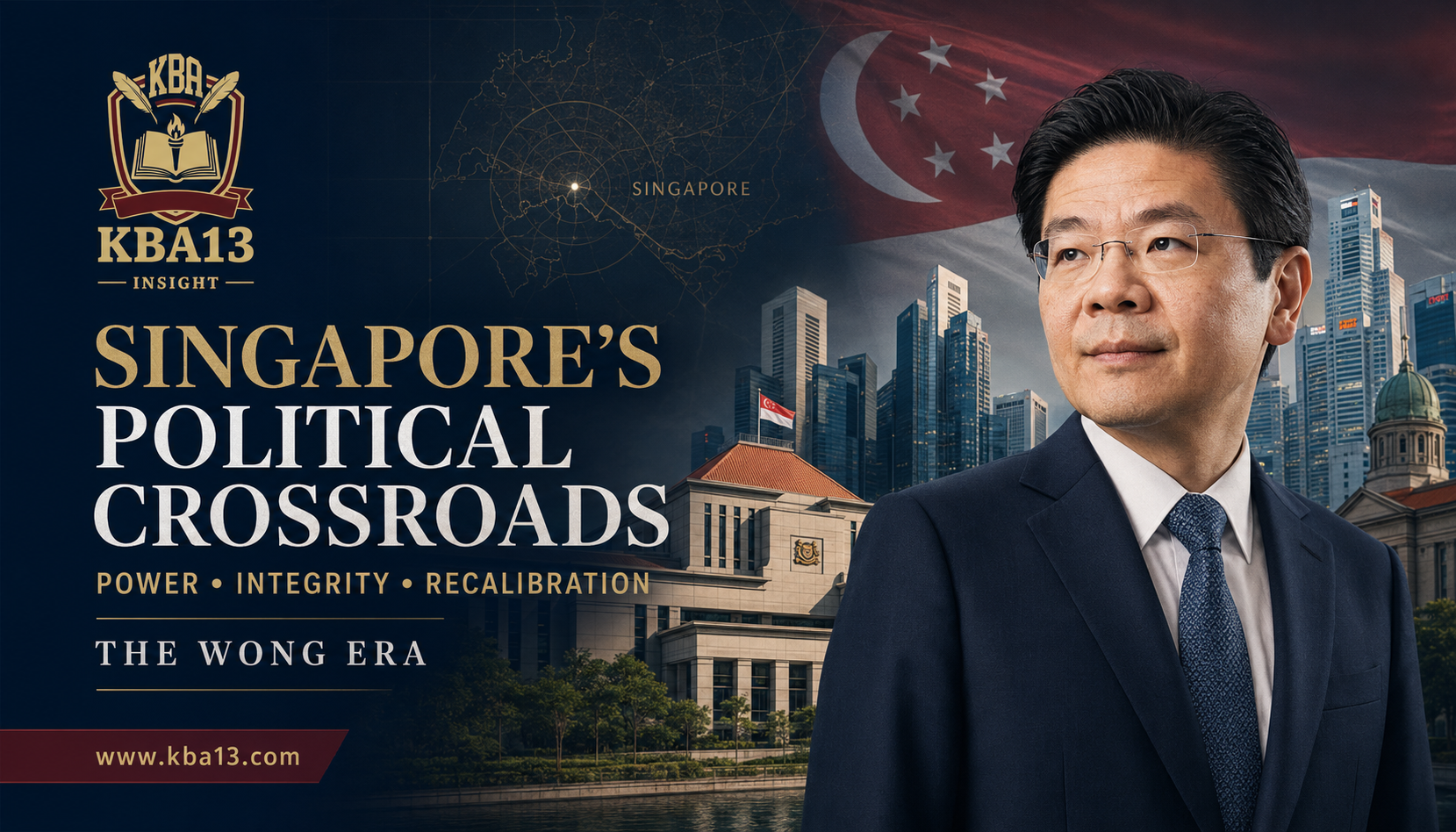
Singapore enters the second half of 2026 as a democracy still governed by a single party, yet visibly more contested, more self-critical, and more anxious about its economic footing than at any point in the past decade. The city-state’s politics this year cannot be understood in isolation from 2025, when Singaporeans marked sixty years of nation-building and handed the People’s Action Party a renewed mandate under Prime Minister Lawrence Wong. That election, and the disciplinary crisis that followed it, together with a sweeping mid-year cabinet reshuffle and a harder economic climate, define the shape of Singaporean politics in 2026.
A Mandate Renewed, But Not Unchallenged
In the May 2025 general election, the PAP won 87 of 97 contested seats and lifted its national vote share from 61.2 percent in 2020 to 65.57 percent, a result that PAP leaders and independent observers alike described as stronger than expected given global headwinds and a cost-of-living squeeze. Under Singapore’s first-past-the-post, group-representation-constituency system, that vote share translated into an overwhelming parliamentary majority, extending the party’s unbroken rule since 1959 into a fifteenth term.
Yet the aggregate numbers understate how contested individual contests have become. The opposition Workers’ Party retained its strongholds and continued to present itself as the only credible check on the PAP, even as its ability to expand beyond its existing base remained limited. For Prime Minister Wong, who took over the top job from Lee Hsien Loong in 2024, the 2025 result was read domestically as a personal endorsement, giving him room to reshape the cabinet and recalibrate economic policy without immediately facing a midterm electoral test. The next general election is not due until roughly 2030, which gives the government an unusually long runway to implement unpopular but, in its view, necessary reforms.
The Removal of Pritam Singh as Leader of the Opposition
The most consequential domestic political story bridging 2025 and 2026 has been the fall of Pritam Singh from his post as Singapore’s first constitutionally recognized Leader of the Opposition, a position created after the 2020 election when his Workers’ Party won ten seats. Singh, the party’s secretary-general since 2018 and Member of Parliament for Aljunied since 2011, was convicted in February 2025 of two counts of lying to Parliament’s Committee of Privileges. The case dated back to 2021, when the committee investigated former Workers’ Party MP Raeesah Khan over a fabricated account she gave in Parliament about accompanying a sexual-assault victim to file a police report. The court found that Singh had known of the falsehood and had encouraged Khan to maintain it rather than come clean promptly. He was fined roughly S$14,000. His appeal to the High Court was dismissed on 4 December 2025.
That conviction set in motion an extraordinary parliamentary process in January 2026. Leader of the House Indranee Rajah tabled a motion arguing that Singh’s conduct — repeated falsehoods to different people over time, and the guiding of a junior MP into deception — was dishonorable and unbecoming, and rendered him unsuitable to continue holding the Leader of the Opposition title, even though the post is legally distinct from his role as an elected MP or party chief. After a lengthy debate on 14 January, Parliament passed the motion; all eleven Workers’ Party MPs present, including Singh himself, voted against it. The following day, Prime Minister Wong exercised his prerogative — the position is formally conferred by the Prime Minister — to strip Singh of the title with immediate effect, while inviting the Workers’ Party to nominate a replacement. Wong said he was disappointed by the outcome but accepted it fully and without reservation, a phrase that underscored how unusual the episode was even by Singapore’s tightly managed political standards.
Singh lost the formal privileges attached to the leader of the opposition role—additional staff support, a larger allowance, and priority in parliamentary debates—but retained his parliamentary seat and, notably, his position at the top of the Workers’ Party. In late June 2026, party members gathered and voted to keep him as secretary-general despite the conviction, after he addressed members directly about the episode. That decision signaled that, whatever damage the courts and Parliament inflicted on Singh’s institutional standing, his own party base still regarded him as its most viable standard-bearer heading toward the next election cycle.
The episode has become something of a political Rorschach test. Government supporters point to it as proof that Singapore’s institutions hold even senior opposition figures to exacting standards of integrity, arguing that dishonesty before a parliamentary committee — an institution built on trust — cannot be tolerated regardless of party. Critics, including some who are otherwise sympathetic to the PAP’s economic record, argue that removing an elected Leader of the Opposition by parliamentary vote, on a matter ultimately decided by the prime minister, illustrates the structural advantage the ruling party retains over any rival, however small the opposition’s presence in the chamber already is. Both readings will likely shape how the episode is remembered as the next election approaches.
Cabinet Renewal and the Generational Handover
If January’s controversy was about the opposition, July brought the most significant reshaping yet of the government side. On 22 July 2026, Prime Minister Wong announced a cabinet reshuffle that accelerated what he has repeatedly called a generational renewal of Singapore’s political leadership. Coordinating Minister for National Security and Home Affairs K. Shanmugam, who has held the security and home affairs portfolio since 2015 and entered politics in 1988, was elevated to Senior Minister — joining former Prime Minister Lee Hsien Loong as one of only two Senior Ministers in Wong’s government, and the first to hold that title while still running a full ministry. Labour movement leader Ng Chee Meng, who lost his parliamentary seat in 2020 but returned to Parliament in the 2025 election, was brought back into cabinet as a minister in the Prime Minister’s Office, having earlier asked to stay outside government to focus on his union responsibilities. Transport chief Jeffrey Siow and Minister for Culture, Community and Youth David Neo were promoted to full ministers. The Ministry of Trade and Industry was renamed the Ministry of Energy, Trade and Industry, reflecting the government’s view that energy security and industrial policy can no longer be treated as separate portfolios, and will be led by Deputy Prime Minister Gan Kim Yong alongside former manpower minister Tan See Leng.
The reshuffle matters beyond its individual appointments because it signals how Wong intends to govern for the remainder of this term: promoting a cohort of ministers in their forties and early fifties into senior roles while retaining a handful of veteran figures — Shanmugam and Lee Hsien Loong chief among them — as institutional ballast. Wong has been explicit that the pace of renewal will continue, with further appointments expected before the next election. For a system that prizes continuity and technocratic competence over charisma, the reshuffle functions as both a leadership pipeline and a signal to Singaporeans that the post-Lee Hsien Loong PAP is capable of self-renewal without destabilizing governance.
Economic Anxiety Beneath a Strong Headline Number
Politics in Singapore this year cannot be separated from the economic backdrop. The city-state’s economy grew by roughly five percent in 2025, a stronger performance than most economists had expected given the disruption caused by United States tariff measures and broader trade fragmentation, and momentum carried into early 2026, with first-quarter growth measured at around six percent year-on-year. On the back of that resilience, the Ministry of Trade and Industry upgraded its full-year 2026 GDP growth forecast to a range of 2.0 to 4.0 percent, though officials caution that downside risks have risen due to geopolitical shocks, including the US-Israel-Iran conflict, and the possibility of resurfacing trade tensions.
That headline resilience, however, sits awkwardly alongside a domestic mood shaped by cost-of-living pressure. Budget 2026, unveiled in February and the first full-term budget since the 2025 election, forecasts a modest fiscal surplus of roughly S$3.2 billion, equivalent to about 0.4 percent of GDP, reflecting a deliberate return to fiscal discipline after several years of expansive pandemic- and inflation-related support. Compared with Budget 2025, direct government transfers to the median Singaporean household are estimated to fall by several hundred dollars, even as total government spending continues to climb toward a targeted 20 percent of GDP by 2030 and defence spending holds near 3 percent of GDP. The government frames this shift as a move away from broad, universal relief and toward more targeted support for lower-income and vulnerable households, paired with heavier investment in structural priorities such as a merged SkillsFuture and Workforce Singapore agency, expanded mid-career training, and sector-specific artificial-intelligence capabilities in fields like accountancy and law. Politically, though, the optics are difficult: a government that campaigned on stability and continuity is now visibly asking households to absorb reduced direct support at the same time as it champions record economic growth figures, and critics have been quick to frame this as an asymmetry between corporate and macroeconomic success on one hand and household strain on the other.
Underpinning all of this is the government’s own Economic Strategy Review, launched in August 2025 and chaired by a new generation of office-holders, which is expected to produce its first substantive policy recommendations before the year is out. Wong has been unusually candid in his public remarks, including his 2026 New Year address, that Singapore cannot simply replicate the strategies that delivered above-trend growth in 2024 and 2025, describing a fractured and increasingly disruptive global trading order as a permanent condition rather than a temporary shock. That framing — resilience without complacency — has become the government’s dominant political narrative for the year, one that tries to reconcile strong statistics with public anxiety about jobs, housing, and daily expenses.
What It All Adds Up To
Taken together, the events of the past several months describe a political system testing the limits of its own stability. The PAP’s electoral dominance remains essentially unchallenged in numerical terms, and its leadership transition to Lawrence Wong appears, on the evidence of the July reshuffle, to be proceeding on the government’s own terms and timetable rather than under external pressure. At the same time, the Pritam Singh affair has exposed genuine tension between the government’s emphasis on institutional integrity and opposition supporters’ concerns about the concentration of disciplinary power in the hands of the ruling party, while economic policy is forcing an uncomfortable public conversation about who bears the cost of Singapore’s adjustment to a more volatile global economy.
None of this threatens the PAP’s hold on power in the near term; Singapore’s institutional architecture, electoral geography, and the sheer scale of the party’s 2025 mandate make that all but certain before the next general election. What has changed is the texture of political debate — sharper scrutiny of individual conduct, more open argument over fiscal trade-offs, and a leadership visibly preparing itself, and the public, for a decade in which Singapore’s traditional formula of export-led growth and broad social compact can no longer be taken for granted. How Wong’s government manages that transition, and how much room it leaves for a chastened but unbowed opposition, will likely define Singaporean politics for the remainder of this parliamentary term and shape the terrain on which the next election is eventually fought.
About The Author

Rekomendasi Bacaan KBA13 INSIGHT
Jika tulisan ini bermanfaat, dukung jurnal ini dengan mencari bukunya melalui tautan berikut:
- Buku-buku Kamaruzzaman Bustamam Ahmad di Periplus
- Koleksi Islamic Studies di Periplus
- Koleksi Geopolitics & Politik Internasional di Periplus
- Cari buku & perangkat baca di Shopee
- Cari di Blibli
Daftar lengkap: Rekomendasi Buku, Alat Tulis & Layanan. Tautan di atas adalah tautan afiliasi — KBA13 INSIGHT dapat memperoleh komisi kecil tanpa biaya tambahan bagi Anda.
Artikel Terkait
 Pustaka Al-Azhar: Preserving Patani’s Islamic Intellectual Heritage Through Jawi Manuscripts and Traditional Knowledge
 Aceh, Nation-State, dan Komparasi Global: Bali, Yogyakarta, Brunei, Singapura, dan Israel dalam Dialektika Demokrasi dan Agama
 Demokrasi Aceh: Antara Tradisi Lokal, Agama, dan Tantangan Negara-Bangsa
 Islam, Violence, and Acehnese Identity: A Socio-Historical Reading of Conflict, Faith, and the Idea of Musoh
 Acehnology as an Intellectual Journey: Aceh, Islam, Southeast Asia, and the Malay World
Leave a Reply