KBA13 Insight · Social Politics
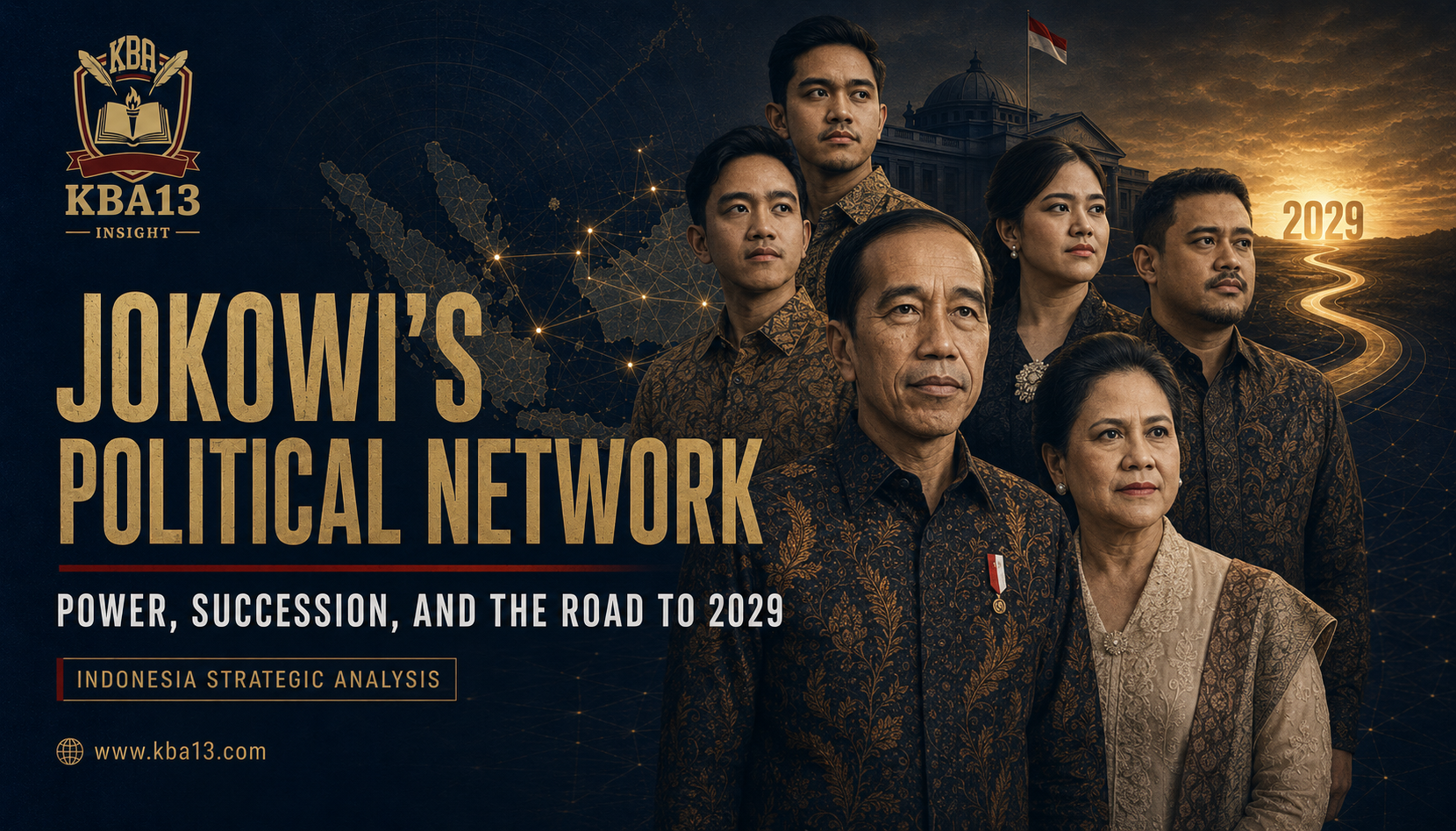
Jokowi’s Political Network After the Presidency:Power, Succession, and the Road to 2029
Jokowi no longer controls the presidency, but his influence persists through Gibran, PSI, volunteer organisations, former officials, regional elites, and cross-party alliances. This strategic analysis maps the strengths, vulnerabilities, and 2029 scenarios of Indonesia’s most consequential post-presidential political network.
Summary
Jokowi no longer controls the presidency, but his influence persists through Gibran, PSI, volunteer organisations, former officials, regional elites, and cross-party alliances. This strategic analysis maps the strengths, vulnerabilities, and 2029 scenarios of Indonesia’s most consequential post-presidential political network.
Keywords
- Bobby Nasution
- Electoral Politics
- Elite Networks
- Gerindra Party
- Gibran Rakabuming Raka
- Indonesia 2029 Election
- Indonesia Politics
- Indonesian Democracy
- Indonesian Political Dynasty
- Joko Widodo
Indonesia’s post-presidential politics has entered a new and unusually fluid phase. Joko “Jokowi” Widodo no longer occupies the presidential palace, but he has not disappeared from the architecture of power. Instead, his influence has shifted from formal authority to a dispersed political network composed of family members, loyalist organisations, party intermediaries, business relationships, regional elites, former officials, volunteer structures, and a carefully cultivated public image. The central question is no longer whether Jokowi still matters. It is how his network operates, how durable it is, and how it may shape Indonesia’s political succession toward 2029.
This article argues that Jokowi’s post-presidential power should not be understood as a conventional party machine. It is better described as a flexible political ecosystem. Its strength lies in personal loyalty, electoral memory, access to governing elites, control over narrative, and the strategic positioning of his family. Its weakness lies in the absence of a single dominant party under his direct command, the growing autonomy of President Prabowo Subianto, and the possibility that former allies may recalculate their loyalties as the next presidential cycle approaches.
From Presidential Power to Networked Influence
During his decade in office, Jokowi accumulated political capital through a combination of electoral popularity, infrastructure-driven developmentalism, patronage, coalition expansion, and the incorporation of rivals into government. The most consequential example was Prabowo Subianto, who moved from being Jokowi’s principal challenger in 2014 and 2019 to becoming defence minister and eventually president. That transition demonstrated Jokowi’s ability to transform antagonism into managed partnership.
After leaving office, however, Jokowi lost the institutional advantages that had previously amplified his influence. He no longer controls cabinet appointments, state budgets, intelligence briefings, or the administrative machinery of government. His continuing relevance therefore depends on whether relationships built during his presidency can be converted into autonomous political leverage.
This conversion is already visible. Jokowi’s public visits, meetings with political actors, engagement with volunteer groups, and association with the Indonesian Solidarity Party, or PSI, indicate an attempt to preserve bargaining power. His political movement is less about returning to office than about maintaining a decisive position within the coalition structure that will shape 2029.
The network is also defensive. Jokowi has a legacy to protect: infrastructure projects, the new capital Nusantara, downstream industrialisation, and the political legitimacy of his family. A former president whose son serves as vice president cannot easily withdraw into ceremonial retirement. His personal legacy and his family’s future are now structurally intertwined.
The Family as the Core Political Node
At the centre of Jokowi’s network is his family. Vice President Gibran Rakabuming Raka is the most important node because he occupies the highest formal position within the network. Gibran’s vice presidency gives Jokowi’s political ecosystem a direct institutional presence in the executive branch, even though the constitutional authority of the vice president remains limited and dependent on the president’s allocation of responsibilities.
Gibran’s future is the central strategic question. If Prabowo seeks a second term in 2029 and retains Gibran as his running mate, Jokowi’s network may favour continuity. Such a scenario would allow Gibran to consolidate national experience while avoiding a premature confrontation with Prabowo. It would also preserve the public narrative of harmony between the two political families.
Yet this arrangement contains a latent succession problem. A two-term Prabowo presidency would postpone Gibran’s possible presidential bid until 2034. That delay may be acceptable if Jokowi’s network believes Gibran needs time to develop administrative credibility. It may be less acceptable if political conditions in 2029 offer an opportunity that may not return.
Kaesang Pangarep and PSI constitute another component. PSI offers the family a more direct organisational vehicle than the major established parties, although its parliamentary weakness remains a serious limitation. The party’s value lies not merely in seats. It can function as a platform for branding, recruitment, youth mobilisation, digital campaigning, and political negotiation. Jokowi’s visible association with PSI can increase its relevance, but converting personal popularity into durable party support is difficult.
Other family connections and regional relationships add breadth, but they also intensify criticism of dynastic politics. The stronger the family becomes, the more easily opponents can frame Jokowi’s network as a hereditary power project rather than an ideological coalition. This narrative vulnerability will become more important as 2029 approaches.
PSI as a Political Laboratory
PSI is the most obvious institutional laboratory for Jokowi’s post-presidential influence. It is younger, more flexible, and less burdened by entrenched internal factions than Golkar, PDI-P, or Gerindra. It also has a digital identity compatible with the demographic composition of Indonesia’s electorate.
The party nevertheless faces a fundamental problem: personal endorsement does not automatically produce organisational depth. Indonesia’s electoral system rewards parties with local machinery, legislative candidates, funding networks, and strong provincial structures. PSI must expand beyond urban social media audiences and develop roots in districts where politics depends on local brokers, religious organisations, community leaders, and patronage networks.
Jokowi’s political tours can assist this process by transferring symbolic authority to local PSI structures. His presence signals access, relevance, and future opportunity. For politicians deciding where to invest their careers, the possibility that PSI could become the principal vehicle of the Jokowi family may be attractive.
But PSI cannot be treated as a substitute for relations with larger parties. Its strategic role is more likely to be complementary. It can serve as Jokowi’s direct political brand while alliances with Golkar, Gerindra, the National Mandate Party, and other coalition actors provide parliamentary and regional reach.
The challenge is that PSI’s rise may alarm larger parties. They may welcome Jokowi’s electoral support while resisting the development of an independent family-controlled party. Coalition partners often prefer a powerful ally who remains organisationally dependent. A stronger PSI would reduce that dependence and could therefore generate resistance.
The Volunteer Organisations: From Campaign Instrument to Political Infrastructure
Jokowi’s volunteer organisations were crucial to his rise. Groups such as Projo and other loyalist networks created a political identity that appeared to operate outside traditional party structures. They mobilised supporters, amplified messaging, and reinforced the image of Jokowi as a leader directly connected to ordinary citizens.
After the presidency, these organisations remain useful because they provide continuity. Parties can change alliances, but volunteer groups often sustain personalised loyalty. They can organise gatherings, defend Jokowi’s record, counter hostile narratives, and mobilise support for candidates endorsed by the network.
Their influence should not be exaggerated. Volunteer organisations vary greatly in coherence, capacity, and geographical reach. Some are effective mobilisation networks; others function mainly as elite labels. Their durability depends on access to resources and on whether Jokowi continues to provide a clear political direction.
The most important function of these groups may be narrative rather than electoral. They keep Jokowi present in public discourse. They frame his interventions as expressions of popular concern rather than elite manoeuvring. They also provide a rapid-response mechanism when controversies threaten Gibran, Kaesang, or Jokowi’s legacy.
In a fragmented media environment, such networks can create the appearance of spontaneous public demand. That appearance matters because Indonesian politics remains highly sensitive to perceptions of momentum, popularity, and inevitability.
Former Ministers, Bureaucratic Alumni, and the Technocratic Network
Jokowi’s decade in office produced a large cohort of former ministers, deputy ministers, presidential staff, advisers, regional officials, and business-linked technocrats. Not all remain personally loyal, but many owe part of their national prominence to his administration.
This alumni network gives Jokowi access to expertise, media platforms, business circles, and party structures. Some figures may act as intermediaries between Jokowi and the Prabowo government. Others may become candidates, campaign strategists, donors, or policy advocates in the 2029 cycle.
The network is especially relevant in sectors associated with Jokowi’s legacy: infrastructure, investment, mining downstreaming, digital industry, social assistance, and the Nusantara capital project. These sectors connect political interests with corporate and bureaucratic interests.
Yet alumni networks are inherently unstable. Former officials often reposition themselves under a new president. Their loyalty may be pragmatic rather than personal. As Prabowo consolidates authority, the incentives to identify as a Prabowo loyalist will grow.
Jokowi therefore faces a classic post-presidential dilemma: the people who once depended on him may no longer need him. His influence will endure only where he retains assets that others value, including popular support, electoral mobilisation, family access to high office, and the ability to affect coalition outcomes.
Relations with Golkar and the Major Parties
Jokowi’s relationship with Golkar remains strategically important. Golkar has national organisation, parliamentary strength, regional networks, business connections, and a long tradition of adapting to the centre of power. For a former president without his own major party, influence within Golkar can provide substantial leverage.
However, Golkar is not easily controlled by an external figure. Its internal elite is transactional, experienced, and capable of changing alignments rapidly. Jokowi-linked figures may hold influence, but the party’s ultimate orientation will depend on the distribution of state power and the perceived winner of the 2029 contest.
Relations with Gerindra are even more sensitive. Jokowi helped create the conditions for Prabowo’s victory by supporting the Prabowo-Gibran ticket. But political debt has limits. Once installed as president, Prabowo has his own mandate, party, military-linked networks, coalition partners, and governing agenda.
PDI-P occupies a different position. Jokowi’s break with the party that carried him to national power remains one of the defining transformations of Indonesian politics. Reconciliation is theoretically possible, but institutional and personal wounds run deep. PDI-P also has an incentive to oppose the consolidation of the Jokowi family as a rival dynasty.
Other parties will behave opportunistically. They may support a Prabowo-Gibran continuation, a Gibran presidential bid, or an alternative coalition depending on electoral calculations. Jokowi’s ability to influence them will depend less on past loyalty than on his capacity to deliver votes and access.
The Prabowo–Jokowi Relationship: Partnership, Competition, and Mutual Constraint
The relationship between Prabowo and Jokowi is the central axis of Indonesia’s current elite politics. Their partnership brought Prabowo to the presidency and Gibran to the vice presidency. It also created a broad governing coalition that initially appeared to fuse the two political networks.
But partnership does not eliminate competition. Prabowo must establish that he is not merely the executor of Jokowi’s agenda. Every president seeks to create an independent legacy, command the bureaucracy, control coalition appointments, and define national priorities. The more Prabowo succeeds, the less room remains for Jokowi to act as an informal centre of authority.
Recent reports of strain should be interpreted carefully. Elite relations often produce tactical disagreements without causing an open rupture. Both sides have strong reasons to preserve public harmony. Prabowo benefits from Jokowi’s residual popularity and from Gibran’s presence in government. Jokowi benefits from access to the governing coalition and from the protection of his legacy.
The relationship is therefore characterised by mutual constraint. Jokowi cannot openly challenge Prabowo without endangering Gibran’s position. Prabowo cannot marginalise Jokowi too aggressively without risking coalition tension and alienating parts of the electorate that associate the current government with continuity.
This equilibrium may survive until the 2029 nomination process becomes unavoidable. At that point, questions of candidacy, vice-presidential pairing, party control, and succession will convert ambiguity into competition.
The Politics of Continuity
Jokowi’s strongest public argument is continuity. His presidency built a political narrative around infrastructure, economic transformation, social assistance, and decisive executive action. The Prabowo-Gibran campaign benefited from presenting itself as the continuation and expansion of that agenda.
Continuity is also an instrument of influence. If Jokowi’s legacy remains popular, politicians seeking election have incentives to associate themselves with it. This allows Jokowi to shape political behaviour even without formal authority.
However, continuity can become a liability when economic or governance problems intensify. Rising living costs, fiscal pressure, dissatisfaction with public services, or controversy over major projects can weaken the value of the Jokowi brand. Opponents may reframe continuity as stagnation, elite capture, or democratic decline.
The Jokowi network must therefore constantly reinterpret the legacy. It cannot rely only on completed infrastructure. It must present Jokowi’s era as the beginning of a longer national transformation whose completion requires continued leadership by aligned figures.
This is why 2029 is not merely an electoral contest. It is a referendum on whether Jokowi’s political model can survive beyond Jokowi himself.
Digital Power and Narrative Management
Jokowi’s political rise was inseparable from media innovation. His image as a practical, accessible, non-elite leader was amplified through television, social media, volunteer messaging, and carefully staged public encounters. That narrative infrastructure remains valuable.
The post-presidential phase requires a modified strategy. Jokowi must appear active without appearing disruptive, influential without appearing unconstitutional, and supportive of the government without becoming politically irrelevant.
Digital media allows this balance to be managed. Visits, statements, informal meetings, and public interactions can be framed as ordinary civic engagement while simultaneously sending signals to political elites. A single appearance can communicate loyalty to Prabowo, support for Gibran, encouragement to PSI, and continuing access to popular constituencies.
The risk is overexposure. If every public movement is interpreted as electoral manoeuvring, Jokowi may lose the informal legitimacy of a retired statesman. The network must preserve ambiguity because ambiguity expands bargaining space.
Narrative control will also be essential in responding to criticism concerning dynastic politics, democratic regression, and the constitutional controversies surrounding Gibran’s candidacy. These issues will not disappear. They will become part of the opposition’s central argument in 2029.
Regional Elites and the Geography of Influence
National political power in Indonesia depends on local networks. Governors, mayors, regents, provincial party leaders, religious figures, business associations, and community brokers shape electoral outcomes. Jokowi’s national tours can be understood as an effort to reactivate relationships across this territorial landscape.
His political roots in Solo and Central Java remain symbolically important, but the network must extend far beyond its original base. Lampung and other regions provide opportunities to test the transferability of the Jokowi brand and to build local structures for PSI or allied candidates.
Regional elites are attracted to credible pathways to national power. If they believe Jokowi can influence nominations, cabinet appointments, or access to the next ruling coalition, they will maintain ties. If they conclude that Prabowo has fully absorbed the political centre, they may shift allegiance.
This means Jokowi’s regional influence is partly anticipatory. It depends on what local actors believe he will be able to do in the future. Political networks are sustained not only by current resources but by expectations.
The 2029 contest will therefore be preceded by an extended struggle over perception: who controls the coalition, who can deliver nominations, and whose endorsement still moves voters.
The 2029 Scenarios
Several scenarios are plausible.
The first is continuity through a second Prabowo-Gibran ticket. This is the least disruptive option. Jokowi would support the incumbent coalition, Gibran would remain vice president, and PSI could grow as an allied party. The main strategic cost is the postponement of Gibran’s presidential ambition.
The second is a negotiated succession in which Prabowo supports Gibran, either in 2029 or at a later stage. This would require extraordinary trust and a favourable political environment. It would also require Gibran to demonstrate greater national authority and independence.
The third is competitive separation. Jokowi’s network could back a coalition distinct from Prabowo’s, with Gibran or another aligned figure as candidate. This scenario would transform latent tension into open conflict. It would also test whether Jokowi’s popularity can be converted into votes without access to the incumbent president’s machinery.
The fourth is fragmentation. PSI may fail to achieve sufficient electoral strength, volunteer networks may weaken, former officials may defect, and Gibran may remain institutionally constrained. Under this scenario, Jokowi would continue to influence public debate but lose the capacity to determine presidential succession.
The fifth is adaptation through a broader alliance. Jokowi may avoid direct confrontation by becoming a coalition broker among parties, regional leaders, business groups, and younger political figures. In this model, his objective would not necessarily be to place one family member immediately in the presidency, but to ensure that no winning coalition can ignore his network.
Structural Strengths of the Jokowi Network
The network retains several important strengths. Jokowi remains one of Indonesia’s most recognisable political figures. His developmental record continues to resonate with voters who value infrastructure and visible state action. Gibran occupies the vice presidency. PSI offers an emerging organisational vehicle. Volunteer groups provide personalised mobilisation. Former officials and business-linked actors maintain access to elite circles.
The network is also flexible. Because it is not confined to one party, it can negotiate across multiple organisations. This flexibility helped Jokowi during his presidency and may help him after it.
Its most important asset is the ability to connect elite bargaining with popular legitimacy. Many political networks possess money or party machinery. Fewer can claim a former president’s electoral brand combined with a family member in national office.
Structural Weaknesses and Risks
The network’s weaknesses are equally significant. It lacks a dominant parliamentary party under Jokowi’s direct control. PSI remains organisationally limited. Volunteer loyalty may decline without access to state resources. Major parties can cooperate with Jokowi while resisting his family’s long-term ambitions.
The greatest risk is dependence on Prabowo. As long as Gibran serves under him, Jokowi must calibrate his moves carefully. Open conflict could damage the vice president and split the coalition.
A second risk is reputational. Criticism of dynastic politics can unify otherwise fragmented opposition forces. Questions about democratic institutions, judicial independence, and electoral fairness can erode the moral appeal that once distinguished Jokowi from traditional elites.
A third risk is generational transfer. Jokowi’s popularity is not automatically transferable to Gibran or Kaesang. Political inheritance requires competence, narrative, organisational strength, and public trust. Family name alone is insufficient.
A fourth risk is performance. If the Prabowo-Gibran government underperforms, Gibran will share the burden. Jokowi’s network cannot claim continuity when policies succeed and separation when they fail without losing credibility.
What Jokowi Is Likely Trying to Achieve
Jokowi’s current strategy appears to pursue several objectives simultaneously.
First, he seeks to keep his network mobilised. Political inactivity would encourage defections and reduce bargaining power.
Second, he seeks to strengthen PSI without abandoning relationships with larger parties.
Third, he seeks to protect Gibran’s institutional position and future candidacy.
Fourth, he seeks to preserve the public legitimacy of his presidential legacy.
Fifth, he seeks to prevent Prabowo’s political consolidation from making the Jokowi network dispensable.
These goals explain the ambiguity of his post-presidential behaviour. He can support Prabowo-Gibran for two terms while also building independent organisational capacity. The two strategies are not necessarily contradictory. Public support for continuity buys time; network-building creates options.
Conclusion: A Network in Transition
Jokowi’s political network is neither collapsing nor fully consolidated. It is in transition from a presidential machine supported by state authority into a post-presidential ecosystem that must survive through loyalty, organisation, narrative, and succession planning.
Its immediate future depends on the balance between cooperation and competition with President Prabowo. Its long-term future depends on whether Gibran can become more than the beneficiary of Jokowi’s popularity. PSI must become more than a family-branded platform. Volunteer organisations must become more than campaign-era symbols. Former officials must see continuing value in remaining connected. Regional elites must believe the network can still shape nominations and government.
The road to 2029 has therefore already begun. Jokowi’s tours, endorsements, alliances, and organisational experiments should be read as components of a broader struggle over political inheritance. The decisive issue is not whether Jokowi intends to remain influential. The evidence strongly suggests that he does. The decisive issue is whether a personalised network built around one of Indonesia’s most successful electoral politicians can be institutionalised strongly enough to survive the growing autonomy of his successor.
For Indonesia, the answer will have consequences beyond one family. It will reveal whether post-Reformasi presidential power can evolve into a durable political dynasty, whether parties can reassert institutional control, and whether the country’s democratic competition will remain open as the 2029 succession takes shape.
References and Further Reading
Channel NewsAsia. “Jokowi May Have Retired, but His Ambitions Remain Big.” 2 July 2026.
The Jakarta Post. “Analysis: Jokowi’s ‘Safari Politik’: Strategy, Motives and Political Impact.” 10 June 2026.
The Jakarta Post. “Prabowo-Jokowi Strains Surface Amid Public Discontent.” 26 June 2026.
Reuters. “Indonesia’s Jokowi Seeks Major Party Takeover to Retain Decade-Long Influence.” 20 March 2024.
East Asia Forum. “Can Jokowi Influence Indonesia’s Presidential Election?” 27 October 2023.
KBA13 Insight invites readers, scholars, and policy professionals to follow our continuing analysis of Indonesia’s political succession, elite networks, democratic institutions, and the road to the 2029 election.
How to Cite
Ahmad, Kamaruzzaman Bustamam. (2026). Jokowi’s Political Network After the Presidency: Power, Succession, and the Road to 2029. Banda Aceh: KBA13 Insight.
https://www.kba13.com/jokowi-political-network-after-presidency-road-to-2029/
Professor of Anthropology of Religion at UIN Ar-Raniry Banda Aceh. He writes on geopolitics, Southeast Asian security and governance, Islam in the Malay world, and the future of knowledge.
About The Author

Artikel Terkait
 The Purbaya Episode: Technocracy, Digital Visibility, and Indonesia’s Unsettled Road to 2029
 Indonesia Strategic Intelligence Report (7–12 July 2026): Political Crisis, Papua Conflict, BrahMos Deal, Economy, and National Security
 Dari Goro-Goro ke Huru-Hara: Audit Prediksi KBA13 tentang Indonesia Menuju 2030
 Southeast Asia Strategic Outlook 2026: South China Sea, Indonesia’s Economy, Myanmar Crisis, and ASEAN Energy Security
 Southeast Asia Strategic Outlook 2026: ASEAN, South China Sea Tensions, Prabowo’s Economic Doctrine, and the Future of Regional Order

Leave a Reply