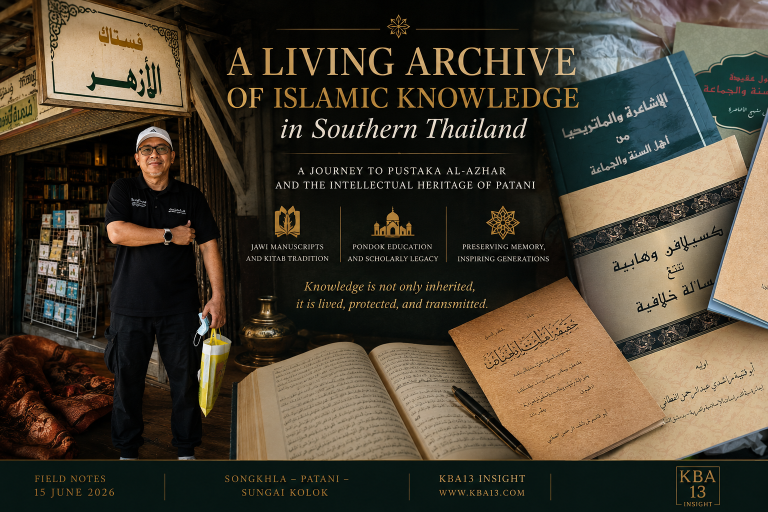
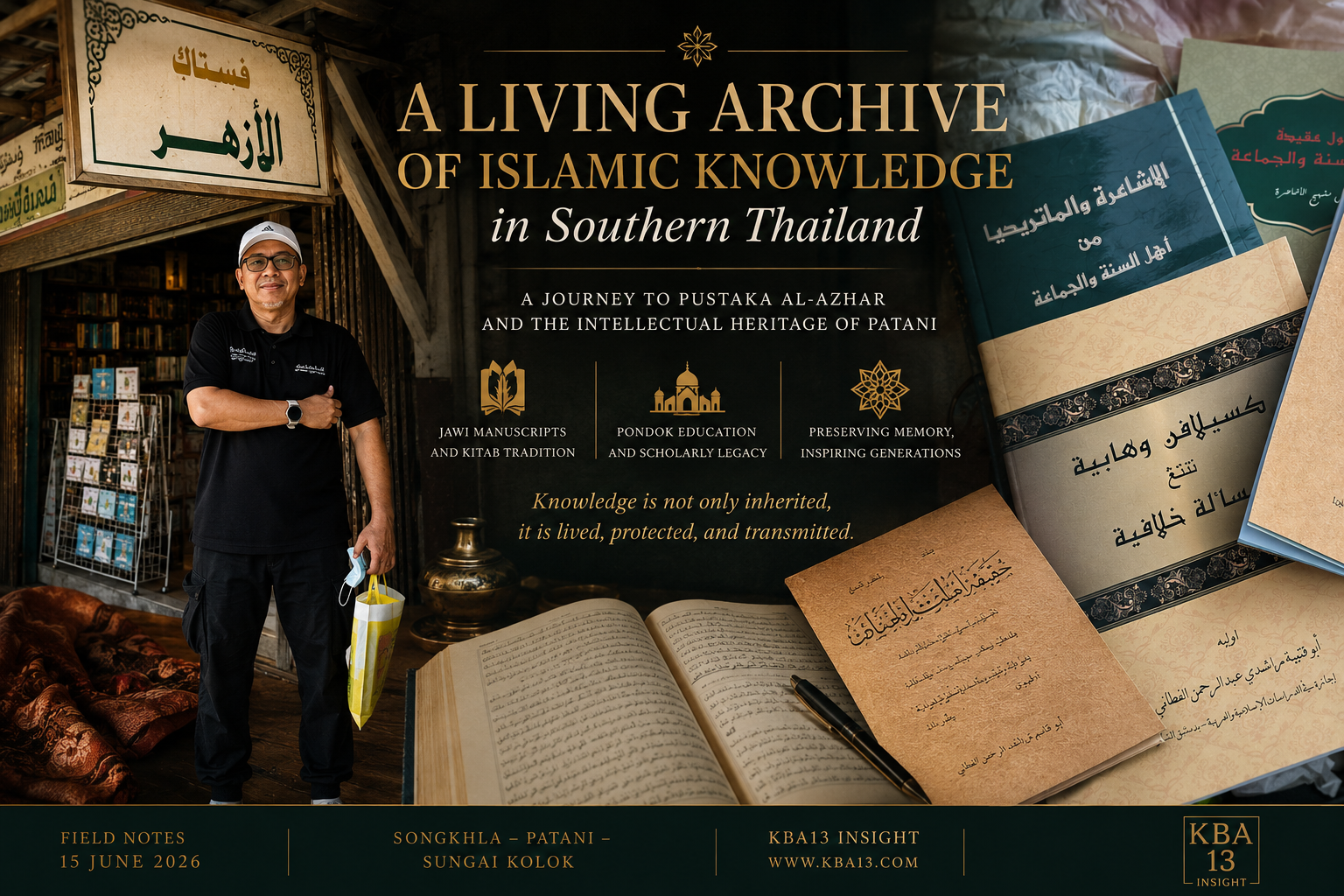
A field journey to Pustaka Al-Azhar, where the intellectual heritage of Patani’s Islamic scholars continues through Arabic and Jawi books.
1. A Small Bookstore on the Road to the Border
On June 15, 2026, during my journey from Songkhla toward Kota Bharu, I stopped at a small bookstore named Pustaka Al-Azhar. The visit was brief, but the impression it left was deep. I was on my way from Patani toward the Sungai Kolok border before continuing my return journey to Kuala Lumpur. I was accompanied by Abdul Rooya Panaemale, a writer from Patani whose presence made this journey more than a passage through geography. It became a passage through memory.
At first glance, Pustaka Al-Azhar did not appear to be a large intellectual institution. It was not a modern bookstore with polished shelves, digital catalogs, or the atmosphere of commercial publishing. It stood quietly in the rhythm of everyday life in Southern Thailand. Yet precisely because of that simplicity, it spoke more strongly. It belonged to the world of ordinary people, students, teachers, and seekers of knowledge.
The signboard above the shop carried Arabic letters. Inside, the books were arranged not as museum objects but as living instruments of learning. There were books in Arabic. There were books in Jawi. There were works connected to the Islamic creed, law, ethics, and spiritual discipline. Some were classical in orientation. Some were written or reproduced for contemporary students. The bookstore was small, but its intellectual world was wide.
I was told that the owner was an alumnus of Al-Azhar University. This detail was important. It explained the symbolic bridge between Egypt and southern Thailand, between Cairo and Patani, between the global center of Islamic learning and the local world of Malay Muslim scholarship. Pustaka Al-Azhar was not merely a shop. It was a small node in a long chain of transmission.
In the Malay Muslim world, knowledge has often traveled through humble spaces. A pondok, a surau, a small library, a teacher’s house, a bookshop near a road, a wooden shelf filled with yellowing texts — these places have preserved more than many official institutions realize. They do not announce themselves loudly. But they carry civilization quietly.
This is why my visit to Pustaka Al-Azhar became an ethnographic moment. It showed me that the Islamic heritage of Southern Thailand is not only preserved in archives, universities, or historical memories. It is still being sold, bought, read, carried, and taught. It remains connected to the lives of students and teachers.
A bookstore like this is not only a commercial site. It is an archive in motion. It is a place where books continue to move from one hand to another, from one generation to another, from one village to another. It is a reminder that knowledge survives not because it is stored, but because it is used.
2. Patani as an Intellectual Geography
Patani is not merely a geographical name. For the Malay Muslim world, Patani is an intellectual memory. It represents a region where Islam, Malay culture, scholarship, and religious education developed through a long historical process. Its significance cannot be understood only through modern political borders. Patani belongs to a wider civilizational map that connects Southern Thailand with Kelantan, Kedah, Aceh, Mecca, Cairo, and the broader Muslim world.
In many discussions, Southern Thailand is often described through the lens of conflict, identity politics, and state-minority relations. These themes are important, but they are not enough. If Patani is seen only as a zone of conflict, then its intellectual depth disappears. The region must also be understood as a place of learning, manuscript culture, religious authority, and scholarly productivity.
The pondok tradition played a central role in this intellectual geography. For generations, students came to learn from tok guru who were respected not only for their knowledge but also for their moral authority. The pondok was not simply a school. It was a complete environment of formation. Students learned texts, but they also learned discipline, manners, humility, and the ethics of seeking knowledge.
This type of education produced a different relationship between teacher and student. Knowledge was not treated as information to be consumed quickly. It was received through adab. It required presence, repetition, memorization, commentary, and correction. A student did not merely read a book. A student entered a tradition.
The books sold in Pustaka Al-Azhar must be understood within this larger ecosystem. They are not isolated products. They are connected to classrooms, pondok circles, mosque lectures, private study, and family transmission. When a student buys a Jawi text, he is not only purchasing printed paper. He is entering a chain of learning.
Patani’s intellectual geography is also multilingual. Arabic connects it to the classical Islamic sciences. Malay connects it to regional culture. Jawi connects both worlds through a script that once served as one of the great vehicles of Islamic knowledge in Southeast Asia. This layered linguistic world is one reason why Patani remained intellectually productive.
To stand in a bookstore in Southern Thailand and see Arabic and Jawi texts side by side is to witness the survival of that world. It is good to see that the Islamic knowledge tradition here was never closed. It absorbed, translated, adapted, and transmitted. It belonged to the local community, but it was never provincial.
3. Jawi as Memory, Method, and Civilization
Jawi is more than a script. It is memory. For centuries, Jawi carried Islamic thought into the Malay world. Through it, theology, jurisprudence, Sufism, ethics, history, grammar, and devotional literature became accessible to Malay-speaking Muslims. It made Islam readable within local civilization without severing the connection to Arabic sources.
In modern times, Jawi has often been reduced to nostalgia. Some see it as an old script, useful only for ceremonial purposes or heritage displays. This is a mistake. Jawi is not merely a cultural ornament. It is a method of knowledge. It shaped how generations of Muslims understood concepts, arguments, religious categories, and moral instruction.
The books I purchased from Pustaka Al-Azhar reminded me of this reality. Their covers may appear simple. Their design may not follow modern publishing aesthetics. But their content belongs to a long intellectual habit. They are written for students who still recognize that knowledge must be approached with seriousness.
In the Malay Muslim tradition, Jawi facilitated the spread of religious knowledge across regions. A text written in Patani could be read in Kelantan. A work circulated in Kedah could be studied in Aceh. A teacher in one pondok could use the same text known to students elsewhere. This produced a shared scholarly language across the Malay world.
This is why the survival of Jawi books in Southern Thailand is significant. It shows that the tradition has not vanished. It may no longer dominate public education, but it continues to live in religious circles, pondok communities, private study, and bookshops like Pustaka Al-Azhar. Its survival is quiet, but not insignificant.
The decline of Jawi literacy would mean more than the loss of a script. It would mean the weakening of access to a whole archive of thought. Many classical Malay Islamic texts cannot be fully appreciated if Jawi is treated merely as a relic. To read Jawi is to enter the conceptual world of earlier scholars.
Therefore, a bookstore that continues to sell Jawi books is performing a cultural and intellectual service. It keeps the door open. It allows younger generations to encounter the script not as a museum artifact but as a living medium of learning. In that sense, Pustaka Al-Azhar is part of the preservation of Islamic civilization in Southern Thailand.
4. The Productivity of Patani Ulama
One of the most important aspects of Patani’s Islamic history is the productivity of its ulama. They were not passive transmitters of knowledge. They wrote, taught, commented, translated, and formed students. Their works circulated widely and shaped Islamic education beyond the borders of Patani itself.
The productivity of Patani scholars must be understood through the structure of traditional learning. A scholar did not write to build an individual literary career in the modern sense. He wrote because students needed texts. He wrote because communities needed guidance. He wrote because knowledge had to be arranged, explained, and transmitted.
This explains why many works in the Malay Islamic tradition are pedagogical. They address creed, worship, ethics, family life, purification, Arabic grammar, Sufi discipline, and practical religious obligations. They are not always written as abstract theoretical treatises. They are often written for formation.
This should not make us underestimate their intellectual value. Practical religious texts are often the backbone of a civilization. They shape daily life. They determine how people pray, trade, marry, remember God, treat parents, teach children, and understand moral responsibility. The productivity of ulama is measured not only by originality but also by their ability to guide communities.
Patani ulama were also connected to transregional networks. Many studied in Mecca, Cairo, or other centers of Islamic learning. They returned with knowledge, but they did not simply copy what they had learned. They translated it into the local intellectual environment. This is where the genius of the Malay Islamic tradition is evident.
The books found in Pustaka Al-Azhar carry this atmosphere. Some are connected to classical Arabic learning. Others reflect local concerns. Together, they show that Islamic scholarship in Southern Thailand continues to depend on the relationship between global sources and local needs.
When I saw these books, I felt that Patani’s ulama were still present. Not physically, of course. But their intellectual traces remained. Their names, methods, concerns, and teachings continued through books. A bookstore became a place where the dead continued to teach the living.
5. Bookstores and the Ecology of Islamic Education
Islamic education does not survive through schools alone. It needs an ecology. It needs teachers, students, texts, institutions, families, mosques, publishers, printers, and bookstores. If one element disappears, the system becomes weaker. Pustaka Al-Azhar belongs to this ecology.
A bookstore may seem secondary compared to a school or university. But in traditional Islamic education, access to books is essential. A student needs texts. A teacher needs references. A community needs devotional and instructional materials. Without bookstores, knowledge becomes dependent only on oral transmission or institutional supply.
In Southern Thailand, where Islamic identity has been preserved through religious education, bookstores function as quiet supporters of continuity. They supply the materials through which students learn. They make books available to communities that may not have easy access to large libraries. They connect local readers to wider traditions.
This is why the survival of such bookstores is important. They are not only places of transaction. They are part of the infrastructure of knowledge. They sustain the movement of books into classrooms, homes, pondok, and mosques. They make learning physically possible.
Pustaka Al-Azhar also shows how Islamic education in Southern Thailand remains connected to material culture. In the digital age, we often imagine knowledge as something invisible, stored in clouds and accessed through screens. But books still matter. Their physical presence matters. The act of buying, carrying, marking, and reading a book produces a different relationship to knowledge.
There is also a moral dimension to this ecology. A student who buys a book is making a small commitment. He chooses to learn. He chooses to preserve a connection with tradition. He may not become a scholar, but he becomes part of the chain of transmission.
For this reason, I see Pustaka Al-Azhar as more than a bookstore. It is a modest educational institution. It does not issue certificates. It does not advertise itself as a university. But it supports the daily life of Islamic learning in Southern Thailand. Its contribution is quiet but real.
6. Preserving Islam in the Age of Forgetfulness
We live in an age of speed. Information moves faster than reflection. Digital platforms produce endless content, but not always depth. Artificial intelligence can generate texts in seconds, but civilization cannot be generated in seconds. Civilization requires memory, discipline, transmission, and moral continuity.
This is why places like Pustaka Al-Azhar are important. They remind us that Islamic knowledge is not only a matter of content. It is a matter of continuity. A book carries more than words. It carries the trace of teachers, students, communities, debates, and centuries of interpretation.
Southern Thailand’s Islamic heritage has survived through many challenges. Political change, modern education, state pressure, globalization, and digital transformation have all affected the way knowledge is transmitted. Yet the tradition has not disappeared. It continues through pondok, teachers, families, Jawi books, and small bookstores.
My visit to Pustaka Al-Azhar convinced me that preservation does not always look grand. Sometimes it looks like a modest shop beside a road. Sometimes it looks like a pile of books placed inside a car. Sometimes it looks like a student buying a text with limited money. Sometimes it looks like an old script still being printed for new readers.
The Islamic heritage of Patani should not be romanticized as if it belongs only to the past. It should be studied as a living tradition. Its strength lies in its ability to remain present even when the world around it changes. It survives because people still need it.
As I continued my journey toward Sungai Kolok and then Kuala Lumpur, the books I bought from Pustaka Al-Azhar became more than souvenirs. They became field notes. They became evidence that the intellectual life of Southern Thailand is still alive. They became reminders that knowledge often survives at the margins before it is recognized by the center.
In the end, Pustaka Al-Azhar teaches us a simple but profound lesson: a civilization is preserved not only by great institutions but also by small acts of loyalty. A teacher teaches. A student reads. A bookstore remains open. A script survives. A book travels. And through these quiet acts, the Islamic knowledge tradition of Southern Thailand continues to breathe.
About The Author

Artikel Terkait
 Islam, Violence, and Acehnese Identity: A Socio-Historical Reading of Conflict, Faith, and the Idea of Musoh
 Acehnology as an Intellectual Journey: Aceh, Islam, Southeast Asia, and the Malay World
 Muslim Zone in Southeast Asia: Islam, Ethno-Religious Conflict, and the Politics of Terrorism
 Aceh, Nation-State, dan Komparasi Global: Bali, Yogyakarta, Brunei, Singapura, dan Israel dalam Dialektika Demokrasi dan Agama
 Demokrasi Aceh: Antara Tradisi Lokal, Agama, dan Tantangan Negara-Bangsa