
Daftar Isi
ToggleThe Archive Is Larger Than the Philosopher
Isaiah Berlin did not consciously write his own intellectual autobiography. No philosopher ever does. Books record arguments, lectures preserve moments of persuasion, and essays capture positions reached after prolonged reflection. None of them reveals the countless decisions that made those arguments possible. Those decisions survive elsewhere—in appointment books, personal correspondence, marginal annotations, unfinished manuscripts, institutional memoranda, and ordinary administrative papers that were never intended for publication. The Bodleian collection forces a simple conclusion: anyone attempting to understand Berlin exclusively through his published works is studying only the visible surface of a much larger intellectual life.
This immediately changes the task of biography. A conventional biography follows a familiar sequence: childhood, education, career, honors, and old age. Such narratives provide continuity because readers expect it. Archives rarely behave that way. They preserve interruptions more faithfully than they preserve order. A single folder may contain an unfinished lecture beside a diplomatic letter, followed by correspondence with a close friend, then a reminder from a secretary, and finally corrections for an article already in press. Chronology remains intact, but intellectual life appears in fragments. The historian is therefore confronted not with a ready-made narrative but with thousands of documentary moments that must be reconstructed into a single narrative.
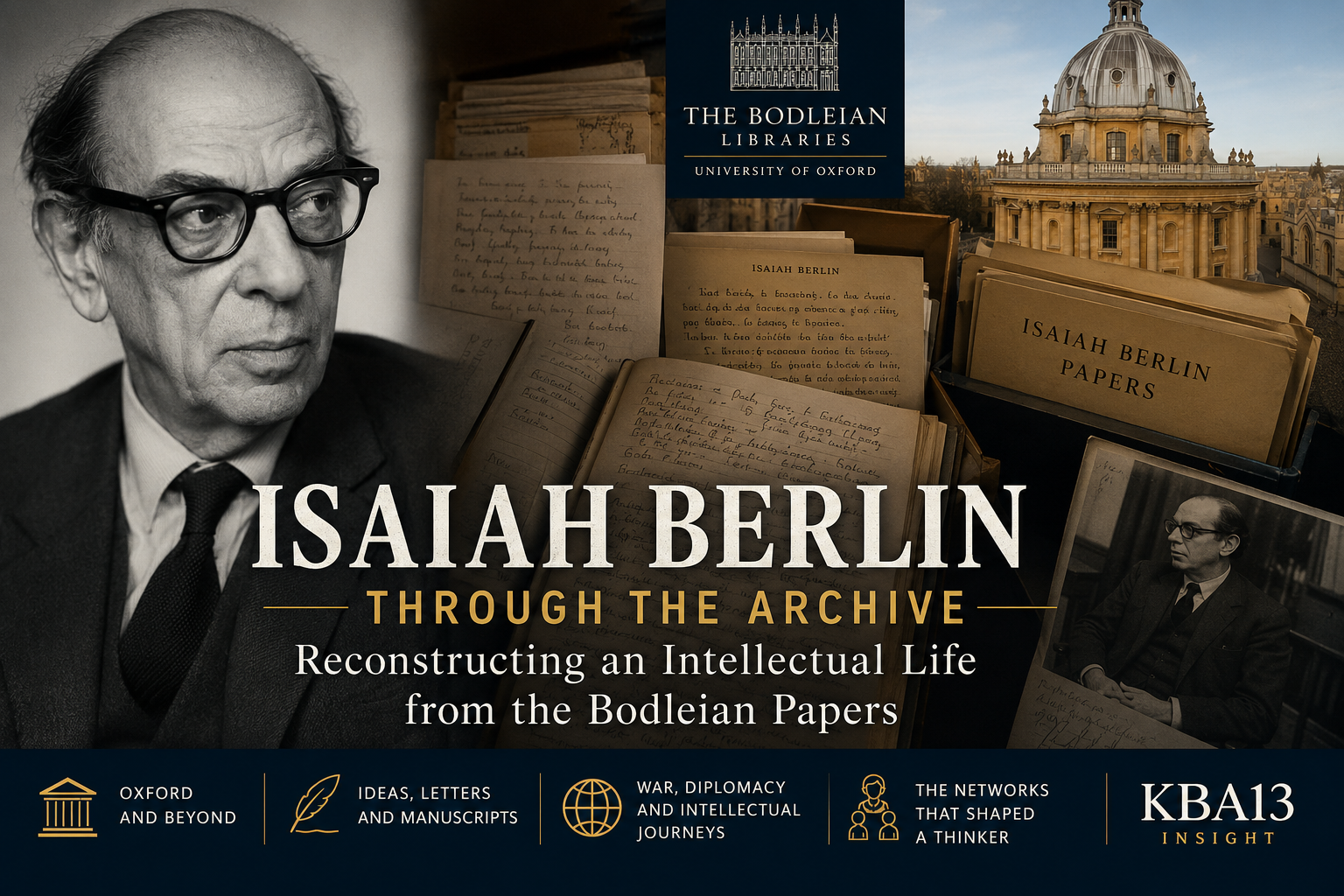
The Berlin Papers illustrate this problem with exceptional clarity. The collection extends across more than sixty-one linear meters, encompassing 826 shelfmarks accumulated over approximately seventy years of intellectual activity. Such figures are impressive, but their real significance lies elsewhere. The archive documents almost every sphere in which Berlin operated. Oxford appears alongside Washington. Academic philosophy appears beside wartime intelligence reporting. Russian literature sits next to administrative correspondence from Wolfson College. Zionist leaders appear in the same documentary universe as British prime ministers, American diplomats, literary critics, composers, and historians. The archive refuses the neat disciplinary boundaries that later scholarship often imposes upon Berlin.
One quickly discovers that correspondence dominates this documentary landscape. That fact deserves more attention than it usually receives. Modern intellectual history often privileges books because books survive in libraries and enter university curricula. Letters rarely enjoy the same status, despite revealing the circumstances under which books were conceived. Berlin’s correspondence demonstrates that ideas seldom emerged in isolation. Arguments developed through continuous exchanges with colleagues, students, publishers, diplomats, politicians, and friends. A philosophical position that eventually appeared under Berlin’s name often had a much longer documentary history dispersed across years of private communication. The archive, therefore, shifts attention away from authorship alone and toward intellectual interaction.
The diaries reinforce this interpretation. Berlin’s appointment books contain remarkably little introspection. Readers searching for confessional writing will probably be disappointed. Yet their apparent simplicity conceals extraordinary historical value. Meetings, journeys, lectures, dinners, conferences, and visits accumulate day after day until patterns begin to emerge. The diaries reconstruct geography before they reconstruct psychology. They show where Berlin traveled, whom he met, how frequently particular names reappeared, and how his professional obligations expanded over time. They reveal movement rather than meditation. For an intellectual historian, movement often proves more revealing because ideas frequently follow networks before they become texts.
Equally revealing is the coexistence of public and private documentation throughout the collection. Institutional papers record elections, appointments, fellowships, committee work, and administrative negotiations. Family correspondence records illness, bereavement, affection, financial concerns, and domestic routines. Research notes preserve conceptual development, while newspaper clippings preserve the external reception of Berlin’s work. None of these categories can be studied independently for very long. A promotion at Oxford influences research priorities. Wartime responsibilities interrupt academic writing. Family circumstances shape decisions about travel and institutional commitments. The archive quietly dissolves the distinction between private life and intellectual production because the documents themselves refuse to separate the two.
Perhaps the greatest contribution of the Bodleian collection lies in what it teaches about intellectual history as a discipline. Ideas do not descend fully formed into published books. They accumulate slowly through reading, correspondence, institutional service, travel, disagreement, revision, and historical experience. Archives preserve that accumulation with a precision unavailable elsewhere. Every draft records hesitation. Every correction preserves an abandoned formulation. Every letter captures a moment before later interpretations became fixed. Berlin’s philosophical legacy therefore resides not only in Two Concepts of Liberty, The Hedgehog and the Fox, or his celebrated essays on Russian thought. It also resides in the documentary sediment surrounding those works—the thousands of ordinary papers through which an intellectual life gradually assumed its final shape.
Oxford Did Not Produce Isaiah Berlin
Biographies often describe Oxford as the institution that produced Isaiah Berlin. The archive suggests a more complicated relationship. Oxford certainly provided the institutional setting within which Berlin matured as a scholar, but the documents indicate that Oxford also became one of the principal arenas in which Berlin continuously negotiated identity, authority, ambition, and intellectual independence. The university did not simply educate him. It became the environment against which his intellectual character was repeatedly tested. Every fellowship application, every letter of recommendation, every examination result, and every administrative decision preserved in the Bodleian collection records another stage in that long negotiation.
The documentary record from the late 1920s captures Berlin before its reputation transformed it into an international public intellectual. These papers possess a freshness largely absent from later correspondence. They preserve the concerns of an exceptionally gifted student whose future remained uncertain. Admission to Corpus Christi College, editorial responsibilities for The Pelican Record, examination performances, competition for prizes, and the pursuit of academic distinction appear not as inevitable milestones but as contingent achievements documented one letter at a time. Later generations remember Berlin as one of Oxford’s defining philosophers. The archive records a young scholar’s attempt to earn recognition in one of Europe’s most demanding academic environments.
Particularly revealing is the documentary trail surrounding Berlin’s election to All Souls College in 1932. Modern readers frequently encounter this appointment as a single sentence within biographies, usually presented as confirmation of extraordinary intellectual ability. The archival evidence restores the complexity behind that achievement. Correspondence exchanged before and after the election reveals not merely institutional procedure but the competitive culture of Oxford itself. Election to All Souls represented entry into one of Britain’s most influential intellectual communities, where scholarship, public service, and political influence intersected. For Berlin, the appointment marked far more than professional advancement. It provided permanent access to networks that would later extend across Whitehall, Washington, Harvard, Jerusalem, and the highest circles of European intellectual life.
Another feature emerges from these early documents with remarkable consistency. Berlin’s Oxford was never intellectually homogeneous. The correspondence introduces philosophers, historians, literary critics, economists, classicists, and public servants moving through overlapping circles rather than isolated disciplines. Figures such as A. J. Ayer, J. L. Austin, T. S. Eliot, Anthony Blunt, Bertrand Russell, and Adam von Trott appear not because the archive seeks to assemble a gallery of famous names but because they formed part of Berlin’s everyday intellectual environment. Oxford appears less as a university organized around departments than as a dense conversational network in which philosophical disagreements, literary interests, political anxieties, and personal friendships constantly crossed disciplinary boundaries.
These documents also complicate another persistent assumption. Berlin is often portrayed retrospectively as the philosopher of liberal pluralism, as though that intellectual identity had emerged early and developed along a predictable path. The archive refuses such simplicity. During the 1930s, Berlin devoted substantial energy to problems that later occupied only a marginal place in its public reputation. Correspondence concerning the preparation of Karl Marx, discussions about contemporary European politics, reflections on Palestine, exchanges with scholars across several disciplines, and the practical realities of academic life demonstrate an intellectual horizon considerably wider than the categories later attached to his name. Liberal pluralism had not yet crystallized into the organizing center of his philosophical work. The documentary record instead reveals an unusually curious scholar moving simultaneously through philosophy, history, literature, political thought, and international affairs.
Perhaps the most valuable lesson emerging from these Oxford papers concerns the relationship between institutions and intellectual creativity. Universities are often evaluated by counting publications, appointments, grants, or honors. The Berlin archive points toward a different measure. Oxford mattered because it concentrated extraordinary conversations within a relatively small social world. Letters travelled quickly between colleges. Ideas circulated through lunches, seminars, private rooms, committee meetings, and informal discussions long before they appeared in print. Berlin’s development, therefore, cannot be explained solely through the books he read or the lectures he delivered. It must also be understood through the lens of the institutional ecology that continuously exposed him to disagreement, criticism, collaboration, and friendship. The archive preserves that ecology with unusual clarity.
Reading these documents today produces an unexpected conclusion. Oxford did not manufacture Isaiah Berlin in the mechanical sense often implied by institutional history. The university supplied opportunities, traditions, and networks, but the archive shows something more demanding. Berlin learned how to occupy institutions without becoming intellectually confined by them. Throughout the surviving correspondence, the movement is always outward—from Oxford toward Europe, America, Russia, and eventually the wider world of twentieth-century political thought. That trajectory explains why Berlin remained recognizably an Oxford scholar while simultaneously becoming one of the twentieth century’s most cosmopolitan interpreters of ideas. The archive records the beginning of that transformation long before history recognized its significance.
War, Intelligence, and the Education of Political Judgment
The Second World War did not interrupt Isaiah Berlin’s intellectual development. It altered the conditions under which that development took place. Historians often separate Berlin into two distinct figures: the Oxford philosopher before the war and the liberal theorist who emerged afterward. The archival record makes that division increasingly difficult to sustain. The years spent in New York and Washington were not an interlude between academic appointments. They constituted one of the decisive periods in the formation of Berlin’s political judgment. The philosopher entered the war carrying an Oxford education in philosophy and history. The official who returned to Oxford had acquired an intimate knowledge of power, diplomacy, intelligence, propaganda, and political decision-making. Those experiences later reappeared, often indirectly, in his reflections on liberty, totalitarianism, nationalism, and historical contingency.
The correspondence from 1941 onward immediately changes the conventional image of Berlin. Instead of seminar rooms and college meetings, the archive introduces government departments, diplomatic missions, intelligence assessments, and trans-Atlantic communications. Berlin served within the British Information Services in New York and Washington, producing regular analyses of American political opinion during the most critical years of the war. These reports were not written for academic audiences. They were prepared for policymakers responsible for strategic decisions at the highest levels of the British government. Their readership reportedly extended to Winston Churchill and members of the War Cabinet. Such documents reveal Berlin performing a role fundamentally different from that of a university philosopher. His task was not conceptual clarification but political interpretation under conditions of uncertainty.
The archive also exposes the practical nature of wartime intelligence work. Intelligence rarely begins with secret operations. It begins with disciplined observation. Berlin’s reports required him to follow newspapers, political speeches, congressional debates, diplomatic conversations, elite opinion, public sentiment, and the changing relationships among American political actors. Every assessment demanded the ability to distinguish temporary political noise from structural developments that might influence Allied strategy. This discipline differs from philosophy in method, yet it shares an important characteristic with serious historical inquiry: both require sustained attention to evidence before interpretation. The documentary record, therefore, suggests that wartime service refined habits of judgment that later became visible throughout Berlin’s historical writings.
Another striking feature of the wartime correspondence is the extraordinary range of personalities entering Berlin’s documentary world. Letters involve diplomats, ministers, military officials, journalists, scholars, and political leaders rather than exclusively philosophers. Anthony Eden, Lord Halifax, Ernest Bevin, Chaim Weizmann, and numerous American officials appear throughout these papers, illustrating that Berlin occupied an unusual position between scholarship and government. He neither abandoned academic life nor became a conventional civil servant. Instead, he served as an interpreter, translating intellectual analysis into politically usable knowledge. That intermediary position would become one of the defining characteristics of his later public career.
One episode preserved within the archive deserves particular attention because it illustrates the unpredictability of historical experience. The correspondence records Berlin’s anticipated involvement with developments surrounding the Potsdam Conference, an opportunity that ultimately did not materialize. At first glance, such documentation appears incidental. In reality, it demonstrates how intellectual biographies are often shaped as much by unrealized possibilities as by celebrated achievements. Archives preserve these abandoned trajectories. They remind historians that careers do not unfold along predetermined paths. Every document concerning appointments declined, journeys canceled, or assignments altered reveals another version of history that never became visible in published memoirs.
The most consequential experience of this period, however, arrived only after the guns had largely fallen silent. Berlin’s official visit to the Soviet Union in 1945 introduced him to realities that no theoretical discussion of authoritarianism could adequately capture. The now-famous meeting with Anna Akhmatova has often taken on an almost mythical place in Berlin scholarship. Yet the archive encourages a more restrained interpretation. Its significance lies less in literary romance than in historical testimony. Berlin encountered an intellectual culture living under surveillance, censorship, fear, and political repression. Conversations with Akhmatova and subsequent references to Boris Pasternak and Lev Gumilev exposed the personal consequences of a political order in which independent thought had become inseparable from personal risk. These encounters transformed abstract questions about liberty into lived historical experience.
Reading these wartime papers as a whole produces a conclusion that extends beyond Berlin himself. Liberalism, in Berlin’s mature work, did not emerge from philosophical abstraction alone. It was informed by prolonged observation of governments at war, democratic politics under pressure, revolutionary regimes, nationalist aspirations, diplomatic negotiation, and the fragile condition of intellectual freedom. The Bodleian archive reveals that political judgment was not an appendix to Berlin’s philosophy. It was one of its principal sources. Long before Two Concepts of Liberty entered the canon of political thought, the habits of mind underlying that essay had already been forged through the daily practice of observing power, interpreting evidence, and confronting the historical consequences of ideological certainty.
The Network That Sustained Isaiah Berlin
Intellectual history often assigns excessive importance to originality while paying insufficient attention to relationships. Philosophers are frequently presented as solitary figures producing ideas in isolation, interrupted only occasionally by criticism or collaboration. The Bodleian archive dismantles that image almost immediately. Berlin’s papers reveal an intellectual whose life unfolded through an unusually dense web of correspondence stretching across universities, governments, publishing houses, diplomatic circles, literary communities, and cultural institutions. Reading the archive, therefore, requires abandoning the familiar image of the isolated thinker. Berlin’s intellectual achievement emerged within a network that continually supplied information, criticism, opportunity, and historical experience. The archive records not simply one philosopher but an entire conversation that lasted more than half a century.
The scale of this documentary network is remarkable because it cuts across boundaries that modern academia usually keeps apart. Philosophers correspond with philosophers, diplomats with diplomats, historians with historians. Berlin moved comfortably among all of them. The same chronological sequence of correspondence introduces A. J. Ayer, Bertrand Russell, T. S. Eliot, George Kennan, Karl Popper, Raymond Aron, Chaim Weizmann, Winston Churchill, David Ben-Gurion, Gershom Scholem, and numerous figures whose influence extended well beyond academic philosophy. These names should not be read as evidence of Berlin’s prestige alone. They indicate the extraordinary diversity of environments within which his political judgment evolved. The archive documents continuous movement between philosophical debate, diplomatic analysis, literary criticism, and geopolitical observation without treating them as separate intellectual worlds.
Among these relationships, George Kennan occupies a particularly significant place. Both men devoted sustained attention to Russia, yet they approached the subject from different professional traditions. Kennan analyzed the Soviet Union as a diplomat and strategist responsible for American foreign policy. Berlin approached the same civilization as a historian of ideas deeply familiar with Russian literature, intellectual history, and revolutionary thought. Their correspondence illustrates an encounter between strategic analysis and historical interpretation rather than a simple exchange between friends. The dialogue reminds us that understanding political systems requires more than institutional knowledge. It demands familiarity with the historical imagination from which those systems emerge. The archive preserves that dialogue in a form unavailable through either man’s published writings alone.
An equally revealing relationship developed with Chaim Weizmann and later with David Ben-Gurion. Historians frequently classify Berlin as a liberal philosopher who happened to sympathise with Zionism. The documentary evidence suggests something more substantial. Zionism appears throughout the correspondence not as an occasional political interest but as a recurring historical concern connecting questions of identity, nationhood, minority existence, exile, and political responsibility. Berlin’s exchanges with leading Israeli figures reveal sustained engagement with the practical dilemmas facing the emerging state rather than abstract reflection on nationalism alone. These letters place him within one of the twentieth century’s defining political transformations while simultaneously demonstrating his reluctance to reduce complex historical realities to ideological formulas.
The literary correspondence introduces another dimension often overshadowed by Berlin’s philosophical reputation. Exchanges involving T. S. Eliot, Edmund Wilson, Anna Akhmatova, Boris Pasternak, and other literary figures reveal that literature occupied a central rather than peripheral place within Berlin’s intellectual world. Russian novels, poetry, memoirs, and historical writing repeatedly entered conversations about politics and moral choice. Berlin never accepted the rigid separation between literature and political thought that later academic specialization frequently imposed. The archive instead demonstrates how literary experience informed historical understanding, particularly when confronting questions of tyranny, memory, individuality, and moral responsibility. Russian poetry sometimes communicated political reality more accurately than official political documents, and Berlin appears to have understood that distinction with unusual clarity.
Perhaps the most striking characteristic of this network is its geographical reach. Oxford remained Berlin’s institutional home, but the documentary record rarely remains confined there for long. Washington, New York, Jerusalem, Moscow, Leningrad, Paris, Harvard, and numerous European capitals repeatedly enter the correspondence. These locations represent far more than travel itineraries. They indicate successive centers of conversation through which Berlin accumulated comparative political experience. His intellectual universe, therefore, expanded through mobility rather than through abstract cosmopolitan ideals. Ideas traveled because people traveled. Correspondence maintained those movements across continents long before digital communication compressed distance into immediacy. The archive preserves an analogue map of twentieth-century intellectual circulation.
The cumulative effect of these relationships is perhaps the archive’s most important historical lesson. Berlin’s intellectual authority did not originate from possessing superior information or from allegiance to a single philosophical school. It emerged from continuous exposure to multiple traditions of thought, each capable of correcting the limitations of the others. Philosophers challenged diplomats. Historians corrected political theorists. Novelists revealed dimensions of human experience inaccessible to official reports. Statesmen confronted scholars with the constraints of political reality. The Bodleian Papers preserve this ongoing exchange with extraordinary richness. They suggest that Berlin’s greatest intellectual strength lay not in constructing a closed philosophical system but in sustaining an unusually wide conversation without allowing any single voice to become intellectually absolute. That habit of listening across traditions may ultimately explain why his reflections on liberty, pluralism, and political judgment continue to resist the dogmatism they were written to oppose.
The Archive of Ideas: Reconstructing How Isaiah Berlin Thought
Most readers encounter Isaiah Berlin through finished texts. Two Concepts of Liberty, The Hedgehog and the Fox, Historical Inevitability, and his essays on Vico, Herder, Herzen, or the Russian intelligentsia have become canonical works in the history of political thought. Canonical texts, however, possess an unintended consequence. They create the illusion that ideas arrive fully formed, carefully organised, and intellectually complete. Publication conceals uncertainty. Revision disappears behind polished prose. Intellectual hesitation becomes invisible. The Bodleian archive overturns that illusion because it preserves Berlin before publication imposed coherence upon his thought. Instead of presenting conclusions, the archive preserves intellectual movement.
One of the greatest strengths of the collection lies in its preservation of successive stages of intellectual production. Published manuscripts appear alongside unpublished essays, lecture drafts, research notes, corrected proofs, and working papers accumulated over several decades. These materials make it possible to observe the evolution of arguments instead of merely analysing their final formulation. A concept that appears elegantly expressed in a published essay often originated in scattered reading notes, reappeared in lectures delivered years apart, and underwent repeated revision before assuming its familiar form. The archive therefore transforms the study of Berlin from textual interpretation into intellectual reconstruction. Rather than asking what Berlin argued, researchers can begin asking how particular arguments gradually emerged.
The research notes are especially revealing because they preserve Berlin’s habits of reading. Unlike systematic philosophers who sought deductive certainty, Berlin approached ideas historically. His notebooks indicate continuous engagement with authors separated by centuries, languages, and intellectual traditions. Russian thinkers appear beside Enlightenment philosophers, Romantic writers beside liberal theorists, historians beside poets. The pattern is difficult to mistake. Berlin rarely read individual books in isolation. He read intellectual traditions against one another. Concepts developed through comparison rather than through deduction. The archive consequently demonstrates that Berlin’s pluralism was not merely a philosophical doctrine. It was already embedded within his method of reading long before it appeared as an explicit political argument.
The unpublished manuscripts deepen this impression. Every archive contains abandoned projects, incomplete essays, unrealised lectures, and arguments that never reached publication. These materials are often dismissed as peripheral because they lack the authority of completed works. Such a distinction underestimates their historical value. An unfinished manuscript frequently reveals more about an intellectual than a celebrated publication. It exposes the problems that resisted resolution, the historical questions that remained open, and the conceptual tensions that publication eventually concealed. Berlin’s unpublished papers, therefore, deserve attention not because they supplement his bibliography, but because they illuminate the limits of his own intellectual certainty.
Perhaps nothing illustrates this better than the documentary history surrounding Berlin’s lectures. His public lectures were never simple performances delivered from completed scripts. The archive preserves evidence of continuous refinement. Reading notes became lecture outlines, which expanded into drafts. Drafts generated correspondence, which produced revisions. Some lectures eventually evolved into published essays, while others remained confined to archival form. The famous texts remembered today represent only one stage within a much longer process of intellectual labor. Their authority rested not upon spontaneous brilliance but upon years of accumulation, correction, and reconsideration. The archive quietly dismantles the romantic image of philosophical inspiration by replacing it with documentary evidence of disciplined craftsmanship.
This documentary process also challenges another widespread misconception. Berlin has often been described as an essayist rather than a systematic philosopher, sometimes with the implication that his work lacks conceptual architecture. The archival evidence suggests a different interpretation. Berlin certainly resisted constructing comprehensive philosophical systems, but resistance to systems should not be mistaken for absence of structure. His papers reveal remarkable continuity in the historical questions that occupied him across decades: liberty and coercion, moral conflict, nationalism, historical determinism, Romanticism, the Russian intelligentsia, and the diversity of human values. Individual essays may appear independent, yet the archive demonstrates that they belonged to a sustained investigation extending across an entire lifetime. The coherence lies not in formal system-building but in the persistence of recurring historical problems.
For historians of ideas, the significance of the Bodleian archive extends well beyond Isaiah Berlin himself. The collection demonstrates that intellectual history cannot be reconstructed solely from published books. Books preserve arguments after they have reached relative stability. Archives preserve the instability from which those arguments emerged. Every correction in the margin records a rejected possibility. Every unfinished draft preserves an alternative direction never pursued. Every research notebook captures a moment before interpretation solidified into doctrine. The Berlin Papers, therefore, invite scholars to rethink the very object of intellectual history. Ideas should not be studied only as texts. They should also be studied as processes whose documentary traces survive long before publication transforms them into philosophical monuments.
Three Civilizations, One Intellectual Life
Isaiah Berlin once described his own life as being shaped by three enduring allegiances: Russia, Britain, and Judaism. The statement has often been quoted because of its autobiographical elegance, yet the Bodleian archive reveals that it should not be read merely as a personal reflection. It provides a key to understanding the internal architecture of Berlin’s intellectual world. The documentary record repeatedly returns to these three civilizational spheres—not as isolated identities competing for dominance, but as historical traditions that continuously interacted throughout his life. The archive demonstrates that Berlin did not move from one civilization into another. Instead, he spent his entire career negotiating among all three simultaneously.
Russia remained the deepest historical memory within Berlin’s intellectual imagination. Although he left the Russian Empire as a child after his family emigrated to Britain in 1921, the documentary evidence makes clear that departure never became intellectual separation. Russian history, literature, philosophy, and revolutionary politics continued to occupy his attention until the end of his life. Research notes, correspondence, lecture manuscripts, newspaper clippings, and unpublished essays repeatedly returned to figures such as Herzen, Belinsky, Turgenev, Bakunin, and later Anna Akhmatova and Boris Pasternak. These were not simply historical interests. They formed Berlin’s laboratory for understanding the relationship between ideas and political catastrophe. Russia became the place where philosophical doctrines repeatedly collided with historical reality.
This persistent engagement explains why Berlin never approached Soviet communism merely as a geopolitical problem. Many Cold War analysts studied the Soviet Union through military capability, diplomatic behavior, or ideological competition. Berlin approached the Soviet experience differently. His concern lay with the destruction of intellectual freedom inside a civilization whose literary and philosophical traditions he deeply admired. The archival references to Akhmatova, Pasternak, Lev Gumilev, and numerous Russian intellectuals demonstrate that Berlin interpreted Soviet authoritarianism not only as political repression but also as the systematic narrowing of cultural and moral imagination. For him, tyranny did not merely imprison individuals. It impoverished civilization itself.
Britain supplied an entirely different intellectual discipline. If Russia gave Berlin historical memory, Britain provided constitutional restraint. The archive records his gradual integration into British academic and public life through Oxford colleges, wartime government service, learned societies, broadcasting institutions, and eventually the honours of the British state. Yet these documents also reveal that Berlin never became intellectually provincial. British liberalism attracted him less because of national identity than because it represented a political tradition suspicious of absolute power. Parliamentary government, constitutional continuity, institutional moderation, and respect for disagreement formed an environment in which Berlin’s historical sensibilities could develop without requiring ideological conformity. His attachment was therefore directed not toward nationalism but toward a political culture that had learned, often imperfectly, to accommodate plurality.
The Jewish dimension of Berlin’s life introduces a third historical horizon that cannot be reduced either to religion or to nationalism. Correspondence with Chaim Weizmann, David Ben-Gurion, Gershom Scholem, and numerous Jewish organisations demonstrates sustained engagement with questions surrounding exile, minority existence, historical survival, and the creation of Israel. These documents reveal a thinker deeply committed to Jewish historical continuity while remaining cautious of political absolutism in all its forms. The archive therefore complicates simplistic attempts to classify Berlin either as a detached liberal universalist or as a political Zionist. His documentary legacy suggests a more demanding position: a scholar attempting to reconcile universal political principles with the historical experiences of a people whose existence had long been defined by displacement and vulnerability.
The importance of these three civilizational strands extends far beyond biography. They explain the distinctive character of Berlin’s political philosophy. Few twentieth-century thinkers experienced revolutionary Russia, constitutional Britain, and Jewish historical consciousness with equal intimacy. Each tradition exposed him to different understandings of authority, freedom, identity, and historical change. Rather than allowing one experience to dominate the others, Berlin continually placed them in conversation. This comparative habit became one of the defining characteristics of his scholarship. His celebrated defense of value pluralism did not emerge from abstract conceptual analysis alone. It reflected a lifetime spent observing civilizations that embodied fundamentally different historical experiences while refusing to collapse them into a single explanatory framework.
The Bodleian archive ultimately transforms Berlin’s autobiographical statement into a broader methodological insight. Civilizations should not be understood as fixed identities carried unchanged throughout life. They become intellectual resources through which individuals interpret historical experience. Berlin’s papers show this process unfolding across more than seven decades. Russia preserved historical memory; Britain cultivated institutional judgment; Jewish civilization sustained questions of identity, exile, and moral responsibility. Together they formed the intellectual terrain upon which Berlin confronted the central political problem of the twentieth century: how radically different visions of human life can coexist without demanding the destruction of one another. The archive preserves that lifelong negotiation with extraordinary clarity, reminding historians that the deepest philosophical commitments often originate not in abstract systems but in the accumulated experiences of several civilizations inhabiting a single mind.
The Politics of Preservation: Why Oxford Keeps Intellectual Memory Alive
The Bodleian archive tells two histories simultaneously. One is the history of Isaiah Berlin. The other is the history of a civilization that decided an intellectual life deserved systematic preservation. Historians often concentrate on the first and overlook the second. Yet the existence of the archive is itself a political and cultural achievement. No archive appears naturally. Every collection survives because institutions allocate space, funding, professional expertise, cataloguing systems, conservation laboratories, legal frameworks, and long-term commitments extending far beyond the lifetime of the individual whose papers they preserve. The Berlin Papers therefore document not only one philosopher but also the institutional maturity of a civilization that understands knowledge as a form of cultural inheritance rather than a temporary academic product.
This observation becomes more significant when placed within the broader history of universities. Most universities celebrate distinguished scholars while those scholars are alive. Portraits are commissioned, honorary lectures are established, buildings receive commemorative names, and obituaries acknowledge intellectual achievements. Much less attention is devoted to preserving the documentary conditions that made those achievements possible. Oxford followed a different path. Instead of protecting only Berlin’s published reputation, the Bodleian preserved the evidence from which future generations could reconstruct that reputation independently. Letters, appointment diaries, unpublished drafts, financial papers, administrative correspondence, family records, lecture notes, and research materials all became part of the historical record. Such preservation reflects confidence that future scholars should not merely inherit conclusions. They should also inherit the evidence.
The labour invested in transforming Berlin’s papers into a usable archive deserves attention in its own right. Following Berlin’s death, the collection consisted of hundreds of unsorted boxes gathered from several locations. Nothing about that accumulation automatically resembled an archive. Professional archivists spent years identifying documents, reconstructing chronology, assigning shelfmarks, describing contents, establishing metadata, and creating a catalogue capable of supporting future scholarship. What researchers now consult with apparent ease is the product of sustained intellectual labour that usually remains invisible. Cataloguing is not clerical work. It is an interpretive discipline. Every archival description determines how future historians will discover relationships among documents and formulate new historical questions.
The contrast with many parts of the contemporary academic world is striking. Universities frequently measure excellence through publication counts, citation indexes, journal rankings, research grants, and institutional visibility. These indicators evaluate productivity but rarely address preservation. Once articles appear in print and administrative service concludes, the documentary traces of intellectual life often disperse into private offices, personal computers, family homes, or institutional storerooms before gradually disappearing altogether. Future historians inherit publications but lose the documentary ecology that explains how those publications came into existence. The result is a historical landscape dominated by finished texts but impoverished in evidence concerning the production of knowledge itself.
This difference is especially visible outside the major archival traditions of Europe and North America. Across much of Asia, Africa, and the Muslim world, distinguished scholars have undoubtedly produced works of lasting significance, yet relatively few have left behind documentary collections preserved with comparable institutional commitment. Correspondence disappears after retirement. Research notebooks remain in private possession. Administrative files are discarded during office relocations. Family papers receive little professional conservation. Even when important manuscripts survive, they often remain uncatalogued and therefore effectively inaccessible. The consequence is profound. Historians attempting to reconstruct intellectual history encounter publications without processes, conclusions without development, and reputations without documentary foundations.
The Berlin Papers, therefore, raise a larger civilizational question. What exactly does a society believe it is preserving when it establishes an archive of this magnitude? The answer cannot simply be paper. Paper deteriorates. Information can be digitized. What is actually being preserved is the continuity of inquiry. Every generation receives the opportunity to reopen old questions using original evidence rather than inherited interpretations. The archive protects disagreement as much as agreement because future scholars remain free to challenge established biographies, reinterpret correspondence, reconstruct forgotten networks, and discover intellectual trajectories overlooked by earlier researchers. Preservation thus becomes an investment in future scholarship rather than an act of memorialization.
For that reason, the Bodleian collection should be understood as more than the documentary afterlife of Isaiah Berlin. It represents an institutional philosophy of knowledge. Oxford preserved not only a philosopher but also the possibility that future historians might write a better history than the present generation. Few academic traditions demonstrate such confidence in the open-ended nature of historical inquiry. The Berlin Papers remind us that civilizations are remembered not only through the books they produce but also through the archives they choose to protect. In the long history of ideas, preservation is never an administrative detail. It is itself one of the highest expressions of intellectual civilization.
Beyond Biography: What the Berlin Papers Teach Intellectual History
The Bodleian archive ultimately asks a question that extends far beyond Isaiah Berlin. What exactly should intellectual historians study? For much of the twentieth century, the discipline concentrated overwhelmingly on published texts. Historians reconstructed traditions by reading books, essays, manifestos, and philosophical treatises. Intellectual influence was measured through publication, translation, citation, and reception. This approach produced an impressive body of scholarship, but it also established an implicit assumption: that intellectual history begins when ideas enter print. The Berlin Papers suggest that assumption deserves reconsideration. Ideas do not begin as books. They begin as conversations, correspondence, reading habits, marginal notes, institutional obligations, unfinished lectures, and repeated revisions accumulated over decades. Publication records only one stage within a much longer intellectual process.
This distinction changes the historical object itself. A published book presents intellectual certainty. An archive preserves intellectual formation. The difference is not merely chronological. It is methodological. Books privilege conclusions because readers expect coherence from published arguments. Archives preserve uncertainty because uncertainty is the ordinary condition of serious thinking. Drafts contain rejected paragraphs. Letters record disagreement before consensus emerged. Research notes reveal questions that never found satisfactory answers. Administrative documents expose practical constraints shaping intellectual production. Taken together, these materials reveal not simply what a thinker believed, but how belief itself gradually acquired form. Intellectual history therefore becomes less concerned with doctrines than with processes of intellectual construction.
Berlin’s archive illustrates this transformation with unusual clarity because no single document explains his philosophy. The archive resists reduction to one decisive manuscript or one defining correspondence. Instead, understanding emerges through accumulation. Diaries establish movement across places and institutions. Family papers preserve emotional continuity beneath public achievement. Wartime correspondence introduces the realities of diplomacy and intelligence. Research notebooks expose long-term reading practices. Lecture drafts document conceptual refinement. Published essays represent only the visible culmination of documentary processes unfolding across several decades. No individual component possesses complete explanatory power. The historical argument arises from their interaction.
This insight carries broader implications for the history of political thought. Political ideas are frequently analysed as abstract propositions detached from the historical circumstances that produced them. The Berlin Papers encourage a different approach. Concepts such as liberty, pluralism, nationalism, historical inevitability, or political judgment did not emerge within philosophical isolation. They evolved through encounters with revolutions, wars, diplomatic negotiations, authoritarian regimes, universities, literary traditions, religious identities, and transnational intellectual networks. The archive restores those encounters to the centre of analysis. Political philosophy becomes inseparable from historical experience because the documentary evidence refuses to separate them.
The implications extend beyond Isaiah Berlin and beyond Oxford. Every civilization produces scholars, philosophers, historians, jurists, and public intellectuals. Far fewer civilizations preserve the documentary environments that allow later generations to reconstruct how those intellectuals actually worked. This distinction matters because civilizations are remembered not only through the ideas they produced but also through the evidence they chose to preserve. When archives disappear, intellectual history becomes increasingly dependent upon published texts, institutional memory, and retrospective interpretation. The internal mechanics of knowledge production gradually vanish from historical view. Future scholars inherit conclusions while losing access to the intellectual labor that generated them.
The Berlin Papers, therefore, offer an important methodological lesson for universities, libraries, and research institutions far beyond Britain. Preserving intellectual heritage should not end with collecting books. It requires preserving correspondence, research notebooks, lecture drafts, editorial exchanges, institutional records, digital files, field notes, and the ordinary documents through which scholarship is actually produced. The future of the history of ideas will increasingly depend on such documentary ecosystems. Without them, intellectual biography risks becoming commemorative rather than analytical, while intellectual history becomes textual rather than archival.
For that reason, the greatest significance of the Bodleian collection may not lie solely in what it teaches about Isaiah Berlin. Its enduring contribution lies in demonstrating that an intellectual life can be reconstructed with extraordinary precision when documentary evidence survives in sufficient depth and institutional order. The archive transforms biography into historical inquiry, correspondence into evidence, and ordinary documents into witnesses of intellectual formation. Long after individual books have entered the canon of political thought, the archive continues asking more demanding questions than the books themselves can answer. It reminds historians that ideas possess histories before they possess titles, and that the deepest history of thought often survives not in the library catalogue but in the archival box waiting to be opened.
About The Author

Kamaruzzaman Bustamam Ahmad
Prof. Kamaruzzaman Bustamam Ahmad (KBA) has followed his curiosity throughout life, which has carried him into the fields of Sociology of Anthropology of Religion in Southeast Asia, Islamic Studies, Sufism, Cosmology, and Security, Geostrategy, Terrorism, and Geopolitics. Prof. KBA is the author of over 30 books and 50 academic and professional journal articles and book chapters. His academic training is in social anthropology at La Trobe University, Islamic Political Science at the University of Malaya, and Islamic Legal Studies at UIN Sunan Kalijaga Yogyakarta. He received many fellowships: Asian Public Intellectual (The Nippon Foundation), IVLP (American Government), Young Muslim Intellectual (Japan Foundation), and Islamic Studies from Within (Rockefeller Foundation).
Artikel Terkait
 The Tragedy of Certainty Isaiah Berlin Karl Marx
 Isaiah Berlin and the Defense of the Human World: Why His Ideas Matter Today
 Romantisisme Jerman dan Krisis Kesadaran Rusia: Memahami Russian Thinkers Karya Isaiah Berlin
 Helvétius dan Godaan Tirani yang Berniat Baik: Membaca Karya Isaiah Berlin tentang Bahaya Utilitarianisme Radikal
 Acehnology as an Intellectual Journey: Aceh, Islam, Southeast Asia, and the Malay World
Leave a Reply