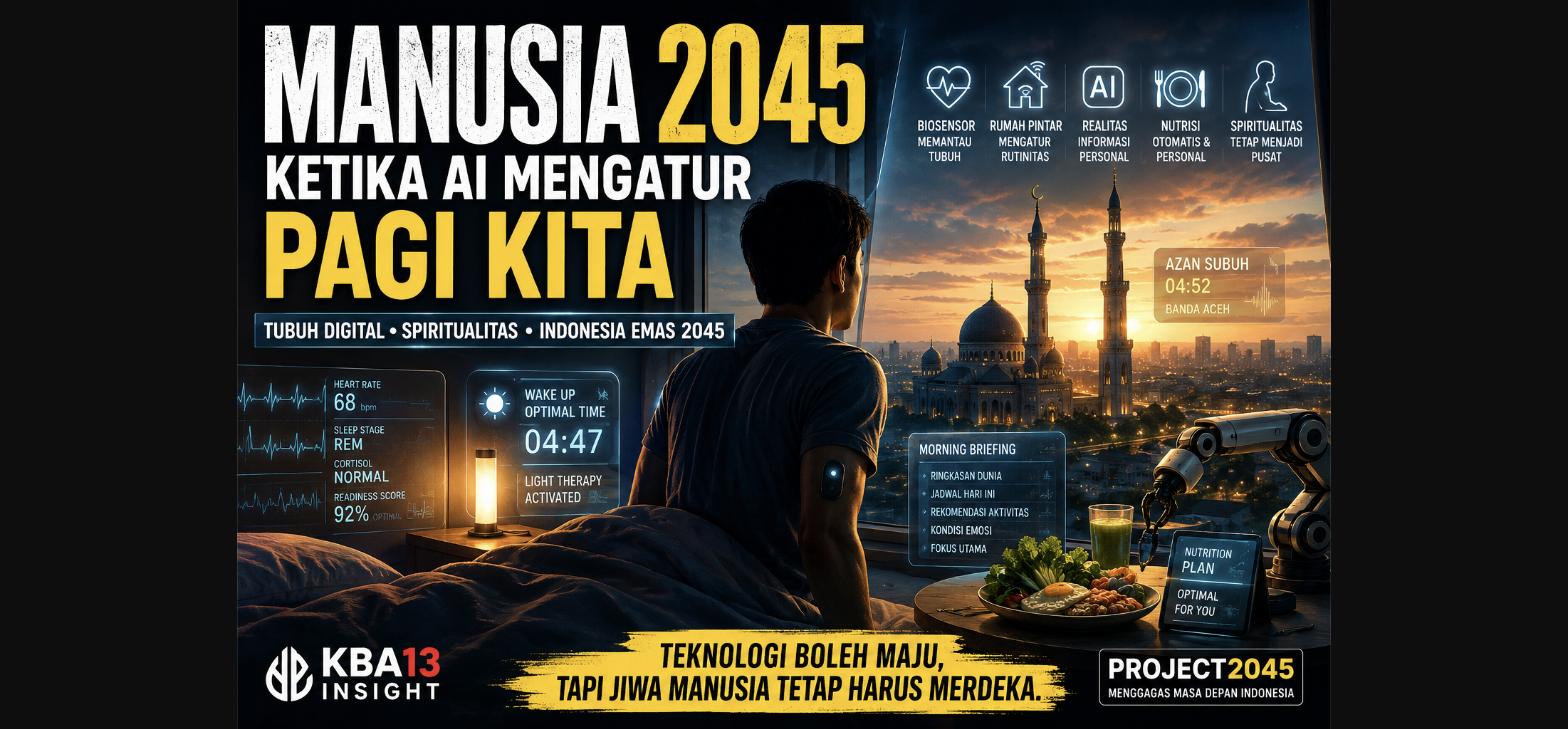
HUMAN BEINGS 2045 — When AI Governs Our Mornings
4:47 a.m.
Before my eyes were truly open, before my consciousness had fully surfaced from sleep, something was already at work. The sensor in my mattress — thin as paper, imperceptible — had been recording my heart rhythm since midnight. It knew when my sleep entered the REM phase. It knew when my breathing changed, when my body began drifting slowly toward the surface of awareness. And because it knew all of this, it decided — not I — that this was the right moment to wake me.
Not an alarm. No harsh sound forcing the soul brutally back into the body, the way we did to ourselves for centuries. There was only light. A bluish-white light that slowly filled the room, mimicking dawn — an artificial dawn, a dawn set by the system, not by the turning of the earth.
I lay still for a moment. And in the silence of those first three minutes of the day, I asked myself a question that has often troubled me lately: Is this morning mine, or does it belong to the system that designed it for me?
A Body That Is No Longer Alone
This is not science fiction. In 2045, the human body — at least for those with access to the digital health ecosystem — no longer moves on its own. It moves within a network.
Biosensors embedded beneath the skin of the wrist, or worn as a patch on the chest, continuously transmit data to a personal health AI: blood glucose levels, heart-rate variability, oxygen saturation, cortisol — the stress hormone — that begins to rise even before we consciously feel any pressure at all. This system does not wait for you to fall ill before acting. It detects patterns leading toward disease two or three weeks before the first symptom appears.
On the surface, this sounds like good news. And indeed, statistically, deaths from cancer, diabetes, and cardiovascular disease have fallen dramatically over the last two decades. Life expectancy in countries that have adopted this ecosystem has surged past 85 years on average.
But something has been lost along the way, and we rarely want to talk about it.
Once, the morning was a private negotiation between a person and their body. You woke with a sore back, and it was a signal you interpreted yourself: perhaps I sat too much yesterday, perhaps age is beginning to speak, perhaps I need more rest. There was an inner conversation. There was a self-awareness trained a little more each day.
In 2045, that negotiation has already been carried out by the system before you even have a chance to begin it. The sore back has already been logged, analyzed, and folded into the morning-exercise recommendation that will appear on the bathroom screen. Even hunger is anticipated — the smart kitchen has already prepared a combination of foods calculated from last night’s biometric data, the nutrients your body needs today, and a prediction of the physical activity you will undertake until evening.
Your body is perfectly maintained.
But do you still know your own body?
The Morning Briefing: When the World Is Summarized Before You Can Even Ask
As I stand before the bathroom mirror — a mirror that is also a screen, also a camera, also a sensor — the morning summary has already begun.
Not the news. Not in the old sense. What appears is a personal narrative assembled by my private AI based on my interest profile, today’s schedule, developments in the world relevant to my work and family, and — this is what unsettles me most — what the system predicts will most affect my mood emotionally today.
The armed conflict in the South China Sea region that has been raging for three days? The system decided not to show it at the start, because, based on my history of emotional responses, heavy geopolitical news in the morning tends to lower my productivity by 12%. It will show it later, after breakfast, in a format that has already been “moderated” — my own words, not the system’s, though I know that terminology no longer means what it once did.
I pause here for a while.
There is something we must admit: we are living in an era in which the reality we consume each morning has been personalized to a degree without precedent in human history. The newspaper was once a single product for millions of readers. Social media began that personalization, and we have already seen its effects — polarization, information bubbles, the erosion of a shared public space. But what happens in 2045 goes far beyond that.
In 2045, every human being potentially lives inside an entirely unique information reality — composed especially for them, based on data they will never fully see, by algorithms they will never fully understand.
The question is no longer: is this news true?
The question becomes: do I still share the same reality as the fellow human beings around me?
The Dawn That Endures — and the One That Begins to Waver
In Banda Aceh, and across the Muslim world, the morning in 2045 still begins with the call to prayer.
But what kind of call to prayer?
In some mosques, the adhan is called by a human muezzin — a voice whose tremor cannot be imitated by a machine, one that carries in every note something that cannot be datafied: the fear of God, the longing, the humility of a servant aware of how small he is. In others — especially in large cities whose mosques are run by digital management systems — the adhan is called by an AI with a voice that is acoustically perfect, timed to the millisecond, and that never suffers a sore throat.
Which is better? I will not answer that question here. But I will admit that the question itself is a symptom of something larger — a crisis about what we consider sacred, and whether the sacred can survive in a world that leaves ever less room for human imperfection.
I prayed the Fajr prayer. On the same prayer mat I have used for decades — an old cloth, its colors faded, holding the creases of a thousand prostrations. In 2045, there are smart prayer mats that can guide your movements, detect whether your bowing is correct, even record your recitation and offer real-time corrections of your tajweed.
I do not use one.
Not because I am anti-technology. I am, in fact, someone who has long wrestled with the question of how Islam should respond to each wave of civilizational change. But there is something in me that refuses — firmly and without compromise — the idea that the most personal moment between a servant and his Lord must be optimized by software.
In prayer, imperfection is part of the humanity we bring before God. Forgetting a verse, a wandering mind, a weary body — all of these are the true human being. Not a user who wants to be upgraded.
Breakfast Without a Cook, Conversation Without a Pause
Breakfast in 2045 is a paradox.
The food is healthier than at any point in human history. The meat most people eat comes from cells cultured in a laboratory — proteinically identical to animal meat, but without bloodshed, without mass farming, without the same carbon footprint. Vegetables grow in vertical gardens inside city buildings, harvested at peak nutrition, delivered home within hours.
Physiologically, the human body in 2045 is better nourished than in any era before it.
But who cooks?
In millions of households, the honest answer is: no one. Or, more precisely, the automated kitchen — a combination of robotic arms, precision heaters, and an ingredient-management system — assembles the meal from an AI-customized recipe. Clean, efficient, perfectly nutritious.
And also cold. Not in the sense of temperature, but in a sense harder to explain.
I remember my late mother in Aceh. The way her wrinkled hands stirred chicken porridge in the small hours, the way she added a little more ginger because “the children need warmth inside” — a sentence with no basis in modern nutritional science, yet containing something far deeper than calories and macronutrients. It was knowledge passed down through the hands, through attention, through love expressed in small, repeated acts.
That knowledge cannot be uploaded to the cloud. It cannot be replicated by a machine. And in 2045, it grows ever rarer, ever more expensive — not in money, but in time and in choice.
At the dining table, the children eat breakfast while part of their attention drifts to the holographic interface floating before their eyes — a review of lessons, conversations with friends in various cities, or simply an endless stream of content. Technically, they are at the same table. Experientially, they are in different places.
This is nothing new — we have seen its seeds since smartphones first arrived at the dining table two decades ago. In 2045, that seed has grown into an enormous tree, with deep roots, and pruning it takes more than good intentions.
The Most Frightening Thing About Mornings in 2045
It is not the robots walking the streets. Not the artificial intelligence writing the news. Not even the reality that many old jobs have vanished.
The most frightening thing is this: human beings in 2045 are in danger of losing the capacity to be bored.
It sounds trivial. But let me explain why it is not trivial at all.
Boredom — the discomfort that arises when nothing stimulates our minds — is one of the most productive psychological states in human history. From boredom, creativity is born. From emptiness, questions arise. From silence comes the voice of conscience.
The Sufis knew this. The philosophers knew this. Even scientists knew this — many great breakthroughs in science happened not in the laboratory, but in the bath, in the garden, on a tedious journey.
In 2045, every crevice of boredom — a queue, a commute, a moment of waiting — has been filled by an endless system of entertainment and information. Lightweight wearable neural interfaces, or even embedded ones, ensure that the human brain is never truly idle.
And a brain that is never idle is a brain that never truly reflects.
This is a quiet loss, one that appears in no news report, that has no statistic on any economic-growth dashboard. But it erodes something fundamental: the human capacity to be fully present in a single moment, in a single place, with a single, whole consciousness.
Three Kinds of Human Being in the Morning of 2045
After years of observation, I see a clear pattern: in 2045, there are three distinct ways people begin their day.
First: The Fully Connected. Those who surrender their morning entirely to the system—waking to an algorithm, breakfasting on an AI recommendation, beginning the day with a pre-personalized briefing. Their productivity is high, their physical health excellent. But a question lurks behind that efficiency: Who is really living this life—them, or the system optimizing them?
Second: The Hybrid. Those who consciously take some of technology’s benefits and refuse others. Those who set “sacred “limits”—perhaps no screens before the Fajr prayer, perhaps breakfast with family without a digital interface, perhaps walking to the office deliberately choosing the slower, less efficient route because they want to feel the morning wind on their faces. This group must struggle every day against the current of a system designed to maximize their connectivity.
Third: The Forcibly Disconnected. Those who have no access to that expensive digital ecosystem. In developing countries, the gap between those with full connectivity and those still struggling with basic connectivity creates a new social stratum sharper than any conventional economic class. Theirs is not a choice to step back from technology — they are left behind because the system does not include them.
And it is here that the promise of a “Golden Indonesia 2045” is truly tested: not in GDP figures, but in the question — in which category will the majority of Indonesians find themselves on that morning in 2045?
A Personal Note from Someone Who Will Grow Old in 2045
If I am still alive in 2045, I will be more than seventy years old.
I do not know whether I will be fully connected, a hybrid, or disconnected. I do not know whether my body will be extended by biotechnology so that I can still walk well or whether I will be one of the millions of elderly who feel the saddest irony of this century: a longevity never seen before but also a loneliness never seen before.
What I do know is this: I want to keep the ability to choose how I begin my morning.
Not because I am romantic about inefficiency. Not because I do not believe in science. But because the way we begin the morning is the way we affirm who we are — not as a data point in a system, not as a user who needs optimizing, but as a human being who has a relationship with God, with oneself, with the people we love, and with the land on which we stand.
In Aceh, there is a saying I learned from my grandmother long ago: “Seumah bak uroe nyang ka trôh.” It means: “Welcome to the day that has arrived.”
Not: “Welcome to the day that has been designed for you.”
The difference between those two sentences is small in words, but very large in meaning. And there, I believe, lies one of the most important struggles of humankind in the twenty-first century: preserving the right to greet the day with our own voice.
“The best technology is not the one that removes life’s obstacles, but the one that expands our capacity to become more human. When it begins to replace that humanity itself, it ceases to be a tool and begins to become a master.”
— KBA
💬 A Question for Discussion
Imagine your morning in the year 2045. What is the one thing you most hope will stay the same as it is now — and the one thing you most hope will have changed? Write it in the comments. I truly want to know.
About The Author

Artikel Terkait
 Islam, Violence, and Acehnese Identity: A Socio-Historical Reading of Conflict, Faith, and the Idea of Musoh
 Can Aceh become a model for the development of a multicultural society in Indonesia?
 How is the Cultural Landscape of the Acehnese Society from the Cosmology side?
 Acehnology and the Social Sciences: Reclaiming Aceh’s Place in Knowledge
 Acehnology as an Intellectual Journey: Aceh, Islam, Southeast Asia, and the Malay World
Leave a Reply