2045 and the Explosion of Common Knowledge
In the framework introduced by Steven Pinker, common knowledge is not merely a fact known by many people, but a fact known together — known to be known together, and known that the knowledge itself is known, without a clear reflective limit. In the past, this condition was rare. It required rituals, symbols, or powerful public events: a declaration of war, a proclamation of independence, or a great scandal.
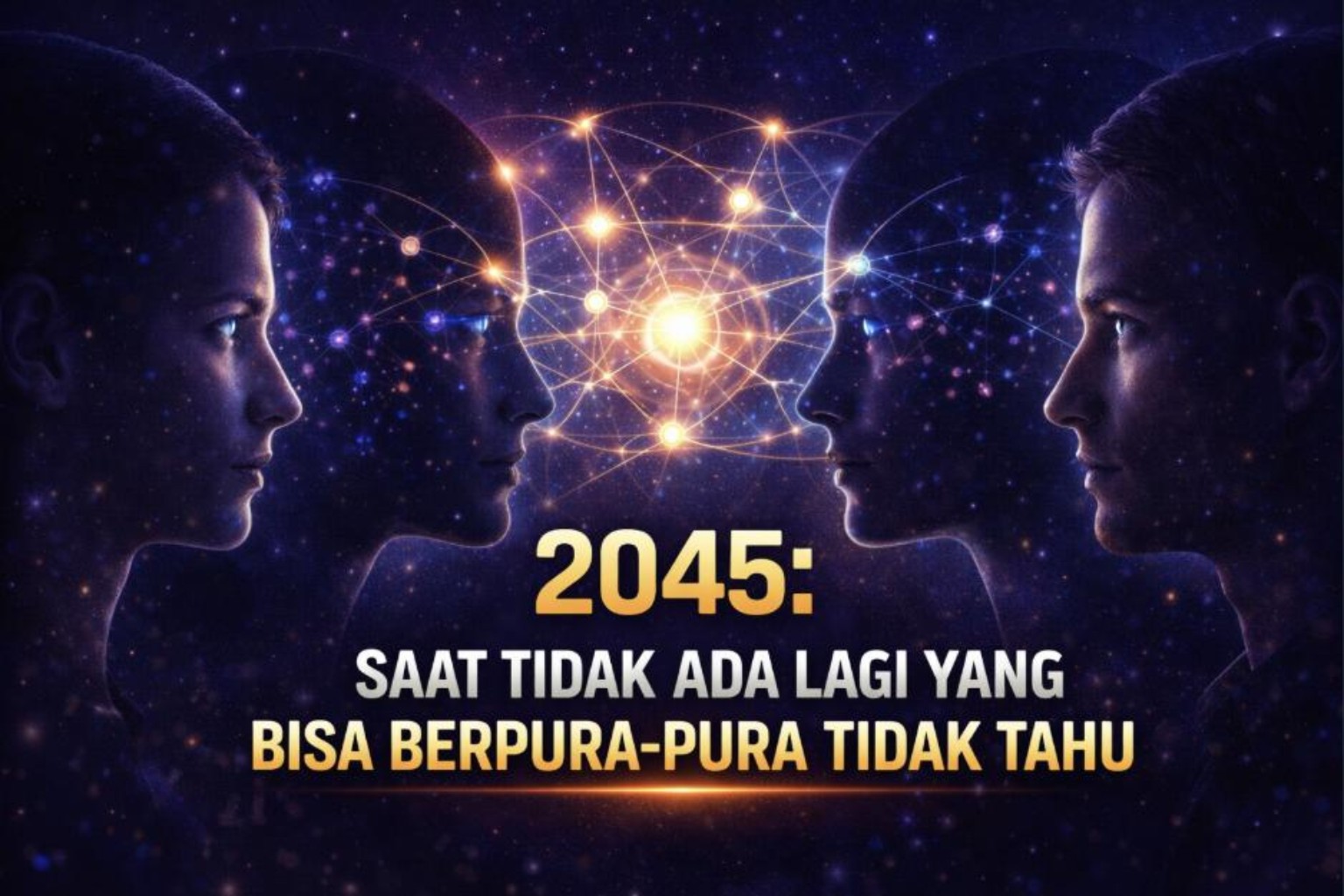
But in 2045, this structure changes radically. Digital Consciousness — through AI, sensor networks, big data, and predictive systems — erases the lag of knowledge. Information no longer moves from one consciousness to another; it emerges simultaneously in the space of collective consciousness. Humans live in a situation where nearly everything significant instantly becomes known, known to be known, and known that it is known by others.
What changes is not only the speed of information but its epistemic status. Once everyone knows that everyone knows, the social space for silence and pretense collapses.
Total Transparency and the Collapse of Social Pretense
For much of human history, social order rested on a subtle form of shared not-knowing: people did not fully know what was actually known in common, which left room for tact, face-saving, and “staying silent for the sake of harmony.” On 2045, this mechanism breaks down. When everyone knows that everyone knows, the room to “stay silent for harmony” narrows drastically. Digital Consciousness does not merely open up information; it exposes the very structure of pretense. Collective lies become fragile — not because they are refuted, but because they can no longer be denied.
Yet this transparency does not automatically give birth to moral honesty. On the contrary, it gives birth to a new psychological pressure. Humans no longer confront the truth alone, but the awareness that the truth is witnessed by another consciousness that is also aware of being witnessed. Social relations become endlessly reflective, exhausting, and often defensive.
Layered Consciousness and a New Psychological Burden
When a person knows that others know that they know, consciousness is no longer linear but layered. Every action is accompanied by a meta-cognitive calculation: how will my action be understood, how will my understanding of their understanding be understood in turn, and so on. In 2045, Digital Consciousness accelerates and expands these layers.
AI does not merely read behavior; it models shared expectations. It predicts not only what people will do, but what they believe about the beliefs of others. In this condition, human spontaneity is threatened by over-reflection. Life becomes an arena of perpetual impression management, in which every gesture is anticipated before it is made.
Politics, Morality, and the End of Strategic Ambiguity
In politics and public ethics, total common knowledge ends what was once called plausible deniability. States, institutions, and actors of power can no longer rely on the asynchrony of knowledge. When a policy is designed, all parties know that all parties know the motive behind it.
Yet a paradox emerges: rather than subsiding, conflict merely changes form. Conflict no longer revolves around “what happened,” but around how the shared fact should be interpreted. The struggle shifts from the domain of information to the domain of interpretation.
In this condition, public morality becomes fragile. When everyone knows that everyone knows of a certain violation, yet the system keeps running, humans face an existential dilemma: does shared knowledge still mean anything if it produces no change? The year 2045 reveals that common knowledge is no guarantee of justice, but a test of collective courage.
Humanity in a World Without Shared Ignorance
In the end, the deepest impact of a world where everyone knows that everyone knows lies not in technology but in the loss of shared ignorance as a social space. Throughout human history, many relationships have survived precisely because certain things were left unsaid, unconfirmed, mercifully unknown. When that space vanishes, humans live in a world too aware of itself.
The question is no longer whether humans possess information, but whether humans still possess room to be not entirely transparent without being deemed guilty. Here lies the greatest challenge of Digital Consciousness: not how it makes humans know everything, but whether humans can still live meaningfully when there is no longer any place to pretend not to know.
About The Author

Artikel Terkait
 Why Angels Might Be Jealous of Google: Spirituality, Search Engines, and the Digital Age
 Google and the New Theology of the Internet: Data, Power, AI, and the Crisis of Human Freedom
 Cryptocurrency and Human Behavior in Cyberspace: Trust, Risk, and Digital Tokens
 What Does TikTok Do to the Human Brain and Nerves? Side Effects Explained
 Artificial Intelligence and the World Order of 2040: A Strategic Essay on AI, Extraterrestrial Intelligence, and the Future of Humanity
Leave a Reply