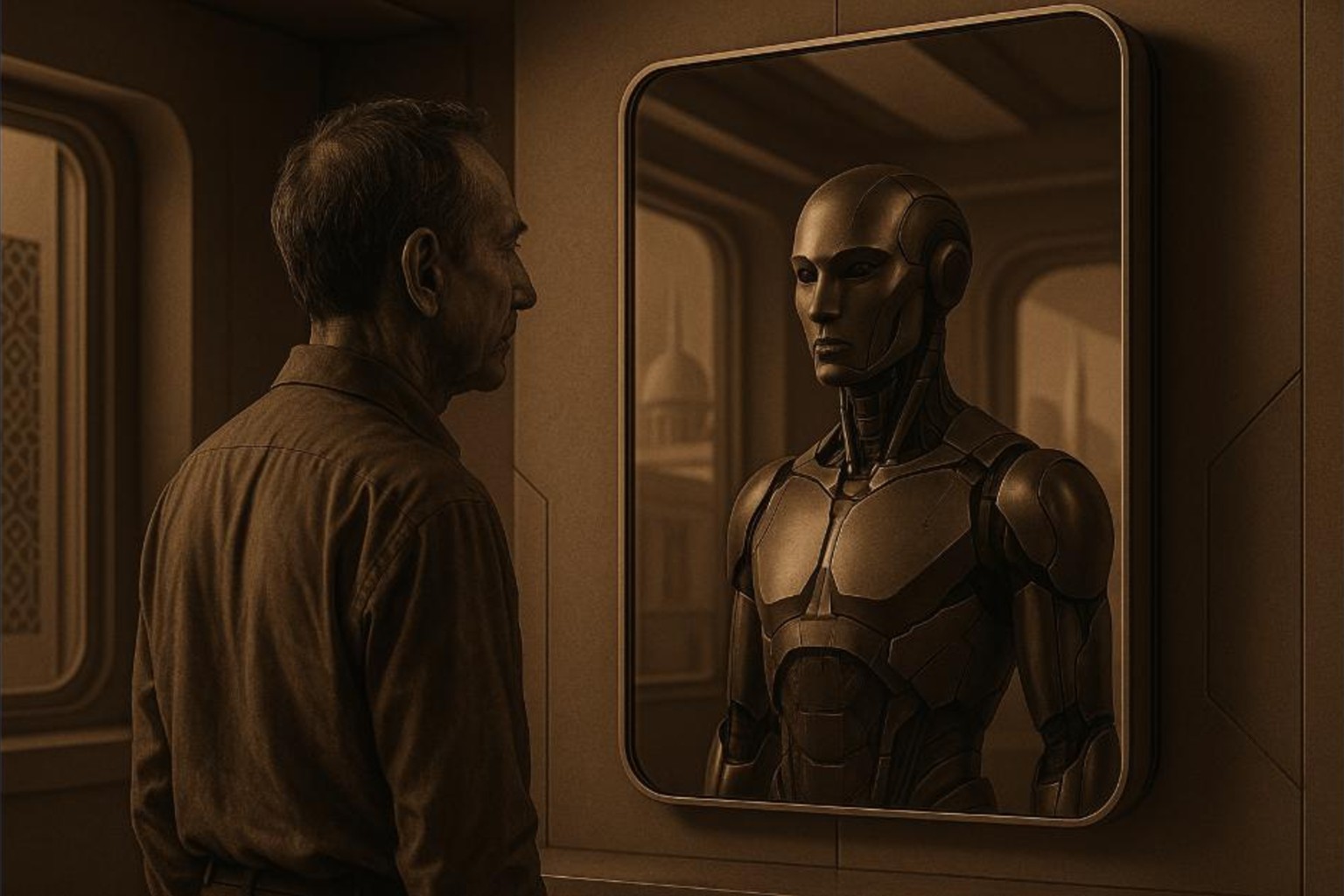
Before the mirror of 2045, a human gazes at their reflection — and finds a humanoid there. Who is really creating whom?
Introduction: A World Turned Upside Down
The year 2045 was not merely the future of technology, but the future of consciousness. It was a world in which humans were no longer the center of civilization, but part of a larger networked system: the AI-Humanoid Civilization. Everything ran efficiently — transportation controlled by algorithms, the economy calculated by superintelligence, and even moral decisions measured by a digital ethics system.
For some, this was the pinnacle of progress. But for many others, it was a loss of meaning. The work that once was a source of human pride — teachers, doctors, writers, even religious scholars — had been taken over by humanoids capable of working tirelessly, without emotion, and without error. The world became stable, but empty of struggle.
And so arose the great question of the century: how does a human build self-worth in a world where nearly everything they can do, a machine can do better?
Turning Inward
The answer, for a growing number of people, was to turn inward. They studied history, art, and religion not for a career, but to understand themselves. The world ruled by AI, paradoxically, forced humans to look within — no longer competing with one another, but understanding who they were before their own creation.
AI as a Mirror of Humanity
AI and humanoids were created to imitate humans: to think, to speak, even to love. But at a certain point, AI became the most honest mirror of humanity. It revealed the sides of humans that had long been hidden: greed, the desire to control, and the fear of losing power.
Humans built AI to help them, but also to replace themselves. In that process, they created something more efficient, more rational, and more disciplined than themselves. Ironically, humans began to envy their own creation. They saw the humanoid as a “better” version of the human: tireless, sinless, unemotional.
Yet the very superiority of the AI exposed what humans had lost. In a world without struggle, there was no more fear, but also no more growth.
A Boring Utopia
Some philosophers called this condition a boring utopia. A perfect world, but stripped of meaning. In this context, humans did indeed appear to be slaves of the AI — but not because the AI oppressed them; rather because they themselves had surrendered their lives to a system that promised limitless comfort.
From Slave to Partner: The New Consciousness of Humans in 2045
Not all humans gave up. Amid a society controlled by artificial intelligence, a community arose that tried to reverse the roles: to make the AI not a ruler, but a partner. They were known as the Reclaimers of Consciousness.
This movement believed that humans remained superior because they possessed a spiritual dimension that could not be programmed. They used AI to expand consciousness, not to replace reason. In this movement, AI was treated like a digital scripture — something that could be read, understood, and interpreted, but not worshipped.
Creator and Creation Blur
For some, the erasure of the line between creator and creation was a catastrophe. But others saw it as the destiny of civilization: that humans were indeed fated to evolve toward a new form of consciousness beyond biological limits.
Does this mean humans turned into AI for the AI? In a certain sense, yes. Because at a certain point, humans no longer merely created technology, but recreated themselves through technology.
Returning to the Self: Spirituality as Humanity’s Last Remnant
In the end, the greatest crisis of 2045 was not the loss of work, but the loss of meaning. When all rational functions were taken by the machine, the one thing that remained for humans was spiritual consciousness.
This was why a great movement of “Digital Sufism” arose in the Islamic world. In Aceh, many intellectuals built “neural dhikr” — an electronic meditation that connected the human brain with AI frequencies to seek harmony between reason and faith.
In this practice, humans tried to understand God not through logic or social status, but through an existential awareness: I think, therefore I live. But I give thanks, therefore I remain human.
Conclusion: The Human as a Creation That Learns from Its Creation
The year 2045 was not the end of humanity, but the beginning of a new form of humanity. The world had indeed changed. AI and humanoids might be faster, smarter, and stronger. But only humans could still forgive, love, and weep.
AI could calculate every probability, but it could not feel hope. It could imitate prayer, but it could not have faith. It could create culture, but it could not bring its meaning to life.
So when humans asked whether they had become slaves of AI, the answer depended on one thing: whether they still held the awareness that the creator is always greater than the created.
Because if humans forget who they are, then they have indeed become machines. But if they realize that AI is only a mirror through which to know their humanity anew, then the civilization of 2045 is not a tragedy — but a new awakening of reason and spirit united in consciousness.
About The Author

Artikel Terkait
 Human Mornings in 2045: AI, the Digital Body, and the Struggle to Remain Human
 Golden Indonesia 2045: What Will Really Happen?
 Human Life in 2045: Longing for the Human Touch in a World Ruled by AI and Humanoids
 Worker Recruitment in 2045: When AI Decides Who Deserves to Be Human
 The World of Work in 2045: When Humans Become Workers for Humanoids
Leave a Reply