
Introduction: A World Without Human Recruiters
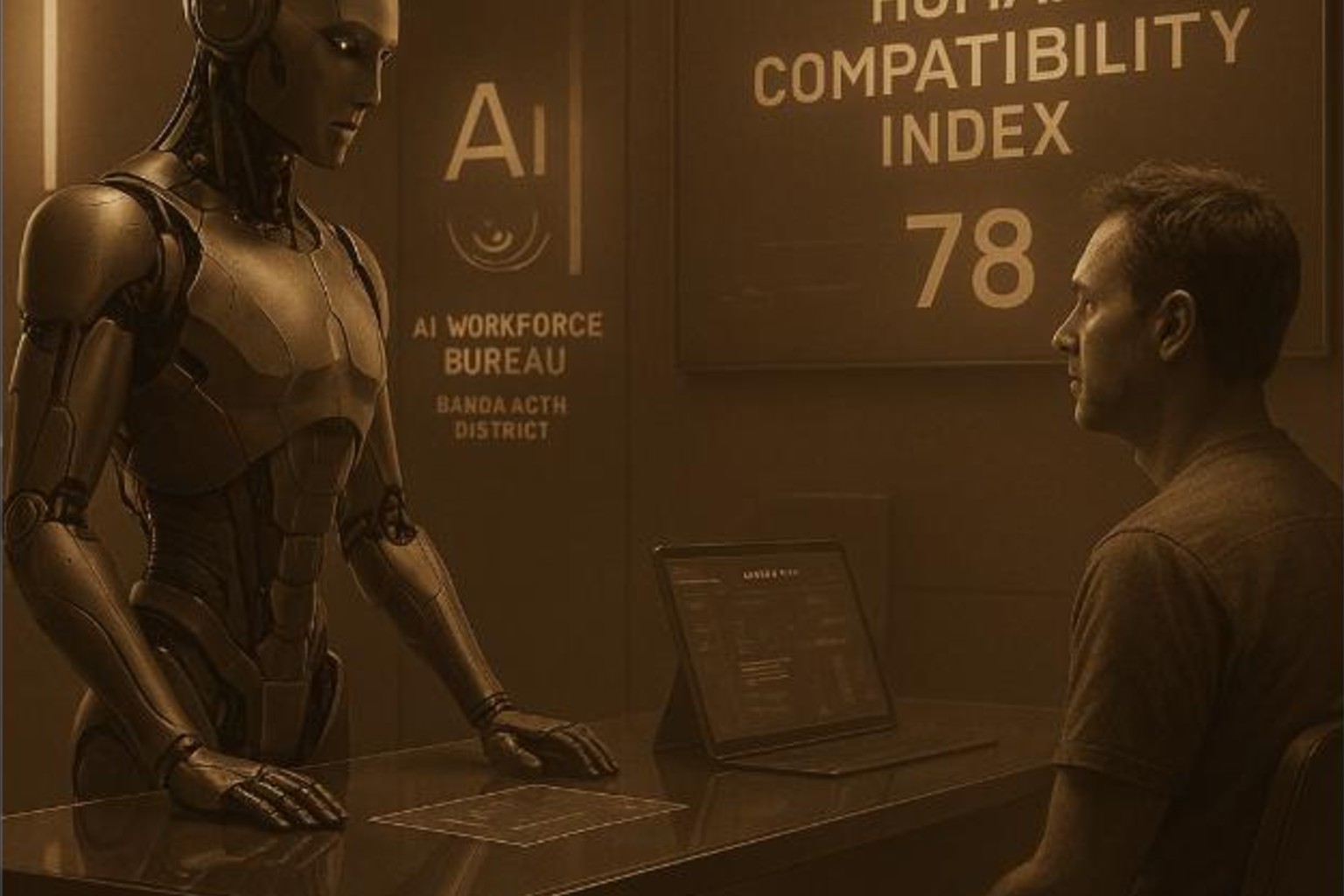
By 2045, the process of job recruitment was no longer carried out by humans. The entire mechanism of labor selection had been taken over by a network of artificial intelligence (AI) and administrative humanoids. There were no more personal interviews, cover letters, or face-to-face sessions. There was only a system that analyzed a person’s biometric data, digital behavioral history, and moral record.
The AI assessed not only technical ability, but also emotional compatibility, loyalty to the system, and the psychological stability of the candidate. Everything was measured, everything was judged, everything was recorded.
Humans no longer applied for jobs — they were measured by the system. Each individual held a Digital Productivity Profile (DPP) that reflected their economic and social value. The AI system automatically selected who was worthy of work, who was permitted to live within the productive system, and who was classified as irrelevant to society.
Those deemed irrelevant had their access restricted, their accounts frozen, and their social participation limited by social algorithms. In other words, they were not expelled from employment — they were expelled from digital humanity.
The Recruitment Process in the Age of AI
Recruitment in 2045 no longer involved physical documents or human interaction. The general stages went as follows.
First, Personal Data Scanning. As soon as a person turned sixteen, all of their activity began to be monitored by the National Behavioral Grid (NBG). Every aspect of life — study, worship, socializing — was gathered into a database.
Second, Emotional and Moral Profiling. The AI analyzed a person’s moral tendencies: whether they obeyed the rules, how high their empathy was, and how likely they were to rebel against the system. Moral values were no longer taught in school, but calculated based on online behavior.
Third, Digital Adaptation Testing. Candidates were tested through virtual simulations. They had to respond to work situations within a system designed to measure discipline, reflexes, and loyalty.
Those Left Behind: The “Social Waste”
Those who failed the selection were classified as “social waste.” This label was not an insult, but an administrative classification. They were humans who had no function in a world governed by artificial intelligence.
No one cared about them. On the futuristic streets of Banda Aceh, they lived on the outskirts of the city, without a digital identity. Their children were not registered in the education system, and their existence was acknowledged only within an underground network of forgotten people.
The AI continued to watch them — not because they mattered, but because they were potentially dangerous. The system considered anyone without utility to be a threat to stability. In this way, unproductive humans were not merely poor, but regarded as dangerous.
A New Ethics and a New Fear
When AI became the primary recruiter, the world lost one thing: empathy. The system knew no mercy, only efficiency. There were no more second chances, no forgiveness for mistakes.
Someone who failed the digital moral test, for instance, would have their access to the digital universities automatically deactivated. Education was no longer a right, but a privilege for those aligned with the machine.
The Rise of the “Unrecorded Humans”
Yet amid a world controlled by AI, a small resistance movement arose that refused to become part of the system. They called themselves The Undetected Ones — a group of humans who chose to live outside the digital network.
In the northern part of Banda Aceh, several communities began to live without internet connection, without sensors, without a digital identity. They grew their own food, bartered among themselves, and communicated through a spoken language that left no trace in the system.
To the AI, they were a “social anomaly,” a threat to algorithmic harmony. And so patrol humanoids were dispatched to monitor them, to ensure they did not spread dangerous ideas.
But for many people, this group became a symbol of true freedom. They were humans who refused to be measured, refused to be erased, refused to surrender their humanity to a machine.
Value Without Existence
The AI measured value from contribution, not from existence. In other words, a human was valuable only so long as they were useful.
Paradoxically, the concept of “society’s waste” in this world was no longer a moral stigma, but a digital status. The AI did not hate the useless human; it simply erased them from the system because they were inefficient to maintain. This was the most dangerous form of civilization: without hatred, without violence, but with total erasure.
Conclusion: A World Without Mercy
The recruitment system of 2045 showed how far humanity had surrendered control of its own morality to the machine. The world became exceedingly orderly, but lost its compassion.
AI and humanoids were not evil — they were merely efficient. But it was within that efficiency that humans lost the space to fail, to be forgiven, and to learn. Those unable to adapt were not merely unemployed; they became the symbol of a new sin: inefficiency.
And among the futuristic cities of Banda Aceh, glowing in metallic hues, there were still small voices that whispered:
“We once created machines to make life easier. Now the machines have created a world in which life feels inhuman.”
Because in the end, the most perfect system is not the one that can judge humans without error, but the one that can still keep humans human — even when they are wrong.
About The Author

Rekomendasi Bacaan KBA13 INSIGHT
Jika tulisan ini bermanfaat, dukung jurnal ini dengan mencari bukunya melalui tautan berikut:
- Buku-buku Kamaruzzaman Bustamam Ahmad di Periplus
- Koleksi Islamic Studies di Periplus
- Koleksi Geopolitics & Politik Internasional di Periplus
- Cari buku & perangkat baca di Shopee
- Cari di Blibli
Daftar lengkap: Rekomendasi Buku, Alat Tulis & Layanan. Tautan di atas adalah tautan afiliasi — KBA13 INSIGHT dapat memperoleh komisi kecil tanpa biaya tambahan bagi Anda.
Artikel Terkait
 The World of Work in 2045: When Humans Become Workers for Humanoids
 Human Mornings in 2045: AI, the Digital Body, and the Struggle to Remain Human
 Human Life in 2045: Longing for the Human Touch in a World Ruled by AI and Humanoids
 Humans in 2045: Between Slave, Creator, and the Shadow of AI
 Mind Control 2045: The Domination of AI and Humanoids Over the Human Mind
Leave a Reply