
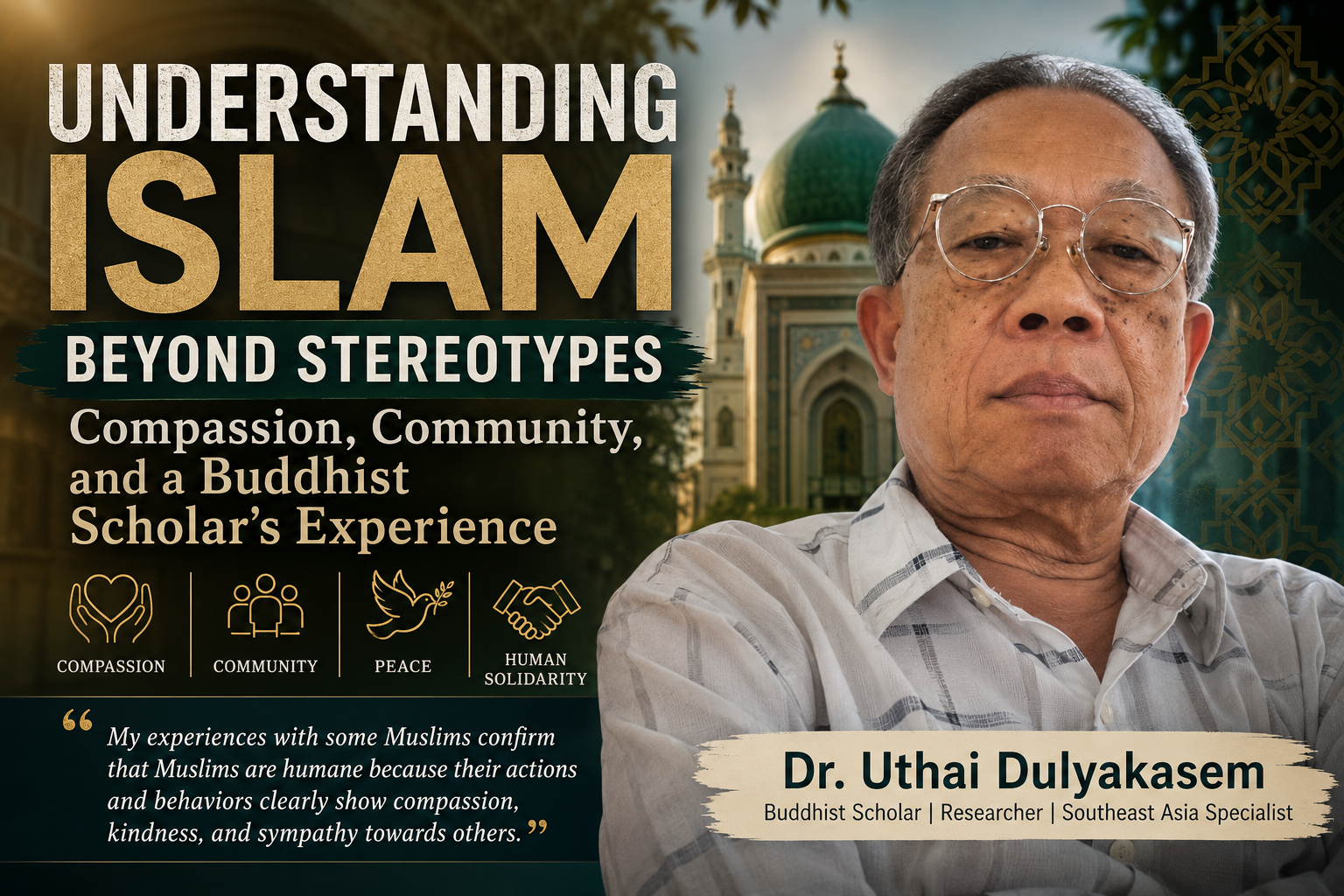
I am a Buddhist by birth and still practicing Buddhism in daily life. I want to record my personal understanding of Islam that I have learned from my experiences with some Muslims. In reality, my knowledge about Islam is next to zero. I know almost nothing about the Al-Qur’an, Sharia, and Hadith. However, I was lucky to get to know some Muslims, one as my classmate at the college and another, a Muslim professor at Thammasat University, and we occasionally exchanged views on Buddhism and Islam. My understanding of Islam began when I interacted with these Muslims. My experience with them taught me many good things, and what I learned from their actions and their daily behaviors was the opposite of many criticisms about Muslims in the media. However, my great opportunity to learn and understand Islam came about by chance when an ordinary Muslim family in Bangkok kindly offered me a room in their house to stay free of charge during my studies at Chulalongkorn University. Many people may wonder as to why they kindly offered me a free room in their house. Please let me briefly clarify it. When I was studying at Chulalongkorn University, I rented a small house close to the Muslim community on the other side of the Chaophraya River. Every day, I took a bus from the Dhonburi side to Chulalongkorn University. At that time, traffic was very bad as the bus crossed the Phra Buddhayodfa Bridge. When I returned from the university to my rented house, I often got off the bus and walked across the bridge. Near the foot of the bridge on the Dhonburi side, there were many eating places, and one of them was run by an elderly Muslim woman. Her shop was quite popular because the food was reasonably priced. I was a regular customer of this shop. As a country boy from a humble family background, when I saw the shop very busy with customers and the waitresses could not handle the workload in a timely manner, I felt I should lend them a helping hand. I did this whenever I felt that they needed help. I believed that my help was seen by an elder Muslima. Eventually, she kindly offered me some free candies as a token of appreciation. Later, she stopped charging me for dinner.
I did not know what she thought of me, but not long after, she asked if I would like to move into her house. This family had no children of their own, but they took care of one boy and one girl. At the time, both of them were teens, and the boy had moved out to stay somewhere else. Only the girl was staying in the family.
I decided to accept her offer because at that time, my financial situation was quite limited. I was staying with this Muslim family for about two years, and I was loved and cared for as their son. I tried to do everything I could to help them and their adopted daughter. At one time, I invited the whole family to visit my family in the South, and they came and stayed at my parents’ home. Even though they were Muslims, they got along very well with my parents and relatives while they were staying at my parents’ home.
After my graduation, I returned to work in the South, but whenever I came to Bangkok, I always visited them at their house, and my relationship with this family continued for many years. Unfortunately, the father (Pa) passed away when I was studying overseas. However, when Ma (mother) passed away, I went to the mosque and paid respect to her for the last time.
Thinking back, I was so lucky to have an opportunity to stay with this Muslim family for two years, and they loved me like their own son. They never asked me to change my religion, and they never showed signs of disgust despite the fact that they knew very well that I am a Buddhist. Moreover, every night when she returned home from her shop, she always bought some candies for me, even during the month of Ramadan.
I therefore disagree with many criticisms of Muslims. My experience with some Muslims confirms to me that Muslims are humane because their actions and behaviors clearly show compassion, kindness, and sympathy towards others, especially those who are suffering.
I never forget what I experienced with my Muslim friends and my Muslim “parents.” It is very sad that my two Muslim friends and my Muslim “parents” have passed away; otherwise, I would have learned more about Islam.
My impressive experience with some Muslims led me to take a keen interest in the situation in the Muslim communities in the southernmost provinces of Siam. While studying for a doctoral degree at Stanford University, I decided to conduct field research in the southernmost provinces of Siam. The research was widely read and recognized by many academic communities. I was very delighted that, at least, I could pay back my gratitude to my Muslim “parents.”
As a Buddhist, who was lucky to be loved and cared for by the ordinary Muslim family, I tried to learn more about Islam, not as a religion, but as the historical development of the term “Islam” and the original meaning of the term.
I learned from my Muslim friends that the term “Islam” means “peace.” However, when I searched for the original meaning of the term “Islam,” I learned that in Arabic, words are built from three-letter root consonants that carry a core meaning. The word “Islam” comes from the root S-L-M. This root carries two primary interconnected meanings: (1) Submission/Surrender: To give oneself up or submit to a higher authority. (2) Peace/Safety: Derived from “Salam,” meaning peace, wholeness, or safety from harm. When this root is put into specific verbal grammar, it means “to submit,” “to surrender,” or “to resign oneself.” The word “Islam” is the verbal noun of this verb, translating literally to “the act of submission” or “the act of surrender.” A follower who performs this act of submission to Allah (God) is called a “Muslim.” I also learned that the word “Imam” comes from the Arabic root consonants A-M-M. This root carries the core meaning of “heading toward,” “leading,” or “being in front of.” Literally, the word “Imam” translates to (1) “The one who is in front,” (2) “Leader,” and (3) “Guide.”
In addition, I learned that when Muslims greet each other, they say “As-Salamu alaikum” when they meet, and the other person replies, “Wa laikumussalam.”
Another term that I learned is the term “Darussalam,” which comes from the word “Dar,” meaning “home” or “realm,” and the word “Salam,” meaning “peace,” “safety,” or “harmony.”
However, my personal experience with some Muslim friends and my Muslim “parents” led me to understand that the foundation of Islam is “being a community.” The term “community” comes from the term “to communicate” or “communication,” and it refers to “horizontal communication” among people. This is quite clear in the Muslim community, where members communicate horizontally among themselves. Horizontal communication fosters a community with close relationships and unity (Islamic Brotherhood). We clearly observe that Muslims always go to the mosque together on Fridays, pray together during Ramadan, and turn their faces to the Kaaba in Mecca, Saudi Arabia, when they pray. These performances show that this foundation establishes a communal bond that is intended to transcend race, ethnicity, social class, and nationality.
It is unfortunate that there are some Muslims who yearn for power and use the Islamic religion for their own interests, leading to unnecessary conflicts both among Muslims themselves and with those of other beliefs.
I think if the world population follows the foundation of Islam, being a community in a true sense, that is, communicating horizontally, real peace would be materialized.
Uthai Dulyakasem
Bangkok, Siam
About The Author

Artikel Terkait
 Pustaka Al-Azhar: Preserving Patani’s Islamic Intellectual Heritage Through Jawi Manuscripts and Traditional Knowledge
 Demokrasi Aceh: Antara Tradisi Lokal, Agama, dan Tantangan Negara-Bangsa
 ASEAN di Bawah Tekanan Tarif Trump: Dari Perang Dagang ke Perang Pengaruh
 Southeast Asia Strategic Outlook 2026: Hormuz Crisis, ASEAN Security Shift, China-US Rivalry, and the Future of Regional Order
 Southeast Asia Strategic Intelligence Update July 2026: Indonesia, Myanmar, South China Sea, and ASEAN Under Pressure
Leave a Reply