
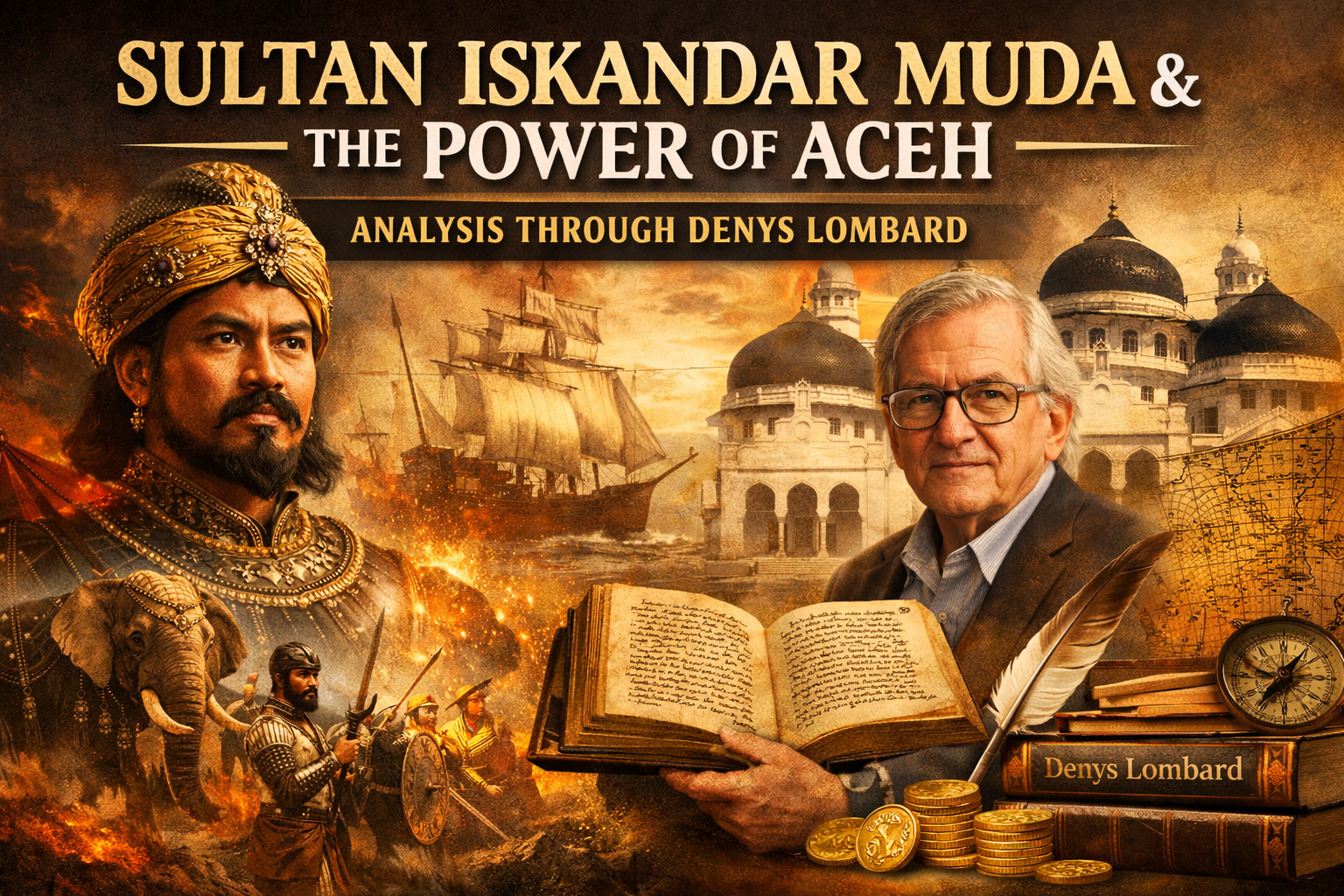
Denys Lombard’s book, originally his dissertation, offers a historical perspective on the concept of mentality. The book explores the reign of Sultan Iskandar Muda, ruler of the Aceh Darussalam kingdom. Lombard’s research primarily draws on reports from foreign travelers who visited Aceh at the time, lending the work a strong sense of objectivity by incorporating viewpoints from European scholars based on their own experiences. Unlike the works of Dutch scholars such as Snouck Hurgronje—who claimed that Aceh experienced no real triumphs in the 16th and 17th centuries—Lombard demonstrates the contrary, substantiating the historical significance of Sultan Iskandar Muda. Furthermore, Lombard’s work reveals insights into Aceh from within the palace itself, rather than from external viewpoints.
This book vividly illustrates the cosmopolitan nature of the Kingdom of Aceh Darussalam. The governance of Aceh was meticulously organized, as reflected in the Adat Aceh manuscripts. Sultan Iskandar Muda, committed to upholding the kingdom’s traditions, effectively curtailed foreign influence in the Melaka Strait. As a result, every foreign visitor—from East Asia, South Asia, or Europe—was required to comply with the laws set forth in Adat Aceh. Lombard’s work also draws upon local sources, such as Bustan al-Salatin, Hikayat Aceh, and Adat Aceh, which have been recognized and examined by scholars. These sources detail the construction of the Acehnese palace system during that era. The maritime and military might of the Aceh Darussalam Kingdom stands as a crucial chapter in the history of defense and security across the Indonesian archipelago.
Lombard also detailed the fiscal and financial systems implemented by the government of the Kingdom of Aceh Darussalam. Tax regulations were applied consistently and systematically, with members of the royal administration playing a crucial role in collecting taxes, particularly from foreign visitors entering Aceh’s waters. Lombard noted, “It was Iskandar the Younger who succeeded in formulating such a policy and carrying it out well during the 30 years he was on the throne.” In addition, Sultan Iskandar Muda maintained order in society by enforcing Islamic law based on the principles of ahl al-sunnah wa al-jama’ah. Religious groups were actively involved in the transmission of knowledge, especially in Islamic studies.
Furthermore, Lombard provides a compelling account of Sultan Iskandar Muda’s ascent to the throne, set against the backdrop of political turbulence following the Portuguese conquest of Melaka in 1511. The Aceh kingdom, destabilized by external threats and internal rivalries, was marked by power struggles and the ambitions of influential elite figures. Despite being imprisoned and facing near-certain death, Iskandar Muda demonstrated remarkable resilience and resourcefulness, ultimately escaping captivity and overcoming his rivals to secure his position as Sultan.
Lombard highlights Iskandar Muda’s exceptional military acumen and strategic vision, qualities instrumental in defending Aceh against foreign encroachment. This is vividly illustrated in the Hikayat Malem Dagang, which recounts the kingdom’s determined resistance against Portuguese advances. Notably, Iskandar Muda personally led his troops into battle, temporarily relinquishing his royal privileges to command the war effort. The consequences of these military campaigns remain evident today: numerous graves of Acehnese warriors are still visible in Aceh, while the Melaka region in present-day Malaysia stands as a testament to Aceh’s historic confrontations with the Portuguese. The enduring legacy of this era is also reflected in sites such as the tomb of Sheik Samsuddin al-Sumatrani, a prominent intellectual and spiritual advisor closely associated with Sheik Hamzah Fansuri, both of whom played significant roles in Aceh’s religious and cultural life.
It is therefore unsurprising that Lombard devoted considerable attention to the formidable military strength of Sultan Iskandar Muda’s war fleet. The reach of Aceh’s conquests under his leadership extended from Aru in eastern Sumatra to the Malay Peninsula, highlighting the vast territorial ambitions of the kingdom. One of the most remarkable aspects of Aceh’s military might was its use of war elephants—Lombard notes that up to 900 elephants were trained and deployed as part of the kingdom’s armed forces. These elephants were meticulously trained for combat, serving as both symbols of royal power and effective assets on the battlefield. Lombard’s analysis draws from firsthand accounts of foreign observers who witnessed these impressive animals in action.
Through the strength of this extraordinary military apparatus, Sultan Iskandar Muda subjugated numerous regions, including Aru and Melaka. The impact of Aceh’s expansionism reverberated throughout the Malay world, prompting a response from the Malay kingdoms on the peninsula. This period represents a foundational chapter in the illustrious history of the Kingdom of Aceh Darussalam’s influence in the broader Rantau Melayu, marking the rise of Aceh as a dominant maritime and military power in Southeast Asia.
The implementation of trade policies under Sultan Iskandar Muda was characterized by stringent control over commercial activities, extending from the highest echelons of governance down to the grassroots level. This comprehensive oversight ensured that foreign traders could not exploit or act arbitrarily toward the local Acehnese population when conducting business within the kingdom’s territory. To further strengthen economic sovereignty and facilitate trade, Sultan Iskandar Muda introduced a formal currency for the Kingdom of Aceh Darussalam, decisively moving away from the traditional barter system toward a gold-based monetary economy. This transition not only modernized commerce but also reinforced the kingdom’s authority over trade.
Archaeological discoveries have since uncovered gold coins issued during Iskandar Muda’s reign, many of which are inscribed with Islamic declarations of monotheism and the names of Aceh’s sultans, providing tangible evidence of the kingdom’s economic sophistication. As a result of these robust policies, Aceh became a vibrant hub of international trade, attracting merchants from across the globe. Lombard’s study documents the arrival of traders and envoys from India, Siam, Turkey, various European nations, and even neighboring regions such as Java, all drawn by Aceh’s flourishing commercial environment and strategic importance within the regional trade networks.
Lombard also observed the flourishing of Islamic culture during the Iskandar Muda Sultanate, emphasizing its profound influence on Aceh’s political, social, and intellectual life. Sufism, in particular, played a pivotal role in constitutional politics, with its principles permeating nearly every aspect of governance and public life. The term “Sufi” became synonymous with the city’s spiritual character, as Sufi traditions and practices were woven into Banda Aceh’s identity.
Sultan Iskandar Muda was renowned for his commitment to upholding Islamic religious values, fostering an environment where religious observance and intellectual inquiry could thrive. Scholars have described the democratization process in the Aceh Darussalam kingdom as being intricately linked to the Sufi worldview, with the palace actively promoting large-scale Islamic celebrations. These events were not limited to the royal court; the broader population was encouraged to participate, reflecting a vibrant communal spirit and reinforcing social cohesion.
The era of Sultan Iskandar Muda is often regarded as a period of Islamic intellectual awakening in Aceh. Lombard noted the emergence of a rich literary tradition, with local writers producing influential works that contributed to the kingdom’s cultural legacy. The Sultan himself provided generous support for intellectual endeavors, granting scholars and poets significant space to cultivate their ideas and share them with the wider society. This dynamic fusion of religious devotion, Sufism, and intellectual creativity helped shape Aceh’s reputation as a center of Islamic culture and learning in the region.
In addition to his analysis of political, economic, and cultural developments, Lombard’s work offers detailed biographical accounts of Sultan Iskandar Muda and other Acehnese monarchs who ruled the Kingdom of Aceh Darussalam. These biographies not only illuminate the personal qualities, leadership styles, and achievements of the sultans but also provide valuable insights into the broader historical context of their reigns. Furthermore, Lombard meticulously compiled a chronicle of significant events that shaped Aceh’s trajectory, offering readers a clear framework for understanding the kingdom’s evolution.
As a result, Lombard’s book stands out as an indispensable historical reference for scholars and readers interested in the archipelago’s history. Its comprehensive treatment of the Kingdom of Aceh Darussalam during the era of Sultan Iskandar Muda makes it one of the most authoritative and thorough works available on this important period, serving as a foundational resource for further study and research.
About The Author

Artikel Terkait
 Acehnology as an Intellectual Journey: Aceh, Islam, Southeast Asia, and the Malay World
 Five Books to Understand the Geopolitical System: Power, Empire, Diplomacy, Pandemic, and the Return of History
 The Kremlin School of Negotiation: Silence, Psychological Pressure, and the Politics of Power
 Artificial Intelligence and the World Order of 2040: A Strategic Essay on AI, Extraterrestrial Intelligence, and the Future of Humanity
 One World in the Planetary Era: Kishore Mahbubani, Global Convergence, and the Future of Civilization

Leave a Reply