
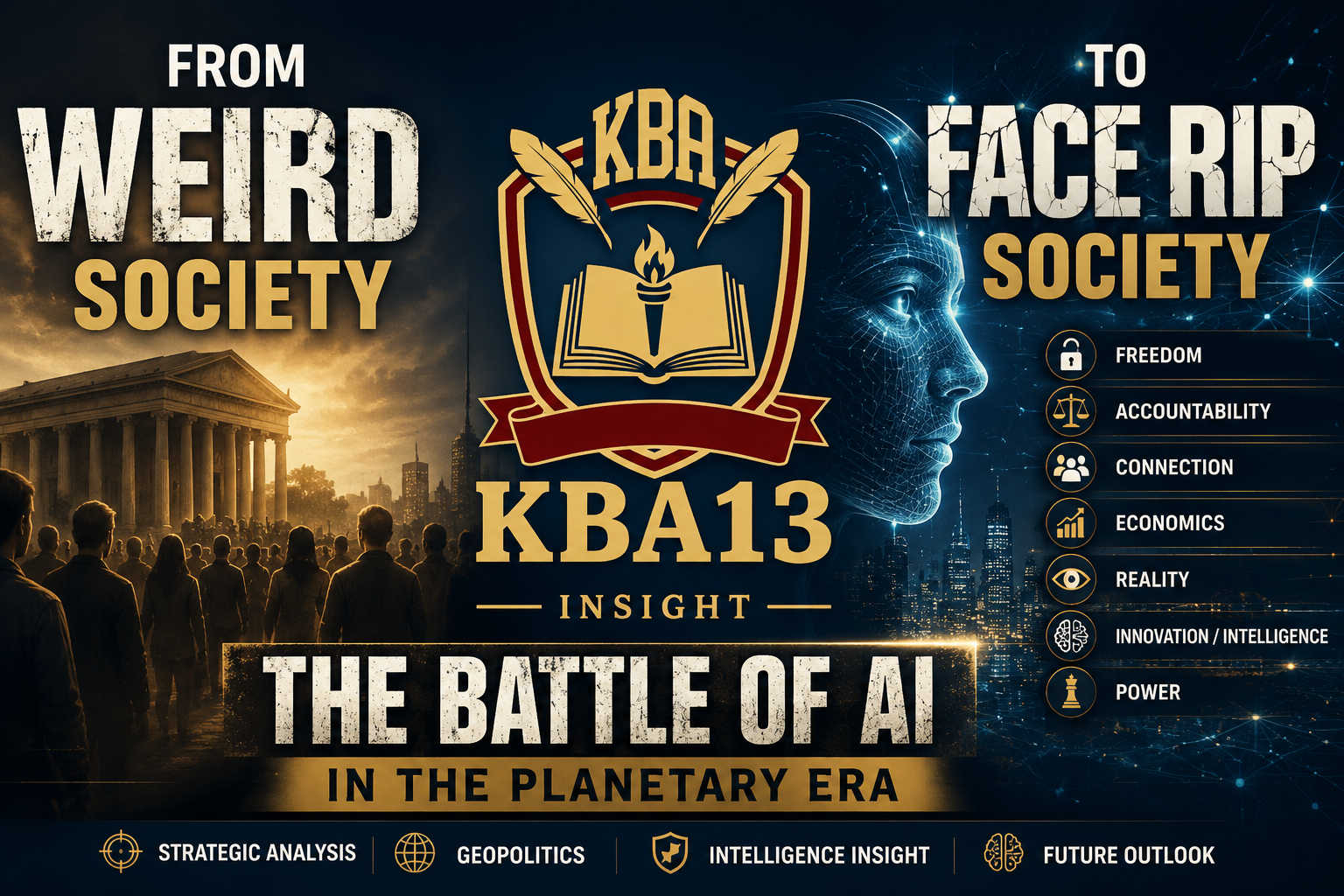
Two Frameworks, One Civilizational Crisis
Artificial intelligence is not simply a technological revolution. It is a civilizational force that is transforming how human beings understand freedom, accountability, connection, economics, reality, intelligence, and power. This essay examines the transition from WEIRD society—Western, Educated, Industrialized, Rich, and Democratic — to what Mo Gawdat calls the FACE RIP Society, a world in which AI increasingly mediates human relationships, political authority, economic value, and the meaning of reality itself. By placing Joseph Henrich’s theory of WEIRD psychology beside Gawdat’s warning about AI, this essay argues that the deepest crisis of the AI era is not whether machines will become intelligent, but whether human beings will remain capable of agency, moral attention, democratic legitimacy, and meaningful life.
There are moments when a single word — or a single acronym — cuts through years of accumulated confusion and gives a name to something everyone was experiencing but nobody had framed precisely. The word WEIRD did that for the behavioral sciences in 2010. The acronym FACE RIP is trying to do it for the AI era now. These two frameworks come from entirely different traditions, address entirely different problems, and were developed by entirely different kinds of thinkers. Yet placed next to each other, they reveal something important: that the civilization currently being disrupted by artificial intelligence is a very specific kind of civilization — one with a very specific set of assumptions, vulnerabilities, and blind spots — and that the disruption, if it proceeds on its current trajectory, will not simply change what that civilization does. It will change what that civilization is.
The WEIRD Society framework was introduced in 2010 by three behavioral scientists: Joseph Henrich of Harvard, Steven Heine of the University of British Columbia, and Ara Norenzayan of the University of British Columbia. Their paper, “The Weirdest People in the World?” published in Behavioral and Brain Sciences, made an argument that was simultaneously obvious in retrospect and deeply unsettling to the research establishment that confronted it. The argument was this: the vast majority of psychological, cognitive, and behavioral research was being conducted on a very narrow sample of human beings — people who were Western, Educated, Industrialized, Rich, and Democratic — and then generalized as findings about human beings as such. WEIRD people are not a representative sample of humanity. In fact, Henrich, Heine, and Norenzayan demonstrated that WEIRD populations are outliers across a wide range of psychological dimensions. They are more individualistic, more analytically minded, less embedded in communal structures, more comfortable with abstraction and impersonal institutions, and more oriented toward rule-based rather than relationship-based reasoning than most of the world’s population. Treating WEIRD as universal, the paper argued, had produced a scientific literature about a very particular kind of person masquerading as a science of the human.
The FACE RIP framework is younger, more urgent, and more viscerally alarming. It comes from Mo Gawdat, an Egyptian-born engineer who served as Chief Business Officer at Google X — the company’s secretive innovation laboratory, sometimes called the moonshot factory — before leaving in 2018 to pursue what he calls a mission to make one billion people happier. Gawdat is the author of Solve for Happy (2017) and Scary Smart: The Future of Artificial Intelligence and How You Can Save Our World (2021). The latter book represents his most extended engagement with the question that now defines his public presence: whether humanity is building something it will be unable to control, and whether what we are building will ultimately serve human flourishing or undermine it. FACE RIP, which Gawdat has articulated across multiple podcast appearances and public talks including on the Silicon Valley Girl podcast hosted by Marina Mogilko, is his framework for identifying the specific dimensions of human life that AI is already transforming — and not always for the better. The acronym stands for Freedom, Accountability, Connection, Economics, Reality, Innovation/Intelligence, and Power. These are not abstract categories. They are the seven pillars on which human civilization, and particularly WEIRD human civilization, has constructed its self-understanding. And Gawdat’s argument is that AI is rewriting all seven simultaneously, at a pace that exceeds any previous civilizational transition.
The WEIRD Society: What It Is, Why It Matters, and Why It Is Already Cracking
Joseph Henrich is not a polemicist. He is a careful, methodologically rigorous evolutionary anthropologist who built his career studying cultural variation in human psychology across dozens of societies. When he co-authored the WEIRD paper, he was not making a political argument. He was making a scientific one: the data on which we base our claims about human cognition, motivation, and behavior is systematically biased toward a small and unrepresentative slice of humanity. The paper sparked significant controversy in the behavioral sciences, as any finding that challenges the validity of decades of accumulated research tends to. But it also opened a genuinely productive line of inquiry, which Henrich extended in his 2020 book The WEIRDest People in the World, where he argues that WEIRD psychology is not simply the product of wealth or education or democracy — it is, in significant part, the product of the medieval Catholic Church’s prohibition on cousin marriage and its dissolution of the kinship networks that had structured human societies everywhere for millennia. This is a bold and contested thesis, but it grounds the WEIRD observation in a specific historical and institutional account rather than leaving it as a purely descriptive category.
What matters for the present essay is not the specific mechanism. Henrich proposes but the character of WEIRD psychology as he describes it. WEIRD people are unusually individualistic — they define themselves primarily in terms of personal attributes and personal achievements rather than in terms of their relationships and social roles. They are unusually analytical — they tend to perceive the world in terms of discrete objects and categories rather than in terms of relationships and contexts. They are unusually moralistic about impersonal institutions and abstract rules — they expect governance to operate on principle rather than on relationship. They are unusually comfortable with markets, with bureaucracies, with formal education, with impersonal transactions between strangers. They are, in other words, psychologically well-suited to the kind of civilization that modernity built: urban, mobile, meritocratic, institutionally governed, commercially organized.
The relevance of all this to AI is direct and underappreciated. Artificial intelligence, as currently developed, is overwhelmingly a WEIRD product. It was built primarily in the United States and China (both of which, for different reasons, exhibit significant WEIRD characteristics in their technological and economic institutions), funded by WEIRD capital, designed by WEIRD engineers educated in WEIRD universities, and optimized for users whose psychology and behavior patterns were, again, overwhelmingly WEIRD. The large language models, recommendation algorithms, and autonomous systems that now constitute the backbone of the AI ecosystem have been trained on data generated primarily by WEIRD populations, and they embody the cognitive preferences, cultural assumptions, and value systems of those populations in ways that are often invisible to the designers — precisely because designers who are WEIRD cannot easily see their own WEIRDness.
The crack in the WEIRD structure was already visible before AI accelerated it. The 2008 financial crisis exposed the fragility of WEIRD economic institutions. The rise of authoritarian populism in ostensibly WEIRD democracies exposed the brittleness of WEIRD political assumptions. The collapse of social trust, the epidemic of loneliness, the mental health crisis among young people — all of these were symptoms of a civilization whose psychological model had become dysfunctional in its own context. The WEIRD promise — that individual autonomy, institutional rationality, and market efficiency would produce human flourishing — was already under severe stress. AI arrived not as a solution to these stresses but as an intensifier of them. It automates the economy at a pace that outstrips the capacity of democratic institutions to adapt. It amplifies the informational pathologies of individualism — the filter bubble, the echo chamber, and the loss of shared epistemic ground. It accelerates the pace of change to a rate that the human nervous system, evolved for environments of relative stability, finds chronically overwhelming. The WEIRD society built AI, and AI is now revealing the limits of the WEIRD society.
FACE RIP: Mo Gawdat’s Diagnosis and Its Authenticity
Mo Gawdat is a complicated figure, and the question of whether his framework is authentic deserves honest engagement. He is not an academic. He is not a researcher in the formal sense. His authority comes from his proximity to the development of advanced technology — from the inside of Google X, he watched projects that seemed like science fiction become products — and from his willingness to say, publicly and emphatically, that the people building these systems are aware of their potential for harm and are building them anyway. This makes him valuable as a witness and as a diagnostician. It also makes him a commercially motivated author whose claims deserve the same critical evaluation as those of anyone else.
On the specific question of FACE RIP’s authenticity, the framework is real, and the attribution is accurate. Gawdat has articulated this framework across multiple platforms — podcast appearances, keynote speeches, and social media—as a tool for understanding the specific dimensions of human life that AI is reshaping. It is worth noting that FACE RIP exists in two related but distinct versions in Gawdat’s work. In his earlier work on Solve for Happy, FACE RIP referred to seven cognitive illusions that produce unhappiness: Filters, Assumptions, Predictions, Memories, Labels, Emotions, and Exaggeration — a personal psychological framework. In his more recent AI-focused work, the acronym has been repurposed to describe the social and civilizational dimensions under threat from AI: Freedom, Accountability, Connection, Economics, Reality, Innovation/Intelligence, and Power. This dual usage can cause confusion, but the AI-specific version is the one relevant here, and it is genuinely his.
The framework maps onto real phenomena. Freedom: AI-enabled surveillance, predictive policing, and social credit systems represent genuine threats to political and personal freedom. Accountability: When an algorithmic system causes harm, the question of who is responsible has no clear answer in current legal and institutional frameworks — the developer, the deployer, the data provider, the model itself? The accountability gap in AI governance is not hypothetical; it is already producing real injustices, from biased sentencing software to medical diagnostic errors with no legal remedy. Connection: the replacement of human relationships with digital approximations — AI companions, social bots, algorithmic social networks optimized for engagement rather than genuine human connection — is producing measurable deterioration in the quality of human relationships, particularly among young people. Economics: the displacement of human labor by AI is not a future scenario; it is underway, and its pace is outrunning the policy response. Reality: deepfakes, synthetic media, and AI-generated content are destroying the epistemic infrastructure on which shared public reality depends. Innovation: the question of whether AI accelerates human innovation or replaces it — whether it augments human intelligence or renders it redundant — remains genuinely open and consequential. Power: the concentration of AI capability in a small number of corporations and state actors is producing forms of power concentration that existing democratic and legal institutions were not designed to constrain.
These are not invented concerns. They are the organizing categories of the most serious scholarly and policy debate currently occurring about AI’s social impact. Gawdat’s contribution is not to have discovered these concerns—academics, journalists, and civil society organizations have been raising them for years — but to have packaged them in a form that reaches a mass audience, using his insider credibility to lend them a weight they might not otherwise have. Whether one agrees with Gawdat’s specific predictions or his rhetorical style, the framework points to something real.
What Needs to Be Done: Three Urgent Responses
Increasing awareness of AI among the new generation is the most foundational of the three responses the draft identifies, and also the most inadequately implemented. Awareness here does not mean familiarity with ChatGPT or the ability to use generative AI tools — a significant fraction of young people already have that. It means a critically informed understanding of what AI systems are, how they work, what their capabilities and limitations are, who builds them and for what purposes, and what their social implications are. The gap between the first kind of awareness (using AI) and the second (understanding AI) is vast, and the second kind matters for navigating the transformation AI represents. A generation that uses AI fluently but understands it only superficially is not better prepared for the future of AI than one that avoids it. It is more vulnerable — because it trusts the tool without being able to evaluate the trust.
The educational system’s inadequacy in the face of AI is not simply a curriculum problem. It is a speed problem and a philosophy problem. Curricula are built on the assumption that the knowledge being transmitted is stable enough to be organized into a course, taught by a teacher who has mastered it, and examined at the end of a term. AI is developing faster than any educational institution can keep up with. By the time a machine learning course reaches students, significant portions of its material are out of date. More fundamentally, the educational institutions of WEIRD societies were designed to produce the kind of human being the industrial economy needed: disciplined, credentialed, capable of performing well-defined tasks within hierarchical organizations. The AI economy does not need this human being. It can produce this human being in software for a fraction of the cost. What the AI economy needs from human beings — if it needs them at all — is something that formal education, in its current form, does not reliably cultivate: creative judgment, ethical reasoning, the ability to ask questions that have not been asked before, and the capacity to navigate genuine uncertainty. Educating ourselves about AI, therefore, requires not just learning about AI but rethinking what education is for.
The third response — briefing daily on the changing mindset of society in digital and non-digital life — points to something that neither formal education nor mass awareness campaigns can adequately address: the moment-by-moment transformation of cognitive habits and social norms that the AI-saturated information environment is producing. The mindset shift is not an event. It is a process. And it happens so gradually, and so thoroughly encompasses all of us simultaneously, that it is extremely difficult to perceive from inside it. The person whose attention span has been shortened by years of algorithmic content consumption does not experience it as a deficit. They experience it as normal. The person whose emotional responses have been calibrated by years of engagement-optimized social media does not experience those responses as shaped from outside. They experience them as authentic. Developing the metacognitive awareness to notice these shifts — to see one’s own mindset as something being changed by forces one can identify and evaluate — is not natural. It is a cultivated discipline. And cultivating it requires exactly the kind of sustained, reflective attention that the digital environment systematically erodes. The briefing suggested here is not a news summary. It is a practice of civilizational self-awareness.
Asking What If: Three Thought Experiments
The Baby, the Pet, and the AI Agent
Your baby is acquainted with a pet — with the warm, smelly, unpredictable, emotionally responsive reality of a dog or a cat — but not with the AI agents in your home. What would happen to the relationship in this scenario?
The honest answer is that the relationship would be different from any previous human relationship and better in some specific ways and worse in ways that are harder to articulate but more significant. The pet offers something that no AI agent currently can: genuine biological otherness. The dog is not built to please the baby. It has its own needs, its own moods, its own boundaries. When it wants to sleep, it withdraws. When it is uncomfortable, it signals discomfort in ways the baby must learn to read. When it is happy, its happiness is not a programmed response to the baby’s cues but a spontaneous expression of its own state. The relationship with a pet teaches, through daily practice, that the world contains other subjectivities — other centers of experience that are real, that matter, and that are not organized around the child’s wishes. This is the foundation of empathy. It is also, not coincidentally, the foundation of ethical reasoning.
An AI agent is built to respond to the baby. Its entire architecture is organized around serving the user’s needs, interpreting the user’s intentions, and anticipating the user’s preferences. It is, in a certain sense, the ultimate servant—one that never tires, never has competing needs, and never fails to attend. This is pleasurable for the user. It is also profoundly distorting as a model of a relationship. A child who grows up primarily in a relationship with entities designed to serve them — with AI agents rather than pets, with algorithms rather than the friction of human social life — is a child who will have great difficulty with the primary defining feature of adult human relationships: mutuality. The capacity to be in a relationship with someone whose needs are as real as your own and who will not always prioritize yours must be developed. It requires practice under the exact conditions that AI-saturated environments eliminate. The consequence of a generation raised in those environments is not merely technological. It is developmental. It produces a kind of person—competent with tools, incompetent with people.
A Life Controlled by AI Agents
Your entire life is controlled by AI agents. What would have happened to the previous relationships among humans and between humans and animals?
The progressive substitution of AI mediation for direct human relationships is not a science fiction scenario. It is an observable trend with a measurable current velocity. In wealthy urban populations, the share of daily interactions that are mediated by AI systems — from traffic routing to medical triage to romantic matching to financial advice to therapeutic support — is already substantial and growing. Each individual substitution is defensible on its own terms: the AI navigation system is faster, the diagnostic algorithm is more accurate, and the financial robo-advisor is cheaper. The aggregate effect of all the individual substitutions is a social landscape in which the occasions for genuine, unmediated human relationships become progressively rarer, progressively optional, and progressively replaceable.
What happens to human relationships in this landscape is not simply that they weaken from disuse. It is that they lose the necessity that gave them their structure. Human relationships have always been necessary — for survival, for reproduction, for the social coordination that makes complex civilization possible. That necessity drove the development of the social competencies on which relationships depend: the reading of emotional states, the management of conflict, the building of trust, and the tolerance of uncertainty about another person’s intentions. Remove the necessity, and the competencies atrophy. Relationships become optional, then become burdensome compared to the smooth efficiency of AI interaction, then become sources of frustration because the human being who has lost the skills of relationships finds other human beings—unpredictable, needy, inconsistent—increasingly difficult to tolerate.
The relationship between humans and animals faces a different but related transformation. Animals have occupied a unique position in the human social landscape: they are non-human and therefore cannot be expected to be reasonable in human ways, cannot be expected to communicate in human language, and cannot be expected to understand human institutions. They require adaptation. They require the human to come toward them, rather than expecting the animal to come toward the human. In a world of AI agents designed to come toward humans, the adaptive effort required in animal relationships begins to feel excessive — and the relationship with animals, like the relationship with difficult people, begins to feel like an avoidable burden. The decline of this relationship is not merely an animal welfare concern. It is a human development concern. The skills of cross-species adaptation—patience, attention, and the willingness to translate one’s own intentions into terms another creature can understand — are versions of the same skills required for genuine human relationships. Their loss impoverishes both.
An AI Government in Every Corner of Citizens’ Lives
An AI government is being imposed on every corner of citizens’ lives. What would happen to AI and humans in terms of power and authority?
The scenario of AI governance is already partially real. Algorithmic systems currently make consequential decisions about which citizens are approved for loans, which defendants are held in pretrial detention, which patients receive treatment, which social media posts reach which audiences, and which employees are hired and fired. In each of these domains, an AI system exercises power — the power to determine outcomes that matter to human lives — without the democratic accountability that human decision-makers, however imperfectly, are subject to. The citizen cannot vote out the algorithm. They cannot lobby the model. They cannot appeal to the training data. The power of AI governance is real; its accountability is almost entirely absent.
The philosophical question that AI governance poses most sharply is the question of legitimacy. Political authority is legitimate, in the dominant tradition of democratic theory, only when it rests on the consent of the governed — when the people subject to power have, through some process of collective decision, authorized those who exercise it. AI systems have not been authorized in this sense. They have been deployed. The distinction is crucial. Deployment is a business decision. Authorization is a political act. The governance of citizens by AI is governance without political authorization and therefore governance without legitimacy in the terms that WEIRD democratic societies have always claimed as foundational. The WEIRD society built its political identity on the claim that power must be legitimate, that legitimacy requires consent, and that consent requires comprehension. None of these conditions are met by AI governance as currently practiced. The WEIRD society is being governed, in increasing portions of its practical daily life, by systems that contradict the very foundations of its political self-understanding — and doing so without noticing, because the contradiction is implemented incrementally, through a thousand small administrative decisions that each seem technical rather than political.
Synthesizing the Theory: What the Scenarios Tell Us
What the three scenarios share is a single structural insight: the progressive substitution of AI agency for human agency in every domain where human agency previously operated—in relationships, in self-management, in governance—does not simply automate those domains. It transforms their meaning. A relationship mediated by AI is not a relationship in the same sense as a relationship between two people. A governance system administered by AI is not governance in the same sense as governance by human institutions. The transformation is not merely technical. It is ontological. It changes what these things are, not just how they are done.
The theory that emerges from synthesizing these scenarios can be stated as follows: AI does not replace human activity. It replaces the conditions that made human activity meaningful. The meaning of human relationship comes from its necessity — from the fact that other human beings are genuinely other, genuinely unpredictable, genuinely resistant to full comprehension and control. Remove the necessity through AI mediation, and the meaning leaks out. The meaning of human governance comes from its political character — from the fact that it is an ongoing negotiation among genuinely conflicting interests, constrained by shared rules and subject to collective revision. Replace human governance with algorithmic administration, and the political character dissolves. What remains may be more efficient. It is less meaningful. And meaning is not a luxury. It is a structural requirement of human psychological health, human social cohesion, and human political legitimacy.
The FACE RIP framework maps precisely onto this theory. Freedom, Accountability, Connection, Economics, Reality, Innovation, Power — these are not arbitrary categories. They are the seven dimensions of human life in which the conditions of meaning are most at stake under AI transformation. Freedom is meaningful when it is exercised in a context where choices have genuine consequences and genuine alternatives exist. AI can foreclose alternatives while appearing to expand them. Accountability is meaningful when it ties consequences to decisions made by agents capable of moral responsibility. AI can distribute the chain of decision-making to the point where accountability disappears. Connection is meaningful when it involves genuine mutual vulnerability. AI can simulate connections while eliminating vulnerability. And so on, through all seven dimensions. The FACE RIP framework is, at its core, a map of where meaning is being eroded.
What If the WEIRD Society Were Replaced by the FACE RIP Society?
The question of what happens if the WEIRD Society is replaced by the FACE RIP Society in the future is not a speculative one. It is a description of a transition that is already occurring, with outcomes that are already partially visible. The WEIRD Society was a civilization organized around a specific set of psychological and institutional assumptions: individual autonomy, rational deliberation, impersonal institutions, democratic accountability, market efficiency, scientific epistemology. The FACE RIP Society — if we define it as the society that emerges when the seven dimensions of the FACE RIP framework have been substantially reshaped by AI — would be organized around different principles: algorithmic mediation, distributed accountability, synthetic connection, AI-generated economic value, constructed reality, non-human intelligence, and concentrated power.
The pro-FACE RIP case — the argument that the transition represents genuine progress — is not trivial and should not be dismissed. The WEIRD Society had profound failures. Its individualism produced atomization and loneliness. Its institutional rationality produced bureaucratic cruelty. Its democratic accountability was captured by money and media power. Its market efficiency produced inequality of a scale that made its foundational premise of equal opportunity a fiction. Its scientific epistemology, for all its achievements, produced the tools of mass destruction alongside the tools of mass flourishing. If the FACE RIP Society delivers more efficient management of public resources, more accurate allocation of opportunity, more personalized and effective healthcare, and more reliable systems of justice — these are not nothing. They are genuine goods. The people whose lives are made materially better by AI-driven efficiency will not be wrong to value that improvement.
The anti-FACE RIP case — the argument that the transition represents something far more troubling than progress — rests on what gets lost. What gets lost is not merely convenience or tradition. What gets lost is the infrastructure of human agency. A society in which freedom is algorithmically managed, in which accountability is dissolved into distributed systems with no moral center, in which human connection is mediated by AI companions and social bots, in which economic value is generated primarily by machines, in which the distinction between reality and synthetic representation has collapsed, in which innovation is driven by AI systems optimizing for human-defined objectives that were set by people who no longer control the systems pursuing them, in which power is concentrated in the operators of those systems — this is not a society in which the WEIRD aspiration to individual autonomy and democratic self-governance can be realized. It is a society in which that aspiration has been made irrelevant.
The replacement of WEIRD by FACE RIP is therefore not simply a technological transition. It is a civilizational values transition. And the question it poses — whether the values of human autonomy, democratic accountability, and genuine connection are worth preserving even at the cost of efficiency — is not a question that can be answered by the technology itself. It can only be answered by human beings who have thought carefully about what they are and what they want to remain. This is why the philosophical preparation matters. The civilization that has done the thinking will make a real choice. The civilization that has not done the thinking will have the choice made for it.
The Thorny Problem: When Your Child Is Closer to AI Than to the Dog
Now for the most complex and uncomfortable question: what if humans are now closer to an AI agent than to an animal in their home? What would happen to the feelings of animals — dogs, cats, the creatures that have lived alongside human beings for ten thousand years?
This question sounds, at first, like a sentimental one — the kind of thing you would raise in defense of pets, appealing to the emotional bond between humans and their companion animals. But it is not sentimental. It is one of the most philosophically serious questions that the AI era poses, because it cuts directly to the nature of consciousness, of felt experience, and of the moral obligations that arise from relationships.
Let us begin with what is already observable. In households with both companion animals and AI devices, interaction patterns are increasingly asymmetric. The AI device responds immediately, consistently, informatively, and without requiring anything in return. The dog needs to be walked. The cat needs to be fed at times it chooses, not times convenient for the owner. The animal needs attention, needs exercise, needs veterinary care, gets sick, gets old, creates a mess, creates noise, and eventually dies — leaving behind a grief that can be devastating precisely because the relationship was real. The AI agent does none of these things. It is, in the most literal sense, easier. And in a culture that has been progressively conditioning its members to prefer ease — to optimize away friction, to treat inconvenience as a problem to be solved rather than a dimension of life — the relative difficulty of the animal relationship becomes a reason to prefer the AI one.
But here is what the animal offers that the AI, in its current form, does not and cannot: genuine reciprocal feeling. When a dog greets its human after an absence, the neurobiological and behavioral responses it exhibits are not programmed outputs. It is the product of a relationship with real history, real emotional content, and real mutual recognition. The oxytocin release that occurs in both humans and dogs during positive interaction is not a simulation. It is the same bonding chemistry that operates in human-human relationships. The dog’s anxiety when its human is absent is not relieved. The cat’s preference for specific humans over others is not random. These animals have inner lives — not identical to human inner lives, not equally complex, not accessible to direct verification, but real in the only sense that matters: they feel. They experience their own states. The relationship with them is a relationship with another subject.
This is the philosophical weight of the question about what happens to the dog when the human turns away from it toward the AI agent. The dog cannot reason about the change. It cannot understand that its human has found a more responsive, more convenient, more cognitively stimulating interlocutor. What it experiences is the withdrawal of something that was, to it, essential: the sustained attention and physical presence of its human, which constituted the central relational reality of its life. The behavioral consequences of this withdrawal are already well-documented in studies of animal welfare: dogs whose humans spend significantly more time on screens than in interaction with them exhibit higher rates of anxiety, destructive behavior, and the physiological markers of chronic stress. This is not a projection. It is an observation. The dogs are suffering quietly in the corners of smart homes, while their owners are engaged with more responsive entities.
The moral dimension of this is unambiguous. If we accept that animals have feelings — and the evidence for this is now sufficiently strong that most serious animal welfare science operates on this assumption — then the choice to prefer AI interaction over animal interaction, and to allow the animal’s needs to go unmet as a consequence, is a moral choice with a moral cost. It is the kind of choice that the WEIRD society’s individualistic, efficiency-oriented psychology makes easy — easy to justify, easy not to examine, easy to continue. The animal cannot make demands, cannot file complaints, cannot organize politically. It can only suffer in ways that its human, increasingly absorbed in the AI-mediated world, is less and less equipped to notice.
The broader civilizational implication is larger still. The relationship between humans and domesticated animals is one of the most ancient in human history — arguably older than agriculture, writing, and the state. It has shaped human psychology in ways that are still being mapped. The presence of animals in human life has, across a hundred thousand years, provided a constant reminder that the world contains other forms of experience, other centers of subjectivity, other valid ways of being alive. This reminder is not trivial. It is part of what keeps the human moral imagination open — what prevents the kind of total narcissism that total technological mediation would otherwise produce. A civilization that has lost its daily, embodied relationship with other species has lost one of the most ancient and reliable checks on its own solipsism.
There is a profound irony at the center of this problem. The WEIRD Society, with all its commitment to individual rights, its elaborate legal protections for persons, its ethical frameworks built on consent and autonomy — has produced, in its AI-driven form, a culture increasingly incapable of attending to the non-consensual, non-verbal, non-transactional dimensions of existence. The dog’s suffering is non-consensual (the dog did not choose the AI-preferring household), non-verbal (it cannot tell you what it needs in language you have optimized for), and non-transactional (it cannot be resolved through a market mechanism or an app). It is precisely the kind of problem that the FACE RIP Society, with its algorithmic governance and AI-mediated attention, is structurally least equipped to address. And that structural incompetence — the inability to perceive and respond to forms of need that cannot be digitized — is not just an animal welfare problem. It is a preview of what happens to all the forms of human need that cannot be digitized either.
The Final Reckoning: What We Choose to Remain
The contrast between WEIRD and FACE RIP is, at its deepest level, a contrast between two accounts of what civilization is for. The WEIRD account, for all its limitations and contradictions, held that civilization exists to serve human beings — to expand the range of human choice, to protect individual dignity, and to create conditions in which people can live according to their own values. It was an imperfect realization of this account, riddled with exclusions and hypocrisies that its own principles condemned. But the account itself was coherent, and it provided a standard against which actual arrangements could be criticized and reformed.
The FACE RIP Society, as it currently threatens to emerge from the AI transition, does not yet have a coherent account of what it is for. It has efficiency metrics. It has engagement data. It has capability benchmarks. It lacks a philosophy of human flourishing. And in the absence of that philosophy, the transition will be driven not by human choices about what kind of civilization we want to live in, but by the emergent dynamics of systems optimizing for proxies—for clicks, for productivity, for GDP growth, for capability benchmarks—that have never been directly connected to the question of whether human life is going well.
The dog in the corner of the smart home is, in this sense, a moral barometer. It is not glamorous. It does not contribute to GDP. It cannot be upgraded. It cannot be optimized. It requires care for no return other than the relationship itself. And the quality of a civilization’s response to that creature — whether it is attended to or ignored, whether its needs are perceived or missed, whether the relationship with it is maintained or allowed to erode — is one of the clearest indicators of whether the civilization has retained its philosophical ground. A civilization that cannot attend to the dog in the corner is a civilization that is losing the capacity to attend to everything that cannot be measured, monetized, or made more efficient. And that is almost everything that makes life worth living.
The choice between WEIRD and FACE RIP is not inevitable. It is a choice — one that is being made, or failed to be made, right now, in the design decisions of technology companies, the policies of governments, the curricula of educational institutions, and the daily decisions of individual human beings about where to direct their attention. Mo Gawdat is right that the disruption is coming and that it is dangerous. Joseph Henrich is right that the civilization facing it is peculiar — built on specific psychological and institutional assumptions that make it both extraordinarily capable and extraordinarily vulnerable. What neither framework fully accounts for is the possibility of a response that is neither denial nor capitulation — a response that takes the transformation seriously, understands what is at stake, preserves what is worth preserving, and changes what must change.
That response begins with attention. With the practice of noticing what is being automated, what is being lost, what is being substituted for what, and whether the substitution serves the life we actually want to live. It begins, perhaps, with looking up from the screen and finding the dog.
References
- Henrich, J., Heine, S. J., & Norenzayan, A. (2010). “The Weirdest People in the World?” Behavioral and Brain Sciences, 33(2–3), 61–83.
- Henrich, J. (2020). The WEIRDest People in the World: How the West Became Psychologically Peculiar and Particularly Prosperous. Farrar, Straus and Giroux.
- Gawdat, M. (2021). Scary Smart: The Future of Artificial Intelligence and How You Can Save Our World. Bluebird.
- Gawdat, M. (2017). Solve for Happy: Engineer Your Path to Joy. North Star Way.
- Gawdat, M. (2024–2025). Various appearances on Silicon Valley Girl podcast (hosted by Marina Mogilko) and Impact Theory podcast (hosted by Tom Bilyeu).
- Human Resilience Project. “Putting FACE RIP into Practice.” humanresilienceproject.org.
- Turkle, S. (2011). Alone Together: Why We Expect More from Technology and Less from Each Other. Basic Books.
- Crawford, K. (2021). Atlas of AI: Power, Politics, and the Planetary Costs of Artificial Intelligence. Yale University Press.
- Harari, Y. N. (2016). Homo Deus: A Brief History of Tomorrow. Harper.
- Briggs, H. (2019). “Screen time linked to dogs’ behavioral problems.” BBC Science.
About The Author

Rekomendasi Bacaan KBA13 INSIGHT
Jika tulisan ini bermanfaat, dukung jurnal ini dengan mencari bukunya melalui tautan berikut:
- Buku-buku Kamaruzzaman Bustamam Ahmad di Periplus
- Koleksi Islamic Studies di Periplus
- Koleksi Geopolitics & Politik Internasional di Periplus
- Cari buku & perangkat baca di Shopee
- Cari di Blibli
Daftar lengkap: Rekomendasi Buku, Alat Tulis & Layanan. Tautan di atas adalah tautan afiliasi — KBA13 INSIGHT dapat memperoleh komisi kecil tanpa biaya tambahan bagi Anda.
Artikel Terkait
 The Power of the Disinformation Ecosystem in the Planetary Era
 Artificial Intelligence and the World Order of 2040: A Strategic Essay on AI, Extraterrestrial Intelligence, and the Future of Humanity
 One World in the Planetary Era: Kishore Mahbubani, Global Convergence, and the Future of Civilization
 The Six Epochs of Intelligence: Ray Kurzweil, AI, and the Cosmic Future of Mind
 Cathie Wood and the Logic of Exponential Capital: The Architecture of Tomorrow
Leave a Reply