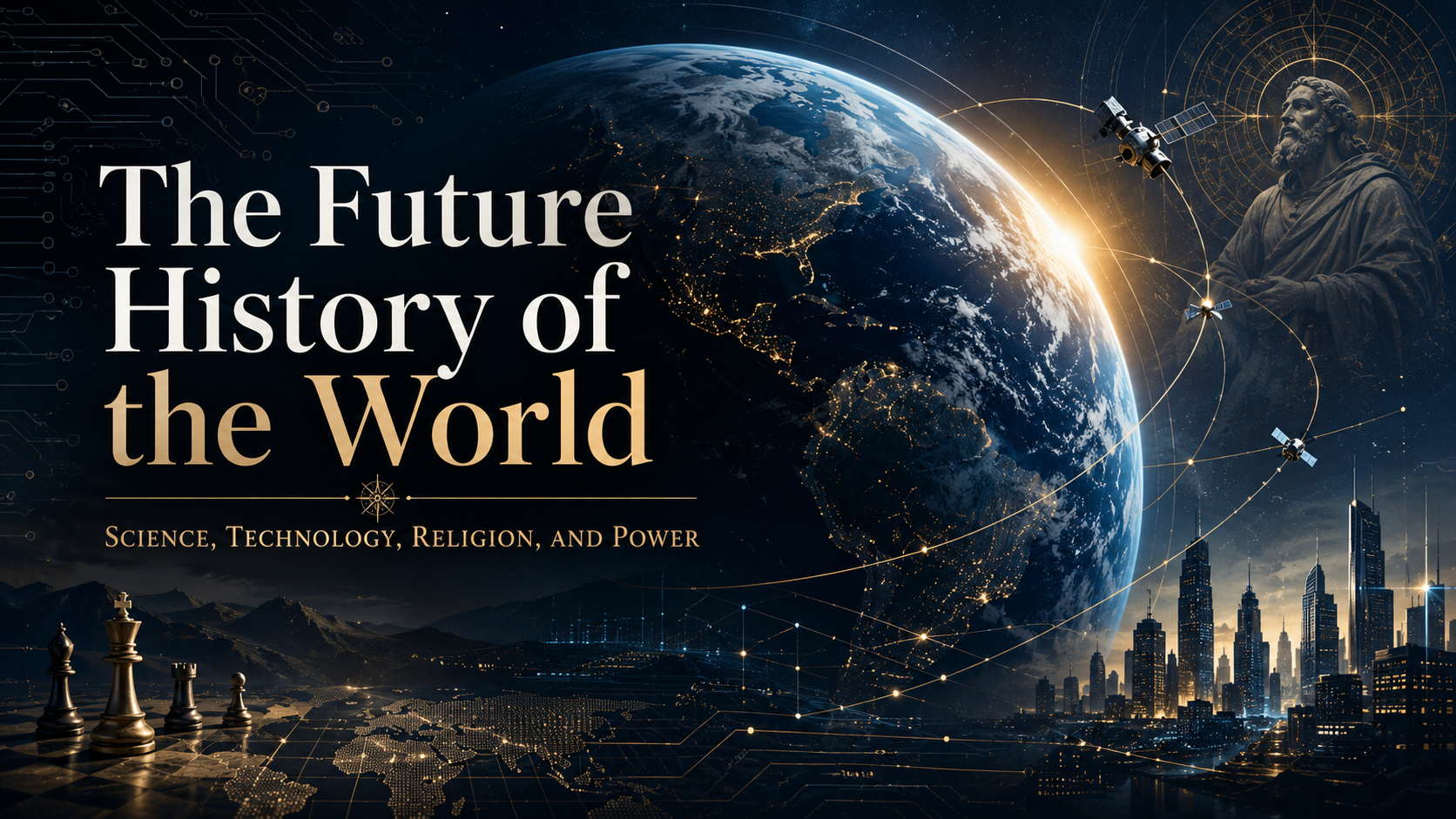
A cinematic reflection on the future history of the world, where science, technology, religion, energy, and power converge to shape the next architecture of global civilization.
Introduction: Reading the Future as a History Not Yet Written
The future of the world cannot be understood merely as a sequence of technological breakthroughs. It must be read as a long historical process in which science, power, religion, imagination, economy, and violence interact. Every civilization produces tools, but tools never remain neutral. Once tools enter the structure of power, they become instruments of control, survival, domination, liberation, or destruction.
The central question of future history is not whether humanity will become more technologically advanced. That question has already been answered by the acceleration of artificial intelligence, quantum computing, biotechnology, robotics, space exploration, surveillance systems, and digital capitalism. The deeper question is whether humanity will become wiser as technology becomes more powerful. A civilization can become technically sophisticated while spiritually poor, morally confused, and politically dangerous.
Modern civilization is increasingly built on the belief that science and technology can solve every problem. Disease, poverty, hunger, aging, conflict, environmental crisis, and even death are now imagined as technical problems waiting for technical solutions. This belief has created a new kind of confidence but also a new kind of arrogance. Humanity begins to see the world not as a sacred trust but as raw material for manipulation.
Religion enters this debate not as an enemy of science, but as a guardian of limits. The religious imagination reminds humanity that power without restraint becomes tyranny, knowledge without humility becomes hubris, and progress without moral direction becomes collapse. Yet religion itself faces a crisis when fragmented into competing claims, political slogans, or ceremonial identity without ethical depth. A weak religious consciousness cannot guide a powerful technological civilization.
This essay begins from three foundational assumptions. First, future world civilization will be measured by the ability of science and technology to secure human life. Second, if scientific progress fails to awaken moral responsibility, the global order will become unstable. Third, when technology becomes detached from spiritual ethics, powerful nations will use it to dominate weaker societies.
The future will not be shaped only by weapons, armies, treaties, and markets. It will also be shaped by data, algorithms, satellites, rare earth minerals, energy corridors, genetic laboratories, artificial intelligence systems, and psychological warfare. The battlefield will move from physical territory into the mind, body, memory, culture, and imagination of humanity.
In this context, “future history” means the study of possible trajectories before they fully unfold. It is not prophecy in the theological sense. It is a strategic interpretation. It attempts to understand how present tendencies may harden into future structures. It asks what will happen when technological ambition, geopolitical competition, religious anxiety, and civilizational fear move together.
The following eight scenarios are not predictions in a narrow sense. They are analytical windows. Each scenario reveals one possible direction in the architecture of future world order: energy annexation, permanent war, division as strategy, technology as dependency, extraterrestrial anxiety, prophetic power through science, technological divinity, and apocalyptic civilization.
Scenario One: The West’s Annexation of Global Energy
Energy has always been the hidden foundation of world power. Empires do not survive only through flags, armies, and ideology. They survive through access to the material sources that keep factories running, cities illuminated, weapons produced, ships moving, satellites functioning, and populations governed. In the modern era, energy is not simply an economic commodity; it is the bloodstream of civilization.
Western power has historically expanded through the control of energy routes and resource zones. Oil, gas, coal, uranium, and now rare earth minerals have shaped military strategy, diplomatic pressure, corporate expansion, and regime politics. The map of modern geopolitics cannot be separated from pipelines, maritime chokepoints, mining concessions, refineries, and energy corridors. Whoever controls energy controls the rhythm of industrial life.
The future will intensify this struggle. The transition from fossil fuels to renewable energy will not end energy imperialism. It will transform it. Lithium, cobalt, nickel, copper, silicon, uranium, and rare earth elements will become as strategic as oil once was. Electric vehicles, solar panels, wind turbines, batteries, drones, missiles, smartphones, satellites, and AI data centers all depend on mineral supply chains. The so-called green transition may create a new geography of extraction.
Resource-rich countries often find themselves trapped in a cruel paradox. They possess the materials the world needs, yet they do not control the technology, capital, logistics, or global pricing systems that determine value. Their soil produces wealth, but their people remain vulnerable to poverty, corruption, environmental damage, and political interference. This is the old colonial structure in a new economic language.
Energy annexation does not always require direct military occupation. It can occur through contracts, debt, infrastructure dependency, security cooperation, intelligence operations, corporate capture, sanctions, and diplomatic pressure. A country may appear politically independent while its energy sector is controlled by external actors. Sovereignty becomes formal, while strategic resources are governed by invisible networks of power.
Intelligence agencies and multinational corporations will play central roles in this future. Intelligence services map instability, protect supply chains, identify political risks, and shape local elites. Corporations secure concessions, influence policy, build infrastructure, and convert natural resources into profit. The boundary between state power and corporate power becomes increasingly blurred.
The most dangerous consequence of energy annexation is the creation of unequal civilization. Developed nations will present themselves as champions of climate transition, technological progress, and sustainable development, while poorer nations absorb the ecological and social costs of extraction. Forests are destroyed, rivers are poisoned, communities are displaced, and local economies become dependent on volatile global markets.
The future history of energy will therefore be a history of moral contradiction. The world may speak the language of sustainability while practicing the politics of extraction. The West may reduce carbon emissions domestically while outsourcing ecological destruction abroad. Energy will remain the central axis of the global hierarchy because every dream of technological progress requires material sacrifice elsewhere.
Scenario Two: The Continuation of War
War will not disappear from human history. It will change form, speed, scale, and psychological depth. The old image of war as a battlefield between armies will become insufficient. Future war will occur through cyberattacks, autonomous weapons, drones, satellites, economic sanctions, information manipulation, financial exclusion, biological threats, and algorithmic control.
Modern war is no longer limited to the destruction of territory. It targets systems. Power grids, banking networks, airports, hospitals, ports, water systems, communication infrastructure, and electoral platforms can be attacked without a single tank crossing a border. A country can be paralyzed before formal war is declared. The future battlefield will be invisible to ordinary citizens until daily life suddenly collapses.
Technology has always advanced through war. Radar, rockets, nuclear energy, computers, satellites, the internet, and drones all carry traces of military ambition. States invest heavily in military research because war creates urgency. What begins as defense innovation often enters civilian life later. This cycle means that the future of technology will continue to be shaped by the logic of conflict.
Artificial intelligence will deepen this transformation. AI can accelerate target identification, battlefield prediction, drone coordination, cyber defense, psychological profiling, and disinformation campaigns. But AI also introduces grave risks. Decisions of life and death may be delegated to systems that operate faster than human judgment. War may become more efficient while becoming less accountable.
Weak nations will face difficult choices. Submission may preserve short-term stability but destroy strategic independence. Resistance may preserve dignity but invite punishment, sanctions, isolation, or military pressure. This dilemma will define much of the twenty-first century. Smaller states will be forced to navigate between competing powers while protecting their sovereignty from direct and indirect coercion.
Information warfare will become one of the most decisive forms of conflict. Character assassination, narrative manipulation, religious polarization, ethnic provocation, fake documents, deepfakes, and coordinated digital attacks can destroy trust inside a society. A nation can be defeated not only by foreign soldiers but also by internal confusion. When citizens no longer trust institutions, leaders, the media, the courts, scholars, or one another, external domination becomes easier.
Future war will also be fought through economic architecture. Sanctions, currency pressure, debt traps, export controls, technological blockades, and supply chain disruption can weaken a nation without visible violence. Financial systems become weapons. Access to chips, cloud platforms, payment networks, and data infrastructure becomes part of strategic competition.
The continuation of war reveals one tragic truth: technological progress does not automatically civilize humanity. A more advanced world can still be a more dangerous world. Without ethical restraint, science becomes a servant of organized violence. The future of war will test whether humanity can control its own inventions before those inventions reshape the very meaning of conflict.
Scenario Three: Expansion Through Division
Division is one of the oldest instruments of power. Empires have long understood that fragmented societies are easier to control than united societies. The principle is simple: weaken internal cohesion, multiply disputes, cultivate dependency, and present external intervention as necessary. In the future, this method will become more sophisticated through digital systems, media networks, funding channels, and psychological operations.
Contemporary geopolitics often uses influence rather than occupation. Powerful states no longer need to govern directly when they can shape opinion, finance institutions, influence elites, control narratives, and exploit social divisions. Influence becomes cheaper than invasion and more durable than temporary military control. A society can be reorganized from within while believing that every decision comes from domestic debate.
Ethnic, religious, ideological, and regional differences can be transformed into strategic vulnerabilities. Diversity itself is not a problem. The danger appears when diversity is weaponized by internal actors and external powers. Once identity becomes a battlefield, public reason weakens. Citizens stop debating policy and begin defending tribes, sects, factions, and emotional loyalties.
Digital platforms intensify this vulnerability. Algorithms reward anger, fear, humiliation, and moral outrage because such emotions generate engagement. External actors can exploit these dynamics by amplifying divisive content, supporting polarizing figures, or spreading false narratives. The result is a society that consumes conflict daily while failing to recognize manipulation.
Aid, education, civil society programs, and development projects can also become channels of influence. Many of these programs may carry genuine benefits. Yet in strategic environments, funding can shape intellectual agendas, policy language, research priorities, elite networks, and institutional dependency. A nation’s conceptual vocabulary may slowly be imported from outside its own historical experience.
The fragmentation of the state is another crucial mechanism. When the central authority becomes weak, local elites, criminal networks, militias, foreign corporations, religious factions, and political brokers compete for influence. The state remains on paper, but actual authority is dispersed. Under such conditions, external powers can negotiate with multiple actors and prevent any single national vision from gaining strength.
Economic division is equally dangerous. Inequality can fracture the moral foundation of a nation. When wealth is concentrated among a small elite while the majority struggles for survival, social trust collapses. Foreign influence then enters through the promise of investment, employment, loans, security, or political protection. Poverty becomes an entry point for strategic dependency.
The future history of division will show that domination does not always arrive as conquest. Sometimes domination arrives as advice, partnership, reform, media framing, investment, or humanitarian concern. The task of weaker nations is not to reject all external cooperation but to build internal resilience. Without social cohesion, intellectual independence, and ethical leadership, every external partnership can become a path toward fragmentation.
Scenario Four: The Gift of Technology, the Extraction of Energy
The modern world is built on a silent bargain: advanced nations export technology, while developing nations supply energy, minerals, labor, data, and markets. This bargain appears beneficial because technology brings modernization. Roads, smartphones, digital platforms, medical devices, online education, payment systems, and communication networks improve daily life. Yet beneath this convenience lies a deeper structure of dependency.
Technology transfer often does not mean knowledge transfer. Many developing nations receive products, platforms, and infrastructure without mastering the scientific and industrial systems behind them. They become users rather than creators. They consume software, devices, machines, and digital services while remaining dependent on foreign patents, updates, cloud systems, spare parts, technical standards, and corporate ecosystems.
This dependency reshapes sovereignty. A country may possess smartphones, satellites, data centers, and digital public services, but if core technologies are owned elsewhere, strategic autonomy remains limited. Control over code, chips, operating systems, AI models, databases, and cybersecurity architecture determines the real location of power. The visible device may be local; the invisible command structure may be foreign.
Digital ecosystems deepen this imbalance. Search engines, social media platforms, e-commerce systems, ride-hailing applications, payment gateways, cloud computing services, and AI tools do not merely provide convenience. They collect data, shape behavior, influence consumption, guide attention, and map social patterns. The population itself becomes a source of extractive value.
Energy extraction and data extraction increasingly operate together. Resource-rich countries provide minerals and energy for global technology, while their citizens generate data for foreign platforms. This creates a double dependency: material extraction from the earth and behavioral extraction from society. The future empire may not only control land and labor, but also attention, emotion, preference, and memory.
The claim that nations refusing technology are backward creates psychological pressure. Every society is pushed to adopt systems before fully understanding their consequences. Schools, governments, businesses, and religious institutions become dependent on digital tools designed elsewhere. Modernization becomes compulsory, while critical reflection is treated as resistance to progress.
Artificial intelligence will intensify this condition. Nations without their own AI infrastructure will depend on external models trained on assumptions, languages, values, and priorities that differ from their own. If AI becomes central to education, law, administration, security, medicine, and economic planning, then dependence on foreign AI becomes dependence on foreign cognition. The deepest form of colonization may occur at the level of thinking itself.
The future challenge is not to reject technology, but to transform the adoption of technology into technological sovereignty. Developing nations must move from consumption to creation, from dependency to mastery, from passive use to ethical governance. Without this shift, the gift of technology will remain tied to the extraction of energy, data, and intellectual independence.
Scenario Five: War Against Extraterrestrials
The possibility of contact with non-human intelligence remains speculative, but speculation itself has strategic importance. Civilizations prepare for the unknown through imagination before formal evidence arrives. Space programs, astronomical research, SETI initiatives, UFO debates, planetary defense systems, and science fiction all reveal a profound human anxiety: humanity does not know whether it is alone.
If contact with extraterrestrial intelligence were to occur, the consequences would extend beyond science. Such an event would transform theology, philosophy, politics, anthropology, law, defense, and civilizational identity. Humanity would be forced to ask whether intelligence is unique to Earth, whether revelation has cosmic meaning, whether human beings occupy a central place in creation, and whether political authority can remain Earth-centered.
The first crisis would be epistemological. How would humanity verify communication from a non-human civilization? Who would interpret the signal? Scientists, military agencies, religious authorities, governments, corporations, or international institutions? The struggle over interpretation would become the first struggle over power. Whoever controls the meaning of contact controls humanity’s emotional response.
The second crisis would be political. No single country can legitimately claim to represent all humanity, yet powerful states may attempt to monopolize contact. Space diplomacy could become space imperialism. The nation with superior satellites, telescopes, spacecraft, and military-space infrastructure may dominate the first stages of communication. A cosmic encounter could reproduce earthly hierarchy.
The third crisis would be religious. Abrahamic traditions affirm creation beyond ordinary human comprehension, but many believers may struggle with the implications of intelligent life beyond Earth. The challenge would not necessarily destroy faith. It could expand theological imagination. Yet religious institutions would need intellectual depth to respond without panic, denial, or simplistic interpretation.
The fourth crisis would be security. If extraterrestrial intelligence appears technologically superior, fear may dominate global reaction. Human governments may frame contact as a threat rather than an opportunity. Military institutions may prepare defensive systems, while corporations may seek technological advantage. Curiosity could quickly turn into strategic paranoia.
Science fiction has already trained modern imagination to anticipate alien conflict. Films and novels often portray extraterrestrials as invaders, saviors, teachers, gods, monsters, or mirrors of human violence. These narratives are not innocent entertainment. They shape collective expectations. When societies imagine the unknown primarily in terms of fear, future contact may be interpreted through the logic of war.
A war against extraterrestrials may never occur. Yet the idea exposes the deepest instability of human civilization: humanity may project its own violence onto the universe. If humans cannot build peace among themselves, any encounter with higher intelligence may be filtered through suspicion, competition, and militarization. The cosmic future will therefore test not only scientific ability but also moral maturity.
Scenario Six: Technology as the Power of Prophets
Religious traditions often describe extraordinary abilities granted to prophets. In Islamic and Abrahamic narratives, Prophet David is associated with mastery over iron, while Prophet Solomon is associated with command over nature, animals, political authority, and unseen realms. These narratives carry theological meaning, but they also reveal a human fascination with the relationship between knowledge, power, and divine permission.
Modern technology increasingly seeks capacities once imagined only within sacred stories. Humans now attempt to manipulate matter at the nanoscale, edit genetic codes, communicate with animals, engineer climate patterns, automate decision-making, explore outer space, and extend biological life. What was once narrated as a miracle is now pursued as a research agenda. This does not make technology prophetic, but it shows how ambition moves toward godlike control.
Artificial intelligence represents one form of this ambition. AI systems can translate languages, generate images, diagnose diseases, predict behavior, analyze massive data, and simulate reasoning. These capacities create an impression of omniscience. The machine appears to know, see, calculate, and respond beyond ordinary human capacity. Yet this appearance hides dependence on data, design, ownership, and human intention.
Biotechnology represents another form. Gene editing, synthetic biology, organ regeneration, reproductive technologies, and longevity research challenge old boundaries of life. Human beings are no longer content to heal disease; they increasingly seek to redesign the body. The line between therapy and enhancement becomes blurred. Medicine may become a path toward biological hierarchy.
Quantum computing and nanotechnology deepen the dream of control over reality. Quantum systems promise computational power beyond classical limits, while nanotechnology works at the level of atoms and molecules. Together, these fields suggest a civilization seeking command over the hidden architecture of matter. The desire is not merely to use nature, but to rewrite nature.
Climate engineering reveals the same pattern at the planetary scale. As the environmental crisis worsens, some scientists propose interventions to reflect sunlight, remove carbon, seed clouds, or manipulate atmospheric systems. Such projects raise profound ethical questions. Who has the authority to adjust planetary conditions? What happens when one region benefits while another suffers? The power to engineer climate resembles political power over creation itself.
Transhumanism pushes this ambition toward the human soul. It imagines a future where aging slows, memory expands, intelligence increases, consciousness merges with machines, and death becomes a technical obstacle. This dream promises liberation from biological limitation, but it also risks creating new forms of inequality. If enhancement becomes expensive, the rich may buy a different kind of humanity.
The danger of technological prophecy lies in confusing ability with legitimacy. Just because humans can do something does not mean they should. Sacred narratives often link extraordinary power with divine responsibility, moral discipline, and humility. Modern civilization often separates power from humility. That separation may become one of the greatest dangers of future history.
Scenario Seven: The Heavenly Kingdom and the Search for God Through Technology
Modern science does not openly claim to search for God in a religious sense, yet many technological projects carry theological shadows. Space exploration, artificial intelligence, simulation theory, consciousness studies, UFO research, and the search for extraterrestrial life all circle around ultimate questions. Where did life come from? What is intelligence? Is the universe designed? Can consciousness survive death? Can humanity become more than human?
The West has often transformed theological longing into technological ambition. The desire for heaven becomes the desire for space colonies. The desire for immortality becomes longevity science. The desire for omniscience becomes artificial intelligence. The desire for divine presence becomes the search for higher intelligence. Technology becomes a secular pathway toward sacred aspiration.
Space exploration carries this symbolism clearly. Mars colonization, lunar bases, asteroid mining, and deep-space missions are presented as scientific and economic projects. But beneath them lies a metaphysical impulse: escape from Earth, expansion beyond mortality, and the creation of a new human destiny. Space becomes the modern heaven of technological civilization.
Artificial intelligence carries another theological structure. Humans create systems in their own image, train them with human knowledge, and then fear that these systems may surpass their creators. This resembles an inverted theology. Humanity becomes the creator, the machine becomes the creature, and the creator fears judgment from the created. The drama of AI is therefore not only technical but spiritual.
The search for God through technology also appears in simulation theory. Some thinkers suggest that reality itself may be a simulation created by a higher intelligence. This idea transforms old metaphysical questions into computational language. God becomes the programmer, creation becomes code, and existence becomes system architecture. Even when secular, the argument remains haunted by theology.
Hollywood and science fiction help normalize these ideas. Films about AI rebellion, alien contact, cosmic beings, time travel, multiverses, and technological immortality are not merely entertainment. They function as cultural laboratories. Societies rehearse possible futures through stories before confronting them in reality. Popular culture becomes a training ground for metaphysical anxiety.
The religious challenge is profound. Faith traditions must respond not by rejecting science, but by offering deeper interpretations of human longing. The search for God cannot be reduced to technological conquest. A telescope may reveal galaxies, but not humility. An AI may process scripture, but not possess spiritual wisdom. A spacecraft may reach Mars, but not solve the moral crisis of the human heart.
The future may therefore produce a strange civilization: technologically advanced, cosmically ambitious, but spiritually restless. Humanity may search the stars while forgetting the ethical demands of life on Earth. The heavenly kingdom pursued through technology may become empty if justice, mercy, humility, and worship disappear from the human project.
Scenario Eight: The Apocalypse and the End of Civilization
Every civilization imagines its end. Religious traditions speak of judgment, cosmic signs, moral decay, and divine accountability. Secular cultures speak of nuclear war, climate collapse, pandemics, artificial intelligence rebellion, asteroid impacts, ecological breakdown, and social disintegration. The language differs, but the anxiety is similar. Humanity knows that civilization is fragile.
The apocalyptic imagination has become stronger in the technological age. Nuclear weapons created the first human capacity for self-annihilation on a planetary scale. Climate change revealed that ordinary economic activity could destabilize the Earth system. Artificial intelligence introduced fear that intelligence itself might escape human control. Biotechnology raised the possibility of engineered pandemics. Space science reminded humanity of cosmic vulnerability.
Religion interprets the apocalypse through moral and metaphysical meaning. The end is not merely destruction; it is judgment, disclosure, and fulfillment of divine order. In Islam, eschatological narratives warn humanity that history has moral direction. Power, wealth, arrogance, injustice, and corruption are not endless. Every civilization stands under accountability.
Modern technology interprets “apocalypse” as risk management. Survival bunkers, Mars colonies, seed vaults, planetary defense systems, AI alignment research, pandemic preparedness, and climate adaptation strategies all reflect the desire to survive catastrophe. The modern elite does not always seek repentance; it often seeks escape. The result is a technological survivalism without moral transformation.
Mars exploration reveals this contradiction. On one level, it represents scientific curiosity and human courage. On another level, it reflects fear that Earth may become uninhabitable. The dream of becoming multiplanetary carries a hidden confession: humanity has damaged its home and now imagines escape as destiny. But a civilization that destroys Earth may carry the same destructive habits to Mars.
Apocalyptic thinking also shapes politics. Leaders may use fear of collapse to justify surveillance, militarization, emergency powers, border control, or technological authoritarianism. When citizens are told that a catastrophe is near, they may accept restrictions they would normally resist. The apocalypse can become a political instrument.
Digital culture intensifies apocalyptic emotion. News cycles, viral panic, conspiracy theories, disaster films, and algorithmic fear create permanent anxiety. People live with the feeling that collapse is always approaching. This emotional condition weakens patience, wisdom, and civic trust. A frightened society becomes easy to manipulate.
The end of civilization may not arrive as a single dramatic event. It may unfold slowly through moral exhaustion, ecological damage, demographic pressure, institutional decay, technological dependency, and spiritual emptiness. A society can collapse while its cities still shine. The deepest apocalypse may occur when humans lose the meaning of being human.
Conclusion: The Moral Compass of Future Civilization
The future of the world will be shaped by the struggle between power and wisdom. Science and technology will continue to expand the boundaries of what humans can do. But the decisive question is what humans should do with that power. Without moral discipline, every breakthrough can become a weapon, every platform a prison, and every innovation a tool of domination.
The eight scenarios presented in this essay reveal a common pattern. Energy, war, division, technology, extraterrestrial imagination, prophetic ambition, the search for divinity, and apocalyptic fear are not separate subjects. They form one civilizational system. At the center of that system stands humanity: brilliant, restless, ambitious, fearful, creative, and spiritually vulnerable.
The most powerful nations will attempt to control the future by controlling energy, data, weapons, supply chains, narratives, and technological standards. Weaker nations must understand that sovereignty in the twenty-first century cannot be reduced to territory. Real sovereignty requires intellectual independence, technological capacity, energy resilience, moral leadership, cultural confidence, and spiritual clarity.
Religion must also rise to the challenge. It cannot remain trapped in ritual without ethics, identity without knowledge, or slogans without a civilizational vision. Religion must provide moral grammar for an age of artificial intelligence, biotechnology, planetary crisis, and digital empire. It must teach limits in a world intoxicated by limitless ambition.
Science, in turn, must recover humility. The scientific method is one of humanity’s greatest achievements, but science becomes dangerous when absorbed by militarism, corporate greed, and imperial strategy. Knowledge must serve life, not domination. Technology must protect human dignity, not reduce the human person into data, labor, consumer behavior, or biological material.
The future history of the world is therefore not already fixed. It remains contested. Humanity can choose domination or stewardship, arrogance or humility, extraction or justice, fragmentation or solidarity, technological idolatry or ethical intelligence. The direction of civilization will depend on the values embedded in its tools.
The central question remains urgent: will science and technology serve humanity, or will humanity become enslaved by its own creations? This question is not abstract. It will determine the fate of nations, religions, cultures, economies, and future generations. A civilization that cannot answer this question wisely may become powerful enough to destroy itself.
About The Author

Artikel Terkait
 Artificial Intelligence and the World Order of 2040: A Strategic Essay on AI, Extraterrestrial Intelligence, and the Future of Humanity
 Deception Theory in Social Media Intelligence: How to Detect Fake Accounts and Malicious Actors
 Transhumanism and the Future of Humanity: Can Technology Save or Redesign the Human Condition?
 Techno-Religion: Silicon Valley Prophets, Big Data Worship, and the Future of Faith
 The Six Epochs of Intelligence: Ray Kurzweil, AI, and the Cosmic Future of Mind