
Daftar Isi
ToggleIntroduction: Transhumanism as the Merger of Biology and Technology
Transhumanism begins with a radical proposition: the human condition can be improved through the deliberate merger of biological existence and technology. Human beings are no longer understood only as natural organisms who must accept the limits of the body, mind, aging, disease, memory, and perception. They are increasingly imagined as beings capable of redesigning their own capacities through science, machines, artificial intelligence, genetic knowledge, and technological enhancement. This is the intellectual foundation of transhumanism: humanity is not treated as a completed form, but as an unfinished frontier.
The meaning of transhumanism cannot be reduced to admiration for futuristic machines. It is an umbrella of ideas that brings together medicine, biology, robotics, artificial intelligence, cognitive science, genetics, and philosophy under one large question: how far can technology be used to improve human life? The goal is not only to create stronger tools outside the body, but also to rethink the body itself as a site of technological intervention. In this sense, transhumanism changes the old relationship between humans and technology. Technology is no longer merely something humans use; technology becomes something that may enter, modify, extend, and even redefine human existence.
At the center of this movement lies the desire to improve the human condition. This phrase is important because transhumanism does not begin from machines, but from human vulnerability. Human beings suffer from illness, physical weakness, limited memory, emotional instability, biological aging, and death. Transhumanism looks at these limitations and asks whether they must remain permanent. If technology can repair organs, enhance cognition, extend life, improve sensory perception, or deepen self-understanding, then technology becomes part of the long human struggle against fragility.
Yet this ambition contains a serious tension. Improvement can easily become transformation. When technology helps humans overcome disease, the moral purpose is clear. But when technology begins to redesign intelligence, emotion, memory, body structure, and identity, the question becomes more difficult. At what point does enhancement stop being a medical solution and become a new form of human engineering? At what point does the human being remain human, and at what point does the human being become something else? Transhumanism forces this uncomfortable question into the center of modern thought.
The future promised by transhumanism appears bright because many technologies are no longer pure fantasy. Some remain speculative, but many others are already developing rapidly. Medical implants, artificial intelligence, neural interfaces, genetic research, robotics, wearable devices, and bioengineering show that the boundary between biology and technology is becoming increasingly porous. The future does not arrive as one dramatic event. The future enters slowly through laboratories, hospitals, devices, platforms, and everyday human dependence on technological systems.
This is why transhumanism must be read with both hope and caution. On one side, the merger of biology and technology may lead humanity toward greater self-understanding. Through science and technology, humans may understand the body, brain, genes, disease, behavior, and consciousness more deeply. Technology can become a mirror through which humanity studies its own biological and psychological structure. In this sense, transhumanism may expand human self-awareness, not merely human power.
On the other side, transhumanism may become dangerous when technology is pursued without moral direction. The danger is not technology itself, but the loss of human purpose inside technological acceleration. If enhancement becomes an obsession, humans may begin to measure themselves according to machine values: speed, efficiency, calculation, productivity, and control. A society that worships technological superiority may forget compassion, wisdom, humility, and ethical restraint. This is the deepest risk of transhumanism: humans may become more advanced while becoming less humane.
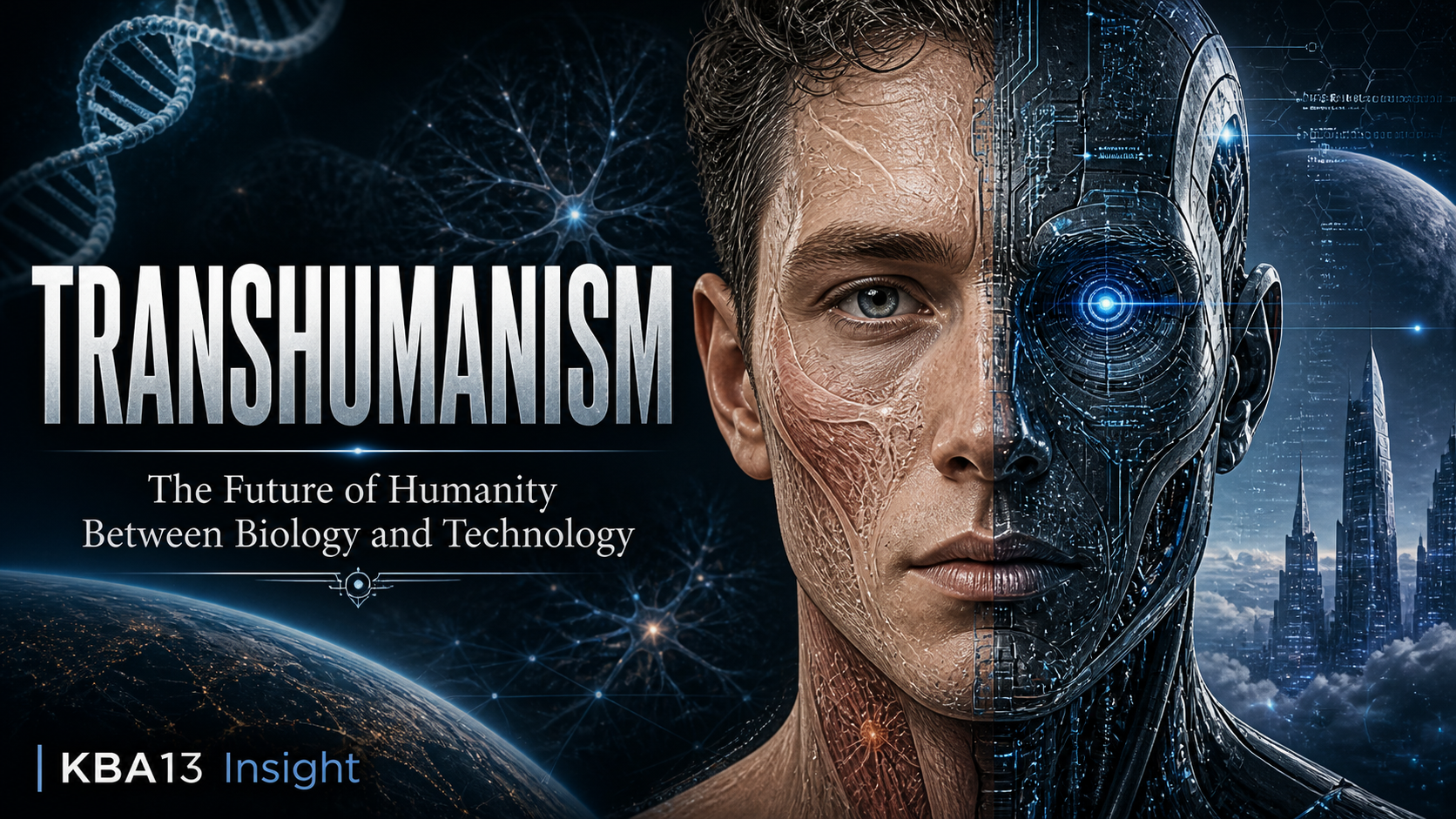
The image of giant robots and cyborgs symbolizes this danger. These images are not only futuristic fantasies. They represent the fear that human beings may surrender their biological, moral, and emotional uniqueness to the logic of machines. A cyborg may be understood not only as a body mixed with technology, but also as a warning about a civilization that no longer knows where human life ends and technological control begins. When machines become models for human perfection, the meaning of humanity itself becomes unstable.
Therefore, transhumanism is not merely a technological issue. It is a civilizational issue. It involves ethics, law, religion, politics, medicine, education, economics, and culture. If humans can be enhanced, then society must ask who controls enhancement, who receives access to it, who benefits from it, and who may be excluded from it. If the human body can be redesigned, then the question of justice becomes unavoidable. Technological progress without ethical governance can create not only stronger humans, but also deeper inequality.
This essay begins from a careful position: transhumanism should neither be rejected blindly nor celebrated naively. It must be examined as one of the most consequential movements of modern civilization. Its promise is the improvement of the human condition through technology. Its danger is the possibility that humanity may lose control over the very technologies created to serve human life. The central issue, therefore, is not simply whether biology and technology can be merged. The deeper issue is whether such a merger will protect human dignity or dissolve it inside a new technological order.
The Meaning and Origin of Transhumanism
Transhumanism must first be understood as a concept that unites two movements of thought: the desire to improve human life and the belief that science can serve as an instrument of transformation. It does not only speak about machines, artificial intelligence, genetic engineering, or future cities. At its core, transhumanism is a philosophy of transition. The human being is situated between inherited biological conditions and a possible future shaped by knowledge, technology, and deliberate intervention. This is why the term “transhumanism” carries the meaning of crossing, moving beyond, and entering a new stage of human existence.
The word itself is significant because it does not simply say “technology.” It says “trans-human.” This means that the central subject remains the human being, but is imagined as capable of moving beyond present limitations. The prefix “trans” gives the concept its historical force. It suggests movement across boundaries: from natural limitation toward engineered capacity, from biological inheritance toward technological enhancement, from passive evolution toward conscious redesign. Transhumanism, therefore, emerges as a way of thinking about the human being as an open project rather than a closed biological destiny.
Julian Huxley occupies an important place in this intellectual history. Huxley connected the idea of human advancement with the scientific imagination of the twentieth century. For Huxley, human beings were not merely creatures shaped by evolution; they could become conscious participants in the direction of their own future. This is the important philosophical shift. Evolution was no longer understood only as a blind natural process. It became something that human intelligence might understand, guide, and perhaps accelerate through science.
The historical meaning of transhumanism therefore cannot be separated from modern confidence in scientific progress. The twentieth century produced new ways of thinking about biology, genetics, medicine, psychology, and social development. Human beings began to see themselves not only as subjects of nature, but also as interpreters and managers of nature. Once the structure of life could be studied scientifically, the possibility emerged that life could also be improved, modified, and redirected. Transhumanism grew from this confidence that knowledge could become an instrument for remaking the human condition.
However, the origin of transhumanism is also ambiguous. On one side, it speaks the language of human improvement. On the other side, it opens the possibility of human redesign. Improvement is easier to accept because it appears ethical, medical, and humanitarian. Redesign is more controversial because it touches identity, dignity, and the boundary of the human. This ambiguity has been present from the beginning. Transhumanism is attractive because it promises liberation from weakness. It is dangerous because it may encourage the belief that all human limits must be eliminated.
The philosophy of transhumanism is also linked to the idea that humanity is still in its early stages of development. Human beings may have built civilizations, religions, states, sciences, and digital systems, but biologically, they remain fragile. They still age, forget, suffer, fear, and die. Transhumanism interprets these realities not only as existential facts but as problems that can be addressed through technology. This creates a new mental framework: what earlier generations accepted as fate may now be viewed as a technical challenge.
This is why transhumanism is deeply modern. It belongs to an age that believes the future can be planned, engineered, and optimized. The old world often understood human life through destiny, nature, divine order, or moral discipline. Transhumanism introduces a different orientation. It asks whether science can expand what nature has given. It asks whether technology can strengthen what biology has limited. It asks whether the future human can become more capable than the present human. These questions show that transhumanism is not merely a scientific idea, but also a civilizational imagination.
At the same time, the origin of transhumanism must not be romanticized. Every idea that seeks to improve humanity carries the risk of defining which version of humanity is considered “better.” This is where transhumanism must be examined carefully. Who decides what counts as improvement? Is longer life always better? Is higher intelligence always wiser? Is technological power always moral progress? These questions are important because the history of human improvement has often been accompanied by domination, exclusion, and hierarchy. Transhumanism must therefore be read through both its promise and its danger.
The early meaning of transhumanism also contains a strong moral aspiration. It does not simply aim to create superior machines or technologically enhanced elites. Its deeper claim is that technology should improve the human condition. This means reducing suffering, expanding knowledge, strengthening human capacity, and opening new possibilities for life. When understood in this way, transhumanism can be placed within the broader history of human attempts to overcome vulnerability. Medicine, education, ethics, and technology all belong to this long struggle. Transhumanism gives that struggle a more radical technological form.
Thus, the meaning and origin of transhumanism reveal a movement that is both philosophical and technological. It begins with the belief that the human being can become more than the present biological condition allows. It grows from modern scientific confidence, especially the belief that life can be studied, understood, and improved. Yet from the beginning, transhumanism also raises a serious question: will the effort to transcend human limitations strengthen human dignity, or will it create a new order in which the human being is measured solely by technological capacity? This question must remain at the heart of any serious discussion of transhumanism.
Why Transhumanism Is Important for Human Adaptation
Transhumanism becomes important because human beings are not passive in the face of change. Human life has always depended on the capacity to adjust, learn, reinterpret, and reorganize itself in relation to the environment. Survival is never only biological. Survival is also cognitive, social, emotional, and technological. Human beings survive because they can read danger, adapt to pressure, create tools, build institutions, and change their patterns of thinking when reality demands a new response.
The key concept here is cognitive flexibility. Human beings are not trapped permanently inside one rigid mental structure. They can change how they think, judge, decide, and respond. This capacity is one of the most important foundations of human survival. Without cognitive flexibility, human beings would remain locked inside old habits even when the environment has already changed. With cognitive flexibility, humans can face uncertainty, revise assumptions, and create new strategies for living.
Transhumanism takes this human capacity for adaptation and places it inside a technological horizon. If the mind can adapt, then technology may become an extension of that adaptive power. Technology not only helps the body work more efficiently. Technology can also help the mind understand itself, expand its capacities, and respond to reality with new instruments. This is why transhumanism is not completely alien to human nature. It grows from a basic human pattern: when humans meet a limitation, they create tools; when tools are not enough, they redesign systems; when systems are not enough, they begin to ask whether the human being itself can be enhanced.
Human adaptation has always involved tools. Fire, language, writing, agriculture, medicine, transportation, and digital networks are all forms of human adaptation. What makes transhumanism different is that the tool is no longer merely outside the human body. The tool begins to approach, enter, and possibly merge with the body. This is the decisive shift. Technology moves from being external support to becoming internal enhancement. The human being is no longer only the user of technology, but also becomes the site where technology operates.
This is why transhumanism forces a new understanding of adaptation. In earlier forms of adaptation, humans changed their environment in order to survive. In transhumanism, humans may begin to change themselves in order to survive, compete, heal, or evolve. This movement is powerful, but also dangerous. If adaptation is guided by wisdom, technology can help human beings overcome disease, disability, ignorance, and suffering. But if adaptation is guided only by competition and ambition, technology can create a new hierarchy between those who are enhanced and those who remain biologically ordinary.
The importance of transhumanism also lies in the way it changes the meaning of human limitation. In traditional human experience, limitation is often accepted as part of life. Weakness, aging, pain, and death are treated as existential realities. Transhumanism approaches limitation differently. It asks whether limitation is a destiny or a problem to be solved. This question is powerful because it has driven many medical and scientific achievements. Yet it is also troubling because not every limit should automatically be destroyed. Some limits teach humility, dependence, compassion, and moral responsibility.
Adaptation, therefore, is not only a technical matter. It is also an ethical matter. A society that enhances human capacity must also ask what kind of human character is being formed. Greater memory does not automatically produce wisdom. Longer life does not automatically produce meaning. Stronger bodies do not automatically produce justice. Faster intelligence does not automatically produce compassion. Transhumanism becomes important precisely because it reveals the gap between capacity and morality. Humans may become more capable, but capability alone cannot define the good life.
This is where empathy becomes central. If human beings can understand change within themselves, they may also become more sensitive to change in others. Transhumanism can become valuable when it deepens awareness that all living beings exist within conditions of vulnerability and transformation. The body changes. The mind changes. Societies change. Species adapt. Planets experience pressure. A technological understanding of life should not make humans arrogant. It should make them more aware of the fragile networks that sustain existence.
However, there is always a risk that transhumanism may narrow rather than expand empathy. If the project of enhancement is controlled by power, wealth, and technological privilege, then adaptation may become a weapon of exclusion. Those who possess access to enhancement may consider themselves more advanced, more efficient, and more valuable than others. This would turn transhumanism from a philosophy of human improvement into a system of technological hierarchy. The danger is not only the machine. The danger is the human ego armed with machines.
For this reason, transhumanism is important not because it gives simple answers, but because it reveals the deepest question of human adaptation in the modern age. Can human beings use technology to become more aware, more compassionate, and more responsible? Or will they use technology only to become faster, stronger, longer-living, and more dominant? The answer will determine whether transhumanism becomes a positive force for the human condition or a dangerous step toward a future where adaptation loses its moral center.
Transhumanism, Epigenetics, and the Flexibility of the Human Mind
Transhumanism becomes more serious when the discussion moves from external technology to the internal flexibility of human life. Human beings are not mechanical objects locked forever inside one fixed biological condition. They are living organisms whose bodies, minds, habits, emotions, and responses are shaped by interaction with the environment. This is why the idea of human flexibility is central. The human being survives not only because of physical strength, but because of the capacity to change, adjust, and reorganize patterns of life.
Epigenetics gives an important doorway into this discussion. It points to the reality that human life is not controlled only by inherited biological structure. Environment, behavior, pressure, experience, nutrition, stress, and social condition can influence how biological potential is expressed. This means that the human being is not merely a prisoner of genetic inheritance. Human life is dynamic. It responds. It absorbs pressure. It changes according to circumstances. This is one reason transhumanism becomes attractive: it begins from the belief that the human condition can be modified.
The flexibility of the human mind also shows that human identity is not static. Humans can learn new languages, develop new skills, revise beliefs, recover from trauma, change moral orientation, and adapt to new worlds. The mind is not a closed chamber. It is a living field of perception, memory, habit, imagination, and decision. When transhumanism speaks about improving human capacity, it is standing on this deeper assumption: if the mind is already flexible, then technology may become another instrument for expanding that flexibility.
However, this must be understood carefully. Flexibility does not mean that the human being can be altered without consequence. A living mind is not the same as a software system that can simply be upgraded. Human thought is connected to memory, emotion, culture, body, family, society, and moral experience. Any technological intervention into human cognition must therefore be examined with caution. To enhance the mind is not only to increase speed or capacity. It may also alter the way humans feel, remember, relate, and understand meaning.
This is where transhumanism touches one of the deepest questions of modern civilization. If the human mind can be technologically assisted, modified, or expanded, what happens to responsibility? If memory can be strengthened by devices, if attention can be regulated by systems, if emotion can be influenced through biological or digital intervention, then the boundary between natural self and engineered self becomes increasingly difficult to define. The human mind may become more capable, but capability alone does not answer the question of authenticity.
The flexibility of the human mind has always been one of humanity’s greatest strengths. It allows humans to survive war, migration, disaster, social change, and technological revolution. But the same flexibility can also become a site of manipulation. A mind that can adapt can also be conditioned. A mind that can learn can also be programmed. A mind that can change can also be captured by systems of power. Therefore, transhumanism must not only ask how the mind can be enhanced. It must also ask who controls the conditions of enhancement.
This is especially important in an age where technology is not neutral. Digital platforms, artificial intelligence, biotechnology, and data systems do not merely serve users. They also shape behavior, attention, desire, and perception. When transhumanism enters this world, the risk is that human flexibility may be exploited by economic, political, or technological interests. Enhancement may be presented as freedom, while in reality, it may produce deeper dependence on systems controlled by institutions, corporations, or states.
The relationship between epigenetics and transhumanism also reminds us that human improvement cannot be separated from the environment. A person’s biological and mental development is shaped by social conditions. Poverty, violence, education, nutrition, inequality, and ecological crisis all affect the human condition. Therefore, any serious transhumanist vision must not focus only on advanced technology for selected individuals. It must also consider the broader environment that shapes human life. Otherwise, transhumanism will become an elite project disconnected from real human suffering.
The flexibility of the human mind should lead to humility, not arrogance. It shows that humans are capable of change, but also vulnerable to influence. Humans can rise above limitations, but they can also be damaged by hostile environments. Humans can use technology to understand themselves, but they can also lose themselves inside technological systems. This double possibility must remain visible. Transhumanism becomes meaningful only when enhancement is connected to responsibility, not merely ambition.
Thus, the discussion of epigenetics and the flexibility of the human mind brings transhumanism back to its most important moral question. If humans are changeable beings, what kind of change should be pursued? Not every transformation is progress. Not every enhancement is wisdom. Not every expansion of capacity strengthens humanity. The future of transhumanism depends on whether human flexibility is used to deepen self-awareness, empathy, and dignity, or whether it becomes a pathway toward control, dependency, and the gradual engineering of the human soul.
Transhumanism as a Path Toward Empathy and Planetary Awareness
Transhumanism becomes more meaningful when it is not reduced to the ambition of making humans stronger, smarter, or longer-living. The deeper value of transhumanism appears when technological enhancement is connected to moral expansion. If human beings use technology only to increase individual capacity, then transhumanism will become narrow and selfish. But if technology helps humans understand vulnerability, suffering, interdependence, and the fragile condition of life, then transhumanism can become a path toward empathy.
Empathy is central because the human condition is not only a biological condition. It is also a relational condition. Human beings live with other humans, other species, and the planet. No human life stands alone. Every body depends on air, water, food, social care, ecological balance, and the presence of other living systems. Transhumanism becomes important when it teaches that improving the human condition cannot mean isolating humans from the wider network of life. Enhancement must not produce arrogance. Enhancement must produce deeper responsibility.
The first form of empathy in transhumanism is empathy toward other human beings. If technology allows humans to understand pain, disease, disability, aging, and mental struggle more precisely, then technology should also deepen compassion. Medical technology, genetic knowledge, artificial intelligence, and cognitive science can reveal how fragile the human body and mind actually are. This knowledge should not be used to divide people between the enhanced and the unenhanced. It should be used to reduce suffering and strengthen human solidarity.
The second form of empathy is empathy toward other species. Human beings are not the only living organisms undergoing change, pressure, and adaptation. Animals, plants, ecosystems, and microorganisms all exist within networks of survival. Transhumanism, when understood carefully, can foster a broader awareness of life’s interconnectedness. If humans study biology deeply, they should not conclude that humans are masters over all life. They should understand that human life is only one part of a larger planetary system.
This is where planetary awareness becomes necessary. The future of human enhancement cannot be separated from the future of the Earth. A technologically advanced humanity living on a damaged planet would be a contradiction. If transhumanism produces smarter humans but ignores ecological destruction, then its intelligence is incomplete. If it produces stronger bodies but weakens the planet, then its vision is morally broken. The improvement of the human condition must include protecting the conditions that make human life possible.
Transhumanism, therefore, must not become a philosophy of escape. Some visions of the future imagine humans leaving behind biological fragility, earthly limitation, and ecological dependence. But this imagination can become dangerous if it encourages contempt for nature. The body is not merely a prison. Nature is not merely an obstacle. Biological life is not merely a weakness to be overcome. Human beings are formed through biological, ecological, and social relations. To forget this is to misunderstand the meaning of humanity itself.
At its best, transhumanism can help humans see that change is not an individual experience alone. Every living system changes. Bodies change. Societies change. Species change. Climate changes. Civilizations change. If humans understand change within themselves, they may also understand change in others. This is the moral possibility of transhumanism. It can teach that transformation is not a privilege of the powerful, but a shared condition of life. From this awareness, empathy can become more than emotion. It can become a structure of civilization.
However, empathy cannot be automatically produced by technology. This point must be made clearly. Technology can provide data about suffering, but data is not compassion. Technology can map disease, but mapping is not care. Technology can measure ecological damage, but measurement is not moral action. Transhumanism becomes dangerous when it assumes that more knowledge will automatically create better humans. History shows that knowledge without ethics can serve domination. Intelligence without compassion can become cruelty with better instruments.
This is why transhumanism must be guided by a moral horizon. The question is not only what humans can become through technology, but what kind of responsibility humans are willing to carry after becoming more powerful. Enhanced humans must not become less sensitive to ordinary human pain. Technologically advanced societies must not treat weaker communities as backward. Scientific progress must not turn living beings into raw material for experimentation. Without empathy, transhumanism may become another language of power.
Planetary awareness also requires humility. Human beings may develop artificial intelligence, genetic engineering, cyborg technologies, and advanced medical systems, but they still remain dependent on the Earth. Breath, food, water, climate, and ecological balance cannot be replaced by technological pride. Transhumanism matures only when it recognizes that humanity’s future is inseparable from the planet’s. The human being may be enhanced, but enhancement has no meaning if the world that sustains life is destroyed.
Therefore, the path toward empathy and planetary awareness is one of the most important dimensions of transhumanism. It prevents the movement from becoming a cold project of technological superiority. It reminds humanity that the purpose of enhancement is not domination, but deeper understanding. If transhumanism can strengthen empathy toward other humans, other species, and the planet, then it may become a positive force for civilization. But if it separates intelligence from compassion and power from responsibility, it will produce a future that is advanced in machinery but poor in humanity.
The Future of Transhumanism: Healthcare, Personal Empowerment, and Nature
The future of transhumanism will not appear only in the form of spectacular machines, giant robots, or dramatic images of cyborg civilization. Its first and most visible field will be healthcare. Human beings have always used medicine to fight disease, reduce pain, restore bodily function, and extend life. Transhumanism pushes this medical project further. It asks whether healthcare should only heal the sick body, or whether it can also enhance the healthy body. This question changes the entire meaning of medicine.
Healthcare becomes one of the most important arenas of transhumanism because the human body is the first site of vulnerability. The body ages. The body weakens. The body carries genetic risks. The body can be damaged by accident, disease, environment, and time. Through biotechnology, artificial organs, genetic research, neural devices, robotic surgery, and advanced diagnostics, transhumanism imagines a future where the body is no longer merely treated after illness, but continuously monitored, repaired, optimized, and possibly redesigned.
This future offers great promise. Earlier detection of disease can save lives. Genetic knowledge can help prevent inherited disorders. Artificial intelligence can assist in diagnosis. Prosthetic technologies can restore mobility. Brain-computer interfaces may help people with severe neurological limitations communicate or move again. In this sense, transhumanism can become deeply humane. It can reduce suffering for those whose bodies have been limited by disease, disability, injury, or aging. The technology becomes meaningful because it returns dignity to human life.
But healthcare also shows the moral complexity of transhumanism. Healing and enhancement are not always easy to separate. If technology restores sight to a blind person, it appears as therapy. But if the same technology gives a healthy person superior vision beyond ordinary human capacity, it becomes an enhancement. If medicine treats memory loss, it serves healing. But if medicine is used to produce extraordinary memory for competitive advantage, it enters another moral territory. The future of transhumanist healthcare will therefore require a serious ethical distinction between care, correction, improvement, and engineered superiority.
Personal empowerment is the second major field of transhumanism. The idea is that individuals may gain greater control over their bodies, minds, health, learning, productivity, and life choices through technology. Wearable devices, digital health systems, cognitive tools, artificial intelligence assistants, and personalized medicine all point to a future in which human beings understand themselves through data. The body becomes readable. Sleep, movement, heart rate, attention, mood, and biological patterns become measurable. The self becomes increasingly translated into information.
This can empower individuals, but it can also create new forms of dependency. When humans come to understand themselves only through devices, numbers, metrics, and algorithmic feedback, self-knowledge may narrow. A person may know heart rate, sleep score, productivity level, and genetic risk, but still fail to understand meaning, purpose, fear, loneliness, or moral direction. Transhumanism must therefore be careful not to confuse measurement with wisdom. Data can inform life, but data cannot replace the inner work of becoming human.
The future of personal empowerment also raises questions about inequality. If enhancement technologies are expensive, they will first serve those with wealth, access, and institutional privilege. This can create a society divided between those who can afford better bodies, sharper cognition, longer life, and superior medical protection, and those who remain exposed to ordinary biological suffering. A future that promises empowerment for all may become empowerment for the few. This is one of the most serious dangers in the social future of transhumanism.
The third field is the human relationship with nature. Transhumanism often speaks about overcoming limitations, but nature is not merely a limitation. Nature is also the condition of life. Human bodies are biological. Human minds are shaped by ecological and social worlds. Human survival depends on air, water, food, climate, and planetary balance. If transhumanism teaches humans to escape nature alone, then it creates an incomplete future. A civilization cannot become more advanced by despising the very systems that sustain it.
A mature transhumanism must therefore rethink the relationship between enhancement and ecology. Technology should not separate human beings from nature, but help them understand nature more deeply. Genetic knowledge, environmental monitoring, artificial intelligence, and planetary systems analysis can help humanity protect ecosystems, manage resources, and understand the fragility of life. In this sense, transhumanism can contribute to a better relationship with nature, but only if its ambition is disciplined by ecological responsibility.
The future of transhumanism will also force humanity to understand the biological self more carefully. As artificial intelligence grows and the world becomes more connected, human beings may feel compelled to study themselves with greater intensity. They will ask what makes the body alive, what makes consciousness meaningful, what makes emotion human, and what separates biological intelligence from artificial intelligence. This self-understanding can be valuable. Yet there is a danger if humans become too absorbed in themselves and forget the world around them. A future obsessed with self-enhancement may produce individuals who are powerful but disconnected.
Therefore, the future of transhumanism must be judged by its balance. In healthcare, it must reduce suffering without turning the body into a commercial project of endless optimization. In personal empowerment, it must strengthen human agency without making humans dependent on machines for every form of self-understanding. In relation to nature, it must deepen planetary responsibility rather than encourage escape from biological and ecological reality. The future of transhumanism will be bright only if its technologies remain anchored in human dignity, social justice, and respect for the living world.
Robots, Cyborgs, and the Problem of Human-Machine Interaction
The future of transhumanism becomes more complicated when the discussion moves from healthcare and personal empowerment to robots, cyborgs, and human-machine interaction. At this level, technology is no longer only a supporting instrument for human life. Technology begins to appear as a partner, competitor, extension, and possible replacement. The human being does not merely ask how machines can help the body or mind. The human being begins to ask whether machines can participate in the sphere of meaning, relationship, intelligence, and social recognition.
Robots represent one of the clearest symbols of this future. A robot is not merely a machine that performs repetitive work. In the transhumanist imagination, robots may become increasingly intelligent, responsive, adaptive, and socially present. If artificial intelligence continues to develop, robots may not only move objects, process commands, or assist labor. They may speak, learn, recognize patterns, respond emotionally, and interact with humans in ways that appear meaningful. This creates a new ethical problem: when a machine behaves as if it understands, how should humans respond?
The question becomes sharper when robots are designed to imitate human behavior. A machine that speaks politely, remembers preferences, recognizes faces, offers companionship, and responds to emotional signals can create the impression of a relationship. But the relationship with machines remains ambiguous. Is the machine truly engaging in human interaction, or merely simulating response patterns? Does meaningful interaction require consciousness, or is behavioral responsiveness enough? Transhumanism forces this difficult question because it places humans inside a world where machines may become socially persuasive.
Cyborgs introduce an even deeper problem because they blur the boundary between human and machine from within the body itself. A cyborg is not only a futuristic figure. It represents the condition in which biological existence is technologically extended, assisted, repaired, or enhanced. A person with advanced implants, neural devices, artificial limbs, sensory extensions, or machine-assisted cognition already lives near this boundary. The cyborg is therefore not only an image of the future. It is also a sign that the boundary between natural body and technological body has already begun to shift.
The central issue is not whether cyborg technology is good or bad in itself. For many people, technological integration can restore dignity. Artificial limbs can restore movement. Implants can restore hearing. Medical devices can sustain life. Neural technologies may help people communicate when the body can no longer obey the will. In this sense, the cyborg condition can be deeply humane. It can return agency to those who have lost bodily function. It can transform technology into a form of care.
However, the same cyborg logic can become dangerous when healing turns into competitive enhancement. A body repaired by technology is one thing. A body redesigned to become superior is another. If cyborg technologies move from restoration to performance optimization, society will face difficult questions. Will enhanced bodies become privileged bodies? Will unenhanced humans be treated as inefficient or inferior? Will the labor market, military, education system, and social hierarchy begin to reward those who have technological upgrades? These questions show that cyborg technology is never only personal. It is social and political.
Human-machine interaction also changes the meaning of intelligence. For a long time, intelligence was associated with human reasoning, judgment, memory, imagination, and moral reflection. Artificial intelligence challenges this assumption by producing systems that can calculate, classify, predict, generate language, and solve problems at extraordinary speed. When humans interact with such systems every day, they may begin to compare their own minds with machine performance. This comparison can create both humility and anxiety. Humans may admire machines, but they may also feel diminished by them.
This anxiety is not only psychological. It is civilizational. If machines become better than humans in speed, memory, calculation, prediction, and pattern recognition, then human societies may gradually redefine value around machine-like qualities. Efficiency may become more important than wisdom. Productivity may become more important than moral judgment. Precision may become more important than compassion. The danger is not that machines become human. The deeper danger is that humans begin to measure themselves according to the logic of machines.
The problem of human-machine interaction also includes responsibility. When humans act through machines, who is responsible for the outcome? If an artificial intelligence system makes a medical recommendation, military decision, financial judgment, or social classification, responsibility cannot be left floating inside the machine. A machine may process data, but humans build, deploy, regulate, and benefit from that machine. Transhumanism must therefore insist that technological complexity cannot become an excuse for moral evasion. The more powerful the machine, the greater the need for human accountability.
This issue becomes even more serious when machines are given emotional or social roles. A robot caregiver, AI companion, digital tutor, or therapeutic machine may help people. But these systems also risk replacing human care with technological simulation. A lonely person may feel comforted by a machine that speaks gently, but society must ask why loneliness became so deep that machines were needed to fill the absence of human presence. Technology can assist care, but it should not become an excuse for abandoning human responsibility toward one another.
Therefore, robots, cyborgs, and human-machine interaction must be placed at the heart of transhumanist debate. They show that the future is not only about better tools, but about changing boundaries: between human and machine, therapy and enhancement, intelligence and consciousness, simulation and relationship, assistance and dependency. Transhumanism becomes dangerous when it forgets these boundaries. But it becomes meaningful when it uses technology to restore dignity, reduce suffering, and deepen human responsibility. The central question remains clear: will machines help humans become more humane, or will humans slowly become disciplined by the logic of machines?
The History of Transhumanism: Genetics, Social Change, and Bioethics
The history of transhumanism must be read through the meeting point between scientific ambition and social change. It did not emerge merely from fantasy about machines or distant speculation about the future. It grew from a wider intellectual atmosphere where human beings began to believe that biology, heredity, disease, reproduction, and social life could be studied, understood, and gradually transformed. This is why the history of transhumanism is inseparable from genetics, evolutionary thought, medical research, and the rise of bioethical reflection.
Julian Huxley stands as one of the important names in the early formation of this idea. The significance of Huxley lies not only in the use of the term transhumanism but in the wider vision that humanity could participate consciously in its own development. The human future was no longer seen as determined solely by blind nature. It could be shaped by science, reason, and deliberate intervention. This view changed the meaning of human evolution. Evolution was no longer merely something that happened to humans; it became something humans might try to understand and direct.
Genetics then became one of the most decisive foundations for this imagination. Once human life could be studied at the level of genes, the human body began to appear as a readable structure. Disease, inheritance, mutation, biological risk, and bodily potential could be examined through scientific methods. This gave transhumanism a powerful intellectual basis. If the biological structure of the human being can be understood, then perhaps it can also be repaired, improved, or modified. Genetics, therefore, opened one of the most sensitive doors in the history of human self-understanding.
The Human Genome Project represents a major turning point in this direction. It showed that modern science could map the biological information that shapes human life. This achievement was not merely technical. It carried deep philosophical consequences. To map the human genome is to move closer to the inner code of biological existence. It gives medicine new possibilities, especially for understanding genetic diseases and inherited vulnerabilities. But it also raises serious questions about privacy, prediction, selection, and the possibility of treating human life as biological data.
This is why genetic knowledge always requires ethical control. The ability to identify mutations linked to disease can save lives. But the same knowledge can also be misused to classify, select, exclude, or rank human beings according to biological traits. The history of transhumanism cannot be separated from this danger. Every project that speaks about improving humanity must confront the risk of deciding which kinds of human bodies are considered desirable and which are considered defective. Without ethics, genetic knowledge can easily move from healing to domination.
The social changes of the twentieth century also shaped the rise of transhumanist thought. Modern societies began to rethink reproduction, family, sexuality, rights, and individual autonomy. The birth control pill, family planning, civil rights movements, and new debates on sexuality changed how people understood the body and social freedom. These changes created a wider moral environment in which biological life was no longer treated only as fate. The body became a site of choice, regulation, identity, and political debate.
From this context, bioethics became increasingly important. Bioethics emerged because scientific progress was outpacing old moral frameworks. Medicine, genetics, reproductive technologies, and human experimentation forced societies to ask new questions. What should science be allowed to do? Who gives consent? Who protects vulnerable bodies? Who benefits from medical innovation? Who may be harmed by it? These questions are essential to transhumanism because the movement addresses the future of the body, mind, and human identity.
Bioethics also reminds transhumanism that not everything technically possible is morally acceptable. A civilization may possess the power to modify life, but power does not automatically create legitimacy. The ethical question must always precede the technological application. If humans can alter genes, extend life, implant devices, or enhance cognition, the question is not only whether the procedure works. The question is whether it respects dignity, justice, consent, and the deeper meaning of human life.
The history of transhumanism, therefore, moves through a complex path. It begins with optimism about human improvement, develops through scientific discoveries in biology and genetics, and becomes entangled with social movements that redefine the meaning of bodily autonomy. At every stage, the same tension appears: science promises liberation from limitation, but also creates new instruments of control. This tension makes transhumanism both historically important and morally unstable.
For that reason, the history of transhumanism should not be written as a simple story of progress. It is better understood as a history of possibility and warning. Genetics gave humanity new knowledge of biological life. Social change gave individuals new claims over their bodies and futures. Bioethics emerged to prevent scientific ambition from becoming reckless power. The future of transhumanism will depend on whether this historical lesson is taken seriously: the human being may be improved through technology, but the human being must never be reduced to an object of technological experimentation.
The Three Main Goals and Core Principles of Transhumanism
Transhumanism has three major goals that must be understood as a single, interconnected intellectual framework. The first goal is to improve the human condition through technology. The second goal is to deepen human understanding through genetics and evolution. The third goal is to build a more meaningful connection between human beings and other living organisms. These three goals show that transhumanism is not only a technological movement. It is also a project of knowledge, ethics, and future-oriented human transformation.
The first goal is the most direct: technology is used to improve biological function. This means that the body is no longer seen only as something to be accepted in its natural limits. The body can be treated, repaired, supported, and possibly enhanced. Medical devices, genetic knowledge, artificial intelligence, robotics, and biological engineering all belong to this horizon. The aim is to reduce suffering, overcome weakness, and expand human capability. In this sense, transhumanism continues the long history of medicine, but pushes it toward a more radical future.
However, improving biological function must not be understood solely as producing stronger or more efficient humans. The moral purpose must remain clear. If technology helps a disabled person walk, helps a sick person recover, helps a patient understand genetic risk, or helps an aging body maintain dignity, then transhumanism serves life. But if improvement becomes merely a competition for superiority, the meaning changes. Technology may then become a tool for ranking human beings according to capacity, productivity, and access to enhancement.
The second goal is to increase the understanding of humanity through genetics and evolution. This goal is important because transhumanism not only asks how humans can be improved, but also what humans are. Genetics allows humans to understand inherited traits, disease, mutation, biological variation, and the hidden architecture of life. Evolution allows humans to understand that they are part of a longer biological history. Together, genetics and evolution place humanity inside a wider scientific narrative.
Yet this knowledge must be handled with intellectual humility. To know the genetic structure of human life does not mean that the full meaning of humanity has been solved. A human being is not only genes. A human being is also memory, language, culture, moral struggle, social relations, imagination, and spiritual depth. Transhumanism becomes dangerous when it reduces the human being to biological information. Genetics can explain many things, but it cannot exhaust the meaning of human dignity.
The third goal is to promote a deeper connection between humans and other living organisms. This goal is often less dramatic than artificial intelligence or cyborg technology, but it is morally crucial. Human beings live among other forms of life. They are not isolated from the biological world. Serious transhumanism must therefore avoid the arrogance of treating nature solely as material for human enhancement. It must recognize that human improvement has meaning only within the wider network of life.
This deeper connection with living organisms can create a more responsible understanding of human progress. If humans understand genetics, evolution, and biological interdependence, they should become more careful in dealing with animals, plants, ecosystems, and the planet. Scientific knowledge should not produce domination alone. It should produce responsibility. The more humans understand life, the more they must respect the fragile systems that sustain life. Without this respect, transhumanism will become technologically advanced but ethically poor.
The core principle of transhumanism is that new technologies should be used for positive purposes and human well-being. This principle is essential because technology has no automatic moral direction. The same technology can heal or harm. Artificial intelligence can assist in diagnosis or deepen surveillance. Genetic knowledge can prevent disease or create biological discrimination. Robotics can help care for the vulnerable or replace human responsibility with mechanical systems. Therefore, the question is never only about innovation. The question is always about purpose.
A positive transhumanism must place well-being above technological pride. Human beings should not pursue enhancement simply because enhancement is possible. The real test is whether a technology reduces suffering, expands dignity, strengthens justice, and deepens human responsibility. If technology only increases power without moral direction, it becomes dangerous. If technology only benefits elites while leaving many people behind, it becomes unjust. If technology weakens compassion, it fails even when it succeeds technically.
Another principle is that humanity must become more connected, but this connection must not be reduced to digital connectivity. Being connected means more than living inside networks, platforms, devices, and artificial systems. It also means becoming more aware of shared vulnerability. Humans are connected through biology, ecology, society, and moral responsibility. Transhumanism becomes meaningful when technology strengthens these forms of connection rather than replacing them with shallow technological dependency.
The use of artificial intelligence and robotics must therefore be placed within a broader ethical frame. AI and robotics can expand human capacity, but they should not become substitutes for human wisdom. They can assist decision-making, but they must not remove responsibility. They can support care, but they must not erase compassion. They can help humans work faster, but speed cannot become the highest value of civilization. A society that becomes more technological must also become more morally disciplined.
Thus, the goals and principles of transhumanism reveal its double character. It is a project of improvement, but also a project that requires restraint. It seeks to enhance human life, but must not forget the meaning of human dignity. It studies genetics and evolution, but must not reduce human beings to biological data. It promotes connection with other living organisms, but must resist the arrogance of technological domination. The future of transhumanism will depend on whether its principles remain stronger than its ambitions.
Challenges, Communities, and the Road Ahead for Transhumanism
The future of transhumanism will be determined not only by the speed of technological invention, but by the quality of ethical judgment that accompanies it. New technologies will continue to emerge. Artificial intelligence will become more sophisticated. Genetic research will become more precise. Robotics will become more adaptive. Medical devices will become more intimate with the body. Human beings will increasingly live inside technological systems that monitor, assist, predict, and influence daily life. The real challenge is not whether these technologies will develop. The real challenge is whether humanity can govern them wisely.
The first major challenge is balance. Transhumanism can become dangerous when human beings become overly focused on understanding, measuring, and enhancing themselves, losing attention to the world around them. Self-knowledge is important, but self-obsession is dangerous. A civilization that constantly monitors the body, optimizes cognition, measures emotion, tracks performance, and upgrades personal capacity may become technically advanced but spiritually narrow. A person may gain more data about the self, yet lose deeper contact with society, nature, and moral responsibility.
The second challenge is the ethical use of genetics. Genetic knowledge can help humanity understand disease, biological risk, inheritance, and human variation. It can become a powerful instrument for healing and prevention. But the same knowledge can also produce discrimination, selection, and hierarchy. If genetic information becomes a tool for ranking human value, then transhumanism will betray its promise to improve the human condition. The future requires a strong ethical framework so that genetics serves dignity, not domination.
The third challenge is artificial intelligence. AI may help humans diagnose disease, process complex information, build safer systems, and understand patterns beyond ordinary human capacity. Yet AI also raises difficult questions about autonomy, accountability, bias, surveillance, and dependence. When humans rely too heavily on intelligent machines, they may slowly surrender judgment to systems they do not fully understand. This is one of the biggest risks of transhumanism: technology may begin as assistance, but gradually become authority.
The fourth challenge is inequality. Enhancement technologies will not be distributed equally if they are controlled only by markets, corporations, and elite institutions. Wealthy groups may gain access to better health, longer life, sharper cognition, and stronger technological protection, while poorer communities remain trapped in ordinary biological and social vulnerability. This would create a new kind of class division: not only between the rich and the poor, but also between enhanced and unenhanced human beings. Transhumanism must confront this danger seriously.
The fifth challenge is the possibility of losing the human center. Technology should improve the human condition, not replace the meaning of humanity with machine logic. The danger is subtle. Humans may begin to admire speed more than reflection, efficiency more than wisdom, optimization more than character, and connectivity more than intimacy. If this happens, transhumanism will not produce a more humane civilization. It will produce a civilization where the human being is redesigned according to the values of machines.
Communities, websites, organizations, summits, and conferences play an important role in shaping the road ahead. They are not merely places for discussion. They are spaces where the future is imagined, debated, promoted, and contested. Through these networks, transhumanist ideas circulate across scholars, technologists, futurists, entrepreneurs, ethicists, and ordinary people who are interested in the future of humanity. These communities can become valuable when they open serious debate. But they can become dangerous if they only celebrate technological acceleration without moral reflection.
The road ahead for transhumanism must therefore be guided by critical communities, not blind enthusiasm. Every conference, organization, and intellectual forum should ask difficult questions. What kind of human being is being imagined? Who benefits from enhancement? Who controls the technology? What happens to those who refuse enhancement? What happens to human dignity when the body becomes an object of continuous redesign? What happens to society when intelligence, health, and longevity become products available only to those who can pay?
A responsible future for transhumanism requires a new alliance between science, ethics, law, religion, philosophy, medicine, ecology, and public policy. No single field can control the consequences of human enhancement alone. Scientists may understand the technology, but ethics must ask whether it should be used. Law must regulate its social impact. Religion and philosophy must question its meaning. Medicine must protect human dignity. Ecology must remind humanity that no enhanced human can survive on a damaged planet. Public policy must ensure that technological progress does not become a privilege for a small class.
The final lesson is clear: transhumanism is not simply about the future of technology. It is about the future of the human condition. Its promise is real because technology can reduce suffering, improve health, expand knowledge, and deepen self-understanding. Its danger is also real because the same technology can produce inequality, dependency, dehumanization, and moral confusion. The road ahead will depend on whether humanity can keep technology as a servant of dignity rather than allowing technology to become the new measure of human worth.
Therefore, transhumanism must be approached with hope, caution, and discipline. It should not be rejected merely because it is radical, but it should not be embraced merely because it is advanced. The true question is not whether humans can merge biology with technology. The true question is whether this merger will make humanity more responsible, more compassionate, and more aware of its place within the wider order of life. If transhumanism protects dignity, reduces suffering, and strengthens moral awareness, it may become a positive force for the future. If it worships power without wisdom, it may become one of the most dangerous illusions of modern civilization.
About The Author

Kamaruzzaman Bustamam Ahmad
Prof. Kamaruzzaman Bustamam Ahmad (KBA) has followed his curiosity throughout life, which has carried him into the fields of Sociology of Anthropology of Religion in Southeast Asia, Islamic Studies, Sufism, Cosmology, and Security, Geostrategy, Terrorism, and Geopolitics. Prof. KBA is the author of over 30 books and 50 academic and professional journal articles and book chapters. His academic training is in social anthropology at La Trobe University, Islamic Political Science at the University of Malaya, and Islamic Legal Studies at UIN Sunan Kalijaga Yogyakarta. He received many fellowships: Asian Public Intellectual (The Nippon Foundation), IVLP (American Government), Young Muslim Intellectual (Japan Foundation), and Islamic Studies from Within (Rockefeller Foundation). Currently, he is Dean of Faculty and Shariah, Universitas Islam Negeri (UIN) Ar-Raniry, Banda Aceh, Indonesia.
Rekomendasi Bacaan KBA13 INSIGHT
Jika tulisan ini bermanfaat, dukung jurnal ini dengan mencari bukunya melalui tautan berikut:
- Buku-buku Kamaruzzaman Bustamam Ahmad di Periplus
- Koleksi Islamic Studies di Periplus
- Koleksi Geopolitics & Politik Internasional di Periplus
- Cari buku & perangkat baca di Shopee
- Cari di Blibli
Daftar lengkap: Rekomendasi Buku, Alat Tulis & Layanan. Tautan di atas adalah tautan afiliasi — KBA13 INSIGHT dapat memperoleh komisi kecil tanpa biaya tambahan bagi Anda.
Artikel Terkait
 Artificial Intelligence and the World Order of 2040: A Strategic Essay on AI, Extraterrestrial Intelligence, and the Future of Humanity
 The Six Epochs of Intelligence: Ray Kurzweil, AI, and the Cosmic Future of Mind
 The Future of Cooperation between Humans and Aliens
 Google and the New Theology of the Internet: Data, Power, AI, and the Crisis of Human Freedom
 One World in the Planetary Era: Kishore Mahbubani, Global Convergence, and the Future of Civilization
Leave a Reply