
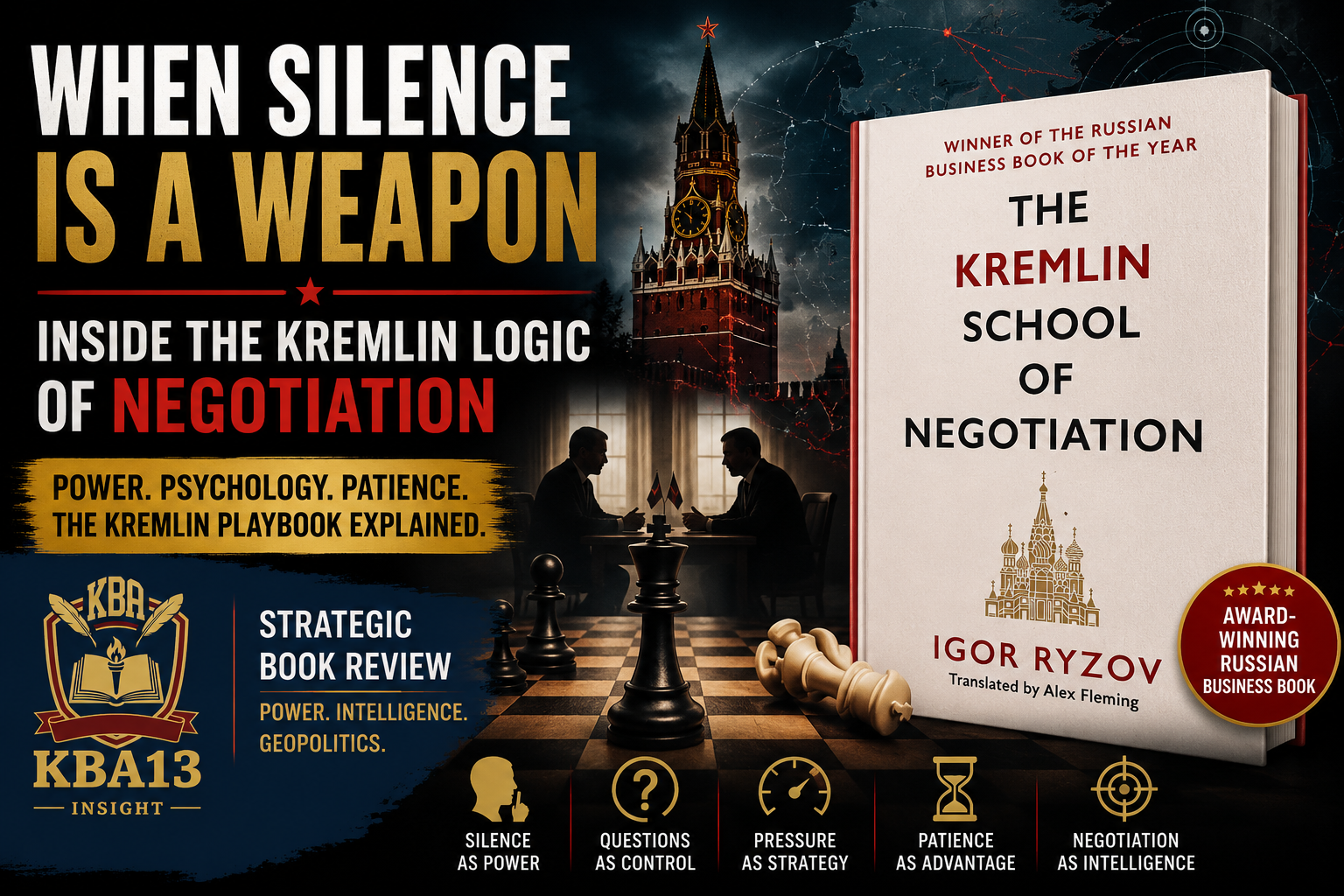
When Silence Is a Weapon: A Deep Reading of Ryzov’s Kremlin Playbook
There is a scene embedded in the institutional memory of Cold War diplomacy that Westerners have never quite forgotten and never quite understood. It is 1946. The United Nations Security Council is in session. A resolution is on the table. The Soviet representative raises his hand. “Nyet.” The room stiffens. The proposal is reformulated, redrafted, and presented again with different language. “Nyet.” Weeks pass. The proposal returns, this time with a new sponsor and new concessions built into the text’s architecture. “Nyet.” The man delivering these verdicts is Andrei Andreyevich Gromyko — a figure who, over his nearly three decades as Soviet foreign minister and forty-plus years in Soviet diplomacy, would deploy the veto or its equivalent more times than any diplomat in the history of multilateral negotiation. The West nicknamed him “Mr. Nyet.” They intended it as a mockery. Gromyko took it as professional certification.
Igor Ryzov’s The Kremlin School of Negotiation — originally published in Russian in 2016, awarded the PwC Prize for Best Business Book in the Russian language that same year, and translated into English by Alex Fleming for Canongate in 2019 — begins, implicitly, with that scene. The book’s entire argument rests on a claim that Gromyko embodied: that in any negotiation, the party with the greatest tolerance for discomfort, ambiguity, and delay is structurally advantaged over the party that needs resolution. The Kremlin method, as Ryzov presents it, is a systematic exploitation of that asymmetry. It is not a philosophy of aggression. It is a philosophy of patience weaponized.
This review will read the book precisely—as precisely as the book demands—examining its actual mechanics, its intellectual genealogy, the real-world contexts in which it is deployed, and the places where its confident facade conceals genuine intellectual weaknesses. The goal is not a summary. It is an honest reckoning with what this book is, what it teaches, and what it costs you if you apply it without thinking.
The Historical Claim and Why It Matters
Ryzov opens with a claim of historical pedigree: the Kremlin school of negotiation was born in 1920s Russia, under Stalin, out of the necessity confronting Soviet diplomacy in a world uniformly hostile to the new Bolshevik state. This claim functions rhetorically in the book as a kind of credential — it says these techniques have been tested in the hardest possible conditions, by the highest possible stakes, against the most sophisticated adversaries in the world. If they worked against Churchill, Roosevelt, and Eisenhower, they can work in a procurement meeting in Moscow or a salary negotiation in London.
The claim is partly historically defensible and partly a myth that Ryzov is consciously cultivating. Let us be clear about both.
What is defensible: Soviet diplomatic culture did develop a coherent, identifiable approach to negotiation that Western counterparts recognized, documented, and feared. Declassified US State Department and CIA analyses from the 1950s through the 1970s describe Soviet negotiators in consistent terms—their willingness to use delay as a strategic resource, their practice of claiming the moral high ground from the opening moment of talks, their rigid adherence to instructions that forced Western parties to keep making concessions while Soviet positions barely moved, and their calculated use of silence and of questions to extract information without revealing their own hand. A 1972 State Department memorandum prepared for President Nixon before his Moscow summit explicitly advised: “We should be prepared for Soviet attempts at psychological one-upmanship. The Soviet penchant for claiming at the outset of negotiations that they are more sinned against than sinning has sometimes succeeded in putting their negotiating partners on the defensive. ” This is Ryzov’s book, written forty-four years earlier by different people, about the same method.
What is myth: Ryzov presents this as a formalized “school” with an institutional lineage — as if there were seminars at the Kremlin where Soviet apparatchiks were drilled in the five postulates. There almost certainly was no such institution. What existed was a culture of negotiation shaped by ideology (Marxist-Leninism’s zero-sum view of history), by political necessity (the existential vulnerability of the early Soviet state), by Stalinist political culture (in which showing weakness at the table could be interpreted back home as betrayal), and by the precedent set by figures like Maxim Litvinov, Vyacheslav Molotov, and Gromyko himself. It was not a school in any institutional sense. It was a tradition, transmitted through observation, emulation, and political survival.
This distinction matters because Ryzov’s framing—”official Kremlin method,” as the back cover has it—implies a precision and systematicity that the historical reality does not fully support. What he is actually transmitting is a distillation of observed patterns, filtered through his own twenty years of Russian business negotiation experience. That is valuable. But it is not the same thing as receiving a certified playbook from a secret Soviet archive.
Why does this matter for the reader? Because it affects what kind of authority claims the book can legitimately make. Ryzov is at his most trustworthy when he writes as a practitioner — when he draws on direct experience in Russian commercial negotiation and illustrates his postulates with cases from the boardroom and the procurement office. He is at his least trustworthy when he leans on the Kremlin brand to give his methods a historical weight they do not fully possess. Read the practitioner. Be skeptical of the brand.
The Five Postulates: The Actual Mechanics
The intellectual core of the book is a set of five sequential postulates that together constitute the Kremlin method as Ryzov defines it. Unlike many business books that describe principles at a high level of abstraction, Ryzov is specific enough about each postulate that you can actually visualize its operation. This specificity is the book’s primary virtue.
Postulate One: Keep Quiet and Listen.
The postulate seems obvious. It is not. What Ryzov is describing is not attentive listening in the therapeutic or collaborative sense — the kind of listening that signals empathy and builds rapport. He is describing listening as an intelligence operation. When you stay silent, your counterpart fills the silence. This is not a choice they make consciously; it is a social reflex, almost irresistible for anyone trained in the conventions of polite conversation. The silence feels like a failure of communication, and people are neurologically wired to repair communication failures. So they talk. And as they talk, they reveal: the constraints they are operating under, the flexibility they have that they hadn’t planned to disclose, the pressure points they are trying to conceal. Ryzov calls this throwing “breadcrumbs” — offering up information that no one asked for, answering questions that were never posed.
The practical implications are sharper than they first appear. Ryzov’s key insight here is that talking is not the same as leading. In most business cultures, the person who speaks most in a meeting is assumed to be the most engaged, the most authoritative, the most in control. Ryzov argues the opposite: the person controlling the meeting is the one listening, because listening is how you accumulate information asymmetry. Every additional sentence your counterpart speaks is data you did not have before. Every additional sentence you speak is data they did not have before. The arithmetic is brutal in its simplicity.
Postulate Two: Ask Questions.
The second postulate follows from the first with structural inevitability. If silence extracts information passively, questions extract it actively — and do so while giving you something even more valuable than information: the role of host. This is Ryzov’s most original conceptual contribution in the book, and it deserves careful attention.
He argues that every negotiation involves an implicit assignment of roles: one party becomes the “host” and the other becomes the “guest.” The host asks questions; the guest answers them. The host evaluates; the guest presents. The host decides; the guest waits. And crucially — the host can always refuse. A guest cannot refuse anything without entirely disrupting the social contract of the encounter. The person who controls the questioning controls the negotiation, even if the questioner appears to be doing less. The illusion that talking equals leading is precisely what the Kremlin method exploits.
Ryzov illustrates this with a dialogue between a retail visitor and a Russian government official. The visitor arrives to request land for a supermarket. The official immediately begins asking questions: What will you sell? Why here? Do you have experience in this region? The visitor answers each question earnestly, accumulating evidence that they are the guest — the one who presents, while the official evaluates. The official’s final response is dismissive: “Come back when you do” have regional experience. The visitor has been eliminated, and they do not understand why. Ryzov’s analysis is that they were eliminated from the first sentence because they allowed themselves to become the guests.
The corrective is to answer questions, then immediately fire back a counter-question. In doing so, you interrupt the role assignment mid-flow and force a renegotiation of who is evaluating whom. This is a remarkably practical technique, and any reader who has ever walked out of a job interview or a sales meeting feeling that they performed well but somehow ended up on the defensive will recognize exactly what Ryzov is describing.
Postulate Three: Impose a Scale of Values (or “Depreciate”).
This is where the Kremlin method reveals its more uncomfortable edge. Once the host-guest dynamic is established, Ryzov explains, the host deploys what he calls “depreciation” — a deliberate diminishment of the guest’s perceived value. The host introduces their own scale of values and implicitly or explicitly places the guest below where the guest believes themselves to belong.
Ryzov’s examples here are vivid and drawn from real-world experience. A buyer in a procurement negotiation looks at your proposal, tosses it aside, and says: “So you think you’re unique? You think I can’t get this anywhere else?” A manager tells a subordinate: “Your degree’s hardly going to cut it on an assignment like this.” The language of depreciation is calibrated to produce a specific emotional response: the guest feels suddenly smaller, suddenly more desperate to prove themselves, suddenly more willing to make concessions they would not otherwise have made.
The mechanism Ryzov uses to explain this is what he calls the “emotional pendulum.” In any negotiation, he argues, a person’s emotional state oscillates between positive and negative poles. The Kremlin method is designed to manipulate this oscillation deliberately. Postulates one and two push the pendulum toward the positive — you feel heard, valued, attended to. Postulate three swings it hard toward the negative — depreciation destabilises, makes the guest feel inadequate, creates the psychological pressure that produces concessions. And then, before the guest can recover their equilibrium and walk away…
Postulate Four: Roll Out the Red Carpet.
…the host offers escape. This is the most psychologically sophisticated move in the entire sequence. After depreciation, the host presents an exit from the uncomfortable state — a path forward, usually framed as an opportunity being generously offered. “Fine, if you insist, I’m prepared to give you a shot at this.” The guest, who has been oscillating between feeling valued (postulates one and two) and feeling small (postulate three), now latches onto the offered path as if it were a lifeline. The emotional pendulum swings back toward the positive. The guest commits.
The brilliance — and the menace — of this structure is that the guest at no point fully understands what has happened to them. They have not been coerced. They have not been forced to sign anything. They have been emotionally steered through a sequence of states that produced a commitment they might not have made if they had been operating from a position of emotional equilibrium throughout. This is not negotiation in the Harvard sense of the term. This is applied psychology operating at the level of the autonomic nervous system.
Ryzov is admirably honest about what this produces. He writes that the party on the receiving end of the complete five-postulate sequence often leaves the negotiation feeling genuinely satisfied — believing they have won something meaningful. Then, later, comes what he calls the “hangover feeling” — the moment when their head clears and they realise that something isn’t right, that they agreed to terms that don’t fully serve their interests. They cannot quite identify the moment when they lost control of the process, because the method is designed to make that moment invisible.
Postulate Five: Push the Opponent Out of Their Comfort Zone.
The fifth postulate is the systemic intensifier — the mechanism that makes the entire sequence more effective. Ryzov’s instruction is to maintain the counterpart in a state of mild but persistent discomfort throughout the negotiation. This can be done through time pressure, through unexpected demands that shift the terms of discussion, through strategic silence deployed at key moments, through challenges to assumptions the counterpart took to be settled. A counterpart operating from a state of discomfort makes worse decisions. They become reactive rather than proactive. They concede to make the discomfort stop rather than because the concession serves their interests.
Read in sequence, the five postulates constitute a complete psychological architecture. They are designed to: gather maximum information while disclosing minimum (postulates one and two); establish a power differential (postulates two and three); use emotional manipulation to extract commitment (postulates three and four); and maintain the counterpart in a state that degrades the quality of their decision-making throughout (postulate five). It is, as Management Today observed in a 2020 extract, “a particularly tough and at times brutal school of getting what you want.”
How the Kremlin School Actually Operates in Practice
The book is most valuable when Ryzov moves from abstract postulates to the granular mechanics of deploying these techniques in specific negotiation contexts. Several of his analytical frameworks deserve extended examination.
The Typology of Negotiation Motives. One of the book’s genuinely underappreciated contributions is its taxonomy of why people come to the table in the first place. Ryzov identifies seven distinct types of negotiation, each with a different underlying motive: to extend existing agreements; to normalize a conflicted relationship; to redistribute advantages; to reach a new agreement; to gather information while appearing to negotiate; to mislead an opponent by simulating the negotiation process while actually stalling; and to provoke — to demonstrate the other party’s incapacity. This last category is almost never discussed in Western negotiation literature, and yet anyone who has dealt with a counterpart who seemed to be negotiating in bad faith — who accepted every meeting, responded to every proposal, but never moved — will recognize it immediately. Ryzov’s diagnosis is that this is not dysfunction; it is strategy. The counterpart has time on their side and is using the negotiation process as a theatre in which to demonstrate your weakness.
The practical implication is one of the most important points in the entire book: before you make your first substantive move, you must identify which of these seven types of negotiation you are actually in. If you assume you are in a type-four negotiation (building a new agreement) when your counterpart is actually engaged in a type-six negotiation (deliberate stalling), every concession you make is not progress — it is loss. You are dancing with someone who is not dancing.
The Three Vectors. Ryzov argues that effective negotiation requires simultaneous command of three capabilities: the ability to defend your own interests, the ability to manage your own emotions, and the ability to manage others’ emotions. Most negotiation training focuses almost entirely on the first of these. The Kremlin method gives roughly equal weight to all three, and Ryzov’s argument — implicit but consistent throughout the book — is that a negotiator who is technically brilliant but emotionally reactive is not only ineffective but dangerous to themselves. An emotionally reactive negotiator hands the Kremlin practitioner exactly what they need: a pendulum that swings wide, a counterpart who reveals their pressure points, and a timeline that collapses prematurely because discomfort has become intolerable.
The “Hangover” Problem. Perhaps the most intellectually honest passage in the entire book is Ryzov’s acknowledgment of the method’s structural limitation. He writes explicitly that the five-postulate sequence is not always conducive to long-term relationships. The party who experiences the “hangover feeling” — the delayed recognition that they agreed to something that did not serve their interests — will not forget who produced that feeling. In a transactional context, where you will deal with this counterpart only once, the Kremlin method can be applied at full intensity without long-term cost. In a relationship context — with suppliers, employees, partners, clients you will face across the table many times over many years — the method deployed at full intensity is a relationship-destroying instrument. The counterpart who “wakes up” and realises they have been emotionally managed will feel not just cheated but played, and that feeling is significantly harder to recover from than a straightforward disagreement over terms.
Where This Book Is Actually Used
The Kremlin School of Negotiation has found genuine traction in several distinct professional contexts, and understanding where it is deployed helps clarify both its value and its risks.
In Russian corporate training, the book serves as a cultural reference. Ryzov runs “Hard Negotiations” corporate training programs for major Russian companies, and the book serves as both a curriculum guide and a credentialing document. In the Russian business environment — which combines oligarchic power dynamics, patron-client networks, and a negotiating culture that is significantly less sentimental about good faith than Anglo-American commercial culture — the Kremlin method’s unsentimental realism resonates as practical wisdom rather than as shock doctrine. This is a context in which the book’s claims are most grounded.
In international procurement and commercial negotiations, the book has been adopted as supplementary reading for buyers and contract managers who need to understand the tactics their suppliers use against them. This is the most intellectually honest use of the book: not as an offensive playbook but as a counter-intelligence document. If you understand the five postulates as an adversary’s toolkit, you can recognize when they are being deployed, name what is happening, and interrupt the sequence before it completes. Ryzov himself acknowledges this defensive application.
In executive education and management training programs, particularly in Europe and the Middle East, the book has been used alongside Fisher and Ury’s Getting to Yes and Voss’s Never Split the Difference to give students a comparative view of negotiation traditions. This is pedagogically sound — the three books represent three genuinely different philosophical positions on what negotiation is for: collaborative value creation (Fisher-Ury), psychological leverage through tactical empathy (Voss), and competitive advantage through emotional architecture (Ryzov). Teaching them together produces a more sophisticated picture than any single text can.
In geopolitical and diplomatic analysis, the book has attracted attention from analysts who see in Ryzov’s framework an explanatory model for understanding Russian negotiating behaviour at the state level — in arms control talks, in energy negotiations (particularly around gas pricing with European customers), and most recently in the extended diplomatic theatre around Ukraine. Ryzov’s description of type-six negotiations — deliberate stalling while time works in your favor — is recognizable in every account of how Russia has approached Western-mediated negotiations over the past decade.
The Strengths of the Book: What Ryzov Gets Genuinely Right
The primacy of emotion over logic. Ryzov’s insistence that negotiation outcomes are determined primarily by emotional dynamics rather than by the objective merits of proposals is not merely an opinion — it is consistent with several decades of behavioral economics research. Daniel Kahneman and Amos Tversky’s work on prospect theory demonstrated that human beings are not rational utility maximizers; they are loss-averse, emotionally reactive, heavily influenced by framing effects, and systematically poor at evaluating outcomes under conditions of uncertainty and stress. Ryzov has arrived at the same conclusions through fieldwork rather than laboratory experiment, and his practical frameworks for exploiting these dynamics are more immediately actionable than the academic literature.
The host-guest framework. This is original, precise, and genuinely useful. The reframing of “who is asking questions” as “who controls the negotiation” cuts through the common confusion between activity and influence. It is a framework that, once learned, cannot be unseen — every negotiation you have ever been in will retrospectively reorganise itself around the question of who was asking and who was answering.
The typology of negotiation motives. As discussed above, the distinction between negotiating to reach an agreement and negotiating to stall, to mislead, or to demonstrate your weakness is practically important and almost entirely absent from Western negotiation literature. Ryzov’s seven-category taxonomy provides a diagnostic tool that should precede every serious negotiation: before you develop your position, determine which type of negotiation you are actually in.
The “hangover” acknowledgment. Most negotiation books are written from the practitioner’s perspective, and most practitioner accounts suppress the damage their methods cause. Ryzov’s willingness to acknowledge that the complete Kremlin sequence can leave counterparts feeling retrospectively deceived — and that this has real consequences for ongoing relationships — is a mark of intellectual honesty that sets this book apart from the pure-win books surrounding it in the business section.
Historical grounding. Even if the “Kremlin school” is partly mythologized, the connection Ryzov establishes between his method and the documented behavior of Soviet diplomatic culture gives the book a depth of context that distinguishes it from technique-collection manuals like most negotiation self-help books. The invocation of Gromyko is not mere name-dropping; it is evidence that these patterns are real, that they carry historical weight, and that they have been tested in the highest-stakes environment possible.
The Weaknesses of the Book: What Ryzov Gets Wrong, Suppresses, or Refuses to Face
The ethics vacuum. This is the book’s most serious flaw, and it is large enough to constitute an intellectual failure rather than merely an oversight. The five-postulate sequence, particularly the depreciation-and-red-carpet movement (postulates three and four), is a method designed to exploit cognitive and emotional vulnerabilities in order to extract concessions. It works precisely because it bypasses the counterpart’s rational faculties and operates on the autonomic emotional system. Ryzov acknowledges the “hangover” effect but treats it as a side note about long-term relationships rather than as a fundamental ethical problem. He does not address whether it is morally acceptable to deliberately engineer an emotional state in another person to make them agree to something they would not agree to in full emotional clarity. In a commercial context, this question matters — not because business negotiation is a genteel exercise in mutual benevolence, but because techniques that operate by bypassing rational consent shade into manipulation, and manipulation in commercial contexts has legal as well as moral dimensions.
The cultural specificity problem. The book was written for a Russian audience, in a Russian context, drawing on Russian examples. When Fleming translates it, and Canongate publishes it for an international readership, the cultural assumptions embedded in the text travel with it unmarked. The “host-guest” dynamic that Ryzov describes operates differently in different cultural contexts. In high-context Asian negotiating cultures (Japan, South Korea, China), the role of silence and indirect communication is already deeply internalized and operates according to its own conventions — applying the Kremlin postulates in these contexts without understanding the existing cultural grammar can produce effects entirely different from those Ryzov predicts. In Nordic business cultures, where directness and egalitarianism are strong organizational values, the postulate of three (depreciation) may be read not as sophisticated positioning but as a personal insult — triggering not compliance but withdrawal. The appendix on national negotiating traits that Ryzov includes (described by at least one reviewer as “questionable”) does not adequately address this problem, and readers who apply the method across cultural lines without interrogating its assumptions should proceed with caution.
The superficiality of the exercises. Ryzov presents the book as a practical training manual, complete with exercises to develop negotiating skills. The exercises are underwhelming. They are mostly introspective prompts — “reflect on a past negotiation and identify which postulate was in play” — rather than structured practice drills. Anyone who has trained in any high-performance skill knows that reading about a technique is almost entirely different from developing the muscle memory to deploy it under pressure. A book that claims to train you for “hard negotiations” but provides exercises you can complete in an armchair is not training you for hard negotiations. It is training you to recognize hard negotiations in retrospect. The gap between recognition and execution is precisely where negotiation skill actually lives, and Ryzov’s training apparatus does not bridge it.
The translation cost. Alex Fleming is an accomplished translator, and the English text reads smoothly. But translation inevitably loses something, and here it is the texture of the Russian examples. Ryzov’s cases are drawn from Russian commercial and institutional life—procurement battles in regional markets, interactions with government officials, and salary negotiations within corporate hierarchies. These are not merely illustrative anecdotes; they are the embodied context in which the method’s logic is self-evident. Translated and decontextualized, some of the cases feel slightly abstract, their internal logic visible but their weight somehow reduced. A Goodreads reviewer noted this directly, observing that “being a translated work, one senses that much of the wisdom may be even richer in the original Russian.” This is almost certainly true.
The “official Kremlin method” overclaims. As discussed above, the historical framing is partly mythologized. But beyond the historical question, there is a rhetorical problem: the “official Kremlin method” language invites the reader to treat the five postulates as a complete and sufficient system. They are not. Real negotiations are messy, non-linear, and resistant to neat sequencing. The postulates describe a disposition — a set of orientations that, if maintained, tend to produce structural advantages. They do not constitute a flowchart that can be followed to a guaranteed outcome. Readers who approach the book as a recipe will be disappointed and possibly damaged; readers who approach it as a set of orientations to cultivate will find it genuinely useful.
Ryzov in the Landscape: Positioning Against the Canon
Three books dominate serious negotiation literature for a general reader: Roger Fisher and William Ury’s Getting to Yes (1981), Chris Voss’s Never Split the Difference (2016), and now Ryzov’s Kremlin School. Understanding the differences between these three is more illuminating than reading any of them in isolation.
Fisher and Ury’s principled negotiation assumes that both parties have genuine interests that can be articulated and that by separating people from problems, focusing on interests rather than positions, and using objective criteria, negotiators can create agreements that genuinely serve both sides. This is an optimistic theory of negotiation grounded in good faith. It works beautifully when both parties are operating in good faith. It is weaponizable when one party isn’t.
Voss’s approach—tactical empathy, calibrated questions, the “no-oriented question,” and mirroring — is more streetwise than Fisher-Ury’s, drawn from hostage negotiation rather than from business school. Voss understands that the counterpart is not a rational actor and designs his techniques accordingly. But his fundamental orientation is still relational—tactical empathy is still empathy, deployed tactically. The goal is a deal, but the path runs through a genuine connection with the counterpart’s emotional reality.
Ryzov’s method makes no such concession to connection. It is not empathetic; it is diagnostic. You are not trying to understand your counterpart’s emotional state in order to connect with them — you are trying to understand it in order to manipulate it. The emotional pendulum is not a metaphor for building rapport; it is an instrument you play. This is a genuinely different philosophical position, and Ryzov is right to position it as such rather than pretending it is merely a variation on interest-based negotiation.
The question is not which of these frameworks is correct. In a world of diverse negotiating counterparts and diverse relational contexts, all three are sometimes right. The operative question is: which is right for this situation, with this counterpart, in this relationship? Fisher-Ury is right when good faith is mutual and long-term relationship matters. Voss is right when the counterpart is emotional, irrational, or under acute pressure. Ryzov is right when your counterpart is sophisticated, disciplined, and not operating in good faith — when you are not building a relationship but winning a contest.
The most sophisticated negotiator is the one who can read which situation they are in and calibrate accordingly. The Kremlin School gives you one of the three essential registers. It does not tell you when to use it.
The Question the Book Cannot Answer
There is a question that hangs over The Kremlin School of Negotiation that Ryzov cannot answer, not because he lacks the intelligence to formulate it, but because answering it would undermine the commercial premise of the book.
The question is this: What happens to the culture of negotiation — and by extension, to the culture of commerce — if everyone reads this book?
The Kremlin method is predicated on a structural asymmetry of knowledge. It works because your counterpart does not know the postulates are being deployed. The moment both parties enter the room having read Ryzov, the game changes entirely. The silence is no longer harvesting information because both parties know that silence is a postulate and are monitoring each other’s deployment of it. The question is no longer a diagnostic tool; it is a performance of the question-asking postulate, and both parties know it. The pendulum manipulation is visible before it begins.
In this respect, the book has a self-defeating quality that is common to all strategic manuals: the more widely they are read, the less effective their techniques become. The Kremlin method worked in Cold War diplomacy partly because Gromyko’s Western counterparts lacked a playbook detailing exactly what he was doing. The more techniques are documented, codified, and distributed, the more visible they become — and visible techniques lose their power.
This does not mean the book is without value. Even in a world where both parties know the postulates, the party that has drilled them more deeply, deployed them more naturally, and maintained their emotional equilibrium more consistently under pressure will still outperform. A technique that has been practiced to the point of reflex is still more powerful than a technique that has merely been read. But readers who assume that knowing the postulates is equivalent to mastering them are making the same mistake the book’s cover implicitly encourages: treating knowledge as skill.
Final Verdict: What You Should Take From This Book, and What You Should Leave
The Kremlin School of Negotiation is worth reading seriously, and it rewards a serious reader. But the serious reader must come to it with critical equipment that Ryzov does not provide.
Read the practitioner, not the brand. The historical framing is partly mythologized, and the “official Kremlin method” language is marketing. The genuine intellectual content lives in the practitioner’s experience — in the host-guest framework, in the typology of negotiation motives, in the emotional pendulum model, in the case studies drawn from Russian commercial life.
Read it as a diagnostic manual as much as an offensive playbook. The book’s greatest practical value for many readers will not be in deploying the five postulates against others but in recognizing when the five postulates are being deployed against you. The moment you can name what is happening — “they are in postulate three, they are trying to depreciate me to push the pendulum toward the negative” — you interrupt the unconscious process that makes the technique work. Naming dissolves the spell.
Do not read it as an ethical free zone. The techniques work precisely because they exploit cognitive and emotional vulnerabilities. That they work does not make them right. Any professional who deploys the complete five-postulate sequence on a counterpart with whom they need to maintain a long-term relationship is taking a significant risk — not just to the relationship but to their own professional reputation. The “hangover feeling” spreads. People talk.
Read it alongside Getting to Yes and Never Split the Difference. Not because these books are equal — they are not trying to do the same thing — but because putting them in conversation with each other produces a three-dimensional picture of negotiation that no single text can provide. Ryzov tells you what to do when good faith is absent. Fisher and Ury tell you what to do when it is present. Voss tells you what to do when you cannot tell which situation you are in.
And finally, read it knowing that Gromyko’s most famous motto — “better ten years of negotiation than one day of war” — was not just a tactical preference. It was a profound understanding that process is outcome. The negotiator who treats the table as a stage, who performs patience without possessing it, who deploys technique without understanding the situation, will eventually encounter a counterpart who has read the same book and who has also spent ten years practising the postulates while they spent ten minutes reading about them. At that point, the “Kremlin school” offers no further protection. Only genuine preparation does.
Rating: 4 / 5 — A sharp, historically grounded negotiation manual that is at its best as a diagnostic and defensive tool, and at its riskiest as a wholesale offensive philosophy. Essential reading for anyone who negotiates in complex, high-stakes, or adversarial environments — provided they read it with their critical faculty fully engaged.
Bibliographic details: The Kremlin School of Negotiation | Igor Ryzov | Translated by Alex Fleming | Canongate Books | First English edition 2019; paperback reprint 2021 | ISBN: 978-1-83885-291-7 | £12.99 / US$18 | Winner of the 2016 PwC Russian Business Book of the Year Award
About The Author

Artikel Terkait
 Five Books to Understand the Geopolitical System: Power, Empire, Diplomacy, Pandemic, and the Return of History
 Menggagas Indonesia Masa Depan: Gagasan Djoko Santoso tentang Kepemimpinan, Budaya, dan Kemandirian Bangsa
 Artificial Intelligence and the World Order of 2040: A Strategic Essay on AI, Extraterrestrial Intelligence, and the Future of Humanity
 China’s Economic Statecraft in ASEAN: Trade, BRI, and Strategic Leverage
 Sultan Iskandar Muda and the Architecture of Power: A Strategic Analysis of Aceh through Denys Lombard
Leave a Reply