Opening
When security forces broke up university screenings of a 95-minute documentary in May 2026, they inadvertently gave the film something no marketing budget could buy: national notoriety.
Within two weeks, Pesta Babi: Kolonialisme di Zaman Kita (Pig Feast: Colonialism in Our Time) had moved from small campus auditoriums to YouTube, where millions could watch it free of charge. The government’s instinct to suppress turned a limited-distribution documentary into a nationwide conversation — and, in doing so, exposed a fault line running through Indonesia’s democracy that cannot easily be papered over.
Context: What Is Pesta Babi?
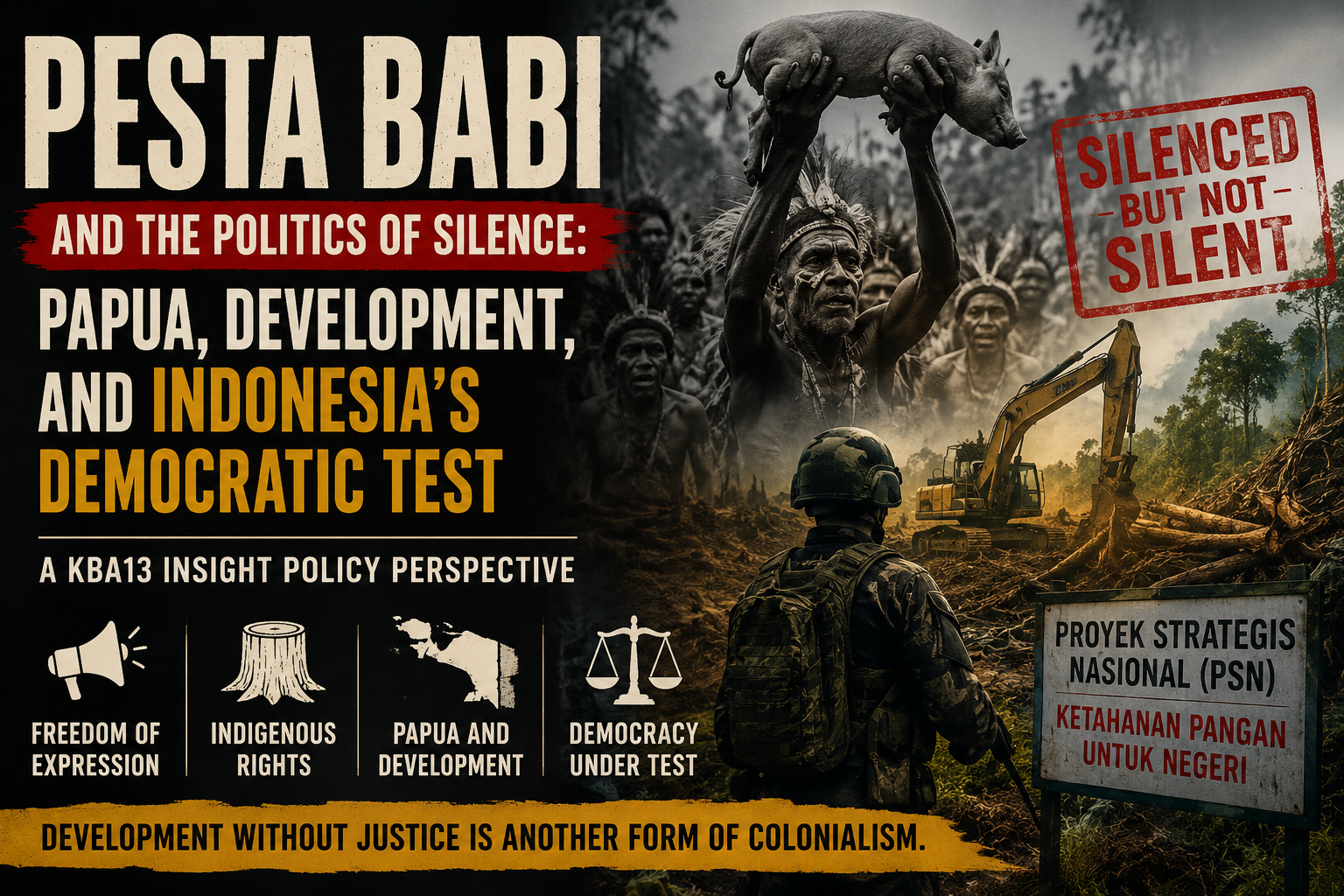
Pesta Babi is a documentary film directed by veteran investigative journalist Dandhy Dwi Laksono and filmmaker Cypri Paju Dale. Released in March 2026, the 95-minute film focuses on Indonesia’s National Strategic Projects (Proyek Strategis Nasional / PSN) in South Papua — specifically the rapid forest clearing linked to agribusiness expansion for sugarcane bioethanol, palm oil, and food estate development in the Merauke, Boven Digoel, and Mappi regencies.
The film’s title derives from traditional Papuan ceremonial feasting practices. The pig feast (pesta babi) represents communal well-being and prosperity tied to the land. By invoking this cultural symbol, the filmmakers frame their central argument: that Indigenous Papuan communities are being stripped of the very land that sustains their cultural identity and physical survival.
The documentary combines historical and anthropological research with investigative journalism and policy analysis. It documents hundreds of excavators arriving under military escort, sent to Papua under the banner of national food and energy security. It records the testimonies of Indigenous communities facing displacement. It traces the political and corporate networks that authorize and profit from this transformation.
Indonesia’s military establishment responded quickly. The Indonesian Armed Forces (TNI) warned that the film could create “misleading perceptions” about Papua. Yet the government’s official position was paradoxically contradictory: Chief Law and Human Rights Minister Yusril Ihza Mahendra denied any official ban while simultaneously labeling the film’s title “provocative.”
What followed was a pattern familiar to students of Indonesian civil-military relations: informal pressure without formal prohibition. By May 2026, Watchdog Indonesia had documented at least 21 serious incidents of intimidation against public screenings—harassment calls from security services, surveillance by intelligence officials, and forced dispersals at universities, including UIN Mataram, ISI Bali, and institutions in Yogyakarta. A screening at Universitas Islam Negeri Mataram was disbanded after just three minutes of playback.
Analysis I: The Development vs. Indigenous Rights Fault Line
At the heart of the Pesta Babi controversy lies a tension Indonesia has never fully resolved: the relationship between national development ambitions and the rights of Indigenous communities.
The PSN projects in South Papua are not small ventures. They represent Indonesia’s bid for food and energy sovereignty — enormous agribusiness corridors involving foreign capital, military logistics, and presidential commitment. From Jakarta’s perspective, these are instruments of national resilience. From the perspective of the Malind, Mandobo, and Asmat peoples of South Papua, they are the latest chapter in a history of dispossession.
The film draws a direct line from colonial-era extraction to present-day development policy. The argument is not that development is inherently wrong but that development conducted without free, prior, and informed consent (FPIC) — the international standard established under UN Declaration on the Rights of Indigenous Peoples (UNDRIP), which Indonesia has endorsed — is structurally indistinguishable from colonial land seizure.
A member of Indonesia’s Regional Representative Council (DPD RI) for West Papua, Filep Wamafma, welcomed the documentary as “an important educational medium” to open public discussion about development issues facing Papuans. His endorsement is significant: it signals that even within Indonesia’s representative institutions, the film’s core argument has sympathisers. The land rights question cannot be resolved by suppressing the film that raises it.
Analysis II: Freedom of Expression and the Surveillance State
The suppression pattern around Pesta Babi reveals something important about Indonesia’s democratic health under President Prabowo Subianto. The 2045 Indonesia Emas (Golden Indonesia) vision emphasizes development and stability. But the treatment of this documentary suggests that “stability” is being operationalized in ways that conflict with reform-era commitments to free expression.
Indonesia’s National Human Rights Commission (Komnas HAM) issued a formal press statement (No. 18/HM.00/V/2026) declaring that the government is obligated to protect freedom of expression, artistic expression, and cultural rights in the context of the Pesta Babi screenings. YLBHI (the Indonesian Legal Aid Foundation) went further, calling the suppression of screenings “illegal and unconstitutional.” Amnesty International Indonesia concurred, stating that the crackdown was silencing critical voices on Papua.
The legal framework is unambiguous. Article 28E of the 1945 Indonesian Constitution protects freedom of expression. The question is not legal but political: why does the state apparatus respond to a documentary film as though it were a security threat?
The answer lies in Papua’s special status in Indonesian state ideology. Papua is the most militarized province in the country. Criticism of development policy in Papua is routinely conflated with separatism. The Pesta Babi episode reveals how this conflation functions as a censorship mechanism — not through formal law, but through informal intimidation that universities and civil society organizations have learned to fear. When a campus rector cancels a screening before security forces arrive, the chilling effect has already done its work.
Analysis III: The Streisand Effect and Digital Resistance
Perhaps the most instructive aspect of the Pesta Babi episode is what happened when suppression failed. On May 22, 2026, the filmmakers released the documentary freely on YouTube. Within days, what had been a film seen by hundreds in campus auditoriums was available to every Indonesian with an internet connection.
This is the classic “Streisand effect”: the attempt to suppress information drawing far more attention to it than silence would have. The 21 documented incidents of forced dispersals did not prevent the film from being seen. They ensured it would be seen by millions.
The episode also reveals the resilience of Indonesian civil society. Student organisers, human rights lawyers, journalists, and academics sustained the screening campaign despite pressure. The documentary was reportedly screened at 130 separate locations on a single day in May 2026 — a grassroots distribution network built precisely because formal channels were closed. The ANU Indonesia Institute in Canberra hosted a nobar (public screening) with a Q&A session with the filmmaker. NYSEAN (New York Southeast Asia Network) organised international viewings.
For analysts of Southeast Asian politics, this pattern — authoritarian impulse meeting digital resilience — is one of the defining tensions of the current regional moment. Indonesia is neither a consolidated liberal democracy nor an authoritarian state. The Pesta Babi episode captures that ambiguity precisely.
Implications
For Indonesian Policymakers
- The land rights question the film raises will not be resolved by suppressing the film. Genuine FPIC processes for PSN projects in Papua are a political, legal, and moral necessity.
- Informal censorship through security apparatus intimidation undermines Indonesia’s international standing as a democracy and damages trust between Jakarta and eastern Indonesia.
- The contradiction between Minister Yusril’s denial of any ban and the 21 documented disruptions must be addressed through clear ministerial direction to security services.
For Civil Society and the Academy
- Indonesian universities that capitulated to pressure have a credibility cost to pay. Academic freedom requires institutional courage, not only individual bravery.
- The documentation work of Watchdog Indonesia and YLBHI created an evidentiary record that will outlast the controversy. Systematic documentation of suppression is itself a democratic act.
For the Islamic Scholarly Community
From an Islamic governance perspective, the ethics of land ownership and communal rights are clear. As NU Online’s analysis noted, forced dispossession of Indigenous communities from their ancestral land raises questions of zulm (injustice) that Muslim scholars and policymakers cannot ignore. Indonesia’s Muslim-majority identity comes with a moral obligation — not merely a legal one — to ensure that development does not become a vehicle for injustice against the vulnerable.
Conclusion
Pesta Babi is not merely a documentary about Papua. It is a test of Indonesia’s democratic institutions, a mirror held up to the contradiction between development rhetoric and human rights reality, and a demonstration that in the digital age, the suppression of knowledge is no longer achievable through intimidation alone.
The film is now on YouTube. The conversation it has catalysed cannot be ended by security services or ministerial warnings. What Indonesia — and the wider Southeast Asian world — does with that conversation will say much about the direction of the region’s largest democracy.
For KBA13 INSIGHT, which observes Southeast Asian politics from Aceh — a region with its own deep experience of military suppression, indigenous identity, and the long road from conflict to autonomy — the parallels are not abstract. Aceh survived its own confrontation between the state’s development logic and its people’s right to exist on their own terms. The Special Autonomy framework that emerged from that experience is imperfect, but it represents a model: that political space, not military force, is the only durable resolution to identity-based conflicts.
Papua deserves that same political space. Pesta Babi — the film, the controversy, and the conversation — is one of the most important public documents produced in Indonesia in recent years. It should be watched, debated, and engaged with honestly, not feared.
Discussion Questions
|
Sources
- Jakarta Globe — “Indonesia Says ‘Pesta Babi’ Screenings Were Never Banned.” jakartaglobe.id
- AsiaNews — “Pesta Babi: The film on the exploitation of Papua that Prabowo wants to ban.” asianews.it
- Amnesty International Indonesia — “Pelarangan film Pesta Babi membungkam suara kritis tentang Papua.” amnesty.id, May 2026
- YLBHI — “Pelarangan Pemutaran Film Pesta Babi adalah Pelanggaran Hukum.” ylbhi.or.id, May 2026
- Komnas HAM — Keterangan Pers No. 18/HM.00/V/2026 on freedom of expression. komnasham.go.id
- LiCAS News — “Documentary on Papua deforestation sparks controversy after disrupted screenings in Indonesia.” licas.news, May 12, 2026
- NU Online — “Film Pesta Babi: Antara Pembangunan dan Kezaliman atas Tanah Adat.” islam.nu.or.id
- West Papua Voice — “Indonesia Responds to Controversial Documentary Film Pesta Babi.” westpapuavoice.ac
- Asia Pacific Report — “Pesta Babi doco stirs West Papuan development debates and crackdown.” asiapacificreport.nz, May 24, 2026
- Project Multatuli — “Film Dokumenter, Pesta Babi, dan Militerisasi.” projectmultatuli.org
About The Author

Artikel Terkait
 KBA13 Insight National Update: Krisis Rupiah, Politik Prabowo, Papua, dan Geopolitik Indonesia 2026
 Islam, Violence, and Acehnese Identity: A Socio-Historical Reading of Conflict, Faith, and the Idea of Musoh
 Dunia Malam di Peunayong Banda Aceh: Kehidupan, Kuliner, dan Jejak Tionghoa Setelah Senja
 Isaiah Berlin, Zionisme, dan Arsitektur Kekerasan: Membaca Gaza, Iran, dan Lebanon dalam Geopolitik Israel Kontemporer
 Buruh Indonesia dalam Kapitalisme Global: Ancaman Tersembunyi bagi Ketahanan Nasional
Leave a Reply