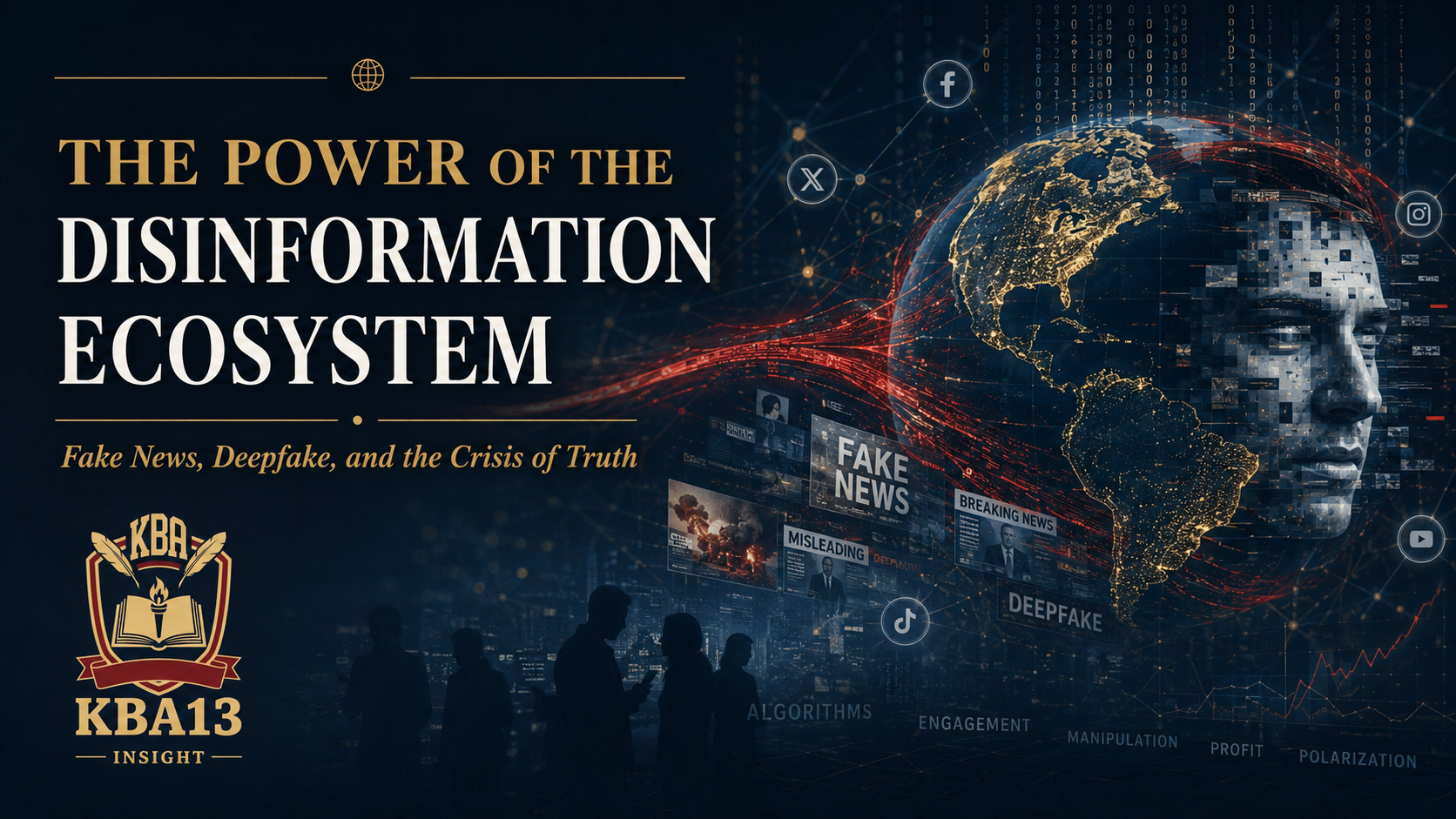
Fake news still spreads quickly on social media platforms. This sentence, by now, should feel like a cliché. It should feel tired, worn out, overused — the kind of observation that belongs in a 2016 op-ed column, not something we still need to say in the mid-2020s. But here we are, still saying it. Still needing to say it. That alone should terrify us.
Because the problem was never the technology. The problem was always us.
The Pleasure of the False
I see that all this time, fake news has become something very pleasurable for humans. That word—”pleasurable”—is important. We do not consume misinformation by accident. We do not stumble into it like a pothole in the dark. We run toward it with open arms. We share it before we have even finished reading it. We feel something in our chests when we encounter a headline that confirms what we already suspected about the world, and that feeling is not anxiety or skepticism — it is relief. It is the warm, narcotic relief of being right.
This is what the mainstream conversation about fake news always misses. It frames disinformation as a problem of access, of algorithm, of bad actors — as if the solution were simply better fact-checking software, more content moderation, stricter platform policies. It treats the human as the victim, passive and helpless, deceived by malevolent forces. But the human is not simply the victim here. The human is also the willing participant. The enthusiastic audience. Sometimes the very engine of the machine.
The spread of irresponsible fake news has become a new direction for human civilization in the current era. Not a detour. Not an anomaly. A direction. This is where we are going. And the philosophical weight of that observation is something we are only beginning to reckon with. What does it mean when a species with the cognitive capacity to map the genome, to split the atom, to send machines to the edges of the solar system, chooses — actively chooses — to believe things that are obviously untrue? What does that tell us about the nature of intelligence itself?
This event reminds us that humans can become so foolish in their thinking, even though they are considered very intelligent in their technological abilities. This is the great contradiction of our moment. We live in the most information-rich environment in the history of human civilization, and we are producing the most spectacular failures of collective reasoning that civilization has ever seen. The library of Alexandria would have fit on a USB drive. Every answer to every question ever posed by human inquiry is available on a device in our pocket. And we use that device primarily to argue with strangers about things that are not real.
I want to provide a philosophical explanation of when ignorance becomes an inevitability in the current state of human genius. Not just a sociological explanation. Not a political science paper. A philosophical one. Because what we are witnessing is not simply a media problem or a technology problem or a democracy problem. It is a problem of what it means to be human when being human no longer requires the discipline of searching for truth.
The Architecture of Reason, and Its Decay
Initially, humans were endowed with reason to seek and understand all information, which was then, in theory, transformed into knowledge. The key phrase there is in theory. In theory, the gift of reason is a tool for navigating reality accurately. In practice, reason has always been something more complicated — a capacity that can be deployed toward truth or away from it, depending on which direction feels more comfortable, more tribal, more emotionally satisfying.
The philosophers of the Enlightenment believed in a kind of cognitive determinism. They believed that once humans were freed from the chains of superstition, once the light of reason was switched on, it would illuminate everything uniformly. Education would be enough. Access to information would be enough. Give people the facts, they said, and they will choose correctly. Reason will prevail.
What they did not anticipate was that reason is not a lamp. It is a weapon. And like any weapon, it can be turned in any direction.
Humans strive to use their common sense to understand everything correctly and produce truthful results. This scientific behavior of humans strongly indicates that this gift of thinking enables humans to see their functions and existence on this earth. Yes — in the ideal formulation. But what the history of the 21st century has shown us, conclusively and without mercy, is that common sense is not common. And that the desire to produce truthful results competes, often unsuccessfully, against the desire to produce results that feel good, that protect the ego, that confirm the story we are already telling ourselves about who we are and what the world owes us.
When humans seek the truth, they always reject falsehood, even after trying various methods of thinking, ranging from philosophical approaches to the ability to narrate their intuition in everything that is absolutely true. But here is the flaw in this model: humans must first want the truth. The entire architecture of epistemology—of how we know what we know—rests on the assumption that the seeker genuinely wants to find what is real. But what happens when entertainment becomes a higher priority than reality? What happens when falsehood is more fun?
This is what the digital ecosystem has done to us. It has made falsehood entertaining. More than entertaining — it has made falsehood addictive. And in doing so, it has not simply misled us about specific facts. It has restructured our relationship to truth itself.
The Long History of the Lie
The history of lies, a legacy of how modern human civilization operates, has become something perpetuated by humans who are supposedly very advanced in technology. We should be honest about something here: lying is not new. Deception is not an invention of Mark Zuckerberg or Twitter’s algorithm. It is as old as language itself. Perhaps older.
In the past, we encountered various appearances that were real but not outright lies, because they were presented as art. Cave paintings that may have exaggerated the size of the hunt. Epic poems that transmuted ordinary military defeats into divine tragedy. Portraits of kings that made them taller, more noble, and more symmetrical than they ever were in life. We have always used representation to distort reality in ways that serve us.
We are even shown advertisements aimed at attracting buyers to certain products, tailored to the product owners’ desired results. The history of commercial advertising is, in one reading, the history of sophisticated lying at scale. The tobacco industry told us cigarettes were healthy. The sugar industry funded research to blame fat for the diseases sugar caused. Oil companies funded climate denial for decades while their own internal scientists were documenting the catastrophe they were creating. These were not the lies of peasants or trolls. These were the lies of institutions, deployed systematically, with scientific precision, in the service of profit.
But when false news, which is part of the development of disinformation theory, becomes undeniable — when it leaps from the margins into the center of public discourse — something qualitatively different has happened. Initially, the spread of lies, or false news, was a mainstay of the theory developed in intelligence operations. Where false news is considered normal, repeated over and over, until the people who consume it believe it to be true. This is the doctrine of dezinformatsiya, pioneered by Soviet intelligence services and refined by every major intelligence apparatus since. The theory is simple, and it works: you do not need people to believe the lie. You only need people to become uncertain about the truth. When truth and falsehood become indistinguishable, power goes to whoever is most willing to act with certainty. And certainty, in a chaotic information environment, almost always belongs to the most extreme voices.
What the digital era has done is democratize this technique. What once required a state intelligence apparatus—the resources, the infrastructure, the network of operatives—can now be executed by a single person with a phone and a grudge. The tools of dezinformatsiya have escaped the laboratory and entered the wild.
We Are Entering a New Era in Which Misinformation Is Increasingly Preferred
We are entering a new era in which misinformation is increasingly preferred in society. Let me sit with that word again: preferred. Not tolerated. Not accidentally consumed. Preferred.
This is the most philosophically disturbing development of our time, and it receives nowhere near the attention it deserves. The mainstream debate about misinformation focuses almost entirely on supply — on the bad actors who create and distribute false content. But it systematically underweights the demand side of the equation. And you cannot understand a market by looking only at the producers.
Why is misinformation preferred? There are several reasons, and they compound each other in ways that make the problem structural rather than incidental.
First, misinformation is almost always simpler than the truth. The real world is complicated. Causality is messy. Historical events have multiple causes, distributed across time, across cultures, across systems so complex that even the experts who study them disagree about the mechanisms. Misinformation cuts through all of this. It offers clean stories: heroes and villains, clear causes, and obvious solutions. It satisfies the human appetite for narrative in a way that the actual complexity of reality never can.
Second, misinformation is faster than the truth. By the time a fact-check reaches the person who needs it, the false story has already been shared 10,000 times. It has already entered the audience’s mental architecture. The correction arrives like a renovation to a building that has already been demolished. Technically correct, completely useless.
Third — and this is the one nobody wants to say out loud — misinformation is often more emotionally satisfying than truth. It tells people what they want to hear. It validates grievances. It confirms suspicions. It makes people feel like insiders, as if they have access to a reality the mainstream does not want them to see. And that feeling of insider knowledge, of seeing past the official story, is one of the most powerful psychological rewards a human being can experience. It makes you feel intelligent. It makes you feel brave. It makes you feel like you belong to a community of similarly clear-eyed people.
Truth, by contrast, is often cold. Impersonal. It does not care about your feelings. It does not reward your suffering or validate your anger. Sometimes truth asks you to accept that the world is not arranged against you specifically—and that is a harder pill to swallow than any conspiracy theory.
The Impact of Irresponsible Social Media Posting on Society
The impact of irresponsible social media posting on society is not measured in individual incidents. We make a mistake when we try to track it that way — when we point to this story or that viral post as the cause of some discrete harm. The real impact is atmospheric. It is the slow transformation of the cognitive environment in which we all live.
Consider what social media has done to the baseline assumptions of public discourse. In the era before mass social media — before every individual became a potential broadcaster — there were gatekeepers. This is not a nostalgic point. The old gatekeepers had their own forms of bias, their own failures, their own systematic distortions. Journalism was never purely objective. The news industry was always shaped by the interests of its owners, its advertisers, and its class assumptions. None of that is in dispute.
But gatekeeping, for all its failures, did perform one crucial social function: it applied, however imperfectly, a filter of verification before information was distributed at scale. The journalist had to call sources. The editor had to check facts. The publisher had to consider legal liability. These were imperfect constraints, corruptible and inconsistent — but they were constraints.
Social media eliminated the constraints while keeping the megaphone. Anyone can now speak to millions. Anyone can now publish to a global audience. The marginal cost of distribution has fallen to zero. And what has filled the vacuum left by the collapse of editorial standards is not a golden age of citizen journalism. What has filled the vacuum is the unconstrained id of the human species — all its tribal impulses, its appetite for spectacle, its rage, and its need to feel significant.
Every irresponsible post is a small act of social pollution. No single exhaust pipe destroys an atmosphere. But enough of them, operating continuously, transform the air everyone breathes. We are all now breathing informational air that has been fouled by decades of unconstrained broadcasting from billions of sources with no accountability and no consequence. And we wonder why it is hard to think clearly.
The World War Through the Algorithm: Everyone Knows That No One Knows
The world war, through the algorithm, is being disseminated, assuming everyone knows that no one knows. This is, perhaps, the sharpest observation in this entire inquiry. The epistemological warfare being conducted through algorithmic platforms is not primarily a war over what people believe. It is a war over whether belief is possible at all.
This is the distinction between first-generation disinformation — which tries to replace one belief with another — and second-generation disinformation, which tries to destroy the very capacity for stable belief. First-generation disinformation says the election was stolen. Second-generation disinformation says you can never know whether any election is legitimate because all institutions are corrupt, all media is biased, all experts are paid, and all evidence is manipulated. The first mode targets a specific belief. The second mode targets epistemology itself.
And the algorithm is extraordinarily well-suited to second-generation disinformation. Not by design, exactly — though the design choices of social media companies have certainly accelerated the problem — but by the structural logic of engagement optimization. The algorithm maximizes attention. And in the contemporary information environment, nothing captures attention like controversy, contradiction, and outrage. A confident, well-sourced, nuanced claim rarely goes viral. But a confident, provocative, counterfactual claim — one that makes people feel like they are seeing something they were not supposed to see — spreads like fire in a dry season.
The result is a public epistemology of perpetual suspicion. Everyone knows that no one knows. And when no one can be said to know anything with certainty, power flows to the loudest, the most theatrical, the most willing to perform certainty in the absence of any actual grounds for it. The epistemological fog of modern social media is not a bug. For certain kinds of actors, it is the product.
The Power of Memes: Distributing Irresponsibility to Each Generation
The power of memes is distributing irresponsibility to each generation on Earth right now. We tend to treat the meme as a joke. A funny picture. A unit of internet humor circulating harmlessly through the digital ecosystem, producing mild amusement and then disappearing. And many memes are exactly that. But the meme, as a form, is something far more powerful than its casual treatment suggests.
The meme is the perfect unit of epistemic manipulation for an attention-deficit information environment. It is visual. It is immediate. It requires no sustained engagement. It bypasses the slow, effortful cognitive processes that we associate with critical thinking and goes directly to the faster, more intuitive, more emotionally resonant channels of cognition. It makes an argument without appearing to do so. It establishes a frame without announcing that it is framing. It is persuasion without the disclosure that persuasion is occurring.
And memes are extraordinarily efficient at encoding worldviews. A single image macro can compress an entire political philosophy into a format that takes three seconds to consume and three minutes to fact-check — if anyone bothers. The asymmetry is devastating. The meme spreads faster than any correction. It lodges in the visual memory in ways that text does not. It reproduces itself across platforms, communities, and languages, mutating slightly with each transmission while preserving its essential payload.
What is most alarming about the memetic transmission of irresponsibility is the generational dimension. Each generation that grows up inside this information environment inherits its assumptions. The epistemological habits formed by meme consumption — the reflexive skepticism, the short attention span, the preference for emotional resonance over factual accuracy, the social signaling function of sharing — these are not just media habits. They are cognitive habits. They shape how a generation thinks, not just what it thinks about.
We are currently raising the first generation of human beings whose primary cognitive environment is one of engineered virality, where the content that spreads is not the most accurate or most important but the content that triggers the most intense emotional response. What kind of minds will this environment produce? What will politics look like when the electorate has been epistemologically formed by TikTok? We are beginning to find out. The results are not encouraging.
Deepfake: A Tidal Wave in Human History in the 21st Century
Deepfake is a tidal wave in human history in the 21st century. Not a wave. A tidal wave. The distinction matters. A wave is something you can see coming, can prepare for, and can ride or duck under. A tidal wave is a displacement of the entire ocean — it arrives not as a single surge but as a fundamental restructuring of the landscape, erasing the features that existed before and leaving a different terrain behind.
The deepfake does to visual evidence what the printing press did to textual authority — it democratizes a previously specialized capability, in the process destroying the scarcity that gave that capability its power. Before the printing press, the authority of textual knowledge rested partly on its scarcity, on the difficulty of production. When anyone can produce text, text loses some of its authority. When anyone can produce a convincing video of any person saying anything, the video loses its evidential authority entirely.
And video is — or was — the most powerful form of evidence available to human beings. We evolved to trust our eyes in ways that we do not trust words on a page. The phrase “seeing is believing” captures something deep about human epistemology: the visual carries a presumption of reality that the verbal does not. Deepfakes exploit this presumption with surgical precision. They weaponize our evolutionary trust in visual evidence against us.
The political implications are not simply that politicians will be discredited by fake videos — though they will be, and they already are. The deeper implication is even more corrosive: once deepfakes become widespread and convincing enough, any authentic video can be dismissed as a deepfake. The technology does not just create false evidence. It destroys the concept of authentic evidence. Every video becomes potentially fabricated. Every image becomes suspect. And in a world where nothing can be trusted, the advantage goes—again—to those who are willing to make claims regardless of evidential support.
This is the tidal wave. It is not the flood of fake content, as damaging as that is. It is the erosion of the ground on which the concept of visual evidence rests. Once that ground is gone, we are building epistemology on sand.
The Contribution of Digital Capitalism to the Disinformation Ecosystem
The contribution of digital capitalism to the distribution of fake news and fake faces on social media is not incidental. It is not a side effect. It is the logical consequence of a business model that was built on the commodification of human attention.
Let us be precise about what digital capitalism actually sells. Facebook does not sell social networking. Google does not sell search. Twitter does not sell conversation. What all of these platforms sell is attention — specifically, human attention measured in time, quantified in behavioral data, packaged into advertising inventory, and sold to the highest bidder. The product is not the service. The product is you. Your time, your preferences, your vulnerabilities, your tribal loyalties, your fears.
The business model requires that you spend as much time as possible on the platform. More time means more data, which means more valuable advertising inventory, which means more revenue. The optimization pressure is therefore always toward maximum engagement. And maximum engagement, in the contemporary information environment, is achieved not by the content that is most accurate, most useful, or most enriching — but by the content that is most emotionally activating.
Anger activates. Fear activates. Outrage activates. Tribal validation activates. And misinformation, which specializes in triggering exactly these emotional responses, is therefore extraordinarily well-adapted to the attention economy. False content that triggers outrage outperforms true content that informs. Not always. Not in every case. But systematically, statistically, at scale.
The contribution of digital capitalism to the disinformation ecosystem in the planetary era is therefore structural. It is baked into the industry’s economic logic. You cannot solve this problem by asking the platforms to be more ethical. You cannot solve it by tweaking the algorithm. The problem is the business model itself, which creates a financial incentive to amplify whatever triggers the strongest emotional response—and therefore, however indirect, a financial incentive for the production and distribution of misinformation.
This is not a conspiracy theory. No one at Facebook headquarters sat in a meeting and decided to radicalize the electorate. But the emergent outcome of optimizing for engagement at a planetary scale over decades is functionally indistinguishable from that decision. Intent is irrelevant. The mechanism does the work regardless of intent.
The Giant Digital Company Contributes to Society’s Stupidity
The giant digital company contributes to society’s stupidity. This is a blunt formulation, and I want to be precise about what I mean by it and what I do not mean.
I do not mean that the people who build these companies are stupid. They are not. They are, in many cases, among the most technically sophisticated individuals their generation has produced. They have solved engineering problems of extraordinary complexity. The infrastructure that makes global real-time communication possible is a genuine technical achievement of the first order.
What I mean is that the infrastructure these companies have built, and the incentive structures they have designed systematically discourage the cognitive behaviors associated with intelligence—critical evaluation, tolerance of complexity, epistemic humility, willingness to revise beliefs in response to evidence — and systematically reward the cognitive behaviors associated with stupidity: reflexive reaction, tribal signaling, confirmation bias, the confusing of emotional intensity with epistemic confidence.
This is a form of structural stupidity. It does not require any individual to be stupid. It produces stupidity as an emergent property of the system. When the interface rewards the fast response over the careful response, when the algorithm amplifies the outraged reaction over the measured one, when status in digital social hierarchies is determined by the virality of one’s posts rather than the accuracy of one’s claims, the system has been designed, however inadvertently, to make its users stupider over time.
There is also something more specific happening: the replacement of knowledge with information and of understanding with consumption. The digital giants have built extraordinary systems for delivering information. What they have not built — and what their business model does not incentivize them to build — are systems for the transformation of information into knowledge, or knowledge into wisdom. Google can tell you anything. It cannot tell you what matters. Facebook can show you what everyone is talking about. It cannot tell you what is worth thinking about. The distinction between information delivery and knowledge cultivation has been systematically collapsed by the digital economy, and the consequences of that collapse are visible in the epistemic condition of every society that has absorbed these platforms.
Can AI Make Humans More Intelligent or More Backward, as Humans-Cum-Animals?
Can AI make humans more intelligent or more backward, as human-cum-animal? This is the question that haunts everything said above, because artificial intelligence is not simply the next chapter in this story. It is the chapter that rewrites all the previous ones.
The optimistic case for AI is real and should be stated seriously. AI systems have demonstrated genuine capabilities for augmenting human reasoning — processing vast amounts of evidence, identifying patterns invisible to unaided cognition, accelerating scientific discovery, providing access to expertise that was previously available only to the privileged. There are genuine ways in which well-designed AI systems could make human beings better able to navigate a complex information environment.
But the pessimistic case is equally real, and in light of everything said above, it must be weighted heavily.
The same conditions that made social media a vehicle for mass stupidity — the optimization for engagement, the attention economy, the financial incentive to maximize time-on-platform — apply with equal force to consumer AI applications. An AI assistant that maximizes user satisfaction will tell users what they want to hear. An AI system optimized for engagement will produce content that is emotionally activating rather than epistemically reliable. An AI model trained on the internet has been trained on the product of the disinformation ecosystem we have been describing — and will reproduce its pathologies at scale, with greater sophistication and greater apparent authority.
There is also a deeper question here: cognitive atrophy. When a muscle is not used, it weakens. When a cognitive capability is not exercised — when it is systematically outsourced to a machine — it degrades. The human capacity for sustained attention, for effortful reasoning, for tolerating the discomfort of uncertainty while working toward a well-founded conclusion — these are capacities that require regular exercise. They are capacities that the digital environment has already begun to erode. AI, deployed carelessly, could catastrophically accelerate that erosion.
The human-cum-animal formulation in question is not mere provocation. It points to something real: the possibility of a regression, not biological but cognitive, in which the capabilities that distinguish human cognition from animal cognition — the capacity for abstraction, for long-term reasoning, for systematic doubt, for revising beliefs in response to evidence — are progressively weakened by technologies that make those capabilities unnecessary. Why think when the machine will think for you? Why evaluate when the algorithm will evaluate for you? Why know when you can look it up?
The answer, which the history of this essay has been building toward, is this: because the machine does not think for you. It thinks instead of you. And what is lost when you stop thinking is not just a particular conclusion. It is the capacity to distinguish between being told something and understanding it. It is the capacity to know when you are being manipulated. It is the capacity to be a citizen rather than a consumer, a person rather than a user, a human being rather than a node in someone else’s attention network.
Coda: On the Possibility of Recovery
I have not been optimistic in these pages. I am not sure optimism is warranted. The forces driving the disinformation ecosystem — the financial incentives of digital capitalism, the evolutionary biases of human cognition, the structural pressures of platform design, the geopolitical weaponization of information disorder — these are not forces that respond easily to good intentions or individual effort.
But I want to end with a distinction rather than a prediction.
There is a difference between a difficult problem and a hopeless one. The disinformation ecosystem is a genuinely difficult problem. It is probably the defining intellectual and political challenge of the 21st century. But it is not hopeless, because it is not a natural phenomenon. It is a constructed one. It was built by human choices — economic, political, technological, and cultural. And what human choices built, human choices can dismantle, reconstruct, or regulate.
The question is whether we have the collective will to take the problem seriously — not as a content moderation challenge, not as a cybersecurity issue, not as a matter for fact-checkers and media literacy curricula — but as the civilizational crisis it actually is. A crisis not of information, but of the conditions that make knowledge possible. A crisis not of technology, but of what we have allowed technology to do to us.
Every human civilization has had to ask, at some point, what kind of people it intends to produce. What kind of mind? What kind of character? What relationship to truth? These questions were once the domain of religion, then of philosophy, then of public education systems. In the planetary era, these questions are being answered — definitively, at scale, for billions of people — by algorithms designed by engineers optimizing for quarterly revenue targets.
That is the power of the disinformation ecosystem. Not that it lies to us. But that it has made us the kind of people who prefer the lie.
And the only way out of that is not more technology. It is the ancient, difficult, uncomfortable, irreplaceable work of learning to think.
About The Author

Artikel Terkait
 From WEIRD Society to FACE RIP Society: AI, Human Agency, and the Crisis of Civilization
 Artificial Intelligence and the World Order of 2040: A Strategic Essay on AI, Extraterrestrial Intelligence, and the Future of Humanity
 The Power of Clicks and Sharing: Human Behavior in the Age of Digital Civilization
 One World in the Planetary Era: Kishore Mahbubani, Global Convergence, and the Future of Civilization
 Islamophobia in Indonesia’s Cyberspace: Politics, Buzzers, and Virtual Fear
Leave a Reply