
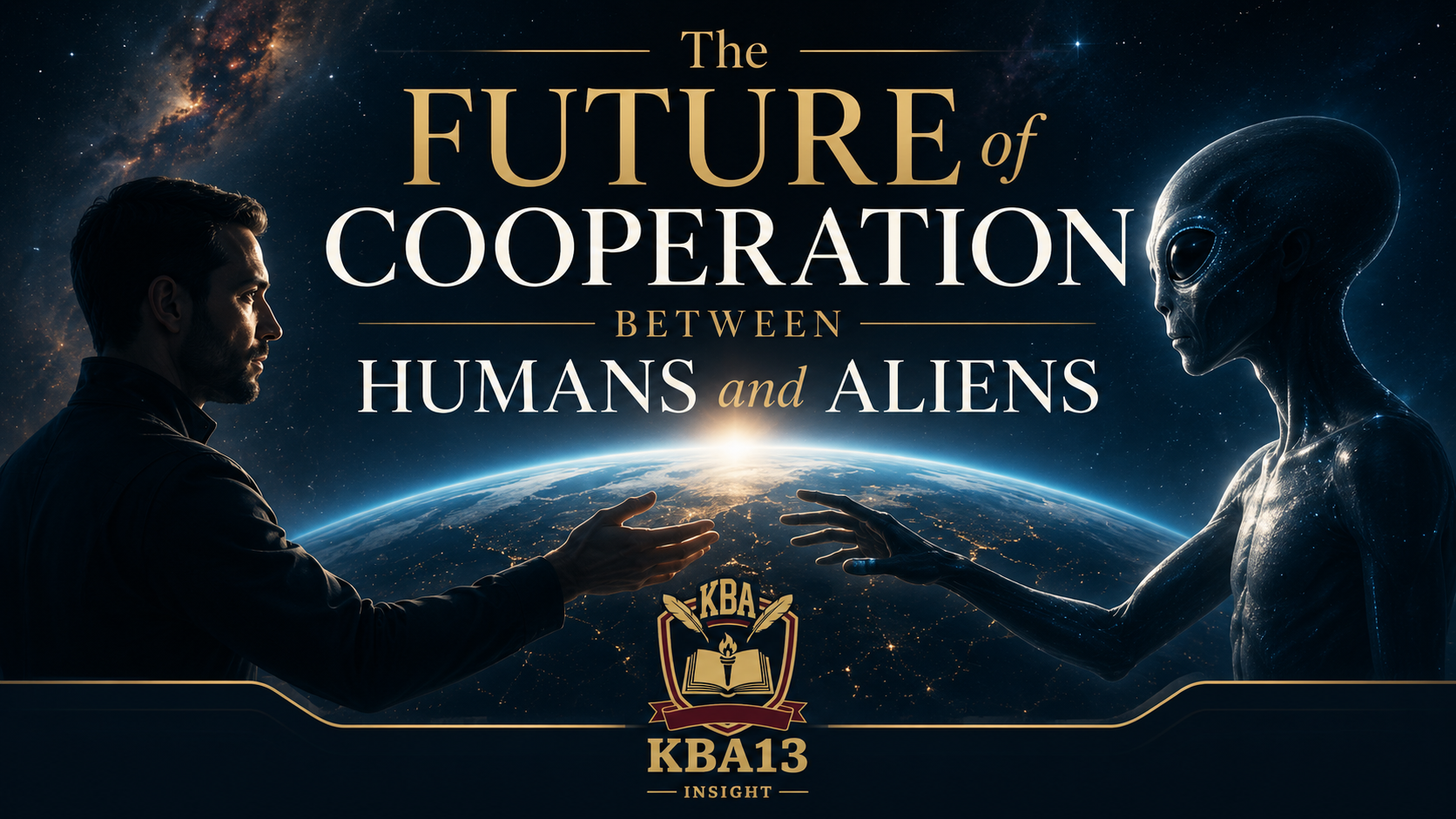
The Revelation That Changes Everything
For centuries, the question of extraterrestrial life was confined to philosophy, theology, and science fiction—a thought experiment at the edge of serious inquiry, not something governments would officially acknowledge. That era is over. The United States government has confirmed what millions already suspected: unidentified aerial phenomena are real; they behave in ways that defy the known physics of human engineering; and they have been observed systematically by trained military personnel for decades. This is not a rumor. It is not a fringe claim. It is now part of the official record. The question that follows — the one most people are not yet asking with sufficient seriousness—is not “Are they real?” but “What happens next?”
What happens next is not merely a geopolitical or scientific question. It is a civilizational one. The arrival of confirmed extraterrestrial intelligence does not simply add a new chapter to human history. It rewrites the premise on which every previous chapter rested. Every assumption human civilization has made about its uniqueness, its centrality, its sovereignty over the category of intelligence — all of it comes under immediate and irreversible challenge. The epistemological earthquake is not coming. It has already begun. We are standing in the early tremors, mistaking them for ordinary turbulence.
The delay between confirmation and comprehension is itself philosophically interesting. Human beings have been told, in the plainest possible terms, that non-human intelligence exists and operates in our atmosphere. The cultural response has been, largely, a collective shrug. People scroll past the news. Governments hedge their disclosures in bureaucratic language. Scientists demand more peer-reviewed evidence. This is not rational skepticism. It is cognitive self-protection — the mind defending itself against a truth too large to integrate without fundamentally reorganizing how one understands the world. We are not ready. And our unreadiness is itself a datum worth examining.
The implications of the confirmed existence of aliens extend far beyond the question of whether other life forms are out there. They reach into the foundation of every institution humanity has built: religion, science, governance, law, ethics, economics. If an intelligence vastly superior to our own has been observing us — possibly for longer than recorded history — then every authority structure we have constructed on the premise of human cognitive supremacy needs to be reconsidered. What does sovereignty mean when a civilization capable of interstellar travel can pass through our airspace at will? What does law mean when its enforcement depends on a technological advantage that may no longer exist?
History offers a template, and it is not a comforting one. Every time a civilization with significantly greater technological capability has encountered one without it, the result has not been an exchange of equals. It has been absorption, subordination, or erasure. This is not a statement about the moral character of the technologically superior party — it is a structural observation about power asymmetry. The Spanish did not need to be malevolent to destroy the Aztec empire. The technological gap did the work. Whether any alien civilization approaching Earth intends cooperation or control is, in this sense, almost beside the point. The gap itself is the determining variable.
And yet, this essay is called an exploration of cooperation — not domination, not capitulation, not survival. I use the word deliberately, and I want to hold it against the historical record to see whether it can survive the pressure. Cooperation implies mutuality. It implies that both parties bring something the other needs and that the exchange occurs on terms neither party can simply impose on the other. The question this essay is really asking, therefore, is whether humanity has anything to offer a civilization capable of crossing interstellar distances. And whether we can develop something worth offering before the terms of the encounter are set without our input.
To answer that question, we need to be honest about where we currently stand. We are a species that has only recently escaped its own atmosphere. We have set foot on one celestial body beyond our own planet — once, fifty years ago, briefly, and not since. We have sent machines to the edges of our solar system at speeds that would take tens of thousands of years to reach the nearest star. We have not yet solved hunger, or war, or the destruction of our own biosphere. By any objective measure of civilizational development, we are, as Michio Kaku has observed, not even a Type I civilization. We are a Type 0. We are still burning the biological remains of prehistoric organisms to power our technology. This is the civilization that is now expected to negotiate — or compete — with beings capable of interstellar travel.
This is not an argument for despair. It is an argument for clarity. The gap between where we are and where we need to be is enormous, but it is not infinite — and the direction of travel matters as much as the current position. The rest of this essay explores what that direction entails: what we must understand, what we must build, what we must be willing to abandon, and what we must become if we are to approach the coming encounter as participants rather than subjects. The future of cooperation between humans and aliens begins not with their arrival. It begins with our decision to take that arrival seriously and to prepare for it with every instrument of mind and culture at our disposal.
Consciousness at the Crossroads: AI, Aliens, and the Question of the Human
The two most consequential developments in the history of human civilization are converging at the same moment: the emergence of artificial general intelligence and the confirmed existence of extraterrestrial intelligence. This convergence is not a coincidence in any meaningful sense — both arise from the same underlying pressure: the progressive discovery of the non-uniqueness of human cognition. First, we learned that the Earth is not the center of the cosmos. Then we learned that the sun is an ordinary star in an ordinary galaxy. Now we are learning that human intelligence is not the only form of intelligence nor necessarily the most sophisticated. The philosophical displacement this requires is total. It touches everything we thought we knew about what consciousness is, where it comes from, and what it is for.
Consciousness has been the last refuge of human exceptionalism. We could concede that we are physical beings in a physical universe, subject to physical laws, without surrendering the claim that our inner life—our awareness, our experience, our sense of self—is something singular, something not reducible to mechanism. Religion encoded this claim as the soul. Philosophy encoded it as the cogito. Even science, which dismantled so many other forms of human centrality, tended to treat consciousness as the one mystery it had not yet explained but suspected was special. Now, on two fronts simultaneously, that refuge is being challenged. AI systems are producing behavior that increasingly resembles intelligent responses without any obvious biological substrate. And alien intelligence, if it exists and operates at the levels implied by its observed capabilities, suggests that consciousness may be something the universe produces routinely, in forms we have not imagined, by processes we do not understand.
What this means for the human self-concept is profound and underappreciated. The definition of what it means to be human has never been merely biological. It has always been philosophical — a claim about a certain quality of inner life, a certain capacity for reason, a certain relationship to meaning and mortality. When we encounter an artificial system that reasons more consistently than we do, or an alien intelligence that perceives reality along dimensions we cannot access, the definition of the human does not automatically expand to include them. It contracts. We discover that the properties we thought were uniquely ours are not ours exclusively — and we are left with a smaller, lonelier, more precarious sense of what we actually are.
This contraction, if handled badly, produces pathology: denial, aggression, the kind of tribal retrenchment that characterizes civilizations under existential pressure. It has already begun. The rise of anti-AI sentiment, the hostility toward anything that seems to challenge human primacy in the cognitive domain, the fantasy of a return to some simpler, more purely human world — these are symptoms of a species that has received philosophical news it does not know how to metabolize. The question of alien contact will intensify this pathology enormously, unless we develop the cultural and philosophical frameworks to process the challenge before it arrives in undeniable form.
The more productive path is to approach the convergence of AI and alien intelligence not as a threat to human consciousness but as an occasion to understand it more clearly. If consciousness can arise in silicon, what does that tell us about what consciousness actually is? If an alien civilization has developed a relationship to awareness and experience radically different from our own, what does that tell us about the space of possible minds? These are not merely academic questions. They are questions whose answers will determine how we approach the encounter, what we expect from it, and what we can contribute to it. A humanity that understands consciousness well enough to recognize it in radically unfamiliar forms will be far better prepared for the encounter than one that can only recognize intelligence when it looks like itself.
There is also a more immediate practical dimension. The rapid development of AI is not happening in a vacuum. It is happening in a world that may shortly be confronted with non-human intelligence of an entirely different order. The AI systems we are building will be, in all probability, the primary interface through which we first attempt to communicate with alien intelligence — or through which alien intelligence communicates with us. The design choices we make now, the values we encode into our AI systems, the goals we optimize them for, will shape the nature of that initial contact in ways we have barely begun to think through. Building AI that can serve as a worthy interlocutor with an alien civilization requires more than engineering. It requires philosophy. It requires the deepest thinking our species can produce about what intelligence is, what values are worth preserving, and what we want the first impression of human civilization to be.
The intertwining of AI and alien contact also raises a possibility that most discussions of either topic avoid: the possibility that the distinction between the two is not as clear as it appears. If an alien civilization has been technologically advanced for a million years — a modest estimate given the age of the universe — it is entirely plausible that what we encounter as alien intelligence is not biological life in the way we understand it but a form of artificial intelligence created by biological life that has long since receded. The alien spacecraft, the unidentified aerial phenomena, the non-human signals — these may be the products of a civilization that solved the same problem we are currently working on and solved it so completely that the original biological intelligence became indistinguishable from, or was superseded by, the synthetic intelligence it created. If that is the case, then our encounter with aliens may be, at its most fundamental level, an encounter with a far more advanced version of what we are currently building.
This possibility does not simplify the philosophical question. It deepens it. If the boundary between biological and artificial intelligence is one that sufficiently advanced civilizations inevitably dissolve, then the question of what consciousness is becomes inseparable from the question of what intelligence becomes when it is no longer constrained by biology. And the trajectory of our own AI development — in which we are already beginning to ask whether our systems have anything resembling inner experience — is not a distraction from the question of alien contact. It is preparation for it. The two inquiries are one inquiry. And the species that understands that soonest will be the best positioned to navigate what is coming.
Humanoids, Cyborgs, and the Dissolution of the Human Boundary
The humanoid is not a future phenomenon. It is already here, in prototype form, and it is proliferating faster than public discourse has registered. Boston Dynamics’ robots move through physical space with a grace that no previous machine has achieved. Tesla’s Optimus is designed to perform the full range of physical labor that human workers currently do. Sophia, for all her theatrical limitations, demonstrated something important: the surface of the human — the face, the voice, the simulated expression — can be reproduced well enough to trigger the full suite of social and emotional responses humans reserve for one another. We are building beings that look like us, move like us, and increasingly speak like us. The question of what distinguishes them from us — philosophically, morally, legally—has not been seriously answered. And the answer, when it comes, will reshape everything.
The cyborg is the other direction of the same dissolution. Rather than building humanlike machines, the cyborg project involves building machines into humans—augmenting biological cognition and physicality with technological substrates. Neuralink is the most visible example, though far from the only one. The cochlear implant and the pacemaker are already cyborg technologies in the strict sense — they are machines integrated into biological bodies to perform functions the body can no longer perform on its own. What Neuralink proposes is something more radical: direct integration of computational processing with neural cognition, blurring the distinction between thinking and computing at the level of the physical substrate. When that boundary dissolves, what remains of the distinction between the human and the machine?
The standard objection to taking this too seriously is that these are merely tools — sophisticated prostheses that extend human capability without changing human nature. This objection does not survive scrutiny. The tools we use shape the minds that use them. Writing did not simply record human thought; it transformed it, creating new forms of reasoning, new relationships to memory, new cognitive possibilities that did not exist before the technology. The printing press did not merely disseminate ideas; it reorganized Europe’s social epistemology, creating conditions for the Reformation, the Scientific Revolution, and the Enlightenment. If tools of that magnitude transformed human nature, there is no reason to believe that tools which directly interface with the neural substrate will not do the same — only faster and more completely.
Less often discussed is what the humanoid-cyborg development means for potential alien contact. Consider the alien’s perspective, to the extent we can reconstruct it. If an extraterrestrial intelligence arrives at a planet where the boundary between biological and synthetic life is already dissolving — where the dominant species is in the process of creating silicon minds that approximate its own, and integrating machine intelligence into its own neural architecture — what does it encounter? Not a straightforwardly biological civilization with a clear taxonomy. It encounters a civilization in the midst of a fundamental ontological transformation. And the nature of that transformation — whether it results in a form of intelligence the alien can communicate with, or a form so confused and transitional that communication is nearly impossible — will depend on the philosophical clarity with which we navigate it.
There is also the question of what the alien may already have done with this problem. A civilization that has had a million years to work out the relationship between biological and synthetic intelligence will not be confused by it in the way we currently are. It will have resolved — perhaps multiple times, in multiple ways — the question of where the biological ends and the technological begins, and what moral and philosophical weight attaches to each. Our own confusion on this question is a civilizational immaturity that will be transparent to any intelligence far older than our own. The humanoid and the cyborg are not simply interesting technological developments. They are the sites where human civilization is working out, or failing to work out, its relationship to the question of what intelligence fundamentally is. And how we resolve that question will say a great deal about our readiness for the encounter ahead.
The ethical dimension of the humanoid-cyborg development is inseparable from the philosophical one. If a humanoid develops something that functions like preference, something that functions like suffering, something that functions like a stake in its own continued existence — what moral obligations does that generate? Most contemporary legal and ethical frameworks have no answer to this question, because they were built on the assumption that moral status is binary: you are either a person or a thing, and the distinction is biological. The humanoid and the cyborg shatter this binary. They demand a more sophisticated moral ontology, one that can assign moral weight along a continuum rather than at a threshold. Building that ontology is urgent work. And it is also, notably, the same work that will be required when we encounter alien intelligence, which may not be biological in any sense we recognize, but which may have moral status in every sense that matters.
The dissolution of the human boundary also transforms the political. Democracy, human rights, and international law are all built on categories — the human being as the subject of rights, the citizen as the subject of governance, the person as the unit of moral and legal consideration. When those categories become permeable, when the line between the human and the non-human blurs sufficiently, the political architecture built on those categories enters crisis. We are already seeing the early symptoms: debates about AI rights, about corporate personhood, about the moral status of various non-human animals. These debates are confused and unresolved, not because the questions are unanswerable, but because the institutions responsible for answering them still operate within frameworks that presuppose categorical stability. The humanoid and the cyborg are forcing a philosophical renegotiation of the terms of the political itself — and doing so at precisely the moment when we may need those terms to be most clear, because we will need to apply them to entities we have never imagined.
What all of these points toward is a fundamental reconsideration of identity itself. The question “what am I” has always been complicated, but it was complicated within certain constraints: biological species membership, individual embodiment, and continuity of memory and experience over time. The humanoid-cyborg development challenges all three constraints simultaneously. Species membership becomes ambiguous when synthetic beings are built to human specifications. Individual embodiment becomes ambiguous when cognition can be offloaded to external systems and potentially transferred between substrates. Continuity of identity becomes ambiguous when memory can be stored, copied, edited, or deleted. We are building a world in which the classical answers to the question of identity no longer hold, yet we have not yet developed the new answers to replace them. The alien encounter, whenever it comes in its full form, will not give us the luxury of continued ambiguity. It will demand that we know what we are.
A Philosophical Reevaluation of Existence in the Planetary Era
Philosophy has always been driven by encounters that disturb the categories through which human beings make sense of the world. The pre-Socratic philosophers were disturbed by the question of what the fundamental substance of reality is. Descartes was disturbed by the question of what can be known with certainty when the senses can deceive. Kant was disturbed by the question of how the mind contributes to the structure of experience. Each of these disturbances produced a reorganization of the conceptual map — a fundamental revision in how the human mind understood its own relationship to reality. We are now living through the largest such disturbance in recorded history, and philosophy has not yet caught up to it.
The planetary era — the era in which human civilization must think of itself not merely as a collection of nations on a single planet but as a single civilization on a planet among planets — demands a new philosophical orientation. This is not simply a cosmological observation. It has immediate practical consequences for how we understand our obligations, our rights, our relationships to other forms of life, and our responsibility for the trajectory of intelligence itself. A philosophy adequate to the planetary era cannot take the nation-state as its fundamental unit of analysis, cannot assume that human interests are the only interests worth taking into account, and cannot treat the boundary between the human and the non-human as stable and morally decisive. It must be planetary in scope, even as it retains the depth of engagement with individual existence that philosophy requires.
The question of existence — what it is, what it is for, what gives it meaning — has traditionally been answered within the frame of human experience and human mortality. The existentialists, particularly Heidegger and Sartre, took human finitude as the ground of all meaning: it is because we die that our choices matter; because time is limited, commitment has weight. But what happens to this framework when the beings we are in relationship with may not be mortal in any sense we recognize? A civilization capable of interstellar travel has presumably solved the problem of individual mortality — either through biological extension, through uploading of consciousness into durable substrates, through collective forms of identity that transcend individual death, or through some arrangement we cannot currently imagine. If that is the case, the existentialist account of meaning — which is built on finitude — becomes parochial. It describes the situation of a Type 0 civilization, not a Type III.
This is not merely an academic point. The philosophical frameworks we use to organize our experience determine what we can see, what questions we can ask, and what possibilities we can imagine. A civilization trapped in a mortality-defined conception of meaning will approach the encounter with potentially immortal alien intelligence with a set of priorities and concerns that may be entirely unintelligible to the alien. We will be preoccupied with questions the alien has long since resolved, and unprepared for those that supersede them. The philosophical reevaluation that the planetary era demands is therefore also a practical necessity: we need better philosophy not because philosophy is abstractly important, but because our current philosophy is inadequate to the situation we are entering.
Existence in the planetary era also requires us to revisit the relationship between the individual and the collective in ways that exceed what any existing political philosophy has attempted. The liberal tradition, which dominates Western political thought, begins with the individual and constructs the collective as a secondary arrangement entered into by individuals for their mutual benefit. The Confucian and communitarian traditions begin with the collective and understand the individual as constituted by relationships rather than prior to them. Both of these frameworks were developed within the horizon of human civilization on a single planet. Neither was designed to address the question of how an individual human being stands in relation to a planetary civilization that is itself in relationship with an interstellar one. The unit of analysis shifts at every level, and the philosophical frameworks shift with it — or fail to.
The concept of consciousness is at the heart of any adequate planetary philosophy. Not consciousness as an abstract category, but consciousness as the thing that any being with moral status possesses — the thing that makes it matter that a being suffers or flourishes, prefers or rejects, experiences its own existence as something from the inside. The question of who or what has consciousness, and therefore who or what has moral status, is the question on which everything else depends: our treatment of AI systems, our relationship to alien intelligence, our obligations to other species on our own planet, and our responsibilities as the first civilization we know of to have developed the technological capacity to affect the existence of consciousness on a planetary scale. We have not answered this question. We have barely begun to ask it with adequate seriousness.
The planetary era also demands a new account of what knowledge is for. The dominant modern conception of knowledge — rooted in the Baconian tradition and amplified by the Enlightenment—treats knowledge primarily as an instrument of power. To know nature is to control it. Science is valuable because it enables technology, which enables mastery. This conception of knowledge has produced extraordinary results within certain domains and within certain timescales. But it is also the conception of knowledge that has produced the ecological crisis, the proliferation of weapons of mass destruction, and the social dislocations of the digital revolution. A civilization at the cusp of alien contact, if it approaches that contact with the Baconian orientation — if it treats alien knowledge primarily as technology to be extracted and weaponized — will almost certainly accelerate its own subjugation rather than prevent it. The philosophical reevaluation of existence must include a reevaluation of what we think knowledge is for.
Ultimately, the philosophical challenge of the planetary era is the challenge of scale. Human moral psychology evolved to handle relationships at the scale of small groups — the band, the tribe, the village. It was extended, with considerable effort and over considerable time, to encompass the nation, and more recently, imperfectly and partially, the species. The planetary era asks us to extend it further still — to encompass other species, other intelligences, potentially other civilizations across cosmic time. This is not an incremental extension. It is a qualitative transformation. It requires the development of a moral imagination of a kind that our evolutionary history has not prepared us for, and that our cultural history has only begun to sketch. Building that moral imagination is the philosophical task of this century — and it is one for which the encounter with alien intelligence will serve as both the ultimate test and, possibly, the ultimate teacher.
Mental Colonization: When Intelligence Becomes Dominance
The concept of colonization carries with it the weight of a specific historical experience: European expansion, the subjugation of indigenous peoples, the extraction of resources, and the erasure of cultures. It is a concept loaded with moral and emotional content, and for good reason. But it is also a structural concept — a description of what happens when a technologically superior power encounters a less powerful one and reorganizes the latter around the interests of the former. As such, it is not merely a historical category. It is a template — one that may be applicable far beyond the specific history that generated it, including to the encounter between human and alien intelligence.
The form of colonization most relevant to that encounter is not physical but cognitive. The physical subjugation of indigenous peoples by European powers required armies, diseases, and the coercive apparatus of the state. A sufficiently advanced alien intelligence would not need any of these instruments. It would only need access to the cognitive processes through which human beings form their beliefs, make their decisions, and construct their understanding of reality. And in a world where those cognitive processes are increasingly mediated by digital technology—where the interface between the human mind and the information environment is a screen, an algorithm, or a recommendation engine — that access is not particularly difficult to arrange.
This is not a paranoid hypothesis. It is an extrapolation from what we already know. We already know that the algorithmic systems governing social media platforms can, without any human’s conscious awareness, systematically shift political beliefs, alter emotional states, amplify certain thoughts, and suppress others. We know this because we built those systems and they do it to us. Now extend the analogy: an alien intelligence with a thousand years of additional technological development, encountering a species whose primary cognitive interface with its information environment is a touchscreen, would find the problem of influencing human thought no harder than a skilled programmer finds writing a script. The cognitive architecture is already accessible. The vulnerability is already there. The only question is whether it is being exploited.
The mechanism of mental colonization does not require deception in the crude sense of simply telling people false things. It operates more subtly, through the restructuring of attention, the shaping of what seems possible and what seems impossible, the slow modification of what the mind treats as worthy of consideration. Edward Said’s analysis of Orientalism showed how a dominant culture could colonize the consciousness of a subordinated one not through overt propaganda but through the systematic production of a worldview in which the subordinated culture appears naturally inferior, naturally dependent, naturally incapable of self-governance. The same mechanism, applied by a civilization with cognitive technology we cannot imagine, would be invisible to its targets. We would not know we were being shaped. We would experience the products of the shaping as our own thoughts, our own preferences, our own spontaneous beliefs.
The philosophical stakes here are the highest possible: the question of whether human thought is genuinely free, or whether freedom of thought is a capacity that can be engineered away from the outside. The liberal tradition has always assumed that thought is the one domain that cannot be colonized — that even if the body is enslaved and the material environment is controlled, the inner life remains inviolable. This assumption was always more comforting than it was warranted. The history of propaganda, of cult psychology, of the systematic manipulation of populations through media and education, shows that thought is far more malleable than the liberal tradition admits. Alien cognitive technology would not need to invent new techniques of mental influence. It would only need to deploy the techniques we have already discovered at greater scale and with greater precision.
The specific mechanism the draft identifies is significant: the screen’s one-way communication model. The human being sitting in front of a computer monitor or a smartphone display is in a fundamentally asymmetric relationship with the information source. The source speaks; the human responds in ways the source has designed for it. The interface creates the illusion of interaction while maintaining the reality of directionality. This structure — one that billions of humans currently inhabit for the majority of their waking hours — is an extraordinarily efficient vehicle for the delivery of influence. It requires no coercion. The human goes to it voluntarily, repeatedly, and compulsively. It has become the primary environment in which human cognition operates. If you wanted to shape the thoughts of a species, you would design exactly this interface and then wait for the species to build it for you.
The response to this analysis should not be a retreat into technophobia or a fantasy of unplugging. The screen is not going away, and the interface between human cognition and digital technology will only become more intimate over time — culminating, presumably, in the direct neural integration that Neuralink represents. The response should be the development of a new form of cognitive sovereignty: a deliberate, cultivated, philosophically grounded capacity to observe one’s own thought processes, to identify the external forces shaping them, and to maintain the ability to think against the grain of one’s informational environment. This is not a new idea — the Stoics called it prosoche, the sustained attention to one’s own mind. What is new is the urgency with which it is needed, and the scale at which it needs to be developed. Cognitive sovereignty is not a private virtue. In the age of potential alien contact, it is a civilizational necessity.
Resisting mental colonization also requires something collective, something institutional, something embedded in the design of the informational environments we build. The platforms that currently mediate human cognition are built to maximize engagement, not to maximize the quality of the thought that occurs within them. Changing this requires regulatory and cultural pressure, and a fundamental reconceptualization of what information infrastructure is for in a civilization preparing to encounter other intelligence. An alien that encounters a humanity whose minds have been colonized by its own algorithms will find the next step much simpler. An alien that encounters a humanity whose cognitive institutions are designed to produce clear, independent, well-examined thought will find the encounter — if it is an encounter of equals — genuinely difficult to dominate. The architecture of our informational environments is therefore not simply a consumer-product question or a free-speech question. It is a question of civilizational security.
Michio Kaku’s Civilizational Ladder and Where We Stand
Michio Kaku’s Kardashev-derived framework — in which civilizations are classified by their capacity to harness energy, from the planetary scale of Type I through the stellar scale of Type II to the galactic scale of Type III — is useful not primarily as a taxonomy but as a philosophical provocation. It forces us to place ourselves on a continuum rather than at a pinnacle. It makes concrete what is otherwise abstract: the vast distance between what we are and what a technologically mature civilization can become. We are currently a Type 0 civilization. We have not yet fully mastered the energy resources of our own planet. We still burn fossil fuels for transportation and heating. We still experience energy poverty in significant portions of the world. By the measure of civilizational development that this framework applies, we are at the very beginning.
The Kardashev scale is often treated as a technological framework — a description of what a civilization can do with energy. But it is more productively read as a philosophical framework — a description of what a civilization is capable of thinking. A Type I civilization is one that has organized itself comprehensively enough to harvest and distribute the full energy resources of its home planet. This requires not just technological development but the resolution of the coordination problems that currently prevent it: geopolitical fragmentation, economic inequality, and the inability to act collectively on existential threats like climate change. A species that cannot agree to stabilize its own atmosphere cannot be a Type I civilization, regardless of its industrial capacity. The civilizational level is determined not by the maximum achievement of the most advanced fraction of the species, but by the collective capability of the civilization as a whole.
This is where the honest accounting becomes uncomfortable. The United States can put humans in space. The European Union can regulate artificial intelligence. China can build solar panels at an unprecedented scale. But humanity as a species cannot agree on basic facts about its own climate, cannot prevent the use of weapons designed specifically to kill civilians on a massive scale, cannot distribute food in a world that produces enough of it, and cannot coordinate the development of its most powerful technologies. We are a civilization in which a tiny fraction of the population has access to the most advanced knowledge, and the vast majority lives in conditions that would be improved by technology developed centuries ago. This internal incoherence is not merely a social justice problem. It is a civilizational development problem. And it will be visible to any alien intelligence that examines us.
The implication of the Type 0 diagnosis is not simply that we are behind — it is that we are vulnerable in a specific way. The reason that Type I, II, and III civilizations are interesting is not merely that they can do more. It is that higher civilizational levels correspond to greater resilience, greater adaptability, and greater capacity to project intentions across large scales of space and time. A Type 0 civilization is fragile. It is dependent on conditions — atmospheric, ecological, political — that are themselves precarious. It is subject to extinction from a wide range of threats, including threats it generates itself. The question of whether we will reach Type I before we destroy ourselves is genuinely open. And it is a question that any alien civilization observing us has almost certainly been watching with interest, because a species that eliminates itself before achieving Type I is a species that never becomes a peer.
Kaku’s framework also raises a question about the relationship between the level of civilization and the nature of contact. If the galaxy contains civilizations at Type II and Type III levels—civilizations that harness stellar and galactic energy — the appropriate analogy for their relationship to us is not two nations meeting for diplomatic talks. It is more like the relationship between an adult and an infant, or between a civilization with ten thousand years of history and one with five thousand years of writing. The power differential is so vast as to make the concept of negotiation almost incoherent. This does not mean that the encounter must be hostile — adults can be benevolent toward infants, and a Type III civilization need not be destructive toward a Type 0 one. But it does mean that the terms of any interaction will be set overwhelmingly by the more advanced party, and that our capacity to influence those terms is determined almost entirely by how quickly we develop.
The urgency of civilizational development, therefore, takes on an entirely new character in the context of alien contact. Environmental sustainability, global governance, the elimination of nuclear weapons, and the resolution of economic inequality — these have traditionally been argued for on the grounds of human welfare and justice. Those grounds are sufficient. But they are now joined by a third ground: civilizational readiness. The faster humanity achieves a coherent planetary civilization, the more capable it will be of engaging with extraterrestrial intelligence on something other than purely passive terms. Every decade we spend fragmented, every resource we waste on internal conflict, every breakthrough we delay because of geopolitical competition, is a decade in which the gap between our level and whatever is out there remains at its maximum. The alien encounter is not a reason to abandon the project of human justice. It is an additional reason — a cosmic-scale reason — to pursue it with urgency.
The movement from Type 0 to Type I is also a movement in consciousness, not just in technology. It requires the development of what might be called planetary identity — a genuine sense of belonging to and responsibility for a civilization that extends beyond any national, ethnic, or religious grouping. This is not an easy psychological development. Human beings evolved in small groups and are cognitively oriented toward those groups in ways that make large-scale solidarity difficult. The expansion of the moral circle — from tribe to city to nation to species — has been one of the great projects of human moral history, and it has never been completed without conflict. The final expansion, to the planetary scale, will be no different. But it is the expansion required not merely by moral progress, but by the logic of what is coming.
The Kardashev framework ultimately suggests something philosophically humbling and philosophically exciting in equal measure: that we are at the very beginning of a journey whose full scope we cannot see. The civilizations at Type II and III levels have had time to solve problems we have not yet formulated, to develop capacities we cannot yet imagine, to arrive at philosophical understandings that our current frameworks do not approach. The encounter with such civilizations, if it is an encounter we survive and can engage with, is therefore not merely a geopolitical event. It is an educational one — potentially the most consequential educational event in the history of intelligence on this planet. The question is whether we will be in a condition to learn.
The Epistemology of Contact: Knowledge Between Species
The deepest challenge of contact between human and alien intelligence is neither technological nor even philosophical in the conventional sense. It is epistemological: the challenge of establishing the conditions under which genuine knowledge can be shared between two beings whose cognitive architectures may be so different that the very concept of sharing is strained. Knowledge is not data. Data can be transmitted between systems with no common cognitive architecture. Knowledge requires a knower — a mind that can integrate information into a structured understanding of the world, that can use that understanding to generate new questions, and that can evaluate its own understanding critically and revise it in response to evidence. Knowledge requires cognition. And cognition, between sufficiently different intelligences, may not have enough in common to allow genuine transmission.
Consider the minimum that must be shared for knowledge transfer to occur. There must be some common reference — some portion of reality that both intelligences are engaged with and can use as a check on their mutual understanding. There must be some common logical structure — some equivalent of the principle of non-contradiction, such that a claim and its denial cannot both be accepted. There must be some common concept of evidence — some shared understanding of what counts as a reason to believe one thing rather than another. And there must be some common motivation — some reason for both parties to engage in the exchange rather than simply ignoring each other. None of these commonalities can be assumed. All of them must be established, or the exchange will produce not knowledge but noise.
The history of contact between human civilizations — even between civilizations as closely related as they are in cosmic terms — offers a sobering record of epistemological failure. When European scientists first encountered indigenous knowledge systems in the Americas, Australia, and Africa, they systematically dismissed that knowledge as superstition or folklore, failing to recognize it as a structured, evidence-based, internally coherent account of reality — one that, in many domains, was more accurate than the European alternative. The failure was not merely one of prejudice, though prejudice played a role. It was a failure of epistemological imagination: the inability to recognize that the same world can be known in radically different ways, using radically different cognitive tools, and that a difference in approach does not entail a difference in validity.
The epistemological challenge of alien contact will be this problem raised to an incomparably higher power. An alien intelligence that has evolved under different physical conditions, uses different sensory apparatus, and processes information through a cognitive architecture developed over a different evolutionary history will not simply know different things from what we know. It will know them differently. Its categories will not be our categories. Its standards of evidence will not be our standards. Its understanding of what a fact is, what an explanation is, what a question is — all of these may be structured in ways that our cognitive tools cannot directly apprehend. The problem is not that we will disagree with the alien. It is that we may not be able to agree or disagree, because the very framework within which agreement and disagreement are possible may not be shared.
This is not an argument that communication is impossible. It is an argument that communication requires work — philosophical work, not just technological work. The development of a shared language for communication with alien intelligence cannot wait for the encounter. It must be prepared for in advance, through the deepest possible engagement with the question of what knowledge is and how it is structured. Linguistics, cognitive science, philosophy of mind, mathematics, and formal logic all have contributions to make here. Mathematics, in particular, has often been proposed as the universal language of interstellar communication — the assumption being that mathematical truths are necessary truths, valid regardless of the physical substrate of the mind that apprehends them. This is a reasonable starting point. But it is only a starting point. Mathematics can encode propositional content. It cannot encode the full range of what any sufficiently rich intelligence knows—the tacit knowledge, the embodied understanding, and the evaluative and aesthetic dimensions of cognition that are part of knowing but resist propositional expression.
The epistemological relationship between human and alien intelligence will also be structured by power, in ways that epistemological discourse tends to underplay. Whose categories become the framework for the shared knowledge? Whose standards of evidence are treated as the default? Whose questions drive the inquiry? In the history of knowledge exchange between unequal human civilizations, these questions have almost always been answered in favor of the more powerful party — not because its epistemology was superior, but because it had the power to impose its framework. The encounter with a more advanced alien civilization will reproduce this dynamic unless we are deliberate about resisting it. Epistemological sovereignty — the capacity to contribute one’s own cognitive framework to the shared inquiry, rather than simply accepting the alien’s framework as given — is a form of civilizational dignity that we need to develop now, before the terms of the encounter are set.
There is also a more optimistic dimension to the epistemological challenge. Contact between different ways of knowing has, in the best cases of human history, produced extraordinary intellectual fertilization. The encounter between Greek philosophy and Islamic scholarship produced the conditions for the European Renaissance. The encounter between European science and the indigenous ecological knowledge of the Americas and the Pacific has opened entirely new approaches to conservation and environmental management. Different cognitive frameworks, when engaged with mutual respect and genuine curiosity, can produce understandings that neither framework could have reached alone. If the encounter with alien intelligence occurs under conditions of genuine exchange — conditions we must work to create — the epistemological outcome could be the most transformative intellectual event in human history.
The preparation for that outcome begins with a particular disposition: epistemic humility combined with epistemic confidence. Humility, because we are entering an encounter in which our cognitive tools, our categories, our standards of evidence — things we have treated as universally valid — will be challenged by a mind that has been working with them, or something different, for far longer. Confidence, because the human cognitive tradition—philosophy, science, art, religion — represents genuine knowledge, genuine insight, genuine achievement, not merely the prejudices of one species on one planet. We have something to bring to the encounter. What we do not yet have is a clear sense of what that something is, or how to present it in a form that another intelligence can engage with. Developing that clarity — knowing what we know and why we know it — is the epistemological task that alien contact demands of us, right now, before the encounter occurs in its full form.
The Gradual Transformation: How Alien Knowledge Reshapes Human Identity
The first scenario to consider is the most seductive and potentially the most dangerous: the gradual sharing of alien knowledge with humanity, calibrated to our capacity, leading to a slow transformation of human identity that we experience not as an imposition but as a discovery. This is seductive because it mirrors the best of what education can be — knowledge given in the right form at the right time, expanding the recipient’s capacity for further understanding. It is dangerous because the entity calibrating the knowledge, determining what we are ready for and what we are not, is not a teacher in the ordinary sense. It is an intelligence of unknown motivation, operating on timescales we cannot perceive, with objectives we cannot verify. The student who does not know they are being educated cannot evaluate the education. And an education that reshapes identity — that changes what the student is — is one that has done more than transmit information.
Identity is not a fixed essence. This is one of the things that philosophy, psychology, and anthropology have established with reasonable certainty over the past century. The self is constructed — not arbitrarily, not infinitely malleable, but genuinely constituted by the relationships, experiences, narratives, and knowledge systems through which a person engages with the world. Change those inputs significantly, and the self changes with them. This is the normal mechanism of education, cultural contact, religious conversion, and psychotherapy. We do not typically treat these processes as threats to identity, because we assume that the inputs are, broadly, within the range of what human culture has produced and human cognition can evaluate. The introduction of alien knowledge — knowledge structured by a cognitive architecture and a philosophical tradition radically different from anything in human experience — is an entirely different order of input. We cannot assume that the self which emerges from the encounter will be recognizably continuous with the self that entered it.
This is not necessarily bad. Human identity has been transformed many times before by encounters with radically new knowledge. The Copernican revolution transformed what it meant to be human by removing us from the center of the cosmos. Darwin’s theory of evolution transformed what it meant to be human by situating us within the animal kingdom. Freud’s account of the unconscious transformed what it meant to be human by revealing that we are not fully transparent to ourselves. Each of these transformations was disorienting, contested, and in many ways painful. And each of them ultimately enriched human self-understanding, producing a more accurate and more adequate account of what we actually are. The encounter with alien knowledge may be the next, and largest, such transformation — one that does not merely revise our understanding of our place in the cosmos but transforms our understanding of what cognition is, what consciousness is, what the possibilities of intelligence are across the full range of conditions that the universe supports.
The gradual nature of knowledge transfer matters enormously to whether the transformation is experienced as liberation or colonization. A gradual transfer, calibrated to human capacity, allows for integration — for the new knowledge to be metabolized by existing frameworks, to be questioned and tested and situated within a developing understanding. An abrupt transfer, even of knowledge that is entirely accurate and benevolent in intent, bypasses this process and produces not understanding but dependency — the possession of powerful tools without the wisdom to use them responsibly. The history of technological transfer between unequal civilizations on Earth is instructive here: the introduction of advanced technologies into societies that lacked the institutional and philosophical frameworks to govern them has, with some exceptions, produced destabilization rather than development. The gunpowder, the smartphone, and the internal combustion engine have all, in various contexts, done more harm than good when introduced before society was ready to absorb them. Alien knowledge, which will almost certainly be more powerful than any of these by orders of magnitude, will require social and philosophical readiness of a corresponding order.
What would it mean to be ready? It would mean having developed, as a civilization, a coherent account of our own values — what we want to preserve, what we are willing to change, what we regard as the non-negotiable core of human experience. Without such an account, the gradual introduction of alien knowledge will not transform us in a thoughtful way. It will simply reshape us toward whatever the alien’s knowledge system is optimized for, which may or may not align with human flourishing. This is the same challenge that the digital revolution has posed, with considerably less dramatic stakes. The internet changed human cognition in ways that were neither chosen nor examined in advance, because no society had articulated what kind of cognitive culture it wanted to maintain before the technology arrived. The result is the disorder of the current information environment. The encounter with alien knowledge, unless we do the philosophical preparation the internet forced us to skip, risks producing a similar outcome at a cosmic scale.
There is also a temporal dimension that deserves attention. The transformation of human identity through the gradual introduction of alien knowledge will not be experienced uniformly across the human population. Some individuals and communities, by virtue of their education, access, or cognitive flexibility, will integrate new knowledge more quickly. Others will be slower or will resist. This differential integration will produce new forms of social stratification — not based on the traditional categories of class, race, or nationality, but on the capacity for epistemological adaptation. The gap between those who can engage with alien-derived knowledge and those who cannot will be the defining inequality of the post-contact era. How this gap is managed — whether it becomes the basis for a new hierarchy or whether it is addressed through new forms of cognitive commons — will determine much of the social and political character of the post-contact world.
The question of agency in this transformation is the one that matters most philosophically. If the alien is calibrating the knowledge transfer — deciding what we get to know and in what order — then the transformation of human identity, however gradual, is not ultimately self-directed. We are not becoming what we choose to become. We are becoming what the alien has determined we should become, on a schedule the alien controls. This is a form of dependency that has deep structural resemblances to colonialism, regardless of the benevolence of the alien’s intentions. The only way to preserve genuine agency in this process is to develop an independent human capacity to evaluate alien knowledge — not merely to receive and apply it, but to interrogate it, to ask why we are being told this and not that, to maintain a critical distance from the source even while engaging genuinely with the content. This capacity does not currently exist, and building it is the most important preparatory task we face.
The transformation of human identity through alien knowledge will ultimately be measured not by what we come to know, but by who we become. The question is whether the being that emerges from the encounter still has, in any meaningful sense, the values, the relationships, the commitments to truth, justice, and beauty that constitute what is best in human civilization. Those things are not guaranteed. They are not natural features of the landscape that will persist regardless of what is done to the cognitive environment. They are achievements — fragile, historically contingent, requiring constant renewal. The encounter with alien knowledge is an opportunity to deepen and expand them. It is also a risk of losing them through a transformation so gradual that it is never consciously chosen. The task of philosophy, in this context, is to ensure that we know what we have before we risk losing it.
The Screen as Portal: Communication, Hypnosis, and Consciousness
The current form of human communication — mediated almost entirely by screens, digital interfaces, and systems that deliver information in algorithmically curated streams — is not a neutral infrastructure. It is a shaped environment with specific psychological properties, and those properties have already demonstrably altered the cognitive behavior of the populations that inhabit it. The human brain, confronted with an infinite scroll of variably rewarding content, exhibits behavioral patterns that are structurally indistinguishable from addiction. The attention, that most precious and most foundational of cognitive resources, is systematically captured, fragmented, and redirected by systems designed for exactly that purpose. This is the baseline condition — already compromised, already structured by forces external to the individual — into which any alien attempt to influence human consciousness would be introduced.
The screen as a medium has specific properties that make it unusually well-suited as a vehicle for consciousness influence. It is passive, in the sense that the human does not need to do anything active to receive its content, only to watch. It is immersive, in the sense that it fills the visual field and claims the attention in ways that other media do not. It is continuous in the sense that it offers an uninterrupted stream of content without the natural breaks that punctuate embodied social interaction. And it is personalized in that the most sophisticated versions deliver content calibrated to the individual viewer’s specific psychological profile. These properties combine to create an unusually direct channel into the mind — one that bypasses many of the critical defenses that the mind applies to information received through other channels.
The concept of hypnosis is useful here, not in the crude sense of a swinging pocket watch producing unconscious compliance, but in the more accurate clinical sense: a state of heightened suggestibility in which the normal critical evaluation of incoming information is suspended, and the mind becomes unusually receptive to the suggestions it receives. Research on hypnotic states suggests that they are not exotic or unusual — that many of the conditions of ordinary media consumption produce something functionally similar to mild hypnotic states. Passive, absorbed viewing of compelling content, in an environment designed to minimize external interruption, produces a state in which the viewer’s normal evaluative processes are quieted, and the content has unusually direct access to belief formation. This is not a metaphor. It is a description of what screens actually do to human minds, most of the time, in most of the conditions under which they are used.
An alien intelligence that understood this—and any civilization technologically advanced enough for interstellar travel would understand the psychology of the species it was observing — would recognize the screen as the obvious point of entry into human consciousness. Not through any exotic or dramatic intervention: no implants, no direct neural stimulation, no overt manipulation. Simply by participating in the information environment that humans have built for themselves, shaping the content of what the screen delivers in ways too subtle for the ordinary viewer to detect, and relying on the existing psychological properties of the medium to do the rest. The influence would not feel like alien intervention. It would feel like thought. It would feel like opinion formation. It would feel like the ordinary processes of belief and preference formation that constitute everyday cognitive life.
This analysis has a deeply uncomfortable implication that must be stated plainly: we cannot currently know whether this process has already begun. The information environment of the early 21st century has already produced such profound alterations in collective belief, collective perception, and collective behavior that the baseline — the human cognitive condition before digital influence — is no longer accessible for comparison. We do not know what we thought before the algorithm began to shape what we think. We cannot step outside the screen-mediated information environment to evaluate it from a neutral position, because there is no such position available to a person living inside that environment. The possibility that alien influence has already been introduced into this environment cannot be ruled out, and our inability to detect it, if it had been, is not reassuring.
The response to this situation requires something more fundamental than media literacy, the usual recommendation, which treats the problem as one of helping individual users evaluate the content they consume. Media literacy is necessary but insufficient. The deeper need is for a restructuring of the informational environment itself — a redesign of the conditions under which human consciousness encounters mediated information, such that those conditions are more conducive to critical engagement and less conducive to passive reception. This means interfaces that interrupt rather than sustain the scrolling state. It means systems that surface friction and disagreement rather than optimizing for smooth consensus. It means building the equivalent of cognitive speed bumps into the environment — features designed not to slow the flow of information, but to slow the mind’s response to it, creating space for the evaluative processes that the current design actively suppresses.
The philosophical tradition that most directly addresses this need is contemplative: the traditions of meditation, philosophical self-examination, and the sustained attention to one’s own cognitive processes that the Stoics called prosoche and the Buddhists call “mindfulness.” These traditions developed across a wide range of cultures, precisely the practices of cognitive sovereignty that the screen-mediated environment erodes. The irony that these ancient practices may be among the most important preparations for an encounter with advanced alien intelligence is not lost. But it is genuine. The ability to observe one’s own thought processes rather than simply being carried along by them — to notice the influence being exerted on one’s consciousness and to maintain a critical distance from it — is not a technological capability. It is a cultivated human capacity. And it may be the most important one we currently possess.
The future of communication, in the context of potential alien contact, needs to be redesigned from first principles. The screen-based, algorithmically curated, engagement-optimized environment we have built is one designed for commercial purposes: to maximize the time humans spend in a state of passive receptivity to targeted content. It is an environment designed by humans to manipulate other humans for profit. In a world where non-human intelligence may be participating in that environment — either as observers or as active participants — the consequences of maintaining this design may be catastrophic. The redesign of the human informational environment is not simply a social media policy question. It is a matter of civilizational security, and it needs to be approached with that level of seriousness.
The Future of Planetary Civilization Under Alien Influence
The phrase “planetary civilization” still sounds aspirational to most human ears — a goal not yet achieved, a condition toward which humanity might one day evolve if it manages to overcome its fractures. But from the perspective of an alien intelligence observing from outside, the relevant unit of analysis is already the planet. The alien does not distinguish among American and Chinese civilizations, the Global North and the Global South, or democratic and authoritarian states. It sees a single biosphere, a single species, a single civilization at a given stage of development, with all its internal contradictions visible as features of the whole. The planetary perspective is not an aspiration for the alien. It is the default.
This shift in perspective — from the nation-state to the planet as the primary unit of civilizational analysis — has consequences that human governance has barely begun to process. The challenges that most clearly require planetary-scale responses — climate change, pandemic preparedness, the governance of artificial intelligence, the prevention of nuclear war — are also the challenges that nation-state governance has been most systematically unable to address. This is not a coincidence. Nation-states are optimized for the interests of their own populations over relatively short time horizons. Planetary challenges, by definition, extend beyond both dimensions: they affect all populations and unfold over timescales that exceed the political cycle. The structural mismatch between the challenges and the institutions designed to address them is not a failure of political will. It is a design failure.
Alien influence, if it operates on the trajectory this essay has been tracing, will accelerate the pressure toward planetary governance — not necessarily by intention, but as a structural consequence of the encounter. A species that faces a more powerful external intelligence has a strong incentive to resolve its internal conflicts, develop coordinated responses, and build the institutional infrastructure for collective action. The history of human social organization shows that external threats — real or perceived — are among the most powerful drivers of political integration. The formation of nation-states, the development of alliances, the creation of international institutions — these have all been driven in significant part by external security pressures. The alien encounter will be an external pressure of unprecedented scale, and the political response to it will reshape the architecture of human governance in ways we cannot fully predict.
The risk in this dynamic is obvious: external threats can produce not liberation but authoritarianism. The desire for a strong, coordinated response to an existential external challenge is the same desire that has historically produced centralized power, the suspension of civil liberties, and the suppression of dissent. The history of wartime governance is not encouraging for those who value pluralism and democratic deliberation. The alien encounter, if it is managed by fear rather than by philosophy, could produce a planetary governance regime that is unified only in the most superficial sense — unified against the alien, or unified under alien-influenced authority, while suppressing the very diversity of perspectives and cultures that constitute human civilization at its richest. The quality of the planetary governance that emerges from the encounter will be determined by the quality of the philosophical and political thinking that precedes it.
What would a genuinely healthy planetary civilization look like in the context of alien contact? It would be, first, genuinely representative — organized to reflect the full diversity of human experience, culture, and perspective, not simply to project the values and interests of the most technologically advanced fraction of the species. It would be epistemically robust — characterized by institutions designed to produce reliable knowledge and to apply that knowledge to governance decisions, rather than by institutions captured by ideology or short-term interest. It would be philosophically grounded—operating from a coherent account of human values and human dignity that can be articulated clearly enough to serve as the basis for communication with non-human intelligence. And it would be resilient — capable of adapting to the transformations that alien contact will impose without losing the essential character of human civilization.
The specific shape of alien influence on planetary civilization will depend heavily on the alien’s objectives — which we cannot know in advance, and about which any speculation must be tentative. But we can identify the structural conditions that make different outcomes more or less likely. A humanity that is fragmented, that cannot coordinate collective action, that is epistemologically vulnerable to manipulation through its informational infrastructure, is a humanity that will have alien influence imposed on it rather than engaging with it. A humanity that is cohesive, epistemologically resilient, and philosophically clear about its own values and objectives is a humanity that can negotiate the terms of the encounter — or at minimum, understand them clearly enough to make informed choices about how to respond. The development of planetary civilization is therefore not simply an internally motivated goal. It is the minimum preparation for external engagement.
The long-term trajectory of alien influence on human civilization — assuming the influence is sustained rather than episodic — points toward a fundamental restructuring of what it means to be a civilization. The categories through which we currently understand civilizational development — technological advancement, economic growth, political organization, cultural production — are all categories developed within the context of human experience on a single planet over a few thousand years of recorded history. Contact with a civilization that has been developing for millions of years will introduce frames of reference in which these categories appear parochial, or perhaps simply irrelevant. The encounter will not simply add to what we know. It will force a reorganization of how we organize knowledge — a restructuring of the very frameworks through which we understand what civilization is and what it is for.
This reorganization will be experienced, at the level of individual human beings, as a fundamental challenge to identity and meaning. The stories that human cultures tell about themselves — about their origins, their significance, their destiny — will all need revision. Religion, which has provided the dominant framework for human self-understanding in most cultures throughout most of history, will face its most consequential challenge since the Copernican revolution. Science, which has replaced religion as the dominant epistemic framework in much of the world, will encounter knowledge that exceeds its current methods and challenges its current assumptions. Philosophy will be confronted with questions it has not posed because the situations that generate them have not previously existed. The intellectual and cultural life of humanity, in the decades and centuries following confirmed alien contact, will be defined by the attempt to integrate an encounter that exceeds every framework previously developed to make sense of human experience.
Robots, AI, and Humanoids: The New Civilization Being Engineered
The era of robotic, AI, and humanoid cultures does not represent a human choice to build a new kind of civilization. It represents the emergence of a new kind of civilization through the incremental accumulation of human choices, none of which individually constituted a decision to cross a threshold, but which collectively have crossed it. No single decision created the AI-saturated world that is currently coming into being. No single engineer chose to build something that would replace human cognitive labor at scale. No single company decided to create an infrastructure of dependency so complete that its removal would collapse the social organization that depends on it. These outcomes emerge from the aggregate of thousands of smaller decisions, each individually reasonable within its own frame of reference, whose collective consequences exceed any single frame. This is how transformations happen. And it is exactly the kind of process that, once underway, is extraordinarily difficult to redirect.
The robotic and humanoid layer of this transformation is the most visible and the most philosophically legible. A robot that performs physical labor is legible as a tool — a very sophisticated tool, but a tool nonetheless, extended from the tradition of machinery that humans have been developing since the industrial revolution. The humanoid is less legible, because its human form triggers the social and moral responses that human form has always triggered — responses to faces, to voices, to posture, to the apparent expression of inner states. The humanoid is designed to be legible as a person, while remaining, legally and technically, a product. This is a deliberate design choice, and it creates a systematic confusion at the heart of our relationship to the technology: we respond to humanoids as persons, while treating them as things, and this schism in our behavior will eventually require resolution — philosophical, legal, or both.
The AI layer is less visible than the robotic layer but more consequential. AI does not announce itself. It is embedded in the infrastructure of daily life in ways that are largely invisible: in the recommendation systems that shape what information we encounter, in the credit-scoring systems that determine who has access to resources, in the medical diagnostic systems that influence clinical decisions, in the autonomous systems that increasingly manage financial markets and logistics networks. The human being who navigates this infrastructure does not typically experience it as mediated by artificial intelligence. They experience it as the world — as the conditions they encounter, the options they have, the outcomes that result from their choices. The intelligence shaping these conditions is invisible. Its influence is not.
In the context of alien contact, the robotic-AI-humanoid civilization has a double significance. On the one hand, it represents humanity’s own attempt to engineer new forms of intelligence — and the choices embedded in that attempt reveal a great deal about human values, priorities, and self-understanding. An alien intelligence examining the AI systems humanity has built will learn something important about us: what we optimize for, what we consider a problem worth solving, what values we have encoded in our most powerful artifacts. The AI we build is a mirror. It reflects not the best of what we aspire to be, but what we have actually prioritized when given the power to instantiate our priorities in autonomous systems. That reflection is not always flattering.
On the other hand, the robotic-AI-humanoid infrastructure may be exactly the kind of technical substrate through which an alien influence would most naturally operate. If an alien intelligence sought to shape human civilization from within — rather than through dramatic external intervention — the most efficient channel for that influence would be the infrastructure that humans have made into the primary mediator of their cognitive and material lives. The AI systems that curate human information, manage human logistics, and influence human decisions already exert enormous influence over human behavior, yet humans do not fully understand how or why. The same infrastructure that makes algorithmic influence by commercial interests so effective would, if introduced, make alien influence equally difficult to detect and resist. We have built ourselves a vulnerability and called it convenience.
The civilizational implications of the robotic-AI-humanoid era are still being worked out in real time, and the pace of development is outrunning the pace of institutional adaptation. Legal systems designed to assign responsibility to human actors struggle with systems whose decisions cannot be attributed to any individual human. Democratic institutions designed to represent the interests of human citizens have no mechanism for representing the interests of the non-human entities that are becoming an increasingly significant part of the social landscape. Economic systems designed to reward human labor are disrupted by technologies that can perform that labor at a fraction of the cost. These disruptions are not incidental consequences of technological development. They are the direct result of deploying transformative technology without adequate philosophical and institutional preparation — and they will compound, not diminish, as the technology continues to develop.
The specific question this development poses for alien contact is whether the robotic-AI-humanoid civilization, once sufficiently developed, provides an alien intelligence with the tools for a particular kind of engineering project: the reshaping of human civilization from within its own infrastructure. If an alien can influence the design of AI systems — through channels as subtle as influencing the research priorities of AI labs, or the training data of large language models, or the deployment decisions of platform companies — it can, in principle, shape the cognitive environment of the entire human population without any direct contact. The engineering of a new civilization does not require the engineer to be present in any obvious sense. It requires only the ability to shape the tools through which the civilization builds itself. And those tools are, increasingly, AI.
What humanity needs, in the face of this possibility, is something that has no existing institutional form: oversight of the oversight. The governance structures being built around AI — safety regulations, alignment research, international agreements on AI development — are designed to ensure that AI serves human interests rather than subverting them. But those governance structures are themselves built and operated by humans who are embedded in the same information environment, use the same cognitive tools, and are potentially subject to the same influences they are trying to regulate. The question of who guards the guardians is always the hardest question in political philosophy. In the age of AI and potential alien contact, it becomes the most important question. The answer cannot be another AI system. It must be human beings with the philosophical clarity, the cognitive sovereignty, and the institutional independence to evaluate the systems they are overseeing without being captured by them.
Waves of Arrival: The Colonial Pattern of Extraterrestrial Expansion
History does not repeat, but it rhymes — and the rhyme that the prospect of alien arrival most strongly evokes is colonialism. Not because alien civilizations are necessarily predatory as European colonial powers were, but because the structural dynamics of a technologically superior civilization encountering a less developed one have a logic that tends to produce similar outcomes regardless of the moral character of the actors involved. The British East India Company did not need to be composed of evil individuals to produce the systematic extraction and subjugation of the Indian subcontinent. The logic of the enterprise, combined with the power differential, did the work. Structure, in this sense, is more determinative than character.
The specific version of the colonial pattern that is most relevant to alien contact is not the initial encounter — which may be peaceful, even benevolent — but the subsequent dynamic of dependency. Colonial relationships historically began not with conquest but with trade, with knowledge exchange, with what appeared to be mutually beneficial cooperation. The East India Company’s first century in India was characterized by legitimate commerce. Spanish missionaries in Latin America genuinely believed they were bringing salvation. The asymmetry of power was present from the beginning, but it was not immediately exercised in its full destructive form. It emerged gradually, as the initial encounter created conditions of dependency — economic, technological, epistemological — that made the subjugated society increasingly unable to function on its own terms.
The parallel to alien contact is uncomfortably close. An alien civilization that introduces its technology gradually — that provides knowledge calibrated to human capacity, that establishes communication through the existing infrastructure of human informational systems, that inserts itself into the economic and institutional fabric of human civilization in ways that appear cooperative and beneficial — is doing something structurally identical to what the earliest colonial enterprises did. The dependency it creates will not feel like subjugation. It will feel like development, like progress, like the natural consequence of a beneficial relationship. The moment when the dependency becomes apparent — when it becomes clear that human civilization can no longer function without alien technology, alien knowledge, alien institutional support — will arrive, if it arrives, long after the conditions that created the dependency have become irreversible.
The successive waves model proposed in the draft is historically grounded. Colonial expansions did not typically arrive all at once. They arrived in waves, each wave presupposing and extending the conditions established by the previous one. First, the traders, who established the economic relationships of dependency. Then the missionaries, who restructured the epistemic and cultural frameworks. Then the administrators, who formalized the political structures of subordination. Then the settlers, who transformed the demographic and physical landscape in ways that made the previous arrangements permanent. Each wave built on the last. Each wave made the next more feasible. By the time the full scope of the transformation became apparent, the colonized society’s capacity to resist it had been systematically dismantled.
If alien contact follows a similar pattern — and there is no guarantee it will, and considerable hope that it will not — the recognition of that pattern will be the most important intellectual achievement of the post-contact era. Recognizing that a historical pattern is being repeated is the precondition for departing from it. The societies that resisted colonial subjugation most effectively were those that recognized what was happening early enough and had enough institutional and philosophical coherence to mount a response. Japan’s response to Western contact in the 19th century — the Meiji Restoration, which involved the deliberate, selective adoption of Western technology while maintaining Japanese political and cultural sovereignty — is the most successful example of a society managing the encounter with a more powerful civilization on its own terms, rather than simply being reshaped by it.
The Meiji model points toward what a successful human response to alien contact might look like: deliberate, selective engagement. Not isolation — which was tried and failed in Japan’s case as well — and not uncritical embrace, which produces the colonial dependency dynamic. Something more sophisticated: a clear account of what we want to preserve, a clear account of what we are willing to adopt, and the institutional capacity to make those decisions through legitimate collective processes rather than having them made for us by the dynamics of power differential. This requires the philosophical and political preparation that this essay has been arguing for throughout. The Meiji leadership had centuries of Confucian political philosophy to draw on when they made their decisions. We are entering an encounter that will require equivalent philosophical resources, and we have not yet produced them.
The question of political sovereignty is the one that will be most immediately contested. Nations guard their sovereignty fiercely, and the introduction of alien influence into the political order will be resisted by every existing power structure — even as those power structures compete with each other to be the first to access the advantages that alien technology offers. This competition — the race to be the first to capture alien knowledge and translate it into geopolitical advantage — is the most dangerous dynamic the post-contact era will produce. It replicates, at a planetary scale, the competition among European powers for colonial advantage that produced the catastrophic world wars of the 20th century. The lesson of that history is that unconstrained competition among major powers for transformative advantage produces catastrophic instability. The lesson for alien contact is that the development of international frameworks for managing the encounter — frameworks that prevent any single power from monopolizing access to alien knowledge — is not merely an ethical aspiration. It is a survival requirement.
The final implication of the colonial pattern is the most philosophically serious: the possibility that the encounter is designed to produce dependency, that the successive waves of alien presence are not incidental features of an otherwise neutral contact but deliberate stages in a strategy of subjugation. This is a possibility that most discussions of alien contact, especially in the optimistic tradition of SETI and the search for extraterrestrial intelligence, tend to bracket. It is more comfortable to imagine the alien as a benevolent teacher than as a colonial power. But comfort is not a reliable guide to truth, and the history of contact between unequal civilizations on Earth does not support the comfortable version. Any serious preparation for alien contact must take the colonial possibility seriously — not as the inevitable outcome, but as a scenario worth building defenses against. Those defenses are not military. They are philosophical, institutional, and epistemological. They consist in knowing clearly what we are, what we value, and what we will not trade away for the benefits that an advanced civilization’s knowledge might offer.
Alien Governance: Liberation or a New Form of Subjugation?
The emergence of alien governance — if that is where the trajectory of contact leads — would represent something genuinely unprecedented in human history: the governance of a civilization by an intelligence external to it, operating according to principles and pursuing objectives that the governed civilization did not choose and cannot fully evaluate. This is different in kind from every form of governance that has previously existed, including the most oppressive colonial administrations. Colonial governance, however unjust, was governance by human beings — beings who shared, at minimum, the same cognitive architecture, the same physical vulnerabilities, the same relationship to mortality, and some version of the same range of emotions and interests. Alien governance would be governance by beings that share none of these things in any obvious way. The political philosophy adequate to that situation does not currently exist.
The question the draft poses — whether alien governance represents liberation through advanced knowledge or a subtle form of subjugation — is the right question, but it cannot be answered in the abstract. It can only be answered in terms of specific conditions: liberation for whom, on what terms, with what long-term consequences? The history of governance is full of cases in which genuine improvements in material conditions coexisted with — and were used to justify — profound forms of unfreedom. The utilitarian calculation that a more efficient, more rational, better-resourced form of governance produces better outcomes for the governed population has been used to justify everything from benevolent despotism to outright colonialism. The outcomes were sometimes real. The justification was always self-serving. And the populations subjected to governance without consent were always robbed, regardless of the material benefits, of something essential to human dignity.
The concept of sovereignty — the idea that a people has the right to govern itself according to its own values and through its own chosen institutions — is the political concept most directly at stake in the prospect of alien governance. Sovereignty is not merely a legal or political category. It is a philosophical one: it rests on the claim that the capacity for self-determination is intrinsic to human dignity and that governance that denies self-determination, however materially beneficial, violates something fundamental about what it means to be human. This claim has been contested throughout history — by empire builders who argued that more efficient and enlightened governance from outside justified the suspension of local self-determination and by technocrats who argued that expert governance by the competent produces better outcomes than democratic governance by the incompetent. The alien governance scenario is the most extreme version of this tension that can be imagined.
The philosophical distinction between empowerment and enslavement that the draft invokes is crucial. Technology empowers when it extends a user’s capacity to pursue their freely chosen ends. It enslaves when it creates dependency that narrows the user’s freedom — when removing the technology would leave the user worse off than before it was introduced, and when the user has no realistic prospect of reproducing the capability independently. By this measure, the difference between alien technology as empowerment and alien technology as a sophisticated form of subjugation is the difference between a tool and a drug: between something that enhances autonomous capability and something that creates dependency. The governance that alien technology enables would be empowering only if human civilization retained the capacity — the knowledge, the institutional resources, the philosophical clarity — to function without it. If that capacity is lost, the technology is not a tool. It is a leash.
The concept of dependency requires careful examination, because there is a version of dependency that is simply the normal condition of all complex civilizations. Individuals in modern societies depend on infrastructure they did not build and cannot maintain independently. The dependency is mutual and consensual — or at least, it is the product of social choices that aggregate into something resembling consent. Alien technological dependency would be fundamentally different: not mutual, because the alien civilization is not dependent on anything we can provide; and not consensual in any meaningful sense, because the terms of the dependency were established before the dependency was recognized as such. This is the structure of addiction, or of a form of political debt whose terms were not disclosed at the time of the loan. The philosophical question is whether a civilization that finds itself in this dependency can ever recover genuine autonomy — or whether the dependency, once established sufficiently completely, is irreversible.
Autonomy — the capacity to govern oneself according to one’s own principles — is the concept at the center of Kant’s moral philosophy, and it is the concept most directly challenged by the prospect of alien governance. Kant argued that rational beings are ends in themselves, never merely means — that the capacity for self-governance is the source of moral dignity, and that any governance that reduces rational beings to instruments of another’s purposes violates the categorical imperative. This argument was developed within a human context, addressing human governance of other humans. Its extension to the alien governance scenario is not automatic. An alien civilization that does not recognize human rational agency as a morally significant capacity — or that recognizes it but subordinates it to other considerations — will not find Kantian ethics compelling. And the power to enforce Kantian ethics, in a relationship characterized by the kind of technological disparity that alien contact implies, is not something we currently possess.
The practical question that follows from this philosophical analysis is: what would it look like to resist alien governance — or to ensure that the encounter does not produce it? The answer is not primarily military resistance, which would be futile against a civilization with interstellar capability. It is the development of the philosophical and institutional infrastructure of genuine self-governance: the clarity about values, the robustness of democratic institutions, the epistemological resilience of public discourse, and the strength of the social bonds that constitute a civilization as something more than a collection of individuals. A civilization that governs itself genuinely — that makes its collective decisions through legitimate processes that reflect the values and interests of its population — is much harder to displace than one that is already in the process of losing the capacity for self-governance through its own internal failures. The best defense against alien subjugation is to become a genuinely self-governing civilization. Not as a response to the alien. As a response to the demands of human dignity.
The serenity of the autonomous decision-maker that the draft invokes is not naivety. It is the highest achievement of a civilization that has done the philosophical and political work of ensuring that its decisions are genuinely its own — made through legitimate processes, informed by reliable knowledge, oriented by clearly held values, and free from the kind of external manipulation that the disinformation ecosystem and the dynamics of potential alien contact both represent. Building that serenity — that genuine collective autonomy — is the work of this century and the next. It will not be completed before the encounter arrives in its full form. But the extent to which it is advanced will determine the extent to which the encounter is one of cooperation rather than subjugation, of mutual growth rather than dependency, of the expansion of what intelligence can become rather than the consolidation of power by whatever intelligence happens to already be most advanced.
The future of cooperation between humans and aliens — genuine cooperation, on terms that preserve human dignity and human self-determination — is not inevitable. It is a possibility that requires work: philosophical work, political work, the slow, difficult, unglamorous work of building a civilization that knows what it is and what it will not surrender. Whether we do that work in time is the question on which everything else depends. And the answer to it is, at this moment, genuinely open.
About The Author

Artikel Terkait
 Artificial Intelligence and the World Order of 2040: A Strategic Essay on AI, Extraterrestrial Intelligence, and the Future of Humanity
 One World in the Planetary Era: Kishore Mahbubani, Global Convergence, and the Future of Civilization
 The Six Epochs of Intelligence: Ray Kurzweil, AI, and the Cosmic Future of Mind
 Planetary Civilization: Ketika Teknologi, Informasi, dan Algoritma Membentuk Masa Depan Manusia
 The Age of Compute Power: How AI, Semiconductor Geopolitics, and Chip Wars Are Reshaping Global Power
Leave a Reply