
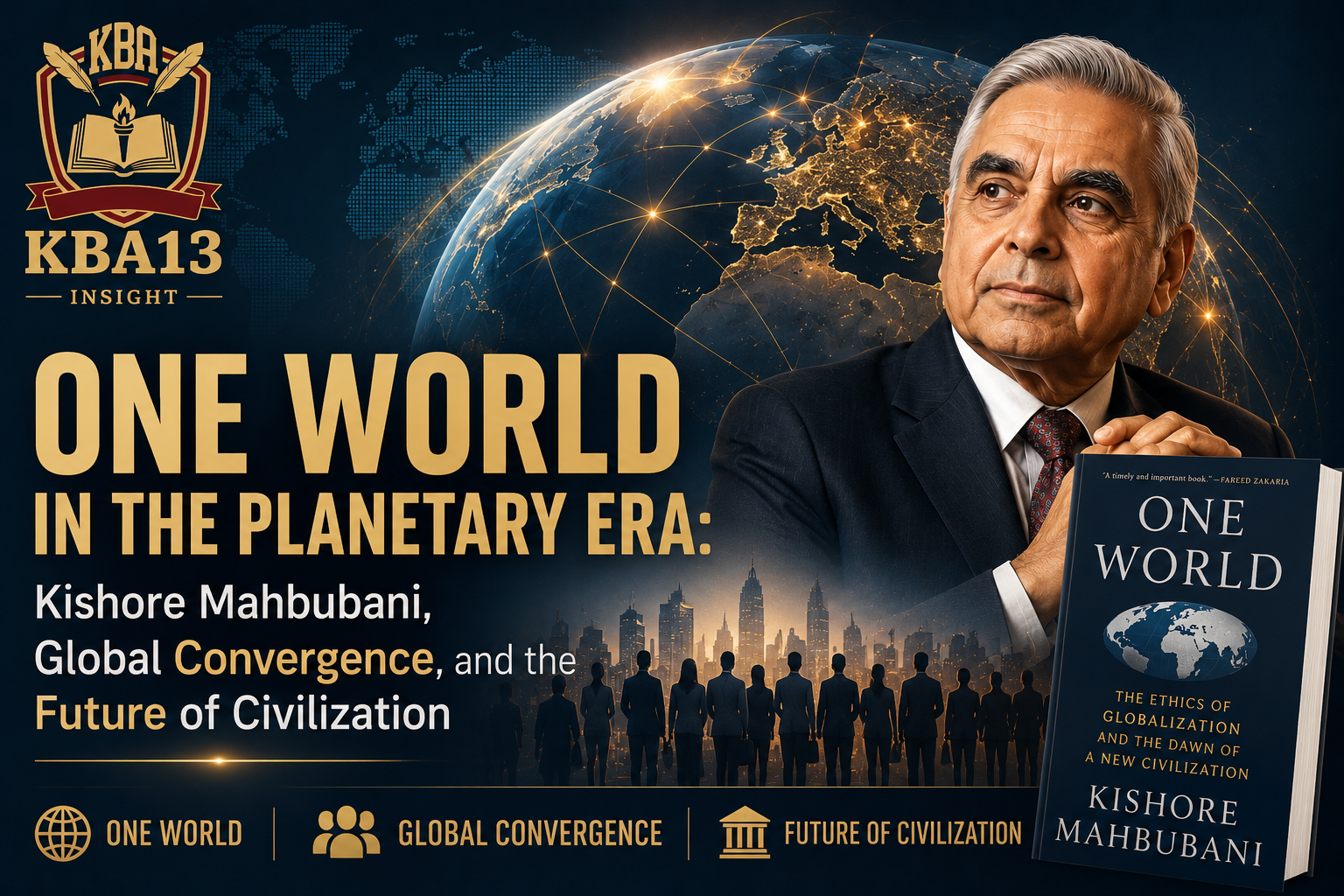
The Idea That Will Not Go Away
There are ideas in the history of political thought that arrive before their time, get filed under utopianism, and then return — not as ideology but as necessity. The concept of One World is one of them. It has been dismissed as naïve idealism by realists, denounced as Western universalism by postcolonial critics, and ignored by the nation-state system that has organized global politics for four centuries. And yet, with each passing decade, the condition it describes becomes harder to argue against. Whether or not we want to live in One World, we increasingly have no choice but to. The climate does not respect borders. Pandemics do not pause at checkpoints. Financial contagion crosses oceans in milliseconds. Algorithms shape opinion simultaneously in Jakarta, Lagos, São Paulo, and Stockholm. The factual condition of One World is already upon us. What has not kept pace is the consciousness, the institutions, and the political will to govern it.
It was Kishore Mahbubani, the Singaporean diplomat, scholar, and provocateur, who gave this condition its most systematic recent articulation. In The Great Convergence: Asia, the West, and the Logic of One World (2013), Mahbubani assembled the evidence for what he calls the logic of convergence — the structural forces that are driving disparate human civilizations, across all their cultural, political, and historical differences, toward a shared condition of existence. This is not a normative argument about what the world should be. It is a descriptive argument about what the world is already becoming and what political and intellectual adjustments that becoming demands. Mahbubani has returned to this argument in Has the West Lost It? (2018) and Has China Won? (2020), deepening and updating the diagnosis. Together, these books constitute one of the most sustained and consequential attempts by a non-Western thinker to map the emerging world order on non-Western terms.
I have previously touched on the concepts of global mind and global brain, which I will develop in a separate post. Those concepts connect directly to what Mahbubani is arguing, because the convergence he describes is not merely institutional or economic. It is cognitive. The emergence of a shared global information environment — one that, for all its distortions and inequalities, connects billions of human beings to a common informational field — is creating something that no previous period of human history has produced: a planetary cognitive commons. What happens in that commons, how it is governed, who controls its architecture, and on whose terms — these are the questions on which the future of One World actually turns. They are also the questions that connect Mahbubani’s political analysis to the analysis of disinformation, cognitive warfare, AI, and planetary civilization that I have been developing across multiple pieces on this site, including The Power of the Disinformation Ecosystem in the Planetary Era, The Future of Cooperation between Humans and Aliens, From WEIRD Society to FACE RIP Society, and The Cartography of the Human.
Going Global: From Globalization to the Global Village to One World
The term global was not always as ubiquitous as it is now. It entered common intellectual currency with the acceleration of globalization in the late 20th century — the era of containerized shipping, liberalized trade, deregulated capital flows, and the internet. When something goes global (GG), in Mahbubani’s usage, it becomes no longer bounded by the scale of any single nation or region. It becomes available, accessible, or influential across the entire surface of the planet simultaneously. This is a genuinely new condition in human history. Until very recently, even the most powerful empires could not achieve it. Rome could project power across its Mediterranean rim, but not beyond. The British Empire controlled a quarter of the earth’s land surface, but could not project real-time influence across it. The internet changed this. The algorithm changed this. The smartphone changed this. Now a teenager in Banda Aceh and a teenager in Cleveland, Ohio, inhabit — in a meaningful sense — the same informational environment. They are both users of the same platforms, consumers of the same content logics, subject to the same algorithmic incentive structures. They are both, in a profound sense, inhabitants of One World whether they know it or not.
The concept of the Global Village, coined by Marshall McLuhan in the 1960s, was the first significant attempt to name this condition. McLuhan argued that electronic media were contracting the globe into a village — making distant events as immediate and emotionally accessible as events in one’s own community, creating a shared nervous system for the entire species. What McLuhan saw in television and radio, we now see at incomparably greater intensity in social media, in real-time video communication, in the global simultaneity of trending content. The Global Village has become, if anything, an overly accurate metaphor. A village is a place where everyone knows everyone else’s business, where rumor travels faster than verification, where social pressure is intense and conformity is enforced by proximity. That is exactly what the global information environment has become. And the pathologies of village life — gossip, tribalism, the persecution of difference, the tyranny of what the neighbors think — have scaled to planetary dimensions, with consequences that are visible in the rise of global populism, the weaponization of identity politics, and the collapse of shared epistemic ground.
I want to add a further observation to McLuhan’s formulation. Not every village has remained a village. Some initially village areas have become what I call City-Village — places that retain the social density and communal memory of the village while acquiring the economic complexity and informational connectivity of the city. This is a useful concept for thinking about what One World might actually look like in practice, rather than in theory. One World is not the Global Village writ large. It is something more complicated: a condition in which the local and the global are simultaneously present in every context, in which the farmer in Aceh and the policy analyst in Singapore and the algorithm engineer in San Francisco are all making decisions that affect each other, in ways none of them can fully see or predict. The City-Village is a hybrid form that captures this complexity better than either the village or the metropolis alone.
Mahbubani’s Four Pillars: The Architecture of Convergence
Mahbubani identifies four pillars driving humanity toward the condition of One World: environment, economy, technology, and aspiration. He argues, in a formulation worth quoting directly, that these are the forces “driving humanity to acknowledge that we live in one world” (p. 55). The formulation is careful: not building One World, not choosing One World, but acknowledging One World. The acknowledgment is something distinct from the condition itself. The condition exists, whether acknowledged or not. What Mahbubani is concerned with is the political and cognitive work required to bring human institutions into alignment with a reality that already obtains. This is, in its way, the most radical claim in the book: that the idealism is behind us, not ahead of us. One World is not the destination. It is the departure point. The question is what we do with it.
The Environment has become, in Al Gore’s formulation in The Future (2013), what Gore calls Earth Inc. — a single interconnected system of planetary life support whose functioning cannot be parceled out among competing national jurisdictions without destroying it. Environmental problems are, by definition, One World problems. A molecule of CO₂ released from a coal plant in Shandong Province does not recognize the difference between Chinese airspace and Australian airspace. The melting of the Greenland Ice Sheet does not disproportionately flood the countries that caused it. The collapse of ocean fisheries does not observe exclusive economic zones. The environment is the most unambiguous case for One World governance precisely because nature imposes the logic of One World regardless of whether human politics is ready to accept it. And the failure of human politics to accept it — the continued insistence on managing a planetary problem through national institutions optimized for national interests — is producing outcomes that threaten the biosphere on which all human civilization, in all its national variety, ultimately depends.
The Economy is perhaps the most politically fraught of the four pillars, because it is the one where the gap between the rhetoric of globalism and the reality of power asymmetry is most visible and most damaging. Mahbubani is clear-eyed about this. The global economic system is not a neutral playing field. It was designed, largely after the Second World War, by the major Western powers, to serve their interests first and others’ interests where convenient. The Bretton Woods institutions — the IMF, the World Bank, the architecture of global trade — were built on Western terms, encoded Western assumptions, and have consistently reflected Western priorities. The convergence economy, the global financial system that integrates emerging markets into a single web of interdependence, is simultaneously a genuine opportunity and a sophisticated trap. The opportunity is real: integration into the global economy has produced the most dramatic poverty reduction in human history, lifting hundreds of millions of people in Asia out of absolute poverty in a generation. The trap is equally real: the rules of integration were written by those who benefit most from them, and countries that enter the system without the institutional capacity to navigate it on favorable terms often find themselves locked into dependency relationships that, in their structural logic, recall the colonial relationships they replaced.
The role of China in this global economic order requires its own reckoning. The philosophy that has driven China’s global economic expansion can be summarized in a formulation I find useful: “Do you want anything?” China has made itself the indispensable supplier of last resort for the world’s manufacturing needs — not through military conquest or formal imperial administration, but through the relentless cultivation of economic dependency across Africa, Asia, Latin America, and increasingly the Global North. This is One World economics with Chinese characteristics: integration on terms that serve Chinese strategic interests while providing genuine material benefits to the countries integrated into the network. The Belt and Road Initiative is the most visible expression of this strategy, but it is only the visible layer. Beneath it lies a more pervasive economic logic: that in a world of One World economics, whoever controls the supply chains, the infrastructure, the digital standards, and the data flows controls the terms on which everyone else participates in the system. The financial crisis dynamic — where a crisis in one country cascades through the integrated system to destabilize others — is both a demonstration of One World interdependence and an argument for the kind of global economic governance that Mahbubani advocates. International coordination is not idealism. It is the minimum rational response to a system in which economic autonomy has already been substantially compromised by the very integration the system promotes.
Technology has played a role in the emergence of One World that exceeds all the other pillars in its speed and its totality. Connectivity, hyper-reality, and big data have made humankind feel — at the level of daily experience, not just abstract analysis — what it means to be dependent on a shared planetary infrastructure. This pillar is closely related to the pillars on either side of it: it amplifies the environmental crisis by enabling the energy consumption and coordination problems of industrial civilization, and it structures the aspirational pillar by shaping what people know is possible and what they believe they deserve. Technology has also created a new world in the human mind. Imagination is no longer a fantasy but can become a reality. The unification of technology and humans is no longer impossible. Humans can install various technological advances in their bodies. The case of cyborgs, Artificial Intelligence, and transhumanism is no longer taboo to discuss, but has become a new norm in the unification of technology with humans themselves.
I see that the technology pillar has enabled every individual to sit down and be involved together to enjoy the results of human intelligence itself. But this enjoyment is not evenly distributed, and the technology’s architecture is not neutral. As I have argued elsewhere on this site, particularly in my analysis of cognitive warfare and the disinformation ecosystem, the same connectivity that enables global coordination also enables global manipulation. The same platforms that give a child of a fisherman in Makassar access to the same information as a child in Manhattan also give a state intelligence service the ability to shape political opinion across a dozen countries simultaneously. The technology pillar of One World is a two-edged sword. It is the most powerful driver of genuine convergence — of the shared informational and cognitive environment that is One World’s most distinctive feature — and the most powerful instrument of its potential subversion.
Aspiration is the pillar that Mahbubani finds most hopeful, and I understand why. It is also the one that needs the most careful scrutiny. The argument is straightforward: globalization has produced a global aspiration class — people at every level of society, on every continent, who know what is possible in terms of education, standard of living, political participation, and personal freedom, and who want it for themselves and their children. In the past, only certain families could get into Harvard and Yale. Now parents across the world can aspire to send their children to these campuses. Through the power of scholarships, farmers’ children can gain admission to prestigious campuses around the world. The new players on the global stage may be the children of farmers, children of immigrants, children of lawyers, children of fishermen — children who are not from VVIP families. I read that some of today’s thinkers are children who are victims of war or have experienced various kinds of violence as they grow from childhood to adulthood. This situation shows the existence of a global aspiration that every resident on this earth owns.
The critical question is whether the global aspiration for a better life — which is real, widespread, and powerful — translates into support for the kind of global governance required to deliver on that aspiration. There is no guarantee that it does. The same aspirational energy can be captured by nationalist politicians who promise national greatness as the vehicle for individual improvement, by authoritarian systems that deliver material development while suppressing political freedom, or by the disinformation ecosystem that tells people what they want to hear while preventing them from seeing what is actually happening to their lives. Global aspiration is a powerful fuel. What it fuels depends on who controls the engine.
Five Principles and the Architecture of Global Civilization
Beyond the four pillars, Mahbubani identifies five principles around which the converging world is organized: acceptance of the framework of modern science, logical reasoning, embrace of the free market economy, transformation of the relationship between rulers and ruled, and increasing focus on multilateralism. These principles are worth examining critically, because they are not as culturally neutral as they appear, and recognizing their cultural embeddedness is essential to understanding the tensions that define the emerging One World order.
The acceptance of modern science and logical reasoning is, in practice, a specific epistemological commitment — one that the West developed through a particular historical and institutional process, and that other civilizations have adopted, adapted, or resisted in ways shaped by their own histories. It is not a claim that non-Western civilizations lack the capacity for rational thought — that would be a gross and well-documented misrepresentation. It is a claim that the specific institutional form that rational inquiry took in post-Enlightenment Europe — the university, the peer-reviewed journal, the experiment, the secular separation of knowledge from religious authority — has become the dominant global standard for what counts as knowledge. This has produced genuine goods: the universality of modern medicine, the shared language of mathematics, the global coordination of climate science. It has also produced genuine costs: the systematic dismissal of forms of knowledge that do not conform to this institutional standard, including forms of ecological knowledge, social knowledge, and practical wisdom that have sustained human communities for millennia and that modern science is only now beginning to recognize as cognitively serious. The epistemological convergence that Mahbubani describes is real, but it is neither painless nor complete.
The embrace of the free-market economy is the most contested of the five principles because the actually existing global free market diverges so dramatically from its theoretical description. The theoretical free market operates on equal terms, under neutral rules, with transparent pricing and competitive entry. The actually existing global market operates on historically accumulated advantages, under rules written by the powerful, with information asymmetries that systematically benefit the well-capitalized, and with entry barriers that reflect the accumulated institutional advantages of the already-developed. Developed countries use the language of free trade to open other countries’ markets to their exports while maintaining agricultural subsidies, intellectual property protections, and financial regulations that effectively protect their own advantages. This is not a failure of the free market principle. It is the free-market principle as actually practiced by the powerful, which is quite different from the free-market principle as described to the less powerful.
The transformation of the relationship between rulers and ruled — the spread of democratic accountability — is the principle most directly under stress in the current moment. The assumption that political modernization leads toward democracy, and that democracy is the stable end-state of political development, has been significantly challenged by the rise of authoritarian models of governance that deliver economic development without political liberalization, and by the dysfunction of established democracies that have failed to deliver economic security and political representation to large portions of their own populations. The democratic deficit in One World is not simply a failure of developing countries to adopt democratic institutions. It is also a failure of established democracies to govern in ways that justify the continued loyalty of their populations. And it is a failure of global institutions to embody any meaningful form of democratic accountability — the UN Security Council remains controlled by the five permanent members who won the Second World War, the IMF’s voting structure reflects the economic weights of the 1940s more than the 2020s, and the global technology platforms that now constitute the primary informational infrastructure of global democracy are accountable to their shareholders, not to the global public whose cognitive environment they shape.
The focus on multilateralism is Mahbubani’s preferred solution and his most contested recommendation. Multilateralism is not a neutral concept. It refers to the management of international affairs through shared institutions and negotiated rules rather than through the direct exercise of power by the strongest parties. The argument for it is essentially the same as the argument for law within domestic political orders: that rule-based systems, even imperfect ones, are preferable to power-based systems because they provide some protection for weaker parties and some predictability for all. The argument against it, which is made both by hegemonic powers who find multilateral constraints on their freedom of action inconvenient and by critical theorists who argue that multilateral institutions simply institutionalize existing power asymmetries at a higher level of abstraction, is not without force. The challenge is not to abandon multilateralism but to reform it — to build multilateral institutions that actually reflect the distribution of power and interest in the world as it currently exists, rather than as it was arranged in 1945.
The National Interest Problem: New Mental Maps for a One World Order
The most philosophically charged observation in The Great Convergence is the one about mental maps. Mahbubani writes that policymakers urgently need to be “equipped with new mental maps” — new conceptual frameworks for understanding the world they are governing. The metaphor is apt. A map is not the territory. It is a representation of the territory, and like all representations, it encodes specific assumptions about what matters and what does not, what is central and what is peripheral, what is adjacent and what is distant. The mental maps that currently govern policymaking were drawn in a world organized around the primacy of the nation-state and the pursuit of national interest. They are not simply incomplete in a One World context. They are actively misleading.
In my previous pieces on this site, particularly those dealing with cognitive warfare and intelligence strategy, I have written about how mental models — cognitive frameworks that organize the interpretation of incoming information — function as the invisible architecture of decision-making. The policymaker who cannot see beyond the nation-state does not simply fail to act on global interests. They genuinely cannot see the global dimensions of the problems they are managing. The climate negotiator whose mental map is organized around national economic competitiveness will systematically underweight the global consequences of national emissions decisions — not out of malice, but because the map lacks the categories needed to make those consequences visible. Building new mental maps is, therefore, not merely an intellectual exercise. It is the precondition for the kind of effective global governance that One World requires.
The tension between national and global interests is not simply a conflict between selfishness and altruism. It is a tension between two frameworks for defining a state’s actual interests. In the short run, on any individual issue, national interests and global interests frequently conflict. A country that uses coal can point to short-term economic costs of decarbonization that genuinely hurt its citizens. A country that benefits from an asymmetric trade relationship can point to domestic jobs and revenues that depend on that asymmetry. These short-term national costs are real, and policymakers who ignore them will not remain policymakers. The argument for attending to global interests is therefore not that national interests do not exist, or that they should be subordinated to an abstract global good. It is that the long-term national interests of every country are inseparable from the health of the global systems — environmental, economic, political, informational — on which every country depends. A national interest analysis that ignores global consequences is not, in fact, optimizing for the national interest. It is a short-term calculation masquerading as one.
Our current global order is run by nation-states and their leaders, with decisions driven primarily by national interests. Nevertheless, this description of prevailing reality also describes the fundamental problem. The world has changed. Our way of managing it has not. This is the Mahbubani diagnosis at its most precise, and it points to what I consider the most underappreciated dimension of the One World challenge: it is not primarily a problem of geopolitics, international law, or institutional design. It is a problem of collective cognition. The world’s most powerful decision-makers are using mental maps drawn for a world that no longer exists to navigate a world that requires entirely different conceptual equipment. The consequences of this mismatch are visible in every major global crisis: in the inadequacy of national climate pledges, in the fragility of global health governance, in the inability of international institutions to manage the conflict dynamics produced by AI, and in the systematic failure to build the kind of shared epistemic ground that genuine global coordination requires.
One World as Post-Colonial Symptom: The Trap of Pseudo-Global Interest
The five pillars above are not new in global studies. However, it will be a new problem if, in the future, the concept of One World is no longer a recommendation but becomes an obligation. This is triggered when there is a global spirit above the global order governing this world in time. This is the critical question that Mahbubani’s optimistic framework tends to underweight, and that a reading of his argument from outside the Western-Asian dialogue he primarily conducts demands to be asked.
If viewed through the lens of the government scenario in this world, countries that act as great transformative states will work hand in hand to defend their national interests in the name of global interests. This is the structure of pseudo-global interest — and it is the most sophisticated form of power that the One World order produces. Pseudo-global interest is national interest translated into the language of global necessity, packaged in the institutional forms of multilateralism, and marketed to the international community as the common good. It is an empire dressed in the vocabulary of global governance. It is not a conspiracy — it does not require any individual actor to consciously intend the deception. It emerges as the natural product of the fact that the powerful shape the institutions, the institutions define the rules, and the rules — even when formally neutral — systematically reflect the interests of those who shaped them.
It is predicted that the concept of One World is a new pattern of post-colonial and post-imperialism symptoms that are, or will slowly emerge, in this world. Annexing each other is no longer carried out through proxy wars but rather through pseudo-global interests, which are, quite possibly, national interests transformed into global ones. The emergence of this pseudo-global interest will force the countries under it to be locked into each of the pillar strategies above. The environmental pillar serves as a mechanism by which developed countries, having already industrialized and accumulated wealth through energy-intensive processes, impose carbon transition costs on developing countries that cannot afford them, while simultaneously protecting the intellectual property of clean energy technologies that would accelerate the transition if freely shared. The economic pillar serves as a mechanism by which the financial infrastructure of One World channels resources upward, from resource-rich but institutionally weak countries to capital-abundant and institutionally powerful ones. The technology pillar becomes a mechanism by which countries that control the hardware, software, platforms, and data standards control the cognitive environment of the entire global population. The aspiration pillar becomes a mechanism through which global standards of success — access to elite education, professional credentials, consumer lifestyles — are defined by the already-successful, and the aspiring are invited to measure themselves against a standard they did not set and cannot revise.
This is not an argument against the One World concept. It is an argument for taking it seriously enough to interrogate its implementation. The logic of One World — the recognition that human civilization on this planet constitutes a single system that must be governed as such — is, I believe, correct and necessary. But the governance of that system is not politically neutral, and the institutions through which it is attempted are not free of the power asymmetries they were designed within. A One World order that is genuinely just — that actually reflects the interests and perspectives of the 88 percent of the world’s people who are not Western, educated, industrialized, rich, and democratic — will look very different from the One World order that is currently being built. Mahbubani, to his credit, makes this argument himself, with specific proposals for reforming the UN Security Council, the IMF, and the World Bank to give more weight to non-Western voices. But the proposals remain far from implementation, and the resistance to them from the existing beneficiaries of the current arrangement is systematic and determined.
From Planetary Civilization to One World: The Missing Bridge
In my piece on Planetary Civilization published on this site, I discussed how technology, information, and algorithms are collectively shaping the future of humanity in ways that exceed what any individual nation-state can manage. The planetary civilization concept is related to Mahbubani’s One World concept, but is not identical to it. Mahbubani’s One World is primarily a political and institutional concept — a description of the governance challenge posed by global interdependence, and a set of proposals for meeting that challenge through reformed multilateral institutions. Planetary civilization is a broader, more philosophical concept — a description of the stage of civilizational development at which human beings become, for the first time, a planetary species, with capabilities and responsibilities that extend to the full scale of the biosphere and potentially beyond.
The bridge between the two concepts is the question of consciousness — not individual consciousness, but what I have previously referred to as the global mind. A planetary civilization is not simply a civilization that operates at a planetary scale. It is a civilization that thinks at a planetary scale — that has developed the cognitive and cultural frameworks to perceive, understand, and take responsibility for the planetary dimensions of its existence. Mahbubani’s call for new mental maps is, in this sense, a call for the development of a global mind: a mode of collective cognition adequate to the condition of One World that the four pillars are producing. The global brain — the networked informational infrastructure that connects billions of individual minds into a shared cognitive system — is the technical precondition for this development. But the technical precondition is not sufficient. A global brain that is organized primarily by commercial algorithms optimizing for engagement — that amplifies division, outrage, and tribalism because those states generate more advertising revenue than cooperation, nuance, and global solidarity — will not produce a global mind. It will produce a planetary Tower of Babel: unprecedented connection producing unprecedented incoherence.
The disinformation ecosystem I analyzed in a previous piece is, within this framework, one of the primary obstacles to developing the global mind that One World requires. If the cognitive environment through which people understand the world is systematically distorted by algorithmically amplified misinformation, by the weaponization of identity and fear, by the systematic destruction of shared epistemic ground, then the political conditions for genuine global governance cannot be created. You cannot build effective multilateral institutions among publics that cannot agree on basic facts about the world they inhabit. The epistemological crisis — the collapse of shared reality — is therefore not a separate problem from the governance crisis. It is the same problem, viewed from a different angle.
The connection to the analysis of cognitive warfare in The Cartography of the Human is direct. Cognitive warfare — the systematic attempt to shape the beliefs, emotions, and decision-making processes of target populations through informational and psychological means — is One World politics pursued by other means. It is the attempt by powerful actors to shape the global mind in directions favorable to their interests, using the technological infrastructure of global connectivity as the delivery mechanism. The countries and corporations that control the platforms, the algorithms, and the data have, in effect, colonized the cognitive commons of One World before any governance framework has been established to regulate that colonization. The result is a global information environment that produces the appearance of shared knowledge while systematically preventing the kind of genuine understanding on which the global mind — and One World governance — depends.
The City-Village and the Future of Global Aspiration
I want to return to the concept I introduced earlier: the City-Village. This is not merely a metaphor. It describes a real socio-spatial and socio-cognitive condition that is becoming increasingly common in the Global South and is one of the most important sites where the dynamics of One World are played out. The City-Village is a community that has been integrated into global flows — of information, commodities, labor, and cultural products — without being integrated into the institutional structures of One World governance. Its inhabitants have global aspirations but no global citizenship. They consume global culture but produce global labor at prices set by global markets they did not design. They are affected by global environmental changes that they did not cause. They are subject to global financial dynamics that they cannot influence. They inhabit One World as its objects, not its subjects.
The political implications of the City-Village condition are significant. It produces populations that are neither fully local nor fully global—that have lost the cohesion of traditional community without gaining the protections of effective global citizenship. These are the populations most vulnerable to the promises of authoritarian nationalism, which offers the psychic compensation of belonging and significance in the face of the material insecurity of global integration. They are also the populations most easily manipulated by the disinformation ecosystem, which finds in their grievances — real grievances, produced by the genuine failures of the global system — the raw material for political mobilization that serves the interests of the manipulators rather than the manipulated.
The global aspiration pillar, in the City-Village context, becomes a double-edged force. The aspirational energy is genuine — the desire for a better life, for education, for dignity, for recognition, is universal. But when aspiration is not matched by opportunity, it becomes resentment. And resentment, at the scale that the current global system produces it, is one of the most powerful and most dangerous political forces in the world. The political consequences of a One World order that talks the language of equal opportunity while systematically reproducing inequality are not abstract. They are visible in the electoral rise of anti-globalization movements in established democracies, in the appeal of revisionist powers that offer alternative visions of the global order, and in the proliferation of conflicts whose proximate causes are local but whose structural causes are embedded in the global system.
The new players on the global stage — the children of farmers, of immigrants, of fishermen, of war victims — who have penetrated the world’s elite institutions are important, but they are a small fraction of the aspirational cohort they represent. The significance of their success lies not simply in its demonstration of individual mobility. It raises, for the billions who cannot achieve the same mobility, a question that the global system has no comfortable answer to: if it is possible, why is it not possible for more? The aspiration pillar of One World raises expectations that the governance architecture cannot currently fulfill. The gap between aspiration and fulfillment is one of the most politically volatile features of the contemporary global order.
After Globalization: One World as the Logic of the Planetary Era
The five pillars above are not new in global studies. However, they will become a new problem if, in the future, the concept of One World is no longer a recommendation but becomes an obligation. Mahbubani’s analysis was published in 2013. More than a decade later, the trajectory he described has continued, accelerated, and complicated itself in ways that his framework anticipates but does not fully capture. The most significant development is the emergence of what I am calling the planetary era — a period in human history qualitatively different from the era of globalization that preceded it, because the scale, speed, and depth of integration have crossed certain thresholds beyond which the dynamics of the system change in kind, not just in degree.
The planetary era is the era in which the five pillars of One World have become structural — not trends that might be reversed, but features of the human condition that cannot be undone without catastrophic disruption. The environmental dimension of One World is now locked in: the consequences of previous emissions are already determined, and the choices we make in the coming decades will shape the planet’s climate for centuries, regardless of what any national government decides. The economic dimension is now locked in: the global financial system is so deeply integrated that a serious attempt to decouple — to retreat into genuine national economic autonomy — would produce disruptions of a scale that no government could survive politically. The technological dimension is now locked in: the digital infrastructure of global connectivity cannot be dismantled without destroying the economic and social systems built on it. The aspiration pillar cannot be reversed: the global knowledge of what is possible cannot be unknowed.
What the planetary era adds to Mahbubani’s framework is urgency and irreversibility. The logic of One World is no longer the logic of a convergence that might or might not occur, depending on political choices. It is the logic of a convergence that has already occurred, whose consequences are already being felt, and whose governance remains catastrophically inadequate. The gap between the world as it actually is — One World, integrated, interdependent, operating as a single system in every domain that matters — and the world as it is governed — through national institutions, competing interests, and mental maps drawn for a world that no longer exists — is the central political problem of the 21st century. Every other problem — climate change, AI governance, pandemic preparedness, nuclear security, the regulation of global financial flows — is a specific manifestation of this central problem.
Mahbubani’s most significant contribution is to insist that this problem is solvable — that the logic of One World, properly understood, points toward governance arrangements that can actually work and that the obstacles are political and cognitive rather than structural. This is an argument that needs to be taken seriously, and tested seriously, rather than dismissed as idealism. The alternative to One World governance is not the comfortable world of sovereign nations managing their own affairs. The alternative is a world in which the forces driving convergence continue to operate without governance, producing outcomes that no nation chose, and no nation can manage alone. The planetary era is arriving whether we are ready for it or not. The concept of One World, as Mahbubani presents it, is not a utopia. It is the minimum adequate response to an existing condition. The question is not whether to have One World. The question is what kind of one world it will be — and whether those who currently inhabit it as objects will find a way to claim their place as subjects.
References
- Mahbubani, K. (2013). The Great Convergence: Asia, the West, and the Logic of One World. PublicAffairs.
- Mahbubani, K. (2018). Has the West Lost It? A Provocation. Allen Lane.
- Mahbubani, K. (2020). Has China Won? The Chinese Challenge to American Primacy. PublicAffairs.
- Gore, A. (2013). The Future: Six Drivers of Global Change. Random House.
- McLuhan, M. & Fiore, Q. (1967). The Medium is the Massage: An Inventory of Effects. Bantam Books.
- Henrich, J., Heine, S. J., & Norenzayan, A. (2010). “The Weirdest People in the World?” Behavioral and Brain Sciences, 33(2–3), 61–83.
- Kamaruzzaman Bustamam Ahmad. (2026). The Power of the Disinformation Ecosystem in the Planetary Era. KBA13 Insight.
- Kamaruzzaman Bustamam Ahmad. (2026). The Future of Cooperation between Humans and Aliens. KBA13 Insight.
- Kamaruzzaman Bustamam Ahmad. (2026). The Cartography of the Human: Multi-Lens Intelligence Profiling, Cognitive Warfare, and the Strategic Art of Reading Power. KBA13 Insight.
- Kamaruzzaman Bustamam Ahmad. (2026). From WEIRD Society to FACE RIP Society. KBA13 Insight.
- Kamaruzzaman Bustamam Ahmad. (2026). Planetary Civilization: Ketika Teknologi, Informasi, dan Algoritma Membentuk Masa Depan Manusia. KBA13 Insight.
Published on kba13.com
About The Author

Rekomendasi Bacaan KBA13 INSIGHT
Jika tulisan ini bermanfaat, dukung jurnal ini dengan mencari bukunya melalui tautan berikut:
- Buku-buku Kamaruzzaman Bustamam Ahmad di Periplus
- Koleksi Islamic Studies di Periplus
- Koleksi Geopolitics & Politik Internasional di Periplus
- Cari buku & perangkat baca di Shopee
- Cari di Blibli
Daftar lengkap: Rekomendasi Buku, Alat Tulis & Layanan. Tautan di atas adalah tautan afiliasi — KBA13 INSIGHT dapat memperoleh komisi kecil tanpa biaya tambahan bagi Anda.
Artikel Terkait
 Artificial Intelligence and the World Order of 2040: A Strategic Essay on AI, Extraterrestrial Intelligence, and the Future of Humanity
 The Future of Cooperation between Humans and Aliens
 Asia’s Cauldron: Laut Cina Selatan, Perebutan Hegemoni, dan Masa Depan Asia-Pasifik
 Has China Won? Kishore Mahbubani on America’s Strategic Dilemma in the 21st Century
 KBA13 Insight Update Internaional: Iran War, Trump-Xi Summit, Ukraine Ceasefire, Taiwan Risk, and the Collapse of Strategic Order
Leave a Reply