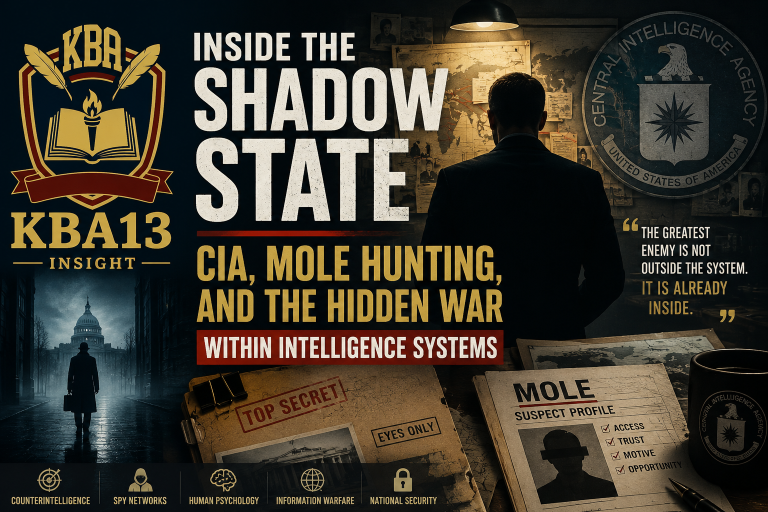
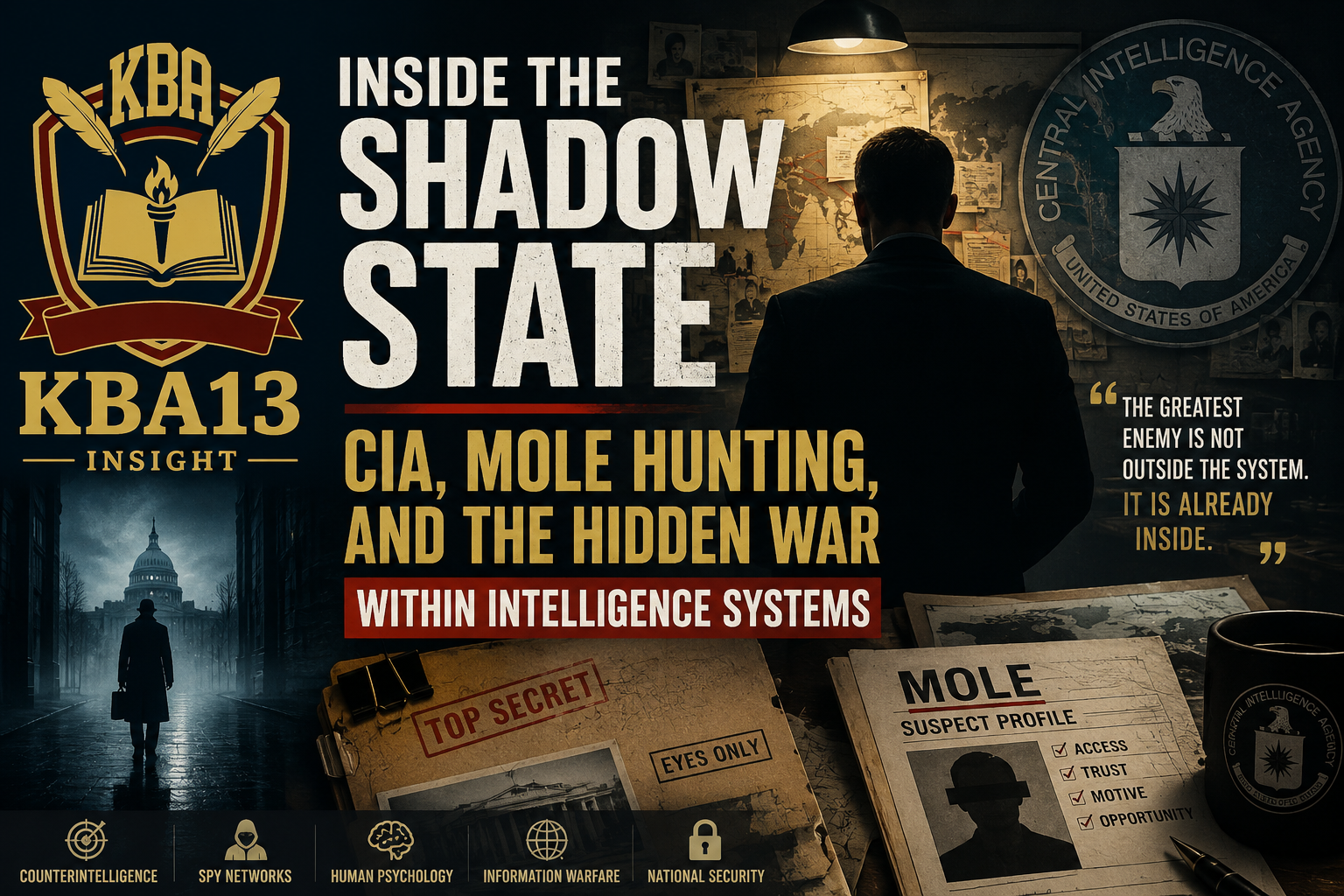
CIA intelligence officer analyzing classified documents during modern counterintelligence and shadow warfare operations
The Architecture of Secrets: Why Intelligence Agencies Exist Beyond Public Visibility
The history of modern intelligence demonstrates one fundamental reality: the most decisive battles between states often occur long before soldiers enter the battlefield. Behind diplomatic statements, military doctrines, and political decisions exists a hidden ecosystem where information becomes power. Intelligence agencies were created because states learned that survival depends not only on responding to visible threats but detecting invisible movements before they transform into strategic disasters. From the Cold War rivalry between the United States and the Soviet Union to the contemporary competition among great powers, intelligence has become the nervous system of national power.
The establishment of the Central Intelligence Agency (CIA) in 1947 through the National Security Act reflected this transformation in American strategic thinking after World War II. Washington realized that military superiority alone was insufficient without a permanent institution capable of collecting, analyzing, and interpreting global threats. The surprise attack on Pearl Harbor in 1941 became a historical lesson that possessing information is different from understanding intelligence. A state can have thousands of pieces of information and still fail if it cannot connect them into strategic awareness.
The Cold War became the laboratory of modern intelligence competition. The United States and the Soviet Union did not only compete through nuclear weapons, military alliances, and ideological influence. They fought a silent war through human sources, defectors, surveillance systems, psychological operations, and classified networks. Organizations such as the CIA and the KGB understood that controlling hidden knowledge could shape global events without triggering direct military confrontation. Intelligence became the battlefield between perception and reality.
However, secrecy creates a dangerous paradox. The same system designed to protect a nation can also produce vulnerabilities that are difficult to detect. The deeper an organization operates behind classified barriers, the harder it becomes to identify internal weaknesses. Intelligence agencies therefore face two simultaneous missions: penetrating the secrets of adversaries while preventing adversaries from penetrating their own institutions. This second mission becomes the foundation of counterintelligence.
History shows that internal compromise can damage a state more severely than external attacks. The cases of Aldrich Ames, a CIA officer arrested in 1994 for spying for the Soviet Union and later Russia, and Robert Hanssen, an FBI counterintelligence agent arrested in 2001, demonstrated how trusted insiders could cause catastrophic intelligence failures. Ames compromised numerous intelligence assets working for the United States, while Hanssen provided highly sensitive information over many years. These cases revealed that the greatest vulnerability of intelligence systems is often not technology, but human access.
This is why the concept of the “mole” occupies a central place in intelligence culture. A mole represents the nightmare scenario for any intelligence organization because the threat does not come from outside the wall; the threat already possesses the keys to enter the system. Unlike external enemies, insiders understand procedures, security protocols, institutional habits, and psychological weaknesses. The organization created to discover secrets suddenly becomes the object being secretly observed.
The architecture of intelligence is therefore an architecture of permanent tension. States need secrecy because adversaries exist, but secrecy itself generates new forms of danger. The future of intelligence will not only depend on stronger surveillance technologies, artificial intelligence, or cyber capabilities. The ultimate challenge remains the oldest problem in human history: whether an institution built to understand others can truly understand itself.
The Enemy Within: Understanding the Strategic Danger of a Mole
The greatest fear inside any intelligence organization is not always the enemy standing outside its borders. External enemies can be monitored, mapped, and analyzed through established intelligence methods. The most dangerous threat emerges when the adversary has already entered the system, gained institutional trust, and operates under the protection of legitimacy. In intelligence terminology, this figure is known as a mole: an insider secretly serving another power while remaining embedded inside the organization. A mole does not attack the walls of the fortress; a mole already lives inside the fortress.
The history of intelligence competition shows that internal penetration can have strategic consequences that last for decades. During the Cold War, the Soviet intelligence services invested heavily in recruiting insiders within Western institutions because they understood a simple principle: stealing secrets from the inside is more effective than trying to break in from the outside. The Cambridge Five spy ring in Britain became one of the most famous examples. Figures such as Kim Philby successfully infiltrated the British intelligence establishment while secretly providing information to the Soviet Union. Philby’s position inside British intelligence allowed Moscow to understand Western operations from within.
The case of Aldrich Ames later became one of the most damaging intelligence breaches in American history. As a CIA officer with access to highly classified information, Ames provided sensitive intelligence to the Soviet Union and later Russia for years before being arrested in 1994. The damage was not merely the transfer of documents. The deeper consequence was the exposure of human intelligence networks. When a mole compromises human sources, intelligence failure becomes a matter of life and death because real individuals operating in dangerous environments become vulnerable.
Robert Hanssen demonstrated another dimension of insider threats. As an FBI counterintelligence agent, Hanssen was responsible for protecting American institutions from foreign penetration. However, the person responsible for hunting spies became the source of the compromise itself. His case revealed a disturbing reality inside intelligence systems: technical security measures cannot fully protect an institution when trust becomes the weapon used against it. The enemy does not always need to defeat security systems if the enemy can recruit someone who already has authorized access.
Counterintelligence, therefore, developed not only as a technical discipline but also as a psychological science. Intelligence agencies study why individuals betray their own institutions. The classic framework often discussed in intelligence analysis is known as MICE: Money, Ideology, Coercion, and Ego. Some insiders are motivated by financial gain. Others believe they are serving a greater ideological cause. Some are pressured through vulnerabilities. Others are driven by resentment, recognition, or personal dissatisfaction. The battlefield is not only information; the battlefield is human psychology.
The existence of a mole causes damage beyond stolen secrets, as it destroys institutional confidence. Once an intelligence agency discovers penetration, every previous operation becomes questionable. Every failed mission must be reviewed. Every compromised source must be examined. Every internal relationship becomes vulnerable to suspicion. This psychological impact is exactly why mole hunting is one of the most difficult tasks in intelligence work. The institution must investigate itself without destroying the trust necessary for it to function.
The deeper lesson from the history of mole cases is that intelligence failure rarely begins with a lack of information. More often than not, failure begins when organizations underestimate human complexity. Technology can monitor communication, protect databases, and detect anomalies, but the human dimension remains unpredictable. The future of intelligence competition will continue to be shaped by this old problem: the strongest security architecture can still collapse through one individual who decides to open the door from inside.
Beyond Hollywood Espionage: The Reality of Modern Intelligence Operations
The popular imagination often misunderstands the world of espionage. Movies usually portray intelligence officers as individuals who operate alone, relying on physical courage, advanced weapons, and dramatic confrontations. This image creates an attractive narrative but hides the real nature of intelligence work. Modern espionage is not built upon individual heroism. It is constructed through systems, patience, analysis, institutional discipline, and the ability to manage uncertainty over long periods.
Real intelligence operations depend on a complex ecosystem. A successful operation may involve case officers, analysts, technical specialists, linguists, psychological experts, legal advisors, and decision-makers. The person meeting a source in the field represents only one visible part of a much larger, invisible structure. Intelligence agencies operate through coordination because a single mistake at the operational level can have consequences for national security, diplomatic relations, and human lives.
Human Intelligence (HUMINT) remains one of the oldest and most valuable forms of intelligence collection. Despite advances in satellites, cyber capabilities, and artificial intelligence, human sources continue to provide something technology cannot fully capture: intention. A satellite may detect military movement, but a human source may explain why that movement occurs. Data can reveal activity, but human access can reveal motivation, internal debate, and strategic thinking behind decisions.
The Cold War demonstrated the importance of HUMINT in great-power competition. Both the CIA and the KGB invested enormous resources into recruiting individuals who could provide access to hidden decision-making environments. The objective was not simply to collect documents. The deeper goal was understanding the thinking process of opponents. Intelligence organizations understood that knowing what an adversary possesses is important, but knowing what an adversary intends to do is far more valuable.
At the same time, the rise of Signals Intelligence (SIGINT) transformed the intelligence landscape. Organizations such as the National Security Agency (NSA) developed capabilities focused on communication interception, electronic intelligence, and data analysis. The digital revolution expanded the battlefield. Modern intelligence no longer exists only in secret meetings or classified documents. It operates through networks, databases, algorithms, cyber operations, and global information systems.
However, technological superiority does not eliminate human vulnerability. The September 11, 2001 attacks became one of the most studied examples of intelligence failure in modern history. Investigations after the attacks showed that different agencies possessed pieces of information, but the challenge was connecting those pieces into a complete threat picture. The problem was not simply collection; the problem was interpretation, coordination, and institutional imagination.
The future of intelligence will therefore not be decided only by which country possesses the most advanced technology. The decisive factor will be the ability to combine human judgment, artificial intelligence, strategic analysis, and institutional learning. Intelligence is ultimately not the science of knowing everything. Intelligence is the discipline of making better decisions under conditions where complete knowledge is impossible.
The Psychology of Betrayal: Why Insiders Turn Against Their Own Institutions
The deepest vulnerability of any intelligence organization is not always found in its technology, communication systems, or security protocols. The most unpredictable vulnerability remains the human mind. Intelligence history repeatedly demonstrates that institutions can build advanced surveillance systems, encrypted networks, and strict classification procedures, yet still fail when a trusted individual decides to betray the system from within. The human factor remains the oldest weakness in the architecture of secrecy.
Counterintelligence studies do not examine betrayal only as a legal violation. Betrayal is analyzed as a psychological process. A mole usually does not emerge suddenly. The transformation from trusted insider into security threat often develops gradually through personal frustration, ideological conflict, financial pressure, emotional isolation, or the desire for recognition. Intelligence agencies, therefore, study not only what people do, but also how individuals change over time.
One of the most common analytical models for understanding insider threats is the MICE framework: Money, Ideology, Coercion, and Ego. Money represents individuals who exchange secrets for financial benefits. Ideology refers to those who believe that another political system, government, or cause deserves their loyalty. Coercion involves pressure, blackmail, or exploitation of personal vulnerabilities. Ego represents the psychological desire to feel powerful, important, or intellectually superior to the institution itself.
Historical cases demonstrate that these motivations often overlap. Aldrich Ames was strongly associated with financial motivation after receiving payments from Soviet intelligence. However, betrayal cannot always be reduced only to money. Many insiders develop narratives that justify their actions. They may convince themselves that their institution has failed, that their decisions serve a higher purpose, or that they understand reality better than those around them. Before betrayal becomes an action, it often begins as an internal justification.
The case of Kim Philby provides another dimension of ideological loyalty. As a senior figure connected to British intelligence circles, Philby’s relationship with Soviet intelligence reflected the ideological struggles of the twentieth century. During the Cold War, espionage was not only about stealing documents; it was also a battle of worldviews. Individuals were recruited not merely because they wanted rewards but because they believed they were participating in a larger historical struggle.
The modern digital era has created even more complicated debates about secrecy and loyalty. Cases involving unauthorized disclosures have sparked global debate over the boundary between betrayal and whistleblowing. Some view the release of classified information as a threat to national security, while others frame certain disclosures as acts of public accountability. This debate reveals a deeper question for modern states: who has the authority to decide when secrecy protects society and when secrecy protects institutions from scrutiny?
Ultimately, intelligence organizations face a permanent human dilemma. They need trust because intelligence work cannot operate without granting individuals access to sensitive information. At the same time, every act of trust creates potential vulnerability. The future of counterintelligence will therefore depend not only on detecting external threats but understanding the complex relationship between loyalty, identity, morality, and human psychology inside the institutions designed to protect the state.
Information Warfare: When Truth Becomes a Strategic Battlefield
The twenty-first century changed the meaning of power. In the past, states measured strength mainly through territory, military capacity, industrial production, and economic resources. Today, the ability to control information has become equally important. Modern competition between states is no longer limited to controlling physical space. It increasingly involves influencing how societies understand events, interpret threats, and make political decisions.
Intelligence agencies have always understood the value of information. During the Cold War, the United States and the Soviet Union competed not only through weapons but through narratives. Both sides attempted to influence international opinion, support political movements, and shape perceptions about global events. The difference today is speed and scale. Digital technology allows information to move across the world instantly, creating opportunities but also new vulnerabilities.
The internet transformed the relationship between citizens, governments, and information. Previously, states and major institutions controlled most channels of communication. Today, anyone can produce and distribute information globally. This transformation created a more open environment, but also made societies vulnerable to manipulation. False information, selective narratives, and coordinated influence campaigns can spread before institutions have time to respond.
Several major events in recent decades have shown that information itself can become a strategic instrument. Governments around the world now invest heavily in cyber capabilities, data analysis, and digital monitoring because future conflicts may begin long before military confrontation. Attacks against communication networks, government systems, financial institutions, and public trust can weaken a society without traditional warfare.
This development also changes the role of intelligence agencies. Their mission is no longer only discovering hidden military plans or recruiting human sources inside foreign governments. They must also understand digital behavior, social movements, online influence networks, and the way information shapes public perception. Intelligence has moved from protecting secrets alone into understanding how societies process reality.
However, there is a danger in treating every disagreement as an information threat. Open societies depend on debate, criticism, and different interpretations of events. The challenge for modern states is separating genuine public discussion from organized manipulation. Protecting society cannot be used as an excuse to eliminate legitimate disagreement. Security and freedom must constantly be balanced.
The new battlefield is therefore not only located on borders, in oceans, or in airspace. It exists inside the flow of information that shapes human understanding. The strongest state in the future may not simply be the one with the largest military force, but the one capable of protecting the integrity of knowledge, maintaining public trust, and making strategic decisions in an environment of uncertainty.
The Intelligence Paradox: Protecting Democracy Through Hidden Power
Modern intelligence institutions live inside a permanent contradiction. They are created to protect the state, but they operate through methods that ordinary citizens rarely see. A democratic society is built upon openness, public debate, and accountability, while intelligence organizations depend on secrecy, restricted access, and controlled information. This contradiction does not automatically make intelligence institutions dangerous, but it explains why they must constantly balance power and responsibility.
The history of the CIA demonstrates this tension. After its establishment in 1947, the agency became one of the central instruments of American global strategy during the Cold War. Intelligence was considered essential because policymakers needed information about Soviet intentions, military capabilities, and political movements worldwide. However, as intelligence activities expanded, questions emerged about how much hidden power should exist inside a democratic system.
The investigations conducted by the Church Committee in the United States Senate during the 1970s became a turning point in the relationship between intelligence and oversight. The committee examined controversial intelligence activities and created a larger debate about limits, accountability, and the role of secret institutions. The lesson was clear: intelligence agencies require operational freedom, but unlimited secrecy can weaken the principles they are designed to defend.
This is the central dilemma of intelligence governance. If intelligence agencies reveal everything, they lose their ability to operate effectively. Sources can be exposed, methods can be compromised, and adversaries can adapt. However, if intelligence agencies reveal nothing, society must place complete trust in institutions it cannot fully observe. Both extremes create risks.
The strongest intelligence systems are therefore not necessarily those with the most secrecy. They are systems capable of creating controlled transparency: protecting sensitive operations while ensuring that power does not operate without boundaries. Oversight mechanisms, legal frameworks, and institutional discipline become essential because intelligence failure is not always caused by external enemies. Sometimes failure emerges from internal confidence that is never questioned.
The cases of insider threats also reveal another dimension of this paradox. Intelligence organizations must trust their own people because secrecy cannot function without trust. Yet every person granted access becomes a possible vulnerability. This creates a unique institutional psychology: agencies must build loyalty while maintaining suspicion, encourage initiative while enforcing control, and protect secrets while constantly examining those who hold them.
The future of intelligence will depend on solving this old problem in a new environment. Artificial intelligence, cyber operations, and global data systems will increase states’ capacity to collect information. But technology cannot answer the deepest question: how much hidden power should society allow in exchange for security? This question will define the relationship between intelligence agencies, governments, and citizens in the coming century.
The Future of Espionage: Artificial Intelligence, Human Weakness, and the Next Shadow War
The future of intelligence will not simply be a competition over who possesses the most advanced technology. Artificial intelligence, quantum computing, satellites, and cyber capabilities will certainly transform how states collect and analyze information. However, the fundamental purpose of intelligence remains unchanged: understanding what others intend to do before their actions become visible. Technology may change the methods, but uncertainty will remain the central problem of statecraft.
Artificial intelligence has introduced a new phase in intelligence analysis. In the past, one of the greatest challenges for intelligence agencies was the lack of information. Today, the challenge is often the opposite: too much information. Governments collect enormous amounts of data from digital systems, communication networks, economic activity, and open sources. The strategic question is no longer only how to obtain information, but how to identify meaningful signals inside overwhelming noise.
This transformation has increased the importance of open-source intelligence (OSINT). Information that was once available only through classified operations can now sometimes be discovered through public sources, including satellite imagery, social media, digital databases, and online activities. Modern conflicts have demonstrated that public information, when analyzed properly, can provide significant strategic insight. The boundary between classified intelligence and public knowledge has become increasingly complex.
However, the rise of technology does not eliminate the importance of human intelligence. Machines can process patterns, but understanding human intention remains difficult. Political decisions are influenced by fear, ambition, ideology, personal relationships, historical memories, and emotions. These factors cannot always be reduced to data. Intelligence agencies will continue to need human judgment because international politics is ultimately shaped by human choices.
The same human dimension also remains the greatest vulnerability. The history of espionage shows that major intelligence failures often stem not from a lack of technology, but from institutions failing to understand people. A trusted insider can bypass expensive security structures. A wrong assumption can mislead advanced analysis. An organization can possess massive amounts of data but still misunderstand reality if its interpretation is flawed.
Future intelligence competition will therefore become a combination of machine capability and human understanding. States will compete through algorithms, cyber operations, and data systems, but also through psychology, narratives, relationships, and trust. The intelligence officer of the future may operate differently from the spies of the Cold War, but the central mission will remain the same: discovering what others seek to hide.
The ultimate lesson from the world of intelligence is that every system built to observe others must also learn to observe itself. A powerful intelligence agency is not only one that can penetrate its adversaries but also one that can recognize its own weaknesses. In the coming century, the greatest intelligence advantage may belong not to the state that knows everything about others, but to the state that understands the limits of its own knowledge.
About The Author

Artikel Terkait
 The Architect and the Figurant: Intelligence, National Interest, and the Grammar of Strategic Power
 Ketika Pikiran Menjadi Medan Perang: Annie Jacobsen, CIA, Nazi, dan Sejarah Perang Kognitif
 One World in the Planetary Era: Kishore Mahbubani, Global Convergence, and the Future of Civilization
 The Cartography of the Human: Multi-Lens Intelligence Profiling, Cognitive Warfare, and the Strategic Art of Reading Power
 Artificial Intelligence and the World Order of 2040: A Strategic Essay on AI, Extraterrestrial Intelligence, and the Future of Humanity