
Introduction
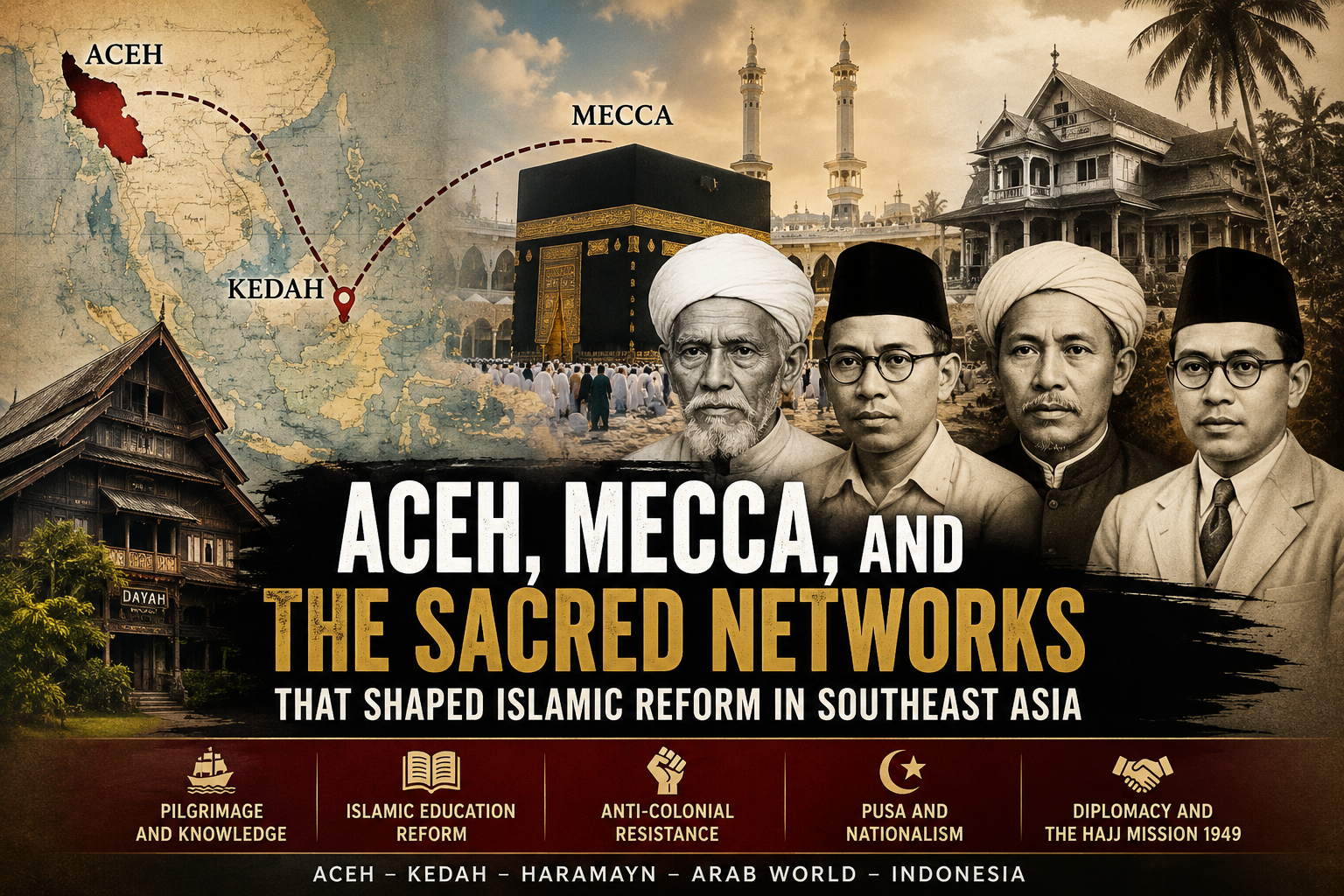
Aceh’s Islamic history was never confined to Sumatra. Its religious imagination, intellectual authority, and political resistance were shaped through a wider sacred geography that stretched from the dayah of Aceh to Kedah, from Kedah to Mecca, and from Mecca back to the political destiny of Indonesia. Through pilgrimage, scholarship, exile, reform, and diplomacy, Acehnese ulama transformed the journey to the Haramayn into a historical force that shaped Southeast Asian Islam.
Meanwhile, the Acehnese are still making the pilgrimage to Arabia. However, in this phase, several developments emerged that made Aceh a significant part of the history of the development of Islam in the archipelago: the arrival of Dutch colonialism, intellectual networks, educational development in Aceh, and the tradition of donating land to some Acehnese who had lived in Haramayn.
The Early Network of Acehnese ‘Ulama in Mecca
These four things became the pressure point for the departure of the Acehnese ulama to Arabia. As for the description of the ‘ulama’s journey to the Holy Land, the following is an excerpt from Muhibuddin Waly’s testimony about his father’s departure to Mecca, namely Maulana Sheik Haji Muhammad Wali al-Khalidy (1919-1961):
[So] his departure to the Holy Land with his family was the encouragement of the people and their sincerity. My father as the son-in-law, descendant, and the great scholars of course everything was easy and everything had been arranged.
To reach Mecca by ship took about three months. Unless there is a desire to live in Mecca, walking is straightforward. My father and my mother, Hajjah Rabi’ah Jami, spent more or less three months in the Holy Land, making the most of their time there. While performing the pilgrimage, my father took advantage of his time to recite the Koran and gain knowledge instead of the ulama taught at the Masjid al-Haram. The great scholar of Makkah at that time was Sheikh ‘Ali Maliki, the author of the book Hasyiah al-Ashbab wa al-Nazair , by Jalaluddin al-Sayuti. He got a scientific diploma from Mr. Sheikh Ali Maliki, even a certificate of hadith and others. Therefore, students who graduated from my father can teach the Prophet’s hadith from various hadith books. Is it in the field of law, fiqh proposals, interpretations, hadith, and others?
The quote above shows that the ‘ulama are strongly encouraged to go to the Arabs. They are considered the most worthy of performing the pilgrimage. An ‘ulama who has studied at several dayahs or pesantren is recommended to go to Mecca and Medina to deepen their knowledge. According to one story, Sheikh Haji Muhammad Wali al-Khalidy stayed in Mecca for one year.
The Role of Acehnese Community
Therefore, the local community prepares provisions for leaving for the Holy Land. The villagers have arranged the financial support while staying in Haramayn. The children of the Acehnese ulama, namely M. Adli Abdullah, said that his father, Tgk. Haji Abdullah al-Bawarith went to the Holy Land prepared by the community, where he devoted his knowledge.
For example, Sheikh Haji Muhammad Wali al-Khalidy, before leaving for the Holy Land, had studied Islamic sciences at several prominent ‘ulama in several prominent dayahs in Aceh. In his hometown in Labuhan Haji (South Aceh), Sheikh Haji Muhammad Wali al-Khalidy studied with Tengku Muhammad ‘Ali at Dayah al-Jami’iyyah al-Khairiyyah.
Subsequently, he moved to Blang Pidie, still in South Aceh, in Dayah Darul Huda, led by Sheikh Mahmud. The two leaders of the dayah came from Aceh Besar. Therefore, Sheikh Haji Muhammad Wali al-Khalidy also continued to Aceh Besar to study with two prominent scholars, Dayah Krueng Kale, under Tengku Hasan Krueng Kale’s leadership Dayah Hasbiayah Indrapuri led by Tengku Haji Ahmad Hasballah (1888-1959).
Yan, Kedah as a transit place
From the genealogy of Sheikh Haji Muhammad Wali al-Khalidy, it can be developed again on the issue of the struggle against the Dutch. The two teachers of Sheikh Haji Muhammad Wali al-Khalidy, namely Tengku Haji Hasan Krueng Kale and Tengku Haji Ahmad Hasballah, also lived in Mecca. However, previously they had studied at Dayah Yan, Kedah in the Malay Peninsula.
Dayah Yan was led by Tengku Muhammad Arsyad. Dayah Yan alumni, including Tengku Sheikh Muhammad Saman, then continued their studies in Mecca al-Mukarramah. According to history, during the Aceh war against the Dutch, several ‘ulama emigrated to Kampung Yan in the land of Kedah.
At least three great ulama migrated to Yan:
First, Tengku Muhammad Arsyad Ie Leubeu, who later became known as Tgk. Chik di Yan.
Second, Tengku Muhammad Saleh, who later became known as Tengku Chik in Lambhuk.
Third, Tengku Haji Umar bin ‘Auf, who later became known as Tengku Chik in Lam-U.
From this generation, only later emerged the ‘ulama, who built the dayah in Aceh. After they returned from Mecca, they then set up a dayah. Haji Ahmad Hasballah was involved in the Indrapuri Dayah in Aceh Besar. In 1916, after returning from Mecca, Tgk. Haji Hasan Kruengkale led the dayah of Kruengkale, which was then given the laqab Tgk. Chik Kruengkale. The son of Tengku Haji ‘Umar bin ‘Auf, namely Abdullah, also followed the same trail, having lived in Mecca while performing the pilgrimage in 1924.
Acehnese ‘Ulama in Mecca and the Idea of Nationalism in Indonesia
This story begins with Tengku Sheik Abdul Hamid Samalanga, from Pulau Pinang to Mecca. According to one record, this cleric’s year of flight was 1926. Furthermore, there is the story of how two great scholars, Tengku Haji Abdullah Ujongrimba and Tengku Sheik Abdul Hamid Samalanga, built a network to reform the Islamic education system.
While in Mecca, Tengku Sheik Abdul Hamid Samalanga sent the newspaper Ummul Qura’ to Tengku Haji Abdullah Ujongrimba regarding the reform of the Islamic education system. The message to reform the education system was then responded to by the ‘ulama of Aceh. The two ‘ulama, namely Tengku Sheik Abdul Hamid and Tengku Haji Abdullah Ujongrimba, were most respected in Aceh, especially by the colonialists.
Tengku Sheik Abdul Hamid is the son of Teungku Haji Idris, a leader of the Tanjungan dayah in Samalanga, Aceh Jeumpa. As for Tgk. This scholar was born on the battlefield in 1902. Haji Idris also lived in Mecca for eleven years. Meanwhile, Teungku Haji Abdullah Ujongrimba is a ‘ulama from Aceh Pidie who was born in 1907 in Ujongrimba.
In 1927, Tengku Haji Abdullah Ujongrimba made the pilgrimage to Mecca. In the Arab land, this scholar then studied for three years. After returning from the Holy Land, he founded Dayah in Ujong Rimba Cot, Pidie. Then, in 1929, he was involved in the establishment and implementation of education reform in Aceh, together with Tengku Muhammad Daud Beureueh.
The name of the ‘ulama mentioned last is a figure in the Aceh struggle and the chairman of the Association of ‘Ulama All Aceh (PUSA), a response to the ideas of Tengku Sheik Haji Abdul Hamid. This can be seen from the following statement:
Ayah Hamid initiated the reform and modern education movement. Finally, the All Aceh Ulama Association (PUSA) was born from this proposal, which Tengku Muhammad Dawud Beureueh long led. They had followed him for a long time in Saudi Arabia, while Abu Beureueh was the driving force in Aceh.
The date of birth of this organization was on May 5, 1939, at Madrasah al-Muslim, Matang Geulumpang Dua, Aceh Jeumpa (Bireuen). The objectives of establishing PUSA are:
First, to spread Islam’s teachings and establish and maintain the syi’ar of Islam.
Second, unite the understanding of the ‘ulama about Islamic law.
Third, standardize the curriculum in all madrasas throughout Aceh.
Fourth, establish a training institution for school teachers so that staff is available for madrasas.
Another mission carried out by Tengku Sheik Haji Abdul Hamid is the Indonesian Hajj Mission II. This mission was undertaken because the government of the Republic of Indonesia was facing Dutch aggression, which did not recognize the country’s independence on August 17, 1945. This incident occurred in 1949. At that time, in response to the Dutch betrayal of the KMB agreement (Round Table Conference), the Indonesian government planned to designate Banda Aceh as the capital city of the Republic of Indonesia.
Those placed in Banda Aceh were Mr. Syafruddin Prawiranegara, who served as deputy prime minister. He has a mandate in a state of emergency. He will form a government cabinet from the city of Banda Aceh. The initial effort made by Mr. Syafruddin Prawiranegara is “establishing the Indonesian Hajj Mission II, which is tasked with visiting Middle Eastern countries to seek help and support for the upcoming struggle of the Republic of Indonesia. ” The composition of the RI II Hajj Mission is:
Chairman and member: Sheikh Abdul Hamid Samalanga
Secretary and member: Muhammad Nur El Ibrahimy
Spokesperson and member: A. Hasjmy
Members: Prof. Abdul Kahar Muzakkir, Haji Syamsir, and Sheik Awab Syahbal.
This mission then departed in September 1949. They met with several leaders from the Islamic world, namely, Malik Abdul Azis (Arabic Authority); Amir Faisal (Minister of Foreign Affairs); Azam Pasha (Secretary of the Arab League); Sheikh al-Azhar (Mufti of the Kingdom of Egypt); Sheikh Abdul Hamid (Chairman of Subhanul Muslimin); and Amir Abdul Karim (Morocco), and many other leaders from Middle Eastern countries.
Conclusion
Thus, a piece of the historical study of the relationship between Aceh and the Arabs. The description above implies that whatever happens in Aceh will not be separated from the Arab land. Vice versa. Whenever significant events and big ideas arise in the Middle East, they always impact the Muslims in Aceh. Because of that, the concept of Arabic identity attached to the word ‘ACEH’ is not merely an abbreviation; it seems scientifically provable. The above study is continued by examining developments in the Arab world to determine how they can affect the socio-religious dynamics in Aceh.
About The Author

Rekomendasi Bacaan KBA13 INSIGHT
Jika tulisan ini bermanfaat, dukung jurnal ini dengan mencari bukunya melalui tautan berikut:
- Buku-buku Kamaruzzaman Bustamam Ahmad di Periplus
- Koleksi Islamic Studies di Periplus
- Koleksi Geopolitics & Politik Internasional di Periplus
- Cari buku & perangkat baca di Shopee
- Cari di Blibli
Daftar lengkap: Rekomendasi Buku, Alat Tulis & Layanan. Tautan di atas adalah tautan afiliasi — KBA13 INSIGHT dapat memperoleh komisi kecil tanpa biaya tambahan bagi Anda.
Artikel Terkait
 Islam, Violence, and Acehnese Identity: A Socio-Historical Reading of Conflict, Faith, and the Idea of Musoh
 Arabic Influence in Aceh Identity: History, Culture, and Islamic Legacy
 Can Aceh become a model for the development of a multicultural society in Indonesia?
 How is the Cultural Landscape of the Acehnese Society from the Cosmology side?
 Acehnology and the Social Sciences: Reclaiming Aceh’s Place in Knowledge
Leave a Reply