
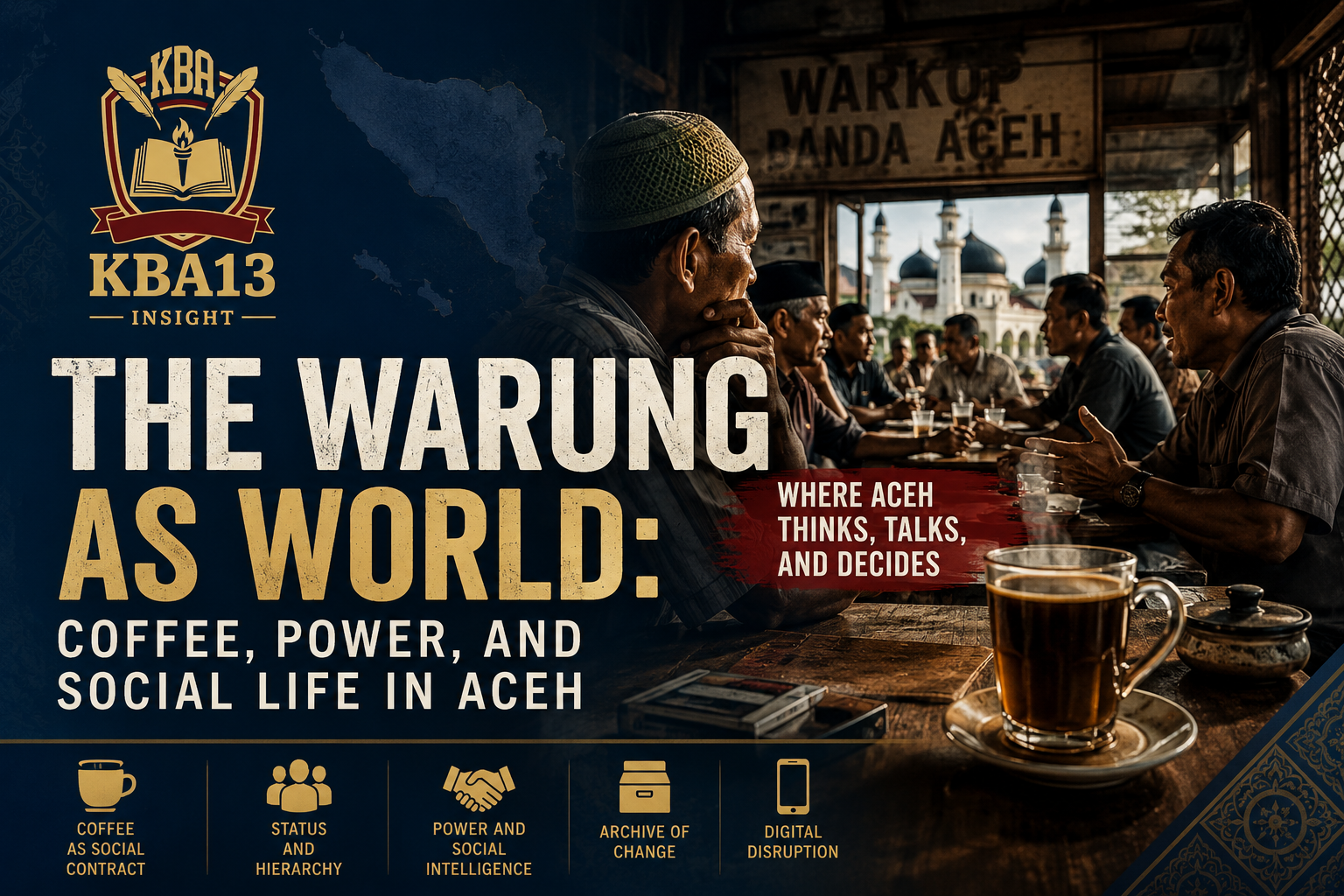
The Cup That Holds a Society
Coffee in Aceh is not a beverage. It is a social contract. When an Acehnese man walks into a warung, he is not simply satisfying a craving for caffeine. He is entering a negotiated space with its own hierarchy, its own unwritten rules, and its own system of obligations that run deeper than anything written in a municipal code or religious decree. The cup of coffee is merely the occasion. What actually happens inside a warung in Banda Aceh, or anywhere across Tanah Rencong, is a continuous rehearsal of who people are to one another, who owes what to whom, and who is worth being seen with.
This is not unique to Aceh in the abstract sense. Societies across the world have built rituals around communal eating and drinking. Tea in Southern Thailand carries this same gravitational weight. Among the Malay community there, tea mixed with milk has become a symbol of friendship that extends beyond the domestic sphere into political fundraising and community celebration. What they call *makan teh* — eating tea — is a formalized act of solidarity that can be mobilized for everything from a birthday to a parliamentary campaign. The form differs, but the function is identical: a consumable substance becomes a medium through which social relations are produced and reproduced.
What makes Aceh distinctive is not that coffee occupies this role, but the particular intensity with which it does. Coffee shops in Aceh are not supplementary to social life. They are load-bearing walls. Remove the warung kopi from the fabric of Acehnese daily existence and significant portions of the social architecture would simply collapse — the political conversations that generate consensus before decisions reach formal meetings, the business negotiations disguised as casual catch-ups, the community intelligence networks that run on gossip exchanged over a glass of kopi tarik. None of this happens in offices. It happens in coffee shops.
To appreciate this, one must first abandon the Western framework of coffee consumption — the solitary professional nursing an Americano over a laptop, or the couple on a date performing intimacy in a neutral space. In Aceh, coffee is almost never a private affair. Even when a man drinks alone at a warung, he is still participating in a public act. He is visible. He can be seen, assessed, and read by everyone around him — what table he chose, whether he greeted people when he walked in, whether he paid for someone else’s drink. Coffee in Aceh is always social, even in silence.
The tradition of meukupi — the Acehnese concept of communal coffee drinking — has deep roots in the social organization of this society. It emerged not from leisure but from the rhythms of labor. Before a fisherman headed out to sea, or a farmer walked to his field, the warung was the transitional space where the private self became the social self. The coffee was the ritual that marked the crossing of that threshold. It was a moment of connection, of confirmation that one still belonged to the community, still had obligations to it, and still expected obligations in return.
Compare this with Australia’s model of “you pay what you eat and drink,” or the American tipping culture, where each individual account is settled at the table without ambiguity. These systems reflect something specific about those societies: a liberal individualism that treats each person as a self-contained economic unit responsible only for their own consumption. The transaction is clean and bound. In Aceh, the transaction is deliberately open-ended. The ambiguity about who will pay is not a social failure — it is the entire point. That ambiguity creates obligation, and obligation creates relationship.
Aceh has experienced a century of turbulence — colonialism, occupation, insurgency, tsunami, and reconstruction — and throughout all of it, the warung kopi has remained a constant. NGOs came and went. International organizations flew in, rebuilt, and departed. Administrations changed. But the coffee shops stayed, absorbing every historical shock and converting it into conversation. The café that sprung up during the reconstruction era, with its English-language menus and inflated prices, was itself a social document — evidence of the foreign money that briefly flooded Aceh and the new aspirational class it temporarily created. The warung adapted and commented on history without writing a single word about it.
This is why the Acehnese coffee shop deserves more than passing description. It is not background color. It is not local color for a travel piece. It is a primary social institution — as serious, in its own way, as a mosque, a market, or a local government office. Those who want to understand Acehnese society cannot afford to look past it. The warung kopi is where Aceh thinks, argues, makes decisions, builds alliances, and performs its understanding of itself. Everything that matters in this society eventually passes through a coffee shop.
The Table as Map of Status
In any warung kopi worth attending in Banda Aceh, the seating arrangement is not a matter of personal preference. It is a map. The tables closest to the entrance — the ones that face the street and receive the most direct light and most direct gaze from passersby — are not neutral territory. They are reserved, without any sign indicating so, for officials, senior figures, and those whose social standing entitles them to be seen and approached. Sitting at a front table when you do not belong there is not merely awkward. It is a statement — and the wrong one.
The middle tables carry their own designation. Academics, employees, members of political parties, and organizers from social and religious groups tend to cluster here. This is the zone of the legitimate middle — people who have standing in the community, whose presence in the warung signals affiliation with its respectable layer. They are not the elite, but they are recognized. Their conversations tend to be semi-public: loud enough to signal that they are engaged in serious business, contained enough to maintain the distinction between their circle and the general crowd.
The back tables operate by a completely different logic. Journalists, activists, and the category of person best described as an intelligence operative — in the sense of someone whose professional purpose is to gather information about what is happening and who is doing what — prefer the rear view. At the back, one sees everything without being fully seen. One can observe who is sitting with whom, what the body language of the conversation suggests, who leaves early, and who stays. The back table is not for those who want to be noticed. It is for those who need to notice.
This tripartite division of café space — front for power, middle for respectability, back for intelligence — is not written anywhere. No one enforces it explicitly. Yet violating it produces immediate social friction, the kind that communicates itself in averted eyes, in the slight pause in conversation that happens when someone sits where they should not, in the whispered consultation between regulars after the newcomer has settled in. The table arrangement is a social grammar, and like all grammars it is most visible when someone breaks it.
What this spatial arrangement reveals is that the warung kopi is a theater. It is a space for social performance, and like all theaters it has a stage, a backstage, and an audience. Those at the front tables are on stage — they expect to be seen and want to be seen. Those at the back are the audience and the stagehands simultaneously — they watch the performance while also shaping its conditions. Those in the middle occupy an ambiguous middle role that is perhaps the most common experience of social life everywhere: neither fully performing nor fully observing, but doing something of both at once.
The spatial logic of the warung also governs how guests from outside the area are managed. When an outsider visits Banda Aceh and is taken to a warung by a local host, the choice of table is a deliberate act of communication — to the guest, to the other customers, and to the owner. A prominent table says: this visitor is someone we are proud to be associated with. A quieter placement says: this is a meeting that does not require witnesses. The warung kopi, through its seating arrangement alone, functions as a system for broadcasting social information across the room without anyone having to say a word.
Over time, in a city like Banda Aceh, particular coffee shops become associated with particular social identities. There are warungs that politicians frequent, warungs that academics consider their own, warungs that businesspeople use for informal meetings, and warungs that are understood to belong to a particular neighborhood or religious community. These reputations are not manufactured by advertising. They are produced by the accumulated weight of who has been seen there, over how many years, drinking coffee with whom. The social identity of a warung is a sediment — it builds up slowly and becomes geological.
The table map, therefore, is not just a local oddity. It is evidence of how deeply space is socialized in Acehnese life. Physical position carries moral weight. Where you sit is a declaration of who you are and who you believe yourself to be. In this sense, the coffee shop in Aceh is a microcosm of the broader social landscape — a miniature in which the larger patterns of hierarchy, affiliation, aspiration, and identity are compressed and made legible for anyone who knows how to read it.
Who Pays, and Why It Matters
The most misunderstood ritual in Acehnese coffee shops is the payment moment. From the outside — particularly from the perspective of someone socialized in an individualist economy — the scene can appear chaotic, even absurd. A group of ten men has been drinking coffee for two hours. The tab is substantial. No one moves toward the cashier. People look at their phones, continue conversations, and order another glass. Minutes pass. Then someone, quietly, gives the waiter a signal. The bill is settled without announcement. The group disperses, and those who were paid for will carry this fact with them — not as a debt to be repaid in kind, but as a social record that shapes future interactions.
This is not indecision. It is a highly structured game, and everyone at the table knows the rules. The question “who will pay?” is not unanswered—it is suspended. The suspension itself serves a function: it allows everyone present to signal, through their behavior during that suspension, what kind of person they are. Those who make an obvious move toward their wallet only to pull back have communicated something. Those who look deliberately away from the waiter have communicated something else. Those who engage in animated conversation as a way of not engaging with the bill have also communicated, to everyone watching, exactly who they are.
The person who eventually pays is making an investment, not a loss. Social capital in Acehnese society accumulates through visible acts of generosity, and few acts are more visible than quietly settling a bill for a large table. The payment says: I can afford this, and more importantly, I choose to spend it on you.” It is simultaneously a display of material capacity and an expression of social commitment. Both are essential. Paying for coffee you cannot afford does not produce respect — it produces pity. Refusing to pay when you can produces a different kind of social record altogether.
In Malaysia, the equivalent practice is called *belanja*, and it follows a similar logic: the person who treats others typically announces it first and frames it as a celebration of a happy occasion. The announcement is part of the gift. In Aceh, by contrast, the payment is frequently secret. The payer gives the waiter a quiet signal, and the group at the other table only discovers they have been paid for after the fact. This secret generosity is considered superior to announced generosity because it eliminates the possibility that the payment is made for the benefit of those who are paid. The best payment in Aceh is the one you discover has already been made.
The social dynamics of payment also operate along professional and institutional lines. A military officer drinking coffee with civilian acquaintances will typically pay. It is not expected from him in the same way that one expects payment from a host — it is more structural than that. His rank creates an obligation to demonstrate generosity toward those beneath it. Similarly, an entrepreneur whose business interests might someday involve the people he is drinking with has every reason to pay the bill. The coffee money is a preliminary investment in a relationship that may eventually be worth far more. In this light, treating a table of acquaintances is less an act of charity than a calculated social expenditure.
The logic, interestingly, breaks down among activists. Among people who organize politically or in civil society, the norm shifts toward a different kind of reciprocity: whoever has money at the moment pays, with an understanding that roles will rotate when financial circumstances change. This reflects a principled rejection of the hierarchy that structures payment in other social groups. Activists, at least in their self-presentation, resist the idea that who pays should determine who leads the conversation. But even here, payment is not individualized — it is still a collective act, still a social statement, still something that generates and reflects relationship.
The extraordinary two-million-rupiah story — the group that sat past midnight because no one wanted to be the one to pay, and everyone was too proud to go home — illuminates something important. The standoff was not about money. Everyone at that table had the money. The standoff was about social positioning. Paying a two-million-rupiah tab in front of a large group of middle- to upper-class acquaintances is a significant symbolic act. It asserts a level of material standing that places one at the top of the social order for the evening. The hesitation was not reluctance — it was the careful calculation of whether the moment was right, whether the audience was worth it, and whether the symbolic return justified the expenditure.
Payment in the Acehnese coffee shop, then, is a language. It has vocabulary — the quiet signal to the waiter, the elaborate wallet-reaching gesture that goes nowhere, the sudden departure before the bill arrives. It has grammar — the rules about who is expected to pay in which contexts and with which social partners. And it has rhetoric — the art of paying in a way that maximizes social impact, that expresses generosity without ostentation, that builds relationship without creating obligation so obvious it becomes burdensome. To understand who pays, and why, is to understand a great deal about how this society actually works.
Time, Rhythm, and the Daily Circulation of Coffee
The warung kopi in Aceh does not operate on a single logic. It operates on multiple logics simultaneously, each calibrated to a different segment of the day and a different population that arrives with its own purposes and social grammar. To track a Banda Aceh coffee shop through the full cycle of a day is to observe something like a social X-ray: each wave of customers reveals a different stratum of the city, each with its own tempo, its own conversation, its own relationship to the space.
Before the Fajr prayer — in the dark hours before dawn — one category of warung is already full. These are the traders: men who will move goods before most of the city has opened its eyes, who need the caffeine before a physical day that starts hours before the professional world wakes up. Their conversations are transactional. Prices, supplies, routes, contacts. At this hour, the warung is a logistics hub disguised as a café. By nine in the morning, these places are empty. The traders are gone, dispersed into the markets and transport routes that are their actual workplaces. To the outsider arriving mid-morning, these early cafés look like any other quiet warung. But their real life happens in the dark.
A second category of coffee shop comes to life immediately after the Fajr prayer itself. Here, the congregation — those who have prayed together at the mosque — walk together to a nearby warung and, over coffee, continue the social ritual the prayer initiated. The mosque provided the vertical dimension of community: the shared address to God, the alignment of bodies in the same direction, the synchronized movement of prayer. The warung provides the horizontal dimension: conversation, local news, and personal exchange that reconnects individuals to one another rather than to the divine. By seven, this group disperses. Offices, children’s schools, the demands of the working day pull people away.
Then there are the warungs that fill up at eight forty-five. This timing is precise and revealing. Eight forty-five is when government employees have completed their morning fingerprint attendance at the office — the biometric check that confirms their physical presence for administrative purposes. Having confirmed their presence, they leave for coffee. This is not absence without leave; it is a semi-institutionalized practice that everyone understands. The warung at eight forty-five is, in functional terms, an extension of the government office — a space where the actual business of the workday, the informal conversation about what will get done and how, begins to take shape over a glass of kopi.
The lunchtime warungs operate differently again. Here the café anchors itself to a specific commercial attraction — a cart, a vendor, a menu that draws midday traffic — and the coffee is secondary to the food. People come to eat and stay for coffee. The social mix is broader here, less defined by professional category, more governed by geography. Who comes to a lunchtime warung is largely determined by who works and lives nearby. These are neighborhood institutions in the deepest sense: they reflect the demographic of the blocks around them, their coffee drunk by people who share not a profession or a social class but a physical location.
The evening brings a different density. Workers stopping on the way home, the day’s pressure not yet fully released, needing the transition that the warung provides between the working self and the domestic self. And then, as night settles, the real crowd arrives. The nighttime warung in Aceh is an entirely different institution from its daytime counterparts. The air changes — cigarette smoke, perfume, the noise of many conversations competing with each other, the difficulty of parking because every spot near the popular places is taken. The nighttime café is where the social world performs itself most completely. There is no purpose except to be there, and being there is precisely the purpose.
The rhythmic structure of coffee shop attendance is, in effect, a map of Acehnese social time. Different groups mark the hours of the day by their relationship to the warung: which one they go to, at what time, with whom. The warung functions as a social clock, its populations cycling through it in regular patterns that give the day its social shape. A man who deviates significantly from his usual coffee routine — who stops appearing at his regular warung at his regular time — has communicated something to his social network, even without saying a word.
What is remarkable about this rhythmic structure is its resilience. The times and patterns described here are not imposed by any authority. No one tells the traders to arrive before Fajr, or the mosque congregation to stay for coffee afterward, or the government employees to appear at eight forty-five. These rhythms emerged organically from the social and professional structure of the city, and they are maintained by the weight of habit and expectation. They are, in the deepest sense, self-organizing social facts — evidence that the warung kopi is not merely a venue for social life but an institution that actively structures it.
The Digital Disruption and the Silent Table
Something changed in the Acehnese coffee shop when the smartphone arrived, and not everyone is comfortable saying precisely what it was. The physical warung remained. The coffee was the same. The furniture, the noise, the cigarette smoke—unchanged. But a new kind of café-goer appeared, one whose presence in the space is, in a meaningful sense, only partial. They are there physically: a body occupying a chair, a hand wrapped around a glass. But they are somewhere else entirely: on a screen, in a social world invisible to everyone around them and requiring none of the skills — the table-reading, the timing of payments, the conversation management—that the physical café demands.
These digital inhabitants of the warung have generated a new category of coffee shop: the silent one. The café that looks, as one observer put it, like a cemetery. Quiet and still, with each customer wrapped in their own screen world, connected to the router rather than to each other. For the warung owner, this customer is simultaneously ideal and useless. Ideal because one cup of coffee can occupy a table for hours without needing attention or service. Useless because a table occupied for three hours by a single coffee drinker who buys nothing else is not a commercially productive table. The compromise that has emerged — providing Wi-Fi in exchange for the presence of this new customer type — is an economic adjustment to a social phenomenon the café industry did not predict.
Online gaming and online gambling have introduced a particularly complex dimension to this. The café-as-gaming-hall is a well-established phenomenon across Southeast Asia, and Aceh is no exception. Young men who spend their evenings at a warung with a screen are engaging in social life of a kind — but it is a social life that bypasses the coffee shop’s traditional functions. They are not building relationships with the people around them. They are not participating in the economy of generosity and obligation that defines the traditional warung experience. They are using the physical space as a platform for digital sociality with its own hierarchies, obligations, and rituals — all of which are invisible to anyone not connected to the same platform.
The internet café, or the warung that has functionally become one, reveals a tension that is not unique to Aceh but is particularly sharp here given the intensity of the coffee shop’s traditional social function. The warung was, as argued above, a space for the production and reproduction of social relations. It was where you were seen, where you performed generosity, where you read the room and chose your table carefully. The digital warung is a space where these social functions are suspended. You do not need to choose a table carefully if you are not looking at the room. You do not need to perform generosity if your social obligations are entirely located on a different platform. You do not need to read anyone else’s body language if the only body language that matters is encoded in an avatar.
There is a generational dimension to this shift that deserves direct acknowledgment. The young people who populate the silent cafés are not being antisocial in the pejorative sense of the word. They are being social in a different register — one that their parents and grandparents do not fully recognize as sociality. The arguments that older Acehnese make about the declining quality of warung culture — that young people do not know how to participate properly, that they are too attached to their phones, that they are letting the social fabric of the café degrade — are also arguments that every generation makes about the next. But this particular version of the argument has more substance than most, because what is actually changing is not just manner or style but the fundamental function of the space.
The service quality problem that has emerged alongside digital café culture is worth examining. There are warungs in Aceh where the waiter barely smiles, where food is placed on the table with minimal care, where the menu is written in English that no one — including the staff — can speak, and where the prices are calibrated to an aspirational market that may not actually exist in the volumes the café owner imagines. This is not primarily a management failure. It is the result of cafés that have reoriented themselves toward a customer who does not require service in the traditional sense — a customer who is staring at a screen and will not notice whether the food is presented well, a customer whose presence in the space is already partial. When the customer is absent, service follows.
There is also a pricing incoherence that has developed as a consequence of the café’s shifting identity. A plate of mie goreng at a traditional warung in Tungkop costs ten thousand rupiah. The same noodles, rebadged as a menu item at a café that uses English-language menus and provides Wi-Fi and a power outlet, cost 50% more in some places and double in others. This is not market failure. It is the market correctly reflecting that some customers are paying not for the food but for the atmosphere—the sense of being in a contemporary, urban, connected space. The English menu is part of the performance. The inflated price is the participation fee for that performance.
The digital warung is not the death of coffee shop culture in Aceh. It is its latest transformation. Every social institution evolves when the conditions that produced it change. The smartphone and the internet are conditions as significant, in their disruptive effect on social behavior, as the arrival of reconstruction money after the tsunami or the political changes that followed the peace agreement. The warung has absorbed each of those shocks and emerged changed but still recognizable. It will absorb this one, too. But the absorption will not be painless, and the result will not be identical to what preceded it. Something is being renegotiated in the silent café, even if the negotiation itself happens mostly without words.
The Warung as Archive of Social Change
The history of Aceh in the twentieth and early twenty-first century could be told through coffee. Not because coffee was the cause of anything that happened — it was not — but because the warung kopi registered, with unusual sensitivity, every major shift in the social and political landscape. It was never passive. The warung did not merely witness change; it processed it, gave it a social form, and sometimes helped generate the conversations that led to it. It is, in this sense, an archive — not a written one, but a living and continuously updated record of how Acehnese society understands its own condition.
Consider the post-tsunami reconstruction period. When the disaster of 2004 killed more than 170,000 people in Aceh, and the international community mobilized one of the largest humanitarian operations in modern history, Banda Aceh was briefly transformed into a global city—dense with foreign workers, international organizations, and the sudden influx of money that accompanies large-scale international intervention. The coffee shop registered this transformation immediately and precisely. English-language menus appeared. Prices rose to meet the spending capacity of foreign staff. Café aesthetics shifted toward an international standard — cleaner, more formal, more oriented toward a customer who had arrived from somewhere else and would leave again when the work was done. The warung, in other words, became a social mirror of the economy of reconstruction.
When the international organizations departed — as they always do, eventually — the menus did not always change back. The English-language menus remained in some places, as did the elevated prices and the international café aesthetic. But the international clientele was gone. What remained was a local customer looking at a menu written in a language they did not speak, paying prices calibrated to an economy that had moved on. This mismatch between the café’s performed identity and the actual social world it inhabited is itself a historical document — evidence of the awkward aftermath of large-scale external intervention, where the forms persist after the substance has departed.
The 2005 peace agreement, which ended decades of armed conflict between the Free Aceh Movement and the Indonesian government, brought its own transformation to the coffee shop landscape. In a conflict society, public space is heavily monitored, and gathering in a semi-public place for conversation carries a risk. The warung kopi during the conflict years was a place of careful speech—one watched not only the usual social hierarchies but also the political risks of what one said and with whom one was in company. After the agreement, the coffee shop exhaled. Conversations that had previously been had only in trusted private company moved into the warung. The volume of public discourse — the density and candor of conversation in coffee shops — increased noticeably in the post-conflict period.
The expansion of the Acehnese middle class in the post-conflict, post-reconstruction period has produced yet another layer of transformation. Coffee shops have become sites of aspiration — places where one goes not merely to drink coffee but to participate in a version of contemporary Indonesian urban culture. The café-not-warung distinction is partly class-based: café implies aspirational consumption, warung implies traditional community. Young Acehnese professionals navigate between these two poles, sometimes patronizing the traditional warung as an act of cultural identification, sometimes choosing the café as a performance of modernist ambition. The choice itself is a social statement, and both choices are available in a way they were not a generation ago.
Women’s increasing presence in coffee shops deserves particular attention. The traditional warung kopi in Aceh was substantially male space. Women could enter, and sometimes did, but the social norm was that coffee shop sociality was primarily a male domain. This is changing. Younger women, particularly university students and young professionals, now occupy coffee shops in Banda Aceh in significant numbers. They have their own preferred venues, their own table customs, and their own version of the social rituals around payment and conversation. This is not a small change. It is a rewriting of one of the warung’s foundational social assumptions — that coffee shop citizenship was gendered, and gendered male.
The family coffee shop — the warung that has expanded its menu and space to accommodate parents with children, couples, and family groups who come together for breakfast, lunch, or dinner — represents another significant transformation. The meukupi tradition, historically a practice of adult male sociality, has been domesticated. Children now sit at warung tables. Families negotiate the menu together. The social obligation structure of the coffee shop — who pays, who leads the conversation, who chooses the table — is renegotiated when children are present and when the social unit is the family rather than the peer group. This is not the destruction of the tradition. It is its expansion into new social territory.
None of these changes should be read as a decline. The narrative of decline — the idea that the authentic warung of some earlier era is being corrupted by commercialism, digital distraction, rising prices, and the loss of old social forms — is tempting but misleading. Every version of the Acehnese coffee shop that has ever existed was a response to the social conditions of its moment. There was no original, uncorrupted warung. There was only the warung as it existed in the conditions of a particular time, serving a particular community in a particular political and economic moment. What we are watching now is not the loss of something fixed. It is the ongoing, adaptive transformation of an institution that has always been in motion.
The warung kopi endures because it serves an irreducible need: the need to be in the same physical space as other people, to share a substance, to negotiate relationships in real time, to perform, witness, and participate in the continuous social drama that holds a community together. Apps and platforms can simulate parts of this, but they cannot replicate the specific social intelligence that is produced when bodies share a table, when payment must be decided by someone present, when the choice of where to sit carries meaning legible to everyone in the room. The warung kopi will continue to change. It will absorb the smartphone, the younger generation’s different social grammar, and the economic pressures of the post-reconstruction era. And it will still be there — slightly different, still essential — for as long as Acehnese society needs a place to think.
About The Author

Rekomendasi Bacaan KBA13 INSIGHT
Jika tulisan ini bermanfaat, dukung jurnal ini dengan mencari bukunya melalui tautan berikut:
- Buku-buku Kamaruzzaman Bustamam Ahmad di Periplus
- Koleksi Islamic Studies di Periplus
- Koleksi Geopolitics & Politik Internasional di Periplus
- Cari buku & perangkat baca di Shopee
- Cari di Blibli
Daftar lengkap: Rekomendasi Buku, Alat Tulis & Layanan. Tautan di atas adalah tautan afiliasi — KBA13 INSIGHT dapat memperoleh komisi kecil tanpa biaya tambahan bagi Anda.
Artikel Terkait
 Islam, Violence, and Acehnese Identity: A Socio-Historical Reading of Conflict, Faith, and the Idea of Musoh
 Harlan dan Tradisi Premanisme di Aceh: Kajian Sosial-Antropologis tentang Kekerasan, Kekuasaan Informal, dan Krisis Nilai
 Update Berita Aceh 1–9 Agustus 2025: Prestasi, Ekonomi, Bencana, dan Dinamika Sosial
 Aceh, Nation-State, dan Komparasi Global: Bali, Yogyakarta, Brunei, Singapura, dan Israel dalam Dialektika Demokrasi dan Agama
 Demokrasi Aceh: Antara Tradisi Lokal, Agama, dan Tantangan Negara-Bangsa
Leave a Reply