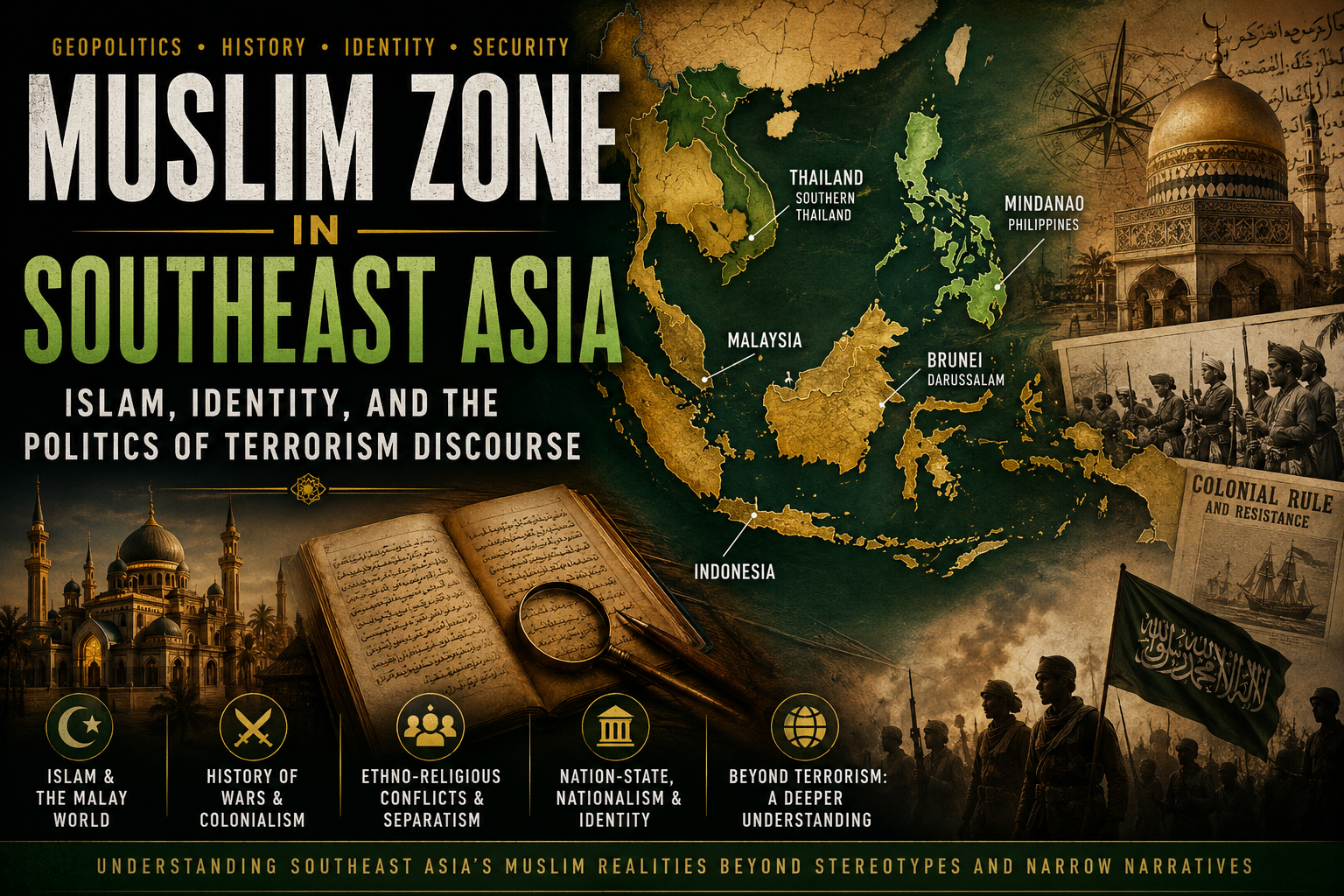
A geopolitical reading of Southeast Asia’s Muslim Zone, where Islam, Malay identity, colonial memory, and modern state power converge beyond the narrow language of terrorism.
Muslim Zone in Southeast Asia
Southeast Asia comprises several countries, most of which are Muslim. It is stated that the boundary of Southeast Asia runs from the west, along the Indian subcontinent, and from the north, along mainland China. [1]The Southeast Asian region is also known as the Malay region. In this case, Islam and Malay serve as two sides of the same coin to illustrate how socio-religious this population is.
Azyumardi Azra stated that “Southeast Asia (or Indo-Malay) is one of the seven areas of Islamic culture or civilization, which strictly consists of areas of Islamic-Arabic, Islamic-Persian, Turkish-Islamic, African-Islamic… The Indian subcontinent, Indo-Malay Islam, and the last area of Islamic civilization in the “Western hemisphere …” [2]. Among Malay-speaking peoples emerged the nation-states, namely Indonesia, Malaysia, Singapore, and Brunei Darussalam. [3]
The number of Muslims in Southeast Asia is 534,309,000. The highest number in Indonesia (189,195,000), followed by Malaysia (14,371,000), the Philippines (4,393,000), Thailand (3,010,000), Burma (1,716,000), Cambodia (700,000), Singapore (663,900), Brunei Darussalam (245,000), Vietnam ( 65,000), and Laos (400). [4]
For a Muslim-majority region, Howard M. Federspiel calls it the “Muslim Zone”. He writes that phenomena are seen from this Muslim zone, which is a big, existence-similarity-total-enough population within _ religious [5] institutions, teachings, and values.
In addition to the first four countries, there are ethnic Malays with strong historical roots in Southern Thailand and Mindanao. So marriages between Malays and Muslims in these two regions have always led to prolonged conflicts today. Apart from these five countries, other countries are not dominated by Malays and Muslims, such as Myanmar, Burma, Laos, Cambodia, and Vietnam. Buddhism mostly rules these countries. [6]
The Southeast Asian region has experienced a meeting of cultures such as China, India, Europe, and Islam. So, before the First and Second World Wars, as nation-states emerged in this region, this cultural meeting had created a process of civilizational blending. It was recently mentioned that the influence of the United States and Japan has become very strong in Southeast Asia. [7]
Southeast Asia is a region that expands the influence of the countries that once colonized it. The most dominant influence is religion, as it can create political stability, as seen in the roles played by Confucianism, Buddhism, and Islam. Then followed by economic interests [8].
In the socio-political field. Therefore, the history of Southeast Asia, in addition to the history of the kings, is also the history of wars for centuries, either with fellow citizens in Southeast Asia [9]or with the colonizers, the majority of whom came from Europe and America.
Islam and Wars in the Malay World
In the history of Southeast Asia, some wars are most widely discussed, namely “the Babad war between Majapahit and Pajajaran, the Burmese attack on Ayuthia, then the war between Trunojoyo and Mataram, the fall of Malacca in the hands of the Portuguese, and then the Sultan Iskandar Muda attack on the Malay peninsula.” [10]
In this case, Islam is the most dominant in the historical structure of Southeast Asia [11], especially in Tanah Melayu or the Archipelago. Islam is not only a personal religion but also one that unites various local interests within a framework of political power. Therefore, until the collapse of the Islamic Caliphate in the Ottoman Empire, there were still well-structured political forces in the form of a kingdom in Southeast Asia. Thus, it is not surprising that Islam ranks first in the region’s religious beliefs.
For example, during the war between Melaka and the Portuguese, Sultan Ahmad invited his people to fight by bringing the Hikayat Muhammad Hanafiah. [12]In the mid-19th century, Moro Muslims in Southern Philippines struggled to defend their country and religion from Spanish colonialism.
Meanwhile, in the 17th-18th century AD, Islamic leaders in Southern Thailand fought desperately against the attacks of the Thai Kings, namely the Ayutthaya and Chakri dynasties, not to mention the history of the war in several areas of Indonesia when they fought the Dutch. [13]
At that time, they used Islam as a spirit of struggle, not in the category of nationalist assets. The political conflict over the place of Islam continues to this day, driven by various motives and influences.
In Indonesia, efforts to make Islam the basis of the state have echoed post-independence, from debates in parliament to the emergence of rebel groups disillusioned with the government in Jakarta. As for Thailand, the conflict over withdrawing from the Thai government in Bangkok (Krueng Thep) remains volatile. In the Philippines, the power of not wanting to be part of the Manila government still resonates.
Meanwhile, in Malaysia, the power of Islam with identity struggles has also created turmoil, although not in the separatist category. [14]In Thailand, the conflict was triggered by the Muslim community’s unwillingness to submit to the Buddhist government.
In the southern Philippines, the Bangsamoro power did not want to be recognized as part of the Christian government in Manila. [15]It can be said that all events related to Islam are always associated with ethnicity. Even in these conflicts, the term used is not “terrorist” but “separatist.”
How do we understand the case of this ethnoreligious conflict forcibly withdrawn by the study of terrorists? How did the concept shift in Southeast Asia to meet the concept of nationalism that did not come from the region? By understanding this, it will be found that the struggle in Southeast Asia, especially those involving Islam, is more than a battle of concepts that arise from within Southeast Asia, with those from outside Southeast Asia.
The cases that emerged in Mindanao and Southern Thailand were not at all related to the study of terrorists at first. As for cases in Indonesia, they were already done appropriately before Indonesia hit the tragedy of 30 S / PKI in 1965. Meanwhile, in Malaysia, the desire to place the rights of Malays exploded on May 13, 1969. Cases involving issues related to Islam also occurred in Singapore on December 11, 1950. [16]
To make it easier for us to understand how to attract concepts related to conflicts involving Islam, we will present several cases from several countries in Southeast Asia. For this, cases in the Southern Philippines, Southern Thailand, Malaysia, and Indonesia will be selected.
Mindanao
The conflict in the Southern Philippines involving Islamic centers centers on an ethnic group known as the Bangsamoro. They inhabit in Mindanao, Sulu, and Palawan. Ethnically, the Bangsamoro consists of 13 sub-ethnic groups, namely: Badjao, Iranun (or Ilanum), Jama-mapun, Kalagan, Kalibugan, Manguindanao, Marano, Molbog (Melebugnon), Palawani, Samal, Sangil, Tausug, and Yakan. [17]
Regarding the identity of the Bangsamoro, Renato T. Oliveros said that ” their indigenous expression of Islam in Mindanao is their soul.” [18] So, to understand Bangsamoro, there are two blends: Islam and Malayness. “Islam” is closely related to the religion’s arrival in this region.
According to history, Islamic traders and preachers came to Mindanao via Malaysia, Borneo, Sumatra. [19]Here one of the most well-known Malay-Islamic kingdoms in the history of Bangsamoro is the North Sulawesi Kingdom, which was founded in 1450. The first king was Seyyed Abubakar, who is considered by the people there to be a descendant of the Prophet Muhammad.
At that time, Seyyed Abubakar used the title, Sharif Hashim. [20]During its heyday, this kingdom was able to control the Sulu Archipelago (including Sulu and Tawi-Tawi), North Borneo (now the state of Sabah, Malaysia), Basilan, Palawan, and Sambowangan (now the city of Zamboanga and the provinces of Zamboanga del Sur and Norte).[21]
However, this Sulu kingdom was attacked by Spain in 1578. According to history, the Spanish could only control Jolo, but they failed to occupy the Sulu Kingdom. [22] The arrival of Spain has also added to the power of weapons, culture, and the religion it brought, namely Christianity. They managed to control Southern Luzon to the Visayas in a short time.
Nevertheless, the fighting between Spaniards and Muslims in the South lasted until the late 19th century. [23]In addition to Spain’s attempts to take Mindanao, the United States has been trying for years to take as much of the island as possible. Historically, the American army controlled the Moro province from 1900 to 1913. [24]Americans think of Muslims in Mindanao as if they thought of the Native Americans (Indians) they had just conquered. [25]
Finally, in 1913, the American army subdued the Moro people. [26]Although the Philippines became independent in 1946, America’s presence in this country remains dominant and has strategic value. In this regard, Joseph Gerson wrote, “As the last 100 years of Philippine history testify, military organization, foreign military bases, and unequal alliances have been essential to the United States Asia-Pacific empire.” [27]
After that, since the Philippines became independent in 1946, the Bangsamoro asked the United States to keep them out of the Manila government. [28] The conflict between the Bangsamoro and the Philippine government began in the 1970s.
One movement against the central government in Manila is the Moro National Liberation Front (MNLF). They become “representatives” of the Bangsamoro voice, fighting for the nation’s rights. Then in 1996, their struggle was continued by the Moro Islamic Liberation Front (MILF) [29]. [30]
Southern Thailand
Cases in Thailand have been ongoing for decades. The essence of this conflict is that the ethnic Malays, who are predominantly Muslim, do not want to join the government of Thailand, which is predominantly Buddhist. However, the conflict in Southern Thailand is no longer only about fighting for the rights of the Malays [31]; national and international issues have also been mixed in.
As is the case in the Southern Philippines, the kingdom of Pattani Darussalam has also emerged in this region and is well known in the history of Southeast Asia. The history of this splendor was triggered by trading activities, which caused not only the Thai kingdom to want to dominate it but also the Dutch, English, French, and Portuguese. [32]
King Rama, I tried to control this area in 1785 until the Kedah, Kelantan, and Terengganu sultanates. According to history, the Siamese considered this annexation a regulation, as they had regarded the Sultanate of Pattani as their territory since the early days of the Kingdom of Siam’s conquest of the peninsula in the mid-13th century. The Malay region is still an independent country. However, from 1791, Terengganu and Pattani were under the rule of the Songkhla Kingdom. Meanwhile, Kelantan and Kedah were under the control of the Nakhon Sri Thammarat government. [33]
This is the beginning of the historical chapter of the Malay community’s resistance in four provinces in Southern Thailand. The Kingdom of Siam’s forced efforts to control the southern and northern regions of Malaysia have led to ongoing battles and conflicts.
According to history, the Malays’ ultimate anger in the Pattani area occurred in 1902, when the area was formally handed over to the Thai Kingdom. This formalization is often referred to in the Anglo-Siamese Treaty in 1909, where Thailand ceded Kedah, Perlis, Kelantan, and Terengganu to the British. [34]
These four countries later became part of the then-independent Malaysian government in 1957. However, historically, the Thai Kingdom also gave France its eastern region in 1893. [35] The politics of giving “colonial areas” by the Thai Empire was one of the strategies to secure the Thai Empire’s government against European invaders.
This forced effort met resistance from the Islamic leaders there, which is related to the Thainization program carried out by the central government in Krungthep (Bangkok). However, the Malay resistance is no longer a “representative of an Islamic empire” but “a representative of an ethnic and religious group,” which, according to Islamic leaders in Pattani, has no historical relationship with the Kingdom of Thailand.
However, this issue turned out to have severe implications for “who are the Malays” and “who are the Muslims,” not only in Southern Thailand but also in the “face of Islam” as a whole in the country.
In the region, the four provinces still define themselves as “Malays” who are more emotionally connected to Kelantan and Terengganu than to Bangkok. [36]
Malaysia
This country is a collection of Malay-Islamic kingdoms that became independent from Britain on August 31, 1957. The main instrument in building the country’s values is the concept of Malay and Islam. Anyone who wants to see Malaysia’s development is always associated with Islam’s role in its development strategy. Malaysia has become a nation to be reckoned with in the Asia-Pacific. [37]
However, Malaysia continues to experience history like other nations in Southeast Asia, namely, facing invaders (the Portuguese and the British). However, suppose Malaysia’s history is related to the archipelago’s history.
In that case, it is part of the territory of several major kingdoms in Indonesia, namely Sriwijaya, Majapahit, and Aceh Darussalam. [38] Therefore, before Malaysia’s independence, several state kingdoms had developed Islam as a political force in the Malay Peninsula. [39]
To see how the role of Islam in Malaysia is summarized, Kamarulnizam Abdullah wrote as follows:
Islam in Malaysia had emerged as the dominant religion and become part of ethnic identification for the Malays since the seventeenth century when non-Malays began to flock into the Malay peninsular under the British’s colonial policy of labor migration. Islam has been the center of the social and cultural activities of the Malays. By the turn of the twentieth century, Islam became increasingly not only the symbol of Malay cultural dominance but also a powerful tool of the Malay elite in Malay politics. Consequently, conflicting views exist over Islam’s role in Malay politics. The Malays, until today, are divided through political lines on this question. On one end, there is a tendency to maintain the role of Islam in private matters, but on another end, Islam has been promoted to encompass every aspect of human life. [40]
As stated above, Islam and Malay played an essential role in the history of Malaysia. [41] However, this country itself does not declare an Islamic State or a Religious State. [42] Therefore, the roots of radicalism in Malaysia rest more on issues of religious formalization in the form of social and political power.
In addition, conflicts that arise involve the role of Malays versus non-Malays, such as Malays versus Chinese [43] or Malays versus Indians [44], who seek to define who the natives are, and conflicts among Malays themselves, such as between political parties, such as UMNO versus PAS.
The latter wants to establish an Islamic state that does not acknowledge the Malaysian government’s efforts to “manage” the states of Sabah and Sarawak in the Kalimantan (Borneo) region, so they are willing to remain subservient to the central government in Kuala Lumpur.
Therefore, unlike in Mindanao and Southern Thailand, the complexity of radicalism’s symptoms in Malaysia is more pronounced. [45] In Malaysia, the effort to establish an Islamic State is almost the same as the experience of post-1945 Indonesia.
However, in Malaysia, the issue of religion is mixed with the issue of ethnicity. Even if a conflict arises, it does not necessarily lead to violence in the name of religion or in defense of religion and the homeland. Malays in Malaysia demand an Islamic State. At the same time, Islam is the leading guide to development, as Mahathir [46] and Abdullah Ahmad Badawi did through Islam Hadhari. [47]
At other times, the Malays themselves do not really like other clans, which they think have usurped the rights of the Malays, as reflected in the May 13, 1969, riots. Several Islamic movements want to install Islam as the main instrument in Malaysia’s development.
At first, in Malaysia, the issue of Islam and the symptoms of radicalism did not seem to be related to terrorism issues. However, what is certain is that the conflict in Malaysia can be mapped as follows: the Malay conflict with the Malay to establish an Islamic state [48]; the Malay conflict with China to limit the involvement of this clan in dominating the economic activities of the Malaysian state; and conflicts between the Malays and the Orang Asli. In this case, China will not unite with the Malays who want to make Islam the basis of the state.
All tribes can be united in Islam as long as they convert to Malay (read: convert to Islam) because Malays, in the view of the Malaysian constitution, are those who speak Malay, were born before 1957, and are Muslim. [49] However, the margins of the identity map in Malaysia still cause conflict, namely when Islam is used as a political force to unite all tribes or ethnic groups under the auspices of Malaysia.
Indonesia
This country is the one most closely related to terrorism in Southeast Asia. Therefore, when we discuss the issue of terrorism, it is necessary to understand that since the Indonesian nation became independent on August 17, 1945, the issue of Islam and separatism cannot be separated.
However, before Indonesia’s independence, there were Islamic kingdoms such as the kingdoms of Aceh, Demak, and Mataram. [50]The colonial experience is no different from that of other countries in Southeast Asia that were colonized by the Portuguese, Dutch, and Japanese.
Therefore, this experience has also led to how to incorporate Islam into the government system, where this religion should not be the basis or principle of the state. [51]
The most powerful tribe in Indonesia is the Javanese. [52] In fact, the philosophy of the Indonesian government is more taken from the Javanese culture than from other tribes. [53] As for the trajectory of Indonesia’s history, a lot has happened on the island of Java. If there are other “turbulent” areas, they must be considered conflicts that disturb the country’s stability.
In Indonesia, Islam has become a kind of value in the life of the Muslim community. At the same time, to glue the nation together, Islam is not used as the main instrument but Pancasila. In other words, if non-Javanese people want to leave Indonesia, they are seen as separatists. If Muslims do not want Pancasila as the basis of the state, they are seen as security disruptors.
Likewise, the dominance of the Javanese in several islands also sometimes creates cultural conflicts that sometimes lead to bloodshed, which is not to mention some of the government’s attitudes that use Islam as an instrument to crush communist forces, which means that seeing the conflict in Indonesia starting from August 17, 1945, until today is challenging to explain from one perspective.
For example, the conflict in Aceh. In the past, when DI/TII was declared in West Java and “accepted” in several regions (Sulawesi and Aceh), it was considered a form of resistance to the central government, which did not want to establish an Islamic state in Indonesia. [54] In this religious uprising, experts have relied on to find the historical roots of terrorism in Indonesia.
However, from the embryo of this movement, other separatist movements, such as GAM in Aceh, were proclaimed by Hasan di Tiro on December 4, 1976. From this path, this movement, even though it demanded independence from the central government, was not considered a terrorist organization. Finally, this movement can be summed up as an ethnic-nationalist movement. [55]
However, as we will see in the following chapters, GAM is still drawn to the issue of terrorism. It is sometimes associated with DI and the discourse on terrorism in Indonesia. However, as an ethnic-nationalist conflict, the GAM rebellion could be “resolved” on August 15, 2005. Even though there have been several attempts to make peace, it has failed. [56]
However, outside Aceh, except in Timor-Leste and Papua, conflicts sometimes arise, always involving Islam. On the island of Java, social and political chaos often becomes an arena for how to place Islam and politics in it. Meanwhile, outside Java, in places such as Ambon, Maluku, and Poso, they are more attuned to issues of ethnicity and religion. [57] Religious conflicts, such as Islam versus Christianity, often occur in Indonesia [58]. However, even though churches or mosques are burned, they are rarely mentioned as acts of terrorism, except for the Christmas bombings.
It can be concluded that there are internal problems within the Indonesian state, which then trigger the issue of acts of violence in the name of religion that lead to terrorism. In the Old Order, the discourse of Islamic resistance to the state wanted more of a Darul Islam.
Meanwhile, in the New Order era, the discourse of tension was more rooted in the issue of the national ideology, namely Pancasila. [59]Meanwhile, during the Reformation Order era, there was a desire to implement Islamic Shari’a [60] and establish an Islamic State, which may have originated from a dream during the Old Order era, namely DI/TII.
Therefore, it is not surprising that terrorist experts mainly refer to the internal problems of the Indonesian state when looking at the historical perspective of the emergence of terrorism in Indonesia. [61]This internal problem is closely related to the international situation in the Middle East and the attitude of the United States and its allies towards Muslims.
Conclusion
From the study above, several points stand out.
First, the study of terrorism in Southeast Asia cannot be separated from global terrorism. The influence of terrorism issues and movements in the Middle East has impacted the Southeast Asian region.
Second, in the study of terrorism, it turns out that there has been hegemony or coercion of the single-door concept of understanding produced by Western scholars, whether they are engaged in purely academic research or policy research.
Third, as presented in this study, the ideology of killing is owned by humans, both those who wage war on terror and those seen as terrorists. In this case, the roles of the Man of War and the Man of Terror have influenced the spread of hatred among humans.
Fourth, the terrorist movement in Southeast Asia is influenced by ongoing internal problems. How to place Islam and Muslims in the life of the nation and state seems to be homework that countries in Southeast Asia have not completed; it is the Muslim-majority and the world’s largest.
[1] (King and Wilder 2006)
[2] (Azra 1999, 20).
[3] (Kahn 2006) (Kim, Abdullah and Hao 2006) (Nasir, Pereira and Turner 2010.)
[4] (Fealy and Hooker 2006, 7). About amount residents each country in Southeast Asia, see (King 2008, xvii) ( Pew Research Center 2011b).
[5] (Federspiel 2007, 3).
[6]See for example (P. Taylor 2007).
[7] (King 2008, 4)
[8] (Reid 1990) (Reid 1982, 1-30)
[9] (Riana 2009)
[10] (Onghokham 1992, xxiiii)
[11] (Reid 1993)
[12]About this story, read(Brakel 1988)
[13] (Mansurnoor 2005, 16)
[14] (K. Abdullah 2004)
[15] (Tuminez 2007) (Kamlian 2004)
[16] (S. M. Aljunied 2009, 106).
[17] (Kamlian 2004, 93).
[18] (Renato T. Oliveros 2007, 18).
[19] (Jubair 1999) (Renato T. Oliveros 2007, 6)
[20] (Jubair 1999, 7)
[21] (Kamlian 2004, 97).
[22] (Alojamiento 2007, 37)
[23] (Federspiel 2007, 24) (Milligan 2003, 470)
[24] (Abinales 2004, 17).
[25] (Abinales 2004, 17). About the influence existence of American soldiers in Mindanao, read (Hawkins 2008)
[26] (Tuminez 2007, 78)
[27] (Gerson 1999, 399)
[28] (Man 1995)
[29] (Santos 2005, 2).
[30] (Santos 2004, 164). Read also(Tuminez 2007)
[31] (I. Yusuf 2006)
[32] (Roux 1998, 225)
[33] (Roux 1998, 225)
[34] (Funston 2006, 78).
[35] (Aphornsuvan 2008, 91)
[36] (Suhrke 1977)
[37]Look for example (Razak 2006)
[38] (K. Abdullah 2003) (Andaya and Andaya 2001, 33-39).
[39] (K. K. Kim 2001)
[40]Abdullah, “Islamic Militancy in Malaysia.” 249.
[41] (Kheng 2002)
[42]Look analysis in (Bustamam-Ahmad 2009)
[43]About Chinese in Malaysia read for example (Suryadinata 2002) (Suryadinata 2007)
[44]About India in Malaysia read (Sandhu and Mani 2006)
[45] (Ahmad 2001)
[46]Look Mahathir Mohammad’s thoughts and policies in (Hwang 2003) (Mohammad 2002) (Welsh 2004)
[47] (Badawi 2006)
[48]Look for example (Isa 2001)
[49] (Bustamam-Ahmad 2009) (Fernando 2006)
[50]Look for example (De Graaf and Pigeaud 1985)
[51] (Abdillah 1999) (Bustamam-Ahmad 2005) (Bustamam-Ahmad 2001) (Bustamam-Ahmad 2004) (Ismail 1999) (Maarif 1996) (Noer 1973)
[52]Read concept power in the ethnic group Java (Koentjaraningrat 1986)
[53]Read (Lombard 2008) (Magnis-Suseno 2003). Regarding the development of Islam in Java, read Beatty (2001), Eiseman (1990), Geertz (1960), Lukens-Bull (2005), and Pranowo (2006).
[54]About Aceh context , see (Jan 1975)
[55]To find out the continuity of DI-Aceh’s ideology with GAM, read also(Adan 2005)
[56] (Aspinnall 2009) (Aspinnall 2009c) (Aspinnall 2006) (Aspinnall 2005) (Aspinnall 2009c). See also(Kingsbury 2007)
[57] (Siregar 2002, 16-17).
[58]For a list of Muslim versus Christian riots, see (C. F. Yusuf 2002, 62-64).
[59] (Karim 1999).
[60] (Bustamam-Ahmad 2007) (Jamhari 2005) (Ramly, Ahmad, and Masroer 2006)
[61] (Barton, Indonesia’s Struggle: Jemaah Islamiyah and the Soul of Islam, 2004)
About The Author

Artikel Terkait
 Terrorism in Southeast Asia: Networks, Field Research, and New Updates 2025
 Islam in Political Affairs: Islamic Thought, Intellectual Movements, and Government Policy in Indonesia and Malaysia
 China’s Economic Statecraft in ASEAN: Trade, BRI, and Strategic Leverage
 The Evolution of Islamic Thought in the Malay World: Adaptation, Reform, and Political Awakening
 Metaphysics and the Making of Islam Nusantara | Corbin, Taylor, al-Attas